
 Download PDF
Market Overview
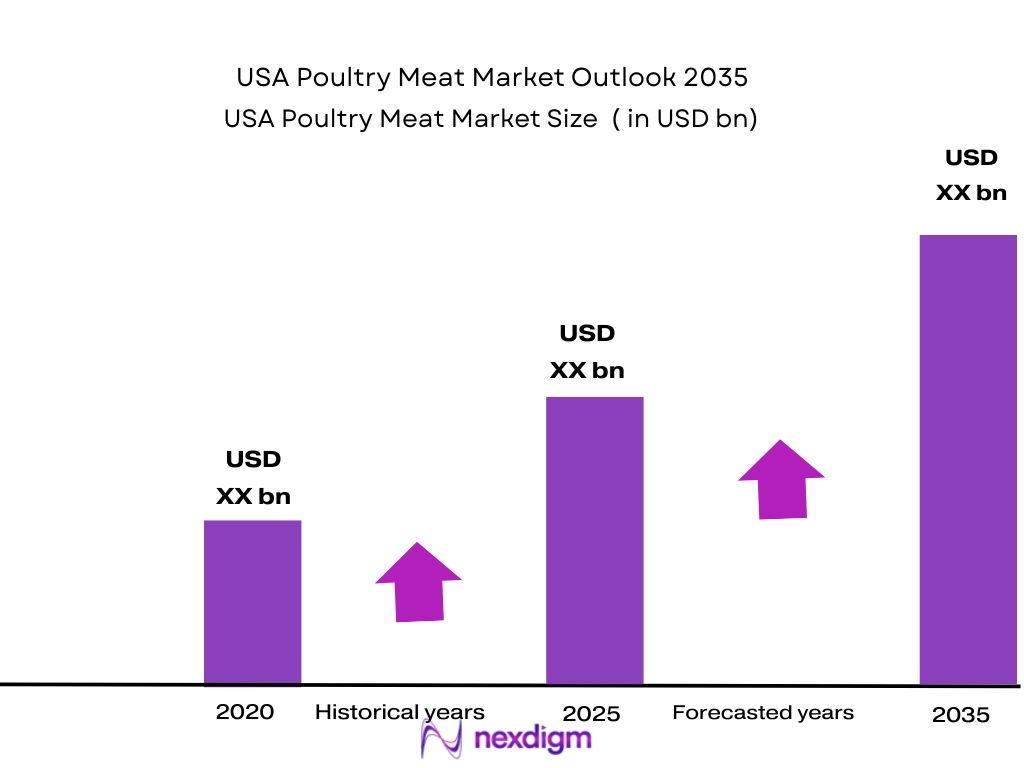
The USA poultry meat market size stood at USD ~ billion, based on a recent historical assessment of broiler, turkey, and other chicken production value. Broilers formed the core of the market with USD 45.4 billion in value, while turkey production contributed USD 3.69 billion, supported by large-scale integrated production, strong domestic protein consumption, and poultry’s affordability compared with several red meat categories.
The market is dominated by poultry-producing clusters across Georgia, North Carolina, Arkansas, Alabama, Texas, Mississippi, Missouri, Maryland, Virginia, Delaware, Tennessee, and South Carolina. These states lead because of contract-farming density, proximity to corn and soybean feed supply, vertically integrated processors, established slaughter and deboning facilities, cold-chain availability, and strong access to retail, foodservice, and export logistics networks across the Southeast, Mid-Atlantic, and central United States.
Market Segmentation
By Product Type
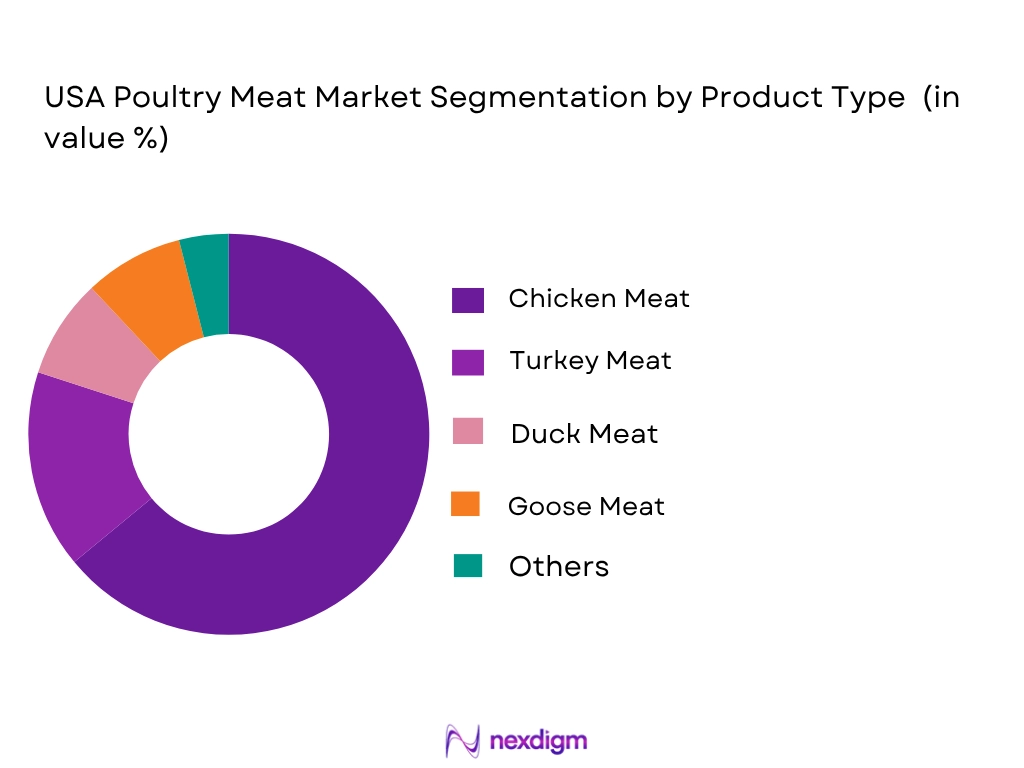
USA Poultry Meat Market is segmented by product type into chicken meat, turkey meat, duck meat, goose meat, and others. Recently, chicken meat has a dominant market share due to factors such as broad household acceptance, high product versatility, strong quick-service restaurant adoption, deep processor capacity, and lower retail positioning compared with several competing animal proteins. Chicken also benefits from extensive cut variety, including breasts, wings, thighs, drumsticks, whole birds, nuggets, tenders, rotisserie formats, and frozen value-added items. Turkey remains important in seasonal, deli, ground meat, institutional, and holiday-driven consumption, but it has faced weaker volume momentum than chicken. Duck, goose, and other specialty poultry products remain niche because they are less widely distributed, less price competitive, and more dependent on specialty retail, ethnic foodservice, and premium restaurant demand.
By Form
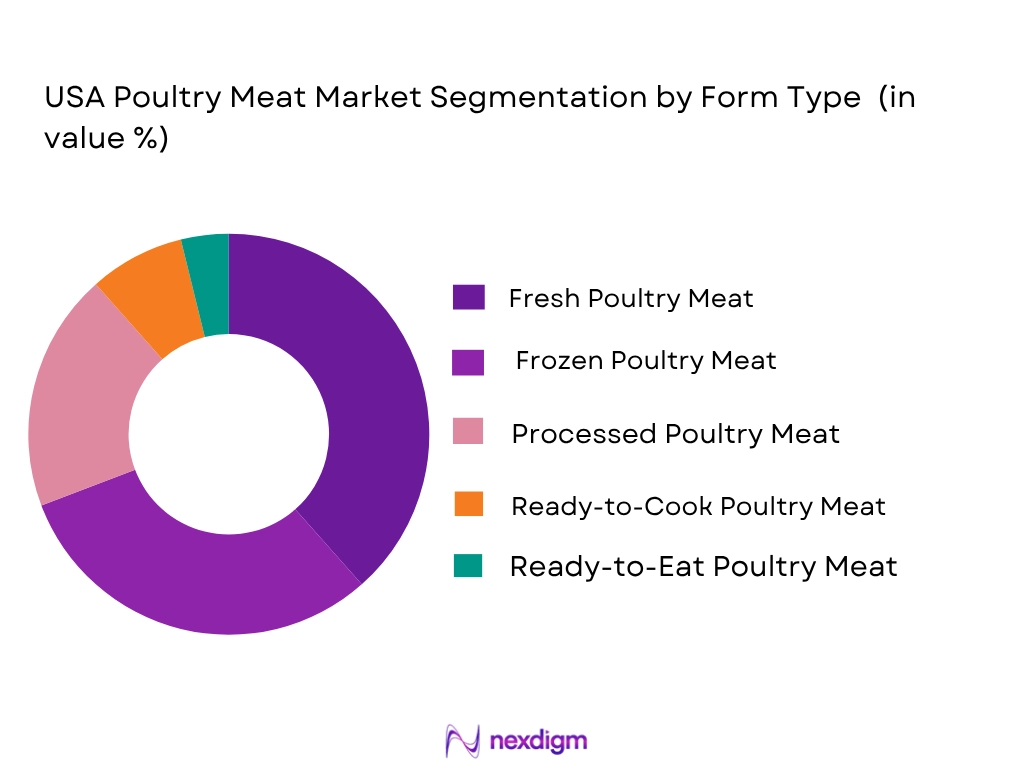
USA Poultry Meat Market is segmented by form into fresh poultry meat, frozen poultry meat, processed poultry meat, ready-to-cook poultry meat, and ready-to-eat poultry meat. Recently, fresh poultry meat has a dominant market share due to high repeat purchase frequency in supermarkets, strong preference for home cooking, wide availability of chilled chicken cuts, and frequent promotional activity by retailers. Fresh poultry is supported by strong cold-chain systems and high domestic consumption of chicken breasts, thighs, drumsticks, wings, and whole birds. Frozen poultry remains substantial because it supports long shelf life, foodservice storage, export channels, and household bulk purchasing. Processed, ready-to-cook, and ready-to-eat formats are growing because consumers and restaurants are demanding marinated, breaded, pre-portioned, cooked, and convenience-oriented poultry products that reduce preparation time.
Competitive Landscape
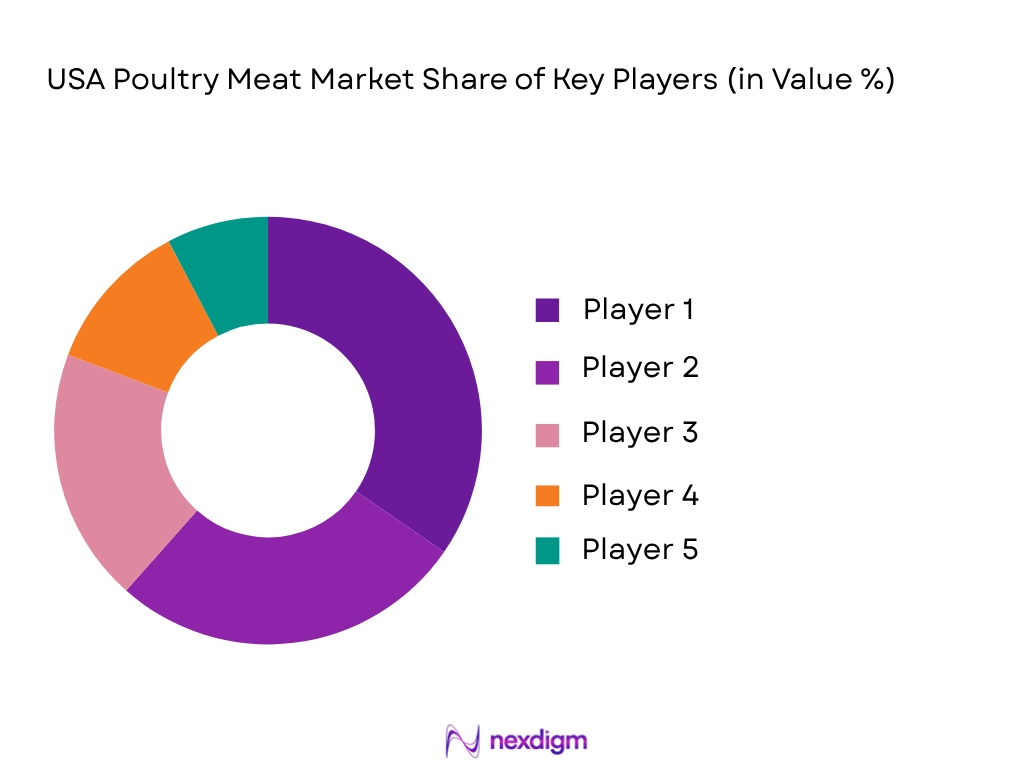
The USA poultry meat market is consolidated around vertically integrated processors that control breeding, hatcheries, feed procurement, contract growing, slaughter, deboning, packaging, and distribution. Tyson Foods, Pilgrim’s Pride, Perdue Farms, Wayne-Sanderson Farms, and Butterball influence pricing, retail shelf presence, foodservice contracts, product innovation, and national supply stability. Tyson reported USD 53.309 billion in annual revenue, Pilgrim’s Pride reported USD 17.9 billion in net sales, while Perdue Farms is reported as generating annual sales exceeding USD 10 billion.
| Company Name | Establishment Year | Headquarters | Technology Focus | Market Reach | Key Products | Revenue | Processing / Market-Specific Parameter |
| Tyson Foods, Inc. | 1935 | Springdale, Arkansas | ~ | ~ | ~ | ~ | ~ |
| Pilgrim’s Pride Corporation | 1946 | Greeley, Colorado | ~ | ~ | ~ | ~ | ~ |
| Perdue Farms Inc. | 1920 | Salisbury, Maryland | ~ | ~ | ~ | ~ | ~ |
| Wayne-Sanderson Farms | 2022 | Oakwood, Georgia | ~ | ~ | ~ | ~ | ~ |
| Butterball LLC | 1954 | Garner, North Carolina | ~ | ~ | ~ | ~ | ~ |
USA Poultry Meat Market Analysis
Growth Drivers
Rising Demand for Protein-rich Food Products
The USA poultry meat market is supported by rising demand for protein-rich food products as consumers increasingly prioritize nutrition, satiety, and convenient meal planning. Poultry, especially chicken, is widely accepted across age groups because it is versatile, easy to cook, and suitable for multiple diets. Demand is further supported by fitness-oriented consumers, working households, and foodservice operators seeking high-protein menu options. Products such as chicken breasts, wings, tenders, ground chicken, and ready-to-cook cuts are used across retail and restaurant channels. The affordability of poultry compared with several other animal proteins strengthens repeat consumption. This trend continues to support steady demand across fresh, frozen, and processed poultry categories.
Expansion of Quick Service Restaurants and Foodservice Chains
Expansion of quick service restaurants and foodservice chains is a major driver for the USA poultry meat market because poultry is central to sandwiches, burgers, nuggets, wings, wraps, salads, and value meals. Restaurants prefer poultry due to its consistent supply, flexible preparation methods, and ability to absorb different flavors and coatings. Large processors benefit from long-term contracts with restaurant chains that require standardized cuts, portion control, and reliable distribution. Poultry also supports menu innovation, including spicy chicken sandwiches, boneless wings, grilled bowls, and breakfast items. As consumers continue dining out and ordering delivery, foodservice demand increases the need for processed, marinated, frozen, and fully cooked poultry products.
Market Challenges
Volatility in Feed Prices
Volatility in feed prices remains a key challenge for the USA poultry meat market because corn and soybean meal are major inputs in poultry production. Changes in crop yields, weather conditions, fuel prices, export demand, and transportation costs can quickly affect production economics. When feed costs rise, growers and processors face pressure on margins, especially in price-sensitive retail and foodservice contracts. Large integrated producers may manage risk through procurement scale, but smaller operators can face higher financial strain. Feed price instability can also influence bird placement, production planning, and wholesale pricing. This makes cost forecasting difficult and can reduce profitability across the poultry supply chain.
Disease Outbreaks and Biosecurity Risks:
Disease outbreaks and biosecurity risks create serious operational challenges for the USA poultry meat market, particularly when avian influenza or other contagious diseases affect poultry flocks. Outbreaks can result in flock losses, farm quarantines, movement restrictions, higher sanitation costs, and disruptions in processing schedules. Producers must invest continuously in biosecurity systems, monitoring, controlled farm access, vaccination planning where applicable, and emergency response procedures. Disease risks also affect exports when trading partners impose restrictions on poultry products from affected regions. Turkey and specialty poultry operations may be more vulnerable due to smaller production bases and longer grow-out cycles. These risks can tighten supply and increase market uncertainty.
Opportunities
Rising Demand for Organic and Antibiotic-free Poultry Meat
Rising demand for organic and antibiotic-free poultry meat presents a strong opportunity for the USA poultry meat market as consumers become more concerned about health, sourcing, animal welfare, and food transparency. Retailers and foodservice brands are expanding premium poultry offerings to meet demand for no-antibiotics-ever, organic, free-range, and traceable products. These products often attract higher margins than conventional poultry and help processors differentiate in a competitive market. Premium claims also support brand loyalty among consumers seeking cleaner labels and trusted sourcing. Producers that can maintain reliable supply, verified standards, and competitive pricing are well positioned to benefit from this shift toward attribute-based poultry.
Innovation in Value-added and Convenience Poultry Products
Innovation in value-added and convenience poultry products offers major growth potential for the USA poultry meat market as consumers seek faster, easier, and more flexible meal solutions. Products such as marinated chicken, breaded tenders, frozen wings, grilled strips, cooked chicken pieces, poultry sausages, and ready-to-cook meal kits reduce preparation time. Foodservice operators also benefit from pre-portioned and partially cooked poultry products that improve consistency and reduce labor requirements. Processors can use value-added formats to increase margins and improve utilization of different cuts. Packaging innovation, flavor development, and healthier formulations can further expand demand across retail, online grocery, and institutional channels.
Future Outlook
The USA poultry meat market is expected to remain structurally strong over the next five years as consumers continue to prioritize affordable, versatile, high-protein foods. Growth will be supported by value-added chicken products, stronger e-commerce grocery penetration, automation in processing plants, and broader demand from quick-service restaurants. Regulatory focus on food safety, labeling transparency, animal health, and traceability will push processors toward stronger compliance systems. Demand-side momentum will remain strongest in chicken, while turkey and specialty poultry will depend on innovation, seasonal demand, and premium positioning.
Major Players
- Tyson Foods, Inc.
- Pilgrim’s Pride Corporation
- Perdue Farms Inc.
- Wayne-Sanderson Farms
- Butterball LLC
- Jennie-O Turkey Store
- Foster Farms
- Mountaire Farms
- Koch Foods
- House of Raeford Farms
- Cargill Meat Solutions
- Hormel Foods Corporation
- Farbest Foods
- Peco Foods
- Amick Farms
Key Target Audience
- Poultry meat producers and processors
- Retail chains and supermarket groups
- Quick-service restaurant operators
- Foodservice distributors
- Frozen and processed food manufacturers
- Cold-chain logistics providers
- Investments and venture capitalist firms
- Government and regulatory bodies
Research Methodology
Step 1: Identification of Key Variables
The research began by identifying variables influencing the USA poultry meat market, including production value, broiler output, turkey output, consumption channels, processing capacity, feed cost sensitivity, regulatory oversight, and state-level production concentration. Key variables were mapped across product type, form, end use, distribution, and competitive structure.
Step 2: Market Analysis and Construction
The market structure was constructed using official poultry value data, company disclosures, industry association references, processor presence, and public market observations. Segmentation was developed by aligning production value, product availability, retail formats, foodservice demand, and common commercial classifications used in poultry meat reporting.
Step 3: Hypothesis Validation and Expert Consultation
Market assumptions were validated through cross-checking official data with company filings, poultry industry associations, processor rankings, and recent public disclosures. Where complete public segment-level data was unavailable, triangulation was applied using product mix, processing patterns, retail visibility, and foodservice demand indicators.
Step 4: Research Synthesis and Final Output
The final report synthesized market sizing, segmentation, competitive landscape, growth drivers, challenges, opportunities, future outlook, target audience, and FAQs. The structure was prepared to match executive-summary requirements while prioritizing credible public sources and clear market-specific reasoning.

- Executive Summary
- Research Methodology (Market Definitions and Assumptions, Abbreviations, Market Sizing Approach, Consolidated Research Approach, Understanding Market Potential Through In-Depth Industry Interviews, Primary Research Approach, Limitations and Future Conclusions)

- Definition and Scope
- Market Dynamics Overview
- Market Genesis
- Major Players and Market Timeline
- Business Cycle and Trends
- Supply Chain and Value Chain Analysis

- Growth Drivers
Rising Demand for Protein-rich Food Products
Increasing Consumption of Chicken as an Affordable Meat Option
Expansion of Quick Service Restaurants and Foodservice Chains
Growing Demand for Processed and Ready-to-Cook Poultry Products
Rising Health Consciousness and Preference for Lean Meat - Market Challenges
Volatility in Feed Prices
Disease Outbreaks and Biosecurity Risks
Labor Shortages in Poultry Processing Facilities
Regulatory Compliance and Food Safety Standards
Consumer Concerns Regarding Antibiotic Use and Animal Welfare - Opportunities
Rising Demand for Organic and Antibiotic-free Poultry Meat
Innovation in Value-added and Convenience Poultry Products
Expansion of Online Meat Delivery and Direct-to-Consumer Channels
Growth in Premium, Free-range, and Cage-free Poultry Products
Increasing Export Potential for US Poultry Meat - Key Trends
Shift Toward Antibiotic-free and Organic Poultry Products
Growing Popularity of Ready-to-Cook and Ready-to-Eat Poultry Products
Rising Adoption of Sustainable and Traceable Poultry Supply Chains
Expansion of Private Label Poultry Meat Products
Increasing Use of Automation in Poultry Processing - Government Regulations
- SWOT Analysis
- Porter’s Five Forces

- By Value, 2020–2025
- By Volume, 2020–2025
- By Average Price, 2020–2025

- By Product Type (In Value %)
Chicken Meat
Turkey Meat
Duck Meat
Goose Meat
Others - By Form (In Value %)
Fresh Poultry Meat
Frozen Poultry Meat
Processed Poultry Meat
Ready-to-Cook Poultry Meat
Ready-to-Eat Poultry Meat - By Cut Type (In Value %)
Whole Bird
Breast Meat
Thighs and Drumsticks
Wings
Minced/Ground Poultry Meat
Others - By Processing Type (In Value %)
Raw Poultry Meat
Marinated Poultry Meat
Cooked/Processed Poultry Meat
Smoked Poultry Meat
Organic and Antibiotic-free Poultry Meat - By Application (In Value %)
Household Consumption
Foodservice and HoReCa
Food Processing Industry
Quick Service Restaurants
Institutional Consumption - By Distribution Channel (In Value %)
Direct Sales
Supermarkets and Hypermarkets
Convenience Stores
Online Channels
Meat Specialty Stores
Wholesale and Cash & Carry Stores - By Region (In Value %)
Northeast Region
Midwest Region
South Region
West Region
Rest of USA

- Market Share of Major Players by Value/Volume
- Market Share of Major Players by Product Type
- Cross Comparison Parameters (Company Overview, Business Strategies, Recent Developments, Strength, Weakness, Organizational Structure, Revenues, Revenues by Product Type, Number of Touchpoints, Distribution Channels, Number of Dealers and Distributors, Margins, Production Plant, Capacity, Unique Value Offering and Others)
- SWOT Analysis of Major Players
- Pricing Analysis Based on Product Categories for Major Players
- Detailed Profiles of Major Companies
Tyson Foods, Inc.
Pilgrim’s Pride Corporation
Perdue Farms Inc.
Sanderson Farms
Foster Farms
Wayne-Sanderson Farms
Mountaire Farms
Koch Foods
House of Raeford Farms
Butterball LLC
Jennie-O Turkey Store
Cargill Meat Solutions
Hormel Foods Corporation
Farbest Foods

- Market Demand and Utilization
- Purchasing Power and Budget Allocations
- Regulatory and Compliance Requirements
- Needs, Desires, and Pain Point Analysis
- Decision-Making Process

- By Value, 2026–2035
- By Volume, 2026–2035
- By Average Price, 2026–2035


 Request a Sample
 Ask for Customization
 Get a Quote
 Enquire Now