
 Download PDF
 Download PDF
Market Overview
The USA Radar Sensors market encompasses both automotive radar systems and broader radar sensor applications across defense, aerospace, industrial, and smart infrastructure sectors. Based on a recent historical assessment, the U.S. automotive radar segment alone was valued at approximately USD ~ billion in 2024 due to increasing adoption of advanced driver‑assistance systems (ADAS) and autonomous vehicle technologies that rely heavily on radar for object detection and safety functions. Broader radar sensor use in aerospace, defense, and industrial systems further reinforces total market demand.
The United States remains a dominant market for radar sensors, supported by strong automotive manufacturing hubs, substantial defense and aerospace expenditures, and robust technological innovation ecosystems. Regions such as Michigan, California, and Texas lead with OEM facilities and research institutions driving radar integration in vehicles and industrial systems. Large defense contracts and aerospace radar deployments also contribute to U.S. leadership in radar technology adoption and development.
Market Segmentation
By Product Type
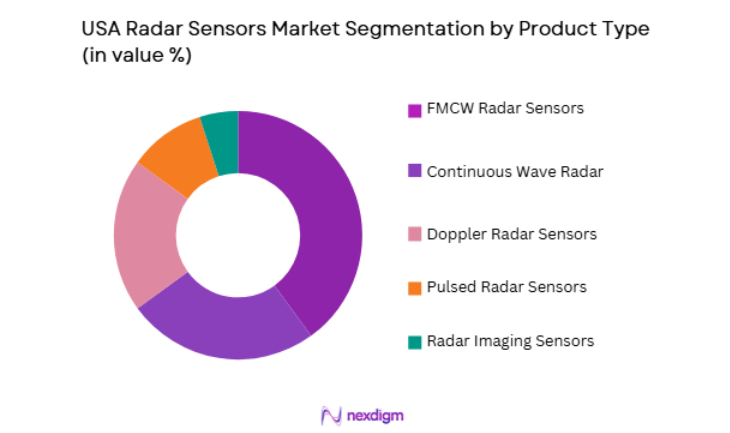
USA Radar Sensors market is segmented by product type into Continuous Wave Radar Sensors, Pulsed Radar Sensors, FMCW Radar Sensors, Radar Imaging Sensors, and Doppler Radar Sensors. FMCW Radar Sensors dominate the market share, primarily due to their high accuracy and precision, which makes them ideal for critical applications such as automotive safety systems, aerospace, and defense. Their ability to provide continuous monitoring of a wide range of frequencies has positioned them as the preferred choice for industries requiring real-time data on moving objects, ensuring their dominance in the market.
By Platform Type
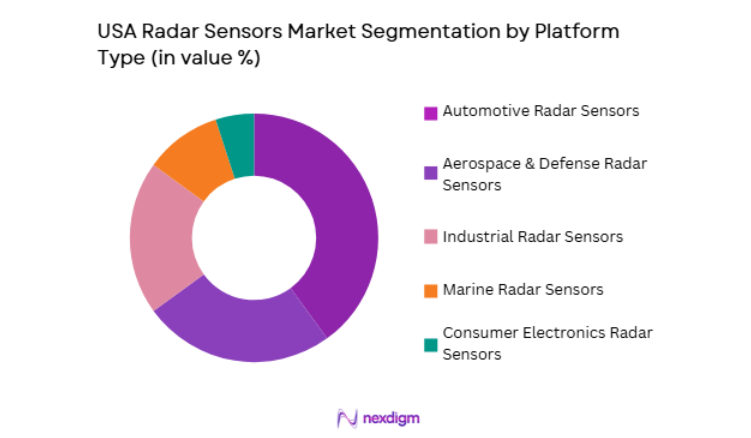
USA Radar Sensors market is segmented by platform type into Automotive Radar Sensors, Aerospace & Defense Radar Sensors, Industrial Radar Sensors, Consumer Electronics Radar Sensors, and Marine Radar Sensors. Automotive Radar Sensors lead the market due to the growing demand for advanced driver-assistance systems (ADAS) and autonomous vehicles. As the automotive industry continues to prioritize safety and automation, radar sensors have become integral to vehicle navigation and collision avoidance systems, propelling this sub-segment to dominate the market.
Competitive Landscape
The competitive landscape of the USA Radar Sensors market is characterized by the presence of several large, well-established players alongside emerging companies focused on innovation. Key players like Northrop Grumman, Honeywell, and Raytheon dominate the market due to their advanced radar sensor technologies and strong relationships with defense contractors and automotive manufacturers. As the market evolves, consolidation trends are expected to continue, with major companies acquiring smaller startups to expand their technology portfolios.
| Company Name | Establishment Year | Headquarters | Technology Focus | Market Reach | Key Products | Revenue (USD) |
| Northrop Grumman | 1939 | Falls Church, VA | ~ | ~ | ~ | ~ |
| Honeywell International | 1906 | Charlotte, NC | ~ | ~ | ~ | ~ |
| Raytheon Technologies | 2020 | Waltham, MA | ~ | ~ | ~ | ~ |
| Texas Instruments | 1930 | Dallas, TX | ~ | ~ | ~ | ~ |
| Bosch | 1886 | Stuttgart, Germany | ~ | ~ | ~ | ~ |
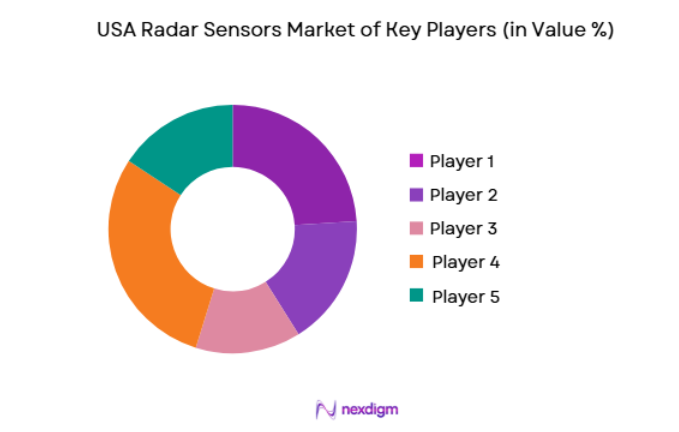
USA Radar Sensors Market Analysis
Growth Drivers
Increasing Demand for Autonomous Vehicles
The growth of autonomous vehicles is a major driver for the USA radar sensors market. Radar sensors are a crucial component in autonomous vehicles, providing real-time data on the surrounding environment and enabling features like adaptive cruise control and collision avoidance. The demand for safety and automation in vehicles continues to rise as manufacturers aim for fully autonomous driving capabilities. With regulations pushing for higher safety standards, radar sensors are indispensable in ensuring vehicles meet the stringent requirements for sensor fusion in self-driving systems. As a result, automotive companies are heavily investing in radar sensor technology to meet the growing demand for ADAS (Advanced Driver Assistance Systems) and autonomous vehicle solutions.
Advancements in Military and Defense Technologies
Radar sensors are vital for the defense sector, driving the growth of the market in the United States. Radar systems play an essential role in surveillance, target detection, and tracking in military applications, including missile defense, air traffic control, and radar-based monitoring systems. The U.S. government continues to invest heavily in defense technologies, with radar sensors being a key area of focus. With increasing defense budgets and the development of next-generation radar systems, the demand for radar sensors in defense applications is expected to grow. As military and defense technologies evolve, radar sensors will be at the forefront of enhancing security and operational capabilities.
Market Challenges
High Cost of Advanced Radar Systems
One of the major challenges faced by the radar sensors market in the United States is the high cost associated with advanced radar sensor systems. These sensors, especially those used in automotive and aerospace applications, require specialized technology, and the manufacturing process is expensive. The high cost of research, development, and production further adds to the overall expense, making it difficult for smaller manufacturers and startups to enter the market. For industries that require large-scale deployment of radar sensors, the high upfront costs remain a significant hurdle. Although technological advancements are gradually reducing costs, the initial investment remains a critical barrier to market growth.
Integration Complexities with Other Sensor Systems
Another challenge facing the radar sensors market is the integration of radar technology with other sensor systems, such as cameras, LIDAR, and ultrasonic sensors, to create efficient sensor fusion solutions. While radar sensors provide critical information regarding the distance and velocity of objects, they need to be integrated with other sensor technologies to ensure that the data they collect is accurately processed and interpreted. The complexity of these integrations increases the cost and development time for radar sensor systems, especially in advanced applications like autonomous vehicles and industrial automation. This integration challenge requires highly skilled engineering teams and specialized software, which can be a limitation for smaller organizations.
Opportunities
Integration of Radar Sensors in Smart Cities
The USA Radar Sensors market has significant opportunities in the growing smart city initiatives. Radar sensors are becoming increasingly important in smart city infrastructure, where they are used in traffic monitoring, security systems, and environmental sensing. Radar-based systems can monitor traffic flow, detect accidents, and optimize traffic light operations, improving overall traffic management. With government investments in smart city projects and the demand for automated systems to manage urban environments, radar sensors have a crucial role in enhancing infrastructure and public safety. As cities look for more sustainable, data-driven solutions, the integration of radar sensors in urban planning is expected to expand.
Expansion of Radar Sensors in Industrial Automation
The increasing adoption of Industry 4.0 and automation technologies presents significant opportunities for radar sensors in the industrial sector. Radar sensors are widely used for material handling, process monitoring, and collision detection in automated factories and warehouses. These sensors can operate in harsh environments, providing reliable performance in temperature extremes, high humidity, and other challenging conditions. As industries move towards more automated and efficient operations, the demand for radar sensors will rise. Radar sensors are also expected to play a key role in robotics, where they help detect objects and navigate in real-time, driving further market growth.
Future Outlook
The future outlook for the USA Radar Sensors market is optimistic, with strong growth expected across various sectors, including automotive, defense, and industrial automation. Technological advancements, coupled with rising investments in autonomous vehicles, smart cities, and defense applications, will drive the demand for radar sensors. The market is also poised to benefit from the growing trend of sensor fusion, where radar sensors are integrated with other technologies to provide enhanced data and improve overall system performance.
Major Players
- Northrop Grumman
- Honeywell International
- Raytheon Technologies
- Texas Instruments
- Bosch
- Continental AG
- Delphi Technologies
- Denso Corporation
- Thales Group
- Aptiv PLC
- Valeo
- SAMSUNG Electronics
- Infineon Technologies
- Siemens
- Zebra Medical Vision
Key Target Audience
- Automotive Manufacturers
- Aerospace and Defense Companies
- Industrial Automation Firms
- Consumer Electronics Manufacturers
- Government Agencies
- Regulatory Bodies
- Technology Startups
- Investment Firms
Research Methodology
Step 1: Identification of Key Variables
Identify the primary drivers, restraints, and growth opportunities within the radar sensors market.
Step 2: Market Analysis and Construction
Analyze the gathered data to create a comprehensive model of the radar sensors market that includes historical trends, current market status, and projections.
Step 3: Hypothesis Validation and Expert Consultation
Consult with industry experts to validate assumptions and ensure that the insights are accurate and relevant.
Step 4: Research Synthesis and Final Output
Compile the findings into a coherent report that delivers valuable insights into the radar sensors market, suitable for stakeholders and decision-makers.

- Executive Summary
- Research Methodology (Definitions, Scope, Industry Assumptions, Market Sizing Approach, Primary & Secondary Research Framework, Data Collection & Verification Protocol, Analytic Models & Forecast Methodology, Limitations & Research Validity Checks)

- Market Definition and Scope
- Value Chain & Stakeholder Ecosystem
- Regulatory / Certification Landscape
- Sector Dynamics Affecting Demand
- Strategic Initiatives & Infrastructure Growth

- Growth Drivers
Increasing demand for automotive safety technologies
Technological advancements in radar sensor capabilities
Rising investments in defense and aerospace technologies - Market Challenges
High cost of advanced radar sensor systems
Integration complexity in multi-sensor systems
Regulatory challenges in various application areas - Market Opportunities
Expansion of radar sensors in autonomous vehicles
Growth in demand for radar sensors in industrial automation
Advancements in radar sensor miniaturization - Trends
Rising adoption of 77 GHz radar sensors
Integration of radar sensors with AI for enhanced functionality
Increased use of radar sensors in 5G networks - Government regulations
- SWOT analysis
- Porters 5 forces

- By Market Value, 2019-2025
- By Installed Units, 2019-2025
- By Average System Price, 2019-2025
- By System Complexity Tier, 2019-2025

- By System Type (In Value%)
Continuous Wave Radar Sensors
Pulsed Radar Sensors
FMCW Radar Sensors
Radar Imaging Sensors
Doppler Radar Sensors - By Platform Type (In Value%)
Automotive Radar Sensors
Aerospace & Defense Radar Sensors
Industrial Radar Sensors
Consumer Electronics Radar Sensors
Marine Radar Sensors - By Fitment Type (In Value%)
Integrated Radar Systems
Standalone Radar Systems
Portable Radar Systems
Fixed Radar Systems
Mobile Radar Systems - By EndUser Segment (In Value%)
Automotive Industry
Defense & Aerospace
Industrial Applications
Consumer Electronics
Healthcare & Medical Applications - By Procurement Channel (In Value%)
Direct Procurement
Online Procurement Platforms
Government Tenders

- Market Share Analysis
- Cross Comparison Parameters (System Type, Platform Type, Procurement Channel, EndUser Segment, Fitment Type, Technology Focus, Geographic Reach, Product Range, Price Sensitivity, Customer Base)
- SWOT Analysis of Key Competitors
- Pricing & Procurement Analysis
- Key Players
Northrop Grumman
Honeywell International
Raytheon Technologies
Texas Instruments
Bosch
Continental AG
Delphi Technologies
Denso Corporation
Thales Group
Aptiv PLC
Valeo
SAMSUNG Electronics
Infineon Technologies
Siemens
Zebra Medical Vision

- Growing automotive sector demand for radar-based safety systems
- Increased use of radar in industrial automation and robotics
- Rising government spending on defense radar systems
- Expanding adoption of radar sensors in consumer electronics

- Forecast Market Value, 2026-2030
- Forecast Installed Units, 2026-2030
- Price Forecast by System Tie, 2026-2030
- Future Demand by Platform, 2026-2030


 Request a Sample
 Ask for Customization
 Get a Quote
 Enquire Now