
 Download PDF
Market Overview
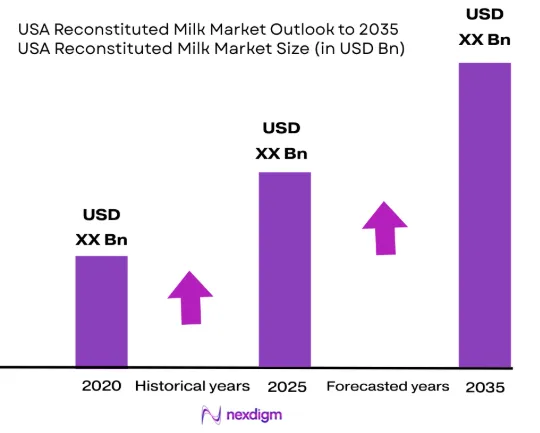
The USA Reconstituted Milk Market is valued at USD ~ billion, derived from a reported USD 55.2 billion prior-year base and the published growth trajectory for the U.S. market. Demand is driven by shelf-stable dairy consumption, institutional procurement, foodservice recovery, bakery and confectionery use, and dairy solids standardization. U.S. milk production stood at 225.868 billion pounds, while the prior comparable base was higher by 443 million pounds, increasing the role of powder-based balancing. California, Wisconsin, Idaho, New York and Texas dominate the USA Reconstituted Milk Market because they anchor the national raw milk, powder, cheese, ESL and institutional dairy supply chain. These states benefit from large dairy herds, high plant utilization, dry-powder processing, cooperative milk pools, and proximity to food manufacturing corridors. The top five milk-producing states generated more than 65% of U.S. milk supply, while total national output stood at 225.868 billion pounds, supporting large-scale reconstitution economics.
Market Segmentation
By Source
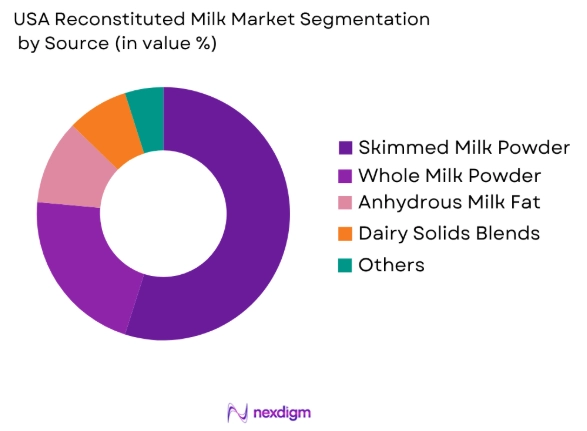
The USA Reconstituted Milk Market is segmented by source into skimmed milk powder based reconstituted milk, whole milk powder based reconstituted milk, anhydrous milk fat/recombined milk base, milk protein concentrate and dairy solids blends, and buttermilk powder blends. Skimmed milk powder based reconstituted milk dominates the market because it gives processors the best balance between cost control, formulation flexibility and fat standardization. U.S. dairy processors use skimmed milk powder and nonfat dry milk to rebuild milk solids in beverages, bakery mixes, institutional milk, frozen desserts, soups, sauces and dairy-based formulations. It also allows manufacturers to add butterfat, cream, anhydrous milk fat or vegetable-fat alternatives depending on product positioning. The segment is strong in B2B channels because processors need predictable protein, solids-not-fat, rehydration performance and shelf stability.
By Application
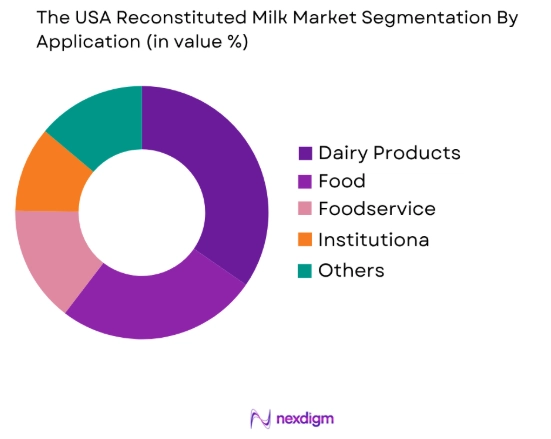
The USA Reconstituted Milk Market is segmented by application into dairy products manufacturing, food and beverage processing, foodservice and HoReCa, institutional procurement, dietary and nutritional supplements, and household retail use. Dairy products manufacturing holds the dominant share because reconstituted milk is widely used for cheese milk standardization, yogurt, ice cream, dairy desserts, flavored milk, UHT milk, ESL milk and cultured products. Manufacturers prefer reconstituted milk because it provides consistent solids, controlled fat content, easier storage, reduced spoilage and year-round supply continuity. This is important in the United States because raw milk availability, butterfat values and nonfat dry milk prices can fluctuate across regions. Dairy manufacturing also has established blending, hydration, pasteurization, homogenization and aseptic packaging infrastructure, allowing large plants to convert powder into finished products efficiently.
Competitive Landscape
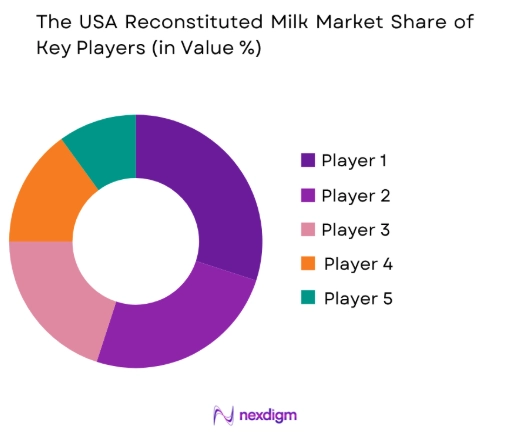
The USA Reconstituted Milk Market is moderately consolidated, led by farmer-owned cooperatives, multinational dairy groups, ingredient suppliers, private-label dairy processors and UHT/ESL milk specialists. Dairy Farmers of America, Lactalis, Nestlé, Saputo and Schreiber Foods are influential because they combine milk sourcing scale, dairy ingredients access, processing infrastructure, foodservice relationships and retail distribution. Competition is increasingly based on powder procurement, hydration efficiency, clean-label positioning, aseptic capability, institutional contracts and value-added dairy formats.
| Company | Establishment Year | Headquarters | Powder / Ingredient Strength | UHT / ESL Capability | Key Product Exposure | Channel Strength | Strategic Advantage | Reconstitution Relevance |
| Dairy Farmers of America | 1998 | Kansas City, Kansas, USA | ~ | ~ | ~ | ~ | ~ | ~ |
| Lactalis Group / Lactalis American Group | 1933 | Laval, France / U.S. operations | ~ | ~ | ~ | ~ | ~ | ~ |
| Nestlé USA | 1866 | Arlington, Virginia, USA | ~ | ~ | ~ | ~ | ~ | ~ |
| Saputo Inc. | 1954 | Montréal, Canada | ~ | ~ | ~ | ~ | ~ | ~ |
| Schreiber Foods | 1945 | Green Bay, Wisconsin, USA | ~ | ~ | ~ | ~ | ~ | ~ |
The USA Reconstituted Milk Market Analysis
Growth Drivers
Strong Dairy Powder and Processing Base Supports Reconstitution at Scale
The USA Reconstituted Milk Market is supported by a large domestic dairy base that gives processors enough milk solids for skimmed milk powder, nonfat dry milk, recombined milk and industrial dairy formulations. U.S. milk production stood at 225,868 million pounds, supported by 9.342 million milk cows and average output of 24,178 pounds per cow, giving processors a deep raw-material pool for powder conversion and fluid milk standardization. USDA also reported 1,668,655 thousand pounds of nonfat dry milk for human use and 599,350 thousand pounds of skim milk powder output, both critical feedstocks for reconstituted milk applications. The manufacturing base is also wide, with 1,183 dairy product manufacturers producing one or more dairy products, which supports regional rehydration, blending, UHT processing and private-label supply. A large macroeconomic demand base reinforces this structure, with U.S. GDP at USD 28,750,956.13 million and GDP per capita at USD 84,534.0, enabling large-scale retail, foodservice and institutional dairy consumption.
Institutional and Foodservice Demand Creates Stable Bulk Use Cases
The USA Reconstituted Milk Market benefits from institutional and foodservice channels because these buyers need consistent milk solids, shelf stability, standardized fat levels and dependable bulk supply. USDA ERS reported that the National School Lunch Program served more than 4.8 billion lunches and operated through nearly 100,000 public and nonprofit private schools and residential childcare institutions, creating large recurring dairy procurement requirements for milk, flavored milk, sauces, desserts and nutrition-compliant beverages. Foodservice demand is also structurally important because reconstituted milk can be used in coffee beverages, bakery fillings, desserts, soups, sauces, frozen dairy and commissary kitchens. BEA data through FRED shows food services and accommodations personal consumption expenditure at USD 1,520.320 billion in Q1 2026, indicating a large commercial food-service base for dairy inputs. The wider consumer base is also expanding, with the U.S. population at 340.1 million, supporting demand for retail, school, healthcare, correctional and emergency dairy formats.
Market Challenges
Powder Output Contraction Limits Flexible Reconstitution Supply
A key challenge for the USA Reconstituted Milk Market is the tightening of dry dairy ingredient availability, especially for processors dependent on nonfat dry milk and skim milk powder. USDA reported 1,668,655 thousand pounds of nonfat dry milk for human use and 599,350 thousand pounds of skim milk powder production, but both categories were below the prior-year base, creating tighter planning conditions for powder-based reconstitution, recombined whole milk and dairy-solids standardization. At the farm level, total U.S. milk production was 225,868 million pounds, while marketed milk was 224,883 million pounds, indicating that processors must compete for milk solids across cheese, butter, powder, frozen dairy and fluid milk uses. This matters because reconstituted milk relies on predictable dry solids rather than only fresh liquid milk availability. The challenge is compounded by a concentrated but capacity-driven processing structure: USDA counted 1,183 dairy product manufacturers, meaning supply reliability depends on plant utilization, regional milk pools, powder inventories, drying schedules and product-mix decisions across multiple dairy categories.
Fluid Milk Mix Shift Reduces Reliance on Skim-Oriented Reconstitution
The USA Reconstituted Milk Market faces a product-mix challenge because U.S. fluid milk demand is shifting toward whole milk and away from traditional fat-reduced formats, while many reconstituted formulations are built from skimmed milk powder or nonfat dry milk. USDA AMS reported March 2026 conventional whole milk sales of 1,328 million pounds, compared with 925 million pounds for reduced-fat milk, 348 million pounds for low-fat milk and 146 million pounds for fat-free skim milk. Year-to-date March 2026 sales show the same imbalance, with whole milk at 3,962 million pounds, reduced-fat milk at 2,780 million pounds, low-fat milk at 1,040 million pounds and fat-free skim milk at 418 million pounds. This creates a challenge for reconstituted milk processors because skim-powder-heavy formulations must match consumer preference for richer taste and texture. The issue is market-specific: reconstitution economics may remain attractive, but product development must increasingly incorporate butterfat, cream, anhydrous milk fat or protein blends to match the sensory expectations of whole-milk consumers.
Market Opportunities
Shelf-Stable and Aseptic Dairy Expansion Can Improve Distribution Reach
The USA Reconstituted Milk Market has an opportunity in shelf-stable, UHT and extended-shelf-life formats because reconstituted milk reduces dependence on fresh milk movement and allows processors to serve distant retail, institutional and emergency channels. USDA AMS reported 3,637 million pounds of total fluid milk product sales in March 2026 and 10,762 million pounds for the year-to-date period, showing a large active packaged milk base where shelf-stable and ESL formats can target households, schools, hospitals and foodservice operators. The same USDA report shows that organic fluid milk sales reached 272 million pounds in March 2026 and 774 million pounds year-to-date, indicating demand for differentiated milk formats that can support premium or specialized reconstituted offerings. The U.S. also has the macroeconomic scale to support wider retail distribution, with GDP at USD 28,750,956.13 million and population at 340.1 million. Reconstituted milk producers can use aseptic cartons, bag-in-box systems and bulk totes to reduce spoilage, expand ambient logistics and serve regions where chilled distribution is costly or operationally constrained.
Nutrition Programs and Food Manufacturing Create Value-Added Use Cases
The USA Reconstituted Milk Market has an opportunity in nutrition-linked and industrial dairy applications because powder-based milk can be fortified, standardized and incorporated into large-volume food systems. USDA ERS reported more than 4.8 billion National School Lunch Program lunches and nearly 100,000 participating schools and residential childcare institutions, which supports demand for milk, flavored milk, dairy desserts, sauces and nutritionally standardized ingredients. Reconstituted milk is suitable for these channels because it can be formulated with controlled protein, calcium, vitamin D, lactose-free enzymes and fat levels. Dairy manufacturing also gives processors a strong downstream base: USDA reported 14.2 billion pounds of cheese production, 2.24 billion pounds of butter production, 886 million gallons of regular ice cream and 412 million gallons of low-fat ice cream output. These categories use dairy solids, milk powder, milk protein and standardized milk bases, creating opportunities for reconstituted milk as an intermediate input. The opportunity is strongest where processors combine skimmed milk powder, milk protein concentrate and butterfat to supply high-protein dairy beverages, institutional meal programs, frozen desserts and prepared food manufacturers.
Future Outlook
The USA Reconstituted Milk Market is expected to expand steadily as processors, foodservice operators and institutional buyers continue shifting toward flexible dairy solids, shelf-stable formats and standardized milk inputs. The forecasted CAGR for the 2026–2035 period is assessed in the 3.7%–7.5% range, depending on whether the market is defined narrowly as reconstituted milk products or broadly as powder-derived dairy applications. Growth will be supported by UHT milk, high-protein dairy, lactose-free products, food manufacturing, emergency food supply and private-label retail expansion. The strongest future opportunities will come from skimmed milk powder-based formulations, lactose-free reconstituted milk, aseptic cartons, bulk foodservice milk bases and industrial dairy ingredient applications. Large dairy states will remain central because milk powder economics depend on raw milk availability, plant scale and logistics. However, demand growth will increasingly come from urban retail channels, foodservice beverage chains, school nutrition programs, healthcare food procurement and shelf-stable household formats.
Major Players
- Dairy Farmers of America
- Lactalis American Group
- Nestlé USA
- Saputo Inc.
- Schreiber Foods
- Danone North America
- HP Hood
- Organic Valley / CROPP Cooperative
- Prairie Farms Dairy
- Darigold
- California Dairies Inc.
- DairyAmerica
- Agropur USA
- Glanbia Nutritionals
- Hilmar Cheese Company
Key Target Audience
- Dairy processors and fluid milk manufacturers
- Milk powder manufacturers and dairy ingredient suppliers
- UHT and extended shelf-life milk producers
- Food and beverage processing companies
- Foodservice distributors and HoReCa procurement teams
- Institutional procurement buyers
- Investments and venture capitalist firms
- Government and regulatory bodies (U.S. Food and Drug Administration, U.S. Department of Agriculture, USDA Agricultural Marketing Service, USDA Food and Nutrition Service, state dairy inspection departments)
Research Methodology
Step 1: Identification of Key Variables
The initial phase involves constructing an ecosystem map covering dairy farmers, cooperatives, powder processors, reconstitution plants, UHT manufacturers, retailers, foodservice distributors and institutional buyers. Key variables include milk powder availability, nonfat dry milk pricing, UHT capacity, fluid milk demand, institutional procurement and regional dairy processing clusters.
Step 2: Market Analysis and Construction
Historical data is compiled for milk production, powder use, dairy manufacturing, packaged milk consumption, institutional dairy procurement and foodservice recovery. The market is constructed using both top-down dairy supply indicators and bottom-up estimates from processor capacity, powder conversion ratios, finished product pricing and application-level demand.
Step 3: Hypothesis Validation and Expert Consultation
Market hypotheses are validated through structured interviews with dairy processors, powder distributors, foodservice buyers, institutional procurement teams and packaging suppliers. These discussions help verify assumptions on powder hydration ratios, product yields, average selling prices, channel margins, UHT utilization and application-level demand.
Step 4: Research Synthesis and Final Output
The final phase combines secondary research, expert validation, company benchmarking and segment-level triangulation. The output is validated through cross-checks between milk supply, powder availability, finished dairy demand, retail channel behavior and institutional procurement patterns to ensure an accurate and commercially usable market assessment.

- Executive Summary
- Research Methodology (Market definitions and assumptions, reconstituted milk versus recombined milk classification, skim milk powder and whole milk powder inclusion criteria, fluid milk equivalence conversion, powder hydration ratio, primary interviews with dairy processors and distributors, retail audit, foodservice channel checks, institutional procurement mapping, bottom-up processor capacity validation, top-down dairy balance sheet approach, triangulation through USDA/FDA/industry datasets, limitations and forecast assumptions)

- Definition and Scope
- Market Genesis and Evolution
- Reconstituted Milk Positioning in the U.S. Dairy System
- Business Cycle and Seasonality
- Supply Chain and Value Chain Analysis

- Growth Drivers (Shelf-stable dairy adoption, milk powder availability, UHT processing capacity, foodservice dairy demand, school milk procurement, disaster-resilient food supply, price competitiveness)
- Market Challenges (Fresh milk preference, labeling perception, powder price swings, rehydration quality control, regulatory compliance, plant-based substitution)
- Market Opportunities (Aseptic retail expansion, private label shelf-stable milk, protein-fortified dairy, institutional tenders, rural access, export reprocessing)
- Market Trends (UHT adoption, functional dairy, ambient dairy packs, premiumization, dairy protein focus, sustainable logistics)
- SWOT Analysis
- PESTLE Analysis
- Porter’s Five Forces Analysis

- By Value (2020-2025)
- By Volume (2020-2025)
- By Average Realization Price (2020-2025)


- Market Share of Major Players (Value share, volume share, powder-equivalent share, fluid milk-equivalent share, regional share)
- Cross Comparison Parameters (Company overview, U.S. dairy processing footprint, milk powder sourcing model, reconstitution/UHT capability, aseptic packaging capability, product portfolio by fat level, institutional and foodservice contract exposure, retail and private label presence, regional distribution strength, pricing architecture, powder inventory management, quality certifications, recent investments, sustainability initiatives, strengths, weaknesses)
- SWOT Analysis of Major Players
- SKU and Price Benchmarking
- Detailed Profiles of Major Companies
Dairy Farmers of America
Lactalis American Group
Nestlé USA
Danone North America
HP Hood
Organic Valley / CROPP Cooperative
Prairie Farms Dairy
Darigold
California Dairies Inc.
DairyAmerica
Saputo Dairy USA
Agropur USA
Glanbia Nutritionals
Hilmar Cheese Company
Fairlife

- Household Consumer Analysis
- Foodservice Operator Analysis
- Institutional Buyer Analysis
- Dairy Processor Analysis
- Packaged Food Manufacturer Analysis

- By Value (2026-2035)
- By Volume (2026-2035)
- By Average Realization Price (2026-2035)


 Request a Sample
 Ask for Customization
 Get a Quote
 Enquire Now