
 Download PDF
Market Overview
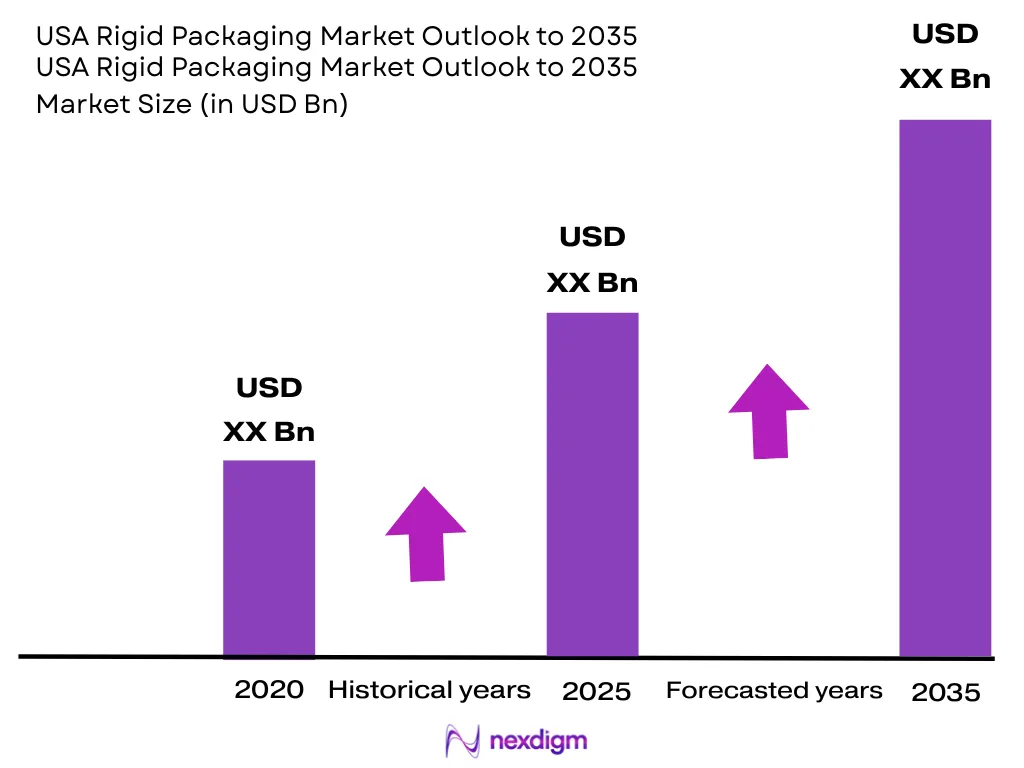
The USA Rigid Packaging Market was valued at USD ~ Billion in 2024 and is anticipated to expand at a CAGR of ~% during 2026-2035. The market is primarily driven by rising demand from the food and beverage, pharmaceutical, and consumer goods sectors, alongside growing consumer preference for convenient, durable, and sustainable packaging solutions. According to industry estimates, the U.S. rigid packaging market reported a value of approximately USD 140.90 billion in 2025 and is projected to reach approximately USD 200.30 billion by 2034, growing at a CAGR of approximately 3.9%, with the United States holding the highest market share globally in 2025. The plastic segment contributed the largest material share at approximately 45% in 2025, owing to its versatility, lightweight nature, durability, and cost-effectiveness, while the biodegradable packaging segment is expected to expand at a significant CAGR through 2034 as brands increasingly adopt lightweight and recyclable rigid packaging to meet evolving sustainability targets and state-level regulatory requirements.
Market Segmentation
By Material
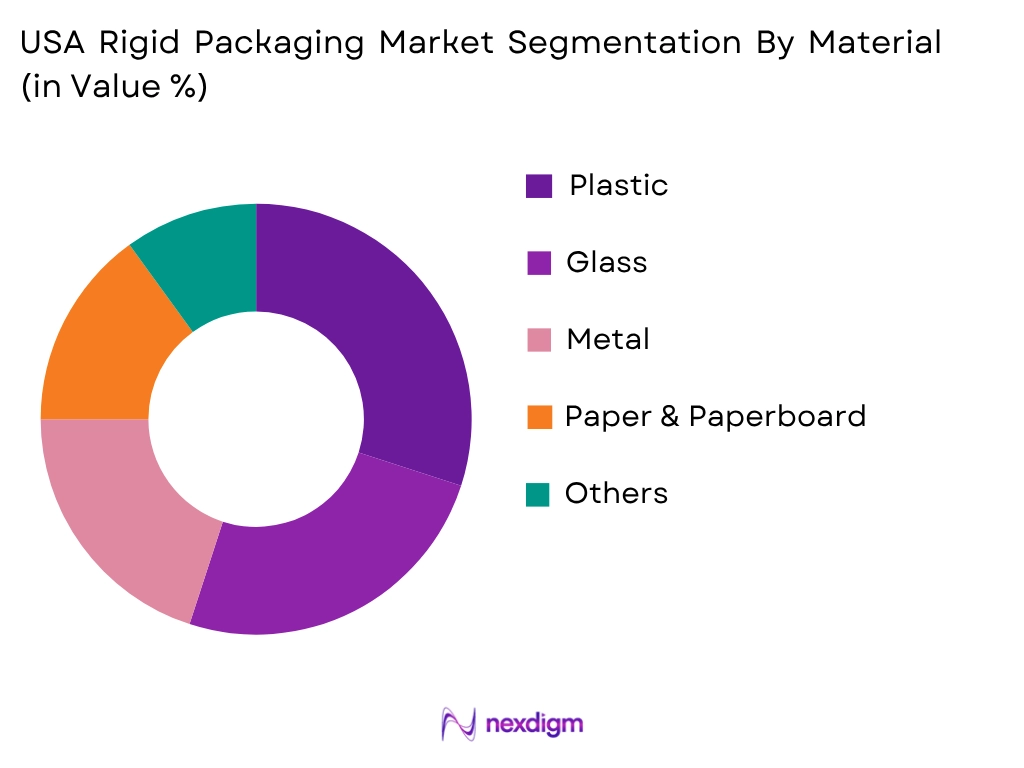
Among these, Plastic continues to dominate the USA Rigid Packaging Market, contributing approximately 45% of material share in 2025 owing to its versatility, lightweight nature, durability, and cost-effectiveness across bottles, jars, containers, and closures. Bottles and jars stand as the largest product component, holding approximately 40.5% of the broader rigid plastic packaging market, driven by key players’ focus on branding and differentiation as bottles and jars offer product protection, visibility, and easy dispensing that improve consumer convenience and maintain product freshness. Metal and Glass retain strong relevance in premium beverage, personal care, and pharmaceutical categories due to their perceived quality and infinite recyclability, while Paper & Paperboard continues to gain share in cartons and boxes as brand owners seek curbside-recyclable alternatives to plastic. Bioplastics remain a smaller but rapidly growing category, with the biodegradable packaging segment expected to expand at a significant CAGR through 2034 as manufacturers respond to state-level sustainability mandates and evolving consumer demand for eco-friendly rigid packaging formats.
By Application
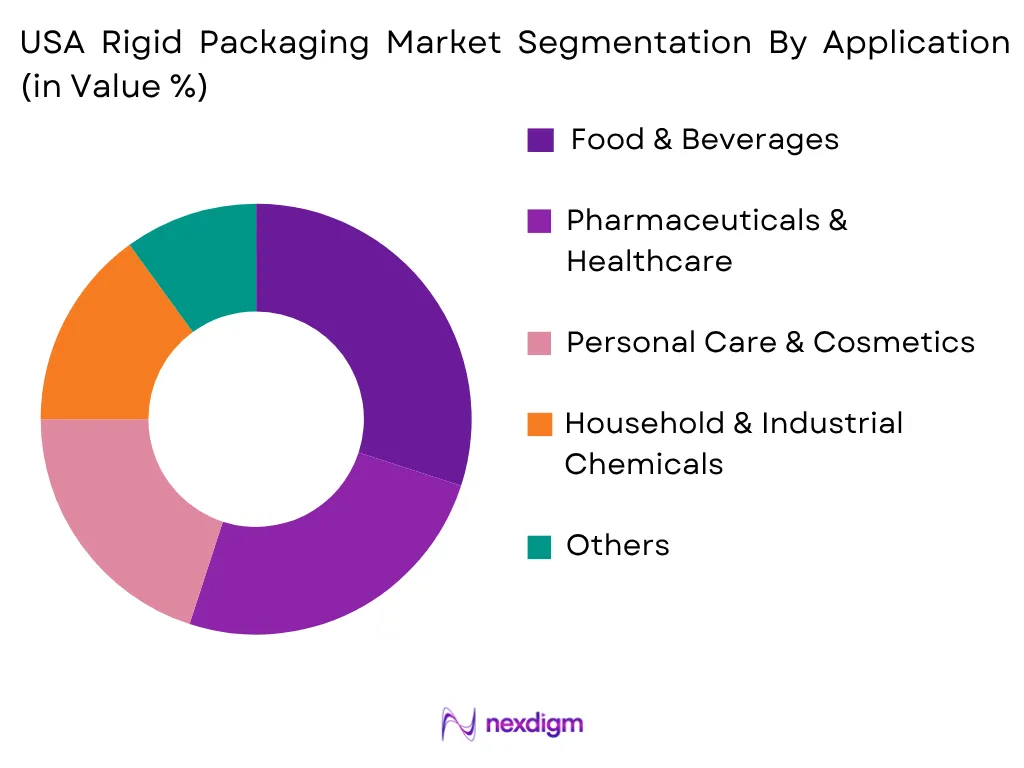
The Food & Beverages segment held the largest share of the USA Rigid Packaging Market in 2025, driven by the busy lifestyles of working individuals and expanding demand for packaged and ready-to-administer food items resulting from changing lifestyle habits. Growing retail food outlets and expansion in packaged food item variety continue to enhance segment growth, supported by rising demand for ready-to-eat food products across the country’s grocery and foodservice channels. The Pharmaceuticals & Healthcare segment is expected to grow at the fastest rate through 2034, driven by rising concern toward the safety of packaged products and increasing regulatory emphasis on tamper-evident and child-resistant rigid packaging formats. Personal Care & Cosmetics and Household & Industrial Chemicals applications continue to generate steady demand, supported by premiumization trends and manufacturers’ growing investment in automation, smart packaging technologies, and premium designs that enable better product protection, brand differentiation, and compliance with evolving regulatory standards.
Competitive Landscape
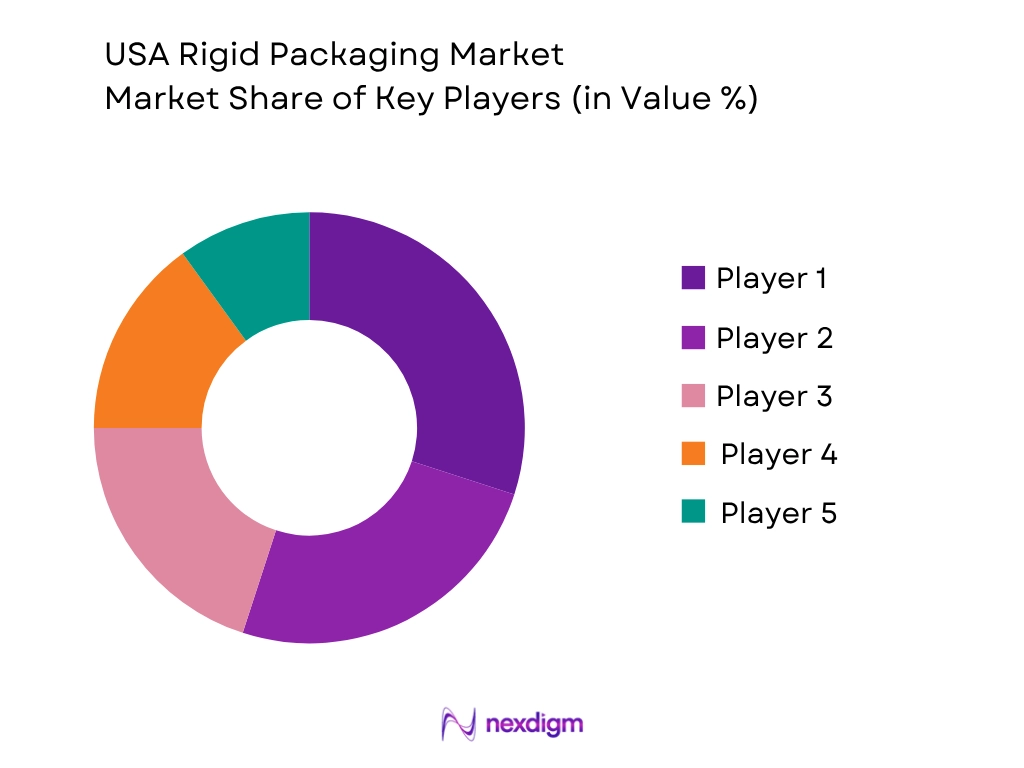
The USA Rigid Packaging Market is moderately consolidated, dominated by large multinational and domestic packaging manufacturers with extensive production facilities across the country, alongside specialized regional converters serving niche applications. Competition is primarily based on recyclability credentials, recycled content capability, regulatory compliance, application-specific technical support, pricing, and innovation in sustainable material design. Companies such as Amcor, Berry Global, Silgan Holdings, Sonoco, and Crown Holdings maintain strong positions across plastic, metal, and glass rigid packaging categories, leveraging extensive domestic manufacturing footprints and long-standing relationships with major food, beverage, and pharmaceutical brand owners. Companies are increasingly investing in automation, smart packaging technologies, and premium designs, enabling better product protection, brand differentiation, and compliance with evolving regulatory standards, while growing state-level EPR requirements continue to accelerate investment in post-consumer recycled content and lightweighting initiatives across the competitive landscape.
| Company | Established | Headquarters | Primary Product Portfolio | Rigid Packaging Portfolio | Manufacturing Presence | Major End-Use Industries | Key Strategic Focus | Certifications & Compliance |
| Amcor plc | 1860 | ~
|
~ | ~ | ~ | ~ | ~ | ~ |
| Berry Global Inc. | 1967 | ~
|
~ | ~ | ~ | ~ | ~ | ~ |
| Silgan Holdings Inc. | 1987 | ~
|
~ | ~ | ~ | ~ | ~ | ~ |
| Sonoco Products Company | 1899 | ~ | ~ | ~ | ~ | ~ | ~ | ~ |
| Crown Holdings, Inc. | 1892 | ~
|
~ | ~ | ~ | ~ | ~ | ~ |
USA Rigid Packaging Market Analysis
Growth Drivers
Rising E-Commerce and Demand for Durable, Secure Packaging
The USA Rigid Packaging Market is experiencing sustained growth driven by the expansion of e-commerce and rising demand for secure and durable packaging for online deliveries. According to industry estimates, the global e-commerce market reached approximately USD 26.8 trillion in 2024 and is forecasted to reach approximately USD 214.5 trillion by 2033, growing at a CAGR of approximately 25.83%, directly increasing demand for rigid packaging formats capable of protecting products during transit. The United States has emerged as a key regional market for rigid plastic packaging, driven by increasing demand for lightweight, durable, and cost-effective packaging across industries such as food and beverages, healthcare, and personal care. Advancements in plastic manufacturing technologies, such as injection molding and thermoforming, continue to enhance design flexibility and production efficiency, while manufacturers increasingly prioritize efficient packaging solutions that improve consumer convenience and maintain product freshness across an expanding range of applications.
Expansion of Pharmaceutical and Personal Care Packaging Demand
The continued expansion of the pharmaceutical, personal care, and household product sectors remains a significant driver of rigid packaging demand across the United States. The pharmaceuticals segment is expected to grow at the fastest rate in the market during the forecast period of 2025 to 2034, driven by rising concern toward the safety of packaged products and increasing regulatory requirements for tamper-evident and child-resistant packaging formats. Manufacturers continue investing in automation, smart packaging technologies, and premium designs, enabling better product protection, brand differentiation, and compliance with evolving regulatory standards across pharmaceutical and personal care applications. Rising consumer preference for convenient, durable, and sustainable packaging solutions continues to boost adoption of materials such as glass, metal, and high-performance plastics across these end-use categories, supporting sustained demand growth for rigid packaging formats capable of meeting increasingly stringent safety and sustainability requirements.
Market Challenges
State-Level EPR Regulations and Plastic Packaging Compliance Costs
The USA Rigid Packaging Market faces significant compliance challenges from an increasingly complex patchwork of state-level Extended Producer Responsibility (EPR) laws, including California’s SB 54, alongside similar frameworks in Colorado, Oregon, Maine, Washington, Maryland, and Minnesota. These state-specific regulations impose varying recycled content mandates, packaging registration fees, and reporting requirements that require packaging manufacturers and brand owners to navigate multiple, sometimes conflicting, compliance frameworks across their national distribution networks. Companies producing rigid packaging must invest substantially in tracking, reporting, and material substitution to meet these evolving requirements, with compliance costs particularly burdensome for smaller manufacturers and brand owners with limited administrative resources to manage state-by-state regulatory variation. This regulatory complexity is expected to intensify as additional states consider adopting similar EPR frameworks, requiring continued investment in compliance infrastructure and material innovation across the industry.
Raw Material Price Volatility and Resin Cost Fluctuations
The USA Rigid Packaging Market remains exposed to significant raw material price volatility, particularly for plastic resins, aluminum, and glass cullet used across the industry’s diverse material portfolio. Fluctuating crude oil and natural gas prices directly affect virgin plastic resin costs, while global supply chain disruptions and energy cost volatility continue to create pricing uncertainty for manufacturers reliant on consistent raw material availability. These cost pressures are compounded by rising energy and freight costs across the domestic manufacturing and distribution network, requiring companies to maintain diversified sourcing strategies and long-term supply agreements to manage input cost volatility. Smaller regional converters with limited purchasing scale face particular challenges in managing these cost fluctuations relative to larger multinational competitors with greater negotiating leverage and diversified global sourcing networks.
Market Opportunities
Growth in Recyclable and Bio-Based Rigid Packaging Materials
The USA Rigid Packaging Market’s evolving regulatory environment and shifting consumer preferences present substantial opportunities for companies investing in recyclable and bio-based material innovation. The biodegradable packaging segment is expected to expand at a significant CAGR between 2025 and 2034, as brands increasingly adopt lightweight and recyclable rigid packaging to meet sustainability targets driven by both regulatory requirements and consumer demand. The recyclability of rigid plastics aligns with the rising emphasis on sustainable packaging solutions, further driving market growth as manufacturers develop post-consumer recycled content formulations and mono-material designs that maintain performance while improving end-of-life recyclability. Companies developing certified compostable materials, high-recycled-content bottles and containers, and innovative bio-based polymers are well positioned to capture growing demand from brand owners seeking to meet both state-level EPR compliance requirements and evolving retailer sustainability commitments across the food, beverage, and personal care sectors.
Expansion of Lightweighting and Smart Packaging Technologies
Continued innovation in lightweighting, advanced plastics, glass, and metal materials presents significant opportunities for companies seeking to enhance functionality while reducing costs and improving environmental performance across the USA Rigid Packaging Market. Manufacturers are increasingly investing in automation, smart packaging technologies, and premium designs, enabling better product protection, brand differentiation, and compliance with evolving regulatory standards. These technological investments allow companies to reduce material usage per unit while maintaining structural integrity and barrier performance, directly addressing both cost pressures and sustainability requirements simultaneously. As e-commerce continues to expand and brand owners seek greater supply chain visibility, companies developing smart and connected packaging technologies, including QR codes, RFID tracking, and tamper-evident sensors, are well positioned to capture premium pricing and strengthen customer relationships across the pharmaceutical, personal care, and premium food and beverage segments of the market.
Future Outlook
The USA Rigid Packaging Market is expected to witness steady expansion over the forecast period, supported by continued growth in food and beverage, pharmaceutical, and personal care demand, alongside sustained e-commerce expansion and evolving state-level sustainability regulations. Continued investment in recyclable materials, lightweighting technologies, and automation-driven manufacturing is expected to further reshape the market’s material composition and competitive dynamics. Growing regulatory emphasis on Extended Producer Responsibility and recycled content mandates will continue to accelerate the shift toward sustainable, mono-material, and bio-based rigid packaging formats through 2035.
Major Players
- Amcor plc
- Berry Global Inc.
- Silgan Holdings Inc.
- Sonoco Products Company
- Crown Holdings, Inc.
- Sealed Air Corporation
- Graham Packaging Company, L.P.
- Plastipak Holdings, Inc.
- ALPLA Werke Alwin Lehner GmbH & Co. KG
- Altium Packaging LLC
- Pactiv Evergreen Inc.
- CKS Packaging, Inc.
- O-I Glass, Inc.
- Ball Corporation
- Gerresheimer AG
Key Target Audience
- Rigid Packaging Manufacturers
- Food & Beverage Processing Companies
- Pharmaceutical and Healthcare Companies
- Personal Care and Cosmetics Manufacturers
- E-Commerce and Retail Brands
- Investment and Venture Capitalist Firms
- Government and Regulatory Bodies (U.S. Food and Drug Administration (FDA), Environmental Protection Agency (EPA), State Recycling and EPR Program Administrators)
- Recycling and Waste Management Infrastructure Providers
Research Methodology
Step 1: Identification of Key Variables
The research process begins with identifying the complete ecosystem of the USA Rigid Packaging Market, including raw material suppliers, packaging manufacturers, converters, food and pharmaceutical processors, retailers, and regulatory authorities. Extensive secondary research is conducted using company annual reports, government publications, trade associations, customs statistics, industry journals, and proprietary databases to determine the variables influencing market demand, pricing, production, consumption, and technological developments.
Step 2: Market Analysis and Construction
Historical market information is collected and analyzed to estimate market size, import-export activity, application-wise demand, and pricing trends. A combination of top-down and bottom-up approaches is used to estimate market revenues and validate segment-level performance. Consumption patterns across food and beverage, pharmaceuticals, personal care, and household chemicals are evaluated to establish an accurate representation of the industry.
Step 3: Hypothesis Validation and Expert Consultation
The preliminary findings are validated through Computer-Assisted Telephone Interviews (CATIs) and structured discussions with packaging manufacturers, procurement managers, retailers, food technologists, regulatory experts, and senior executives operating within the USA’s rigid packaging industry. These interviews help verify market assumptions, competitive developments, technology adoption trends, pricing dynamics, and future investment opportunities while refining the overall market estimates.
Step 4: Research Synthesis and Final Output
The final stage integrates insights obtained from primary interviews with quantitative information collected through secondary sources. Data triangulation techniques are applied to reconcile differences between supply-side and demand-side estimates, ensuring robust market forecasting. The report is then reviewed through multiple quality assurance checkpoints to deliver a comprehensive analysis covering market size, segmentation, competitive landscape, future outlook, and strategic recommendations for industry stakeholders.

- Executive Summary
- Research Methodology (Market Definitions and Assumptions, Abbreviations, Market Sizing Approach, Top-Down Analysis, Bottom-Up Analysis, Demand-Side Assessment, Supply-Side Assessment, Primary Industry Interviews, Secondary Research Validation, Data Triangulation, Forecasting Framework, Limitations and Future Conclusions)

- Definition and Scope
- Market Evolution and Industry Genesis
- Timeline of Major Industry Developments
- Rigid Packaging Industry Value Chain Analysis
- Supply Chain Analysis

- Growth Drivers (Rising E-Commerce and Demand for Durable Packaging, Expansion of Pharmaceutical and Personal Care Packaging, Growing Demand for Ready-to-Eat Food Products, Premiumization of Consumer Goods Packaging, Lightweighting and Automation Investment, Growth in Household and Industrial Chemical Packaging)
- Market Challenges (State-Level EPR Regulations and Compliance Costs, Raw Material Price Volatility, Fragmented Recycling Infrastructure, Rising Energy and Freight Costs, Competition from Flexible Packaging Alternatives, Complex Multi-State Regulatory Landscape)
- Market Opportunities (Growth in Recyclable and Bio-Based Rigid Packaging Materials, Expansion of Lightweighting and Smart Packaging Technologies, Investment in Chemical and Mechanical Recycling Capacity, Premium and Direct-to-Consumer Packaging Growth, Reusable Packaging System Development, Automation-Driven Manufacturing Efficiency)
- Market Trends (Shift Toward Post-Consumer Recycled Content, Growth in Biodegradable Packaging Materials, Rise of Smart and Connected Packaging, Lightweighting of Rigid Formats, Premiumization of Brand Packaging Design, Automation in Manufacturing Processes)
- Government Regulations (U.S. Food and Drug Administration (FDA) Food Contact Substance Regulations, Environmental Protection Agency (EPA) Recycling and Waste Guidelines, State-Level Extended Producer Responsibility (EPR) Laws (California SB 54, Colorado, Oregon, Maine, Washington, Maryland, Minnesota), Federal Trade Commission (FTC) Green Guides, State Recycled Content Mandates)
- Import and Export Analysis (Trade Volume, Major Import Sources, Export Destinations, HS Code Analysis, Trade Balance)
- Raw Material Availability Analysis (Virgin and Recycled Polymers, Aluminium and Steel, Glass Cullet, Kraft Paperboard, Bio-Based Feedstocks)
- Technology Landscape (Injection and Blow Molding Technologies, Thermoforming Technologies, Chemical Recycling Processes, Lightweighting Design Software, Smart and Connected Packaging Systems)
- Sustainability Assessment (Post-Consumer Recycled Content Adoption, Recyclability and Curbside Collection Compatibility, Carbon Footprint Reduction, Circular Economy Integration, Biodegradable Material Development)
- PESTLE Analysis
- SWOT Analysis
- Porter’s Five Forces Analysis
- Stakeholder Ecosystem
- Competition Ecosystem

- By Market Value (2020-2025)
- By Volume Consumption (2020-2025)
- By Average Selling Price (2020-2025)

- By Material (In Value %)
Plastic
Metal
Glass
Paper & Paperboard
Bioplastics - By Product Type (In Value %)
Bottles & Jars
Containers & Tubs
Cans
Boxes & Cartons
Caps & Closures - By Production Process (In Value %)
Injection Molding
Blow Molding
Thermoforming
Extrusion
Others - By Application (In Value %)
Food & Beverages
Pharmaceuticals & Healthcare
Personal Care & Cosmetics
Household & Industrial Chemicals
Others - By Region (In Value %)
Northeast
Midwest
South
West

- Market Share of Major Players (By Value, Volume, Material Type, Application Industry, Product Type)
- Cross Comparison Parameters (Recyclable Portfolio Breadth, Recycled Content Capability, Manufacturing Capacity, Application Technical Support Capability, Regulatory Compliance & Certifications, Food & Beverage Customer Base, Innovation & New Product Launch Frequency, Post-Consumer Recycling Infrastructure)
- SWOT Analysis of Major Players
- Pricing Analysis by Material Category and Format
- Production Capacity Analysis
- Manufacturing Footprint Analysis
- Distribution Network Analysis
- Innovation Benchmarking
- Detailed Profiles of Major Companies
Amcor plc
Berry Global Inc.
Silgan Holdings Inc.
Sonoco Products Company
Crown Holdings, Inc.
Sealed Air Corporation
Graham Packaging Company, L.P.
Plastipak Holdings, Inc.
ALPLA Werke Alwin Lehner GmbH & Co. KG
Altium Packaging LLC
Pactiv Evergreen Inc.
CKS Packaging, Inc.
O-I Glass, Inc.
Ball Corporation
Gerresheimer AG

- Consumption Pattern Analysis (Order Volume, Batch Size, Product Category Penetration, Seasonal Demand, Reformulation Activity)
- Purchasing Criteria (Recyclability, Regulatory Compliance, Cost Efficiency, Shelf-Life Performance, Barrier Properties, Brand Presentation)
- Procurement and Supplier Selection Analysis
- Sustainable Packaging Adoption Assessment
- Premium vs Conventional Packaging Demand
- Product Attribute Preference Analysis (Recycled Content Percentage, Barrier Performance, Resealability, Shelf Appeal, Material Origin, Curbside Recyclability)
- Consumer Sustainability and Convenience Expectations
- Pain Point Analysis
- Decision-Making Process

- By Market Value (2026-2035)
- By Volume Consumption (2026-2035)
- By Average Selling Price (2026-2035)


 Request a Sample
 Ask for Customization
 Get a Quote
 Enquire Now