
 Download PDF
Market Overview
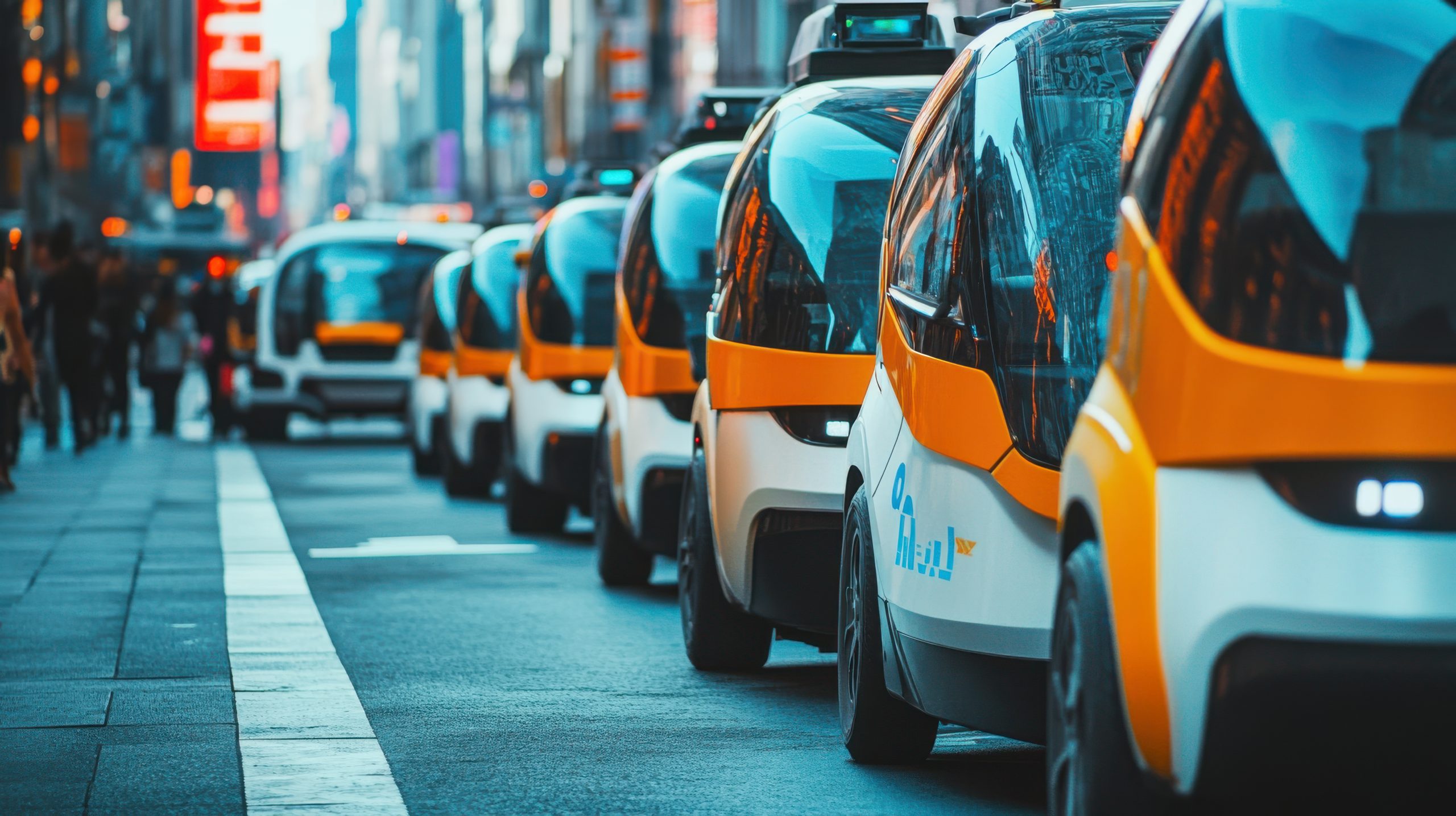
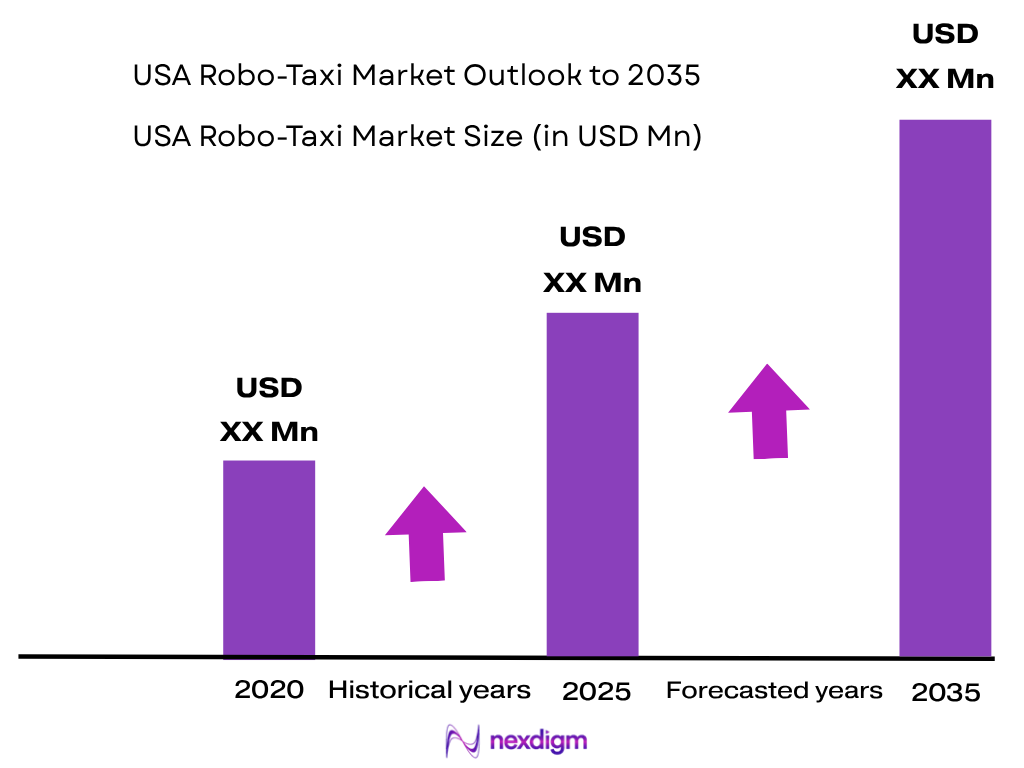
The USA Robo-Taxi market is valued at ~USD XX billion, based on historical analysis of autonomous mobility deployments, commercial driverless ride-hailing operations, autonomous vehicle testing activities, and fleet expansion initiatives. The market growth is supported by increasing investment in Level 4 autonomous driving technologies, expansion of commercial robotaxi services, rising demand for shared mobility solutions, and integration of artificial intelligence, LiDAR, high-definition mapping, and vehicle connectivity systems. According to the National Highway Traffic Safety Administration (NHTSA), more than 50 companies and organizations have reported autonomous vehicle testing activities in the United States, highlighting the country’s advanced autonomous mobility ecosystem.
The USA Robo-Taxi market is primarily driven by the convergence of autonomous technology development, urban transportation demand, and electric vehicle adoption. The commercial deployment of driverless taxi services in cities such as Phoenix, San Francisco, Los Angeles, and Austin has accelerated industry validation. Waymo reported millions of fully autonomous miles driven on public roads, while Cruise and other autonomous mobility companies have expanded testing and operational programs. Increasing urban congestion, demand for affordable mobility alternatives, and shortage of professional drivers are further encouraging investment in autonomous ride-hailing networks.
Market Segmentation
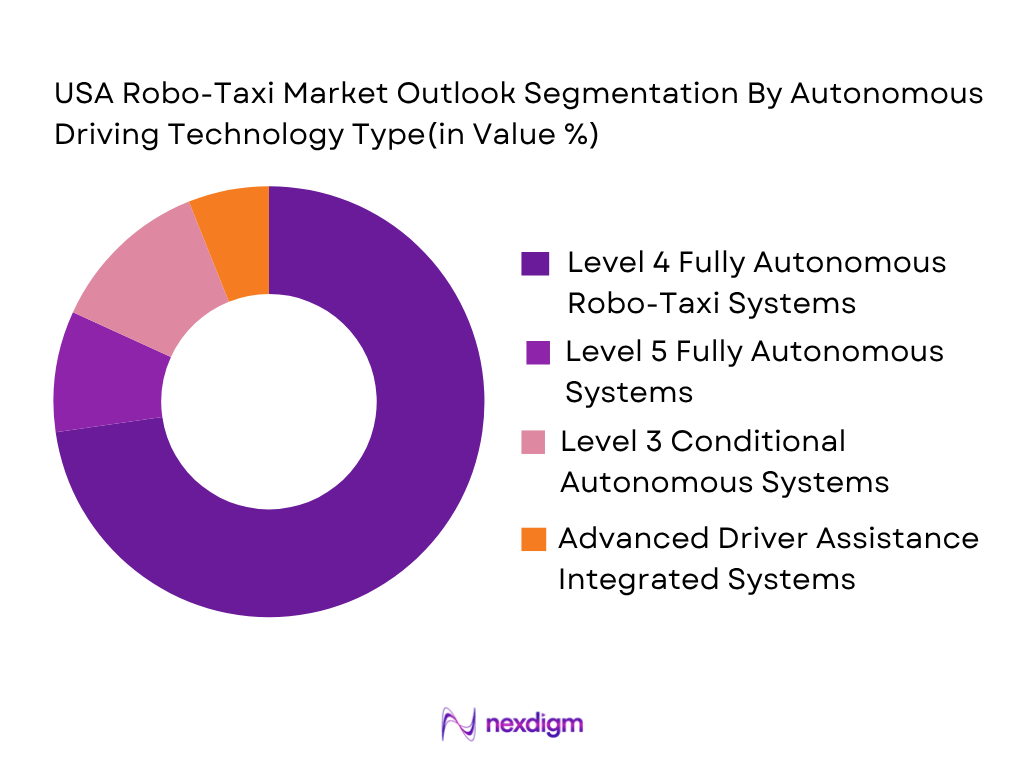
By Autonomous Driving Technology Type
The USA Robo-Taxi market is segmented into Level 4 fully autonomous systems, Level 3 conditional autonomous systems, ADAS-integrated platforms, and pilot-stage autonomous technologies. Level 4 autonomous systems dominate the market due to their ability to operate without human intervention within defined operational design domains. Companies such as Waymo have focused on commercial Level 4 deployments using combinations of LiDAR, radar, cameras, artificial intelligence, and HD mapping technologies. The increasing commercialization of driverless services in controlled urban environments has accelerated adoption of Level 4 platforms. These systems provide improved fleet efficiency, reduced dependence on human drivers, and compatibility with electric autonomous vehicle platforms. Regulatory approvals and operational experience gained through pilot programs are further strengthening the position of fully autonomous robo-taxi technology.
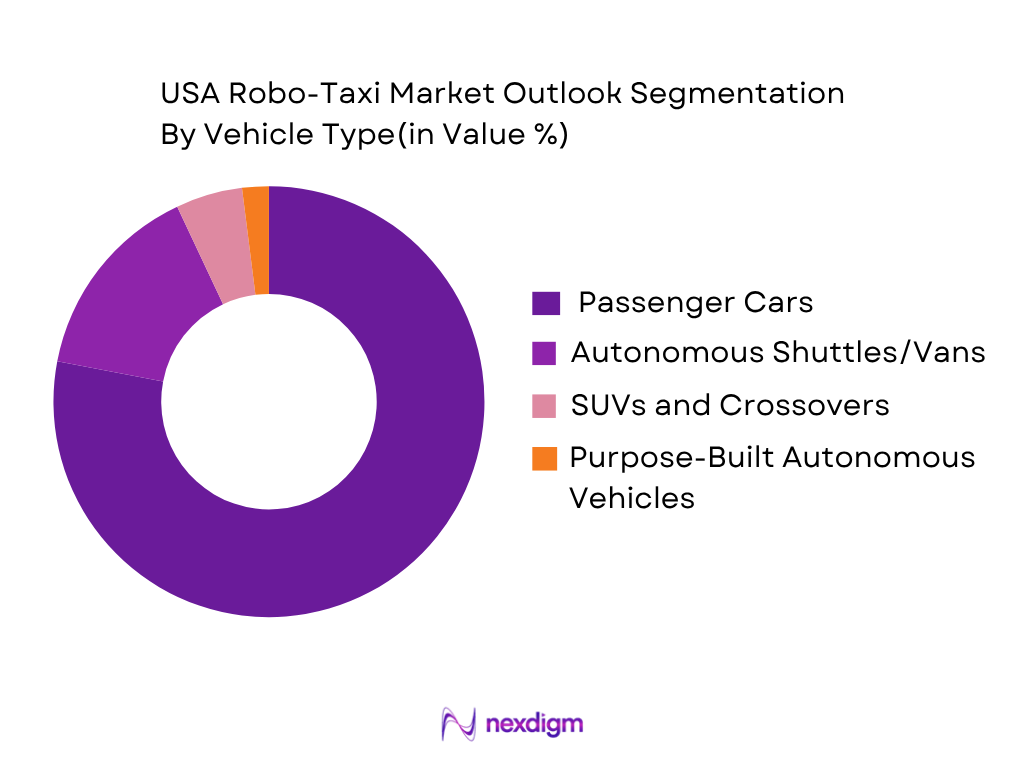
By Vehicle Platform Type
The USA Robo-Taxi market is segmented into electric passenger vehicles, autonomous shuttles, SUVs, sedans, and purpose-built autonomous vehicles. Electric passenger vehicles represent the leading segment due to their compatibility with autonomous technology architectures, lower operating emissions, and suitability for urban mobility applications. Electric platforms provide advantages including simplified drivetrain integration, centralized electronic control systems, and reduced maintenance requirements compared with internal combustion vehicles. Robo-taxi operators are increasingly adopting electric vehicles because fleet operators prioritize operational efficiency and sustainability. Purpose-built autonomous vehicles are also gaining attention as companies develop vehicles specifically designed without traditional driver controls. These vehicles enable optimized passenger space utilization, improved sensor placement, and enhanced autonomous functionality.
Competitive Landscape
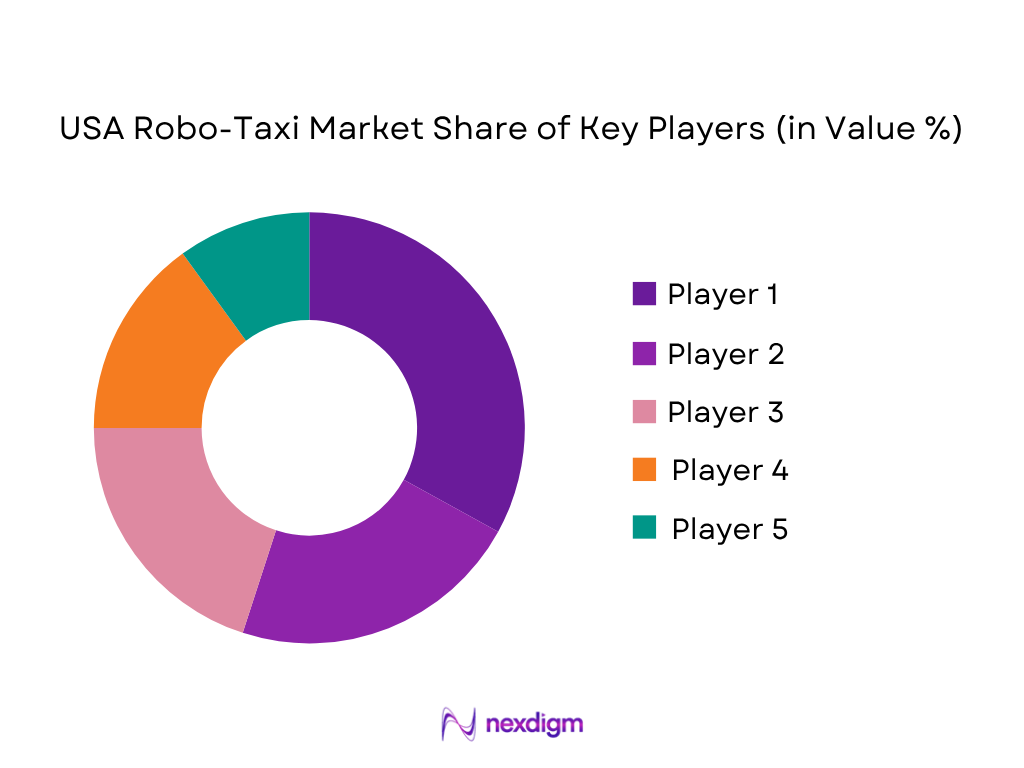
The USA Robo-Taxi market is highly concentrated among technology companies, automotive manufacturers, and mobility platforms investing in autonomous driving capabilities. Major players including Waymo, Cruise, Zoox, Tesla, and Motional are competing through autonomous technology development, fleet deployment, geographic expansion, and strategic partnerships. The competitive environment is shaped by autonomous driving capability, safety validation, operational permits, artificial intelligence expertise, and commercial deployment experience.
| Company | Establishment Year | Headquarters | Autonomous Technology | Key Deployment Cities | Vehicle Partnerships | Technology Focus | Fleet Operations |
| Waymo | 2009 | Mountain View, California | ~ | ~ | ~ | ~ | ~ |
| Cruise | 2013 | San Francisco, California | ~ | ~ | ~ | ~ | ~ |
| Zoox | 2014 | Foster City, California | ~ | ~ | ~ | ~ | ~ |
| Tesla | 2003 | Austin, Texas | ~ | ~ | ~ | ~ | ~ |
| Motional | 2020 | Boston, Massachusetts | ~ | ~ | ~ | ~ | ~ |
USA Robo-Taxi Market Analysis
Growth Drivers
Expansion of Autonomous Mobility Infrastructure and Urban Transportation Demand
The expansion of autonomous mobility infrastructure in the United States is accelerating robo-taxi adoption by creating suitable operating environments for commercial driverless transportation services. The United States recorded a GDP of approximately USD 29.18 trillion in 2024, according to the World Bank, reflecting the economic capacity supporting investments in advanced transportation technologies. Urban mobility demand remains concentrated in metropolitan regions, with the U.S. Census Bureau reporting that more than 268 million people lived in urban areas in 2024, creating significant demand for efficient shared transportation solutions. Autonomous ride-hailing companies are leveraging this urban concentration by deploying services in cities such as Phoenix, San Francisco, Los Angeles, Austin, and Las Vegas, where road infrastructure and technology ecosystems support autonomous testing. The U.S. Department of Transportation has continued to support connected and automated vehicle research through initiatives focused on transportation safety and innovation. Additionally, the National Highway Traffic Safety Administration reported that autonomous vehicle developers continue submitting voluntary safety assessment information, reflecting ongoing industry participation. The availability of advanced digital infrastructure, high smartphone penetration, and established ride-hailing behaviour creates a favourable environment for robo-taxi services. Increasing congestion in major cities, demand for first-mile and last-mile connectivity, and the need for alternative mobility solutions are encouraging investment in autonomous fleet deployment and supporting long-term commercial adoption.
Advancement of Artificial Intelligence, Electric Vehicles, and Autonomous Driving Technologies
Technological advancements in artificial intelligence, electric vehicle platforms, and autonomous driving systems are strengthening the foundation of the USA robo-taxi market. The United States remains one of the leading global centres for artificial intelligence development, supported by extensive semiconductor, software, and computing capabilities. The International Energy Agency reported that the United States recorded more than 1.4 million electric car registrations in 2024, demonstrating increasing acceptance of electric mobility platforms that are increasingly integrated with autonomous vehicle systems. Electric vehicle architectures provide advantages for robo-taxi operators due to simplified drivetrains, lower maintenance requirements, and compatibility with advanced electronic control systems. Autonomous operators are increasingly using LiDAR, radar, cameras, artificial intelligence processors, and high-definition mapping technologies to improve vehicle decision-making capabilities. The U.S. Department of Transportation has highlighted connected vehicle technologies as a key component of future transportation systems, supporting development of safer automated mobility solutions. The growth of computing infrastructure is also supporting autonomous fleet operations, as robo-taxi providers require extensive data processing from real-world driving environments. These technological developments are enabling companies to improve autonomous driving reliability, expand operational zones, and reduce dependence on human drivers. Continued innovation in AI-based perception, vehicle connectivity, and electric platforms is expected to strengthen commercial deployment opportunities across major U.S. cities.
Market Challenges
Regulatory Complexity and Autonomous Vehicle Safety Approval Requirements
Regulatory complexity remains one of the primary challenges affecting the large-scale commercialization of robo-taxi services in the United States. Autonomous vehicles operate under a combination of federal guidance and state-specific regulations, creating different approval requirements across deployment locations. The National Highway Traffic Safety Administration manages federal vehicle safety oversight, while states including California, Arizona, Texas, and Nevada maintain individual autonomous vehicle testing and deployment frameworks. California’s Department of Motor Vehicles reported hundreds of autonomous vehicle testing permits issued to companies operating within the state, demonstrating the extensive regulatory monitoring required before commercial expansion. Safety validation remains a significant operational requirement because autonomous systems must process millions of driving scenarios involving pedestrians, weather conditions, road infrastructure variations, and complex traffic environments. The U.S. Department of Transportation continues to focus on automated driving system safety research, cybersecurity, and operational transparency. The challenge is intensified by differences in public road conditions across regions, requiring robo-taxi operators to validate technology performance in multiple environments. Insurance frameworks, liability determination, cybersecurity requirements, and data-sharing expectations further increase regulatory complexity. While autonomous technology continues advancing, achieving consistent regulatory approval across multiple states remains essential for nationwide robo-taxi expansion.
High Technology Development Requirements and Infrastructure Limitations
High technology development requirements and infrastructure limitations create significant challenges for robo-taxi operators seeking commercial-scale deployment. Autonomous vehicles require advanced hardware components, including LiDAR sensors, cameras, radar systems, computing platforms, and artificial intelligence software, all of which require substantial engineering investment and continuous improvement. The U.S. semiconductor ecosystem remains critical for autonomous vehicle development, with the Semiconductor Industry Association reporting that the U.S. semiconductor industry generated approximately USD 264 billion in revenue in 2024, supporting availability of advanced computing technologies required for autonomous systems. However, autonomous fleets require additional infrastructure, including charging networks, fleet monitoring facilities, maintenance centres, and high-definition mapping capabilities. The U.S. Energy Information Administration reported that the country had more than 192,000 publicly available electric vehicle charging ports in 2024, but charging availability remains uneven across regions, creating operational challenges for electric robo-taxi fleets. Autonomous vehicles also require continuous software updates and data management capabilities, increasing operational complexity. Weather conditions, construction zones, road quality differences, and complex urban environments require extensive testing before deployment expansion. Smaller technology developers face additional barriers due to high capital requirements associated with autonomous vehicle development, fleet scaling, and regulatory compliance. These factors limit rapid expansion and require companies to establish strategic partnerships with automotive manufacturers, infrastructure providers, and technology suppliers.
Market Opportunities
Commercial Expansion of Driverless Fleet Operations and Mobility-as-a-Service Platforms
The expansion of commercial driverless fleet operations represents a significant opportunity for robo-taxi companies as cities increasingly explore technology-driven transportation solutions. The United States has a strong foundation for shared mobility services, supported by large metropolitan populations and established digital transportation platforms. According to the U.S. Census Bureau, metropolitan areas continue to account for the majority of the country’s population concentration, creating demand for efficient urban mobility alternatives. Autonomous fleet operators can leverage this demand by integrating robo-taxis into mobility-as-a-service platforms that combine ride-hailing, public transportation connectivity, and subscription-based mobility solutions. The Federal Transit Administration has emphasized technology integration and innovative mobility solutions as part of future transportation development strategies. Current commercial deployments in cities such as Phoenix and San Francisco demonstrate the feasibility of operating autonomous passenger services under controlled conditions. Robo-taxi fleets can improve transportation accessibility by providing additional mobility options for passengers without access to private vehicles. Fleet operators can also benefit from reduced dependence on human drivers, improved vehicle utilization, and centralized fleet management systems. The growth of electric vehicle infrastructure further supports deployment opportunities because many autonomous fleets are transitioning toward electric platforms. Increasing collaboration between automotive manufacturers, technology companies, and transportation agencies is expected to create new opportunities for large-scale autonomous mobility networks.
Integration of Autonomous Vehicles with Smart City Infrastructure and Advanced Data Platforms
Integration of robo-taxis with smart city infrastructure and advanced data platforms creates opportunities for improved transportation efficiency and broader autonomous mobility adoption. U.S. cities are investing in connected transportation systems, digital infrastructure, and intelligent traffic management solutions that can support autonomous vehicle operations. The U.S. Department of Transportation has supported smart transportation initiatives focused on connected vehicle technologies, traffic optimization, and transportation safety improvements. Advanced data platforms allow robo-taxi operators to analyse vehicle performance, optimize routes, improve passenger experience, and enhance autonomous decision-making capabilities. The deployment of electric autonomous fleets also aligns with broader transportation electrification initiatives. The International Energy Agency recorded continued expansion of electric vehicle adoption in the United States, supported by government incentives and charging infrastructure investments. Autonomous fleets operating in controlled environments such as airports, business districts, and planned communities provide opportunities for faster technology validation. Partnerships between autonomous technology providers, municipalities, and infrastructure companies can accelerate deployment by improving road connectivity and data availability. Future opportunities include integration with public transit networks, autonomous airport transportation, corporate mobility services, and last-mile transportation solutions. These developments position robo-taxis as part of a broader transition toward connected, automated, and digitally managed urban transportation ecosystems.
Future Outlook
Over the next decade, the USA Robo-Taxi market is expected to expand significantly due to increasing commercialization of autonomous transportation services, continuous advancements in artificial intelligence, and growing investment from automotive and technology companies. The transition from pilot programs to commercial operations will accelerate as regulatory frameworks mature and autonomous systems achieve higher reliability. Integration with electric mobility, smart city infrastructure, and mobility-as-a-service platforms will further support market expansion.
Future growth will be supported by increasing deployment in metropolitan areas, expansion beyond controlled operating zones, improved sensor technologies, and declining autonomous hardware costs. Robo-taxi operators are expected to focus on fleet scaling, operational efficiency, passenger experience enhancement, and integration with public transportation networks.
Major Players
- Waymo
- Cruise
- Zoox
- Tesla
- Motional
- Aurora Innovation
- May Mobility
- Pony.ai
- Nuro
- Baidu Apollo
- Mobileye
- NVIDIA
- Uber
- Lyft
- Volkswagen Group
Key Target Audience
- Autonomous Vehicle Manufacturers
- Automotive OEMs and Tier-1 Suppliers
- Ride-Hailing and Mobility Platform Operators
- Artificial Intelligence and Autonomous Driving Technology Providers
- Investments and Venture Capitalist Firms
- Government and Regulatory Bodies (National Highway Traffic Safety Administration, California Department of Motor Vehicles, Department of Transportation)
- Fleet Management and Transportation Service Providers
- Electric Vehicle Charging Infrastructure Companies
Research Methodology
Step 1: Identification of Key Variables
The initial phase involves mapping the USA Robo-Taxi ecosystem, including autonomous vehicle manufacturers, technology developers, mobility operators, regulatory authorities, infrastructure providers, and fleet operators. Extensive secondary research is conducted to identify critical market variables such as autonomous fleet deployment, technology adoption, regulatory approvals, and operational coverage.
Step 2: Market Analysis and Construction
Historical and current market information is analyzed through assessment of autonomous vehicle testing activities, commercial robo-taxi deployments, passenger mobility trends, and technology investments. The market estimation framework evaluates fleet expansion, operational availability, vehicle utilization, and service adoption across major deployment regions.
Step 3: Hypothesis Validation and Expert Consultation
Market assumptions are validated through discussions with autonomous mobility professionals, vehicle manufacturers, technology suppliers, and transportation stakeholders. Expert inputs are used to evaluate deployment challenges, technology readiness, regulatory developments, and future commercialization pathways.
Step 4: Research Synthesis and Final Output
The final stage integrates primary and secondary findings to develop a comprehensive assessment of the USA Robo-Taxi market. Data validation is performed through comparison of technology developments, operational milestones, company announcements, and regulatory updates to ensure accurate market insights.

- Executive Summary
- Research Methodology (Market Definition and Scope, Robo-Taxi Ecosystem Mapping, Autonomous Driving Technology Assessment, Market Sizing Framework, Top-Down Market Estimation, Bottom-Up Fleet Deployment Analysis, Demand-Side Mobility Assessment, Supply-Side Operator Assessment, Primary Industry Interviews, Autonomous Vehicle Data Validation, Fleet Utilization Modelling, Regulatory Landscape Review, Data Triangulation, Forecasting Methodology, Research Limitations)

- Definition and Scope
- Evolution of Autonomous Mobility and Robo-Taxi Industry Development Timeline
- Major Industry Milestones in Autonomous Ride-Hailing Deployment
- USA Robo-Taxi Value Chain Analysis
- USA Robo-Taxi Ecosystem Analysis
- USA Robo-Taxi Supply Chain Analysis

- Growth Drivers (Expansion of Autonomous Vehicle Testing Programs, Rising Urban Mobility Demand, Driver Shortage in Transportation Services, Artificial Intelligence Advancement, Electric Vehicle Integration, Fleet Automation Demand)
- Market Challenges (Regulatory Approval Complexity, Autonomous Driving Safety Concerns, High Technology Development Requirements, Public Acceptance Barriers, Liability and Insurance Challenges, Infrastructure Readiness Constraints)
- Market Opportunities (Commercial Robo-Taxi Fleet Expansion, Autonomous Airport Transportation, Integration with Public Transit Networks, AI-Based Mobility Platforms, Electric Autonomous Fleet Deployment, Autonomous Mobility-as-a-Service Development)
- Market Trends (Driverless Commercial Operations, AI-Based Autonomous Decision Systems, Sensor Cost Reduction, Electric Robo-Taxi Adoption, Fleet Remote Monitoring, Autonomous Vehicle Partnerships, Mobility Subscription Models)
- Government Regulations (NHTSA Autonomous Vehicle Guidelines, Federal Autonomous Driving Policy Framework, State-Level Autonomous Vehicle Permitting, California DMV Testing Regulations, Insurance and Liability Requirements, Data Privacy Regulations)
- SWOT Analysis
- Porter’s Five Forces Analysis
- PESTLE Analysis
- Stakeholder Ecosystem Analysis
- Competition Ecosystem Analysis

- By Market Value (2020-2025)
- By Number of Autonomous Vehicles Deployed (2020-2025)
- By Active Robo-Taxi Fleet Size (2020-2025)
- By Passenger Trips Completed (2020-2025)
- By Average Trip Distance (2020-2025)
- By Fleet Utilization Rate (2020-2025)
- By Geographic Deployment Coverage (2020-2025)

- By Autonomous Driving Level (In Value %)
Level 4 Fully Autonomous Robo-Taxi Services
Level 3 Conditional Autonomous Ride Services
Pilot and Testing Stage Autonomous Vehicles - By Vehicle Type (In Value %)
Passenger Sedans
Electric SUVs and Crossovers
Electric Minivans
Shuttle Vehicles
Special Purpose Autonomous Mobility Vehicles - By Service Model (In Value %)
Public Robo-Taxi Ride-Hailing
Airport Autonomous Shuttle Services
Corporate Campus Mobility Services
Residential Community Transportation
Autonomous Delivery and Passenger Hybrid Services - By Technology Platform (In Value %)
LiDAR-Based Autonomous Systems
Camera-Based Autonomous Systems
Radar and Sensor Fusion Platforms
Artificial Intelligence-Based Driving Systems
HD Mapping and Localization Platforms - By Operating Region (In Value %)
California Autonomous Mobility Hub
Arizona Testing and Deployment Cluster
Texas Autonomous Vehicle Ecosystem
Nevada Autonomous Transportation Corridor
Florida and Other Emerging Deployment Regions - By Application Area (In Value %)
Urban Transportation
Suburban Mobility
Airport Connectivity
First and Last Mile Transportation
Shared Autonomous Fleet Operations

- Market Share Analysis of Major Players (By Fleet Deployment, Autonomous Testing Miles, Commercial Operations, Geographic Coverage, Technology Platform)
- Cross Comparison Parameters (Autonomous Driving Technology Level, Active Robo-Taxi Fleet Size, Operational City Coverage, Sensor Technology Integration, AI Software Capability, Vehicle Partnership Network, Autonomous Testing Experience, Commercial Deployment Status)
- SWOT Analysis of Major Players
- Detailed Profiles of Major Companies
Waymo
Cruise
Tesla
Zoox
Motional
Aurora Innovation
May Mobility
Pony.ai
Nuro
Baidu Apollo
Mobileye
NVIDIA
Uber
Lyft
Volkswagen Group

- Passenger Adoption Assessment
- Consumer Demographic Analysis
- Urban Mobility Behaviour Analysis
- Consumer Trust and Safety Perception Analysis
- Pricing and Affordability Analysis
- User Experience Preference Analysis
- Purchase Decision Factors

- By Market Value (2026-2035)
- By Number of Autonomous Vehicles Deployed (2026-2035)
- By Active Robo-Taxi Fleet Size (2026-2035)
- By Passenger Trips Completed (2026-2035)
- By Average Trip Distance (2026-2035)
- By Fleet Utilization Rate (2026-2035)
- By Geographic Deployment Coverage (2026-2035)


 Request a Sample
 Ask for Customization
 Get a Quote
 Enquire Now