

 Download PDF
 Download PDF
Market Overview
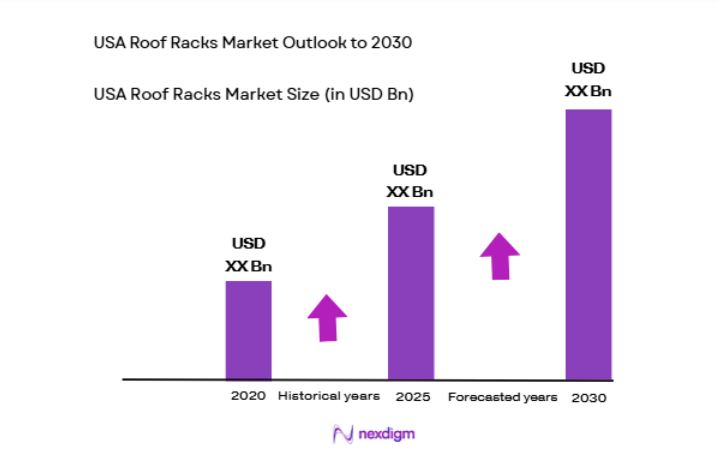
The USA roof racks market is valued at approximately USD ~ billion based on a recent historical assessment derived from U.S. light truck and SUV production statistics and automotive accessory aftermarket sales data, reflecting combined OEM-installed and aftermarket roof cargo carrying system demand. Market expansion is driven by strong SUV and pickup ownership exceeding 140 million units and rising participation in outdoor recreation activities that require vehicle-mounted cargo transport solutions, sustaining consistent installation and replacement demand across passenger and utility vehicle segments nationwide.
Key automotive and outdoor recreation markets including California, Texas, Colorado, Washington, and Utah dominate the USA roof racks market due to high SUV and pickup ownership, active outdoor tourism economies, and strong aftermarket accessory retail networks. These regions benefit from proximity to national parks, camping and cycling infrastructure, and off-road vehicle culture that encourages cargo carrier adoption. Concentration of automotive accessory distributors and logistics hubs further supports regional dominance in both consumption and distribution of roof rack systems.
Market Segmentation
By Product Type
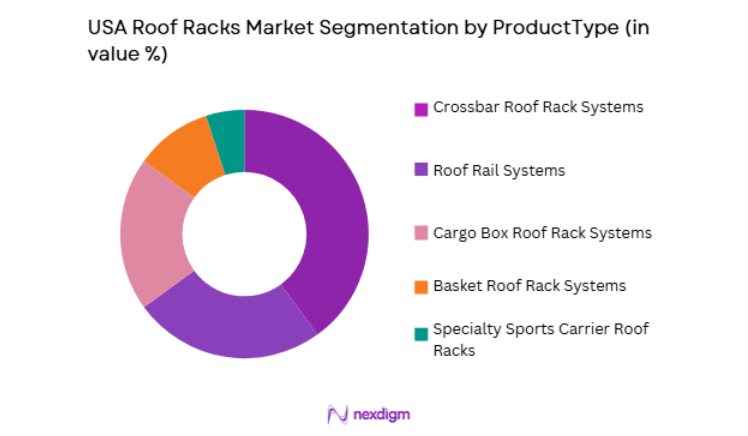
USA Roof Racks market is segmented by product type into roof rail systems, crossbar roof rack systems, basket roof rack systems, cargo box roof rack systems, and specialty sports carrier roof racks. Recently, crossbar roof rack systems has a dominant market share due to factors such as universal compatibility, modular accessory attachment capability, and widespread OEM integration across SUVs and crossovers. Crossbars serve as the foundational mounting structure for multiple carrier accessories including cargo boxes, bike mounts, and kayak holders, making them essential components for both factory-installed and aftermarket configurations. Their adjustable fit across vehicle roof rails and growing standardization by automakers have expanded adoption across diverse vehicle platforms and user applications.
By Vehicle Type
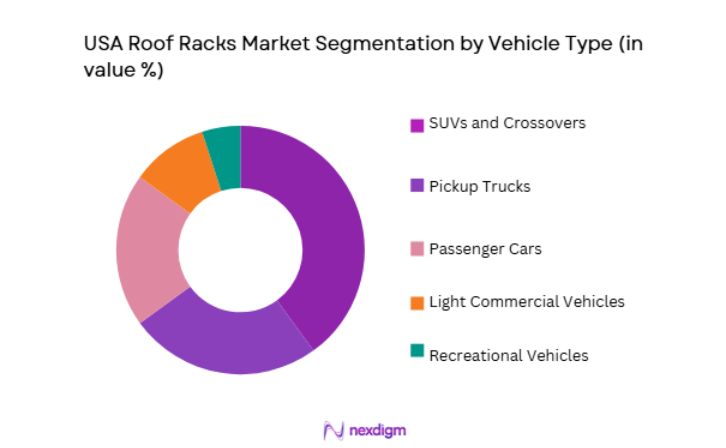
USA Roof Racks market is segmented by vehicle type into SUVs and crossovers, pickup trucks, passenger cars, light commercial vehicles, and recreational vehicles. Recently, SUVs and crossovers has a dominant market share due to factors such as integrated roof rail availability, high ownership penetration, and lifestyle-oriented usage patterns. These vehicles are commonly used for family travel, outdoor recreation, and cargo transport, increasing demand for roof-mounted storage and sports carrier systems. Automakers frequently offer factory roof rails and crossbars as standard or optional equipment on SUVs, simplifying installation and encouraging adoption, while their large roof area supports higher load capacity compared with passenger cars.
Competitive Landscape
The USA roof racks market is moderately consolidated with global outdoor mobility and automotive accessory manufacturers dominating both OEM supply and premium aftermarket segments through strong brand recognition and modular product ecosystems. Leading firms leverage aerodynamic design, lightweight materials, and multi-sport compatibility to differentiate offerings. Established distribution through automotive dealers, specialty outdoor retailers, and e-commerce platforms enables scale advantage, while smaller regional brands compete primarily in value-priced utility racks and niche vehicle applications.
| Company Name | Establishment Year | Headquarters | Technology Focus | Market Reach | Key Products | Revenue | Product Ecosystem |
| Thule Group | 1942 | Sweden | ~ | ~ | ~ | ~ | ~ |
| Yakima Products | 1979 | USA | ~ | ~ | ~ | ~ | ~ |
| Rhino-Rack | 1992 | Australia | ~ | ~ | ~ | ~ | ~ |
| JAC Products | 1993 | USA | ~ | ~ | ~ | ~ | ~ |
| Atera GmbH | 1963 | Germany | ~ | ~ | ~ | ~ | ~ |

USA Roof Racks Market Analysis
Growth Drivers
Expansion of Outdoor Recreation and Adventure Travel Participation
Expansion of outdoor recreation and adventure travel participation is a primary growth driver for the USA roof racks market because roof-mounted cargo systems enable transport of bicycles, kayaks, skis, camping gear, and luggage required for recreational mobility activities. Participation in camping, cycling, skiing, and water sports has increased steadily across the United States, supported by national park visitation exceeding 300 million annual visits and growth in domestic road travel. Consumers increasingly choose vehicle-based travel and outdoor experiences, elevating demand for vehicle cargo expansion solutions. SUVs and crossovers used for family recreation often require additional storage capacity beyond interior space, encouraging installation of roof rack systems. Multi-sport lifestyles drive demand for modular carriers compatible with diverse equipment types. Automotive accessory culture also promotes personalization and adventure-ready vehicle modifications. Outdoor retail channels actively market roof rack products as essential travel gear, reinforcing adoption. As experiential travel and outdoor recreation continue expanding nationwide, cargo-carrying roof systems remain fundamental enabling accessories, sustaining strong demand growth in the USA roof racks market.
Rising SUV and Crossover Vehicle Ownership with Integrated Roof Rail Platforms
Rising SUV and crossover vehicle ownership with integrated roof rail platforms significantly drives the USA roof racks market because these vehicles provide factory mounting points and structural roof load capacity designed specifically for cargo carrier installation. SUVs and crossovers represent the fastest-growing passenger vehicle segment in the United States, exceeding half of new vehicle sales and dominating the national light vehicle fleet. Automakers increasingly include roof rails or crossbars as standard or optional equipment, lowering installation barriers and encouraging consumer adoption. Larger roof surface area and higher permissible load ratings allow transport of bulky recreational equipment and cargo boxes. Lifestyle marketing of SUVs emphasizes adventure and utility, aligning directly with roof rack usage. Fleet vehicles and utility service providers also utilize SUV platforms with roof-mounted equipment carriers. Aftermarket accessory suppliers design vehicle-specific rack kits for major SUV models, expanding compatibility. Continued dominance of SUV platforms therefore structurally increases the addressable market for roof rack systems across both OEM and aftermarket channels.
Market Challenges
Fuel Efficiency Penalty and Aerodynamic Drag from Roof-Mounted Systems
Fuel efficiency penalty and aerodynamic drag from roof-mounted systems represent a key challenge in the USA roof racks market because external cargo carriers increase vehicle air resistance, noise, and energy consumption, particularly at highway speeds. Roof racks and cargo boxes disrupt airflow over the vehicle roofline, reducing fuel economy in combustion vehicles and driving range in electric vehicles. Consumers concerned with operating costs may avoid permanent roof rack installation unless necessary. Automakers also seek to minimize aerodynamic losses to meet efficiency regulations, limiting factory-installed rack adoption in some models. Noise generated by crossbars and carriers at high speed can reduce driving comfort. Aerodynamic penalties are more pronounced in smaller passenger vehicles with lower power reserves. Manufacturers must invest in low-drag designs and wind-tunnel testing to mitigate performance impact. Balancing load capacity with aerodynamic efficiency therefore remains a persistent engineering and market acceptance challenge across the USA roof racks industry.
Vehicle Compatibility Variability and Installation Complexity Across Models
Vehicle compatibility variability and installation complexity across models challenge the USA roof racks market because roof geometry, rail spacing, mounting interfaces, and load ratings differ widely among vehicle manufacturers and model generations. Consumers often face uncertainty selecting correct rack systems for specific vehicles, increasing purchase friction. Aftermarket suppliers must design numerous vehicle-specific mounting kits to ensure safe fitment and regulatory compliance. Installation procedures may require tools, adjustments, or professional fitting, discouraging adoption among casual users. Incorrect installation can cause safety risks, product returns, and liability concerns. Rapid vehicle model turnover further complicates compatibility management and inventory planning for retailers. OEM integration offers better fit but limits aftermarket flexibility. Standardization across vehicle platforms remains limited due to design differences. Ensuring universal compatibility while maintaining structural safety and aesthetics therefore remains a significant market constraint for roof rack manufacturers and distributors.
Opportunities
Growth of Electric Vehicle Compatible Aerodynamic Roof Rack Systems
Growth of electric vehicle compatible aerodynamic roof rack systems presents a major opportunity in the USA roof racks market because electric vehicles prioritize aerodynamic efficiency and energy conservation while still requiring cargo transport capability for travel and recreation. EV owners often seek accessory solutions that minimize range loss, encouraging development of low-profile, lightweight, and streamlined rack designs. Manufacturers can engineer composite materials and optimized cross-section profiles to reduce drag compared with conventional racks. EV-specific mounting interfaces and integrated design aesthetics also create new product categories. Premium EV buyers demonstrate willingness to pay for high-performance accessories aligned with vehicle technology. As electric vehicle adoption accelerates across the United States, compatible cargo systems will experience increasing demand. OEM partnerships for factory-approved EV roof racks can secure long-term supply contracts. Electric mobility growth therefore opens a technologically differentiated expansion pathway for roof rack manufacturers.
Expansion of Modular Multi-Sport and Overlanding Vehicle Accessory Ecosystems
Expansion of modular multi-sport and overlanding vehicle accessory ecosystems offers significant growth potential in the USA roof racks market because consumers increasingly configure vehicles for adventure travel, camping, and off-road exploration requiring integrated cargo platforms. Overlanding culture promotes roof-mounted tents, storage baskets, lighting systems, and equipment carriers mounted on modular rack structures. Manufacturers can develop ecosystem-based product lines enabling interchangeable accessories on standardized crossbar or platform bases. Bundled accessory kits and lifestyle branding strengthen customer engagement and repeat purchases. Pickup trucks and SUVs used for off-road travel provide ideal platforms for modular roof systems. Specialty outdoor retailers and online communities actively promote overlanding vehicle modifications. Premium materials and heavy-duty load ratings command higher margins. As adventure mobility lifestyles expand across North America, modular roof rack ecosystems represent a high-growth opportunity within the USA roof racks market.
Future Outlook
The USA roof racks market is expected to grow steadily over the next five years driven by continued SUV dominance, expansion of outdoor recreation travel, and increasing adoption of modular cargo carrier systems. Electric vehicle integration will accelerate aerodynamic rack innovation. Premium lightweight materials and quick-mount designs will enhance consumer adoption. Regulatory emphasis on cargo safety and vehicle efficiency will guide product evolution. Strong aftermarket accessory culture is anticipated to sustain long-term demand.
Major Players
- Thule Group
- Yakima Products
- Rhino-Rack
- Atera GmbH
- JAC Products
- Mont Blanc Group
- Cruzber
- Perrycraft
- Vantech
- Kuat Innovations
- SportRack
- INNO Racks
- Malone Auto Racks
- Front Runner Vehicle Outfitters
- Magna International
Key Target Audience
- Automotive OEM manufacturers
- Automotive accessory distributors
- Outdoor equipment retailers
- Fleet operators
- Recreational vehicle manufacturers
- Off-road vehicle modifiers
- Investments and venture capitalist firms
- Government and regulatory bodies
Research Methodology
Step 1: Identification of Key Variables
Key variables including SUV ownership, outdoor recreation participation, vehicle roof load standards, aftermarket accessory sales, and OEM installation rates were identified to define structural demand drivers and segmentation parameters in the USA roof racks market.
Step 2: Market Analysis and Construction
Market sizing integrated automotive production statistics, vehicle parc data, and accessory adoption ratios across SUV, pickup, and passenger vehicle segments to estimate total roof rack system demand across OEM and aftermarket channels.
Step 3: Hypothesis Validation and Expert Consultation
Interviews with automotive accessory manufacturers, outdoor equipment retailers, and vehicle modification specialists validated adoption trends, pricing structures, compatibility constraints, and consumer usage patterns influencing roof rack demand.
Step 4: Research Synthesis and Final Output
Quantitative modeling and qualitative insights were synthesized into a comprehensive framework covering segmentation, competitive landscape, technological evolution, and growth outlook across the USA roof racks market.

- Executive Summary
- Research Methodology (Definitions, Scope, Industry Assumptions, Market Sizing Approach, Primary & Secondary Research Framework, Data Collection & Verification Protocol, Analytic Models & Forecast Methodology, Limitations & Research Validity Checks)

- Market Definition and Scope
- Value Chain & Stakeholder Ecosystem
- Regulatory / Certification Landscape
- Sector Dynamics Affecting Demand
- Strategic Initiatives & Infrastructure Growth

- Growth Drivers
Rising outdoor recreation and adventure travel participation
Increasing SUV and crossover vehicle ownership
Expansion of automotive accessory aftermarket culture - Market Challenges
Vehicle fuel efficiency impact from roof-mounted loads
Price sensitivity in aftermarket accessory segment
Compatibility variations across vehicle models - Market Opportunities
Growth in electric vehicle compatible aerodynamic roof racks
Expansion of modular multi-sport carrier systems
Integration of lightweight composite rack materials - Trends
Shift toward aerodynamic low-noise crossbar designs
Adoption of quick-mount and tool-free rack systems
Increasing demand for premium branded cargo carriers - Government regulations
- SWOT analysis
- Porters 5 forces

- By Market Value, 2019-2025
- By Installed Units, 2019-2025
- By Average System Price, 2019-2025
- By System Complexity Tier, 2019-2025

- By System Type (In Value%)
Roof Rail Systems
Crossbar Roof Rack Systems
Basket Roof Rack Systems
Cargo Box Roof Rack Systems
Specialty Sports Carrier Roof Racks - By Platform Type (In Value%)
Passenger Cars
SUVs and Crossovers
Light Commercial Vehicles
Pickup Trucks
Recreational Vehicles - By Fitment Type (In Value%)
OEM Integrated Roof Racks
Aftermarket Clamp-On Roof Racks
Factory Rail Compatible Roof Racks
Permanent Mounted Roof Racks
Modular Adjustable Roof Racks - By EndUser Segment (In Value%)
Individual Vehicle Owners
Outdoor Recreation Enthusiasts
Commercial Fleet Operators
Logistics and Utility Service Providers
Automotive OEM Manufacturers - By Procurement Channel (In Value%)
Automotive OEM Supply Contracts
Automotive Accessory Retailers
Online Automotive Accessory Platforms

- Market Share Analysis
- Cross Comparison Parameters (Load Capacity, Mounting Compatibility, Material Type, Aerodynamic Design, Price Tier ,Installation Method, Vehicle Fit Range, Accessory Modularity, Noise Reduction Design, Corrosion Resistance, Locking Mechanism, Weight Efficiency)
- SWOT Analysis of Key Competitors
- Pricing & Procurement Analysis
- Key Players
Thule Group
Yakima Products
Rhino-Rack
Atera GmbH
Mont Blanc Group
Magna International
JAC Products
Cruzber
Perrycraft
Vantech
Kuat Innovations
SportRack
INNO Racks
Malone Auto Racks
Front Runner Vehicle Outfitters

- Outdoor enthusiasts drive demand for multi-sport carriers
- SUV owners prefer integrated aesthetic roof rack systems
- Commercial fleets require durable cargo transport racks
- OEMs adopt factory-installed roof rail platforms

- Forecast Market Value, 2026-2030
- Forecast Installed Units, 2026-2030
- Price Forecast by System Tier, 2026-2030
- Future Demand by Platform, 2026-2030


 Request a Sample
 Ask for Customization
 Get a Quote
 Enquire Now