
 Download PDF
Market Overview
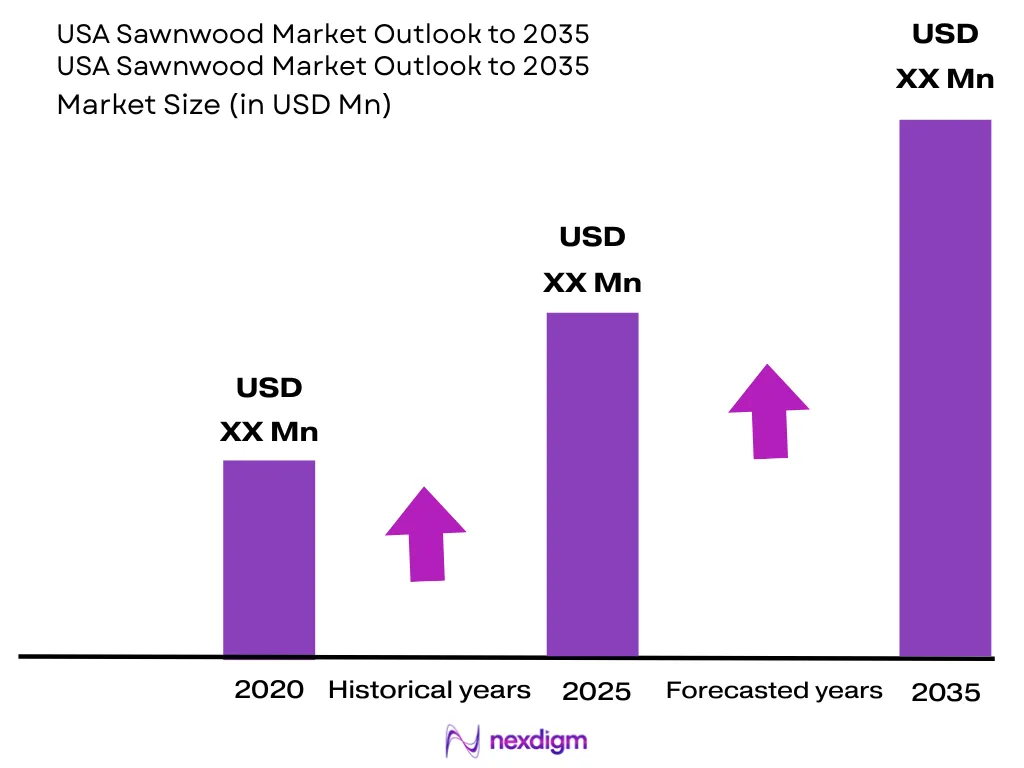
The USA Sawnwood Market was valued at approximately USD ~ Million in 2024, underpinned by the country’s position as the world’s largest single-nation softwood lumber producer and consumer. According to data published by the Food and Agriculture Organization and the American Forest & Paper Association (AF&PA), the United States possesses more than 750 million acres of forested land, of which approximately 500 million acres constitute commercial timberland. The market is primarily driven by robust residential construction activity, rising furniture manufacturing output, strong demand for pallets and packaging materials, industrial applications, and ongoing infrastructure investment programs across federal and state levels.
Market Segmentation
By Wood Species Type
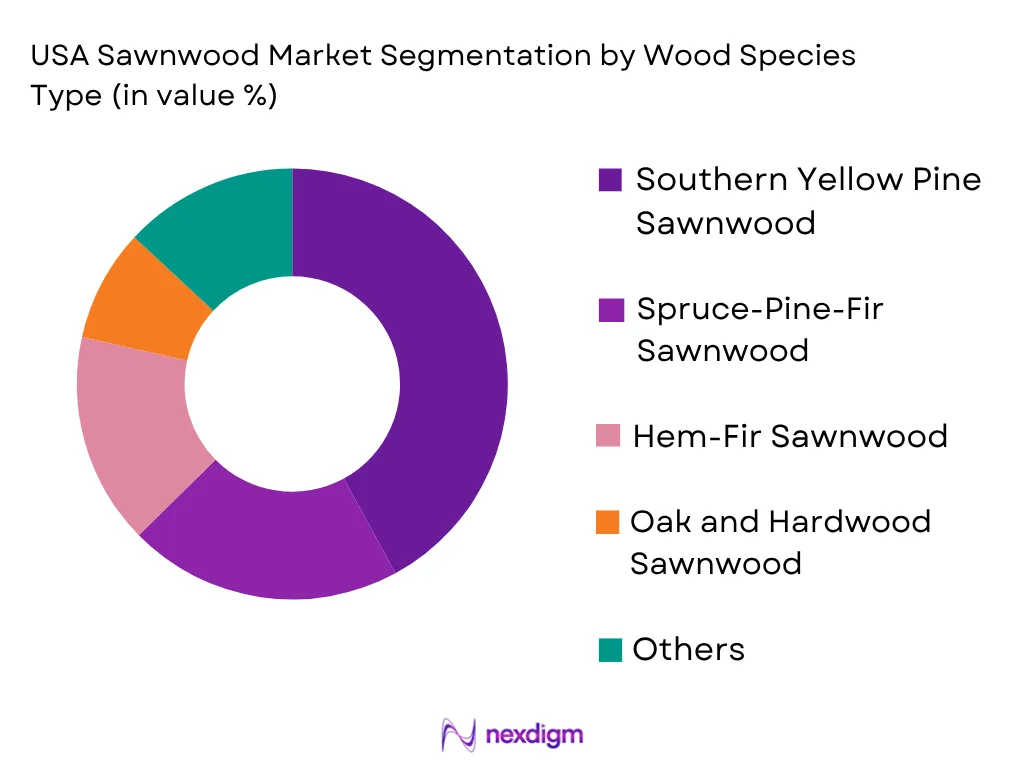
USA Sawnwood Market is segmented by wood species type into Southern Yellow Pine Sawnwood, Douglas Fir Sawnwood, Spruce-Pine-Fir Sawnwood, Hem-Fir Sawnwood, Oak and Hardwood Sawnwood, and Other Commercial Species. Southern Yellow Pine Sawnwood holds the dominant market share owing to its extensive natural and plantation-grown timber base across the southeastern United States, consistent structural properties, high sawmill processing efficiency, and broad applicability for framing, decking, industrial flooring, and export markets. The species benefits from year-round harvesting capability and favorable growth rates in the region. Large-scale private timberland ownership in states including Georgia, Alabama, Mississippi, Arkansas, and North Carolina has strengthened raw material availability, while modern continuous kiln operations have improved production economics. Furthermore, Southern Yellow Pine lumber is widely accepted by building codes and is preferred by residential construction companies, framing contractors, and industrial users seeking cost-effective, dimensionally stable, and pressure-treatment-compatible timber solutions.
By End-Use Industry
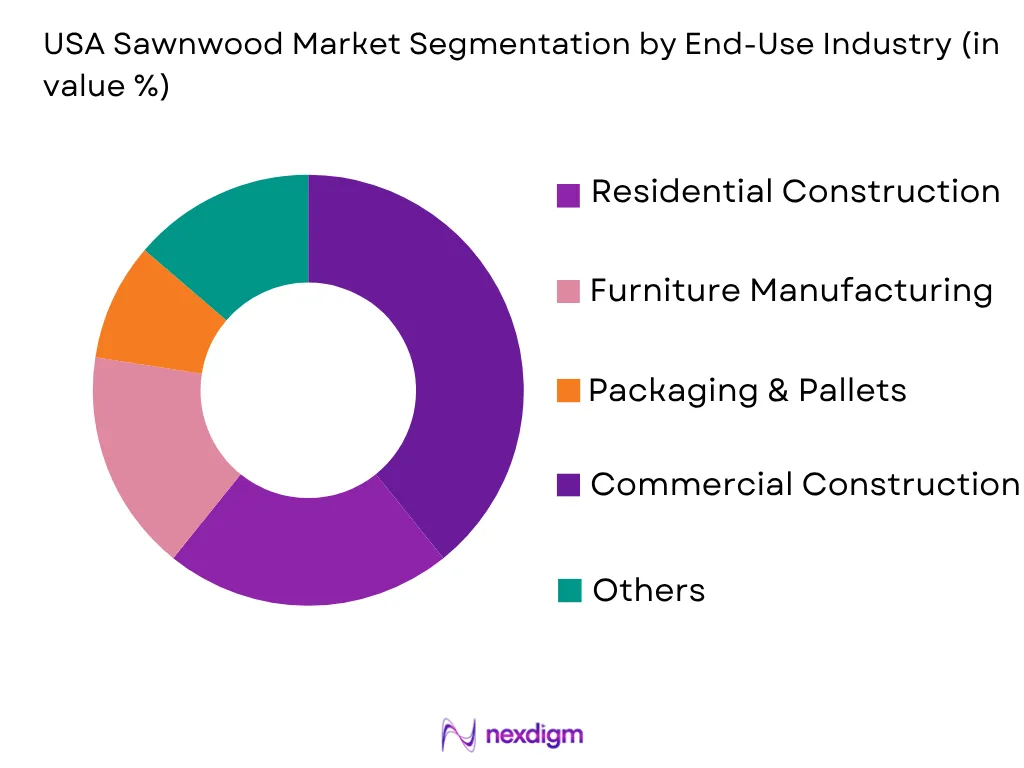
USA Sawnwood Market is segmented by end-use industry into Residential Construction, Commercial Construction, Furniture Manufacturing, Packaging & Pallets, Infrastructure Projects, and Joinery & Interior Applications. Residential Construction represents the largest market segment due to continuous demand for timber framing, roof truss systems, subfloor structures, exterior wall sheathing, doors, windows, and interior finish materials. Housing starts, repair and remodeling activity, and adoption of wood-frame construction methods have consistently supported sawnwood consumption within the residential sector. Timber offers favorable structural performance, energy efficiency credentials, and design flexibility compared to alternative construction materials. Growth in prefabricated housing, panelized construction systems, and mass timber applications has further broadened demand for processed sawnwood. The segment benefits from a well-established distribution network involving building material wholesalers, two-step distributors, pro dealers, home improvement retailers, and direct sales channels serving residential developers and contractors across all major U.S. regions.
Competitive Landscape
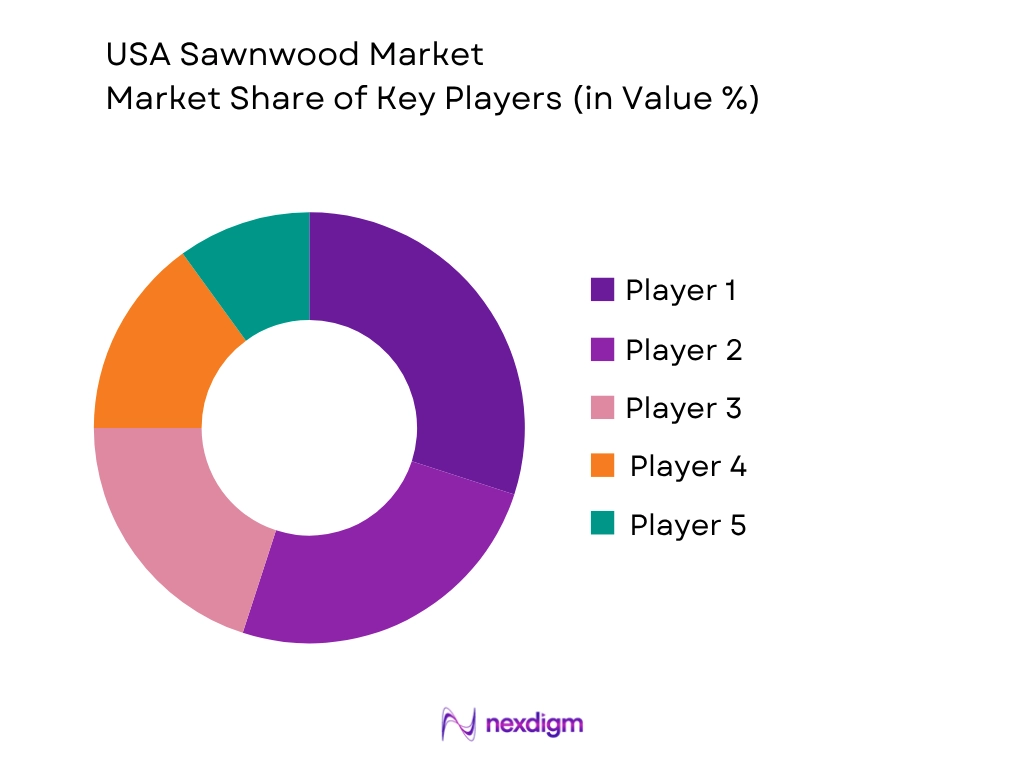
The USA Sawnwood Market is moderately consolidated, with a mix of large integrated timber REITs, private timberland owners, independent sawmill operators, and vertically integrated wood products manufacturers. Major participants leverage extensive timberland assets, vertically integrated operations, advanced kiln-drying facilities, and well-developed domestic and export distribution networks to maintain competitive advantages. Companies with strong certification credentials under the Sustainable Forestry Initiative (SFI) and Forest Stewardship Council (FSC) programs are particularly well-positioned to serve increasing demand for responsibly sourced timber across residential construction, retail channels, and international export markets.
| Company | Establishment Year | Headquarters | Plantation Assets | Sawmill Capacity | FSC/PEFC Certification | Export Presence | Product Portfolio | End-Use Focus |
| Weyerhaeuser Company | 1900 | ~ | ~ | ~ | ~ | ~ | ~ | ~ |
| West Fraser Timber | 1955 | ~ | ~ | ~ | ~ | ~ | ~ | ~ |
| Potlatch Deltic Corporation | 1903 | ~ | ~ | ~ | ~ | ~ | ~ | ~ |
| Sierra Pacific Industries | 1949 | ~ | ~ | ~ | ~ | ~ | ~ | ~ |
| Interfor Corporation | 1963 | ~ | ~ | ~ | ~ | ~ | ~ | ~ |
USA Sawnwood Market Analysis
Growth Drivers
Timberland Ownership Strength and Log Supply Availability
The USA sawnwood industry benefits from one of the world’s most extensive privately managed timberland bases, which provides long-term log availability for sawmill operations across key producing regions. The United States possesses approximately 750 million acres of forested land, with around 500 million acres designated as commercial timberland suitable for periodic timber harvesting. Private timberlands account for the majority of industrial wood supply, managed by timber REITs, institutional investors, integrated forest products companies, and family forest owners. According to the U.S. Forest Service, the country’s forests contain substantial standing timber volumes supporting long-term sustainable harvest programs. The southeastern United States alone accounts for a disproportionate share of softwood lumber production, with Southern Yellow Pine plantations delivering consistent log flows to regional sawmills. In the Pacific Northwest and Inland West, Douglas Fir, Hem-Fir, and Spruce-Pine-Fir species support a well-established lumber manufacturing base. The availability of large-scale privately owned timberland reduces reliance on federal forest management decisions and supports more stable production planning for industrial sawmill operators. These factors collectively underpin the competitiveness of the U.S. sawnwood sector and support high utilization of sawmill capacity across major producing states including Georgia, Alabama, Oregon, Washington, Idaho, and Montana.
Growth in Residential Construction and Wood Processing Industries
The expansion of U.S. residential construction, renovation activity, and downstream wood processing industries continues to be the primary demand driver for sawnwood products. According to the U.S. Census Bureau and National Association of Home Builders (NAHB), single-family and multifamily housing starts generate substantial and recurring demand for framing lumber, structural panels, and appearance-grade wood products. Repair and remodeling expenditures, which consistently represent a large portion of total construction spending, contribute additional year-round demand for dimensional lumber and specialty wood products. The forestry and wood products value chain has become increasingly integrated with furniture manufacturing, industrial flooring, packaging, and prefabricated construction. Domestic consumption of structural lumber remains among the highest globally on a per-capita basis, supported by wood-frame construction methods that account for the vast majority of new residential builds in the United States. The sector’s forestry export activities also contribute to overall market revenue, with U.S. softwood lumber products reaching key markets in Asia, the United Kingdom, and the Middle East. Broader economic growth, infrastructure investment, and continued urbanization in high-growth Sun Belt states are expected to sustain strong underlying demand for sawnwood through the forecast period.
Market Challenges
Log Supply Constraints and Timber Availability Pressures
Despite extensive timberland resources, the USA sawnwood market faces ongoing challenges related to log supply stability, public land management restrictions, and sustainable harvesting constraints. Federal forest lands managed by the U.S. Forest Service and Bureau of Land Management have experienced significant reductions in permitted timber harvest volumes over several decades due to environmental litigation, regulatory requirements under the National Environmental Policy Act (NEPA), and wildlife habitat protections. This has effectively transferred the majority of U.S. log supply dependency to private timberlands, creating concentration risks in certain regional supply chains. Additionally, rising competition for fiber resources from pulp, bioenergy, oriented strand board, and engineered wood product industries intensifies pressure on softwood and hardwood log supply. Regional wildfire activity in western states has disrupted timber availability and necessitated salvage harvest operations, while insect infestations such as the southern pine beetle periodically affect timber quality in southeastern producing regions. Sawmill operators must navigate these supply dynamics while maintaining stable access to certified, traceable, and competitively priced logs. These factors increase operational complexity, procurement planning challenges, and raw material cost volatility throughout the sawnwood value chain.
Transportation and Logistics Infrastructure Constraints
Transportation and logistics constraints represent a persistent operational challenge for the U.S. sawnwood industry due to the geographic distances between producing regions, processing facilities, and major consumption centers. Producing regions in the Pacific Northwest, Inland West, and Southeast are often located hundreds to thousands of miles from key housing construction markets in the Midwest, Northeast, and Sunbelt metropolitan areas. Sawnwood is a bulky, weight-intensive commodity with high transportation cost sensitivity, making freight network efficiency critical to product competitiveness and margin management. Rail dependency in western lumber-producing states exposes producers to Class I railroad service reliability, capacity constraints, and fuel surcharge volatility. Port bottlenecks at West Coast export terminals have periodically constrained access to Asian markets for Pacific Northwest and Inland West producers. Import competition from Canadian lumber producers, particularly from British Columbia and Alberta under the softwood lumber trade dispute framework, also creates pricing dynamics that affect market conditions across U.S. regional markets. As construction demand continues to grow in high-population states with limited proximate timber supply, efficient logistics management remains essential for ensuring competitiveness and sustaining timely product delivery to downstream customers.
Market Opportunities
Rising Demand for Certified and Sustainable Timber Products
Growing domestic and international demand for certified, sustainably sourced wood products presents a significant opportunity for U.S. sawnwood producers. Residential construction companies, commercial developers, retail home improvement chains, furniture manufacturers, and institutional buyers increasingly require timber products that meet recognized sustainability standards. The United States has one of the most extensive certified forest areas globally, with forests certified under the Sustainable Forestry Initiative (SFI), Forest Stewardship Council (FSC), and American Tree Farm System (ATFS) programs. SFI alone covers more than 300 million acres of certified forestland in the United States and Canada, providing a strong credentialing base for U.S. producers accessing premium domestic and export markets. Green building programs including LEED, BREEAM, and the National Green Building Standard specifically favor certified wood products, creating measurable demand premiums for producers with verified chain-of-custody documentation. Export markets in Japan, the United Kingdom, Australia, and Northern Europe have tightened procurement standards for sustainably sourced timber, creating additional opportunities for certified U.S. producers. As environmental and governance requirements intensify across supply chains, certified SFI and FSC sawnwood from U.S. producers is expected to benefit from enhanced market access, stronger customer relationships, and preferential positioning in value-added construction applications.
Expansion of Value-Added Wood Processing and Mass Timber Applications
The United States possesses substantial opportunities to expand value-added processing capabilities and capitalize on growing demand for mass timber and engineered wood products. The domestic construction sector has experienced significant growth in mass timber applications including cross-laminated timber (CLT), glulam beams, laminated veneer lumber (LVL), and nail-laminated timber (NLT), all of which rely on high-quality sawn lumber inputs. Commercial and institutional construction projects utilizing mass timber structural systems have increased substantially across major metropolitan markets, with projects approved under updated International Building Code provisions allowing mass timber structures up to 18 stories. The U.S. Forest Service’s Wood Innovation Grant Program and other federal initiatives have provided capital support for value-added wood product investments at regional sawmill facilities. Domestic wood panel production, industrial flooring, and appearance lumber manufacturing provide additional demand vectors for processed sawnwood inputs. By investing in precision sawing, grading automation, kiln-drying optimization, and CLT lamstock production, sawmills can significantly improve raw material recovery, product quality, and revenue per log. As global demand for sustainable, low-carbon construction materials continues to grow, U.S. producers are well-positioned to supply higher-value sawnwood and engineered wood products to both domestic and international markets.
Future Outlook
The USA Sawnwood Market is expected to witness sustained growth over the forecast period, supported by robust housing construction demand, growing investments in private timberland management, and rising global interest in sustainable timber products. Expansion of certified forest programs, technological modernization of sawmill operations, and increasing utilization of kiln-dried and precision-cut lumber products are expected to improve productivity and product quality across the industry. Growing adoption of mass timber and wood-frame construction in commercial and multifamily applications, combined with continued development of export markets in Asia and Europe, will further strengthen long-term market prospects. Value-added processing expansion, downstream integration with furniture manufacturing, and the scaling of mass timber production are anticipated to create new growth opportunities for market participants through 2035.
Major Players
- Weyerhaeuser Company
- West Fraser Timber Co. Ltd.
- Potlatch Deltic Corporation
- Sierra Pacific Industries
- Interfor Corporation
- Canfor Corporation (US Operations)
- Rayonier Advanced Materials
- Idaho Forest Group
- Hampton Affiliates
- Stimson Lumber Company
- Merrill & Ring
- Collins Companies
- Boise Cascade Company
- UFP Technologies
- Resolute Forest Products (US Operations)
Key Target Audience
- Forestry and Timber Production Companies
- Sawmill Operators and Wood Processing Enterprises
- Furniture Manufacturing Companies
- Residential and Commercial Construction Companies
- Building Material Distributors and Timber Traders
- Investments and Venture Capitalist Firms
- Government and Regulatory Bodies (U.S. Forest Service, Bureau of Land Management, U.S. Department of Agriculture, Environmental Protection Agency)
- Exporters, Importers and International Timber Trading Organizations
Research Methodology
Step 1: Identification of Key Variables
The initial phase involves constructing an ecosystem map covering forestry companies, timberland owners, sawmills, timber traders, exporters, construction companies, and furniture manufacturers operating within the USA Sawnwood Market. Extensive secondary research is conducted using industry associations, trade databases, forestry reports, and government publications including data from the U.S. Forest Service, American Forest & Paper Association, and Random Lengths Publications to identify the variables influencing market demand and supply.
Step 2: Market Analysis and Construction
This phase focuses on gathering historical information relating to timber harvesting volumes, sawnwood production, domestic consumption, export and import performance, pricing trends, and end-use demand. Market revenues are estimated using a combination of production volumes, average selling prices, and trade flow assessments while validating relationships between supply-side and demand-side indicators.
Step 3: Hypothesis Validation and Expert Consultation
Market assumptions are validated through structured interviews with forestry executives, sawmill operators, timber exporters, distributors, and industry specialists. These consultations provide operational insights regarding production capacity utilization, procurement trends, export demand, pricing dynamics, and technological developments, ensuring greater accuracy of market estimates.
Step 4: Research Synthesis and Final Output
The final stage integrates findings from primary and secondary research to develop market forecasts, segmentation analysis, competitive benchmarking, and strategic recommendations. Data triangulation techniques are applied to validate market estimates and generate a comprehensive assessment of the USA Sawnwood Market while ensuring consistency across all segments and stakeholder perspectives.

- Executive Summary
- Research Methodology (Market Definitions and Assumptions, Abbreviations, Market Sizing Approach, Top-Down Analysis, Bottom-Up Analysis, Demand-Side Assessment, Supply-Side Assessment, Primary Industry Interviews, Forestry Sector Validation Framework, Trade Flow Assessment, Data Triangulation, Forecasting Framework, Limitations and Future Conclusions)

- Definition and Scope
- Market Evolution and Industry Genesis
- Timeline of Major Industry Developments
- Forestry and Wood Processing Industry Ecosystem
- Sawnwood Value Chain Analysis

- Growth Drivers (Timberland Ownership Expansion, Construction Activity Growth, Furniture Manufacturing Demand, Sustainable Building Material Adoption, Export Market Expansion)
- Market Challenges (Log Supply Volatility, Transportation Bottlenecks, Environmental Compliance Costs, Sawmill Productivity Constraints, Competition from Engineered Wood Products)
- Market Opportunities (Value-Added Lumber Products, Certified Timber Demand, Export Diversification, Digital Timber Trading Platforms, Sawmill Modernization Investments)
- Market Trends (SFI/FSC Certification Adoption, Kiln-Dried Lumber Penetration, Sawmill Automation, Softwood Timber Utilization Growth, Sustainable Construction Practices)
- Government Regulations (National Forest Management Act, Timber Traceability Requirements, Environmental Compliance Standards, Export Certification Requirements, Sustainable Forest Management Guidelines)
- SWOT Analysis
- Porter’s Five Forces Analysis
- PESTLE Analysis
- Stakeholder Ecosystem
- Competition Ecosystem

- By Market Value (2020-2025)
- By Volume (2020-2025)
- By Average Realized Price (2020-2025)

- By Wood Species Type (In Value %)
Southern Yellow Pine Sawnwood
Douglas Fir Sawnwood
Spruce-Pine-Fir Sawnwood
Hem-Fir Sawnwood
Oak and Hardwood Sawnwood
Other Commercial Wood Species - By Product Form (In Value %)
Rough Sawn Lumber
Planed Sawnwood
Kiln-Dried Sawnwood
Treated Sawnwood
Structural Sawn Timber
Appearance Grade Lumber - By End-Use Industry (In Value %)
Residential Construction
Commercial Construction
Industrial Construction
Furniture Manufacturing
Packaging and Pallets
Joinery and Interior Applications
Infrastructure and Utility Projects - By Distribution Channel (In Value %)
Direct Sales to Industrial Buyers
Timber Traders and Wholesalers
Building Material Distributors
Retail Lumber Yards
Export Trading Companies - By Region (In Value %)
South
West
Northeast
Midwest
Pacific Northwest

- Market Share of Major Players (By Value, Production Volume, Export Volume, Sawmill Capacity)
- Cross Comparison Parameters (Annual Sawnwood Production Capacity, Timberland Area, Sawmill Recovery Rate, Kiln Drying Capacity, SFI/FSC Certified Timber Share, Export Revenue Share, Number of Sawmill Facilities, Product Grade Portfolio)
- SWOT Analysis of Major Players
- Benchmarking Analysis of Major Players
- Pricing Analysis (By Species, Grade, Moisture Content, Thickness, Export vs Domestic Sales)
- Detailed Profiles of Major Companies
Weyerhaeuser Company
West Fraser Timber Co. Ltd.
Potlatch Deltic Corporation
Sierra Pacific Industries
Interfor Corporation
Canfor Corporation (US Operations)
PotlatchDeltic Corporation
Rayonier Advanced Materials
Idaho Forest Group
Hampton Affiliates
Stimson Lumber Company
Merrill & Ring
Collins Companies
Boise Cascade Company
UFP Technologies

- Consumption Pattern Assessment (Consumption Frequency, Product Mix, Industry Demand Share, Volume Utilization, Seasonal Demand)
- Sawnwood Utilization by Industry (Construction Usage, Furniture Manufacturing Share, Packaging Consumption, Infrastructure Demand, Industrial Applications)
- Procurement and Sourcing Analysis (Contract Duration, Supplier Preference, Import Dependence, Procurement Volume, Lead Time Requirements)
- Buyer Preference Analysis (Species Preference, Grade Preference, Moisture Requirements, Certification Requirements, Delivery Expectations)
- Price Sensitivity Analysis (Price Elasticity, Grade-Based Pricing, Regional Price Variations, Volume Discounts, Contract Pricing Trends)

- By Market Value (2026-2035)
- By Volume (2026-2035)
- By Average Selling Price (2026-2035)


 Request a Sample
 Ask for Customization
 Get a Quote
 Enquire Now