

 Download PDF
Market Overview
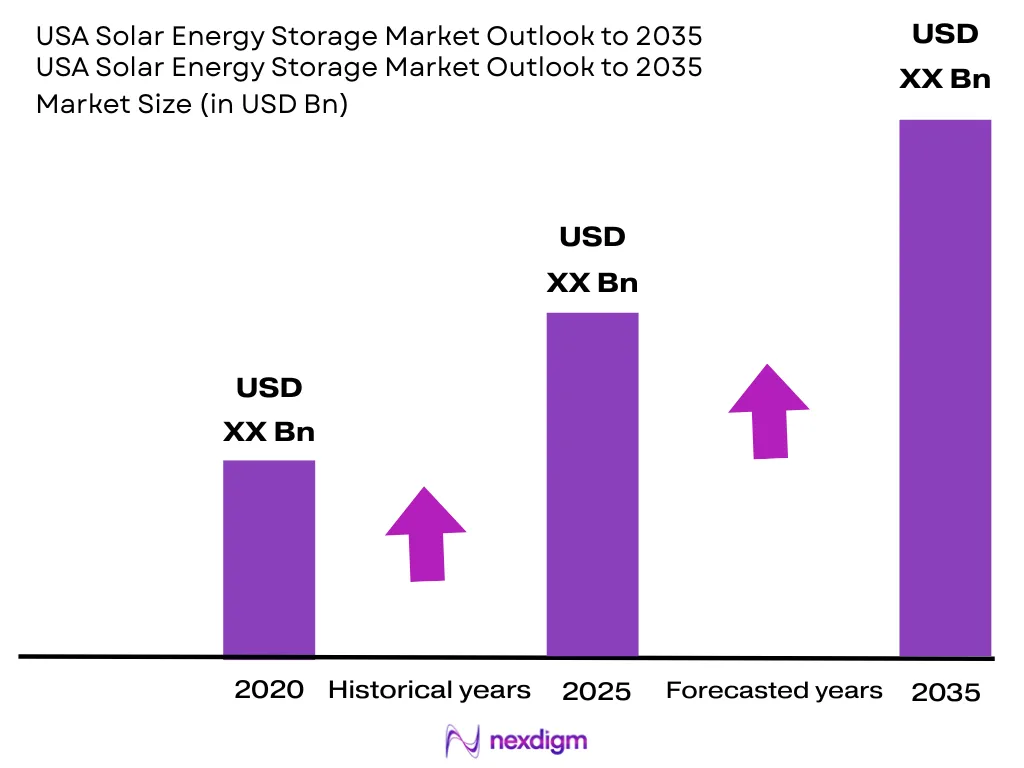
The USA Solar Energy Storage Market was valued at USD ~ Billion in 2024 and is anticipated to expand at a CAGR of ~% during 2026-2035. The market is primarily driven by the 30% standalone storage Investment Tax Credit available under the Inflation Reduction Act through 2032, surging electricity demand from data centers and AI infrastructure, and continued declines in battery and solar system costs. According to industry estimates, the U.S. battery energy storage system market was valued at approximately USD 2.85 billion in 2025 and is projected to reach approximately USD 36.47 billion by 2035, growing at a CAGR of approximately 25.99%, while the broader U.S. solar energy and battery storage market is projected to reach approximately USD 80.0 billion by 2034. Residential installations rose approximately 42% year-over-year in 2025, with California, Texas, and Arizona accounting for approximately 68% of those additions, while Tesla’s Powerwall 3 captured roughly 35% of the residential segment by mid-2025, reflecting the market’s rapid maturation across both residential and utility-scale segments.
Market Segmentation
By Technology
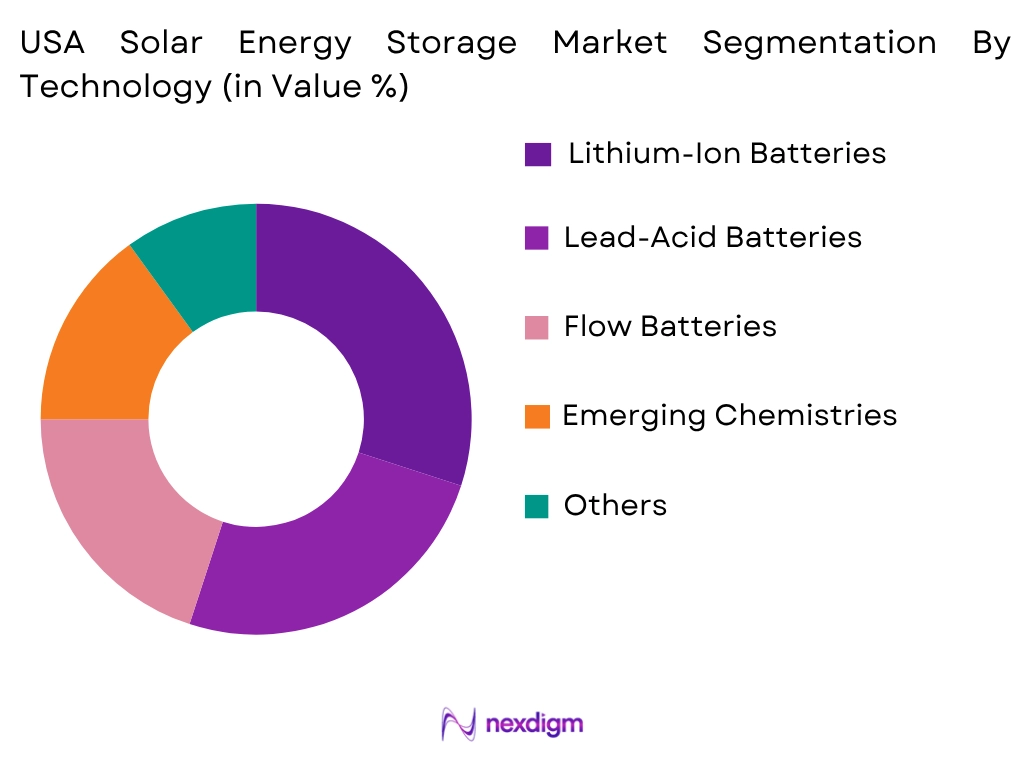
Among these, Lithium-Ion Batteries continue to dominate the USA Solar Energy Storage Market, with Tesla’s vertically integrated supply chain driving turnkey prices under USD 250 per kWh while sustaining 15-18% gross margins. LG’s Arizona gigafactory continues to guarantee domestic content for Powin and other integrators, while Chinese producers CATL, BYD, and Sungrow underbid U.S. rivals by up to 15% due to lower cell costs, though tariff risk and domestic-content rules continue to temper their growth within the U.S. market. Emerging chemistries are gaining increasing attention as an alternative to conventional lithium-ion technology, with Form Energy and Eos Energy disrupting incumbents through iron-air and zinc chemistries that promise 100-hour or fire-safe performance at competitive costs, particularly suited for long-duration grid applications. Flow batteries are also emerging as a fast-growing technology segment, offering extended cycle life and enhanced safety characteristics that are increasingly attractive for utility-scale and long-duration storage applications across the country’s rapidly expanding grid infrastructure.
By Application
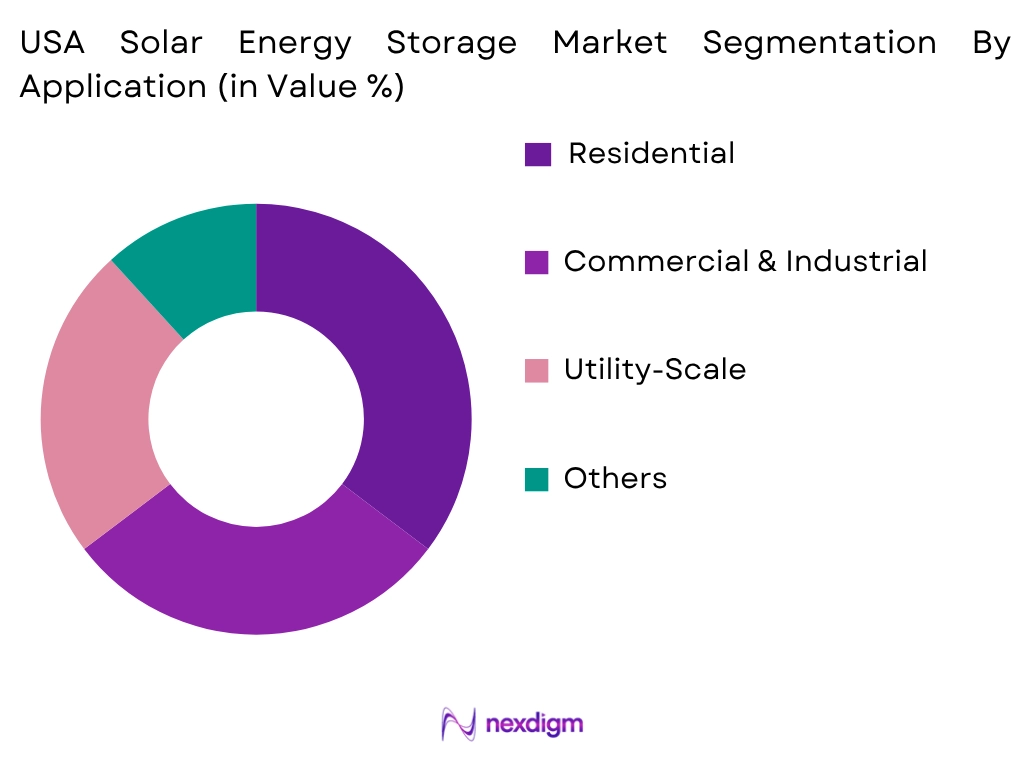
The Residential segment remains the largest application category within the USA Solar Energy Storage Market, with Enphase, Tesla, and LG dominating residential offers in the 10-15 kWh range as the 30% standalone storage credit, now available until 2032, unlocked a surge of retrofit sales as households add batteries to existing rooftop solar arrays. Enphase Energy shipped 29% more IQ Battery units during the first quarter of 2025 as installers increasingly bundled storage with new solar projects to maximize customer tax savings. The Commercial & Industrial segment continues to expand as businesses deploy 1-5 MW systems to shave peak demand charges and secure backup power, with Walmart pledging in 2025 to roll out batteries at 500 stores. The Utility-Scale segment remains the largest by installed capacity, with Fluence’s software-centric Gridstack platform securing 4.2 GW of orders during 2024-2025, including a 700 MW contract with Southern California Edison, and commissioning a 250 MW/1,000 MWh standalone system in Texas in late 2024, one of the largest such projects in the United States.
Competitive Landscape
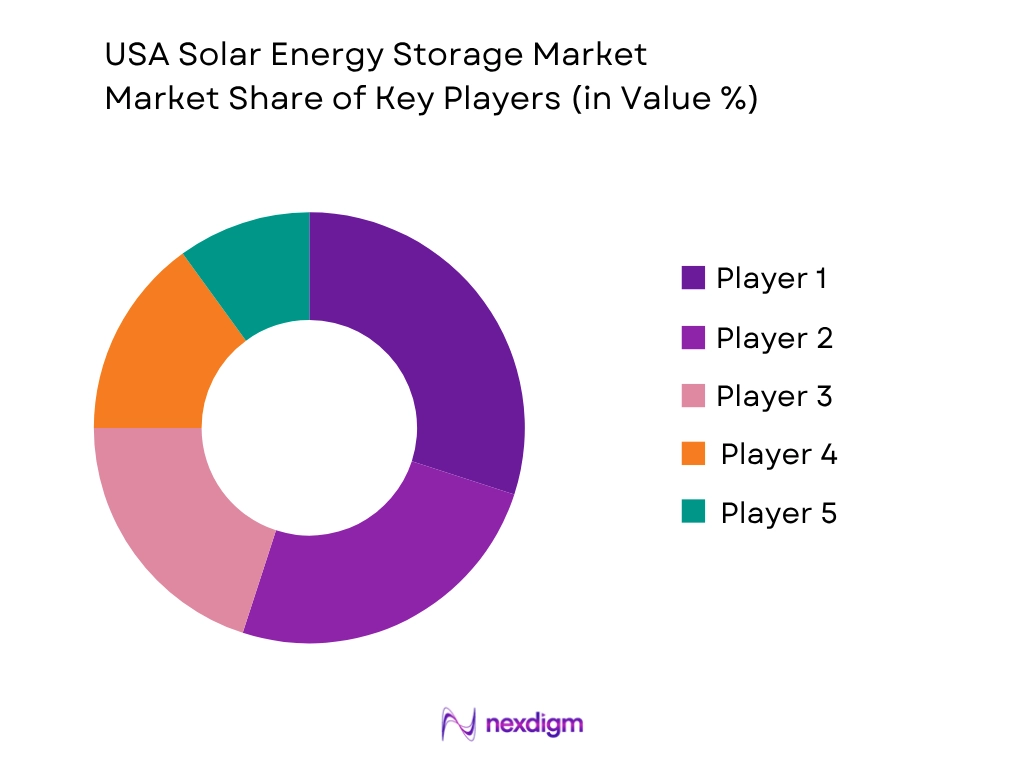
The USA Solar Energy Storage Market is moderately concentrated, with Fluence Energy, Tesla, NextEra Energy Resources, AES Corporation, and Powin controlling roughly 60% of commissioned capacity in 2025. Competition is primarily based on domestic content eligibility, technology reliability, software optimization capability, manufacturing scale, and long-term utility offtake relationships. Tesla maintains dominant residential market share through its vertically integrated supply chain and Powerwall 3 platform, while Fluence continues to expand its utility-scale footprint through its Gridstack and Smartstack platforms and strategic alliances such as its partnership with TransAlta in Alberta. Asian cell manufacturers including CATL, LG Energy Solution, and BYD continue building U.S. gigafactories to earn the 10-percentage-point Domestic Content Adder, a strategic shift that increasingly forces system integrators to compete on software capability rather than hardware alone. Fluence’s Mosaic and Tesla’s Autobidder optimization platforms already command USD 3-5 per kW-year for services, creating stickier, longer-duration customer relationships than traditional one-time turnkey EPC contracts, while emerging players such as Form Energy, Eos Energy, and GridStor continue to secure project financing and expand capacity to capture growing long-duration and utility-scale demand.
| Company | Establishment Year | Headquarters | Primary Program Portfolio | Executive Education Portfolio
|
Delivery Presence | Major End-Use Industries | Key Strategic Focus | Certifications & Compliance |
| Tesla, Inc. | 2003 | ~ | ~ | ~ | ~ | ~ | ~ | ~ |
| Fluence Energy, Inc. | 2018 | ~ | ~ | ~ | ~ | ~ | ~ | ~ |
| Enphase Energy, Inc. | 2006 | ~ | ~ | ~ | ~ | ~ | ~ | ~ |
| LG Energy Solution Ltd. | 2020 | ~ | ~ | ~ | ~ | ~ | ~ | ~ |
| NextEra Energy Resources, LLC | 1998 | ~ | ~ | ~ | ~ | ~ | ~ | ~ |
USA Solar Energy Storage Market Analysis
Growth Drivers
Extension of the 30% Investment Tax Credit and Domestic Content Incentives Under the IRA
The USA Solar Energy Storage Market continues to be shaped decisively by federal policy support under the Inflation Reduction Act, which established a 30% standalone storage Investment Tax Credit that remains available until 2032, unlocking a surge of retrofit sales as households add batteries to existing rooftop solar arrays. According to industry estimates, the U.S. battery energy storage system market is projected to grow from approximately USD 2.85 billion in 2025 to USD 36.47 billion by 2035, registering a CAGR of approximately 25.99%. The Domestic Content Adder, offering a 10-percentage-point bonus credit for systems meeting domestic manufacturing thresholds, has directly encouraged gigafactory build-outs from LG, Panasonic, and other manufacturers, with LG’s Arizona gigafactory now guaranteeing domestic content for Powin and other system integrators. This policy architecture has fundamentally reshaped capital allocation decisions across the industry, driving both residential retrofit adoption and utility-scale project financing while creating durable incentives for domestic manufacturing investment through the next decade.
Surging Data Center Electricity Demand and Grid Reliability Needs
Rapidly growing electricity demand from artificial intelligence data centers and broader electrification trends continues to be a critical driver of utility-scale storage deployment across the United States. According to the U.S. Energy Information Administration, renewable energy sources are expected to account for 50% of total electricity generation by 2030, with solar energy serving as a major contributor requiring robust storage solutions to manage intermittent supply and maintain grid stability. Scaling storage in a high-demand world driven by data centers, electrification, and grid congestion continues to push the industry toward more localized production and greater control of the battery supply stack. Fluence’s Gridstack platform secured 4.2 GW of orders during 2024-2025, including a 700 MW contract with Southern California Edison, while utility-scale developers such as Jupiter Power secured USD 286 million in project financing in March 2025 to fund standalone battery storage systems in Michigan and Texas, illustrating the scale of capital being deployed to address surging grid reliability and capacity needs.
Market Challenges
Import Tariffs, Domestic Content Requirements, and Battery Supply Chain Dependency on China
The USA Solar Energy Storage Market faces significant challenges from battery supply chain dependency on China, with rising dependency on Chinese lithium-ion battery cells and growing geopolitical tensions between the U.S. and China expected to restrain product deployment. While Chinese producers CATL, BYD, and Sungrow continue to underbid U.S. rivals by up to 15% due to lower cell costs, tariff risk and domestic-content rules continue to temper their growth within the American market, creating both pricing pressure and supply chain uncertainty for system integrators. Battery supply chain constraints, including dependence on critical minerals such as lithium, nickel, and graphite, continue to affect manufacturing costs and equipment availability across the industry. These dynamics require companies to navigate complex tradeoffs between cost competitiveness and domestic content eligibility for federal tax incentives, adding strategic complexity to sourcing and manufacturing decisions across the value chain.
Interconnection Queue Delays and Permitting Complexity
Project permitting requirements, transportation regulations for large battery systems, and evolving safety standards continue to increase deployment complexity across the USA Solar Energy Storage Market. Utility-scale storage developers continue to face extended interconnection queue delays as grid operators work to process a rapidly growing pipeline of solar-plus-storage and standalone battery projects seeking to connect to an aging transmission and distribution infrastructure. Limited charging infrastructure for mobile battery fleets in certain regions presents an additional operational challenge, while evolving fire safety and UL 9540 certification requirements add compliance complexity for both residential and utility-scale system deployments. These permitting and interconnection bottlenecks continue to extend project development timelines and increase soft costs across the industry, requiring developers to maintain larger project pipelines to offset the extended time between initial development and commercial operation.
Market Opportunities
Growth in Long-Duration and Emerging Battery Chemistries
The growing need for long-duration energy storage presents substantial opportunities for companies developing emerging battery chemistries beyond conventional lithium-ion technology. Form Energy and Eos Energy are disrupting incumbents with iron-air and zinc chemistries that promise 100-hour or fire-safe performance at competitive costs, addressing grid reliability needs that conventional four-hour lithium-ion systems cannot economically serve. In February 2026, Lyten finalized the acquisition of key Northvolt battery assets, expanding its manufacturing and research capabilities to bolster a trans-Atlantic battery ecosystem serving both North American and European markets, while Redwood Materials unveiled its energy storage venture, Redwood Energy, in December 2025, reflecting continued investment in domestic battery innovation and recycling capability. Companies developing fire-safe, long-duration, and domestically manufactured battery technologies are well positioned to capture growing utility and commercial demand for storage solutions capable of addressing multi-hour and multi-day grid reliability requirements.
Expansion of Residential Storage Retrofits and Virtual Power Plant Programs
The continued expansion of residential storage retrofits and virtual power plant programs presents significant opportunities for companies with strong residential distribution networks and software optimization capabilities. Residential installations rose approximately 42% year-over-year in 2025, with California, Texas, and Arizona accounting for approximately 68% of those additions, as households increasingly add battery storage to existing rooftop solar arrays to maximize the 30% standalone storage tax credit. Software-centric optimization platforms such as Fluence’s Mosaic and Tesla’s Autobidder are creating recurring revenue streams of USD 3-5 per kW-year, illustrating a broader industry pivot toward long-duration service revenue over one-time hardware margin. Companies capable of aggregating distributed residential and commercial storage assets into virtual power plants, combined with strong software and grid-services capabilities, are well positioned to capture growing utility demand for flexible, dispatchable capacity as data center and electrification-driven demand continues to strain grid infrastructure across the country.
Future Outlook
The USA Solar Energy Storage Market is expected to witness robust expansion over the forecast period, supported by continued federal tax incentives, surging data center and electrification-driven electricity demand, and declining battery costs across both residential and utility-scale segments. Continued investment in domestic gigafactory capacity, long-duration battery chemistries, and software-enabled grid optimization services is expected to further strengthen the market’s competitive landscape. Growing regulatory emphasis on domestic content and supply chain resilience will continue to reshape manufacturing investment decisions and competitive dynamics across the industry through 2035.
Major Players
- Tesla, Inc.
- Fluence Energy, Inc.
- Enphase Energy, Inc.
- LG Energy Solution Ltd.
- NextEra Energy Resources, LLC
- AES Corporation
- Panasonic Corporation
- Sonnen GmbH
- Generac Holdings Inc.
- Powin, LLC
- Sunrun Inc.
- Form Energy, Inc.
- Eos Energy Enterprises, Inc.
- General Motors Company (GM Energy)
- Samsung SDI Co., Ltd.
Key Target Audience
- Battery Storage Manufacturers and System Integrators
- Residential Solar and Storage Installers
- Utilities and Independent Power Producers
- Commercial & Industrial Facility Operators and Data Center Companies
- Investment and Venture Capitalist Firms
- Government and Regulatory Bodies (Federal Energy Regulatory Commission (FERC), U.S. Department of Energy (DOE), U.S. Energy Information Administration (EIA))
- Battery Cell and Critical Mineral Suppliers
- Grid Operators and Transmission System Owners
Research Methodology
Step 1: Identification of Key Variables
The research process begins with identifying the complete ecosystem of the USA Solar Energy Storage Market, including battery cell manufacturers, system integrators, solar installers, utilities, and regulatory authorities. Extensive secondary research is conducted using company annual reports, government publications, regulatory agency disclosures, industry journals, and proprietary databases to determine the variables influencing market demand, pricing, installed capacity, and technological developments.
Step 2: Market Analysis and Construction
Historical market information is collected and analyzed to estimate market size, installed capacity, application-wise demand, and pricing trends. A combination of top-down and bottom-up approaches is used to estimate market revenues and validate segment-level performance. Consumption patterns across residential, commercial and industrial, and utility-scale applications are evaluated to establish an accurate representation of the industry.
Step 3: Hypothesis Validation and Expert Consultation
The preliminary findings are validated through Computer-Assisted Telephone Interviews (CATIs) and structured discussions with battery manufacturers, system integrators, utility procurement managers, regulatory experts, and senior executives operating within the USA’s solar energy storage industry. These interviews help verify market assumptions, competitive developments, technology adoption trends, pricing dynamics, and future investment opportunities while refining the overall market estimates.
Step 4: Research Synthesis and Final Output
The final stage integrates insights obtained from primary interviews with quantitative information collected through secondary sources. Data triangulation techniques are applied to reconcile differences between supply-side and demand-side estimates, ensuring robust market forecasting. The report is then reviewed through multiple quality assurance checkpoints to deliver a comprehensive analysis covering market size, segmentation, competitive landscape, future outlook, and strategic recommendations for industry stakeholders.

- Executive Summary
- Research Methodology (Market Definitions and Assumptions, Abbreviations, Market Sizing Approach, Top-Down Analysis, Bottom-Up Analysis, Demand-Side Assessment, Supply-Side Assessment, Primary Industry Interviews, Secondary Research Validation, Data Triangulation, Forecasting Framework, Limitations and Future Conclusions)

- Definition and Scope
- Market Evolution and Industry Genesis
- Timeline of Major Industry Developments
- Solar Energy Storage Industry Value Chain Analysis
- Supply Chain Analysis

- Growth Drivers (Extension of the Investment Tax Credit and Domestic Content Incentives, Surging Data Center Electricity Demand, Rising Residential Retrofit Adoption, Declining Battery and Solar System Costs, Grid Reliability and Resilience Needs, State-Level Clean Energy Mandates)
- Market Challenges (Import Tariffs and Domestic Content Requirements, Battery Supply Chain Dependency on China, Interconnection Queue Delays, Permitting and Siting Complexity, Critical Mineral Price Volatility, Grid Infrastructure Constraints)
- Market Opportunities (Growth in Long-Duration and Emerging Battery Chemistries, Expansion of Virtual Power Plant Programs, Domestic Gigafactory Investment, Data Center Co-Location Storage Demand, Software-Enabled Optimization Services, Second-Life Battery Recycling Ventures)
- Market Trends (Growth in Iron-Air and Zinc Battery Chemistries, Rise of Grid-Forming Inverter Technology, Bundling of Storage with New Solar Installations, Software-Centric Optimization Platforms, Modular and Mobile Battery Systems, Utility Long-Term Offtake Agreements)
- Government Regulations (Investment Tax Credit (ITC) Under the Inflation Reduction Act, Domestic Content Adder Requirements, Federal Energy Regulatory Commission (FERC) Order 2222, UL 9540 Energy Storage Safety Standards, State-Level Interconnection Standards, State Renewable Portfolio Standards)
- Import and Export Analysis (Trade Volume, Major Import Sources, Export Destinations, HS Code Analysis, Trade Balance)
- Raw Material Availability Analysis (Lithium, Nickel, and Graphite Supply, Domestic Cell Manufacturing Capacity, Iron and Zinc Feedstocks for Emerging Chemistries, Inverter and Power Electronics Components, Critical Mineral Recycling Feedstocks)
- Technology Landscape (Lithium-Ion Cell Technologies, Grid-Forming Inverter Systems, Iron-Air and Zinc Battery Technologies, AI-Based Energy Optimization Software, Battery Management and Monitoring Systems)
- Sustainability Assessment (Domestic Content Manufacturing, Battery Recycling and Second-Life Applications, Carbon Emissions Reduction Through Grid Integration, Renewable Energy Integration Support, Fire-Safe and Non-Flammable Chemistries)
- PESTLE Analysis
- SWOT Analysis
- Porter’s Five Forces Analysis
- Stakeholder Ecosystem
- Competition Ecosystem

- By Market Value (2020-2025)
- By Installed Capacity (2020-2025)
- By Average Selling Price (2020-2025)

- By Technology (In Value %)
Lithium-Ion Batteries
Flow Batteries
Lead-Acid Batteries
Emerging Chemistries (Iron-Air, Zinc) - By Application (In Value %)
Residential
Commercial & Industrial
Utility-Scale - By Ownership Model (In Value %)
Customer-Owned
Third-Party Owned/Leased
Utility-Owned - By End User (In Value %)
Residential Homeowners
Commercial & Industrial Facilities
Utilities & Independent Power Producers
Data Centers
By Region (In Value %)
California
Texas
Arizona
Northeast
Rest of United States

- Market Share of Major Players (By Value, Installed Capacity, Technology Type, Application Segment, System Size)
- Cross Comparison Parameters (Storage Technology Portfolio Breadth, Domestic Manufacturing and Content Adder Eligibility, Manufacturing Capacity, Application Technical Support Capability, Regulatory Compliance & Certifications, Utility and Residential Customer Base, Innovation & New Product Launch Frequency, Software and Optimization Platform Capability)
- SWOT Analysis of Major Players
- Pricing Analysis by System Size and Technology
- Production Capacity Analysis
- Manufacturing Footprint Analysis
- Distribution Network Analysis
- Innovation Benchmarking
- Detailed Profiles of Major Companies
Tesla, Inc.
Fluence Energy, Inc.
Enphase Energy, Inc.
LG Energy Solution Ltd.
NextEra Energy Resources, LLC
AES Corporation
Panasonic Corporation
Sonnen GmbH
Generac Holdings Inc.
Powin, LLC
Sunrun Inc.
Form Energy, Inc.
Eos Energy Enterprises, Inc.
General Motors Company (GM Energy)
Samsung SDI Co., Ltd.

- Consumption Pattern Analysis (Installation Volume, System Size Distribution, Product Category Penetration, Seasonal Demand, Retrofit vs New Installation Activity)
- Purchasing Criteria (Usable Capacity, Regulatory Compliance, Cost per kWh, Round-Trip Efficiency, Warranty and Reliability, Software and Monitoring Capability)
- Procurement and Supplier Selection Analysis
- Domestic Content Adoption Assessment
- Standalone vs Solar-Paired Storage Demand
- Product Attribute Preference Analysis (Usable Energy Capacity, Cycle Life, Safety Certification, Grid-Forming Capability, Domestic Content Eligibility, Integration with Solar Inverters)
- Consumer Energy Independence and Resilience Expectations
- Pain Point Analysis
- Decision-Making Process

- By Market Value (2026-2035)
- By Installed Capacity (2026-2035)
- By Average Selling Price (2026-2035)


 Request a Sample
 Ask for Customization
 Get a Quote
 Enquire Now