
 Download PDF
Market Overview
The USA Sour Milk Drinks Market is valued at USD ~billion, based on triangulation of published global sour milk drinks value, North America’s regional contribution, and the U.S. share within North America. The market is driven by kefir, cultured buttermilk, drinkable yogurt, and probiotic dairy beverages, supported by a broader U.S. probiotic drink market valued at USD ~ billion. Domestic yogurt output rose from 4.59 billion pounds to 4.88 billion pounds, strengthening the cultured dairy manufacturing base.
New York, Los Angeles, Chicago, Houston, Dallas-Fort Worth, San Francisco, Seattle, and Boston dominate demand because of dense premium grocery networks, natural-channel retail, ethnic-food consumption, and higher adoption of functional nutrition. California and New York are also relevant manufacturing and consumption hubs, with yogurt production recorded at 219.59 million pounds and 981.51 million pounds respectively. These cities benefit from multicultural lassi, kefir, and probiotic-drink demand, stronger cold-chain grocery penetration, and higher household spending on wellness beverages.
Market Segmentation
By Product Type
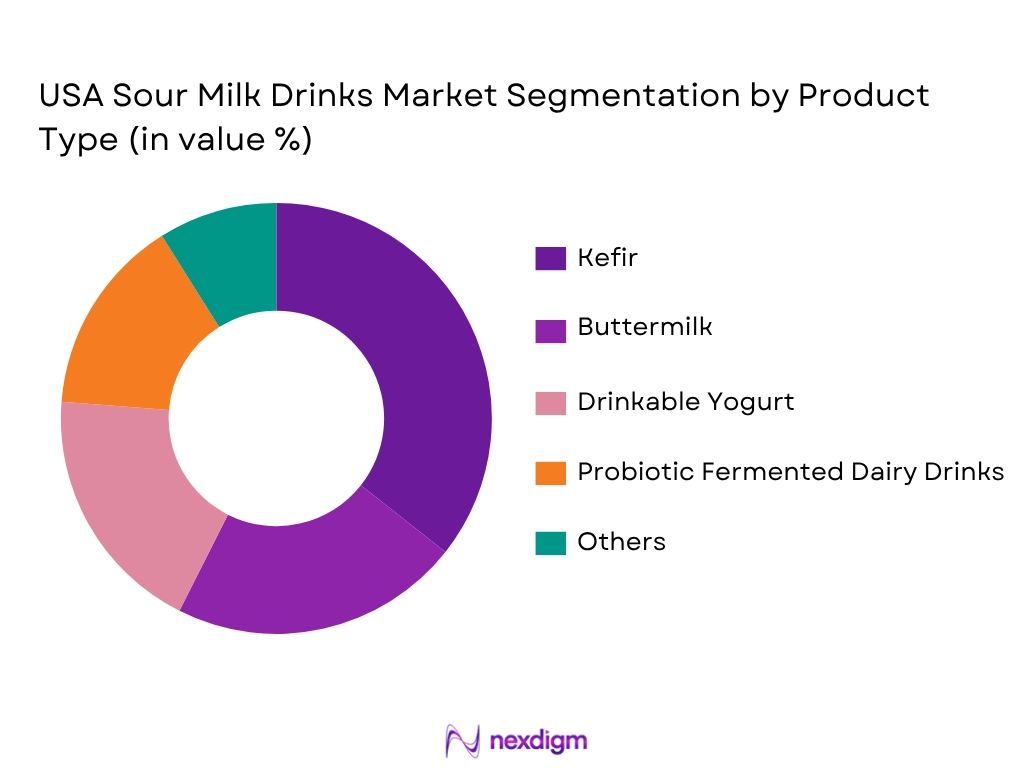
The USA Sour Milk Drinks Market is segmented by product type into kefir, buttermilk, drinkable yogurt, probiotic fermented dairy drinks, lassi and ethnic cultured milk drinks, and others. Kefir holds the dominant market share because it has moved from specialty health-food shelves to mainstream refrigerated dairy cases. Its positioning is stronger than conventional buttermilk due to multi-strain probiotic claims, higher gut-health relevance, and suitability for smoothies, breakfast occasions, and on-the-go wellness routines. Brands such as Lifeway, Green Valley Creamery, Maple Hill, and Redwood Hill have reinforced kefir’s visibility through multi-serve bottles, organic variants, lactose-free lines, and flavored formats. Kefir also benefits from consumer willingness to pay a premium for digestive wellness and live-culture claims.
By Distribution Channel
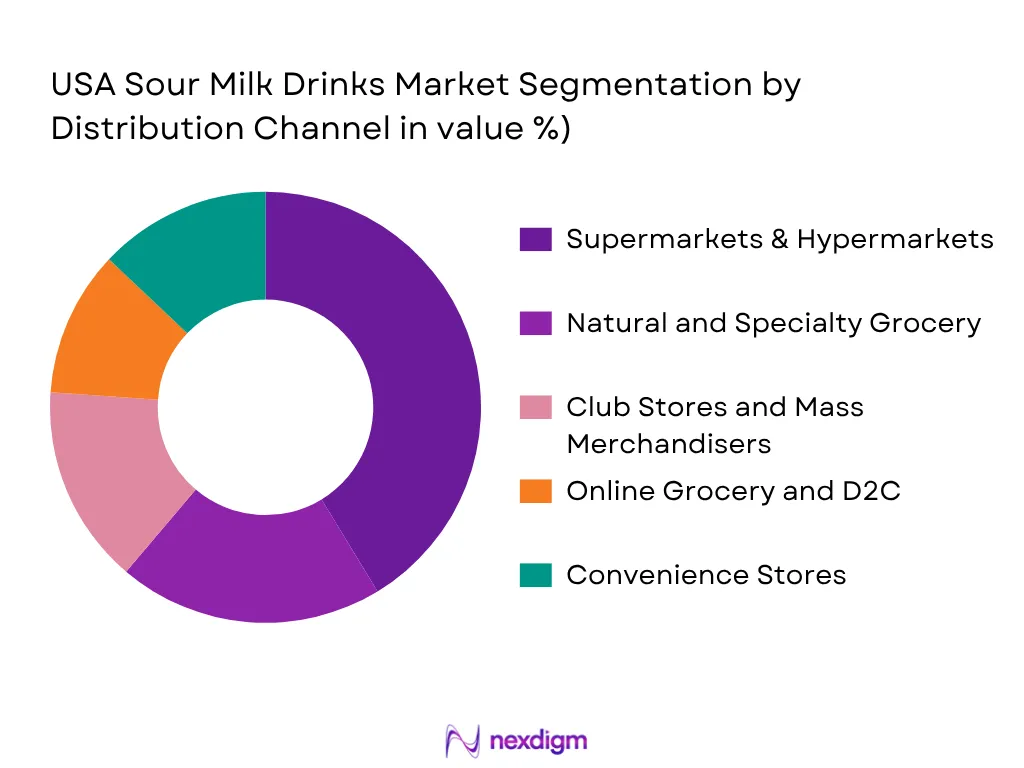
The USA Sour Milk Drinks Market is segmented by distribution channel into supermarkets and hypermarkets, natural and specialty grocery, club stores and mass merchandisers, online grocery and direct-to-consumer, convenience stores, and ethnic grocery and foodservice. Supermarkets and hypermarkets dominate because sour milk drinks require refrigerated placement, repeat household replenishment, and shelf adjacency with yogurt, milk, smoothies, and functional dairy. Large chains provide the cold-case space needed for 32 oz kefir bottles, multipack yogurt drinks, probiotic shots, and private-label cultured dairy lines. In-store promotions, sampling, loyalty-card discounts, and broader flavor assortment also support conversion from conventional yogurt consumers to drinkable cultured dairy formats.
Competitive Landscape
The USA Sour Milk Drinks Market is moderately consolidated across kefir specialists, global dairy companies, probiotic drink brands, organic dairy processors, and ethnic cultured dairy brands. Lifeway Foods has strong kefir specialization, while Danone North America, Chobani, General Mills, Yakult, and Lactalis leverage broader yogurt and probiotic portfolios. Competition is defined by live-culture claims, refrigerated distribution breadth, flavor innovation, price per fluid ounce, low-sugar reformulation, organic positioning, and ability to win shelf space in supermarkets, natural grocers, and club formats.
| Company | Establishment Year | Headquarters | Key Sour Milk Drink Portfolio | Culture / Probiotic Positioning | U.S. Retail Channel Strength | Pack Architecture | Pricing Position | Strategic Advantage |
| Lifeway Foods | 1986 | Morton Grove, Illinois | ~ | ~ | ~ | ~ | ~ | ~ |
| Danone North America | 1972 | White Plains, New York / Broomfield, Colorado | ~ | ~ | ~ | ~ | ~ | ~ |
| Chobani | 2005 | New Berlin, New York | ~ | ~ | ~ | ~ | ~ | ~ |
| Yakult U.S.A. | 1999 | Fountain Valley, California | ~ | ~ | ~ | ~ | ~ | ~ |
| Lactalis U.S. Yogurt | 1981 | Buffalo, New York | ~ | ~ | ~ | ~ | ~ | ~ |
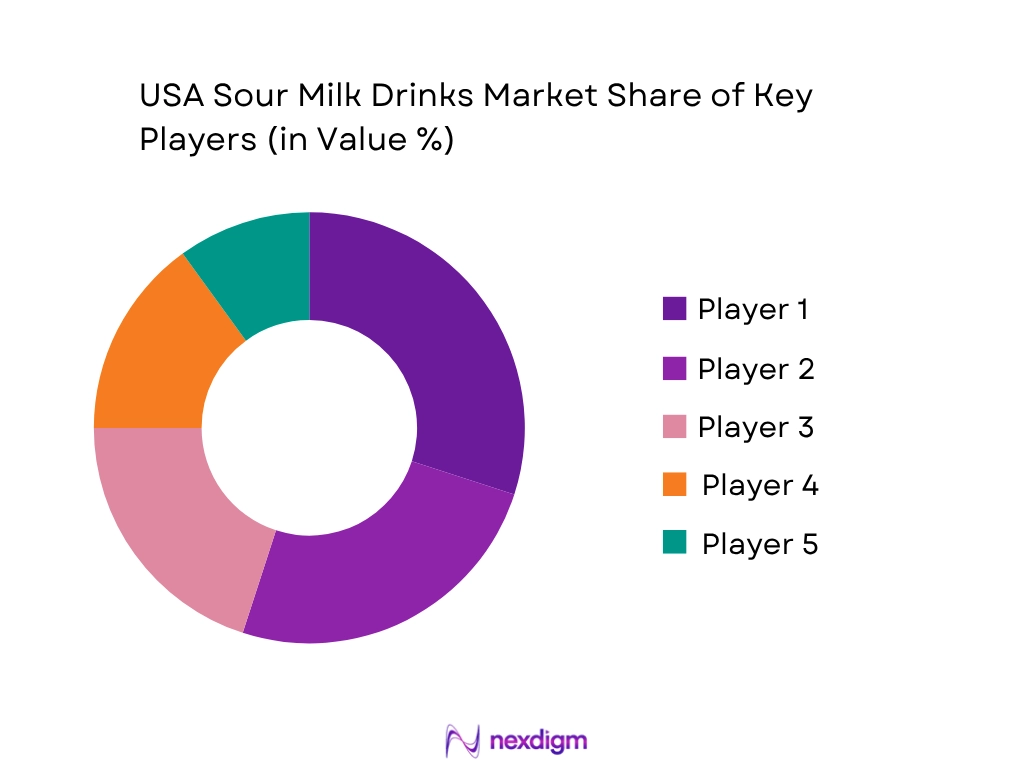
USA Sour Milk Drinks Market Analysis
Growth Drivers
Digestive Wellness Demand
Digestive wellness demand is strengthening the USA Sour Milk Drinks Market because kefir, drinkable yogurt, cultured buttermilk, and probiotic fermented dairy drinks sit directly within the refrigerated cultured-dairy ecosystem. The macro base is large: the U.S. population is 340,110,988 and GDP is USD 28.75 trillion, giving the category access to a deep consumer base with high formal retail penetration. Food-at-home demand also supports repeat refrigerated purchases, with BEA-reported personal consumption expenditure on food and beverages purchased for off-premises consumption at USD 1,479,571.8 million. Market-specific supply is also established: USDA recorded 4,879,392 thousand pounds of U.S. plain and flavored yogurt production from 155 plants, while total U.S. milk production reached 226 billion pounds from 9.34 million milk cows. This supports sour milk drinks because yogurt, kefir, and cultured milk drinks depend on a stable dairy-processing base, chilled retail flow, and consumer acceptance of fermented dairy formats. FDA’s yogurt standard also reinforces the digestive-wellness positioning by allowing “contains live and active cultures” when products meet 10⁷ CFU/g at manufacture with expected 10⁶ CFU/g through shelf life.
Probiotic Adoption
Probiotic adoption is a core growth driver for the USA Sour Milk Drinks Market because the category’s most differentiated products kefir, probiotic drinkable yogurt, fermented milk shots, and cultured dairy beverages compete on live-culture density, strain communication, and refrigerated freshness. FDA’s current yogurt regulation defines yogurt as cultured with Lactobacillus delbrueckii subsp. bulgaricus and Streptococcus thermophilus, requires finished-product pH of 4.6 or lower, and permits live-culture labeling at 10⁷ CFU/g at manufacture with reasonable expectation of 10⁶ CFU/g through assigned shelf life. This matters commercially because probiotic adoption in sour milk drinks depends on credible labeling rather than generic wellness language. The production platform is also large enough to support formulation scaling: USDA reports 4,879,392 thousand pounds of yogurt production, including 1,578,320 thousand pounds in the Atlantic region, 2,036,906 thousand pounds in the Central region, and 1,264,166 thousand pounds in the West. In macro terms, the U.S. consumer base is supported by USD 19,825.338 billion in household final consumption expenditure, which indicates significant purchasing capacity for functional refrigerated food and beverage formats.
Market Challenges
Cold Chain Dependency
Cold chain dependency is a structural challenge for the USA Sour Milk Drinks Market because kefir, drinkable yogurt, lassi-style dairy drinks, and cultured buttermilk must remain within safe refrigerated handling conditions from plant to distributor, retailer, and household. FDA consumer guidance states refrigerators should be kept at or below 40°F / 4°C, while FDA retail food-safety material requires cooling to 41°F or less after defined cooling windows; these requirements make sour milk drinks operationally different from shelf-stable beverages. The scale of chilled movement is large: USDA reports 4,879,392 thousand pounds of U.S. yogurt production and 155 yogurt plants, creating high dependence on refrigerated storage, transportation, backroom handling, and shelf temperature compliance. USDA also reports 1,183 manufacturers producing one or more dairy products, showing a broad but cold-chain-sensitive manufacturing network. Cold chain complexity is especially important because sour milk drinks are sold in refrigerated dairy cases beside milk, yogurt, smoothies, and probiotic shots, where deviations can damage live-culture viability, reduce shelf life, and increase shrink.
Short Shelf Life
Short shelf life remains a market challenge because sour milk drinks combine dairy perishability with live-culture positioning. FDA states that refrigerated appliances should remain at or below 40°F / 4°C, and FoodSafety.gov notes that refrigerated food is generally safe for only up to 4 hours during a power outage if the door remains closed. That creates direct risk for kefir, drinkable yogurt, and fermented milk shots because the products depend on chilled integrity at retail and during last-mile grocery delivery. FDA’s yogurt regulation further links live-culture labeling to product life: a product using “contains live and active cultures” must contain 10⁷ CFU/g at manufacture with reasonable expectation of 10⁶ CFU/g through the manufacturer’s assigned shelf life. This creates pressure on formulation, packaging, distribution speed, retail rotation, and household storage. The challenge scales with production volume: USDA recorded 4,879,392 thousand pounds of yogurt output and 226 billion pounds of U.S. milk production, meaning even small shelf-life disruptions can affect large volumes of cultured dairy inputs and finished refrigerated beverages.
Market Opportunities
White Space SKUs
White space SKUs represent a future growth opportunity in the USA Sour Milk Drinks Market because the dairy-processing base is large, but product development can still expand across low-sugar kefir, lactose-free kefir, high-protein drinkable yogurt, kids’ probiotic dairy drinks, savory cultured milk, and single-serve fermented milk formats. USDA’s yogurt data shows 155 plants and 4,879,392 thousand pounds of output, while total dairy manufacturers producing one or more dairy products stood at 1,183. This indicates manufacturing capacity for differentiated refrigerated cultured-dairy SKUs beyond conventional yogurt cups. The raw material base is also stable: USDA recorded 226 billion pounds of U.S. milk production, 9.34 million milk cows, and 24,178 pounds of milk production per cow. On the demand side, BEA/FRED reports USD 1,479,571.8 million in food and beverages purchased for off-premises consumption, supporting household-oriented refrigerated beverage innovation. White space is strongest where brands can combine FDA-compliant live-culture claims, controlled sugar profiles, functional protein, and portable packaging while remaining within refrigerated dairy-case operating constraints.
Ethnic Beverages
Ethnic beverages are a future growth opportunity because lassi-style drinks, ayran/laban-style drinks, kefir variants, and savory cultured dairy beverages align with U.S. demographic diversity and existing fermented-dairy manufacturing capacity. The U.S. population base is 340,110,988, and Census-linked analysis reports 50.2 million foreign-born residents, creating a large consumer foundation for South Asian, Middle Eastern, Eastern European, Hispanic, and Mediterranean cultured dairy formats. The opportunity is also supported by the current dairy supply system: USDA recorded 4,879,392 thousand pounds of yogurt production, including 981,506 thousand pounds from New York and 219,590 thousand pounds from California, both relevant to multicultural urban consumption corridors. The broader milk input base 226 billion pounds of milk production from 9.34 million milk cows supports scalable ethnic sour milk drink production if brands can secure refrigerated retail placement. Future growth is likely to come from mango lassi, salted lassi, plain/tart kefir, laban-style drinks, and hybrid ethnic-probiotic SKUs positioned for both diaspora consumers and mainstream gut-health shoppers.
Future Outlook
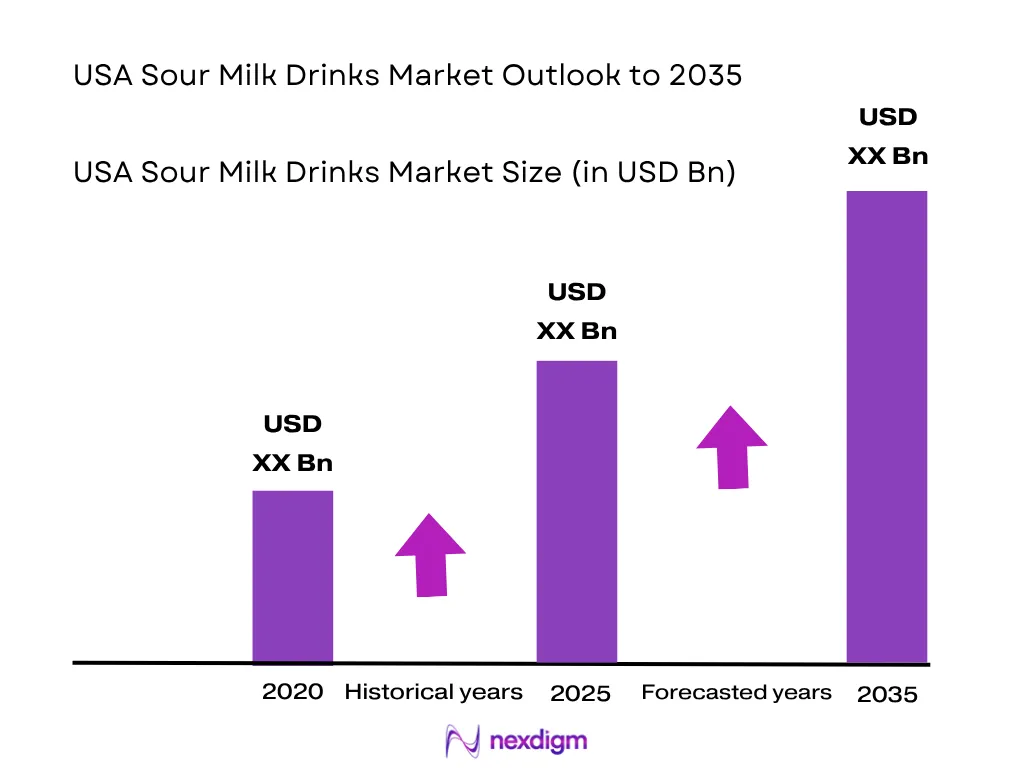
The USA Sour Milk Drinks Market is forecasted to expand at a CAGR of 4.8% during 2026–2035. Growth will be led by kefir, probiotic fermented dairy drinks, drinkable yogurt, and low-sugar cultured milk formats. The category will benefit from digestive wellness demand, live-culture labeling clarity, GLP-1-linked protein and satiety consumption, and broader refrigerated retail penetration.
Future growth will also be shaped by product architecture. Large-format kefir bottles will remain important for household consumption, while single-serve probiotic dairy drinks will expand through impulse occasions, workplace consumption, kids’ lunchbox formats, and post-workout routines. Online grocery will improve visibility for specialty brands, but supermarkets and natural grocers will continue to define velocity because cold-chain credibility and shelf placement remain essential.
Major Players
- Lifeway Foods
- Danone North America
- Chobani
- General Mills
- Yakult U.S.A.
- Lactalis U.S. Yogurt
- FAGE USA
- Icelandic Provisions
- The Hain Celestial Group
- Maple Hill Creamery
- Wallaby Organic
- Green Valley Creamery
- Redwood Hill Farm & Creamery
- Karoun Dairies
- Stonyfield Organic
Key Target Audience
- Dairy processors and cultured dairy manufacturers
- Kefir, drinkable yogurt, and probiotic dairy drink brands
- Supermarket, club-store, and natural grocery category managers
- Cold-chain logistics and refrigerated distribution companies
- Packaging manufacturers for refrigerated dairy beverages
- Investments and venture capitalist firms
- Government and regulatory bodies (U.S. Food and Drug Administration, U.S. Department of Agriculture, Federal Trade Commission, state dairy regulatory agencies)
- Foodservice chains, smoothie chains, cafés, and institutional buyers
Research Methodology
Step 1: Identification of Key Variables
The initial phase involves constructing an ecosystem map covering dairy processors, kefir specialists, probiotic drink brands, retailers, culture suppliers, packaging vendors, cold-chain operators, and regulatory bodies. This step identifies key variables such as refrigerated shelf space, probiotic positioning, pack size, flavor mix, household penetration, price per fluid ounce, and channel velocity.
Step 2: Market Analysis and Construction
Historical market data is compiled from published sour milk drink, probiotic drink, yogurt, dairy production, and retail-channel sources. The analysis evaluates market size, category contribution, production base, distribution footprint, SKU concentration, pricing architecture, and consumption occasions. Bottom-up validation is performed through brand portfolios, product listings, and retail assortment mapping.
Step 3: Hypothesis Validation and Expert Consultation
Market hypotheses are validated through structured interviews with dairy processors, retail buyers, refrigerated beverage distributors, nutrition-focused brand managers, and packaging suppliers. These discussions help test assumptions around kefir growth, buttermilk demand, drinkable yogurt adoption, probiotic claims, low-sugar reformulation, online grocery traction, and premium pricing acceptance.
Step 4: Research Synthesis and Final Output
The final stage integrates secondary research, primary inputs, competitive benchmarking, retail SKU mapping, and triangulated market sizing. Findings are reconciled across top-down and bottom-up approaches to ensure consistency across market value, segmentation, competitive position, channel mix, and future outlook. The output is structured for investment, strategy, product planning, and market entry use cases.

- Executive Summary
- Research Methodology (Market Definitions and Assumptions, Sour Milk Drink Inclusion Criteria, Kefir and Drinkable Yogurt Taxonomy, Cultured Buttermilk and Lassi Classification, Abbreviations, Market Sizing Approach, Top-Down Demand Estimation, Bottom-Up Retail SKU Mapping, Scanner Data Triangulation, Store Audit Approach, Primary Interviews with Dairy Processors and Retail Buyers, Consumer Panel Validation, Price Pack Architecture Analysis, Limitations and Future Conclusions)

- Definition and Scope
- Market Genesis and Evolution
- Product Lifecycle of Sour Milk Drinks
- Timeline of Major Product Launches and Category Expansion
- Business Cycle and Seasonality
- Supply Chain and Value Chain Analysis
- Retail Shelf Architecture and Cold Chain Flow
- Consumer Need-State Mapping
- Role of Probiotics, Live & Active Cultures, Protein, Calcium, and Digestive Wellness
- Regulatory and Labeling Context

- Growth Drivers (Digestive Wellness Demand, Probiotic Adoption, High-Protein Dairy Consumption, Clean Label Preference, Ethnic Beverage Mainstreaming, On-the-Go Breakfast Consumption, GLP-1 Nutrition Shift)
- Market Challenges (Cold Chain Dependency, Short Shelf Life, Added Sugar Scrutiny, Price Premium, Culture Viability, Retail Slotting, Brand Education Cost)
- Market Opportunities (White Space SKUs, Ethnic Beverages, Kids’ Probiotic Drinks, Low-Sugar Kefir, Functional Fortification, Foodservice Applications, Digital Grocery Growth)
- Market Trends (Probiotic Premiumization, Clean Label Fermentation, Low-Sugar Reformulation, Protein Fortification, Retail Pack Diversification, Ethnic Flavor Localization)
- Government Regulation and Compliance (FDA Standard of Identity, Live & Active Culture Labeling, Nutrition Facts, Allergen Declaration, Pasteurization, Dairy Grade Standards, Claims Substantiation, State Dairy Rules)
- SWOT Analysis (Brand Equity, Culture Differentiation, Refrigerated Distribution, Flavor Innovation, Price Premium, Retail Fragmentation, Private Label Threat, Functional Beverage Competition)
- Stakeholder Ecosystem (Milk Producers, Culture Suppliers, Co-Packers, Dairy Processors, Brand Owners, Retail Buyers, Cold Chain Providers, Certification Bodies, Foodservice Operators, Consumers)
- Porter’s Five Forces (Supplier Power of Milk and Cultures, Buyer Power of Retail Chains, Threat from Yogurt and Protein Drinks, New Entrants in Functional Dairy, Competitive Rivalry in Refrigerated Dairy Case)
- Competition Ecosystem (National Dairy Brands, Kefir Specialists, Greek Yogurt Majors, Private Label Players, Organic Dairy Brands, Ethnic Dairy Brands, Probiotic Drink Brands)
- Pricing Analysis (Price per Fluid Ounce, Single-Serve Premium, Multi-Serve Economy, Organic Premium, Lactose-Free Premium, Club Pack Discount, Promotional Depth, EDLP vs High-Low Retailing)
- Channel Margin Analysis (Manufacturer Margin, Distributor Margin, Retail Margin, Cold Chain Cost, Slotting Fee, Promotional Allowance, Shrinkage Cost, Trade Spend)
- Consumer Purchase Journey (Awareness, Trial, Taste Acceptance, Digestive Benefit Perception, Repeat Purchase, Household Adoption, Cross-Use in Smoothies, Brand Loyalty)

- By Value (2020-2025)
- By Volume (2020-2025)
- By Average Selling Price (2020-2025)
- By Retail Sales Velocity (2020-2025)
- By Per Capita Consumption (2020-2025)
- By Household Penetration (2020-2025)
- By Pack-Size Mix (2020-2025)
- By Refrigerated Dairy Beverage Shelf Share (2020-2025)

- By Product Type (In Value%)
Kefir
Drinkable Yogurt
Cultured Buttermilk
Lassi-Style Drinks
Ayran/Laban-Style Drinks
Probiotic Fermented Milk Shots
Sour Milk Smoothie Drinks - By Milk Base (In Value%)
Cow Milk-Based Sour Milk Drinks
Goat Milk-Based Sour Milk Drinks
Sheep Milk-Based Sour Milk Drinks
Lactose-Free Dairy Sour Milk Drinks
Low-Fat Dairy Sour Milk Drinks
Whole Milk Dairy Sour Milk Drinks - By Culture and Functional Positioning (In Value%)
Live & Active Culture Sour Milk Drinks
Multi-Strain Probiotic Sour Milk Drinks
Kefir Grain-Fermented Drinks
High-Protein Sour Milk Drinks
Low-Sugar Digestive Wellness Drinks
Immunity-Support Positioned Drinks - By Flavor Profile (In Value%)
Plain/Tart
Vanilla
Strawberry
Blueberry
Mango
Peach
Mixed Berry - By Sugar and Nutrition Profile (In Value%)
Unsweetened
Low Sugar
No Added Sugar
Regular Sweetened
High Protein
Added Fiber
Vitamin D Fortified
Calcium Fortified
Low Fat
Whole Milk - By Packaging Type (In Value%)
Single-Serve Bottles
Multi-Serve Bottles
Family-Size Bottles
Multipack Drinkable Yogurt Cups
Cartons
Pouches
PET Bottles
HDPE Bottles
On-the-Go Shots - By Distribution Channel (In Value%)
Supermarkets
Hypermarkets
Club Stores
Mass Merchandisers
Natural and Specialty Grocery
Convenience Stores
Ethnic Grocery Stores
Online Grocery
Direct-to-Consumer
Foodservice - By End User (In Value%)
Adults
Children
Fitness-Oriented Consumers
Gut Health Seekers
Lactose-Sensitive Consumers
Ethnic and Diaspora Consumers
Weight Management Consumers
Family Households - By Region (In Value%)
Northeast
Midwest
South
West
Urban Metro Markets
Suburban Grocery Markets
Hispanic-Dense Markets
Natural Channel Strongholds

- Market Share of Major Players by Value and Volume (Kefir Share, Drinkable Yogurt Share, Probiotic Dairy Drink Share, Natural Channel Share, Conventional Grocery Share, Club Channel Share)
- Market Share of Major Players by Product Type (Kefir, Drinkable Yogurt, Cultured Buttermilk, Lassi-Style Drinks, Probiotic Dairy Shots, Sour Milk Smoothie Drinks)
- Cross Comparison Parameters (Live & Active Culture Claim, Probiotic Strain Count, CFU Positioning, Kefir Grain Fermentation, Protein per Serving, Added Sugar per Serving, Lactose-Free/Organic/Grass-Fed Claims, Refrigerated Retail Distribution Reach)
- Additional Benchmarking Parameters (Company Overview, Brand Portfolio, Product Launches, Retail Presence, Price per Fluid Ounce, Pack Sizes, Flavor Portfolio, Channel Mix, Manufacturing Footprint, Co-Packing Dependency, Cold Chain Capability, Private Label Exposure, Promotional Strategy, Strengths, Weaknesses)
- SWOT Analysis of Major Players (Brand Trust, Functional Claim Strength, Distribution Scale, Product Innovation, Pricing Power, Retail Dependence, Consumer Loyalty, Portfolio Risk)
- Pricing Analysis by SKU and Pack Size (Single-Serve Bottle, Multi-Serve Bottle, Multipack, Organic Premium, Lactose-Free Premium, High-Protein Premium, Club Pack, Promotional Price)
- Product Portfolio Heat Map (Kefir, Drinkable Yogurt, Lassi, Buttermilk, Probiotic Shots, Kids’ Drinks, Organic Lines, Lactose-Free Lines, High-Protein Lines)
- Detailed Profiles of Major Companies
Lifeway Foods
Danone North America
Chobani
General Mills
Yakult U.S.A.
Lactalis U.S. Yogurt
FAGE USA
Icelandic Provisions
The Hain Celestial Group
Maple Hill Creamery
Wallaby Organic
Green Valley Creamery
Redwood Hill Farm & Creamery
Karoun Dairies
Stonyfield Organic

- Market Demand and Utilization (Breakfast, Snack, Post-Workout, Smoothie Ingredient, Digestive Health Routine, Kids’ Lunchbox, Meal Replacement, Ethnic Meal Pairing)
- Purchasing Power and Budget Allocation (Premium Dairy Spend, Organic Spend, Functional Beverage Spend, Club Store Basket Size, Weekly Dairy Basket, Price per Serving)
- Needs, Desires, and Pain Point Analysis (Gut Health, Protein, Low Sugar, Taste Tartness, Lactose Tolerance, Clean Label, Convenience, Shelf Life, Affordability)
- Decision-Making Process (Ingredient Check, Culture Claim Check, Sugar Check, Flavor Trial, Brand Trust, Retail Availability, Price Promotion, Family Acceptance)
- Consumer Cohort Analysis (Gut Health Seekers, Fitness Consumers, GLP-1 Users, Parents, Ethnic Consumers, Natural Channel Shoppers, Value Shoppers, Premium Dairy Buyers)
- Retail Buyer and Category Manager Analysis (Shelf Productivity, SKU Rationalization, Cold Case Space, Brand Velocity, Promotional Lift, Private Label Potential, Shrink Rate, Basket Attachment)

- By Value (2026-2035)
- By Volume (2026-2035)
- By Average Selling Price (2026-2035)
- By Household Penetration (2026-2035)
- By Retail Sales Velocity (2026-2035)
- By Per Capita Consumption (2026-2035)
- By Pack-Size Mix (2026-2035)
- By Channel Contribution (2026-2035)


 Request a Sample
 Ask for Customization
 Get a Quote
 Enquire Now