

 Download PDF
Market Overview
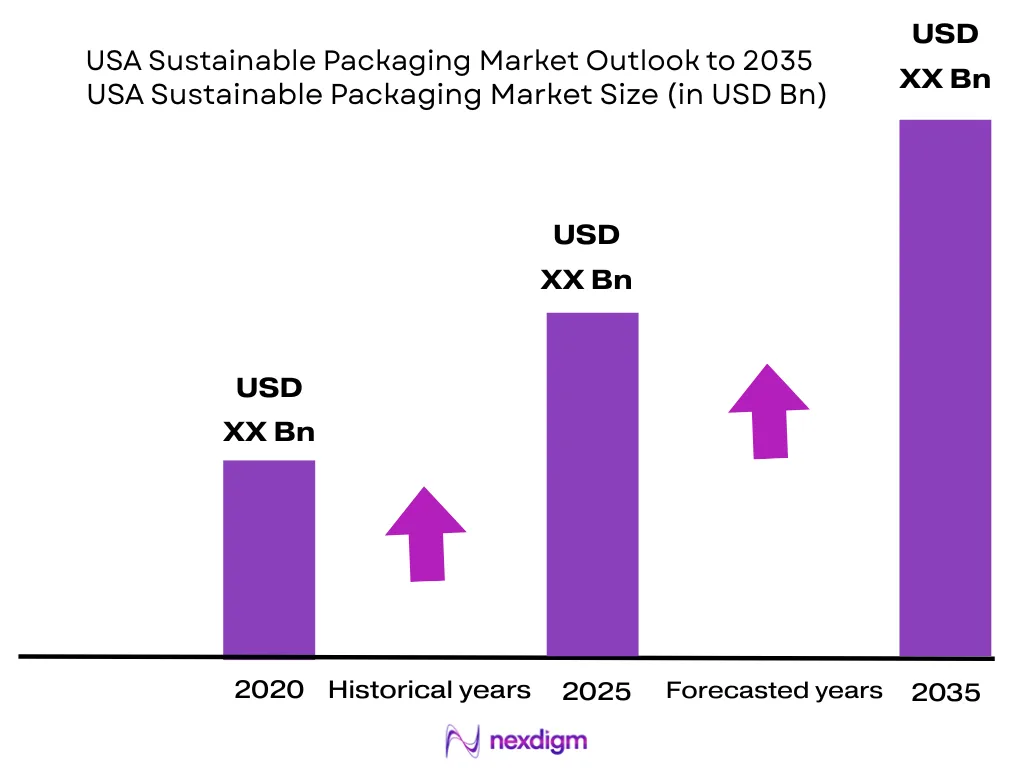
The USA Sustainable Packaging Market is valued at approximately USD ~ billion and is forecast to expand at a CAGR of % during 2026–2035. Based on historical analysis, current-dollar national output increased from USD 27.36 trillion to approximately USD 29.18 trillion, while the population rose from 336.8 million to 340.1 million. Demand is driven by packaging-intensive consumer spending, e-commerce, recycled-content commitments, lightweighting, state producer-responsibility laws, and substitution of difficult-to-recycle structures. California, Texas, Illinois, Ohio, Pennsylvania, Georgia, Wisconsin, Michigan, New York, and New Jersey dominate the USA Sustainable Packaging Market. California leads regulatory development and consumer-brand conversion, while Texas and the Midwest combine resin, paper, food, beverage, and manufacturing capacity. Illinois, Ohio, Wisconsin, and Georgia contain major converting and corrugated operations. Coastal states also benefit from ports, large retail markets, recycling infrastructure, e-commerce fulfilment, and proximity to food, personal-care, pharmaceutical, and consumer-goods customers.
Market Segmentation
By Material Type
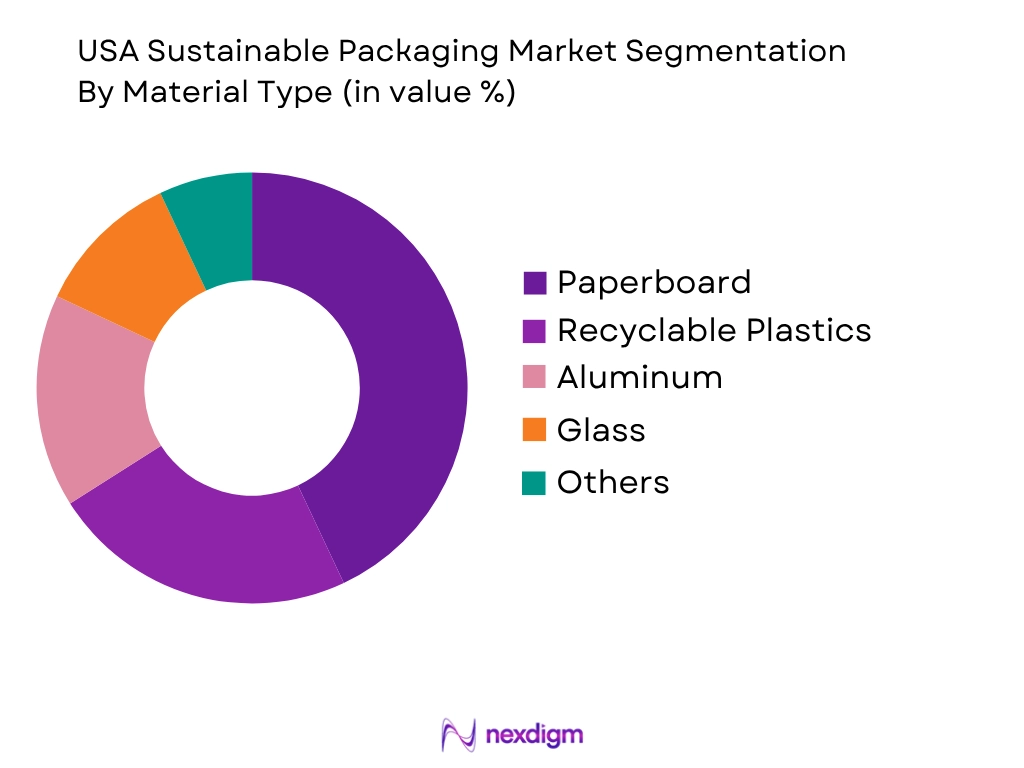
The USA Sustainable Packaging Market is segmented into paper and paperboard, recycled plastics, metals, glass, bio-based and compostable materials, wood, and multi-material sustainable structures. Paper and paperboard hold the dominant position because corrugated boxes, folding cartons, molded fiber, paper bags, cups, and shipping mailers serve food, beverage, retail, foodservice, and e-commerce applications. Fiber packaging benefits from established collection systems, domestic mill infrastructure, renewable feedstocks, and broad consumer familiarity. Brand owners also use paper-based formats to replace selected plastic trays, wraps, rings, and protective components. However, fiber substitution is not universally appropriate because moisture, grease, oxygen, sealing, and shelf-life requirements can necessitate coatings or combined materials. Recycled plastic remains important in bottles, jars, tubs, trays, films, and pouches where lightweighting and product protection are critical. Metals and glass benefit from strong material recovery characteristics, while compostable formats remain more dependent on local organics-collection and processing infrastructure.
By End-Use Industry
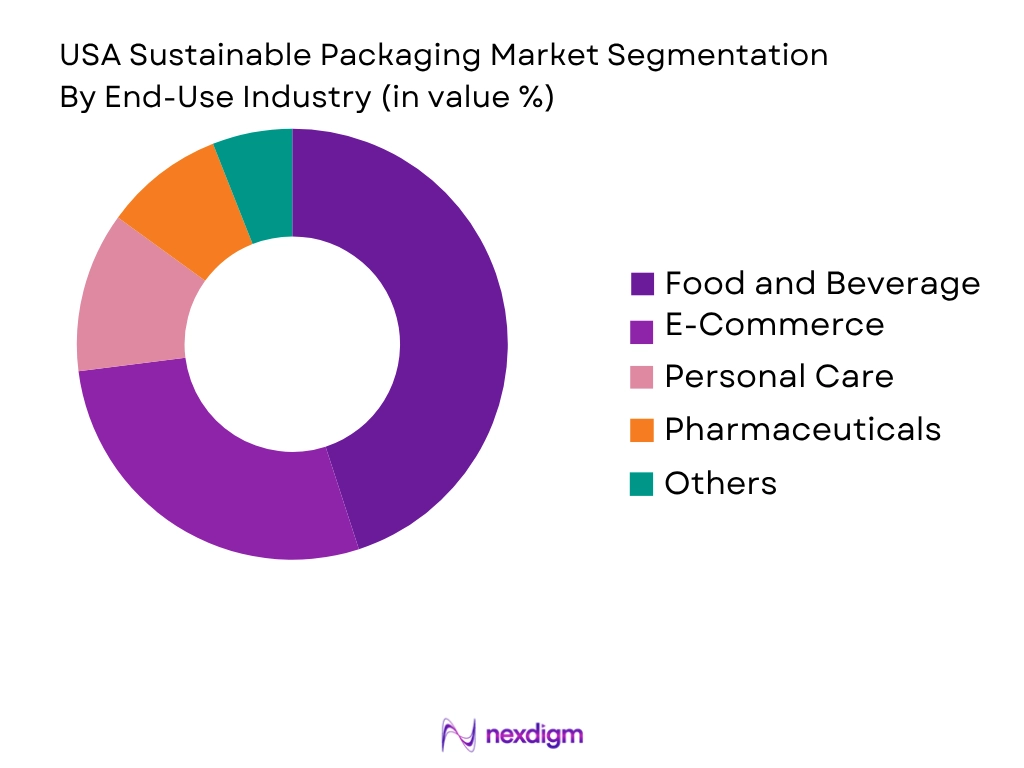
The USA Sustainable Packaging Market is segmented into food and beverage, e-commerce and retail, personal and household care, healthcare and pharmaceuticals, foodservice, industrial goods, electronics, and other consumer applications. Food and beverage hold the dominant position because packaging must simultaneously protect product safety, shelf life, flavour, moisture, and physical integrity while meeting food-contact requirements. The sector uses corrugated cases, cartons, bottles, cans, trays, pouches, films, cups, and molded-fiber formats in extremely high volumes. Sustainability initiatives include lightweighting, higher recycled content, mono-material flexible structures, fiber substitution, refill models, and improved component separability. E-commerce and retail form another major segment because shipping materials generate visible household waste and directly affect freight efficiency. Pharmaceutical and healthcare packaging are slower to convert because sterility, barrier performance, tamper evidence, and regulatory validation take precedence. Foodservice demand is increasingly influenced by reusable systems, compostability regulations, and restrictions on selected single-use formats.
Competitive Landscape
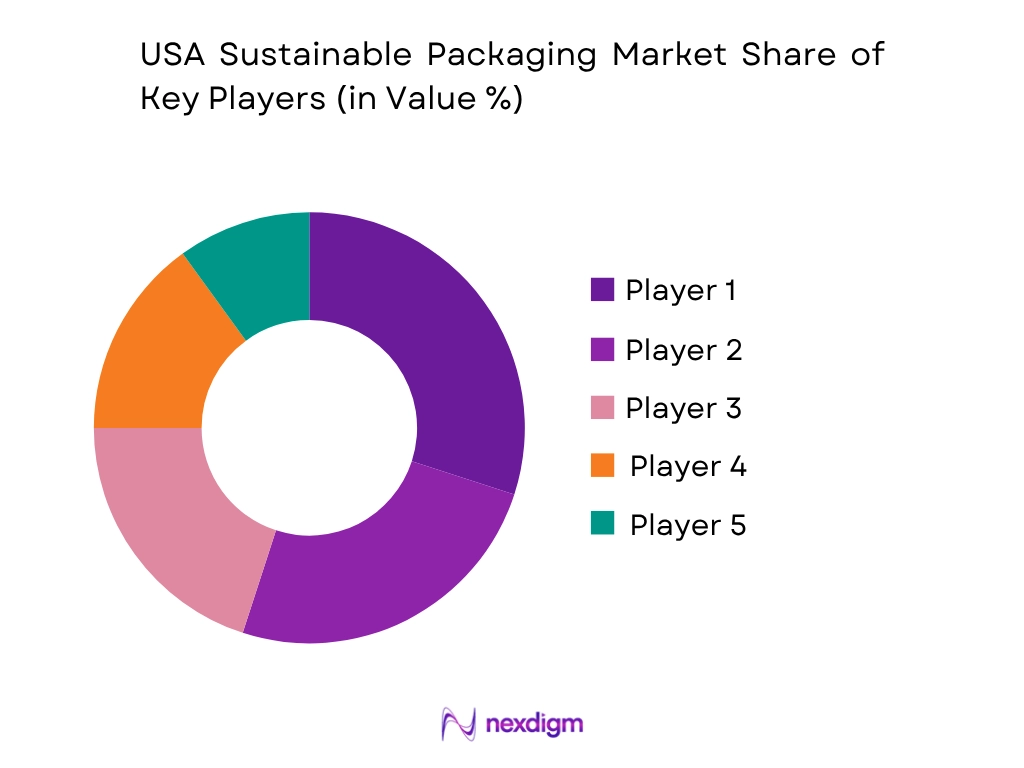
The USA Sustainable Packaging Market includes large integrated packaging groups, fiber-based packaging manufacturers, flexible and rigid packaging converters, metal and glass container producers, and specialty material innovators. Amcor competes across flexible and rigid formats, while Smurfit Westrock and Graphic Packaging emphasize renewable, recycled, and recyclable fiber packaging. Ball Corporation is prominent in aluminum containers, and Sonoco operates across paper, flexible, rigid, and protective packaging. Competitive differentiation increasingly depends on recycled-content capability, design-for-recycling expertise, conversion scale, regulatory support, life-cycle assessment, and closed-loop partnerships.
| Company | Establishment Year | Headquarters | Core Sustainable Portfolio | Principal End Uses | Material Capabilities | U.S. Operating Model | Circularity Capability | Strategic Differentiation |
| Amcor | 1860s heritage | Zurich, Switzerland | ~ | ~ | ~ | ~ | ~ | ~ |
| Smurfit Westrock | 2024 as combined company | Dublin, Ireland | ~ | ~ | ~ | ~ | ~ | ~ |
| Graphic Packaging International | 1920 heritage | Atlanta, Georgia | ~ | ~ | ~ | ~ | ~ | ~ |
| Sonoco Products Company | 1899 | Hartsville, South Carolina | ~ | ~ | ~ | ~ | ~ | ~ |
| Ball Corporation | 1880 | Westminster, Colorado | ~ | ~ | ~ | ~ | ~ | ~ |
USA Sustainable Packaging Market Analysis
Growth Drivers
E-Commerce Expansion and High-Volume Urban Packaging Demand
The expansion of U.S. e-commerce, retail distribution, food delivery, and urban consumption is increasing demand for corrugated boxes, recyclable mailers, molded-fiber protection, right-sized cartons, paper void fill, reusable shipping containers, and lightweight flexible packaging. The U.S. Census Bureau estimated total retail e-commerce sales at USD 1,192.6 billion in 2024, compared with approximately USD 1,103.2 billion in 2023, adding around USD 89.4 billion in digitally ordered merchandise within one year. Every online transaction creates packaging requirements involving product protection, warehouse handling, order consolidation, last-mile transportation, customer opening, possible returns, and household disposal. This operating model is encouraging retailers and fulfilment companies to reduce empty space, replace oversized boxes, remove unnecessary plastic components, and adopt packaging compatible with automated sorting and packing equipment. National population growth reinforces this demand. The U.S. Census Bureau recorded 340.1 million residents in 2024, compared with 336.8 million in 2023, adding approximately 3.3 million consumers. Large metropolitan distribution networks around New York, Los Angeles, Chicago, Dallas, Houston, Atlanta, Phoenix, Philadelphia, Miami, and Seattle concentrate online orders, grocery deliveries, prepared-food shipments, consumer goods, and reverse-logistics activity. Corrugated packaging remains particularly relevant because it provides stacking strength, printability, warehouse compatibility, and access to established fiber-recovery systems. EPA’s published packaging data identify corrugated boxes as one of the most frequently recovered packaging products, demonstrating why retailers often prioritize fiber formats for shipping applications. Sustainable design is nevertheless moving beyond simple paper substitution. A heavier paper package may require more material or transport capacity than a lightweight alternative, while inadequate protective performance may increase product damage and returns. Packaging engineers are therefore evaluating package-to-product ratios, dimensional weight, compression strength, moisture resistance, adhesive selection, and the quantity of protective material used per shipment. E-commerce is also increasing interest in resealable and return-ready packaging because apparel, electronics, personal-care products, and household goods frequently move through reverse-logistics systems. A package capable of completing both the outbound and return journey may avoid the use of a second container. Retailers are additionally introducing recyclable paper mailers for small products, padded fiber envelopes for fragile items, and reusable totes for controlled grocery-delivery routes. The U.S. economy provides the commercial scale supporting these conversions. Bureau of Economic Analysis data show that real gross domestic product expanded during 2024, while household consumption remained a principal contributor to national activity. Sustainable packaging suppliers benefit when this consumption is routed through digital channels because packaging becomes visible to the final consumer rather than remaining within industrial distribution. The growth driver is therefore not urbanization alone. It is the combination of 340.1 million residents, USD 1,192.6 billion in annual e-commerce sales, high-density fulfilment networks, and retailer pressure to reduce material, shipping volume, product damage, and disposal complexity.
Extended Producer Responsibility and Industrial Packaging Conversion
State producer-responsibility laws are transforming sustainable packaging from a voluntary brand initiative into an operational, reporting, and material-design requirement. California’s SB 54 establishes an extended producer responsibility system covering packaging and single-use plastic foodservice ware across the state’s economy. Producers must participate in an approved producer responsibility organization, operate independently under an accepted plan, or qualify for an exemption. Oregon’s Recycling Modernization Act moved into implementation on July 1, 2025, requiring producers of covered packaging, paper, and foodservice ware to register with an approved producer responsibility organization, report supplied material, and fund program activities. These frameworks affect packaging manufacturers because producer fees and compliance obligations can reflect material type, weight, recyclability, reuse potential, and burden on collection systems. Brand owners consequently require packaging suppliers to provide detailed information on resin, fiber, coatings, adhesives, inks, components, post-consumer recycled content, and realistic end-of-life pathways. The regulatory effect extends through the manufacturing chain. Packaging converters must redesign multilayer pouches, labels, closures, sleeves, pumps, trays, cartons, and foodservice items so that components do not undermine collection or reprocessing. Fiber converters are developing repulpable barrier coatings, grease-resistant paper, molded-fiber trays, and paperboard structures intended to replace selected plastic formats. Plastic converters are simplifying structures around polyethylene or polypropylene and increasing use of post-consumer recycled resin where performance and food-contact requirements permit. Metal and glass producers are emphasizing high recovery value, recycled inputs, lightweighting, and closed-loop container systems.
Market Challenges
Recycling Infrastructure and High-Quality Feedstock Constraints
The U.S. sustainable packaging market is constrained by the difference between packaging that is technically recyclable and packaging that can be collected, sorted, processed, and sold into a responsible end market at scale. EPA’s national recycling infrastructure assessment determined that modernization across collection, drop-off services, material recovery facilities, packaging-specific processing, composting, and related systems could enable recovery of an additional 82 million to 89 million tons of packaging and organic material. This potential volume demonstrates that substantial recoverable material is currently lost because of incomplete access, contamination, inadequate sorting, limited processing capacity, and weak regional end markets. The challenge varies by material. Corrugated boxes benefit from established commercial collection and paper-mill demand, but smaller paper packaging, coated cartons, wet-strength papers, and fiber-plastic combinations may not perform equally well in repulping systems. PET and natural HDPE bottles have recognized recycling pathways, yet EPA’s historical material data show that only a limited portion of generated bottles entered recycling systems. Flexible films and pouches face greater barriers because curbside programs may not accept them, material recovery facilities can experience operational problems with loose film, and multilayer structures are difficult to separate. Compostable packaging faces a parallel problem: certification does not guarantee collection or acceptance by an industrial composting facility. Some composters exclude packaging because of contamination, identification difficulties, or concerns about incomplete breakdown. Reusable packaging also requires infrastructure, including return points, washing facilities, inspection systems, storage, redistribution, and asset tracking. Feedstock quality creates a second constraint. Packaging companies seeking high levels of post-consumer recycled material compete for limited quantities of clean PET, HDPE, polypropylene, fiber, aluminum, and glass cullet. Food and beverage applications may require greater source control, decontamination, testing, and regulatory documentation than non-food uses. FDA guidance for recycled plastics in food packaging expects manufacturers to evaluate the recycling process, incoming source material, contaminant removal, intended conditions of use, and the possibility of chemical migration. A converter cannot therefore replace virgin resin with an unidentified recycled stream without confirming its suitability. Color variation, odour, contamination, polymer degradation, moisture, and inconsistent melt characteristics can affect packaging appearance, barrier performance, sealing, and mechanical strength. Regional imbalance further complicates supply. A packaging plant may be located far from a recycler producing the required resin or fiber grade, increasing transportation and inventory exposure. The U.S. population of 340.1 million generates a very large stream of used packaging, but dispersed municipal rules mean that households receive different instructions about accepted materials. EPA’s recycling strategy identifies standardization, collection improvement, contamination reduction, policy coordination, and stronger end markets as necessary components of a more resilient system. Until these gaps are addressed, companies may introduce packaging labelled as recyclable even though access is limited in some communities. The market challenge is therefore not simply insufficient waste volume. It is the inability to convert available discarded material consistently into clean, specification-grade feedstock suitable for new packaging.
Technical Performance, Regulatory Fragmentation, and Workforce Requirements
Sustainable packaging conversions are technically demanding because environmental objectives must be achieved without compromising product protection, manufacturing efficiency, food safety, transportation performance, consumer usability, or legal compliance. Packaging frequently performs several functions simultaneously containing the product, controlling oxygen and moisture, preventing contamination, resisting puncture, providing tamper evidence, surviving distribution, displaying information, enabling dispensing, and supporting automated filling. A change from a multilayer film to a mono-material structure may improve recyclability but reduce oxygen or aroma protection. Replacing a plastic tray with molded fiber can change moisture resistance, rigidity, sealing behaviour, microwave performance, or shelf life. Increasing recycled content may affect colour, odour, transparency, impact strength, and process consistency. Lightweighting a bottle or can may reduce material use but create top-load, paneling, denting, or line-handling problems. These trade-offs require packaging engineers, polymer scientists, paper specialists, tooling experts, regulatory personnel, life-cycle analysts, and production technicians. The scale of the required workforce is evident in Bureau of Labor Statistics data. Production occupations employed 8.7 million people in May 2024, while plastics product manufacturing accounted for approximately 592,500 workers. Packaging-related operations also depend on paper converting, printing, metal forming, glass production, industrial maintenance, material handling, laboratory testing, and transportation. Sustainable conversion requires these employees to operate new coatings, recycled resins, mono-material laminates, molded-fiber equipment, digital printing systems, and quality-control methods. Workforce development must therefore occur alongside material innovation. Regulatory fragmentation adds another layer of difficulty. California, Oregon, Colorado, Maine, Minnesota, and other states have adopted or developed producer-responsibility programs with different covered-product definitions, exemptions, reporting formats, implementation schedules, fee systems, and recycling criteria. State rules may also differ on compostability labelling, environmental marketing, chemical restrictions, bags, foodservice ware, and beverage containers. A package may comply with one state’s labelling expectations but require qualification or redesign elsewhere. Oregon began producer obligations in 2025, while California’s regulatory process continued through 2025 and 2026, requiring producers and suppliers to monitor implementation rather than relying only on statutory language. Environmental claims create further risk. Statements such as recyclable, compostable, biodegradable, renewable, or lower-carbon require evidence and appropriate qualification. A package that is recyclable in theory may not qualify for an unqualified claim when collection access is limited. Companies must also distinguish between industrial composting and home composting, mechanical and chemical recycling, post-consumer and post-industrial content, and physical versus mass-balance attribution. Technical validation can involve material screening, migration assessment, transport simulation, shelf-life testing, sealing trials, drop tests, line-speed evaluation, consumer testing, and recovery-facility review. Large brand owners can maintain dedicated packaging and regulatory teams, while smaller businesses often rely on converters and distributors for compliance support. This creates an opportunity for technically strong suppliers but also slows material conversion. The challenge is therefore the need to coordinate engineering, workforce capability, regulatory intelligence, and environmental substantiation across thousands of products and multiple state systems.
Market Opportunities
Advanced Material Design, Smart Sorting, and Circular Packaging Technology
Technological development creates a major opportunity to make sustainable packaging perform more reliably within existing manufacturing and recovery systems. The strongest opportunities include high-barrier recyclable films, repulpable paper coatings, molded-fiber structures, wash-off labels, compatible adhesives, digital watermarks, artificial-intelligence-assisted sorting, advanced decontamination, and package-design software. U.S. e-commerce sales reached USD 1,192.6 billion in 2024, creating a large addressable base for right-sized packaging, automated carton selection, paper mailers, reusable shipping assets, and material-reduction technologies. Automated fulfilment systems can use product dimensions and fragility data to select smaller boxes, reduce void fill, and lower the number of packaging formats held in inventory. Machine-vision systems can identify package geometry and detect defects before shipment. Digital printing allows converters to produce shorter runs with less obsolete inventory when brand or regulatory information changes. In recycling facilities, near-infrared sensors, optical sorters, robotics, and artificial intelligence can improve identification of plastics, cartons, paper grades, and contaminants. Digital watermarks or machine-readable features may provide information that is difficult to communicate through material appearance alone. Improved sorting is particularly relevant because EPA estimates that modernized infrastructure could enable recovery of an additional 82 million to 89 million tons of packaging and organic material. Capturing even part of this volume would expand recycled feedstock available to converters. Material technology can improve the usability of that feedstock. Advanced washing and decontamination can remove labels, adhesives, food residue, odours, and incompatible polymers. Recycled resin can then be filtered, pelletized, tested, and blended for selected packaging applications. FDA’s recycled-plastic guidance provides a technical framework for evaluating source control and contaminant removal in food-contact uses. Fiber innovation offers another opportunity. Water-based coatings can provide grease, moisture, or heat-seal performance while allowing more effective repulping than certain conventional laminates. Molded fiber can replace expanded foams, plastic inserts, trays, and protective components in electronics, foodservice, produce, and industrial packaging. Nanocellulose and improved fiber forming can reduce material weight while maintaining stiffness. Flexible packaging innovation is moving toward polyethylene- or polypropylene-dominant structures that retain sealing and barrier functions without combining numerous incompatible polymers. Reuse technology adds software, QR codes, radio-frequency identification, and deposit management to track container circulation, washing, damage, and loss. The U.S. manufacturing base provides the personnel and facilities required to commercialize these systems, including approximately 592,500 workers in plastics product manufacturing in 2024 and a much wider workforce across paper, printing, metal, glass, logistics, and recycling. The future opportunity is therefore not a single replacement material. It is an integrated technology stack connecting design, production, product protection, collection, sortation, reprocessing, data, and verified end markets.
Producer-Funded Recovery Systems and Regional Circular Supply Chains
The implementation of producer-responsibility programs creates an opportunity to build more coordinated regional supply chains linking packaging producers, brands, retailers, municipalities, material recovery facilities, recyclers, composters, and manufacturers using recovered feedstock. Oregon’s system began operating on July 1, 2025, with producers registering through an approved producer responsibility organization, reporting covered materials, and funding program activities. California’s SB 54 establishes a broader system for packaging and single-use plastic foodservice ware, placing producers in a central role in designing and financing circular outcomes. These programs can create more predictable demand for collection, sorting, recycling, education, data systems, responsible end-market verification, and package redesign. They also create commercial opportunities for packaging companies capable of helping customers classify materials, prepare reports, reduce packaging weight, increase recyclability, and document post-consumer content. EPA’s infrastructure assessment indicates that upgraded systems could recover an additional 82 million to 89 million tons of packaging and organic waste. This is a significant potential material stream for domestic mills, plastic reclaimers, metal producers, glass plants, composters, and reusable-packaging operators. Regional development is particularly important because recycling economics depend heavily on transportation distance and local end markets. Fiber collected near a paper mill, glass recovered near a beneficiation facility, or plastic sorted near a reprocessor has a more practical route back into manufacturing than material transported across several states. Producer-funded systems can support collection access in smaller cities, rural communities, multifamily housing, schools, public spaces, and commercial districts that have historically received uneven service. They can also finance improvements in carts, drop-off sites, transfer systems, balers, optical sorting, contamination reduction, and public instructions. Rural expansion is especially relevant because the Census Bureau reported that 14,603 of 19,479 incorporated places had fewer than 5,000 residents in 2024. These communities may not generate enough material individually to support specialized facilities, but hub-and-spoke collection, regional aggregation, mobile baling, and shared processing contracts can improve scale. Reuse systems offer a parallel opportunity in defined networks such as grocery delivery, beverage distribution, institutional foodservice, automotive components, agricultural crates, and business-to-business transport packaging. Standardized containers can circulate among multiple users when washing, inspection, tracking, and reverse logistics are coordinated. Compostable foodservice packaging may also become more viable where producer programs are aligned with food-waste collection and industrial composting, although acceptance standards must remain clear. The opportunity extends to data services. Producers need package-level information on weight, material composition, state sales, exemptions, recyclability, and recovery pathways. Software platforms can connect packaging specifications with producer reporting and fee exposure. The U.S. sustainable packaging market can therefore grow through infrastructure and service models, not only through sales of new containers. Producer responsibility creates recurring demand for system design, compliance support, recovery verification, recycled feedstock, and regional partnerships that return material to manufacturing.
Future Outlook
The USA Sustainable Packaging Market is expected to expand during 2026–2035 as state producer-responsibility programs, recycled-content requirements, retailer standards, and corporate waste-reduction commitments alter packaging design and procurement. Growth will not be limited to replacing plastic with paper. It will involve source reduction, mono-material structures, higher-quality recycled feedstocks, reusable systems, better labelling, and investments in collection and processing. Extended producer responsibility will become one of the market’s most important structural forces. California’s SB 54 shifts responsibility for covered packaging and single-use plastic foodservice ware toward producers and requires systemic reductions in unnecessary packaging. Oregon’s Recycling Modernization Act began operational changes in July 2025, using producer funding to improve collection, processing, and responsible recycling outcomes. Fiber-based packaging will continue gaining applications in e-commerce, foodservice, multipacks, protective components, trays, and selected flexible formats. Innovation will focus on aqueous coatings, grease resistance, moisture barriers, heat sealability, repulpability, and the removal of plastic components that interfere with fiber recovery. Recycled plastic will remain necessary where flexibility, low mass, transparency, impact resistance, or high barriers are essential. Growth will depend on more consistent post-consumer feedstock, improved sorting, decontamination, colour control, and food-contact suitability. FDA guidance requires manufacturers using recycled plastics in food packaging to evaluate source control, contaminant removal, and intended conditions of use.
Major Players
- Amcor
- Berry Global
- Smurfit Westrock
- International Paper
- Graphic Packaging International
- Sonoco Products Company
- Sealed Air
- Novolex
- Huhtamaki
- Mondi
- Tetra Pak
- Ball Corporation
- Crown Holdings
- O-I Glass
- Packaging Corporation of America
Key Target Audience
- Packaging material manufacturers and converters
- Food, beverage, and consumer-goods brand owners
- Retailers, e-commerce companies, and foodservice operators
- Recycling, composting, and reusable-packaging providers
- Packaging distributors and contract packagers
- Investments and venture capitalist firms
- Private-equity and strategic packaging investors
- Government and regulatory bodies
Research Methodology
Step 1: Identification of Key Variables
The initial phase involves constructing an ecosystem map covering material producers, packaging converters, brand owners, retailers, producer-responsibility organizations, collectors, material-recovery facilities, recyclers, composters, and regulators. Desk research identifies critical variables such as material type, package weight, recycled content, end-use requirements, recovery access, converter capacity, and regulatory exposure.
Step 2: Market Analysis and Construction
Historical data are compiled by material, format, end-use industry, packaging level, sustainability strategy, and region. The bottom-up model evaluates converter shipments, package volumes, resin and paperboard use, recycled-content integration, and customer adoption. The top-down model examines manufacturing output, material consumption, packaging trade, company revenue, and relevant end-market activity.
Step 3: Hypothesis Validation and Expert Consultation
Market hypotheses are validated through computer-assisted telephone interviews with packaging engineers, converters, sustainability executives, procurement teams, recyclers, material suppliers, retailers, and producer-responsibility specialists. These interviews assess qualification cycles, material switching, feedstock constraints, pricing structures, performance requirements, regulatory costs, and customer adoption.
Step 4: Research Synthesis and Final Output
Supply-side and demand-side findings are triangulated to reconcile converter output, material shipments, customer procurement, and recovery-system data. Segment shares and forecasts are reviewed against package weights, unit volumes, recycled-content assumptions, capacity additions, regulatory timelines, and expert feedback. The final output provides a consolidated assessment of market structure and opportunity.

- Executive Summary
- Research Methodology (Market Definitions and Assumptions, Sustainable Packaging Inclusion and Exclusion Criteria, Abbreviations, Market Sizing Approach, Top-Down Analysis, Bottom-Up Analysis, Packaging-Volume Conversion Model, Material Flow Analysis, Demand-Side Assessment, Supply-Side Assessment, Converter Capacity Assessment, Primary Industry Interviews, Data Triangulation, Forecasting Framework, Regulatory Scenario Modelling, Limitations and Future Conclusions)

- Definition and Scope
- Market Evolution and Industry Genesis
- Transition from Conventional Packaging to Circular Packaging Systems
- Evolution of Lightweighting, Recycled Content and Design for Recycling
- Development of Reusable and Refill Packaging Models
- Growth of Compostable and Bio-Based Packaging
- Timeline of Major Industry Developments

- Growth Drivers (Extended Producer Responsibility Expansion, Brand Packaging Commitments, Recycled-Content Demand, E-Commerce Packaging Optimization, Foodservice Material Transition, Consumer-Goods Lightweighting, Retailer Packaging Standards and Corporate Carbon Reduction)
- Market Challenges (Fragmented State Regulations, Recycled Feedstock Availability, Food-Grade PCR Constraints, Flexible Packaging Recovery Gaps, Composting Infrastructure Limitations, Green-Claim Risk, Material Performance Trade-Offs and Capital-Intensive Conversion)
- Market Opportunities (Fiber-Based Flexible Packaging, Mono-Material Barrier Structures, Reusable Packaging Platforms, Food-Grade Recycled Plastics, Molded Fiber Replacement, Compostable Foodservice Packaging, Smart Sorting Technologies and Closed-Loop Brand Partnerships)
- Market Trends (Paperization, Lightweighting, High-PCR Packaging, Refill Models, Right-Sized E-Commerce Packaging, Digital Watermarks, Wash-Off Labels, Fiber-Based Bottles, Recyclable Barrier Coatings and Packaging Carbon Disclosure)
- SWOT Analysis
- Porter’s Five Forces Analysis
- PESTLE Analysis

- By Market Value (2020-2025)
- By Packaging Volume (2020-2025)
- By Packaging Unit Shipments (2020-2025)

- By Material Type (In Value %)
Paper and Paperboard
Corrugated Board
Molded Fiber
Recycled Plastic
Bio-Based Plastic
Compostable Plastic
Aluminum - By End-Use Industry (In Value %)
Food and Beverage
Personal Care and Cosmetics
Household Care
Healthcare and Pharmaceuticals
E-Commerce
Retail and Consumer Goods - By Distribution Channel (In Value %)
Direct Sales to Brand Owners
Packaging Distributors
Contract Packaging Companies
Digital Packaging Platforms
Industrial Wholesalers
Retail Packaging Suppliers - By Region (In Value %)
Northeast
Midwest
South
West

- Market Share of Major Players (By Value, Packaging Volume, Material Type, Packaging Format, End-Use Industry and Region)
- Cross Comparison Parameters (Sustainable Material Portfolio Breadth, Post-Consumer Recycled Content Capability, Design-for-Recycling and Lightweighting Expertise, Manufacturing and Conversion Footprint, Closed-Loop Recovery and Take-Back Services, Food-Contact and Regulatory Compliance Capability, End-Use Industry Coverage, Packaging Innovation and Commercialization Speed)
- SWOT Analysis of Major Players
- Detailed Profiles of Major Companies
Amcor
Berry Global
Smurfit Westrock
International Paper
Graphic Packaging International
Sonoco Products Company
Sealed Air
Novolex
Huhtamaki
Mondi
Tetra Pak
Ball Corporation
Crown Holdings
O-I Glass
Packaging Corporation of America

- Food and Beverage Brand Analysis
- Retailer Analysis
- E-Commerce Company Analysis
- Foodservice Operator Analysis
- Consumer Packaged Goods Analysis

- By Market Value (2026-2035)
- By Packaging Volume (2026-2035)
- By Packaging Unit Shipments (2026-2035)


 Request a Sample
 Ask for Customization
 Get a Quote
 Enquire Now