

 Download PDF
 Download PDF
Market Overview
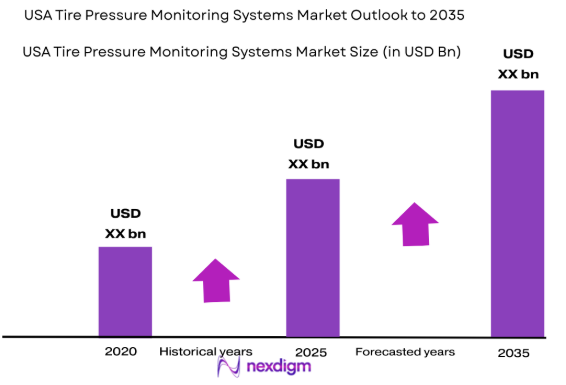
The USA Tire Pressure Monitoring Systems (TPMS) market reached approximately USD ~ billion based on a recent historical assessment, driven primarily by mandatory safety compliance under Federal Motor Vehicle Safety Standard sustained vehicle production volumes. Strong aftermarket replacement demand for sensor modules and batteries further contributes to revenue generation. Expansion of electric vehicle manufacturing and increasing integration of TPMS with telematics and connected vehicle platforms continue to support steady revenue expansion across OEM and fleet segments.
Detroit, Michigan remains a strategic hub due to the presence of major automotive OEMs and suppliers integrating TPMS at the factory level. California plays a significant role due to high electric vehicle registrations and advanced emission compliance frameworks encouraging tire efficiency monitoring. Texas and Ohio contribute through large-scale manufacturing facilities and commercial fleet operations, while southern states support distribution networks and aftermarket service infrastructure that reinforce national dominance.
By Product Type
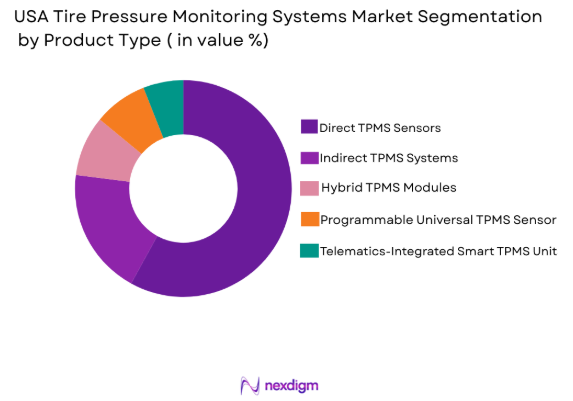
USA Tire Pressure Monitoring Systems (TPMS) market is segmented by product type into Direct TPMS Sensors, Indirect TPMS Systems, Hybrid TPMS Modules, Programmable Universal TPMS Sensors, and Telematics-Integrated Smart TPMS Units. Recently, Direct TPMS Sensors have a dominant market share due to mandatory safety compliance requirements, higher measurement accuracy, real-time pressure and temperature monitoring capability, OEM standardization across passenger vehicles, and stronger compatibility with advanced driver assistance and connected vehicle architectures.
By Platform Type
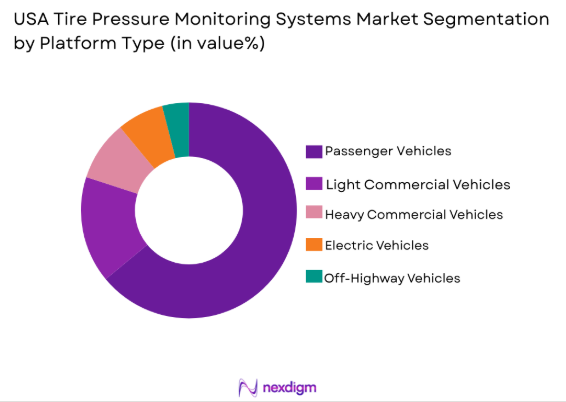
USA Tire Pressure Monitoring Systems (TPMS) market is segmented by platform type into Passenger Vehicles, Light Commercial Vehicles, Heavy Commercial Vehicles, Electric Vehicles, and Off-Highway Vehicles. Recently, Passenger Vehicles have a dominant market share due to large production volumes, regulatory mandates for factory installation, high vehicle parc requiring aftermarket replacements, strong consumer awareness regarding fuel efficiency, and consistent OEM integration across entry-level and premium models.
Competitive Landscape
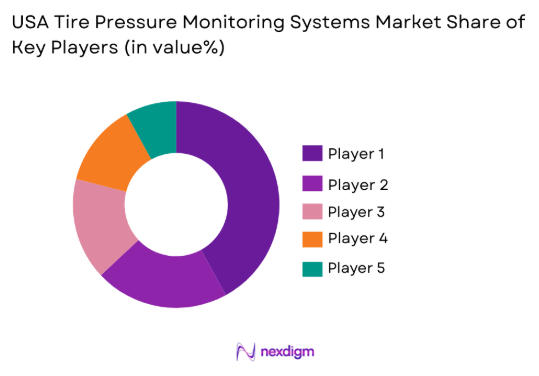
The USA Tire Pressure Monitoring Systems (TPMS) market exhibits moderate consolidation with global automotive suppliers dominating OEM contracts while specialized firms compete in programmable and aftermarket sensor solutions. Long-term supply agreements with automakers create entry barriers, and technological differentiation in sensor accuracy, battery longevity, and wireless communication standards shapes competitive positioning.
|
Company Name |
Establishment Year | Headquarters | Technology Focus | Market Reach | Key Products | Revenue (USD) | OEM Integration Depth |
| Continental AG | 1871 | Germany | ~ | ~ | ~ | ~ | ~ |
| Sensata Technologies | 1916 | USA | ~ | ~ | ~ | ~ | ~ |
| DENSO Corporation | 1949 | Japan | ~ | ~ | ~ | ~ | ~ |
| Schrader International | 1844 | USA | ~ | ~ | ~ | ~ | ~ |
| Huf Hülsbeck & Fürst | 1908 | Germany | ~ | ~ | ~ | ~ | ~ |
USA Tire Pressure Monitoring Systems (TPMS) market Analysis
Growth Drivers
Federal Safety Mandates and Compliance Enforcement
Federal safety mandates requiring tire pressure monitoring installation across light vehicles significantly influence the USA Tire Pressure Monitoring Systems (TPMS) market by creating a non-discretionary demand base that is largely insulated from cyclical purchasing fluctuations. Compliance under Federal Motor Vehicle Safety Standard No. 138 obligates OEMs to equip passenger vehicles with functional TPMS technology capable of alerting drivers to underinflation conditions, thereby sustaining baseline procurement volumes across all production cycles. Regulatory enforcement mechanisms ensure that even entry-level vehicles incorporate standardized direct TPMS architectures, which strengthens supplier revenue stability and promotes continuous design upgrades. Automakers prioritize sensor reliability, battery durability, and diagnostic compatibility to meet inspection requirements, thereby increasing demand for advanced MEMS-based modules. This compliance-driven framework also extends to replacement markets because malfunctioning or depleted sensors must be substituted to pass vehicle inspections in several states. Fleet operators adopt robust TPMS systems to mitigate liability exposure associated with tire-related accidents and regulatory penalties. Insurance incentives linked to safety technologies further reinforce adoption rates in both personal and commercial vehicle segments. Additionally, regulatory scrutiny surrounding fuel efficiency indirectly supports TPMS integration because properly inflated tires contribute to optimized energy consumption, thereby aligning safety and environmental objectives. Continuous updates to safety protocols encourage innovation and product differentiation, ensuring that manufacturers maintain R&D investments to comply with evolving standards.
Expansion of Electric and Connected Vehicle Ecosystems
The significantly accelerates demand within the USA Tire Pressure Monitoring Systems (TPMS) market by embedding pressure sensing within broader digital vehicle architectures. Electric vehicles rely heavily on optimized tire performance to maximize driving range, making accurate real-time monitoring an operational necessity rather than a supplementary feature. Manufacturers integrate TPMS data streams into centralized vehicle control units and telematics dashboards, enabling predictive maintenance and over-the-air diagnostic alerts. Connected fleet management platforms leverage sensor data analytics to reduce downtime, enhance route efficiency, and lower operational expenditure across logistics networks. Increasing penetration of advanced driver assistance systems encourages interoperability between TPMS modules and braking or stability systems to improve safety outcomes. Consumer expectations for smart dashboards and mobile application connectivity further stimulate demand for Bluetooth-enabled and cloud-integrated TPMS solutions. Automakers differentiate premium models through integrated digital monitoring packages, thereby raising average system value per vehicle. As software-defined vehicle platforms evolve, TPMS modules transition from standalone alert mechanisms to integral components within comprehensive vehicle health ecosystems. This structural transformation elevates technological complexity and strengthens supplier positioning within high-value electronic subsystems.
Market Challenges
Sensor Battery Longevity and Replacement Cost Pressures
pose a significant challenge within the USA Tire Pressure Monitoring Systems (TPMS) market because direct TPMS units typically rely on sealed lithium batteries that cannot be recharged or easily replaced. Over time, battery depletion necessitates complete sensor replacement, which increases maintenance costs for vehicle owners and fleet operators. Aftermarket service providers must maintain diverse inventories to ensure compatibility with multiple vehicle models, raising operational complexity and procurement expenses. Consumer resistance to higher replacement pricing may lead to delayed servicing, which compromises system functionality and weakens long-term adoption confidence. OEMs face engineering trade-offs between compact sensor design and extended battery life, as higher capacity solutions may increase size and cost. Warranty obligations associated with premature sensor failures can further strain supplier margins. Additionally, environmental considerations related to battery disposal introduce compliance requirements that add administrative burdens. Technological advancements aimed at energy efficiency partially mitigate these constraints but often involve higher upfront development expenditure. The cumulative impact of these factors creates ongoing pricing sensitivity across both OEM and aftermarket channels.
Compatibility Fragmentation Across Vehicle Platforms
presents a persistent challenge in the USA Tire Pressure Monitoring Systems (TPMS) market because sensor protocols, frequency standards, and communication architectures vary between manufacturers. Automakers often employ proprietary calibration software and coding processes that restrict universal compatibility, complicating aftermarket installation and programming procedures. Service technicians require specialized diagnostic tools to pair sensors with onboard control units, increasing training and equipment costs. Programmable universal sensors attempt to address this fragmentation, yet software updates and firmware synchronization remain complex and time-intensive. Fleet operators managing mixed vehicle brands encounter operational inefficiencies due to inconsistent sensor configurations. Cross-border supply chains further complicate standardization when global OEM platforms adopt region-specific compliance modifications. Technological evolution toward integrated telematics systems increases interoperability demands between TPMS and other vehicle electronics. Cybersecurity considerations introduce additional layers of encryption and authentication that may differ among manufacturers. Collectively, these compatibility barriers elevate system integration complexity and limit seamless scalability across diverse vehicle fleets.
Opportunities
Integration with Predictive Fleet Analytics Platforms
Represents a major opportunity in the USA Tire Pressure Monitoring Systems (TPMS) market because commercial fleet operators increasingly rely on data-driven maintenance strategies to reduce downtime and operational expenditure. By aggregating tire pressure and temperature data into centralized analytics dashboards, fleet managers can proactively schedule maintenance before failures occur. Predictive modeling algorithms utilize historical performance data to optimize tire rotation cycles and extend asset lifespan. Insurance providers may offer incentives for fleets that implement advanced monitoring solutions, further encouraging adoption. Telematics providers can incorporate TPMS modules into subscription-based service models, generating recurring revenue streams for technology suppliers. Cloud-based data integration enables cross-fleet benchmarking and performance comparisons, enhancing decision-making accuracy. Logistics companies prioritize fuel efficiency improvements, and optimized tire inflation directly supports these cost-reduction initiatives. As regulatory oversight of commercial vehicle safety intensifies, analytics-enabled TPMS systems strengthen compliance documentation. This opportunity positions TPMS vendors as long-term strategic partners within digital fleet ecosystems.
Development of Smart Aftermarket Retrofit Solutions
offers significant growth potential in the USA Tire Pressure Monitoring Systems (TPMS) market because millions of older vehicles operate beyond factory warranty periods and require sensor replacements or upgrades. Programmable universal sensors reduce inventory complexity for service providers and enable broader compatibility across multiple vehicle brands. Mobile application integration enhances user experience by providing real-time alerts and maintenance reminders directly to drivers. Retail distribution through online automotive parts platforms expands consumer access and simplifies purchasing processes. Technological miniaturization allows retrofit solutions to achieve performance parity with OEM-installed systems. Partnerships between sensor manufacturers and automotive repair chains create bundled service offerings that increase installation rates. Rising consumer awareness regarding tire safety and fuel efficiency strengthens aftermarket demand. Integration of Bluetooth and cloud connectivity adds premium value to replacement products, encouraging higher-margin sales. This opportunity supports revenue diversification beyond traditional OEM contracts and enhances resilience against production cycle volatility.
Future Outlook
Over the next five years, the USA Tire Pressure Monitoring Systems (TPMS) market is expected to experience steady expansion supported by regulatory compliance, electric vehicle growth, and digital vehicle integration. Advancements in sensor miniaturization, extended battery life, and cloud connectivity will enhance system reliability and value. Strong demand from fleet management platforms and telematics integration will reinforce commercial adoption. Regulatory reinforcement and sustainability objectives will continue to support long-term market stability.
Major Players
- Continental AG
- Sensata Technologies
- DENSO Corporation
- Schrader International
- Huf Hülsbeck & Fürst
- ZF Friedrichshafen AG
- Aptiv PLC
- Pacific Industrial Co., Ltd.
- NIRA Dynamics AB
- ATEQ Corporation
- Bartec USA LLC
- Alligator Ventilfabrik GmbH
- Hamaton Limited
- Autel Intelligent Technology Corp., Ltd.
- Bendix Commercial Vehicle Systems LLC
Key Target Audience
- Automotive OEMs
- Fleet Operators
- Logistics Companies
- Automotive Aftermarket Distributors
- Electric Vehicle Manufacturers
- Investments and venture capitalist firms
- Government and regulatory bodies
- Automotive Component Manufacturers
Research Methodology
Step 1: Identification of Key Variables
Primary variables such as vehicle production volumes, replacement rates, regulatory mandates, and sensor pricing trends were identified. Secondary variables including fleet adoption rates and telematics integration were mapped to assess broader ecosystem impact.
Step 2: Market Analysis and Construction
Historical data from automotive associations, regulatory filings, and company financial disclosures were synthesized to estimate revenue contributions. Segment-level shares were validated through supplier interviews and industry databases.
Step 3: Hypothesis Validation and Expert Consultation
Industry experts including OEM procurement managers and aftermarket distributors were consulted to validate adoption assumptions. Feedback was incorporated to refine growth projections and segment positioning.
Step 4: Research Synthesis and Final Output
Quantitative data and qualitative insights were consolidated into structured market models. Final outputs were reviewed to ensure alignment with regulatory frameworks and industry benchmarks.

- Executive Summary
- Research Methodology (Definitions, Scope, Industry Assumptions, Market Sizing Approach, Primary & Secondary Research Framework, Data Collection & Verification Protocol, Analytic Models & Forecast Methodology, Limitations & Research Validity Checks)

- Market Definition and Scope
- Value Chain & Stakeholder Ecosystem
- Regulatory / Certification Landscape
- Sector Dynamics Affecting Demand
- Strategic Initiatives & Infrastructure Growth

- Growth Drivers
Federal Motor Vehicle Safety Standards mandating TPMS installation in light vehicles
Rising vehicle parc and replacement tire demand across passenger and commercial segments
Increasing adoption of electric vehicles requiring advanced tire monitoring solutions
Growing emphasis on fuel efficiency and carbon emission reduction compliance
Expansion of connected vehicle ecosystems integrating TPMS with telematics - Market Challenges
Battery life limitations and sensor replacement costs in direct TPMS
Compatibility issues across different vehicle models and aftermarket solutions
Price sensitivity in entry-level vehicle segments
Cybersecurity concerns in connected TPMS architectures
Supply chain disruptions affecting semiconductor and sensor components - Market Opportunities
Integration of TPMS data with predictive maintenance platforms for fleet management
Adoption of smart TPMS in autonomous and semi-autonomous vehicle platforms
Expansion of TPMS adoption in off-highway and specialty vehicles - Trends
Shift from indirect to direct TPMS for enhanced measurement accuracy
Incorporation of real-time data transmission to cloud-based fleet dashboards
Development of sensor miniaturization and low-power consumption designs
Growing aftermarket demand for programmable universal sensors
Integration of TPMS with advanced driver assistance systems - Government Regulations & Defense Policy
Compliance with Federal Motor Vehicle Safety Standard No. 138
Environmental Protection Agency fuel efficiency targets influencing TPMS adoption
Department of Transportation safety mandates for commercial fleet operations
SWOT Analysis
Stakeholder and Ecosystem Analysis
Porter’s Five Forces Analysis
Competition Intensity and Ecosystem Mapping

- By Market Value, 2019-2025
- By Installed Units, 2019-2025
- By Average System Price, 2019-2025
- By System Complexity Tier, 2019-2025

- By System Type (In Value%)
Direct TPMS
Indirect TPMS
Hybrid TPMS
Programmable Universal TPMS
Integrated Smart TPMS with Telematics - By Platform Type (In Value%)
Passenger Vehicles
Light Commercial Vehicles
Heavy Commercial Vehicles
Electric Vehicles
Off-Highway Vehicles - By Fitment Type (In Value%)
OEM Factory Installed Systems
Aftermarket Retrofit Systems
Dealer Installed Systems
Fleet Integrated Systems
Telematics Integrated Systems - By End User Segment (In Value%)
Automotive OEMs
Aftermarket Service Providers
Fleet Operators
Logistics & Transportation Companies
Individual Vehicle Owners - By Procurement Channel (In Value%)
Direct OEM Contracts
Authorized Automotive Distributors
Online Automotive Parts Platforms
Fleet Procurement Programs
Independent Automotive Retailers - By Material / Technology (in Value %)
MEMS Pressure Sensors
Lithium Battery Powered Sensor Modules
RF Based Communication Modules
Bluetooth Low Energy Enabled TPMS
Cloud Connected Data Analytics Platforms

- Market structure and competitive positioning
- Market share snapshot of major players
- Cross Comparison Parameters (Sensor Accuracy, Battery Life, Communication Range, OEM Partnerships, Aftermarket Network Strength)
- SWOT Analysis of Key Competitors
- Pricing & Procurement Analysis
- Porter’s Five Forces Analysis
- Key Players
Continental AG
ZF Friedrichshafen AG
Sensata Technologies
DENSO Corporation
Aptiv PLC
Schrader International
Pacific Industrial Co., Ltd.
Huf Hülsbeck & Fürst GmbH & Co. KG
Bendix Commercial Vehicle Systems LLC
NIRA Dynamics AB
ATEQ Corporation
Bartec USA LLC
Alligator Ventilfabrik GmbH
Hamaton Limited
Autel Intelligent Technology Corp., Ltd.

- Automotive OEMs prioritize compliance and integration with digital vehicle architectures
- Fleet operators leverage TPMS for cost optimization and preventive maintenance
- Aftermarket service providers focus on sensor replacement and reprogramming services
- Electric vehicle manufacturers adopt advanced TPMS to support energy efficiency goals

Forecast Market Value, 2026-2030
Forecast Installed Units, 2026-2030
Price Forecast by System Tier, 2026-2030
Future Demand by Platform, 2026-2030


 Request a Sample
 Ask for Customization
 Get a Quote
 Enquire Now