
 Download PDF
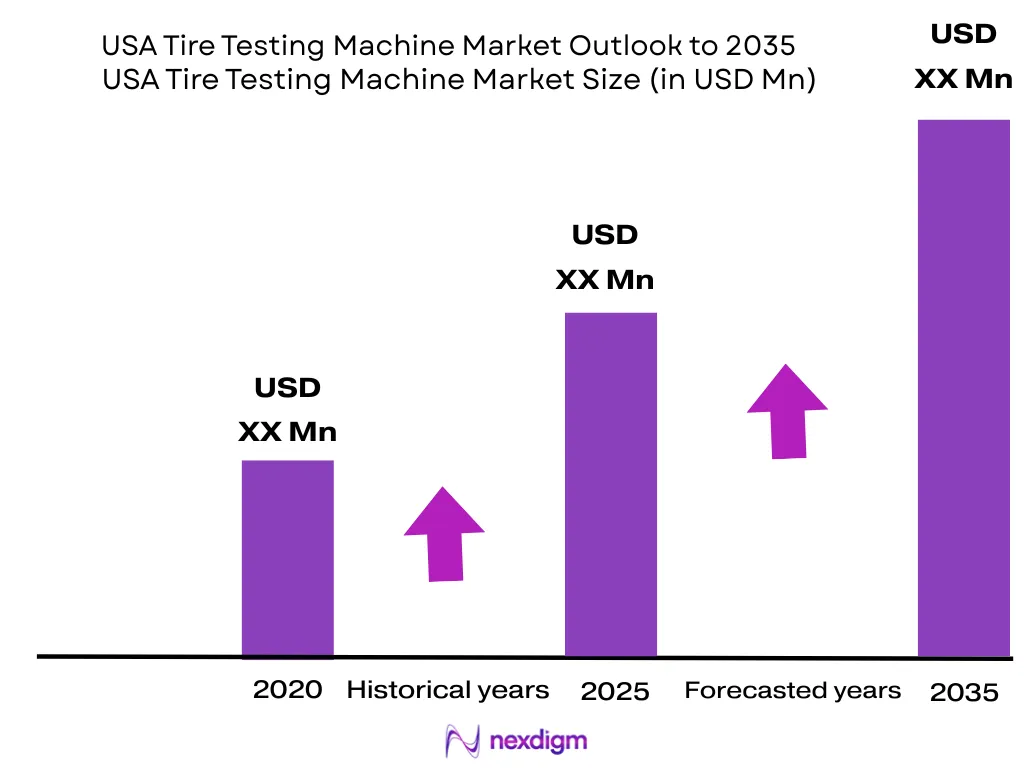
Market Overview
The USA Tire Testing Machine Market is valued at approximately ~ million, compared with ~ million in the preceding reporting period. Demand is supported by tire-manufacturing quality control, federal tire-safety compliance, rolling-resistance certification, electric-vehicle tire development, and laboratory modernisation. The U.S. economy recorded real output growth of 2.8%, while private goods-producing industries expanded by 3.4%, supporting expenditure on manufacturing equipment, research facilities, instrumentation, automation, and test-cell upgrades. Michigan, Ohio, Indiana, Tennessee, South Carolina, North Carolina, Texas, Arizona, California, and New York dominate the USA Tire Testing Machine Market. Michigan and Ohio concentrate vehicle engineering, tire research, polymers, laboratories, and automotive suppliers. Southern states host major tire and vehicle plants, creating production-line uniformity and endurance-testing demand. Arizona and Texas support hot-weather and proving-ground work, California leads EV and autonomous-vehicle development, while western New York contains established tire-performance research and testing infrastructure.
Market Segmentation
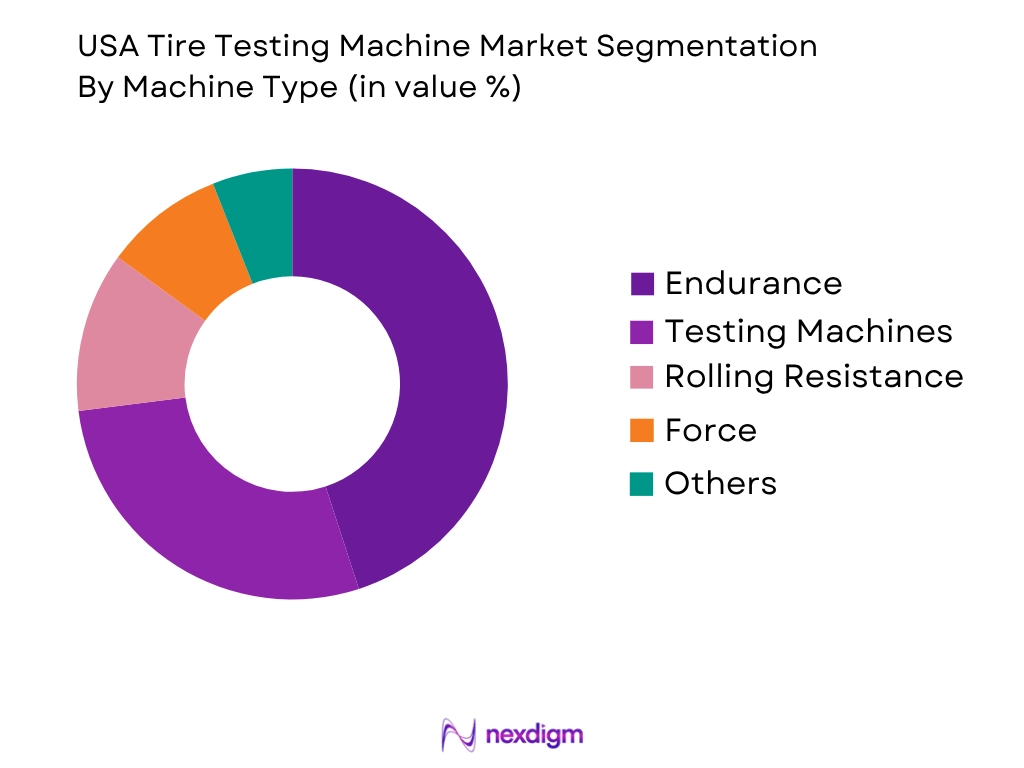
By Machine Type
By machine type, the USA Tire Testing Machine Market is segmented into endurance and high-speed machines, tire-uniformity machines, rolling-resistance systems, force-and-moment machines, non-destructive inspection systems, dynamic balancing and geometry machines, wear and traction systems, and specialty testing machines. Endurance and high-speed machines hold the dominant market share because they are central to product validation and federal safety-compliance testing. Tire manufacturers must demonstrate that regulated tires withstand prescribed loads, pressures, speeds, and test cycles without prohibited failures. Endurance machines are also used extensively during compound development, construction validation, warranty investigations, and production change approval. Multi-station machines allow laboratories to test several tires simultaneously, improving throughput and asset utilisation. High-speed systems are technically demanding because they require precision spindles, stable drums, temperature monitoring, strong containment structures, and automated shutdown logic. Commercial, light-truck, performance, and EV tires further increase load and speed requirements. Their importance across compliance, research, product qualification, and quality assurance supports the segment’s dominant revenue position.
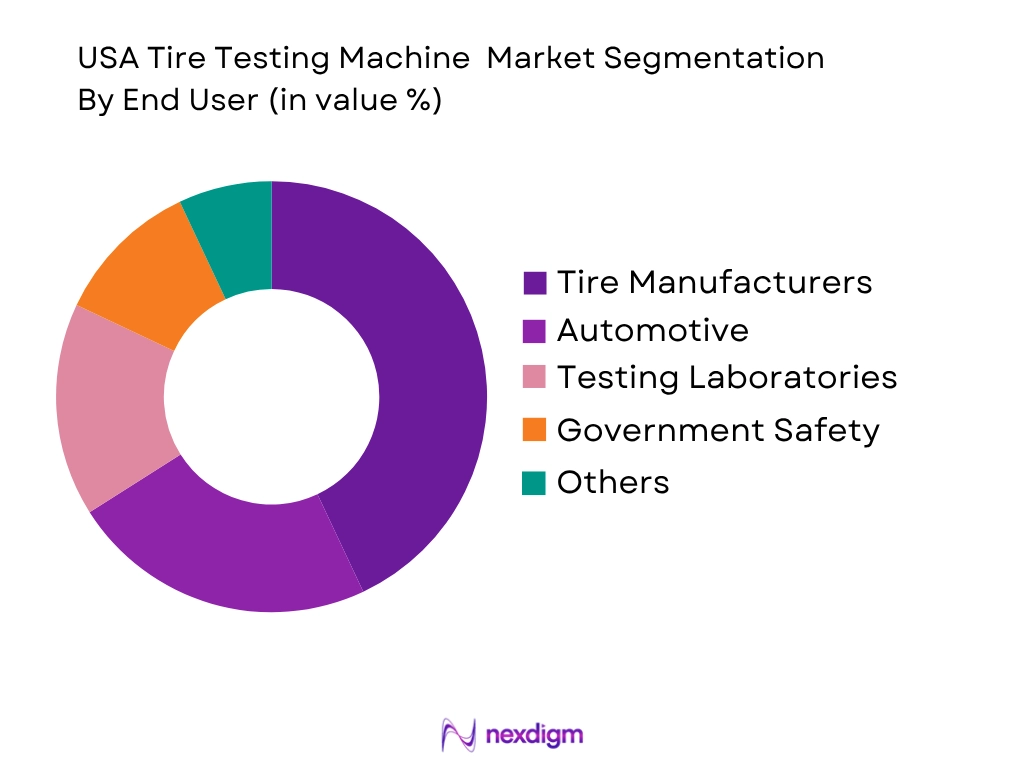
By End User
By end user, the USA Tire Testing Machine Market is segmented into tire manufacturers, automotive original equipment manufacturers, independent laboratories, government laboratories, research organisations, motorsport teams, retreaders, component suppliers, and proving-ground operators. Tire manufacturers hold the dominant market share because they require testing throughout product development and production. A single tire programme can require material screening, structural analysis, endurance testing, rolling-resistance measurement, force-and-moment characterisation, wet-grip assessment, noise analysis, uniformity inspection, and final production validation. Large tire plants also operate end-of-line uniformity, balance, geometry, and non-destructive inspection equipment continuously. Machines are therefore required both in central research laboratories and manufacturing facilities. Automotive OEMs are major users of force-and-moment, rolling-resistance, ride, and noise data, but they often combine internal testing with supplier or independent-laboratory results. Tire manufacturers generally maintain the broadest equipment base and the highest utilisation across passenger, light-truck, commercial, racing, and specialty applications.
Competitive Landscape
The USA Tire Testing Machine Market is specialised and moderately concentrated. Competition is led by established test-and-measurement companies, tire-specific machine manufacturers, laboratory operators with proprietary equipment capabilities, balancing and uniformity specialists, and industrial automation suppliers. MTS, Calspan, Kokusai, Micro-Poise, and A&D Technology compete through different combinations of test-system engineering, machine control, instrumentation, tire characterisation, production integration, and lifecycle support. Entry barriers are high because customers require measurement repeatability, machine safety, reference correlation, compliance with recognised test procedures, and long-term availability of technical support. Buyers also assess foundation requirements, maximum load, test speed, tire envelope, environmental conditioning, data-acquisition bandwidth, automation, software compatibility, spare parts, calibration, and machine uptime.
| Company | Established | Headquarters | Core Tire Capability | Maximum Application Focus | Automation Capability | Measurement Capability | U.S. Service Position | Digital Capability |
| MTS Systems | 1966 | Eden Prairie, Minnesota | ~ | ~ | ~ | ~ | ~ | ~ |
| Calspan | 1943 | Buffalo, New York | ~ | ~ | ~ | ~ | ~ | ~ |
| Kokusai | 1969 | Indianapolis, Indiana | ~ | ~ | ~ | ~ | ~ | ~ |
| Micro-Poise Measurement Systems | 1928 | Streetsboro, Ohio | ~ | ~ | ~ | ~ | ~ | ~ |
| A&D Technology | 1986 | Ann Arbor, Michigan | ~ | ~ | ~ | ~ | ~ | ~ |
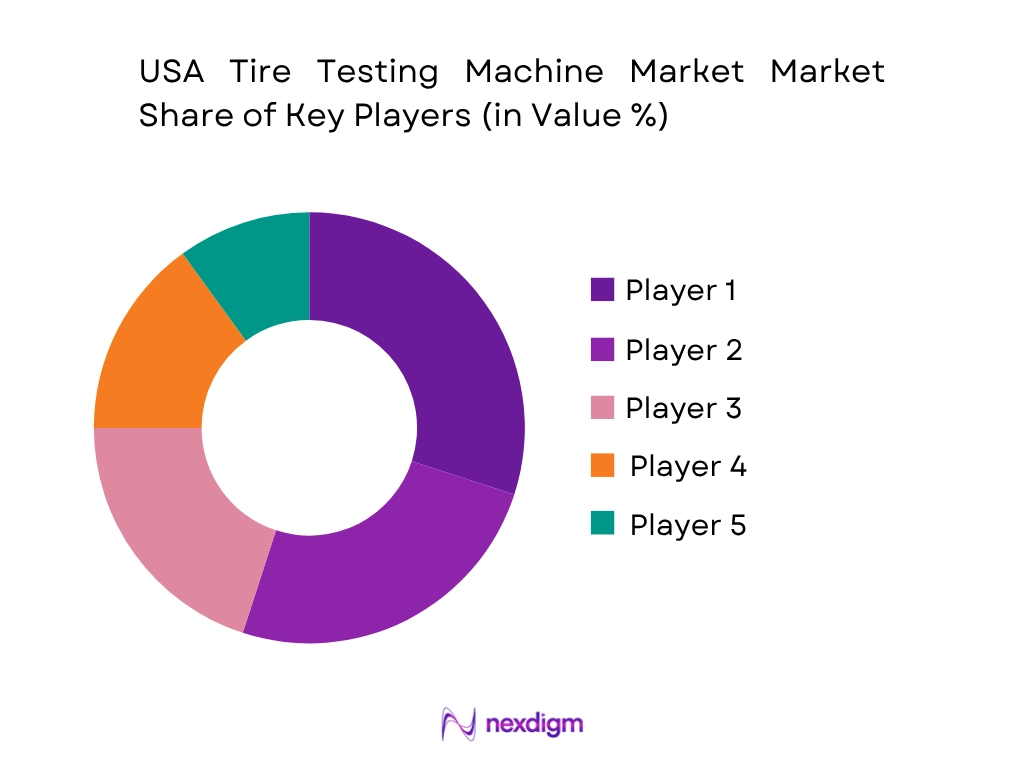
USA Tire Testing Machine Market Analysis
Growth Drivers
Federal Tire-Safety and Rolling-Resistance Testing Requirements
Federal safety and environmental requirements create recurring demand for tire endurance, high-speed, strength, bead-unseating, uniformity, and rolling-resistance testing equipment. NHTSA procedures require regulated tires to undergo controlled laboratory evaluation using specified loads, inflation pressures, speeds, rims, conditioning periods, and failure criteria. Tire manufacturers consequently require calibrated test systems not only for initial product certification but also for design changes, material substitutions, production transfers, warranty investigations, and routine conformity checks. EPA heavy-duty vehicle procedures also use tire rolling-resistance inputs within the Greenhouse Gas Emissions Model applied to regulated trucks, tractors, and vocational vehicles. SmartWay verification requires manufacturers to test at least 3 tires from a tire model and permits methods including SAE J1269 and ISO 28580, creating demand for temperature-controlled drums, force and torque measurement, reference-tire correlation, and automated result processing. U.S. real GDP expanded by 2.8% in 2024, while foreign direct investment in domestic manufacturing reached USD 2.42 trillion, providing a supportive capital-investment environment for laboratories and production facilities. As tire designs become more specialised, compliance testing increasingly requires automated recipe control, secure electronic records, high-speed containment, and traceable calibration, strengthening demand for new machines and modernisation of legacy test cells.
Electric Vehicles, Light Trucks, and Advanced Tire Development
Changes in the U.S. vehicle mix are increasing the technical demands placed on tire-testing machinery. Electric vehicles impose high vertical loads because of battery mass, rapid longitudinal forces from immediate motor torque, and stricter rolling-resistance requirements linked to driving range. Reduced powertrain noise also makes tire cavity noise, tread impact, and road-induced vibration more noticeable, increasing demand for force-and-moment, endurance, wear, rolling-resistance, thermal, acoustic, and contact-patch testing systems. Electrified vehicles accounted for 10.2% of new U.S. light-duty sales in 2024, and 144 electric car, utility vehicle, pickup, and van models were available during the fourth quarter. Light trucks represented 81.3% of all new light-vehicle sales, requiring equipment with wider tire envelopes, heavier spindle capacity, greater vertical loading, and more robust safety enclosures than conventional passenger-car machines. These vehicle trends create additional development programmes across electric SUVs, pickups, delivery vans, and commercial platforms. Tire companies and automotive manufacturers must characterise combined slip, camber thrust, aligning torque, high-load durability, regenerative-braking effects, and wear under repeated acceleration. As a result, laboratories are investing in multi-axis flat-belt systems, high-capacity rolling-resistance machines, automated tire conditioning, and software capable of generating digital tire models for virtual vehicle development.
Market Challenges
High Capital Requirements and Complex Test-Cell Infrastructure
Tire-testing machines require substantial supporting infrastructure beyond the machine itself. High-speed endurance systems need reinforced foundations, containment structures, ventilation, fire protection, electrical drives, compressed air, cooling, pressure control, and remote operator stations. Flat-belt and force-and-moment systems require precision alignment, multi-axis load cells, controlled belt tension, high-speed data acquisition, and regular surface replacement. Rolling-resistance laboratories need stable temperature, humidity, inflation pressure, drum geometry, bearing-loss correction, and reference-tire correlation. These requirements make procurement difficult for smaller laboratories, component suppliers, retreaders, and emerging mobility companies. Installation and commissioning can also interrupt existing laboratory operations and require custom civil works. U.S. machinery manufacturing employed approximately 29,140 mechanical engineers, 19,000 industrial engineers, and 17,590 inspectors and testers in major machinery subsectors during 2024, illustrating the specialised workforce required to design, build, verify, and maintain advanced equipment. Rubber-product manufacturing separately employed 3,950 industrial machinery mechanics and 5,630 inspectors and testers. Competition for these skills raises execution risk for customers and suppliers. When capital budgets are constrained, users often extend machine life through partial retrofits, which can preserve mechanical frames but leave fragmented controls, incompatible software, and uneven measurement quality across laboratories.
Calibration Complexity and Shortage of Specialised Technical Personnel
Reliable tire testing depends on measurement repeatability rather than machine operation alone. Load cells, torque transducers, pressure sensors, speed encoders, displacement systems, environmental controls, and data-acquisition channels must remain calibrated and traceable. Rolling-resistance machines also require correction for machine losses, drum diameter, temperature, and reference-tire behaviour. Small errors can change compliance conclusions or produce inaccurate tire-model coefficients for vehicle simulation. Force-and-moment machines are particularly demanding because they measure longitudinal force, lateral force, vertical force, aligning moment, overturning moment, and rolling resistance under combinations of slip angle, camber, load, pressure, and speed. Laboratories therefore require engineers who understand tire mechanics, control systems, instrumentation, statistics, software, and regulatory procedures. BLS recorded 5,630 inspectors, testers, sorters, samplers, and weighers in U.S. rubber-product manufacturing during 2024, alongside 2,810 industrial engineers and 3,950 industrial machinery mechanics. Across the broader economy, approximately 69,900 quality-control inspector openings are projected annually, largely because existing workers retire or transfer occupations. This replacement requirement can intensify competition for skilled personnel. Inadequate staffing increases machine downtime, delays calibration, weakens data review, and raises dependence on external service providers, particularly for legacy systems with proprietary controls or discontinued components.
Market Opportunities
Automated, Connected, and AI-Enabled Tire Laboratories
The existing U.S. manufacturing and testing base creates a substantial opportunity for automated laboratories, machine retrofits, and connected test operations. Tire plants can integrate robotic loading, automatic rim mounting, inflation, conditioning, recipe selection, testing, marking, sorting, and reporting into a continuous workflow. Independent laboratories can use connected machines to increase utilisation and remotely supervise long-duration endurance cycles. Artificial intelligence can classify X-ray, shearography, geometry, and machine-vision images for belt displacement, trapped air, cord irregularity, bead defects, tread separation, and sidewall anomalies. Predictive maintenance can analyse spindle vibration, bearing temperature, hydraulic pressure, belt condition, and calibration drift before failure disrupts testing. U.S. navigational, measuring, and control-instrument manufacturing employed 33,340 software developers, 15,950 industrial engineers, 10,430 mechanical engineers, and 10,280 electrical engineers during 2024, providing a strong technical base for machine digitalisation. The country’s manufacturing investment position is also significant: foreign direct investment in U.S. manufacturing reached USD 2.42 trillion, and manufacturing recorded the largest industry increase in foreign investment during 2024. Machine suppliers can use this environment to offer digital-twin integration, cloud-based test management, automated compliance records, cybersecurity upgrades, remote diagnostics, and multiyear software subscriptions alongside physical equipment.
Heavy-Duty Electrification and New Tire-Architecture Testing
Federal investment in zero-emission freight and continued development of electric commercial vehicles create future demand for specialised heavy-duty tire testing. The U.S. government announced USD 1.5 billion in 2024 to support the transition of medium- and heavy-duty vehicles toward zero-emission technologies. Electric trucks combine high curb weight, concentrated axle loads, regenerative braking, immediate torque, and demanding fleet utilisation, requiring tire machines capable of measuring load-dependent rolling resistance, tread wear, heat build-up, bead durability, transient forces, and wide-base tire behaviour. Commercial fleets also need verified rolling-resistance data because tire performance influences energy consumption and operating range. New opportunities extend beyond conventional pneumatic tires. Non-pneumatic structures, sensor-integrated tires, sustainable compounds, retreadable electric-truck casings, and advanced low-resistance tread materials require different test fixtures and measurement routines. Suppliers can develop modular high-load platforms that combine endurance, torque, temperature, footprint, and rolling-resistance testing in one cell. Testing-as-a-service is another opportunity for vehicle start-ups, material developers, and fleet technology companies that cannot justify dedicated equipment. Existing labour capacity in rubber manufacturing—including 19,800 tire builders, 16,810 forming and pressing machine operators, and 5,630 inspectors and testers—provides an industrial base for product development and validation.
Future Outlook
The USA Tire Testing Machine Market is forecast to expand at approximately ~ CAGR during the forecast period. Growth will be shaped by electric-vehicle tire requirements, heavy-duty rolling-resistance regulation, automated tire production, smart-tire development, virtual vehicle engineering, and replacement of legacy machines.nElectric vehicles create demanding tire conditions. High battery mass raises vertical loads, immediate motor torque increases longitudinal stress, and reduced powertrain noise makes tire cavity noise and road excitation more noticeable. EV development therefore requires machines capable of testing high-load endurance, torque response, rolling resistance, wear, thermal behaviour, force and moment, and acoustic characteristics. Electrified vehicles represented 10.9% of new U.S. light-duty sales in the fourth quarter of 2024, with 144 models available across battery-electric, plug-in hybrid, and fuel-cell categories. This broadening model portfolio supports additional tire-development and validation programmes across passenger cars, SUVs, pickups, vans, and premium performance vehicles. Light trucks represented 81.3% of U.S. new light-vehicle sales in 2024, increasing demand for equipment capable of testing larger, heavier, higher-load tires used on SUVs, crossovers, pickups, and vans. These products require wider machine envelopes, increased spindle capacity, higher vertical loads, and more robust containment.
Major Players
- MTS Systems
- Calspan Tire Research Facility
- A&D Technology
- Kokusai
- Micro-Poise Measurement Systems
- ZF Test Systems
- Instron
- Illinois Tool Works
- TMSI
- Hofmann Maschinen- und Anlagenbau
- Akron Standard
- Leonardo Automation
- Kobe Steel
- Tire Testing International
- Larsen & Toubro Rubber Processing Machinery
Key Target Audience
- Tire manufacturers and retread producers
- Automotive, electric-vehicle and commercial-vehicle manufacturers
- Independent tire testing and certification laboratories
- Tire uniformity, inspection and production-equipment integrators
- Tire material, compound, sensor and smart-tire developers
- Motorsport, aircraft, defense and off-highway tire developers
- Investments and venture capitalist firms
- Government and regulatory bodies (National Highway Traffic Safety Administration, Environmental Protection Agency, Department of Transportation, National Institute of Standards and Technology, and Occupational Safety and Health Administration)
Research Methodology
Step 1: Identification of Key Variables
The first phase constructs an ecosystem map covering machine manufacturers, tire producers, automotive OEMs, laboratories, regulators, sensor suppliers, system integrators, calibration providers, and service companies. Key variables include machine type, load range, speed, tire envelope, installed base, utilisation, price, automation, application, and replacement cycle.
Step 2: Market Analysis and Construction
Historical tire-production activity, automotive output, laboratory investment, regulatory testing, machine shipments, retrofits, and service revenue are compiled. Top-down analysis allocates capital-equipment spending to tire testing, while bottom-up analysis aggregates machine installations, average selling values, retrofit expenditure, and recurring lifecycle services.
Step 3: Supply-Side Assessment
Suppliers are evaluated by product breadth, measurement accuracy, maximum speed, maximum load, force-axis capability, automation, software, regulatory compatibility, U.S. service coverage, calibration support, installed base, and custom-engineering capability.
Step 4: Demand-Side Assessment
Tire manufacturers, automotive OEMs, EV developers, independent laboratories, government facilities, retreaders, motorsport users, and research organisations are assessed by annual test volume, machine utilisation, outsourcing behaviour, compliance requirements, capital budgets, and procurement criteria.
Step 5: Hypothesis Validation and Expert Consultation
Market hypotheses are validated through interviews with test engineers, laboratory managers, tire-development specialists, machine suppliers, calibration companies, manufacturing engineers, and procurement executives. Consultations examine capacity constraints, machine age, pricing, lead times, retrofit demand, and EV testing requirements.

- Executive Summary
- Research Methodology (Market Definitions and Assumptions, Abbreviations, Tire Testing Machine Market Boundary, Capital Equipment Revenue Recognition, Installed Base Assessment, New Machine Shipment Assessment, Retrofit and Modernisation Assessment, Top-Down Analysis, Bottom-Up Analysis, Demand-Side Assessment, Supply-Side Assessment, Tire Plant Capacity Mapping, Testing Laboratory Mapping, Primary Industry Interviews, Machine Price Benchmarking, Data Triangulation, Forecasting Framework, Limitations and Future Conclusions)

- Definition and Scope
- Market Evolution and Industry Genesis
- Timeline of Major Industry Developments
- Evolution from Mechanical Test Rigs to Automated Multi-Axis Systems
- Tire Testing Machine Industry Business Cycle

- Growth Drivers (FMVSS Compliance, Tire Production Quality, EV Tire Validation, Heavy-Duty Rolling Resistance, Automated Inspection, Laboratory Modernisation)
- Market Challenges (High Capital Cost, Long Qualification Cycles, Calibration Complexity, Skilled Labour, Machine Downtime, Technology Obsolescence)
- Market Opportunities (EV High-Load Tires, Automated Testing, Smart Tire Validation, Digital Twins, Retread Testing, Testing Services)
- Market Trends (Automation, Electrification, Multi-Axis Testing, AI Inspection, Virtual Engineering, Connected Laboratories)
- Government Regulations and Industry Standards (FMVSS Requirements, EPA Procedures, SAE Methods, ISO Methods, Calibration, Laboratory Accreditation)
- SWOT Analysis
- Porter’s Five Forces Analysis
- PESTLE Analysis

- By Market Value (2020-2025)
- By New Machine Sales Value (2020-2025)
- By Retrofit and Modernisation Value (2020-2025)

- By Machine Type (In Value %)
Tire Endurance Testing Machines
High-Speed Performance Testing Machines
Rolling Resistance Testing Machines
Tire Uniformity Testing Machines
Force and Moment Testing Machines - By Tire Category (In Value %)
Passenger Car Tires
SUV and Crossover Tires
Light Truck Tires
Pickup Tires
Commercial Truck Tires - By End User (In Value %)
Tire Manufacturers
Automotive Original Equipment Manufacturers
Electric Vehicle Manufacturers
Commercial Vehicle Manufacturers
Motorcycle Manufacturers
Aircraft Tire Manufacturers - By Geographic Region (In Value %)
Northeast United States
Midwest United States
South United States
West United States

- Market Share of Major Players (By Value, Unit Shipments, Machine Type, End User, Application)
- Cross Comparison Parameters (Machine Portfolio Breadth, Maximum Tire Load and Speed Envelope, Force–Moment–Rolling Resistance Measurement Accuracy, FMVSS–EPA–SAE–ISO Test Method Compatibility, Flat-Belt–Drum–Uniformity–Inspection Technology Capability, Automation–Robotic Handling–Data Acquisition–Digital Twin Integration, United States Installed Base–Field Service–Calibration–Spare Parts Coverage, EV–Commercial Truck–Smart Tire–Non-Pneumatic Tire Testing Readiness)
- SWOT Analysis of Major Players
- Detailed Profiles of Major Companies
MTS Systems
Calspan Tire Research Facility
A&D Technology
Kokusai
Tire Testing International
Micro-Poise Measurement Systems
Larsen & Toubro Rubber Processing Machinery
Kobe Steel
ZF Test Systems
Instron
Illinois Tool Works
TMSI
Leonardo Automation
Hofmann Maschinen- und Anlagenbau
Akron Standard

- Tire Manufacturer Analysis
- Passenger Vehicle OEM Analysis
- Electric Vehicle Manufacturer Analysis
- Commercial Vehicle OEM Analysis
- Aircraft Tire Manufacturer Analysis

- By Market Value
- By New Machine Sales Value
- By Retrofit and Modernisation Value


 Request a Sample
 Ask for Customization
 Get a Quote
 Enquire Now