
 Download PDF
Market Overview
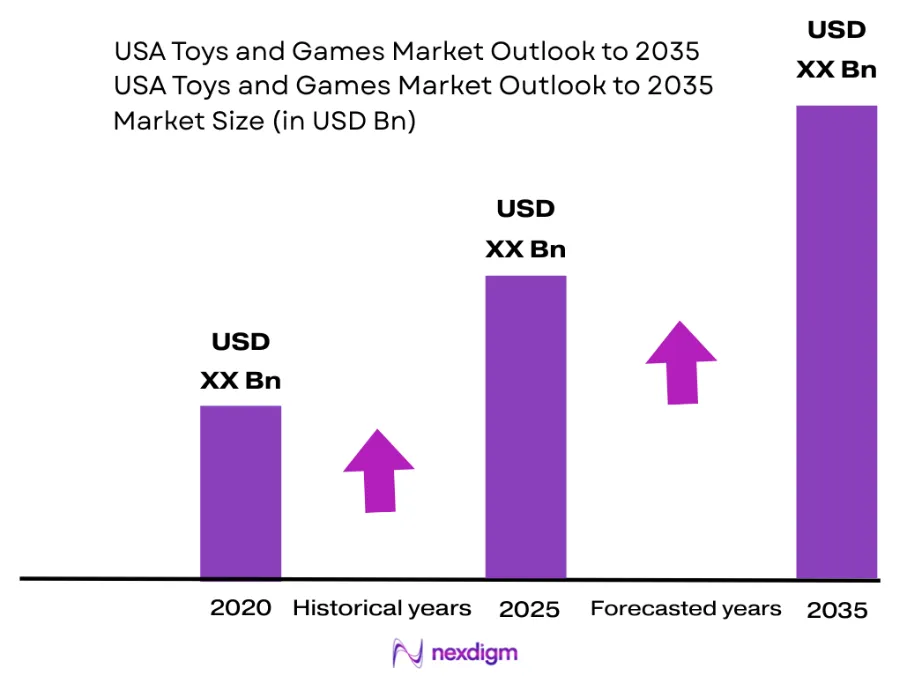
The USA Toys and Games Market is valued at USD ~ billion, supported by licensed toys, games, puzzles, plush, building sets, dolls, action figures, collectibles and kidult purchases. U.S. toy dollar sales declined by 0.3%, improving from a 7% decline in the preceding cycle, showing market stabilization after post-pandemic correction. Growth is supported by mass retail, e-commerce, licensed entertainment, trading cards and adult collector demand. California, Texas, Florida and New York dominate the USA Toys and Games Market because they combine large child populations, dense retail networks, entertainment licensing ecosystems, port access, e-commerce fulfilment and high holiday gifting demand. California had 39,431,263 residents, Texas 31,290,831, Florida 23,372,215 and New York 19,867,248, creating large buyer bases for toys, games, collectibles, preschool products, licensed merchandise and outdoor play products.
Market Segmentation
By Product Category
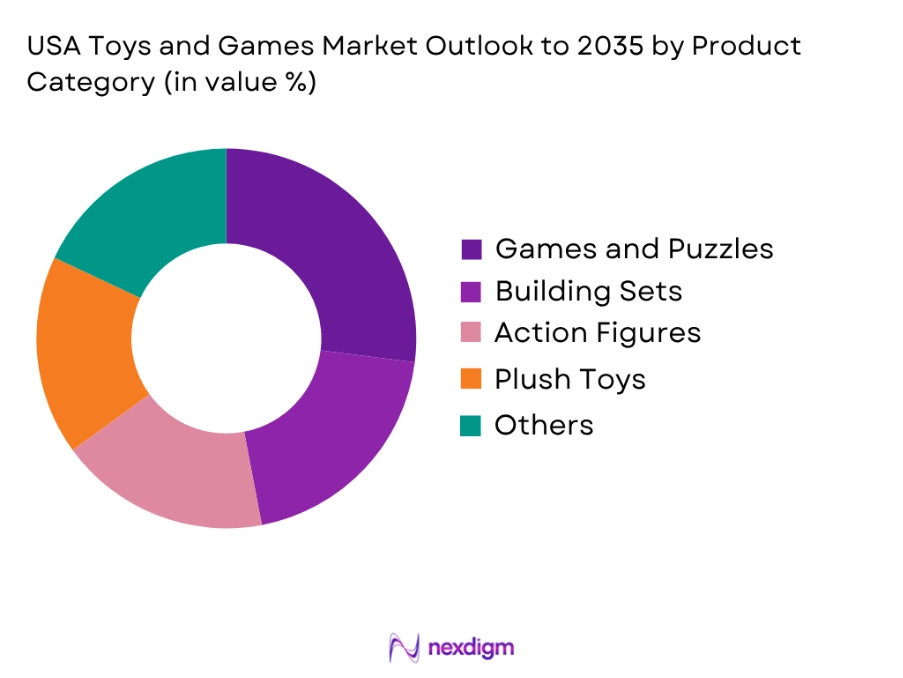
USA Toys and Games Market is segmented by product category into action figures, dolls, plush, building sets, games and puzzles, outdoor and sports toys, infant and preschool toys, arts and crafts, STEM toys, trading cards and collectibles. Recently, games and puzzles have a dominant market share in the USA under the product category segmentation, due to their strong appeal across children, families, teens, adults, hobby gamers and collectors. The category benefits from family game nights, party games, strategy games, tabletop communities, licensed card games and adult social play. Building sets and collectibles are also expanding because kidult consumers are purchasing nostalgia-led and display-oriented products. Circana reported that building sets grew strongly across tracked global markets, while plush and games and puzzles also increased sales, showing resilience in tactile and social-play categories.
By Distribution Channel
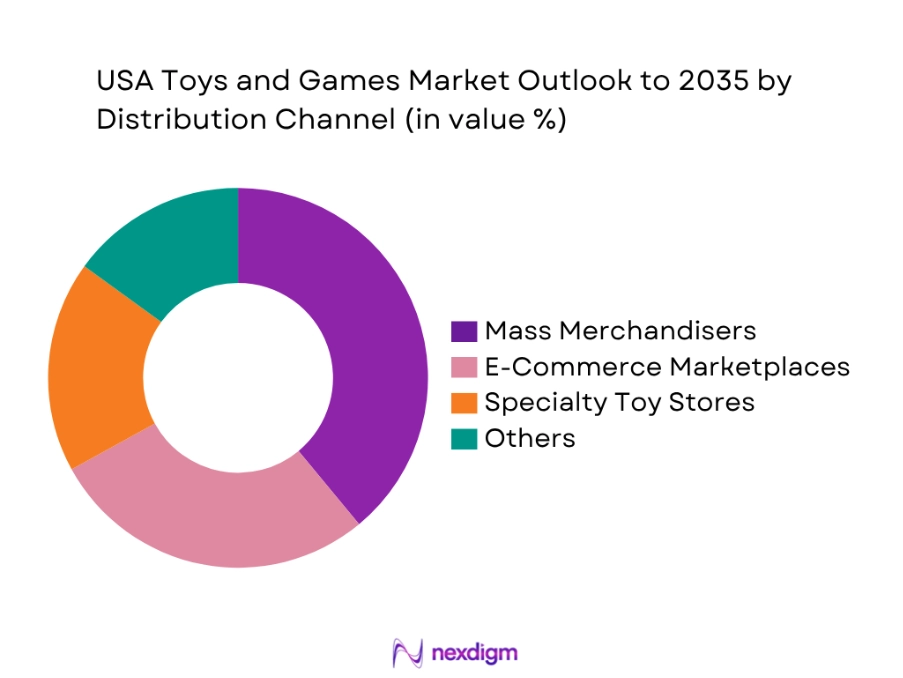
USA Toys and Games Market is segmented by distribution channel into mass merchandisers, e-commerce marketplaces, specialty toy stores, club stores, hobby/game stores and direct-to-consumer brand channels. Recently, mass merchandisers have a dominant market share in the USA under the distribution channel segmentation, due to Walmart and Target’s scale, holiday toy lists, exclusive SKUs, promotional depth, omnichannel fulfilment and broad category coverage. These retailers are central to parents, grandparents and gift buyers because toys are purchased frequently during birthdays, back-to-school, Halloween, Black Friday and Christmas. E-commerce marketplaces are also significant because online reviews, fast delivery and marketplace assortment influence toy discovery. Specialty and hobby stores remain important for premium games, collectibles, trading cards and community-led purchases, while D2C platforms are increasingly relevant for limited-edition drops and adult collectors.
Competitive Landscape
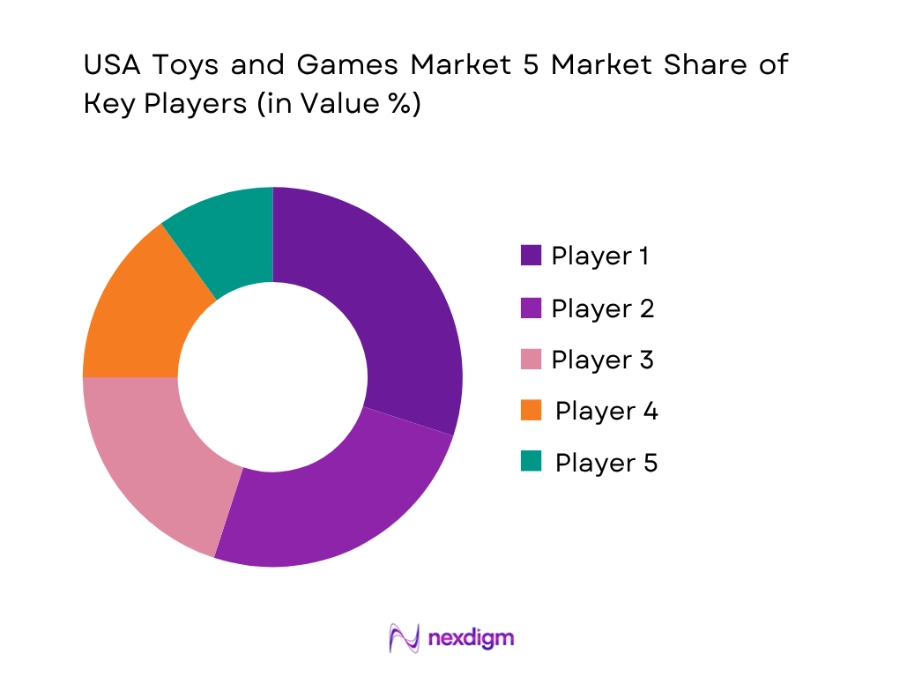
The USA Toys and Games Market is dominated by a mix of global toy majors, licensed IP owners, building-set specialists, collectible companies, game publishers and fast-moving challenger brands. Mattel, Hasbro, LEGO, MGA Entertainment and Spin Master remain highly influential due to their brand portfolios, retail reach, licensing access, innovation pipelines and global sourcing capabilities. Competition is shaped by mass retail shelf space, entertainment tie-ins, kidult and collector monetization, e-commerce performance, safety compliance, holiday inventory planning and exposure to imported manufacturing. U.S. toy sales stabilization has increased focus on resilient categories such as building sets, games and puzzles, plush and fan-oriented collectibles.
| Company | Establishment Year | Headquarters | Core Toy Portfolio | Licensing Strength | Channel Strength | Consumer Cohort Focus | Innovation Focus | Strategic Positioning |
| Mattel | 1945 | El Segundo, California | ~ | ~ | ~ | ~ | ~ | ~ |
| Hasbro | 1923 | Pawtucket, Rhode Island | ~ | ~ | ~ | ~ | ~ | ~ |
| The LEGO Group | 1932 | Billund, Denmark | ~ | ~ | ~ | ~ | ~ | ~ |
| MGA Entertainment | 1979 | Chatsworth, California | ~ | ~ | ~ | ~ | ~ | ~ |
| Spin Master | 1994 | Toronto, Canada | ~ | ~ | ~ | ~ | ~ | ~ |
USA Toys and Games Market
Growth Drivers
Large Child Population and Household Gifting Base Supporting Core Toy Demand
The USA Toys and Games Market is supported by a large addressable child population, which directly sustains demand for dolls, action figures, preschool toys, plush, outdoor play products, STEM toys, board games, puzzles and licensed character merchandise. The U.S. Census Bureau records the population under age 18 at 73.1 million in 2024, creating a large direct user base for age-graded toys and games. The World Bank records U.S. GDP at USD 28.75 trillion and GDP per capita at USD 84,534.0 in 2024, supporting household spending capacity for birthdays, holidays, educational play and entertainment-linked toys. The Census Bureau also records the total U.S. population at 340,110,988 in 2024, showing the size of the parent, grandparent and gift-buyer base around child consumers. For toy companies, this demographic base supports mass retail shelf depth, seasonal promotions, licensed toy rollouts, school-age play products and recurring gift occasions across Walmart, Target, Amazon, specialty stores and direct-to-consumer channels.
E-Commerce and Omnichannel Retail Scale Expanding Toy Discovery
The USA Toys and Games Market is driven by the scale of digital retail and omnichannel fulfilment, which is particularly relevant for toys because parents, collectors and gift buyers increasingly discover SKUs through online reviews, holiday lists, marketplace rankings, influencer content and brand-owned launches. The U.S. Census Bureau records adjusted U.S. retail e-commerce sales at USD 326.7 billion in the first quarter of 2026, while total retail sales reached USD 1,929.0 billion in the same quarter. In the fourth quarter of 2024, not-adjusted retail e-commerce sales reached USD 352.9 billion, reflecting the strength of holiday online shopping, when toys, games, puzzles, trading cards, plush, collectibles and licensed products typically receive high promotional visibility. The World Bank records U.S. GDP at USD 28.75 trillion in 2024, and the IMF records U.S. GDP at USD 32.38 trillion in 2026, supporting the scale of consumer commerce infrastructure. For toy brands, this creates stronger reach through Amazon, Walmart.com, Target.com, LEGO.com, Mattel Creations, Hasbro Pulse and collector-focused product drops.
Market Challenges
Toy Safety Compliance and Recall Exposure
The USA Toys and Games Market faces a compliance challenge because children’s toys must meet strict safety rules for small parts, age grading, chemical limits, batteries, magnets, flammability, mechanical hazards and labelling. The U.S. Consumer Product Safety Commission completed 333 cooperative voluntary recalls in FY 2024, showing the scale of corrective action activity across consumer products under its jurisdiction. CPSC’s toy safety guidance also states that toys must have age labels when a toy presents a choking hazard for children under 3 years old, directly affecting preschool toys, infant toys, plush accessories, small collectibles, activity kits and electronic toys. The challenge is amplified by the size of the U.S. consumption base: the Census Bureau records 73.1 million residents under age 18 in 2024, while the World Bank records GDP per capita at USD 84,534.0 in 2024. In this environment, brands must maintain testing, Children’s Product Certificates, ASTM F963 alignment, recall response systems and retailer compliance documentation to protect shelf access and consumer trust.
Import and Supply-Chain Exposure for Seasonal Toy Inventory
The USA Toys and Games Market is challenged by import dependence and seasonal inventory pressure because toys are heavily tied to holiday demand, retailer planograms, licensed entertainment calendars and fast-moving trend cycles. U.S. Census trade data for China states that trade figures are reported in millions of U.S. dollars, while external trade tracking of toys, games and sports requisites records U.S. imports from China at USD 20.19 billion in 2025, showing the importance of overseas sourcing for toys and games. This matters because action figures, dolls, plush, electronic toys, board games, collectibles and seasonal outdoor toys must reach U.S. distribution centres before key promotional windows. The World Bank records U.S. GDP at USD 28.75 trillion in 2024, and the IMF records U.S. GDP at USD 32.38 trillion in 2026, showing the size of the consumer economy that must be served by reliable imports and domestic distribution. For brands and retailers, delays can create markdown exposure, missed movie tie-ins, stockouts and weaker holiday sell-through.
Market Opportunities
Premium Collectibles, Games and Kidult-Focused Product Expansion
The USA Toys and Games Market has an opportunity in premium collectibles, tabletop games, trading cards, licensed figures, building sets and nostalgia-led products because the country has a large adult buyer base alongside its child user base. The U.S. Census Bureau records the population age 65 and older at 61.2 million in 2024, while the under-18 population is 73.1 million, indicating a multi-generational gifting and collecting ecosystem that includes parents, grandparents, adult fans and children. The World Bank records U.S. GDP per capita at USD 84,534.0 in 2024, supporting discretionary purchasing for premium LEGO sets, collector figures, trading cards, limited-edition plush, board games and fandom merchandise. IMF records U.S. GDP at USD 32.38 trillion in 2026, reinforcing the scale of the formal consumer economy available to toy brands. This opportunity reflects future growth because adult-oriented product lines can reduce dependence on child-only demand and extend monetization through limited drops, hobby communities, convention releases, D2C stores and licensed entertainment franchises.
Digital Retail, D2C Launches and Licensed Toy Drops
The USA Toys and Games Market has a future growth opportunity in digital-first distribution, direct-to-consumer launches and licensed toy drops because the U.S. has a large online retail infrastructure that supports toy discovery, pre-orders, exclusives and collector communities. The U.S. Census Bureau records adjusted retail e-commerce sales of USD 326.7 billion in the first quarter of 2026 and total retail sales of USD 1,929.0 billion in the same quarter. In the fourth quarter of 2024, not-adjusted retail e-commerce sales reached USD 352.9 billion, a period that aligns with holiday gift buying and toy promotional intensity. The World Bank records U.S. population at 340,110,988 in 2024 and GDP at USD 28.75 trillion, providing a large buyer base for online toy retail. For toy manufacturers, this supports expansion through Amazon, Walmart.com, Target.com, LEGO.com, Mattel Creations, Hasbro Pulse and Funko Shop, especially for licensed movie toys, gaming IP, anime collectibles, trading cards, plush drops, STEM kits and limited-edition fan merchandise.
Future Outlook
Over the next phase, the USA Toys and Games Market is expected to expand through licensed entertainment, kidult demand, collectibles, games, puzzles, STEM toys, outdoor play and direct-to-consumer fan platforms. The market is projected to grow at a 5.9% CAGR, with long-term demand supported by premium toys, adult collector products, gaming-linked IP, educational play and digital-first toy discovery. Mass retailers will remain central, but e-commerce, marketplace sellers and brand-owned D2C stores will continue gaining relevance for limited drops, exclusive SKUs and collector launches. Supply-chain diversification, toy safety compliance, tariff exposure, sustainability and product lifecycle management will shape brand strategy through 2035.
Major Players
- Mattel
- Hasbro
- The LEGO Group
- MGA Entertainment
- Spin Master
- Jazwares
- Funko
- JAKKS Pacific
- Moose Toys
- Basic Fun!
- VTech
- Melissa & Doug
- Ravensburger
- Goliath Games
- ZURU
Key Target Audience
- Toy manufacturers and brand owners
- Licensed merchandise companies
- Mass retailers and omnichannel toy category teams
- E-commerce marketplaces and direct-to-consumer toy platforms
- Specialty toy retailers and hobby/game retailers
- Entertainment studios and intellectual property licensors
- Investments and venture capitalist firms
- Government and regulatory bodies, including U.S. Consumer Product Safety Commission, Federal Trade Commission, U.S. Customs and Border Protection, Office of the United States Trade Representative
Research Methodology
Step 1: Identification of Key Variables
The initial phase involves constructing an ecosystem map for the USA Toys and Games Market, covering manufacturers, licensors, retailers, e-commerce platforms, distributors, contract manufacturers, collectors, parents and regulators. The objective is to define key variables such as product category mix, licensed IP dependence, channel structure, seasonality, consumer cohort demand and safety compliance.
Step 2: Market Analysis and Construction
In this phase, historical and current data is compiled using retail sales indicators, public company filings, brand portfolios, product-level shelf checks, marketplace listings and industry sales references. The market is constructed across toys, games, puzzles, plush, dolls, action figures, building sets, collectibles, STEM toys, outdoor toys and licensed merchandise.
Step 3: Hypothesis Validation and Expert Consultation
Market hypotheses are validated through computer-assisted interviews with toy manufacturers, retail category managers, licensors, distributors, specialty toy stores, hobby retailers and e-commerce sellers. These discussions validate category demand, channel concentration, price-tier movement, collector behavior, licensed-property performance, inventory planning and holiday-season dynamics.
Step 4: Research Synthesis and Final Output
The final phase combines top-down market sizing with bottom-up SKU, company and channel intelligence. This process validates segmentation, competitive landscape, growth outlook and strategic recommendations. The final output supports manufacturers, retailers, licensors, investors and regulatory stakeholders evaluating the USA Toys and Games Market.

- Executive Summary
- Research Methodology (Market Definitions and Assumptions, Abbreviations, Market Sizing Approach, Top-Down Retail Sales Assessment, Bottom-Up SKU and Channel Mapping, POS Data Review, Brand Portfolio Benchmarking, Licensing and Entertainment Content Mapping, Primary Interviews with Retail Buyers/Manufacturers/Distributors/Licensors, Limitations and Forecast Assumptions)

- Definition and Scope
- Market Genesis
- Business Cycle
- Supply Chain and Value Chain Analysis

- Growth Drivers (Licensed Entertainment Content, Kidult and Collector Demand, Games and Puzzles Growth, Building Set Momentum, E-Commerce Convenience, STEM Learning Demand, Outdoor Play Renewal, Gift-Giving Culture)
- Market Challenges (Tariffs, China Manufacturing Dependence, Retailer Consolidation, Inventory Risk, Product Recalls, Digital Entertainment Competition, Short Product Life Cycles, Counterfeit Toys)
- Opportunities (Collector Platforms, Premium Licensed Toys, Sustainability, STEM Learning, Preschool Development, Adaptive Toys, AI-Enabled Play, D2C Communities, Experiential Retail)
- Market Trends (Collectibles, Blind Boxes, Trading Cards, Nostalgia Toys, Anime Licensing, Movie Tie-Ins, AI Toys, Screen-Free Play, Social Play, Sustainable Packaging)
- Government Regulation (CPSC, CPSIA, ASTM F963-23, Lead Limits, Phthalate Restrictions, Small Parts Regulation, Battery Safety, Labeling, Age Grading, Recall Reporting)
- Supply Chain and Import Analysis (China Sourcing, Vietnam and Mexico Diversification, Domestic Assembly, Port Logistics, Tariff Exposure, Retail Distribution Centers, Seasonal Inventory Builds)
- SWOT Analysis
- Stakeholder Ecosystem
- Porter’s Five Forces Analysis
- PESTLE Analysis
- Competition Ecosystem

- By Value (2020-2025)
- By Volume (2020-2025)
- By Average Selling Price (2020-2025)

- By Product Category (In Value %)
Action Figures and Accessories
Dolls and Role-Play Toys
Plush Toys
Building Sets
Games and Puzzles - By Age Group (In Value %)
Infants and Toddlers
Preschool Children
Early Elementary Children
Tweens and Teens
Adults and Kidults - By Distribution Channel (In Value %)
Mass Merchandisers
E-Commerce Marketplaces
Specialty Toy Stores
Club Stores
Hobby and Game Stores - By Geography (In Value %)
West
South
Midwest
Northeast

- Market Share of Major Players (Value Share, Volume Share, Category Share, Retail Channel Share, E-Commerce Share, Licensed Toy Share, Collectible Share)
- Cross Comparison Parameters (Brand Portfolio Dolls/Action Figures/Games/Plush/Building Sets/Collectibles; Licensed IP Strength Movies/TV/Gaming/Anime/Sports/Original IP; Retail Channel Reach Walmart/Target/Amazon/Costco/Specialty/D2C; Innovation Pipeline STEM/AI Toys/Interactive Play/Collectibles/Sustainable Toys; Manufacturing and Sourcing Network China/Vietnam/Mexico/U.S./Contract Manufacturing; Safety and Compliance Capability)
- SWOT Analysis of Major Players
- Pricing Analysis Basis SKUs
- Detailed Profiles of Major Companies
Mattel
Hasbro
The LEGO Group
MGA Entertainment
Spin Master
Jazwares
Funko
JAKKS Pacific
Moose Toys
Basic Fun!
VTech
Melissa & Doug
Ravensburger
Goliath Games
ZURU

- Parent and Household Buyer Analysis
- Child and Age-Cohort Demand Analysis
- Kidult and Collector Analysis
- Gift Buyer Analysis
- Hobby Gamer Analysis

- By Value (2026-2035)
- By Volume (2026-2035)
- By Average Selling Price (2026-2035)


 Request a Sample
 Ask for Customization
 Get a Quote
 Enquire Now