

 Download PDF
 Download PDF
Market Overview
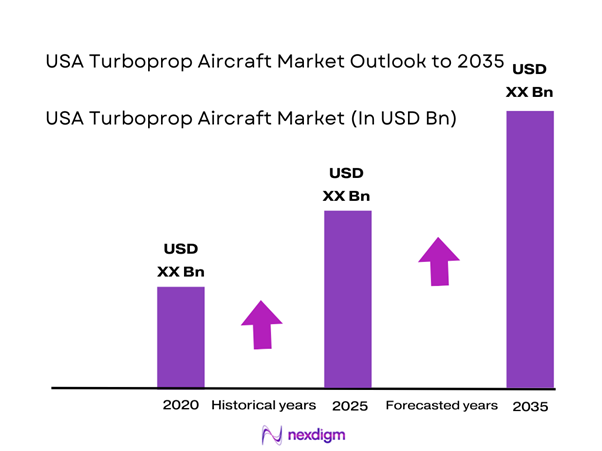
The USA Turboprop Aircraft Market current size stands at around USD ~ million, supported by steady fleet utilization and replacement demand across multiple aviation segments. Aircraft deliveries remained stable with approximately ~ units operationally active, while average utilization hours increased during recent periods. Regional connectivity programs and fleet modernization initiatives sustained consistent procurement interest. The market reflects balanced demand between commercial, cargo, and government applications, supported by favorable operational economics. Fleet age profiles indicate gradual renewal cycles supported by maintenance optimization strategies. Overall market activity remains resilient despite cost pressures and competitive transport alternatives.
The market is primarily concentrated across the Midwest, Southern, and Western regions due to strong regional air connectivity needs. High density of regional airports, cargo hubs, and military bases drives sustained turboprop utilization. States with dispersed populations rely heavily on turboprops for short-haul connectivity. Mature aviation infrastructure, established MRO networks, and favorable state-level aviation policies further reinforce regional dominance. Coastal regions demonstrate growing adoption driven by logistics expansion and island connectivity requirements.
Market Segmentation
By Fleet Type
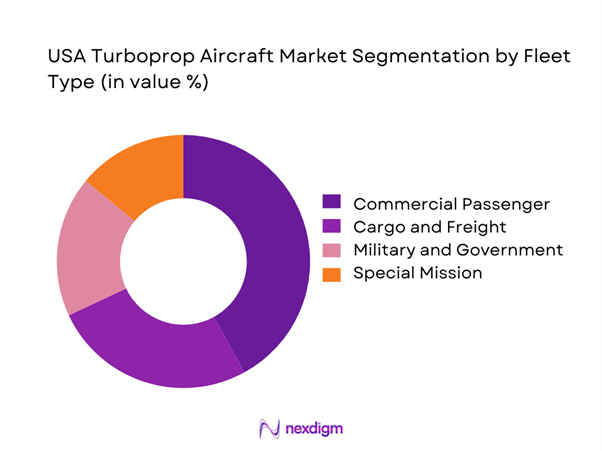
The market is dominated by commercial and utility turboprop fleets, driven by consistent regional connectivity demand and cost-efficient operations. Cargo-configured turboprops continue gaining traction as logistics operators prioritize short-haul efficiency and rapid turnaround. Military and government fleets remain stable, supported by surveillance, transport, and training requirements. Special mission aircraft are increasingly deployed for border surveillance, disaster response, and maritime patrol operations. Fleet diversification has increased as operators seek multi-role capabilities and lifecycle cost optimization. Replacement of aging aircraft remains a major contributor to sustained demand.
By Application
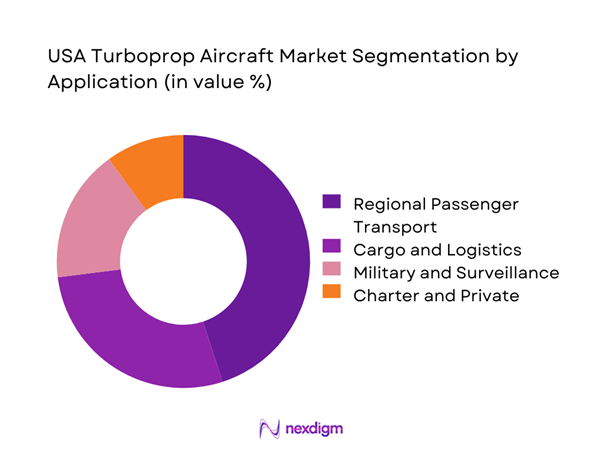
Regional passenger transport represents the largest application segment due to its efficiency on short routes and underserved corridors. Cargo operations have expanded significantly as e-commerce networks demand reliable feeder aircraft. Military and surveillance usage remains steady, supported by modernization programs and homeland security priorities. Charter and private operations contribute moderate volumes, driven by flexibility and operational cost advantages. Application diversification has strengthened fleet utilization and improved asset lifecycle management. Operators increasingly prefer turboprops for their adaptability across varied mission profiles.
Competitive Landscape
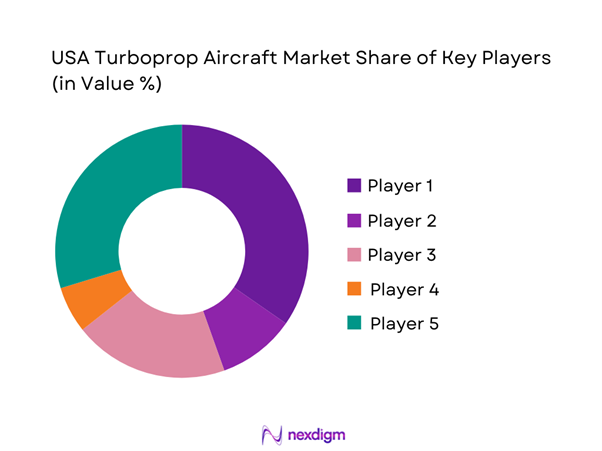
The USA turboprop aircraft market features a moderately consolidated structure supported by established manufacturers and specialized service providers. Competition is shaped by aircraft performance, lifecycle support capability, and delivery reliability. Long-term service contracts and fleet modernization programs strongly influence competitive positioning.
| Company Name | Establishment Year | Headquarters | Formulation Depth | Distribution Reach | Regulatory Readiness | Service Capability | Channel Strength | Pricing Flexibility |
| ATR | 1981 | France | ~ | ~ | ~ | ~ | ~ | ~ |
| De Havilland Canada | 1928 | Canada | ~ | ~ | ~ | ~ | ~ | ~ |
| Textron Aviation | 2014 | USA | ~ | ~ | ~ | ~ | ~ | ~ |
| Pilatus Aircraft | 1939 | Switzerland | ~ | ~ | ~ | ~ | ~ | ~ |
| Leonardo | 1948 | Italy | ~ | ~ | ~ | ~ | ~ | ~ |
USA Turboprop Aircraft Market Analysis
Growth Drivers
Rising demand for regional connectivity and short-haul routes
Regional air connectivity continues expanding as operators seek efficient alternatives for short-distance travel across dispersed geographic markets. Infrastructure investments have improved airport accessibility, enabling turboprops to serve secondary and tertiary destinations efficiently. Passenger preference for direct routes supports increased deployment of regional turboprop services nationwide. Government-supported connectivity programs enhance operational viability for low-density travel corridors. Airlines increasingly prioritize turboprops to optimize seat economics and reduce operational complexity. Fleet utilization rates have improved steadily across multiple states due to route network expansion. Turboprops offer favorable turnaround performance compared to larger jet aircraft on short routes. Operational flexibility allows operators to adjust capacity based on fluctuating regional demand patterns. Airport congestion management further encourages turboprop deployment at constrained regional hubs. These combined factors consistently reinforce demand for turboprop aircraft operations.
Growing cargo and e-commerce driven feeder aircraft demand
E-commerce expansion has increased demand for efficient short-haul cargo aircraft across domestic logistics networks. Turboprops enable cost-effective feeder services connecting regional hubs with major distribution centers. Cargo operators benefit from turboprop versatility across varied runway conditions and weather environments. Increasing parcel volumes require reliable aircraft with frequent daily operations. Logistics providers prioritize aircraft with lower operating costs and rapid turnaround capabilities. Turboprops fulfill these requirements while supporting high-frequency delivery schedules. Network optimization strategies continue to favor turboprop integration within multimodal logistics chains. The rise of regional fulfillment centers further supports consistent aircraft utilization. Cargo fleet expansion has accelerated alongside digital commerce growth. This demand trend continues strengthening turboprop market fundamentals.
Challenges
Competition from regional jets
Regional jets present strong competition due to higher speed and passenger capacity advantages. Airlines often favor jets for premium routes and longer regional sectors. Passenger perception sometimes favors jet aircraft for comfort and travel time. Fuel efficiency improvements in regional jets reduce the historical cost advantage of turboprops. Fleet standardization strategies also influence operator preferences toward jet platforms. Infrastructure upgrades enable greater jet accessibility across regional airports. Leasing availability for jets creates additional competitive pressure on turboprop adoption. Operational flexibility of jets challenges turboprop dominance on certain routes. Market perception remains a barrier despite turboprop efficiency gains. These factors collectively restrain turboprop fleet expansion rates.
High acquisition and maintenance costs
Aircraft acquisition costs remain a significant barrier for small and mid-sized operators. Maintenance expenses increase with aging fleets and component replacement cycles. Limited supplier base for specific components elevates lifecycle support costs. Skilled labor shortages impact maintenance turnaround times and operational efficiency. Regulatory compliance requirements add complexity to maintenance planning. Financing constraints affect fleet expansion decisions for regional carriers. Currency fluctuations also influence procurement affordability for imported aircraft. Cost pressures encourage extended fleet utilization rather than new acquisitions. Budget limitations restrict rapid modernization across operator segments. These cost-related challenges impact overall market growth dynamics.
Opportunities
Expansion of regional air mobility networks
Regional mobility initiatives are strengthening air connectivity between underserved communities. Policy support encourages development of short-haul aviation corridors nationwide. Public-private partnerships facilitate investment in regional aviation infrastructure. Turboprops align well with emerging mobility frameworks emphasizing efficiency and accessibility. Network expansion enables new route development with manageable operational costs. Airports increasingly accommodate turboprop operations through infrastructure enhancements. Digital scheduling tools improve route viability and utilization efficiency. Community air service programs further stimulate aircraft deployment. Fleet renewal aligns with sustainability objectives across regional aviation. These factors collectively create long-term growth opportunities.
Growth in cargo feeder aircraft demand
Cargo networks continue expanding due to rising consumer expectations for faster delivery services. Regional distribution centers increasingly rely on turboprop feeder aircraft for time-sensitive shipments. Operational reliability makes turboprops suitable for high-frequency cargo rotations. Fleet scalability allows logistics providers to adjust capacity efficiently. Airport accessibility supports seamless cargo transfer across smaller hubs. Demand for overnight and same-day delivery sustains aircraft utilization levels. Turboprops enable flexible routing with minimal infrastructure requirements. Cargo operators prioritize aircraft with lower operating risk profiles. Continued logistics digitalization supports long-term cargo aircraft demand. These trends reinforce growth opportunities across the turboprop segment.
Future Outlook
The USA turboprop aircraft market is expected to maintain steady momentum through continued regional connectivity expansion and cargo network development. Fleet modernization initiatives will support demand stability across commercial and government segments. Technological enhancements will improve operational efficiency and environmental performance. Policy support for regional aviation is expected to strengthen long-term market fundamentals.
Major Players
- ATR
- De Havilland Canada
- Textron Aviation
- Pilatus Aircraft
- Leonardo
- Viking Air
- Beechcraft
- L3Harris Technologies
- Northrop Grumman
- Lockheed Martin
- Sierra Nevada Corporation
- MAG Aerospace
- RUAG Aerospace
- Textron Systems
- General Atomics
Key Target Audience
- Commercial airline operators
- Cargo and logistics service providers
- Regional airport authorities
- Aircraft leasing companies
- Defense and homeland security agencies
- Federal Aviation Administration
- State transportation departments
- Investment and venture capital firms
Research Methodology
Step 1: Identification of Key Variables
Market scope, aircraft categories, operational roles, and application areas were identified through structured industry mapping. Data points were aligned with fleet deployment, utilization trends, and regulatory considerations.
Step 2: Market Analysis and Construction
Quantitative and qualitative indicators were assessed to construct market structure and segmentation. Demand drivers and operational constraints were evaluated through industry-level data synthesis.
Step 3: Hypothesis Validation and Expert Consultation
Findings were validated through expert discussions with aviation operators, maintenance specialists, and regulatory professionals. Insights were refined to ensure accuracy and market relevance.
Step 4: Research Synthesis and Final Output
All data points were triangulated and consolidated into a structured analytical framework. Final outputs were reviewed for consistency, relevance, and decision-making applicability.

- Executive Summary
- Research Methodology (Market Definitions and fleet classification logic, Aircraft platform segmentation and configuration mapping, Bottom-up fleet and delivery-based market sizing, Revenue attribution across OEM and aftermarket streams, Primary interviews with operators lessors and MROs, Data triangulation using FAA fleet data and OEM disclosures, Assumptions based on utilization cycles and replacement rates)

- Definition and scope
- Market evolution
- Usage and operational role across aviation segments
- Ecosystem and value chain structure
- Supply chain and distribution channels
- Regulatory and certification environment

- Growth Drivers
Rising demand for regional connectivity and short-haul routes
Growing cargo and e-commerce driven feeder aircraft demand
Lower operating costs versus regional jets
Fleet modernization and replacement cycles
Government and defense procurement support
Increased use in remote and underserved regions - Challenges
Competition from regional jets
High acquisition and maintenance costs
Pilot availability and training constraints
Noise and emissions compliance requirements
Limited airport infrastructure in some regions
Volatility in fuel prices - Opportunities
Expansion of regional air mobility networks
Growth in cargo feeder aircraft demand
Adoption of fuel-efficient and hybrid turboprops
Military fleet modernization programs
Increased charter and utility aircraft usage
Aftermarket and MRO service expansion - Trends
Shift toward fuel-efficient turboprop models
Integration of advanced avionics and connectivity
Rising use of turboprops in cargo logistics
Fleet life extension through retrofits
Focus on sustainability and emissions reduction
Growth in public service and surveillance roles - Government Regulations
- SWOT Analysis
- Stakeholder and Ecosystem Analysis
- Porter’s Five Forces Analysis
- Competition Intensity and Ecosystem Mapping

- By Value, 2020–2025
- By Volume, 2020–2025
- By Installed Base, 2020–2025
- By Average Selling Price, 2020–2025

- By Fleet Type (in Value %)
Commercial passenger turboprops
Cargo and freight turboprops
Military and government turboprops
Special mission and utility aircraft - By Application (in Value %)
Regional passenger transport
Cargo and logistics operations
Military transport and ISR
Aerial surveillance and special missions
Charter and private aviation - By Technology Architecture (in Value %)
Conventional turboprop
Advanced turboprop with digital avionics
Hybrid-assisted turboprop
Short takeoff and landing optimized turboprop - By End-Use Industry (in Value %)
Commercial aviation operators
Defense and homeland security
Cargo and logistics providers
Charter and business aviation operators
Government and public service agencies - By Connectivity Type (in Value %)
Analog avionics
Digitally integrated avionics
Satellite-enabled connectivity
Flight data and fleet management systems - By Region (in Value %)
Northeast
Midwest
South
West

- Market structure and competitive positioning
Market share snapshot of major players - Cross Comparison Parameters (Fleet size, Aircraft performance range, Pricing and cost structure, Technology adoption, Aftermarket support strength, Delivery timelines, Geographic presence, Customer base diversity)
- SWOT Analysis of Key Players
- Pricing and Commercial Model Benchmarking
- Detailed Profiles of Major Companies
ATR
De Havilland Canada
Textron Aviation
Pilatus Aircraft
Leonardo S.p.A.
Viking Air
Beechcraft
Lockheed Martin
Northrop Grumman
L3Harris Technologies
General Atomics Aeronautical Systems
MAG Aerospace
Textron Systems
Sierra Nevada Corporation
RUAG Aerospace

- Demand and utilization drivers
- Procurement and tender dynamics
- Buying criteria and vendor selection
- Budget allocation and financing preferences
- Implementation barriers and risk factors
- Post-purchase service expectations

- By Value, 2026–2035
- By Volume, 2026–2035
- By Installed Base, 2026–2035
- By Average Selling Price, 2026–2035


 Request a Sample
 Ask for Customization
 Get a Quote
 Enquire Now