
 Download PDF
 Download PDF
Market Overview
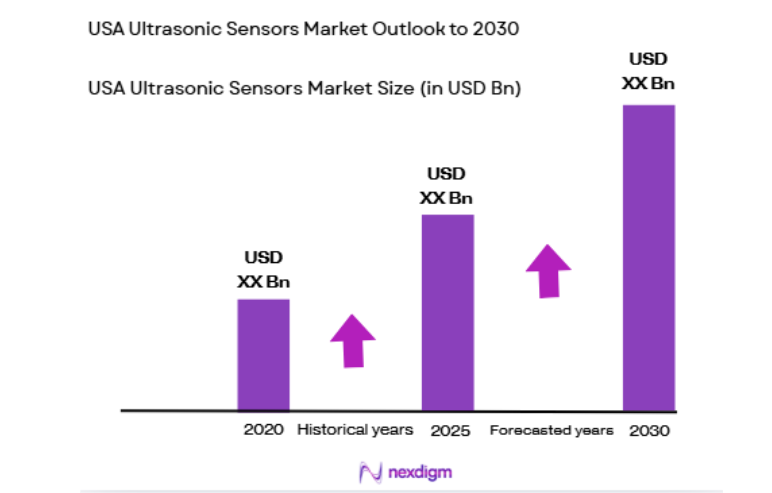
The USA Ultrasonic Sensors market is driven by widespread adoption across automotive, industrial automation, and safety systems, with significant economic value in USD terms. According to available industry analyses, the market size in the United States reached approximately USD ~ billion based on a recent historical assessment, with increasing deployment in applications such as vehicle parking assistance, collision avoidance, and industrial proximity measurement driving this value. This growth reflects broader demand for sensor technologies that support automation and safety functions.
Based on a recent historical assessment, the United States remains a key regional leader in ultrasonic sensor deployment due to its mature automotive industry, extensive manufacturing base, and strong adoption of automation technologies. Major hubs such as Michigan and Ohio benefit from large automotive OEM and supplier networks that incorporate ultrasonic sensors into advanced driver‑assistance systems, while California’s tech ecosystem fosters innovation in industrial and robotics applications. Demand is further supported by diverse end‑use sectors, including healthcare and consumer electronics.
Market Segmentation
By Product Type
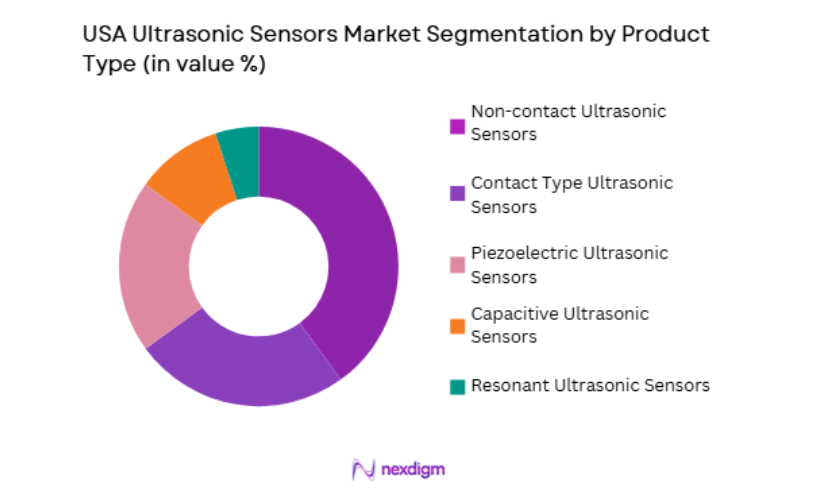
USA Ultrasonic Sensors market is segmented by product type into Contact Type Ultrasonic Sensors, Non-contact Ultrasonic Sensors, Piezoelectric Ultrasonic Sensors, Capacitive Ultrasonic Sensors, and Resonant Ultrasonic Sensors. Non-contact ultrasonic sensors have become the dominant sub-segment due to their increased application in safety and monitoring systems, especially in automotive and industrial automation. The demand for non-contact sensors is driven by their ability to provide continuous, non-invasive measurements, making them suitable for harsh or hazardous environments where contact-based solutions are less effective.
By Platform Type
USA Ultrasonic Sensors market is segmented by platform type into Automotive Ultrasonic Sensors, Industrial Ultrasonic Sensors, Healthcare Ultrasonic Sensors, Consumer Electronics Ultrasonic Sensors, and Marine Ultrasonic Sensors. Automotive ultrasonic sensors dominate the market, mainly driven by the increasing adoption of safety systems such as parking sensors, collision avoidance systems, and proximity detection in autonomous vehicles. The need for precise, real-time data to enhance vehicle safety and functionality in various driving conditions has significantly contributed to the strong growth of this sub-segment.

Competitive Landscape
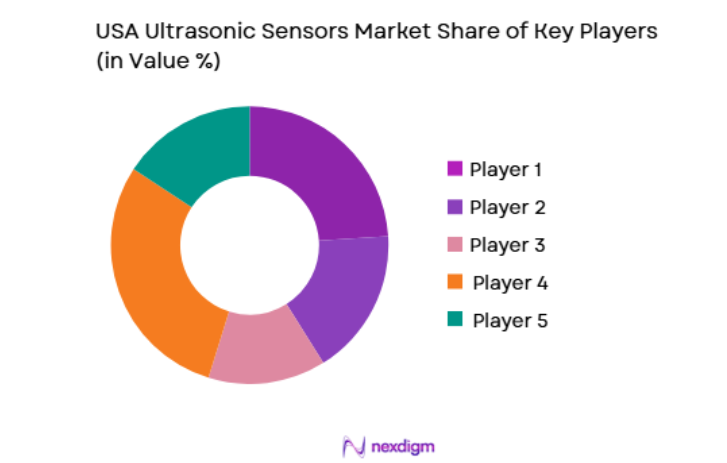
The competitive landscape of the USA Ultrasonic Sensors market is influenced by both established players and emerging innovators. Key market players, such as Honeywell and Bosch, dominate the market by offering advanced sensor technologies for automotive, industrial, and consumer applications. These companies continue to innovate by enhancing sensor accuracy, range, and performance to meet the rising demand for ultrasonic sensors across various industries. Furthermore, the growing emphasis on sensor fusion in autonomous vehicles and industrial automation is expected to intensify competition in the market.
| Company Name | Establishment Year | Headquarters | Technology Focus | Market Reach | Key Products | Revenue (USD) |
| Honeywell International | 1906 | Charlotte, NC | ~ | ~ | ~ | ~ |
| Bosch | 1886 | Stuttgart, Germany | ~ | ~ | ~ | ~ |
| Siemens | 1847 | Munich, Germany | ~ | ~ | ~ | ~ |
| STMicroelectronics | 1987 | Geneva, Switzerland | ~ | ~ | ~ | ~ |
| Murata Manufacturing | 1944 | Kyoto, Japan | ~ | ~ | ~ | ~ |
USA Ultrasonic Sensors Market Analysis
Growth Drivers
Increasing Demand for Automotive Safety Systems
The rising demand for advanced driver-assistance systems (ADAS) is a major driver of growth in the USA Ultrasonic Sensors market. As automakers prioritize vehicle safety, ultrasonic sensors are integrated into features such as parking assistance, blind-spot detection, and collision avoidance systems. These sensors offer real-time, precise data on vehicle surroundings, which is crucial for improving safety and enabling autonomous driving technologies. With increasing consumer demand for safety, coupled with regulatory pressure for enhanced vehicle safety features, ultrasonic sensors have become a critical component in modern automotive designs. The trend towards fully autonomous vehicles further accelerates the need for more sophisticated sensor systems, providing ample growth opportunities for the ultrasonic sensors market.
Technological Advancements in Industrial Automation
The growing adoption of ultrasonic sensors in industrial automation is another key growth driver. These sensors are widely used in process monitoring, material handling, and level measurement applications. Their ability to operate in harsh environments, such as high temperatures and dust, makes them ideal for industrial settings. With the rise of Industry 4.0 and smart factories, the demand for reliable and non-invasive sensors is expected to increase. Ultrasonic sensors are integral to enhancing efficiency, reducing operational costs, and ensuring the safety of machinery and workers in industrial environments. As manufacturing processes become increasingly automated, ultrasonic sensors will continue to play a pivotal role in optimizing operations.
Market Challenges
High Cost of Advanced Ultrasonic Sensors
One of the major challenges in the USA Ultrasonic Sensors market is the high cost of advanced sensor systems, particularly in high-performance applications such as automotive safety and industrial automation. These sensors often require specialized components and precision manufacturing, making them expensive to produce. While prices have been gradually decreasing, the initial investment cost for advanced ultrasonic sensor systems remains a barrier for many industries, especially smaller businesses looking to integrate these technologies. The need for continuous innovation and improvement also contributes to higher R&D expenses, further adding to the overall cost structure. As the demand for ultrasonic sensors grows, addressing the cost-related challenges will be key to making these sensors more accessible across various market segments.
Integration Complexities with Other Sensor Systems
Another challenge is the complexity of integrating ultrasonic sensors with other sensing technologies, such as LIDAR and cameras, to create more comprehensive sensor fusion systems. While ultrasonic sensors provide valuable data for proximity detection and level measurement, their performance may be limited in certain environments or scenarios, requiring the integration of additional sensor types for more accurate data. This process of integrating various sensors, each with different operating principles and data formats, requires significant investment in specialized hardware and software, posing a challenge for manufacturers looking to deploy cost-effective and efficient sensor solutions. As sensor fusion becomes increasingly important in autonomous vehicles and industrial automation, overcoming these integration challenges will be critical for further market growth.
Opportunities
Expansion of Ultrasonic Sensors in Medical Applications
The growing use of ultrasonic sensors in medical diagnostics presents a significant opportunity for the market. Ultrasonic sensors, particularly those used in non-invasive medical imaging, such as ultrasound equipment, have become indispensable in healthcare. These sensors provide real-time, high-resolution imaging for various medical procedures, including pregnancy monitoring, tumor detection, and cardiovascular imaging. As the demand for non-invasive and cost-effective diagnostic tools increases, the market for ultrasonic sensors in healthcare is expected to expand. The integration of ultrasonic sensors into wearable health devices and diagnostic equipment will further accelerate their adoption, creating new opportunities for market players.
Increased Adoption in Smart Cities and IoT Applications
The USA Ultrasonic Sensors market has substantial growth opportunities in the expanding field of smart cities and the Internet of Things (IoT). Ultrasonic sensors play a crucial role in applications such as smart traffic management, waste management, and environmental monitoring. Their ability to detect distance and measure levels accurately makes them ideal for applications like automated parking systems and smart waste bins. As cities adopt more IoT-driven solutions to improve efficiency and sustainability, the demand for ultrasonic sensors is expected to rise. Additionally, ultrasonic sensors’ ability to monitor environmental conditions, such as water levels in rivers or air quality, will further drive their adoption in smart city projects.
Future Outlook
The future outlook for the USA Ultrasonic Sensors market is positive, with strong growth expected across multiple sectors, particularly automotive, healthcare, and industrial automation. Technological advancements, including miniaturization and sensor fusion, will drive the demand for ultrasonic sensors, enabling more efficient and cost-effective solutions. Additionally, government regulations supporting safety standards and environmental monitoring will further fuel market expansion. As industries increasingly adopt smart technologies and automation, the demand for ultrasonic sensors will continue to grow, with new applications emerging in both consumer and industrial markets.
Major Players
- Honeywell International
- Bosch
- Siemens
- STMicroelectronics
- Murata Manufacturing
- Texas Instruments
- Omron Corporation
- Emerson Electric
- Ametek
- Panasonic
- TDK Corporation
- Infineon Technologies
- NXP Semiconductors
- Analog Devices
- Maxim Integrated
Key Target Audience
- Automotive Manufacturers
- Industrial Automation Companies
- Healthcare Providers
- Consumer Electronics Manufacturers
- Government Agencies
- Smart City Developers
- Research and Development Organizations
- Investments and Venture Capitalist Firms
Research Methodology
Step 1: Identification of Key Variables
Identify and define the primary drivers, restraints, and opportunities impacting the ultrasonic sensors market.
Step 2: Market Analysis and Construction
Use the collected data to build a comprehensive market model that includes historical data, current trends, and future projections.
Step 3: Hypothesis Validation and Expert Consultation
Engage industry experts to validate the research hypotheses and refine the market assumptions.
Step 4: Research Synthesis and Final Output
Compile the validated insights and produce a detailed report on the ultrasonic sensors market, providing actionable insights for stakeholders.

- Executive Summary
- Research Methodology (Definitions, Scope, Industry Assumptions, Market Sizing Approach, Primary & Secondary Research Framework, Data Collection & Verification Protocol, Analytic Models & Forecast Methodology, Limitations & Research Validity Checks)

- Market Definition and Scope
- Value Chain & Stakeholder Ecosystem
- Regulatory / Certification Landscape
- Sector Dynamics Affecting Demand
- Strategic Initiatives & Infrastructure Growth

- Growth Drivers
Increased demand for automation in manufacturing and healthcare sectors
Technological advancements in ultrasonic sensor miniaturization
Government support for automotive and industrial applications - Market Challenges
High cost of advanced ultrasonic sensor systems
Integration complexities with existing technologies
Limited adoption in certain industrial sectors - Market Opportunities
Growth in demand for ultrasonic sensors in medical diagnostics
Expansion in automotive safety features and autonomous vehicles
Emerging applications in the Internet of Things (IoT) - Trends
Rising adoption of non-contact ultrasonic sensors
Increased miniaturization of ultrasonic sensor devices
Advancements in ultrasonic sensor data analytics - Government regulations
- SWOT analysis
- Porters 5 forces

- By Market Value, 2019-2025
- By Installed Units, 2019-2025
- By Average System Price, 2019-2025
- By System Complexity Tier, 2019-2025

- By System Type (In Value%)
Contact Type Ultrasonic Sensors
Non-contact Ultrasonic Sensors
Piezoelectric Ultrasonic Sensors
Capacitive Ultrasonic Sensors
Resonant Ultrasonic Sensors - By Platform Type (In Value%)
Automotive Ultrasonic Sensors
Industrial Ultrasonic Sensors
Healthcare Ultrasonic Sensors
Consumer Electronics Ultrasonic Sensors
Marine Ultrasonic Sensors - By Fitment Type (In Value%)
Embedded Ultrasonic Sensors
Standalone Ultrasonic Sensors
Portable Ultrasonic Sensors
Integrated Ultrasonic Systems
Fixed Ultrasonic Systems - By EndUser Segment (In Value%)
Automotive Industry
Manufacturing and Industrial Automation
Healthcare and Medical Devices
Consumer Electronics
Aerospace and Defense - By Procurement Channel (In Value%)
Direct Procurement
Third-party Distributors
Government Tenders

- Market Share Analysis
- Cross Comparison Parameters (System Type, Platform Type, Procurement Channel, EndUser Segment, Fitment Type, Technology Focus, Geographical Reach, Product Range, Production Capacity, Customer Demographics)
- SWOT Analysis of Key Competitors
- Pricing & Procurement Analysis
- Key Players
Honeywell International
Bosch
Analog Devices
Siemens
Murata Manufacturing
STMicroelectronics
Riko Ultrasonic
GE Measurement & Control
Kistler
Emerson Electric
Microchip Technology
TE Connectivity
MaxBotix
Ametek
Omron Corporation

- Rising adoption in automotive safety and ADAS systems
- Increased use of ultrasonic sensors in industrial automation
- Medical devices incorporating ultrasonic sensors for diagnostics
- Growth in consumer electronics requiring proximity and level sensors

- Forecast Market Value, 2026-2030
- Forecast Installed Units, 2026-2030
- Price Forecast by System Tier, 2026-2030
- Future Demand by Platform, 2026-2030


 Request a Sample
 Ask for Customization
 Get a Quote
 Enquire Now