
 Download PDF
Market Overview
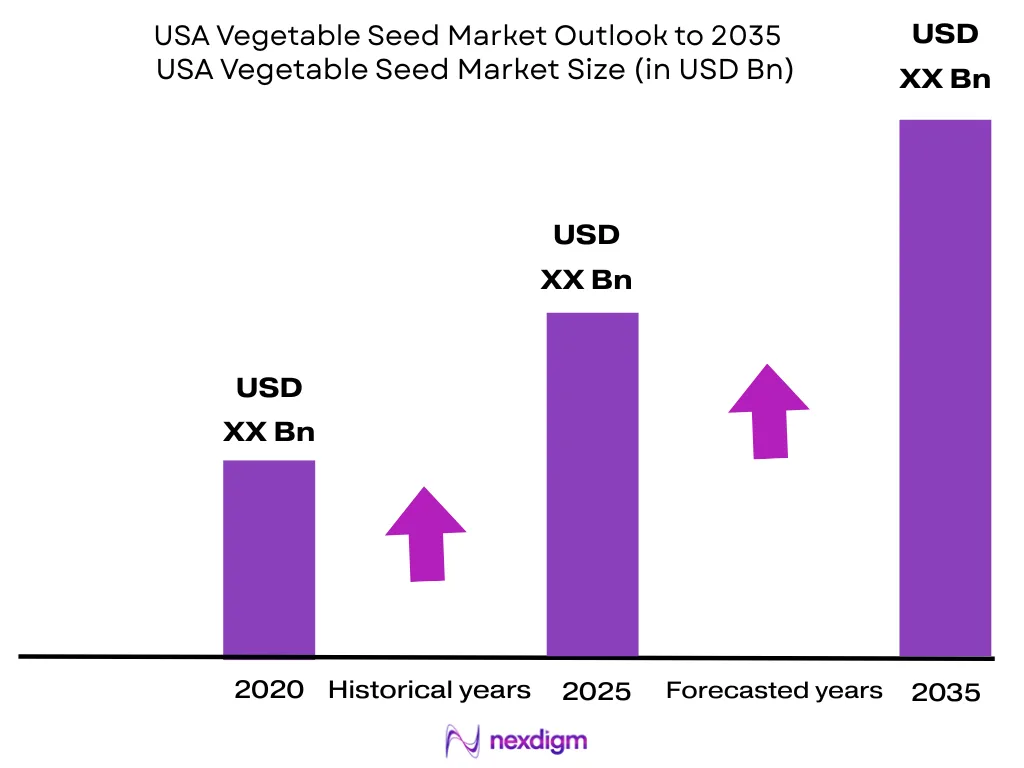
The USA vegetable seed market is valued at USD ~ billion, based on a five-year historical analysis and normalization of the published 2025 base of USD ~ billion. Demand is driven by commercial vegetable acreage, high seed replacement frequency, hybrid penetration, and disease-resistant cultivars. USDA vegetable output supports this demand base: tomato production reached 236 million cwt compared with about 274 million cwt earlier, while onion production reached 77.1 million cwt compared with about 73.4 million cwt earlier. California, Florida, Texas, Arizona, Washington and Georgia dominate USA vegetable seed demand because they combine large open-field vegetable acreage, fresh-market logistics, processing contracts and year-round planting windows. California leads due to leafy greens, processing tomatoes and coastal vegetable systems; Florida dominates winter tomatoes, peppers and cucumbers; Texas and Arizona are important for warm-season and climate-stressed crops. Urban CEA clusters around New York, Chicago, Atlanta and Dallas also raise demand for leafy green, tomato, cucumber and herb seed lines.
Market Segmentation
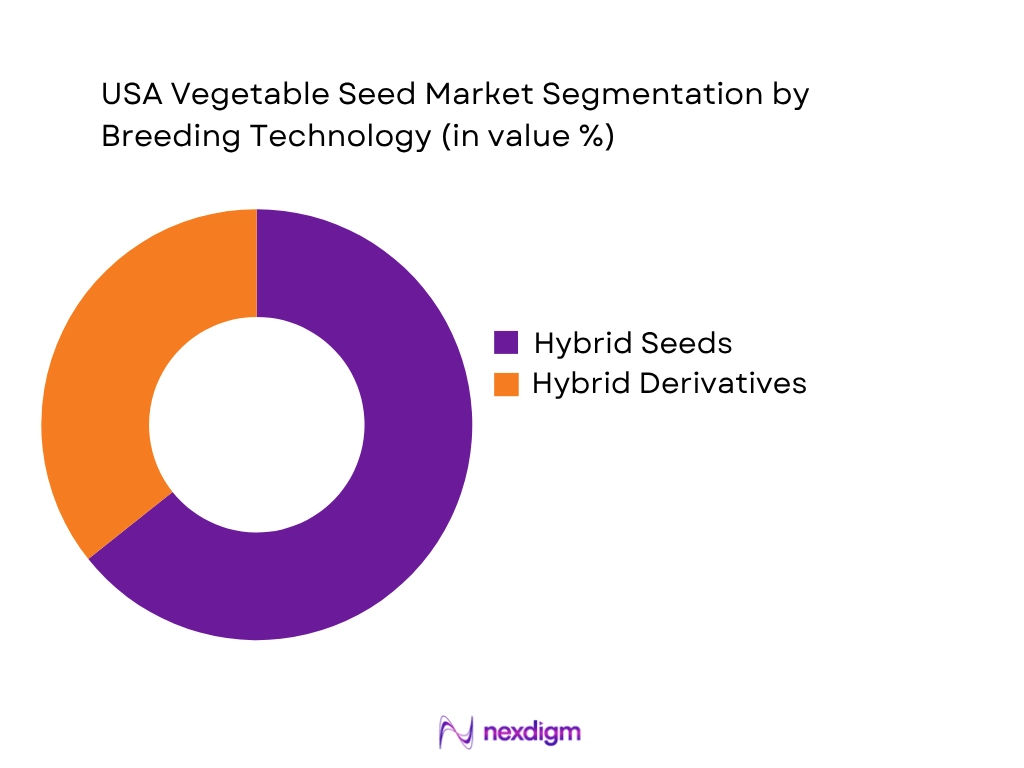
By Breeding Technology
The USA vegetable seed market is segmented by breeding technology into hybrid seeds and open-pollinated varieties with hybrid derivatives. Hybrid seeds dominate the USA vegetable seed market because commercial growers prioritize yield uniformity, disease resistance, predictable maturity, shelf-life performance and harvest consistency. Large farms supplying supermarkets, processors and foodservice buyers require varieties that meet strict size, color, firmness and transport standards. Hybrid tomato, cucumber, pepper, lettuce, brassica and sweet corn varieties are preferred because they reduce crop-failure risk and deliver better stand establishment under intensive production. Open-pollinated and heirloom seeds remain important in organic farms, small diversified farms and home gardening, but their commercial share is limited by lower uniformity, weaker disease packages and inconsistent performance across regions. The premium pricing of hybrids is accepted where seed cost is offset by higher marketable yield, lower rejection and better crop scheduling.
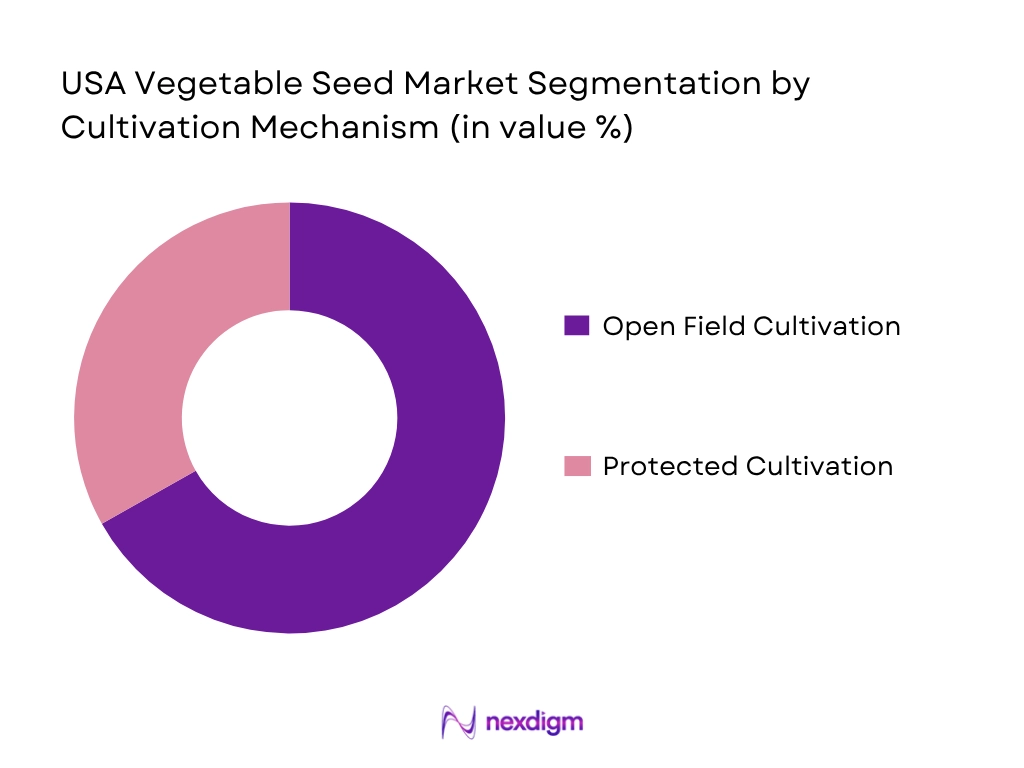
By Cultivation Mechanism
The USA vegetable seed market is segmented by cultivation mechanism into open field cultivation and protected cultivation. Open field cultivation dominates because most U.S. vegetable production still occurs across large acreage systems for fresh market and processing crops, including tomatoes, onions, pumpkins, watermelons, sweet corn, lettuce, brassicas and peppers. This segment benefits from established grower networks, mechanized planting, contract farming, regional seed dealers and crop-specific trial programs. California, Florida, Arizona, Texas, Washington and the Midwest continue to generate recurring demand for bulk commercial vegetable seeds. Protected cultivation is growing faster because greenhouse, high tunnel, hydroponic and vertical farming operators require specialized seeds for compact plant architecture, artificial light response, high-density spacing and continuous harvest. However, its share remains smaller because capital intensity and controlled-environment operating costs limit adoption compared with established open-field vegetable farming.
Competitive Landscape
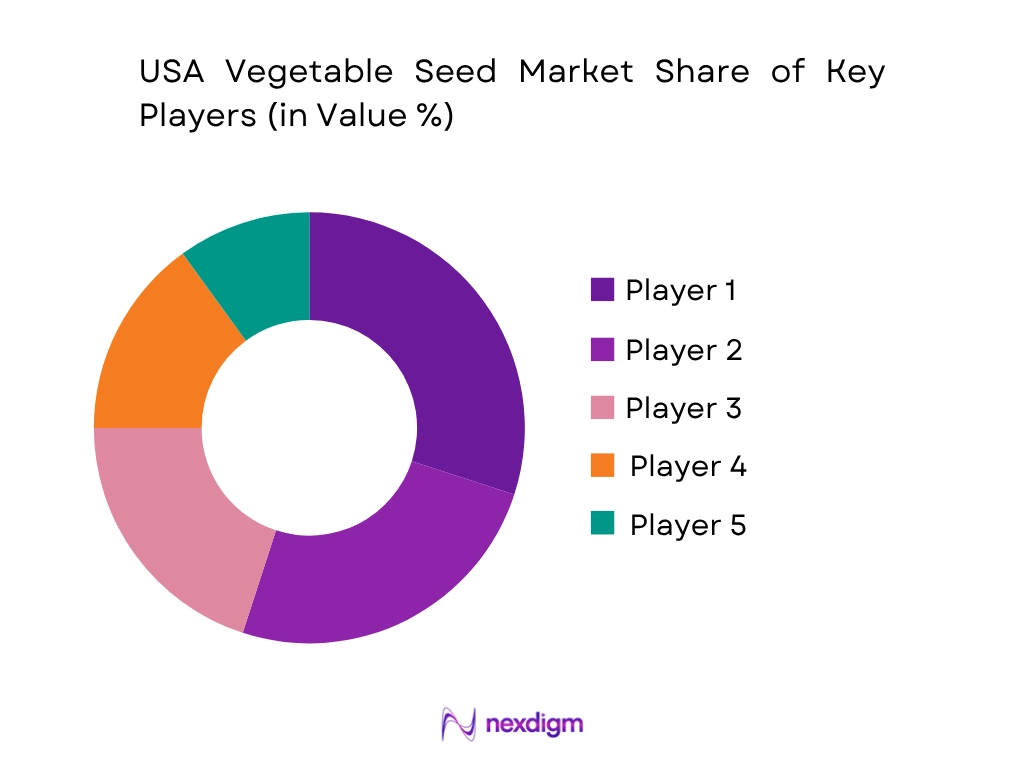
The USA vegetable seed market is moderately concentrated, led by multinational seed companies with strong germplasm libraries, disease-resistance portfolios, molecular breeding capabilities, controlled-environment varieties and national distribution networks. Bayer, Syngenta, BASF, Rijk Zwaan and Groupe Limagrain influence the market through hybrid tomato, cucumber, pepper, brassica, lettuce and cucurbit portfolios. Regional and specialist players compete through organic, untreated, heirloom, open-pollinated and specialty crop seeds.
| Company | Establishment Year | Headquarters | Vegetable Seed Brand/Platform | Key Crop Families | CEA/Greenhouse Strength | Disease-Resistance Focus | USA Channel Presence | Market Positioning |
| Bayer AG | 1863 | Leverkusen, Germany | ~ | ~ | ~ | ~ | ~ | ~ |
| Syngenta Group | 2000 | Basel, Switzerland | ~ | ~ | ~ | ~ | ~ | ~ |
| BASF SE | 1865 | Ludwigshafen, Germany | ~ | ~ | ~ | ~ | ~ | ~ |
| Rijk Zwaan | 1924 | De Lier, Netherlands | ~ | ~ | ~ | ~ | ~ | ~ |
| Groupe Limagrain | 1965 | Saint-Beauzire, France | ~ | ~ | ~ | ~ | ~ | ~ |
The USA vegetable seed market Analysis
Growth Drivers
Commercial Vegetable Acreage and High-Volume Crop Cycles Support Recurring Seed Replacement
The USA vegetable seed market is supported by a large commercial vegetable production base that requires recurring seed purchases across fresh-market and processing crops. USDA NASS reported that tomatoes remained the largest U.S. vegetable crop by production, with 236 million cwt produced and 269,000 acres planted, while sweet corn covered 342,800 planted acres and generated 52.7 million cwt of production. Onions added another major seed-demand base with 136,500 planted acres and 77.1 million cwt of production. These crops require planned varietal replacement because commercial growers prioritize disease resistance, uniform maturity, processing recovery, shelf life and retail-grade output. The macroeconomic base also supports stable commercial seed demand: the World Bank recorded U.S. GDP at USD 28.75 trillion and GDP per capita at USD 84,534.0, indicating a large food-consumption economy with strong downstream demand from processors, supermarkets and foodservice buyers. The U.S. population reached 340,110,988 people, widening the domestic demand base for fresh vegetables and processed vegetable products. For seed suppliers, this creates recurring demand for hybrid tomato, sweet corn, onion, pepper, lettuce and cucurbit varieties aligned with regional planting cycles.
Fresh Vegetable Consumption Base Strengthens Demand for Yield-Stable and Quality-Focused Varieties
Fresh vegetable consumption remains a direct driver for premium vegetable seeds because growers must meet buyer specifications for color, size, firmness, disease tolerance and shelf life. USDA ERS reported U.S. vegetable and pulse availability at 376 pounds per person, while fresh vegetables reached 148 pounds per person, making fresh vegetables the largest component of total vegetable availability. This supports demand for hybrid seeds used in lettuce, tomato, cucumber, pepper, onion, brassica and leafy green production. USDA NASS also shows strong crop-specific foundations: head lettuce produced 41.8 million cwt, romaine lettuce produced 39.1 million cwt, leaf lettuce produced 16.1 million cwt, bell peppers produced 9.81 million cwt, and chile peppers produced 2.32 million cwt. These crops are seed-intensive and quality-sensitive, making genetics a critical production input rather than a discretionary purchase. The World Bank’s U.S. GDP per capita of USD 84,534.0 and national GDP of USD 28.75 trillion further indicate a mature consumer economy where vegetable quality, availability and retail consistency matter for the supply chain. Seed companies benefit from this structure through demand for disease-resistant, heat-tolerant and high-uniformity varieties designed for fresh-market channels.
Market Challenges
Weather Volatility Disrupts Vegetable Production and Raises Demand Uncertainty for Seed Suppliers
Weather volatility is a major challenge for the USA vegetable seed market because vegetable crops are concentrated in climate-sensitive states such as California, Florida, Arizona, Texas, Georgia and Washington. NOAA reported 27 confirmed U.S. weather and climate disaster events in 2024, including drought, severe storms, flooding and tropical cyclones, with total disaster costs of USD 182.7 billion. USDA ERS noted that extreme weather complicated vegetable and pulse production, with temperatures exceeding 10 degrees above normal in parts of California’s North Coast, Central Coast, Sacramento Valley, San Joaquin Valley and Cascade-Sierra Mountains. This directly affects seed demand planning because growers may reduce acreage, shift crop calendars or change variety choices after heat, flooding or hurricane damage. USDA NASS data shows several affected vegetable categories recorded lower production: tomatoes fell to 236 million cwt, carrots to 24.8 million cwt, cucumbers to 11.3 million cwt, spinach to 6.17 million cwt, and green peas to 4.50 million cwt. With the World Bank reporting U.S. GDP at USD 28.75 trillion and population at 340,110,988 people, downstream demand remains large, but weather shocks create production-side instability for seed inventory, trial planning and regional sales forecasting.
Farm Labor Dependence Pressures Vegetable Growers and Influences Seed-Technology Adoption
Labor dependence is a structural challenge for the USA vegetable seed market because vegetables require intensive planting, transplanting, thinning, weeding, harvesting and post-harvest handling. USDA ERS reported that around 315,500 H-2A visas were issued in FY2024, highlighting continued reliance on temporary agricultural labor. The H-2A program exists to help U.S. farmers fill employment gaps by hiring workers from other countries, according to USDA Farmers.gov. Labor tightness affects seed purchasing because growers increasingly prefer varieties that improve field uniformity, reduce harvest passes, support mechanized harvesting or perform reliably in transplant systems. USDA NASS reported sweet corn planted area of 342,800 acres, tomato planted area of 269,000 acres, onion planted area of 136,500 acres, romaine lettuce planted area of 116,800 acres, and head lettuce planted area of 109,800 acres. These acreage bases require reliable labor availability and precise crop scheduling. At the macro level, the World Bank recorded U.S. GDP per capita at USD 84,534.0, while the total population reached 340,110,988 people, supporting strong food demand but also a high-wage operating environment. For seed companies, labor pressure creates opportunities for precision-suited genetics, but it also challenges growers’ ability to plant, manage and harvest acreage consistently.
Market Opportunities
Protected Cultivation and Import Substitution Create Opportunity for Greenhouse-Specific Vegetable Seeds
Protected cultivation presents a market opportunity because imported fresh vegetables continue to fill gaps in U.S. supply, especially for tomatoes, cucumbers and peppers. USDA ERS reported that U.S. fresh vegetable imports reached 20.3 billion pounds, while exports were 5.2 billion pounds, showing a large domestic supply gap that greenhouse, high-tunnel and controlled-environment producers can target. USDA ERS also reported fresh vegetable availability at 148 pounds per person, while the U.S. population reached 340,110,988 people, creating a large consumption base for consistent fresh vegetable supply. This supports opportunity for seeds bred for greenhouse tomato, cucumber, pepper, lettuce, basil and leafy green production. Protected-crop operators need genetics with compact plant architecture, high-density performance, disease resistance, uniform fruiting and continuous harvest ability. USDA NASS crop data reinforces the opportunity: fresh-market tomatoes contributed 12.0 million cwt, bell peppers produced 9.81 million cwt, cucumbers produced 11.3 million cwt, and romaine lettuce produced 39.1 million cwt. The World Bank’s U.S. GDP of USD 28.75 trillion supports investment capacity across food supply chains, while domestic import dependence creates a practical route for seed suppliers to position CEA-specific varieties for local production resilience.
Organic, Untreated and Compliance-Ready Seeds Gain Relevance from Federal Organic Oversight
Organic and untreated vegetable seeds represent a future growth opportunity because federal organic oversight is becoming more traceable and compliance-driven. USDA AMS states that the National Organic Program develops and enforces national standards for organically produced agricultural products and accredits third-party certifiers. The Strengthening Organic Enforcement rule required operations to comply by March 19, 2024, strengthening traceability expectations across organic supply chains. This matters for vegetable seed suppliers because certified organic growers must document seed sourcing and use organic seed when commercially available. USDA ERS reported that U.S. fresh vegetable availability reached 148 pounds per person, while total vegetable and pulse availability stood at 376 pounds per person, demonstrating a large domestic vegetable consumption base that supports differentiated seed lines. USDA NASS also reported production bases for organic-relevant fresh crops: head lettuce at 41.8 million cwt, leaf lettuce at 16.1 million cwt, romaine lettuce at 39.1 million cwt, carrots at 24.8 million cwt, onions at 77.1 million cwt, and tomatoes at 236 million cwt. With U.S. GDP at USD 28.75 trillion and GDP per capita at USD 84,534.0, the market has enough purchasing capacity for premium, compliance-ready seed categories such as certified organic, untreated, non-GMO, pelleted and disease-tested vegetable seeds.
Future Outlook
The USA vegetable seed market is forecast to expand at a 5.21% CAGR during the forecast period, with growth led by hybrid adoption, protected cultivation, specialty vegetables, seed enhancement and disease-resistant genetics. Demand will increasingly shift toward seeds that support climate resilience, water-use efficiency, uniform maturity and traceable supply chains. Growers will continue investing in premium seeds where performance improves yield reliability and reduces rejection risk. Greenhouse and CEA operators will create incremental demand for tomatoes, cucumbers, peppers, lettuce, basil and microgreens. Long-term growth will be shaped by four structural themes. First, disease pressure will increase demand for resistance packages in tomato, lettuce, cucurbits, onion and pepper. Second, protected cultivation will require varieties bred for artificial light, compact architecture and continuous production cycles. Third, organic and untreated seed demand will expand as certified organic growers seek compliant seed lots. Fourth, gene editing and molecular breeding will shorten variety-development cycles, creating new premium seed categories for flavor, shelf life, nutrient density and abiotic stress tolerance.
Major Players
- Bayer AG
- Syngenta Group
- BASF SE / Nunhems
- Rijk Zwaan
- Groupe Limagrain / HM.CLAUSE / Vilmorin-Mikado
- Sakata Seed America
- Enza Zaden USA
- Bejo Seeds
- Takii & Co. / American Takii
- Hazera Seeds
- East-West Seed
- UPL / Advanta Seeds
- Johnny’s Selected Seeds
- SEEDWAY
- Harris Seeds
Key Target Audience
- Vegetable Seed Manufacturers
- Hybrid Seed Breeding Companies
- Commercial Vegetable Growers
- Greenhouse and Controlled Environment Agriculture Operators
- Organic and Untreated Seed Suppliers
- Food Processing and Contract Farming Companies
- Investments and Venture Capitalist Firms
- Government and Regulatory Bodies
Research Methodology
Step 1: Identification of Key Variables
The initial phase involves constructing an ecosystem map covering vegetable seed breeders, foundation seed producers, contract seed growers, seed processors, distributors, commercial growers, greenhouse operators and regulators in the USA vegetable seed market. This step uses desk research, proprietary databases, USDA crop statistics, seed company portfolios and industry publications to identify variables influencing demand, pricing, crop family mix and channel structure.
Step 2: Market Analysis and Construction
In this phase, historical market data is compiled and analyzed for crop acreage, vegetable production, seed replacement cycles, hybrid penetration, open-field demand, protected cultivation and commercial grower purchasing behavior. The market model evaluates seed use by crop family, average seed realization, planting density, pack format and channel margin. These variables are used to construct revenue estimates through both top-down and bottom-up approaches.
Step 3: Hypothesis Validation and Expert Consultation
Market hypotheses are validated through structured interviews with vegetable seed suppliers, distributors, crop consultants, greenhouse operators, commercial growers and organic seed specialists. These discussions test assumptions on hybrid pricing, crop-specific seed demand, channel preference, disease-resistance adoption and protected cultivation seed requirements. Expert inputs are used to refine segmentation, competitive positioning and growth outlook.
Step 4: Research Synthesis and Final Output
The final phase synthesizes secondary data, primary insights, company portfolio mapping and crop-level demand modelling into a validated market report. Multiple data points are triangulated to ensure consistency across market size, segmentation and competitive analysis. The output presents strategic insights for business professionals, investors, seed suppliers, growers and regulatory stakeholders operating in the USA vegetable seed market.

- Executive Summary
- Research Methodology (Market Definitions and Assumptions, Vegetable Seed Taxonomy, Commercial vs Retail Seed Boundary, Hybrid/Open-Pollinated/Heirloom/Organic/Untreated Seed Classification, Market Sizing Approach, Bottom-Up Acreage-to-Seed Requirement Model, Top-Down Seed Revenue Validation, Primary Interviews with Breeders/Distributors/Growers/Greenhouse Operators, SKU and Dealer Channel Mapping, Data Triangulation, Forecast Modelling, Limitations and Future Conclusions)

- Definition and Scope
- Overview Genesis
- Evolution of Vegetable Breeding in the USA
- Timeline of Major Players
- Business Cycle

- Growth Drivers (Hybrid Penetration, Protected Cultivation Expansion, Organic Produce Demand, Seed Replacement, Specialty Crop Diversification)
- Market Challenges (Seed Production Risk, Germination Failures, Regulatory Complexity, Disease Outbreaks, Input Cost Pressure, Channel Fragmentation)
- Opportunities (Protected Cultivation Genetics, Organic Seed Portfolio Expansion, Regionalized Breeding, Seed Enhancement, Digital Agronomy, Private Label Retail)
- Trends (Hybridization, Trait Stacking, Sustainability Claims, Dealer Consolidation, DTC Seed Retailing, Climate-Resilient Breeding)
- SWOT Analysis
- Porter’s Five Forces
- PESTLE Analysis

- By Value (2020-2025)
- By Volume (2020-2025)
- By Average Realization per Pound/Kilogram of Seed (2020-2025)

- By Crop Family (In Value %)
Tomato Seeds
Pepper Seeds
Cucurbit Seeds
Brassica Seeds
Leafy Green Seeds - By Distribution Channel (In Value %)
Direct-to-Grower Sales
Seed Dealers and Regional Distributors
Farm Input Retail Chains
Online B2B Platforms
Catalog and Direct-to-Consumer Retail - By End User (In Value %)
Commercial Fresh Market Growers
Processing Vegetable Growers
Greenhouse and CEA Operators
Organic Growers
Transplant Nurseries
- By Region (In Value %)
West
Southeast
Midwest
Pacific Northwest
Northeast

- Market Share of Major Players (Commercial Vegetable Seed Revenue, Crop-Family Share, Dealer Reach, Protected Cultivation Presence)
- Cross Comparison Parameters (Vegetable Crop Portfolio Breadth, Hybrid F1 Strength, Disease-Resistance Trait Depth, Greenhouse/CEA Variety Portfolio, Organic and Untreated Seed Availability, Dealer/Distributor Network Coverage, Seed Enhancement and Pelleting Capability, Trial and Technical Agronomy Support)
- SWOT Analysis of Major Players
- Detailed Profiles of Major Companies
Syngenta Vegetable Seeds
BASF Vegetable Seeds / Nunhems
Bayer Vegetable Seeds / Seminis / De Ruiter
Sakata Seed America
Enza Zaden USA
Rijk Zwaan USA
HM.CLAUSE
Bejo Seeds
Takii & Co. / American Takii
Vilmorin-Mikado / Limagrain Vegetable Seeds
Hazera Seeds
East-West Seed
UPL / Advanta Seeds
Johnny’s Selected Seeds
SEEDWAY

- Commercial Fresh Market Grower Analysis
- Processing Grower Analysis
- Greenhouse and CEA Operator Analysis
- Organic Grower Analysis
- Transplant Nursery Analysis

- By Value (2026-2035)
- By Volume (2026-2035)
- By Average Realization per Pound/Kilogram of Seed (2026-2035)


 Request a Sample
 Ask for Customization
 Get a Quote
 Enquire Now