

 Download PDF
 Download PDF
Market Overview
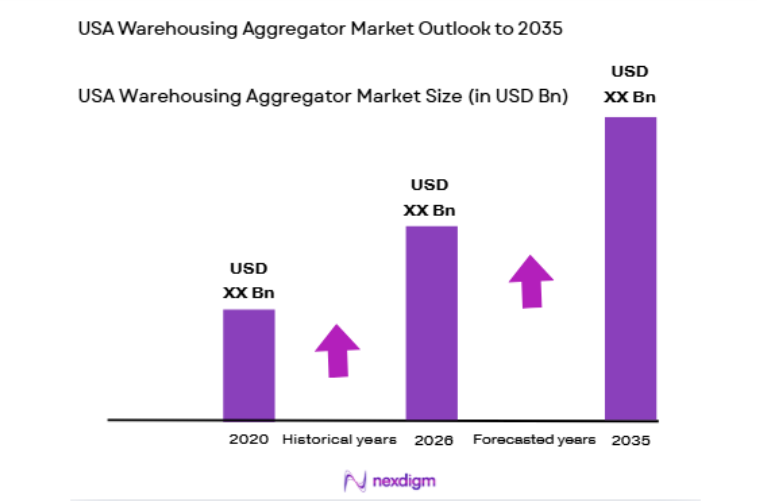
The USA warehousing aggregator market is estimated to be valued at approximately USD ~ billion, driven by the expanding demand for logistics services across various sectors including e-commerce, retail, manufacturing, and distribution. This growth is largely influenced by the need for efficient inventory management and the rising expectations for faster delivery times. E-commerce’s ongoing boom, coupled with the increasing complexity of supply chains, continues to fuel the demand for warehousing and logistics aggregation services.
Major cities like New York, Chicago, Los Angeles, and Dallas dominate the warehousing aggregator market due to their strategic locations and strong infrastructure. New York serves as a hub for retail and e-commerce logistics, while Chicago plays a crucial role due to its position as a key transportation and distribution center. Los Angeles benefits from its major port facilities, and Dallas serves as a vital logistics hub for the southern United States. These cities are central to the market due to their transportation infrastructure, proximity to industrial and commercial zones, and access to global trade routes.
Market Segmentation
By Product Type
The USA warehousing aggregator market is segmented by product type into ambient storage, temperature-controlled storage, and hazardous goods storage. Recently, ambient storage has dominated the market due to the increase in demand for non-perishable goods driven by the growth of e-commerce, retail, and consumer electronics. The need for ambient storage solutions is growing as businesses require cost-effective warehouses for inventory storage that doesn’t require temperature control. Additionally, the development of large-scale industrial and distribution hubs across cities like Chicago and Los Angeles has bolstered the growth of ambient storage, allowing companies to optimize space while meeting demand for faster delivery and reduced lead times.

By Warehouse Size
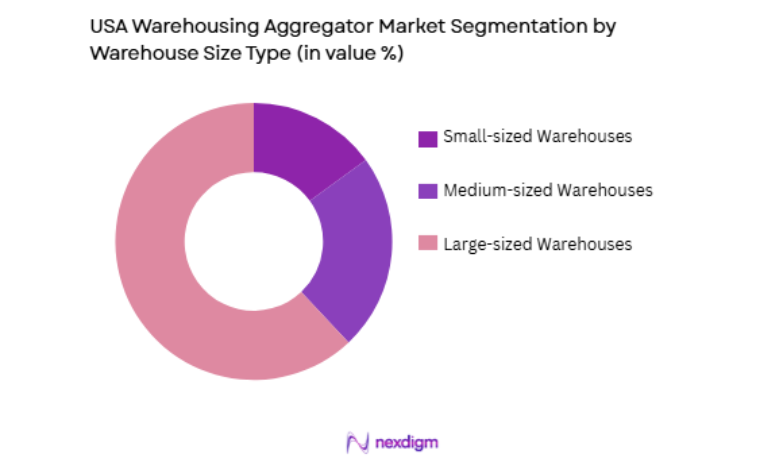
The USA warehousing aggregator market is segmented by warehouse size into small, medium, and large-sized warehouses. Recently, large-sized warehouses have dominated the market due to the increasing demand for storage solutions that can accommodate the growing volume of inventory in the e-commerce sector. Large warehouses allow companies to store greater quantities of goods, improving supply chain efficiency and reducing costs. The development of massive distribution centers, especially in logistics hubs like Dallas and Chicago, has supported the growth of large-sized warehouses, which provide significant economies of scale for businesses managing substantial product volumes across multiple regions.
Competitive Landscape
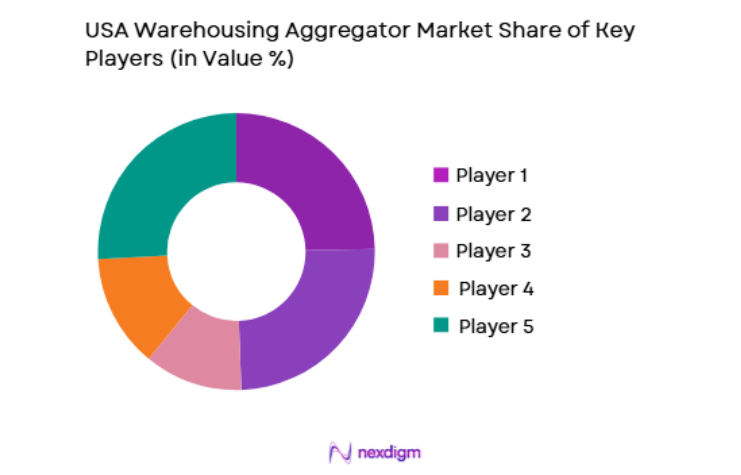
The competitive landscape in the USA warehousing aggregator market is dynamic, with both established players and newer entrants vying for market share. Consolidation is a growing trend as larger warehousing providers acquire smaller players to expand their geographic reach and service offerings. The market is also being driven by technological advancements, with companies investing in automation, robotics, and IoT solutions to enhance operational efficiency and reduce costs. Warehousing aggregators are focusing on expanding their service portfolios by offering integrated supply chain solutions that enable businesses to streamline their logistics and inventory management.
| Company Name | Establishment Year | Headquarters | Technology Focus | Market Reach | Key Products | Revenue (USD) | Additional Parameter |
| Prologis Inc. | 1983 | San Francisco | ~ | ~ | ~ | ~ | ~ |
| CBRE Group | 1906 | Los Angeles | ~ | ~ | ~ | ~ | ~ |
| XPO Logistics | 1989 | Greenwich | ~ | ~ | ~ | ~ | ~ |
| Amazon Logistics | 1994 | Seattle | ~ | ~ | ~ | ~ | ~ |
| DHL Supply Chain | 1969 | Bonn, Germany | ~ | ~ | ~ | ~ | ~ |
USA Warehousing Aggregator Market Analysis
Growth Drivers
E-commerce Growth and Online Retail Expansion
The explosive growth of e-commerce in the United States has been a significant driver of demand for warehousing aggregation services. As consumers continue to shift toward online shopping, businesses require efficient storage and distribution solutions to meet rising customer expectations for fast delivery. E-commerce giants like Amazon, Walmart, and Target are investing heavily in building and upgrading their warehousing operations to handle increasing inventory volumes. This demand for faster order fulfillment and reduced delivery times has pushed businesses to partner with warehousing aggregators that provide flexible, scalable storage solutions capable of adapting to fluctuating demand. The need for advanced inventory management systems, real-time data, and integrated supply chain solutions is expected to increase as e-commerce continues to expand across the United States.
Technological Advancements in Logistics and Automation
The adoption of technology in warehousing and logistics is a key growth driver for the market. Automation, robotics, and IoT solutions are transforming the warehousing industry, making it more efficient and cost-effective. The rise of automated guided vehicles (AGVs), drones for inventory management, and smart sensors for real-time tracking of goods is driving the demand for advanced warehousing solutions. These technologies allow businesses to optimize warehouse space, improve operational efficiency, and reduce labor costs. Additionally, the integration of AI and machine learning in warehouse management systems (WMS) enables businesses to forecast demand, optimize inventory levels, and streamline their supply chains. As these technologies become more affordable and accessible, more warehousing aggregators are adopting them to remain competitive.
Market Challenges
High Operational Costs and Real Estate Prices
One of the primary challenges in the USA warehousing aggregator market is the rising cost of real estate, particularly in key logistics hubs like New York, Chicago, and Los Angeles. Demand for warehouse space has increased significantly in recent years, driving up rental prices, especially in prime locations near transportation networks and ports. The high cost of land and the need for large, specialized facilities are putting pressure on businesses to secure affordable spaces while maintaining operational profitability. Additionally, increasing energy costs, transportation expenses, and labor shortages are further driving up operational costs for warehousing aggregators. As competition increases and real estate prices continue to rise, warehousing companies must find innovative ways to manage costs and maximize warehouse space efficiency to remain profitable.
Labor Shortages and Skill Gaps in the Workforce
The warehousing and logistics sectors in the United States are facing significant labor shortages, particularly in the areas of warehouse operations, inventory management, and technology maintenance. As e-commerce and other industries require more advanced warehousing solutions, the demand for skilled workers to operate and maintain automation systems, robotics, and warehouse management software has risen. However, there is a growing gap in the availability of workers with the necessary technical skills to manage these advanced systems. This labor shortage is making it increasingly difficult for warehousing companies to scale operations while maintaining efficiency and productivity. Furthermore, attracting and retaining talent in the warehousing sector remains a challenge as competition for skilled workers intensifies across the logistics industry.
Opportunities
Investment in Sustainable and Green Warehousing Practices
As businesses and consumers increasingly prioritize sustainability, the demand for green warehousing solutions is growing. Companies are looking for ways to reduce their carbon footprint, optimize energy use, and adopt environmentally friendly practices within their supply chains. The warehousing aggregator market offers significant opportunities for businesses to implement sustainable practices, such as energy-efficient buildings, solar-powered facilities, and waste-reduction strategies. Warehousing operators that invest in green logistics and sustainable technologies can differentiate themselves in the market and attract environmentally conscious clients. Moreover, government incentives and tax breaks for green initiatives are encouraging businesses to invest in sustainable warehousing solutions. This trend is expected to continue as the demand for environmentally responsible logistics practices grows.
Expansion of Multimodal Logistics and Cross-Border Trade
The increasing globalization of supply chains presents significant opportunities for warehousing aggregators, particularly as cross-border trade and multimodal logistics become more prevalent. The rise of international e-commerce and the expansion of trade agreements have created a need for integrated logistics solutions that offer both domestic and global warehousing options. Warehousing aggregators that can provide seamless cross-border shipping, customs clearance, and international distribution services are well-positioned to capitalize on this trend. Additionally, the growing popularity of multimodal transport—combining road, rail, air, and sea transportation—creates opportunities for warehousing companies to offer more comprehensive and cost-effective supply chain solutions. As businesses expand their global reach, the demand for flexible, scalable warehousing services that can accommodate international logistics needs will continue to rise.
Future Outlook
The future outlook for the USA warehousing aggregator market is highly positive, with expected growth driven by the continued expansion of e-commerce, technological advancements, and increasing demand for sustainable logistics solutions. Over the next five years, the market is likely to witness rising demand for smart warehousing and automation technologies as businesses seek to improve efficiency and reduce operational costs. Furthermore, the ongoing investment in infrastructure development, both domestically and internationally, will create new opportunities for warehousing aggregators to expand their service offerings. As e-commerce continues to grow and global trade expands, warehousing aggregators will play a crucial role in facilitating the efficient movement of goods and meeting the evolving needs of businesses.
Major Players
- Prologis Inc.
- CBRE Group
- XPO Logistics
- Amazon Logistics
- DHL Supply Chain
- J.B. Hunt Transport Services
- UPS Supply Chain Solutions
- C.H. Robinson
- Ryder Supply Chain Solutions
- Lineage Logistics
- Scania Logistics
- Kuehne + Nagel
- Maersk Logistics
- Geodis
- FedEx Logistics
Key Target Audience
- Investments and venture capitalist firms
- Government and regulatory bodies
- E-commerce companies
- Logistics service providers
- Retailers and wholesalers
- Manufacturing companies
- Industrial parks and real estate developers
- Freight forwarding companies
Research Methodology
Step 1: Identification of Key Variables
This step involves identifying key market drivers such as technological advancements, demand for warehousing, e-commerce growth, and government infrastructure initiatives.
Step 2: Market Analysis and Construction
The analysis of market conditions and segmentation allows for the construction of a detailed model that highlights the current trends and future growth areas in the warehousing aggregator market.
Step 3: Hypothesis Validation and Expert Consultation
Consultations with industry experts validate market assumptions, providing insights into the validity of the current trends and expected future developments.
Step 4: Research Synthesis and Final Output
The final report integrates the collected data, providing actionable insights and recommendations based on the comprehensive market analysis.

- Executive Summary
- Research Methodology (Definitions, Scope, Industry Assumptions, Market Sizing Approach, Primary & Secondary Research Framework, Data Collection & Verification Protocol, Analytic Models & Forecast Methodology, Limitations & Research Validity Checks)

- Market Definition and Scope
- Value Chain & Stakeholder Ecosystem
- Regulatory / Certification Landscape
- Sector Dynamics Affecting Demand

- Growth Drivers
Expanding E-commerce Sector
Technological Advancements in Automation
Government Investment in Logistics Infrastructure - Market Challenges
High Initial Capital Investment
Technological Integration Barriers
Labor Shortage and Skill Gaps - Market Opportunities
Demand for Real-time Inventory Management Solutions
Advancement of Warehouse Automation Technologies
Growth in Cross-border E-commerce - Trends
Adoption of Artificial Intelligence in Warehouse Management
Use of Robotics and Automated Vehicles
Integration of Energy-efficient Technologies - Government regulations
- SWOT analysis
- Porters 5 forces

- By Market Value, 2020-2025
- By Installed Units, 2020-2025
- By Average System Price, 2020-2025
- By System Complexity Tier, 2020-2025

- By System Type (In Value%)
Inventory Management Systems
Order Fulfillment Systems
Warehouse Management Systems
Automated Storage & Retrieval Systems
Warehouse Control Systems - By Platform Type (In Value%)
Cloud-based Platforms
On-premise Platforms
Hybrid Platforms
Mobile Platforms
Integrated Platforms - By Fitment Type (In Value%)
Standalone Solutions
Modular Solutions
Cloud-based Solutions
Hybrid Solutions
Custom Solutions - By End User Segment (In Value%)
E-commerce Retailers
Third-party Logistics Providers
Manufacturers
Automotive Industry

- Market Share Analysis
- Cross Comparison Parameters (System Type, Platform Type, Procurement Channel, EndUser Segment, Fitment Type, Automation Level, Operational Efficiency, Service Delivery Time, Scalability, Regional Penetration)
- SWOT Analysis of Key Competitors
- Pricing & Procurement Analysis
- Key Players
XPO Logistics
DHL Supply Chain
Kuehne + Nagel
DB Schenker
Agility Logistics
FedEx Logistics
Siemens Logistics
Manhattan Associates
Dematic
Honeywell Intelligrated
JDA Software
Cushman & Wakefield
GLP
DHL
Savills

- E-commerce Companies Needing Efficient Fulfillment Solutions
- Logistics Providers Seeking Cost-effective Automation
- Manufacturers Adopting Warehouse Management Solutions
- Food & Beverage Industry Requiring Temperature-controlled Storage

- Forecast Market Value, 2026-2035
- Forecast Installed Units, 2026-2035
- Price Forecast by System Tier, 2026-2035
- Future Demand by Platform, 2026-2035


 Request a Sample
 Ask for Customization
 Get a Quote
 Enquire Now