

 Download PDF
 Download PDF
Market Overview
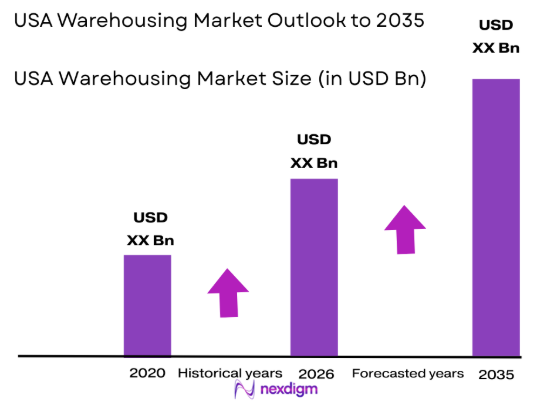
The USA Warehousing market represents one of the largest logistics infrastructure segments globally, supported by the country’s extensive supply chain ecosystem and high freight volumes. Based on a recent historical assessment, the total market value of the USA warehousing sector reached approximately USD ~ billion according to logistics industry data published by the United States Bureau of Economic Analysis and the United States Census Bureau. The market is driven by large scale retail distribution networks, rapid expansion of e commerce fulfillment operations, increasing third party logistics outsourcing, and growing adoption of automated storage and warehouse management systems.
Major logistics hubs across the United States play a critical role in shaping warehousing demand due to their proximity to transportation infrastructure and consumer markets. Cities including Chicago, Los Angeles, Dallas, Atlanta, and Inland Empire support extensive warehousing clusters connected to major ports, rail terminals, interstate highways, and air cargo facilities. These regions attract large scale distribution centers operated by retail corporations, e commerce companies, and third party logistics providers because of efficient freight connectivity, access to skilled logistics labor, and proximity to major population centers that support high volume distribution activity.
Market Segmentation
By Warehouse Type
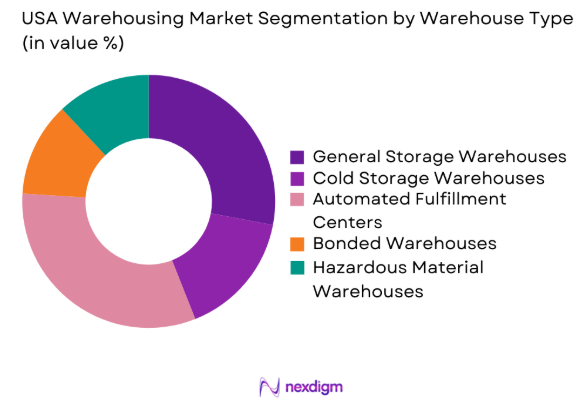
USA Warehousing market is segmented by product type into general storage warehouses, cold storage warehouses, automated fulfillment centers, bonded warehouses, and hazardous material storage facilities. Recently, automated fulfillment centers have a dominant market share due to factors such as rapid expansion of online retail platforms, rising demand for same day delivery services, and large scale investments in warehouse automation technologies. Major retailers and logistics companies increasingly deploy robotic picking systems, automated sorting lines, and advanced warehouse management software to improve operational efficiency and process extremely high order volumes. Automated fulfillment infrastructure also supports large national distribution networks that require fast order processing and real time inventory visibility, making these facilities particularly attractive for e commerce companies and third party logistics providers managing multi client distribution operations.
By End User
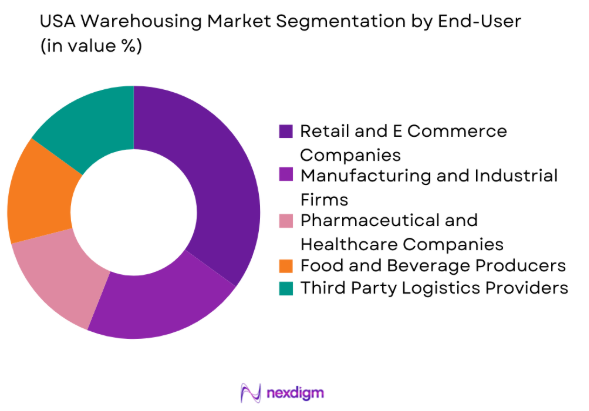
USA Warehousing market is segmented by product type into retail and e commerce companies, manufacturing and industrial firms, pharmaceutical and healthcare companies, food and beverage producers, and third party logistics providers. Recently, retail and e commerce companies have a dominant market share due to factors such as expanding online shopping activity, rapid consumer demand for fast delivery services, and the need for large scale inventory storage supporting national distribution networks. Retailers increasingly operate large fulfillment centers near major urban regions to ensure faster order processing and last mile distribution. The expansion of omnichannel retail strategies also requires additional warehouse capacity to manage both store replenishment and direct consumer shipments, reinforcing the strong presence of retail and e commerce companies in the warehousing ecosystem.
Competitive Landscape
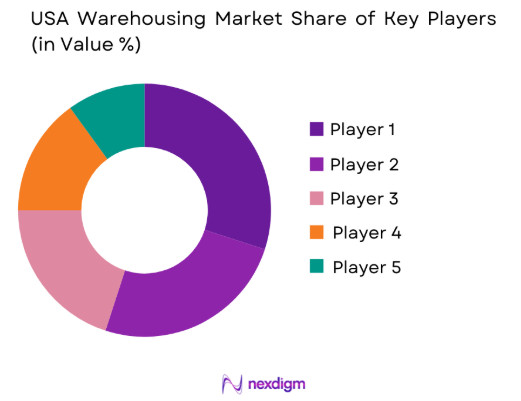
The USA Warehousing market is characterized by the presence of large industrial real estate operators, global logistics service providers, and specialized cold storage infrastructure companies. Market consolidation continues as logistics operators expand through acquisitions and strategic partnerships to increase warehouse capacity and geographic coverage. Major players operate large distribution center networks across multiple logistics hubs and invest heavily in automation technologies, digital warehouse management systems, and temperature controlled storage facilities to strengthen their competitive positioning within national supply chains.
| Company Name | Establishment Year | Headquarters | Technology Focus | Market Reach | Key Products | Revenue | Warehouse Capacity |
| Prologis | 1983 | United States | ~ | ~ | ~ | ~ | ~ |
| Lineage Logistics | 2012 | United States | ~ | ~ | ~ | ~ | ~ |
| Americold Realty Trust | 1903 | United States | ~ | ~ | ~ | ~ | ~ |
| Ryder System | 1933 | United States | ~ | ~ | ~ | ~ | ~ |
| XPO Logistics | 1989 | United States | ~ | ~ | ~ | ~ | ~ |
USA Warehousing Market Analysis
Growth Drivers
Rapid Expansion of E Commerce Fulfillment Infrastructure
The expansion of digital retail platforms across the United States significantly increases demand for advanced warehousing infrastructure capable of supporting high volume order fulfillment. Online marketplaces process millions of daily transactions involving electronics, clothing, groceries, and household goods that require efficient storage and distribution. Companies invest heavily in automated fulfillment centers equipped with robotics, conveyor systems, and advanced warehouse management software to manage complex inventory flows. Retailers also establish distribution hubs near major metropolitan areas to shorten delivery distances and accelerate shipping timelines. Growth of same day and next day delivery services further increases demand for efficient warehouse operations capable of processing large order volumes across national logistics networks.
Expansion of Third Party Logistics and Outsourced Supply Chain Services
The growing adoption of third party logistics services across the United States significantly increases demand for commercial warehousing operated by specialized logistics providers. Many manufacturers, retailers, and consumer goods companies increasingly outsource inventory storage, distribution management, and order fulfillment to logistics operators with extensive warehouse networks. These providers manage multi client facilities while offering integrated transportation, packaging, and distribution services. Outsourcing allows companies to focus on core business activities while reducing capital investment in private warehouse infrastructure. Third party logistics firms also deploy advanced warehouse management systems to optimize inventory movement and shipment coordination. Expanding global supply chains and rising delivery expectations further strengthen demand for outsourced warehousing services.
Market Challenges
High Industrial Real Estate and Land Acquisition Costs
Rising industrial real estate and land acquisition costs represent a major operational challenge for the USA warehousing market. Logistics hubs near large metropolitan regions experience particularly high land prices due to strong demand for industrial development and limited availability of suitable properties. Developers require large land parcels to build distribution centers with modern logistics infrastructure including automated storage systems, truck docks, and freight vehicle parking. Increasing construction material costs, financing expenses, and zoning regulations further raise development investment requirements. High property prices also increase warehouse leasing costs for businesses. In some logistics hubs, developers explore multi story warehouses or redevelop older industrial sites to expand storage capacity despite higher construction complexity.
Labor Shortages in Logistics and Warehouse Operations
The USA warehousing market faces persistent labor shortages that impact operational efficiency across logistics facilities nationwide. Warehousing operations require significant manpower for inventory handling, order picking, packaging, equipment operation, and facility maintenance. Logistics companies often struggle to recruit and retain workers due to physically demanding tasks and competition from other sectors offering comparable wages. High employee turnover increases recruitment and training costs while reducing productivity. Expanding distribution networks and growing e commerce fulfillment operations increase demand for skilled roles including forklift operators and automation technicians. Companies increasingly adopt warehouse automation to reduce labor dependence, yet implementing advanced systems requires substantial capital investment and technical expertise, which smaller operators may struggle to adopt.
Opportunities
Expansion of Cold Storage Infrastructure for Food and Pharmaceutical Supply Chains
The expansion of temperature sensitive supply chains across the United States creates strong opportunities for specialized cold storage warehousing infrastructure. Food distribution networks require refrigerated facilities capable of maintaining precise temperature conditions for products such as dairy items, frozen foods, fresh produce, and processed food goods. Pharmaceutical supply chains also depend on validated temperature controlled environments for vaccines, biologic drugs, insulin, and other medical treatments. Rising consumer demand for frozen and ready to eat foods encourages retailers and manufacturers to expand refrigerated storage capacity. Cold storage operators invest in advanced refrigeration systems, digital temperature monitoring technologies, and automated inventory management platforms. Expanding food trade and biopharmaceutical production further strengthen the strategic importance of temperature controlled warehousing infrastructure.
Adoption of Smart Warehouse Technologies and Robotics Systems
Rapid technological advancement in warehouse automation creates major opportunities for improving operational efficiency across the USA warehousing market. Logistics companies increasingly deploy robotics technologies including automated guided vehicles, robotic picking systems, and automated storage and retrieval equipment capable of managing high volume inventory handling with minimal manual intervention. Smart warehouse management platforms integrate artificial intelligence, predictive analytics, and real time inventory tracking to optimize storage allocation and coordinate shipping schedules. Retailers and third party logistics providers also invest in robotics enabled fulfillment centers processing thousands of orders per hour with improved accuracy. Internet of Things sensors and cloud logistics platforms further enhance productivity by monitoring equipment performance and warehouse conditions continuously.
Future Outlook
The USA Warehousing market is expected to experience continued expansion as logistics infrastructure evolves to support growing national freight movement and digital commerce activity. Companies are expected to invest significantly in automated warehouse technologies, robotics based fulfillment systems, and smart logistics management platforms that enhance operational efficiency. Increasing demand for temperature controlled storage, urban distribution centers, and third party logistics outsourcing will further stimulate infrastructure development. Government transportation investments and supply chain modernization initiatives will also strengthen long term logistics capacity.
Major Players
- Prologis
- Lineage Logistics
- Americold Realty Trust
- Ryder System
- XPO Logistics
- CBRE Group
- Goodman Group
- STAG Industrial
- EastGroupProperties
- GLP Global Logistics Properties
- Bridge Industrial
- Blackstone Industrial Logistics
- UPS Supply Chain Solutions
- FedEx Supply Chain
- DHL Supply Chain
Key Target Audience
- Logistics infrastructure investors
- Real estate investment trusts
- E commerce companies
- Retail distribution companies
- Manufacturing companies
- Investments and venture capitalist firms
- Government and regulatory bodies
- Third party logistics providers
Research Methodology
Step 1: Identification of Key Variables
The research begins with identifying major variables influencing the warehousing market including logistics infrastructure capacity, supply chain demand patterns, e commerce growth, and industrial real estate development. Key industry indicators such as warehouse capacity, automation adoption, and logistics outsourcing are analyzed to determine the structure of the market.
Step 2: Market Analysis and Construction
Quantitative and qualitative data are collected from industry databases, government publications, logistics associations, and corporate reports. Market frameworks are constructed using supply chain infrastructure indicators, industrial real estate data, and logistics service demand patterns.
Step 3: Hypothesis Validation and Expert Consultation
Industry assumptions and analytical models are validated through expert consultation with logistics professionals, supply chain analysts, and infrastructure specialists. Feedback from industry participants helps refine market assumptions and validate key growth drivers affecting the warehousing sector.
Step 4: Research Synthesis and Final Output
All collected insights are synthesized into a comprehensive market analysis framework combining quantitative data, industry trends, and competitive benchmarking. The final research output integrates supply chain infrastructure insights with strategic analysis of warehousing market developments.

- Executive Summary
- Research Methodology (Definitions, Scope, Industry Assumptions, Market Sizing Approach, Primary & Secondary Research Framework, Data Collection & Verification Protocol, Analytic Models & Forecast Methodology, Limitations & Research Validity Checks)

- Market Definition and Scope
- Value Chain & Stakeholder Ecosystem
- Regulatory / Certification Landscape
- Sector Dynamics Affecting Demand
- Strategic Initiatives & Infrastructure Growth

- Growth Drivers
- Expansion of E Commerce Fulfillment Infrastructure
Growth of National Retail Distribution Networks
Increasing Investment in Warehouse Automation Technologies - Market Challenges
High Industrial Real Estate and Land Acquisition Costs
Labor Shortages in Logistics and Warehouse Operations
Rising Energy Costs for Large Scale Storage Facilities - Market Opportunities
Expansion of Cold Storage Infrastructure for Food and Pharmaceuticals
Integration of Robotics and Artificial Intelligence in Warehousing
Growth of Urban Micro Fulfillment Centers - Trends
Adoption of Smart Warehouse Management Platforms
Expansion of Multi Client Third Party Logistics Warehousing
Development of High Throughput Automated Fulfillment Facilities - Government Regulations
- SWOT Analysis of Key Competitors
- Porter’s Five Forces

- By Market Value, 2020-2025
- By Installed Units, 2020-2025
- By Average System Price, 2020-2025
- By System Complexity Tier, 2020-2025

- By System Type (In Value%)
General Storage Warehouses
Cold Storage Warehouses
Automated Fulfillment Centers
Bonded Warehouses
Hazardous Material Warehouses - By Platform Type (In Value%)
Retail Distribution Warehousing
E Commerce Fulfillment Warehousing
Manufacturing Support Warehousing
Third Party Logistics Warehousing
Port and Intermodal Warehousing - By Fitment Type (In Value%)
Automated Storage and Retrieval Systems
Conventional Racking Warehousing
High Density Pallet Storage
Temperature Controlled Storage
Smart Warehouse Management Systems - By End User Segment (In Value%)
Retail and E Commerce Companies
Manufacturing and Industrial Firms
Food and Beverage Producers
Pharmaceutical and Healthcare Companies
Third Party Logistics Providers - By Procurement Channel (In Value%)
Direct Industrial Leasing
Third Party Logistics Contracts
Government Logistics Procurement
Private Warehouse Ownership
Real Estate Investment Trust Leasing

- Market Share Analysis
- Cross Comparison Parameters(Warehouse Capacity, Automation Technology Level, Geographic Coverage, End User Industry Focus, Logistics Integration Capability)
- SWOT Analysis of Key Competitors
- Pricing & Procurement Analysis
- Key Players
Prologis
Duke Realty
Lineage Logistics
Americold Realty Trust
Ryder System
XPO Logistics
CBRE Group
Goodman Group
Blackstone Industrial Logistics
STAG Industrial
Bridge Industrial
EastGroup Properties
GLP Global Logistics Properties
UPS Supply Chain Solutions
FedEx Supply Chain

- Retail companies expanding national distribution center networks
- Manufacturers increasing regional inventory storage capacity
- Pharmaceutical firms requiring validated temperature controlled warehousing
- Third party logistics providers managing outsourced warehouse operations

- Forecast Market Value, 2026-2035
- Forecast Installed Units, 2026-2035
- Price Forecast by System Tier, 2026-2035
- Future Demand by Platform, 2026-2035


 Request a Sample
 Ask for Customization
 Get a Quote
 Enquire Now