
 Download PDF
 Download PDF
Market Overview
The USA Wellness Tracking Solutions Market (covering wellness-led wearables and their companion software/subscription layers used to track activity, sleep, recovery, stress, and related wellbeing signals) is valued at USD ~ billion in the prior year and USD ~ billion in the latest year. This expansion is driven by smartwatch/ring-led tracking becoming a daily utility, rising subscription attach for premium insights and coaching, and deeper sensor stacks that keep users engaged beyond step counting (sleep, recovery/HRV, stress, and cardio signals).
The market is most concentrated in the San Francisco Bay Area, New York Metro, Boston, Seattle, and Los Angeles, because these hubs combine (a) a dense base of wearable and digital health employers, (b) strong consumer-tech distribution ecosystems, and (c) capital and talent that accelerate product cycles, partnerships, and platform integrations. This concentration is visible alongside US digital health financing of USD ~ billion in the prior year and USD ~ billion in the latest year, supporting continuous platform innovation and commercialization momentum.

Market Segmentation
By Solution Type
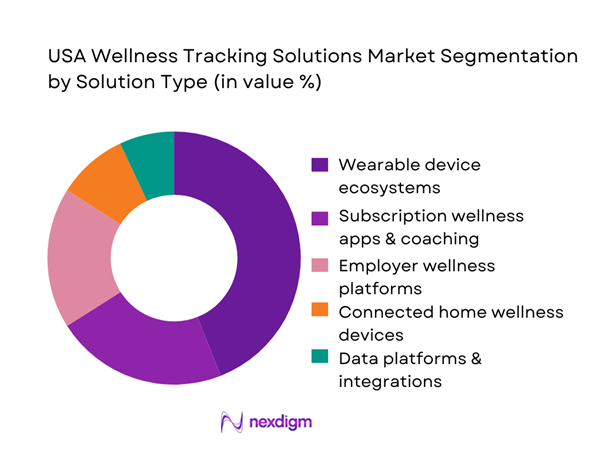
USA Wellness Tracking Solutions Market is segmented by solution type into wearable device ecosystems, subscription wellness apps & coaching, employer wellness platforms, connected home wellness devices, and data platforms & integrations. Recently, wearable device ecosystems have a dominant market share under solution type because they control the “sensor-to-insight” loop: they capture high-frequency biometric signals (sleep, HRV/recovery, activity, cardio proxies), translate them into simple readiness/stress narratives, and nudge users daily via on-device UX. This habit loop reduces churn versus app-only solutions, while monetization is reinforced through upgrades and premium subscriptions for deeper insights, training plans, and long-term trend analytics. Wearable ecosystems also win distribution: D2C, mass retail, carrier bundles, and app-store onboarding are all optimized for device-led funnels. In addition, employer challenges and incentive programs often start with wearable compatibility, making device ecosystems the default tracking layer that other wellness services plug into.
By Device Form Factor
USA Wellness Tracking Solutions Market is segmented by device form factor into smartwatches, fitness bands, smart rings, hearables (sensing earbuds), and smart patches/other wearables. Recently, smartwatches hold a dominant market share under the device form-factor segmentation because they offer the most complete wellness experience: continuous passive tracking, real-time notifications, and a broad app ecosystem that supports multi-domain engagement (activity, sleep, stress, workouts, and lifestyle). Smartwatches also benefit from strong upgrade cycles tied to flagship launches and ecosystem lock-in (phone OS integration, wallets, and services), keeping users inside a single health dashboard over time. Compared with bands, watches capture higher ASPs and stronger premium attach; compared with rings, watches offer richer interaction surfaces; and compared with patches, watches are more mainstream in retail and gifting. For many users, the smartwatch is also the “first wearable,” after which complementary devices (rings/scales) may be added—preserving smartwatch leadership.
Competitive Landscape
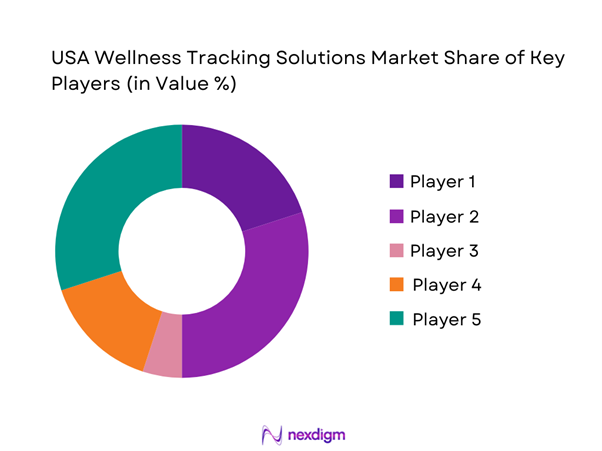
The USA Wellness Tracking Solutions Market is dominated by a mix of platform-centric device ecosystems and subscription-first wellness specialists. Competition concentrates around who can deliver the best “insights experience” (sleep/recovery/stress narratives), sustain retention through coaching/community, and expand distribution via retail + employer/payer channels. Vendors that combine strong sensing, trusted UX, and multi-channel go-to-market typically shape category standards and partner ecosystems.
| Company | Established | Headquarters | Core Wellness Proposition | Primary Form Factor | Key Tracking Domains | Ecosystem / Integration Strength | Subscription Model | USA Channel Strength |
| Apple | 1976 | USA | ~ | ~ | ~ | ~ | ~ | ~ |
| Google (Fitbit) | 1999 | USA | ~ | ~ | ~ | ~ | ~ | ~ |
| Garmin | 1989 | USA | ~ | ~ | ~ | ~ | ~ | ~ |
| Oura | 2013 | USA | ~ | ~ | ~ | ~ | ~ | ~ |
| Personify Health (Virgin Pulse + HealthComp) | 2004 | USA | ~ | ~ | ~ | ~ | ~ | ~ |
USA Wellness Tracking Solutions Market Analysis
Growth Drivers
Consumerization of health data
The USA Wellness Tracking Solutions market rides on the same structural forces that have “consumerized” other data categories: high disposable income, a very large addressable population, and a digitally mediated services economy. The United States reported population of ~ and GDP per capita of USD ~—a spending base that supports recurring purchases of wearables, wellness apps, connected scales, sleep trackers, and recovery platforms that generate continuous user data exhaust. At the macro layer, the U.S. economy’s scale (GDP of USD ~) creates large downstream ecosystems—sports/fitness, employer benefits, digital health, pharmacy, and device retail—where personal wellness telemetry becomes a product feature, a service differentiator, and (increasingly) a data asset. In parallel, the “health spend gravity” in consumer behavior is visible in national accounts: Personal Consumption Expenditures for health care services reached USD ~ billion and then moved to USD ~ billion, indicating a large and still-expanding health-services backdrop that normalizes tracking, triage, and habit change as part of daily life rather than episodic care. Finally, labor-market tightness matters because it increases employer attention to productivity and burnout mitigation: the World Bank reports U.S. unemployment at ~ and inflation at ~, which keeps pressure on household budgets and reinforces the value proposition of “do more with the same time/energy” wellness tools (sleep optimization, stress detection, coaching prompts, recovery scoring).
Subscriptionization of wellness
Wellness tracking has shifted from “device-only” to subscription-led monetization (continuous insights, coaching, content, and premium analytics). That business model aligns with a U.S. macro environment where high-income consumers can sustain recurring digital services: GDP per capita at USD ~ provides the spending headroom that makes monthly wellness memberships viable at scale. The key market-enabler is that subscription value is framed against large, measurable household and national health outlays: national accounts show health care services PCE rising from USD ~ billion to USD ~ billion and then to USD ~ billion across the recent period—an operating context where consumers and employers accept “ongoing service” as normal. For vendors, subscriptions are also a hedge against hardware replacement cycles: the recurring layer funds algorithm refreshes (sleep staging, arrhythmia flags, stress inference), cloud storage of longitudinal biometrics, and increasingly multimodal models that unify steps + HRV + sleep + nutrition logs into one coaching narrative. This is particularly relevant in a large economy (GDP USD ~) where scale rewards platforms that can spread fixed AI/cloud costs across millions of paid seats. Inflation dynamics also matter for “bundle economics”: with inflation at ~, consumers become more selective, which pushes vendors to justify renewals via measurable outcomes (sleep consistency streaks, resting heart rate trends, activity minutes) rather than novelty.
Challenges
Data privacy and “non-HIPAA” health data exposure
A defining U.S. market friction is that a lot of wellness tracking data sits outside HIPAA, yet still carries high sensitivity (mental health, fertility, addiction recovery, medication behaviors). Enforcement history shows this is not theoretical: regulatory actions required payments of USD ~ million and USD ~ million over alleged sensitive health data sharing for advertising and health breach violations. These cases directly shape procurement checklists for wellness tracking vendors (SDK governance, pixel restrictions, data-sharing contracts, consent logs). The macro environment amplifies the stakes: with U.S. GDP at USD ~, the incentive to monetize data and run performance marketing at scale is enormous, which increases both the opportunity and the compliance risk in non-HIPAA consumer ecosystems. Cybercrime economics further elevate privacy exposure as a board-level issue: federal reporting cited ~ complaints and losses exceeding USD ~ billion, underscoring the attack surface for any platform holding large volumes of identity-linked wellness data. In parallel, consumer fraud reporting summarized USD ~ billion in fraud losses, signaling a broader environment of digital exploitation that makes users and employers more skeptical of data collection.
Fragmented data standards
Wellness tracking in the U.S. must bridge a fragmented standards landscape: consumer wearables, employer platforms, payer programs, and clinical interoperability don’t share one canonical schema. That matters because buyers want unified longitudinal views (activity + sleep + stress + nutrition + biometrics) and vendors need data portability to reduce switching friction. The fragmentation challenge is felt most in a large economy (GDP USD ~) where thousands of employers and multiple benefit administrators create heterogeneous integrations and reporting requirements. It also shows up in the “telework scale” problem: ~ teleworkers implies programs must ingest data from many device ecosystems across a distributed workforce, making standardization more critical and more difficult. On the policy side, the U.S. is actively updating health IT certification and information governance via federal rulemaking, but wellness tracking vendors still face a gap between “clinical-grade interoperability expectations” and consumer app realities. Macroeconomic pressure adds urgency: with inflation at ~, procurement teams are less tolerant of integration waste and demand faster time-to-value, which exposes standards fragmentation as a cost and time risk (longer deployments, brittle APIs, incomplete histories, and inconsistent metrics like HRV baselines or sleep staging definitions).
Opportunities
Personalized coaching at scale
The biggest near-term opportunity is to industrialize “personalized coaching” using passive sensing + AI, while staying inside stricter privacy and trust expectations. The U.S. can support this at scale because of its economic and population base: GDP USD ~, population ~, and GDP per capita USD ~—a combination that enables large employer deployments and consumer subscriptions simultaneously. The demand signal is strengthened by work pattern data: ~ teleworkers implies millions of people need low-friction, remote-friendly behavior support (sleep regularity, movement breaks, stress downshifts) that can’t rely on in-person touchpoints. Another current-data anchor is the sheer magnitude of health-services spending behavior: U.S. health care services PCE at USD ~ billion indicates an economy where health improvement products can be positioned as “always-on services” rather than one-time purchases. The coaching-at-scale play is to turn raw signals into decision-ready micro-actions: adaptive goals, context-aware nudges, and human-in-the-loop escalation when risk flags appear—without making medical claims. Importantly, privacy enforcement history means vendors that can deliver coaching while minimizing data sharing and proving governance will win enterprise trust.
Multimodal sensing + AI insights
A second opportunity is moving from single-signal products (steps-only, sleep-only) to multimodal sensing and AI insights that unify sleep + activity + stress + context (work patterns, travel, medication routines) into a coherent “wellness operating system.” This matters in the U.S. because the data volume and digital risk environment reward platforms that can deliver value without excessive user input. Current macro and behavioral signals support this: U.S. GDP per capita USD ~ supports premium sensor stacks, while unemployment ~ implies employed users need passive, low-friction insights rather than high-effort logging. The shift is also motivated by cyber and privacy realities—more data must still be safe data. With ~ internet crime complaints and losses exceeding USD ~ billion, vendors that can produce high-quality insights via privacy-preserving architectures (on-device inference, minimal retention, strong consent) have an advantage. The GLP-1 era further reinforces multimodal value: regulatory shortage communications and warning actions against unapproved sellers push consumers toward trusted ecosystems, where multimodal tracking helps users manage routines (activity, sleep, hydration, stress) that interact with weight-management behaviors—without requiring future projections to justify demand. Finally, the scale of U.S. health-services consumption (health care services PCE USD ~ billion) creates headroom for AI-driven wellness layers that sit adjacent to care, translating sensor noise into actionable routines.
Future Outlook
The USA Wellness Tracking Solutions Market is expected to expand through deeper biometric sensing, improved personalization, and stronger “wellness-to-care” pathways that help users translate tracking into sustained behavior change. Wearables will increasingly act as the daily engagement anchor, while software layers drive retention via coaching, community, and incentive wallets. Enterprise buyers will raise the bar on reporting, privacy posture, and integration readiness. Platforms that can balance trust, insight quality, and interoperability are likely to outperform.
Major Players
- Apple
- Samsung
- Garmin
- Oura
- WHOOP
- Withings
- Polar
- Amazfit
- Personify Health
- WebMD Health Services
- Omada Health
- Teladoc Health
- Noom
Key Target Audience
- Wearable device OEMs and consumer electronics brands
- Subscription wellness app publishers and digital coaching platforms
- Employer benefits leaders and HR wellbeing program owners
- Health plans, payers, and Third-Party Administrators
- Retailers, e-commerce marketplaces, and carrier channel partners distributing wellness devices
- Corporate wellness aggregators, incentive/rewards platforms, and benefits marketplaces
- Investments and venture capitalist firms
- Government and regulatory bodies
Research Methodology
Step 1: Identification of Key Variables
We construct a stakeholder ecosystem map spanning device OEMs, app publishers, employer platforms, payers/TPAs, and retail/carrier channels. We finalize inclusion/exclusion boundaries for “wellness tracking” versus regulated medical claims. Secondary research and proprietary databases are used to define the variables that shape adoption, monetization, and retention.
Step 2: Market Analysis and Construction
We compile historical revenue signals across devices, subscriptions, and enterprise contracts, and normalize for multi-device ownership and bundle economics. Segment splits are constructed using a triangulated approach across product mix, channel performance, and platform monetization models. Engagement and churn mechanics are evaluated to stress-test revenue durability.
Step 3: Hypothesis Validation and Expert Consultation
Hypotheses are validated via structured interviews with industry executives across wearables, employer wellbeing, and digital coaching. These consultations confirm pricing structures, subscription attach levers, distribution performance, and partnership economics. Inputs are used to refine segment shares and competitive positioning.
Step 4: Research Synthesis and Final Output
Findings are synthesized into market sizing, segmentation, competitive benchmarking, and forward-looking scenarios. Cross-validation checks are performed using vendor disclosures, channel signals, and consistency tests across segments. The final report is reviewed for scope discipline, internal coherence, and decision-usefulness for business buyers.

- Executive Summary
- Research Methodology (Market definition boundary: wellness vs regulated health, scope inclusion/exclusion, taxonomy, assumptions & abbreviations, bottom-up build from device shipments/subscriptions/contracts, top-down triangulation from digital health spend & employer benefits mix, primary interviews mix, channel checks, app-store/retail validation, data normalization for multi-device users, limitations & confidence scoring, QA and peer review protocol)

- Definition and Scope
- Market Genesis and Evolution
- Business Cycle and Demand Seasonality
- Industry Convergence Map

- Growth Drivers
Consumerization of health data
Subscriptionization of wellness
Employer health cost pressure
GLP-1 era behavior change
Remote/hybrid workforce wellbeing - Challenges
Data privacy and “non-HIPAA” health data exposure
Fragmented data standards
Accuracy/validation skepticism
User fatigue and churn
Incentive gaming/fraud - Opportunities
Personalized coaching at scale
Multimodal sensing + AI insights
Menopause/women’s health tracking
Cardiometabolic prevention ecosystems
Family/household wellness plans - Trends
Sensor fusion
Cuffless BP claims scrutiny
Sleep/HRV as primary engagement lever
Ring adoption
Screenless wearables - Regulatory & Policy Landscape
- SWOT Analysis
- Stakeholder & Ecosystem Analysis
- Porter’s Five Forces Analysis
- Competitive Intensity & Ecosystem Mapping

- By Value, 2019–2024
- Installed Base by Active Users / Paid Subscribers, 2019–2024
- Service Revenue Mix, 2019–2024

- By Fleet Type (in Value %)
Wearables
App-only wellness trackers
Employer wellbeing platforms
Digital coaching programs
Biomarker-enabled wellness ecosystems - By Application (in Value %)
Physical activity & cardio fitness
Sleep staging & recovery
Stress/HRV & readiness
Nutrition & weight
Mental wellbeing/mindfulness - By Technology Architecture (in Value %)
Smartwatch
Band
Ring
Patch/sensor
Smart scale
Smart BP/thermometer adjacency
Hearables/earbuds sensing - By Connectivity Type (in Value %)
B2C direct buyers
Employers
Health plans
Providers/health systems
Sports/performance organizations - By End-Use Industry (in Value %)
Device-only
Device + subscription
Subscription-only
Freemium
Per-member-per-month enterprise - By Region (in Value %)
D2C online
App stores
Mass retail
Specialty sports retail
Carrier bundles

- Competitive Universe and Category Clusters
Market Share View - Cross Comparison Parameters (Sensor depth & signal quality, insight quality/readiness scoring, subscription packaging & retention levers, interoperability & data portability, privacy/compliance posture for consumer health data, employer/payer outcomes reporting maturity, channel strength & GTM model, service stack breadth—coaching/navigation/mental wellbeing integration)
- Pricing and Packaging Benchmark
- Partnership and Integration Benchmark
- Detailed Profiles of Major Companies
Apple
Google
Garmin
Samsung
Oura
WHOOP
Withings
Polar
Amazfit
Personify Health
WebMD Health Services
Omada Health
Teladoc Health
Noom

- Consumer Buyer Journey
- Employer Buyer Journey
- Health Plan & TPA Buyer Journey
- Provider/Health System Adjacency
- KPI Framework by Buyer Type

- By Value, 2025–2030
- Installed Base by Active Users / Paid Subscribers, 2025–2030
- Service Revenue Mix, 2025–2030


 Request a Sample
 Ask for Customization
 Get a Quote
 Enquire Now