
 Download PDF
Market Overview
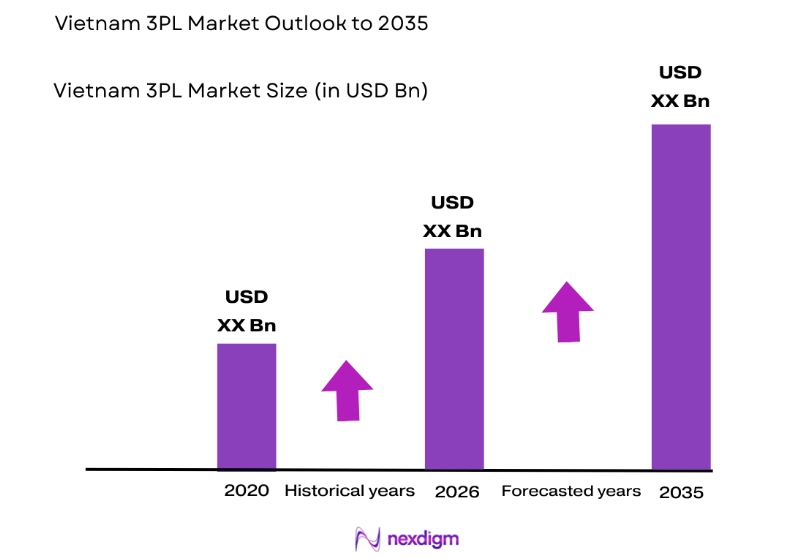
Based on a recent historical assessment, the Vietnam third party logistics market is valued at approximately USD ~ billion according to data published by the Vietnam Logistics Business Association and the Ministry of Industry and Trade. The market is driven by expanding export manufacturing, rising international trade volumes, and rapid e-commerce adoption that generates demand for integrated transportation, warehousing, and distribution services. Logistics providers are investing in modern warehouses, multimodal transport systems, and digital supply chain technologies to improve efficiency.
Ho Chi Minh City and Hanoi dominate logistics activity due to their concentration of industrial parks, export manufacturing facilities, and national distribution centers supporting international trade flows. Provinces such as Binh Duong, Dong Nai, and Hai Phong also serve as major logistics hubs because of port connectivity, manufacturing clusters, and cross-border trade routes linking Vietnam with regional markets. Infrastructure including Cai Mep–Thi Vai Port, Hai Phong Port, and major highway corridors strengthens logistics connectivity nationwide.
Market Segmentation
By Service Type
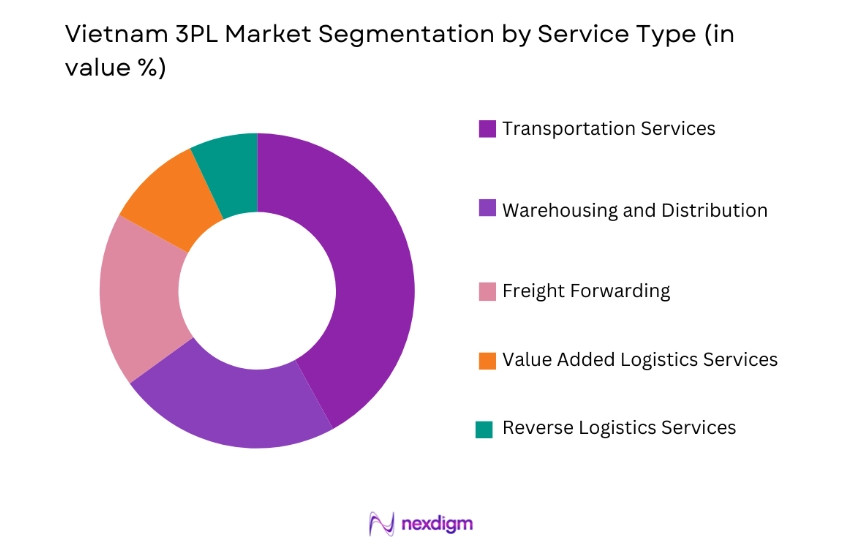
Vietnam 3PL market is segmented by service type into Transportation Services, Warehousing and Distribution, Freight Forwarding, Value Added Logistics Services, and Reverse Logistics Services. Recently, Transportation Services has a dominant market share due to factors such as strong export manufacturing activity, rising domestic freight movements, and the need for reliable cargo transportation between industrial zones and international ports. Manufacturing clusters located across southern and northern industrial corridors generate substantial freight volumes requiring efficient road, sea, and air transport coordination. Logistics providers manage transportation fleets and multimodal freight networks that connect factories, warehouses, and export gateways. The continuous expansion of international trade and domestic cargo distribution strengthens the role of transportation services within third-party logistics operations.
By End User Industry
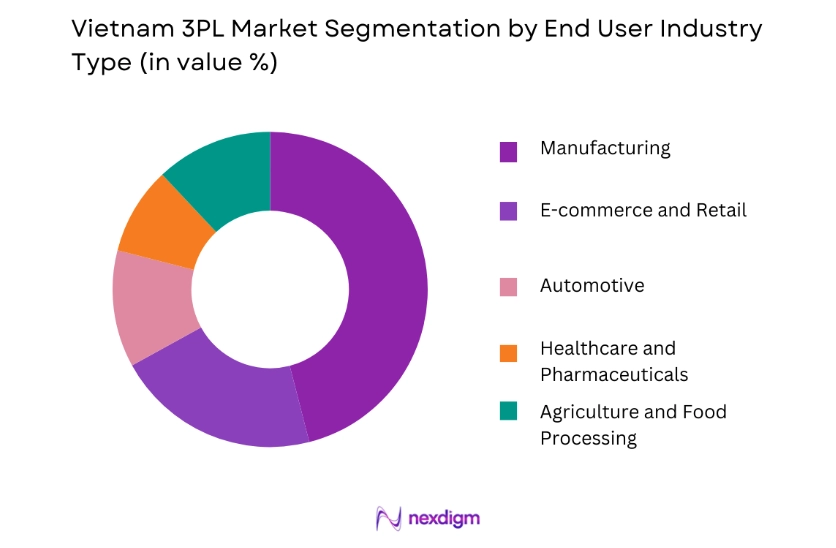
Vietnam 3PL market is segmented by end user industry into Manufacturing, E-commerce and Retail, Automotive, Healthcare and Pharmaceuticals, and Agriculture and Food Processing. Recently, Manufacturing has a dominant market share due to factors such as Vietnam’s strong export-oriented industrial sector and increasing foreign direct investment in electronics, textiles, and consumer goods production. Manufacturing companies rely heavily on third-party logistics providers to manage transportation, inventory storage, and international freight coordination linking factories with overseas markets. Industrial parks located across southern and northern economic corridors generate high logistics demand requiring integrated supply chain services. Logistics providers support manufacturers through distribution centers, freight forwarding operations, and international shipping coordination.
Competitive Landscape
The Vietnam 3PL market is moderately fragmented with a combination of domestic logistics companies and international supply chain operators competing for transportation and warehousing contracts. Large multinational logistics firms maintain strong market presence due to advanced logistics technologies, global shipping networks, and established relationships with multinational manufacturers operating in Vietnam. Domestic logistics providers also play a significant role by offering regional distribution services and local transportation capabilities supporting national supply chains.
| Company Name | Establishment Year | Headquarters | Technology Focus | Market Reach | Key Products | Revenue | Warehouse Capacity |
| Gemadept Corporation | 1990 | Ho Chi Minh City, Vietnam | ~ | ~ | ~ | ~ | ~ |
| DHL Supply Chain Vietnam | 1969 | Bonn, Germany | ~ | ~ | ~ | ~ | ~ |
| Maersk Logistics Vietnam | 1904 | Copenhagen, Denmark | ~ | ~ | ~ | ~ | ~ |
| Kerry Logistics Vietnam | 1981 | Hong Kong | ~ | ~ | ~ | ~ | ~ |
| CJ Logistics Vietnam | 1930 | Seoul, South Korea | ~ | ~ | ~ | ~ | ~ |
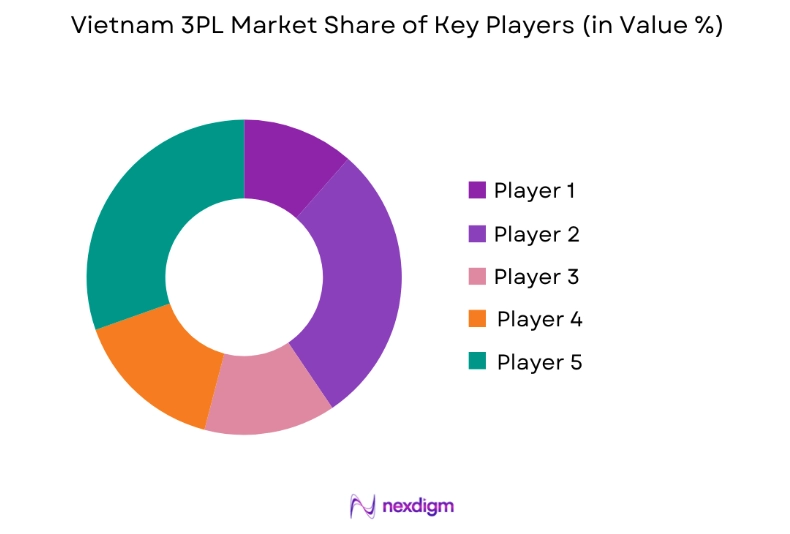
Vietnam 3PL Market Analysis
Growth Drivers
Expansion of Export Manufacturing and Global Supply Chain Integration
Vietnam has become one of the most important manufacturing hubs in Southeast Asia, attracting multinational companies seeking cost-efficient production locations and diversified global supply chains. Export industries including electronics, garments, footwear, and consumer electronics require sophisticated logistics networks to transport raw materials and finished goods between factories, ports, and international markets. Third-party logistics providers support these supply chains by offering freight forwarding, warehousing, customs clearance, and transportation management services that streamline export logistics operations. Industrial parks across provinces such as Binh Duong, Bac Ninh, and Dong Nai generate substantial cargo volumes that must be coordinated through integrated logistics systems connecting manufacturers with shipping carriers and distribution partners. Global supply chain diversification strategies adopted by multinational corporations have further increased production activity within Vietnam, strengthening demand for reliable third-party logistics services capable of managing international trade flows. Logistics providers also deploy advanced supply chain visibility technologies allowing manufacturers to monitor shipments and inventory movements in real time. Investments in port infrastructure and logistics parks have improved cargo handling capacity and freight connectivity across Vietnam’s transportation network. As export manufacturing continues expanding, third-party logistics providers play a crucial role in enabling efficient global supply chain integration.
Rapid Expansion of E Commerce and Domestic Distribution Networks
The rapid growth of digital commerce platforms across Vietnam has significantly increased demand for third-party logistics services capable of managing nationwide product distribution and last mile delivery operations. Online retail marketplaces generate substantial order volumes requiring integrated warehousing, order fulfillment, and parcel transportation networks connecting sellers with consumers across urban and provincial markets. Logistics providers are therefore expanding fulfillment centers, automated warehouses, and parcel sorting facilities designed to support large volumes of online retail shipments. Third-party logistics companies provide essential services including inventory management, packaging operations, and distribution coordination for retailers and e-commerce merchants operating through digital platforms. Consumer demand for faster delivery services further encourages logistics operators to develop urban distribution hubs and technology driven route optimization systems that enhance delivery efficiency. The growth of mobile commerce applications and digital payment systems also increases the frequency of online retail purchases, creating sustained logistics demand across the domestic distribution ecosystem. Retailers increasingly outsource logistics operations to specialized third-party providers capable of managing complex order fulfillment requirements. As digital retail continues expanding across Vietnam, the role of third-party logistics providers becomes increasingly central to supporting nationwide supply chain operations.
Market Challenges
Infrastructure Bottlenecks and Limited Multimodal Transport Integration
Despite strong economic growth and expanding trade activity, Vietnam’s logistics sector faces infrastructure constraints that limit the efficiency of national supply chains and third-party logistics operations. Road congestion around major metropolitan areas and port regions often increases transportation times for freight shipments moving between industrial zones and export gateways. Limited integration between road, rail, and inland waterway transport systems also restricts the development of efficient multimodal logistics solutions capable of reducing cargo transit costs. Many logistics providers therefore rely heavily on road transportation, which increases operational costs and creates congestion across major freight corridors. Port congestion during peak export periods further delays cargo handling and shipping schedules for manufacturers relying on timely international logistics services. Logistics companies must invest significantly in transportation coordination systems and distribution infrastructure to maintain service reliability despite these structural limitations. Infrastructure modernization initiatives continue improving logistics connectivity, but significant investment remains necessary to strengthen multimodal freight networks across the country. These operational constraints represent ongoing challenges for logistics providers seeking to expand large-scale supply chain services throughout Vietnam.
Shortage of Skilled Logistics Workforce and Supply Chain Expertise
Vietnam’s rapidly expanding logistics industry faces increasing demand for skilled professionals capable of managing complex supply chain operations, advanced logistics technologies, and international freight coordination systems. Many logistics companies experience difficulties recruiting personnel with specialized expertise in supply chain planning, warehouse automation management, and digital logistics platforms. The shortage of experienced logistics professionals can affect operational efficiency and increase training costs for companies seeking to maintain high service standards across transportation and distribution networks. As supply chains become more technologically advanced, logistics providers require personnel capable of operating automated warehouse systems, digital tracking platforms, and integrated transportation management software. Training and workforce development programs are therefore becoming critical priorities for logistics companies operating within Vietnam’s growing logistics sector. Universities and vocational training institutions are gradually expanding supply chain management programs, but workforce development continues lagging behind rapid industry expansion. Companies often invest in internal training programs and international partnerships to build operational expertise among employees. Addressing workforce capability gaps remains essential for sustaining the long term growth of Vietnam’s third-party logistics industry.
Opportunities
Development of Smart Logistics Infrastructure and Digital Supply Chain Platforms
The integration of digital technologies and smart logistics infrastructure presents significant opportunities for third-party logistics providers operating within Vietnam’s rapidly expanding supply chain ecosystem. Logistics companies are increasingly adopting warehouse automation systems, artificial intelligence driven demand forecasting tools, and real time cargo tracking platforms that improve operational efficiency and supply chain visibility. Automated warehouses equipped with robotics and advanced inventory management systems enable logistics providers to process large shipment volumes while minimizing manual labor requirements. Cloud based logistics platforms also facilitate data sharing between manufacturers, retailers, and transportation providers, allowing supply chains to operate with greater coordination and transparency. Digital freight management platforms connect shippers with transport providers and optimize cargo movement across multimodal transportation networks. Logistics technology adoption also enhances risk management capabilities by providing real time shipment monitoring and predictive analytics tools that identify potential disruptions. Government initiatives supporting digital transformation across Vietnam’s logistics sector further encourage investment in smart logistics infrastructure. These technological developments create significant opportunities for logistics providers to improve service quality and expand value added supply chain solutions.
Expansion of Regional Trade Corridors and Cross Border Logistics Services
Vietnam’s participation in regional trade agreements and international economic partnerships creates substantial opportunities for logistics providers specializing in cross border freight transportation and supply chain coordination. Trade agreements including the Comprehensive and Progressive Agreement for Trans Pacific Partnership and the Regional Comprehensive Economic Partnership strengthen Vietnam’s integration into global supply chains and increase international cargo flows. Logistics providers supporting cross border trade operations offer freight forwarding, customs brokerage, and international distribution services linking Vietnam with regional markets across Asia and beyond. Border logistics corridors connecting Vietnam with China, Laos, and Cambodia facilitate land based trade routes that complement maritime shipping networks. International logistics operators are investing in cross border distribution hubs and bonded warehouses designed to streamline customs procedures and improve cargo transit efficiency. Ports such as Hai Phong and Cai Mep Thi Vai also serve as critical international trade gateways supporting global logistics operations. As international trade volumes continue expanding across Southeast Asia, third-party logistics providers operating in Vietnam are well positioned to capture growing cross border freight opportunities.
Future Outlook
Vietnam’s third-party logistics market is expected to expand steadily as international trade, manufacturing investment, and digital commerce continue strengthening the country’s supply chain ecosystem. Logistics providers are increasingly adopting automation technologies, smart warehouses, and digital supply chain platforms that improve operational efficiency. Government initiatives aimed at improving transportation infrastructure and logistics connectivity further support industry expansion. Growing regional trade integration and cross-border commerce are also expected to increase demand for integrated logistics services across Vietnam.
Major Players
- Gemadept Corporation
- DHL Supply Chain Vietnam
- Maersk Logistics Vietnam
- Kerry Logistics Vietnam
- CJ Logistics Vietnam
- Nippon Express Vietnam
- DB Schenker Vietnam
- Yusen Logistics Vietnam
- Kuehne + Nagel Vietnam
- UPS Vietnam
- FedEx Vietnam
- Vietnam Post Logistics
- Saigon Newport Logistics
- Transimex Corporation
- Sotrans Logistics
Key Target Audience
- Manufacturing companies and export producers
- E commerce retailers and digital marketplace operators
- Logistics and freight transportation companies
- Port and warehouse infrastructure developers
- Investments and venture capitalist firms
- Government and regulatory bodies
- Supply chain technology solution providers
Research Methodology
Step 1: Identification of Key Variables
Key variables influencing the Vietnam 3PL market including trade flows, manufacturing output, logistics infrastructure, and transportation demand were identified through government reports, logistics databases, and international trade statistics.
Step 2: Market Analysis and Construction
Market structure was constructed using secondary research sources including industry associations, port throughput statistics, company financial reports, and logistics infrastructure data to determine market size and segmentation.
Step 3: Hypothesis Validation and Expert Consultation
Findings were validated through consultations with logistics professionals, supply chain analysts, and international trade specialists to ensure accuracy of market assumptions and industry insights.
Step 4: Research Synthesis and Final Output
Quantitative trade data and qualitative logistics industry insights were integrated into a structured analytical framework to produce the final Vietnam 3PL market outlook report.

- Executive Summary
- Research Methodology (Definitions, Scope, Industry Assumptions, Market Sizing Approach, Primary & Secondary Research Framework, Data Collection & Verification Protocol, Analytic Models & Forecast Methodology, Limitations & Research Validity Checks)

- Market Definition and Scope
- Value Chain & Stakeholder Ecosystem
- Regulatory / Certification Landscape
- Sector Dynamics Affecting Demand

- Growth Drivers
Rising E-commerce Adoption and Online Retail Expansion
Government Investment in Logistics Infrastructure
Integration of Digital and Real-Time Supply Chain Technologies - Market Challenges
High Capital Investment Requirements for Advanced Logistics
Fragmented Logistics Providers Across Regions
Regulatory Compliance and Customs Clearance Complexities - Market Opportunities
Expansion of Cold Chain Logistics for Perishable Goods
Adoption of AI-Driven Route Optimization and Automation
Partnerships Between 3PL Providers and E-commerce Companies - Trends
Use of Autonomous Delivery Vehicles
Integration of IoT and Data Analytics in Supply Chain Management - Government Regulations
Licensing and Transportation Compliance
Customs and Cross-Border Trade Regulations
Government Incentives for Logistics Infrastructure Development - SWOT Analysis
- Porter’s Five Forces

- By Market Value, 2020-2025
- By Installed Units, 2020-2025
- By Average System Price, 2020-2025
- By System Complexity Tier, 2020-2025

- By System Type (In Value%)
Transportation and Fleet Management
Warehouse Management Systems
Inventory and Order Management
Cold Chain Logistics Solutions
E-commerce Fulfillment Solutions - By Platform Type (In Value%)
Land Transport Platforms
Air Freight Platforms
Maritime Shipping Platforms
Integrated Multimodal Platforms - By Fitment Type (In Value%)
On-premise 3PL Solutions
Cloud-based 3PL Solutions
Hybrid 3PL Solutions
Modular Logistics Solutions - By End User Segment (In Value%)
E-commerce Retailers
Manufacturing Companies
Food and Beverage Companies

- Market Share Analysis
- Cross Comparison Parameters (Service Type, Platform Type, Fitment Type, End User Segment, Technology Adoption, Automation Level, Geographic Coverage)
- SWOT Analysis of Key Competitors
- Pricing & Procurement Analysis
- Key Players
DHL Supply Chain Vietnam
Kerry Logistics Vietnam
DB Schenker Vietnam
Kuehne + Nagel Vietnam
UPS Supply Chain Solutions Vietnam
FedEx Express Vietnam
Nippon Express Vietnam
CEVA Logistics Vietnam
Panus Assembly Systems Vietnam
Toll Group Vietnam
Expeditors Vietnam
Agility Logistics Vietnam
Schenker Vietnam
Yusen Logistics Vietnam
Vietnam Post Logistics

- E-commerce Retailers Expanding Same-Day and Express Delivery Services
- Manufacturers Outsourcing Logistics Operations to 3PL Providers
- Food and Beverage Companies Requiring Temperature-Controlled Distribution
- Retailers Leveraging Technology for Real-Time Tracking and Optimization

- Forecast Market Value, 2026-2035
- Forecast Installed Units, 2026-2035
- Price Forecast by System Tier, 2026-2035
- Future Demand by Platform, 2026-2035


 Request a Sample
 Ask for Customization
 Get a Quote
 Enquire Now