

 Download PDF
Market Overview
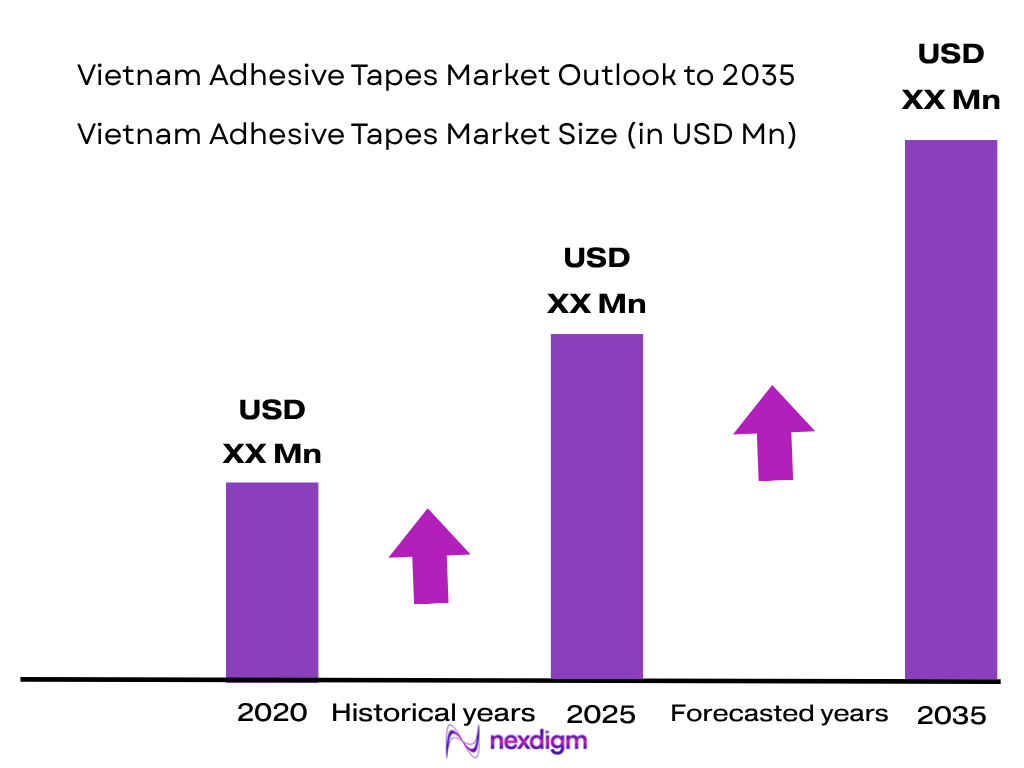
The Vietnam Adhesive Tapes Market is valued at approximately USD ~ million, supported by electronics, packaging, footwear, furniture, textiles and export manufacturing. Electronics, computers and components exports increased from USD 57.3 billion to USD 72.6 billion, while footwear exports moved from USD 20.2 billion to USD 22.9 billion. Wood and wood-product exports also advanced from USD 13.5 billion to USD 16.3 billion, sustaining demand for precision, packaging and process tapes.
Bac Ninh, Thai Nguyen, Hai Phong, Hanoi, Ho Chi Minh City, Binh Duong and Dong Nai dominate adhesive-tape demand because they host dense electronics, industrial, logistics and export-manufacturing ecosystems. Vietnam’s total goods trade increased from roughly USD 683 billion to USD 786.29 billion, while manufacturing and processing attracted USD 25.58 billion in registered foreign investment. Samsung’s Thai Nguyen plant also reached cumulative production of 1 billion mobile phones, illustrating the scale of precision-tape-intensive electronics manufacturing.
Market Segmentation
By Product Type
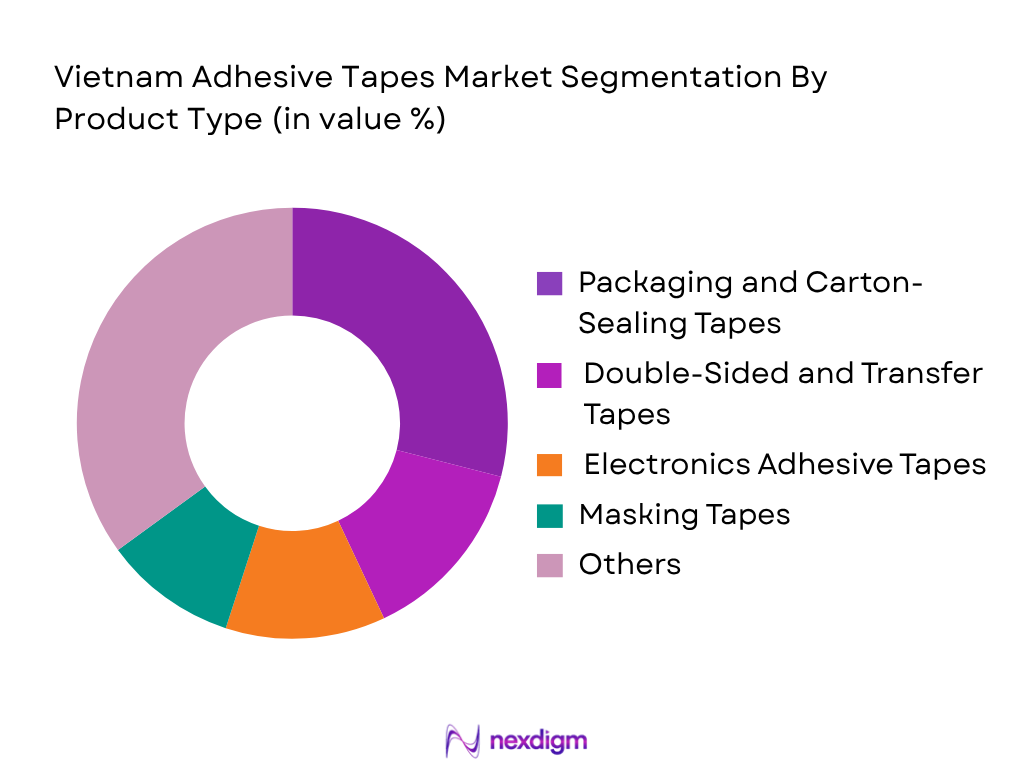
By Product Type: The Vietnam Adhesive Tapes Market is segmented into packaging and carton-sealing tapes, masking tapes, double-sided tapes, transfer tapes, electrical and insulation tapes, foam tapes, electronics tapes, automotive tapes, footwear tapes, construction tapes and specialty industrial products. Packaging and carton-sealing tapes hold the dominant share because Vietnam’s manufacturing economy is highly export oriented. Goods exports reached USD 405.53 billion, including USD 356.74 billion of processed industrial products, creating substantial requirements for carton closure, reinforcement and export logistics. Packaging tape also has a substantially shorter consumption cycle than installed specialty tapes because each finished carton requires fresh sealing material. Electronics tapes are nevertheless emerging as a strategically important category as Vietnam expands smartphone, computer, appliance and component production. Double-sided and foam products are also gaining relevance as manufacturers move toward cleaner component assembly and automation-compatible attachment. Footwear and furniture producers further sustain demand for masking, temporary holding and surface-protection products.
By End-Use Industry
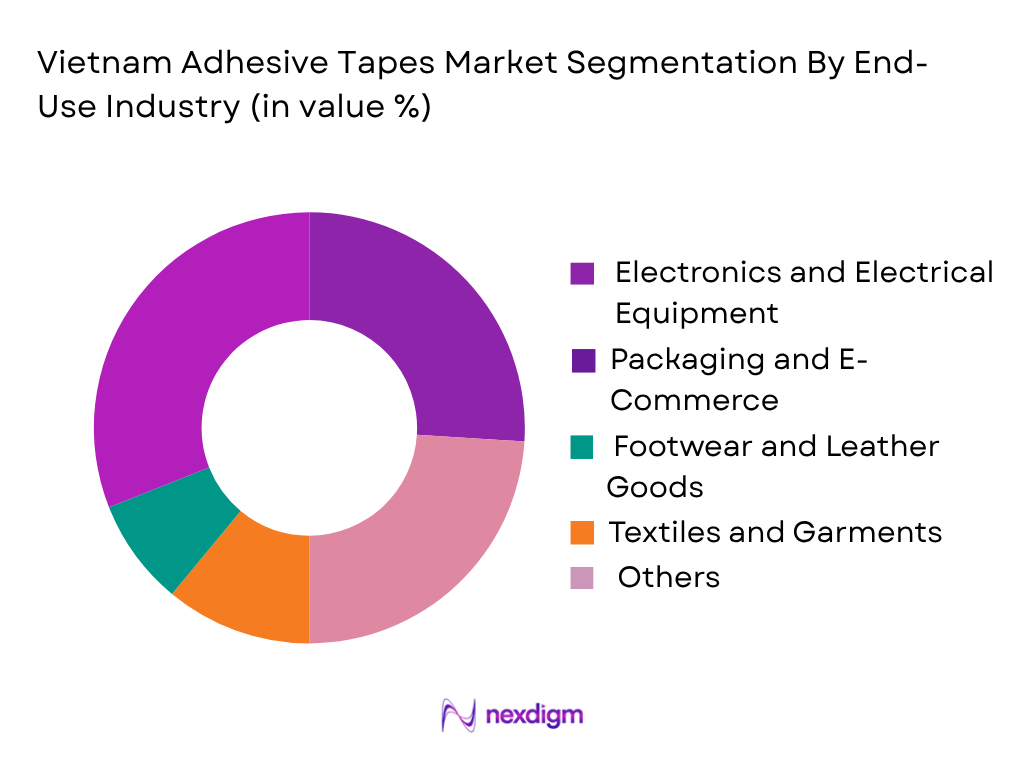
By End-Use Industry: The Vietnam Adhesive Tapes Market is segmented into electronics and electrical equipment, packaging and e-commerce, footwear and leather goods, textiles and garments, furniture and wood products, automotive, construction, appliances, healthcare and general industrial manufacturing. Electronics and electrical equipment represent the dominant end-use segment because Vietnam has become a major global assembly base for smartphones, computers and components. Electronics, computers and components exports reached USD 72.6 billion, while phones and components generated USD 53.9 billion. Samsung operates major manufacturing complexes in Bac Ninh, Thai Nguyen and Ho Chi Minh City, while its Thai Nguyen factory alone reached cumulative output of 1 billion phones. Electronics manufacturing consumes a wider range of specialty tapes than most sectors, including insulation, thermal-management, shielding, protective, ultra-thin double-sided and precision die-cut materials. Packaging remains a large-volume end use, while footwear and furniture provide important demand diversity.
Competitive Landscape
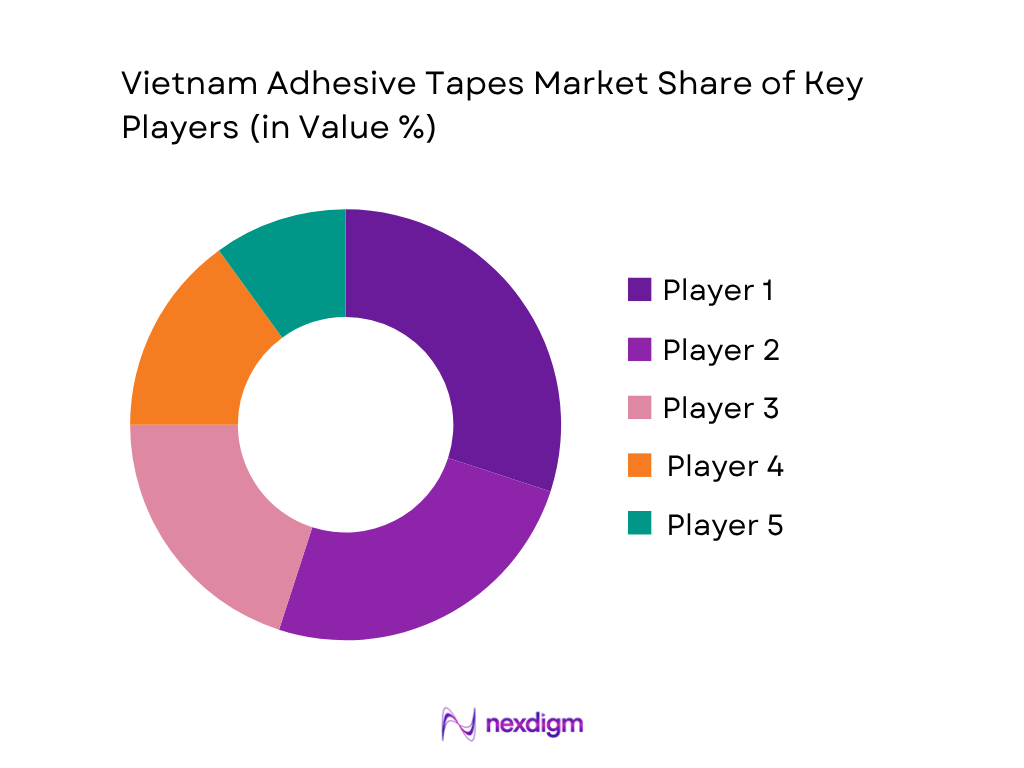
The Vietnam Adhesive Tapes Market combines global adhesive-technology manufacturers with companies that have local manufacturing, converting, distribution or OEM relationships. 3M, Nitto, tesa, Avery Dennison and LINTEC are prominent through their pressure-sensitive technology portfolios and exposure to electronics, automotive, labeling, packaging and industrial applications. tesa operates a manufacturing site in Hai Phong, while LINTEC maintains facilities in southern Vietnam and Bac Ninh. Competition is increasingly determined by technical support, die-cut precision, local availability and OEM qualification capability.
| Company | Establishment Year | Headquarters | Adhesive Technology Capability | Major Tape Applications | Vietnam Footprint | Electronics Capability | Converting / Technical Support | Sustainability Focus |
| 3M Company | 1902 | St. Paul, Minnesota, US | ~ | ~ | ~ | ~ | ~ | ~ |
| Nitto Denko Corporation | 1918 | Osaka, Japan | ~ | ~ | ~ | ~ | ~ | ~ |
| tesa SE | 2001* | Norderstedt, Germany | ~ | ~ | ~ | ~ | ~ | ~ |
| Avery Dennison Corporation | 1935 | Mentor, Ohio, US | ~ | ~ | ~ | ~ | ~ | ~ |
| LINTEC Corporation | 1934 | Tokyo, Japan | ~ | ~ | ~ | ~ |
Vietnam Adhesive Tapes Market Analysis
Growth Drivers
Expansion of Electronics and Electrical Manufacturing
The Vietnam Adhesive Tapes Market is strongly supported by the country’s large electronics manufacturing base, where pressure-sensitive tapes are used for component fixation, electrical insulation, battery protection, display assembly, thermal management and temporary process protection. Vietnam’s electronics, computers and components exports reached USD 72.6 billion in 2024, while imports of the same product group reached USD 107.1 billion, taking combined two-way trade in this category to USD 179.7 billion, according to the General Statistics Office of Vietnam. Phones and components generated an additional USD 53.9 billion in exports, highlighting the scale of assembly operations that require double-sided, polyimide, protective, foam and precision die-cut tapes. Processing and manufacturing also attracted USD 25.58 billion in registered foreign investment and USD 20.62 billion in realized foreign investment, according to Vietnam’s Ministry of Planning and Investment. The broader macroeconomic backdrop further reinforces industrial demand, with World Bank data recording Vietnam’s GDP at USD 476.39 billion in 2024 and GDP per capita at USD 4,717.3. These manufacturing and trade volumes create recurring demand for technically engineered adhesive materials across electronics production clusters.
Export-Oriented Packaging, Footwear and Furniture Manufacturing
Vietnam’s export-oriented manufacturing structure creates sustained demand for carton-sealing, reinforcement, masking, surface-protection and double-sided adhesive tapes used during production and outbound logistics. The General Statistics Office reported total merchandise exports of USD 405.53 billion in 2024, while imports reached USD 380.76 billion, taking total goods trade to USD 786.29 billion. Several tape-intensive industries contributed materially to these flows: textiles generated USD 37.0 billion in exports, footwear contributed USD 22.9 billion, and wood and wood products reached USD 16.3 billion. Machinery, equipment and spare parts generated another USD 52.3 billion in exports, reinforcing demand from industrial assembly and packaging operations. These sectors consume packaging tapes repeatedly because each exported carton requires closure, reinforcement or identification, while footwear and furniture factories also use masking, temporary holding and surface-protection products during manufacturing. Vietnam’s macroeconomic fundamentals support the depth of this demand. World Bank data record national GDP at USD 476.39 billion in 2024 and GDP per capita at USD 4,717.3. The combination of large merchandise flows and diversified export manufacturing gives adhesive tapes a recurring role across production, warehousing and international shipment preparation.
Market Challenges
High Dependence on Imported Electronics-Grade and Specialty Materials
The Vietnam Adhesive Tapes Market faces a structural challenge from dependence on imported specialty materials required for high-performance electronics, automotive and industrial applications. The General Statistics Office recorded USD 107.1 billion of imports of electronics, computers and components in 2024, demonstrating the scale of imported inputs supporting domestic assembly. Foreign-invested enterprises imported approximately USD 241.6 billion of goods during the same period, according to the Ministry of Planning and Investment, underscoring the reliance of Vietnam’s manufacturing ecosystem on international supply networks. Adhesive tape manufacturers and converters serving electronics customers often depend on imported PET and polyimide films, specialty acrylic systems, silicones, release liners and engineered foams that must meet narrow tolerances. These materials cannot always be substituted quickly because changes in adhesive thickness, release force, dielectric properties or thermal performance can trigger OEM requalification. Vietnam’s World Bank-recorded GDP of USD 476.39 billion in 2024 and GDP per capita of USD 4,717.3 show the scale of the economy supporting industrial expansion, but the high import intensity of advanced manufacturing means tape suppliers must maintain qualified dual sources, adequate inventory and reliable logistics. This is particularly important in electronics applications where production interruptions can disrupt large export programs.
Limited Domestic Specialty Coating and OEM Qualification Capability
Vietnam has a substantial converting and packaging base, but high-performance adhesive tape applications require capabilities beyond conventional slitting and rewinding. Electronics-grade tapes may need controlled cleanroom conversion, narrow dimensional tolerances, stable coat weights, optical cleanliness, dielectric performance and validated release characteristics. The Ministry of Planning and Investment reported 3,375 new foreign-invested projects with USD 19.7 billion of newly registered capital in 2024, while 1,539 existing projects recorded an additional USD 14.0 billion of investment. This continued manufacturing expansion raises the technical expectations placed on domestic material suppliers. Bac Ninh attracted USD 5.12 billion in foreign investment and Hai Phong attracted USD 4.94 billion, reinforcing the concentration of electronics and industrial customers in northern Vietnam. However, serving these OEMs requires extensive qualification and application-engineering support rather than only low-cost tape supply. World Bank data show Vietnam’s GDP at USD 476.39 billion in 2024 and GDP per capita at USD 4,717.3, reflecting an economy moving toward higher-value manufacturing. Tape suppliers that lack precision die-cutting, contamination control, application laboratories or technical documentation may therefore struggle to participate in advanced electronics, battery, automotive and medical applications despite strong underlying industrial demand.
Market Opportunities
Localization of Precision Electronics Tape Converting
Vietnam’s electronics manufacturing scale creates a clear future opportunity for localized precision converting of double-sided tapes, insulation materials, protective films, thermal-management tapes and die-cut adhesive components. Current trade and investment indicators already demonstrate the size of the addressable manufacturing ecosystem. Electronics, computers and components exports reached USD 72.6 billion in 2024, while phone and component exports added USD 53.9 billion, according to the General Statistics Office. Processing and manufacturing attracted USD 25.58 billion in registered foreign investment, with USD 20.62 billion of realized foreign investment directed into this sector. Northern manufacturing hubs also continue attracting capital: Bac Ninh recorded USD 5.12 billion in foreign investment and Hai Phong USD 4.94 billion. These existing production clusters provide a strong foundation for future demand for local slitting, laminating, rotary die-cutting, laser cutting and cleanroom conversion. World Bank data record Vietnam’s GDP at USD 476.39 billion in 2024 and GDP per capita at USD 4,717.3, supporting continued industrial upgrading. Suppliers capable of producing precision components locally can reduce lead times, lower imported finished-tape dependence and provide faster prototype support to electronics OEMs and contract manufacturers.
Sustainable Packaging and Local Specialty Tape Manufacturing
Vietnam’s large export and manufacturing base creates future opportunity for locally produced packaging tapes, paper-backed products, water-based adhesive systems and lower-material specialty constructions. The General Statistics Office recorded USD 405.53 billion in merchandise exports and USD 380.76 billion in imports during 2024, creating USD 786.29 billion in total goods trade. Processed industrial products generated USD 356.74 billion in exports, meaning a very large volume of finished goods moved through cartons, pallets and export logistics systems where adhesive tapes are repeatedly consumed. Footwear exports reached USD 22.9 billion, textiles USD 37.0 billion, wood and wood products USD 16.3 billion, and machinery and equipment USD 52.3 billion, providing multiple application bases for sealing, masking, reinforcement and protection tapes. Vietnam also had 42,002 valid foreign-invested projects with registered capital of USD 502.8 billion, according to the Ministry of Planning and Investment. World Bank data place national GDP at USD 476.39 billion in 2024 and GDP per capita at USD 4,717.3. These current manufacturing volumes support future localization of solvent-reduced coatings, recyclable packaging tapes and specialty tape production closer to export-oriented customers.
Future Outlook
The Vietnam Adhesive Tapes Market is forecast to expand at approximately ~X.X% CAGR during 2026–2035, with the rate retained as a placeholder for the proprietary forecast. Growth will increasingly shift from commodity BOPP packaging tapes toward electronics-grade double-sided, protective, insulating, thermal-management and precision-converted adhesive products. Expansion of export manufacturing, foreign investment and industrial localization will reinforce this transition. Electronics will remain the most important specialty-tape opportunity. Vietnam exported USD 72.6 billion of electronics, computers and components and USD 53.9 billion of phones and components, establishing a substantial installed manufacturing base for precision adhesive materials. High-end devices require thinner adhesive constructions, greater dimensional accuracy, clean conversion and strong resistance to heat and humidity.
Industrial localization should further support domestic conversion and coating. Vietnam attracted USD 38.23 billion of registered foreign investment, including USD 25.58 billion directed toward processing and manufacturing. A total of 3,375 new FDI projects were licensed. These investments create additional production lines that require packaging, masking, protection, insulation and assembly tapes. Footwear and furniture will continue offering volume diversification. Footwear exports reached USD 22.9 billion, textiles reached USD 37 billion, and wood and wood products generated USD 16.3 billion. These sectors generate recurring requirements for temporary fixation, masking, reinforcement, double-sided bonding and export-packaging tapes.
Major Players
- 3M Vietnam Ltd.
- Nitto Denko Tape Materials (Vietnam) Co., Ltd.
- tesa Site Haiphong Co., Ltd.
- Avery Dennison Vietnam
- LINTEC Vietnam Co., Ltd.
- DIC Vietnam Co., Ltd.
- Sekisui Chemical Group
- Denka Company Limited
- Mitsui Chemicals Group
- Teraoka Seisakusho Co., Ltd.
- Nichiban Co., Ltd.
- Yamato Co., Ltd.
- Four Pillars Enterprise Co., Ltd.
- Naxin Tape Products
- Wonderland Industry Co., Ltd.
Key Target Audience
- Adhesive Tape Manufacturers
- Pressure-Sensitive Adhesive and Functional Polymer Producers
- Precision Tape Converters, Laminators and Die-Cutting Companies
- Electronics, Footwear, Furniture, Automotive and Appliance OEMs
- Packaging Material and Industrial MRO Distributors
- Backing Film, Foam, Release-Liner and Tackifier Suppliers
- Investments and Venture Capitalist Firms
- Government and Regulatory Bodies (Ministry of Industry and Trade, Ministry of Finance, Ministry of Agriculture and Environment, Vietnam Chemicals Agency, Commission for the Management of State Capital at Enterprises)
Research Methodology
Step 1: Identification of Key Variables
The first stage constructs an ecosystem map of Vietnam’s adhesive tape manufacturers, international suppliers, resin and film producers, converters, distributors and major OEM customers. The analysis identifies adhesive chemistry, backing materials, tape construction, domestic production, trade dependency, converting requirements and end-use demand. Electronics, packaging, footwear, furniture and industrial manufacturing are separately mapped because their consumption patterns and technical specifications differ materially.
Step 2: Market Analysis and Construction
Historical market demand is developed through top-down and bottom-up approaches. The top-down methodology assesses electronics exports, footwear and textile output, wood-product exports, manufacturing investment, packaging requirements and industrial activity. Bottom-up analysis evaluates manufacturer revenues, imported tapes, converter throughput and OEM consumption. Commodity BOPP tapes are separated from high-performance specialty products to ensure that differences in volume, specification and value are correctly reflected.
Step 3: Hypothesis Validation and Expert Consultation
Market hypotheses are tested through CATI and structured interviews with tape producers, converters, electronics-material distributors, packaging suppliers, footwear manufacturers and OEM procurement personnel. Discussions validate adhesive preferences, conversion tolerances, import dependency, qualification cycles, supplier switching barriers and local sourcing requirements. Primary feedback is used to refine preliminary market allocations and reconcile discrepancies between supply-side revenues and end-user consumption assumptions.
Step 4: Research Synthesis and Final Output
The final stage triangulates government trade data, manufacturing indicators, supplier information, FDI trends and end-user consumption patterns. Tape volumes are cross-validated against electronics production, export packaging, footwear, furniture and automotive applications. Forecast scenarios incorporate manufacturing localization, electronics investment, automation, precision conversion, sustainable packaging and advanced adhesive technologies. This process produces the final Vietnam Adhesive Tapes Market sizing, segmentation, competitive landscape and long-term strategic outlook.

- Executive Summary
- Research Methodology (Market Definition and Scope, Vietnam Adhesive Tapes Taxonomy, Pressure-Sensitive Adhesive Tape Classification, Commodity and Specialty Tape Classification, Adhesive Chemistry Mapping, Backing Material Assessment, Tape Construction Framework, Adhesive Coating Technology Assessment, Application Mapping, Raw Material Assessment, Sustainable Tape Technology Evaluation, Market Sizing Framework)

- Definition and Scope
- Vietnam Adhesive Tapes Industry Evolution and Pressure-Sensitive Adhesive Technology Development
- Adhesive Tape Manufacturing and Coating Process
- Adhesive Tape Value Chain Analysis
- Vietnam Adhesive Tapes Supply Chain Analysis
- Adhesive Resin, Backing Material and Release-Liner Ecosystem Analysis
- Vietnam Adhesive Tapes Import Dependency and Localization Assessment
- OEM Adhesive Tape Application Architecture and Specialty Tape Solution Framework

- Growth Drivers (Expansion of Electronics and Component Manufacturing, Growth of Export Packaging Requirements, Footwear and Textile Manufacturing Scale, Furniture and Wood Product Exports, Industrial Park Expansion, Foreign Direct Investment in Manufacturing, Automation Adoption, Shift from Mechanical Fastening to Tape-Based Bonding)
- Market Challenges (High Dependence on Imported Specialty Tapes, Adhesive Resin and Film Import Exposure, Price Competition in Commodity BOPP Tape, OEM Qualification Barriers, Limited Domestic Specialty Coating Capability, Electronics-Grade Cleanliness Requirements, VOC and Chemical Compliance, Fragmented Converting Ecosystem)
- Market Opportunities (Electronics Precision Die-Cut Tapes, EV Battery Assembly Tapes, Appliance Bonding Tapes, Sustainable Packaging Tapes, High-Performance Double-Sided Tapes, Localized Specialty Tape Manufacturing, Footwear Automation-Compatible Tape Formats, Low-VOC and Solvent-Free Adhesive Systems)
- Market Trends (Electronics-Grade Thin Tapes, High-Bond Acrylic Foam Tapes, Automated Tape Application, Precision Die-Cut Components, Paper-Based Packaging Tapes, Low-VOC Adhesive Formulations, Local Converting Expansion, OEM-Specific Custom Tape Development)
- Regulatory and Standards Landscape (Vietnam Chemical Law Compliance, Chemical Declaration and Inventory Requirements, Hazard Classification and Safety Data Sheet Requirements, Industrial Chemical Storage and Handling Requirements, VOC and Air Emission Compliance, Extended Producer Responsibility for Packaging, Industrial Waste Management Requirements, ISO and ASTM Adhesive Tape Test Standards)
- SWOT Analysis
- Porter’s Five Forces Analysis
- PESTLE Analysis
- Stakeholder Ecosystem
- Competition Ecosystem

- By Market Value (2020-2025)
- By Adhesive Tape Consumption Volume (2020-2025)
- By Coated Surface Area (2020-2025)
- By Domestic Production Volume (2020-2025)
- By Import Volume (2020-2025)
- By Export Volume (2020-2025)
- By Average Selling Price (2020-2025)
- By Commodity Adhesive Tape Consumption (2020-2025)
- By Specialty Adhesive Tape Consumption (2020-2025)

- By Product Type (In Value %)
Packaging and Carton Sealing Tapes
Masking Tapes
Double-Sided Tapes
Transfer Tapes
Duct and Cloth Tapes
Electrical and Insulation Tapes
Foam Tapes
Filament and Strapping Tapes
Electronics Adhesive Tapes
Automotive Adhesive Tapes
Footwear and Leather Goods Tapes
Furniture and Woodworking Tapes
Construction and Building Tapes
Protective Films and Surface Protection Tapes
Specialty High-Performance Industrial Tapes - By Adhesive Chemistry (In Value %)
Acrylic Adhesives
Natural Rubber Adhesives
Synthetic Rubber Adhesives
Hot-Melt Rubber Adhesives
Silicone Adhesives
Hybrid Adhesive Systems
Bio-Based and Renewable-Content Adhesive Systems - By Backing Material (In Value %)
Biaxially Oriented Polypropylene Film
Polyethylene Film
Polyvinyl Chloride Film
Polyethylene Terephthalate Film
Paper
Cloth and Fabric
Aluminum Foil
Copper Foil
Foam
Nonwoven Materials
Polyimide Film
Glass Cloth
Unsupported and Carrier-Free Constructions - By End-Use Industry (In Value %)
Electronics and Electrical Equipment
Packaging and E-Commerce
Footwear and Leather Goods
Textiles and Garments
Furniture and Wood Products
Automotive and Mobility
Building and Construction
General Industrial Manufacturing
Home Appliances
Medical and Healthcare
Printing and Converting
Renewable Energy
Transportation and Logistics
Retail and Consumer Applications - By Distribution Channel (In Value %)
Direct Manufacturer-to-OEM Sales
Authorized Industrial Distributors
Adhesive Tape Converters
Packaging Material Distributors
Electronics Material Distributors
Automotive Tier Supplier Channels
Footwear and Textile Material Distributors
Construction Supply Distributors
Industrial MRO Distributors
Online B2B Platforms - By Region (In Value %)
Northern Vietnam
Hanoi
Bac Ninh
Bac Giang
Hai Phong
Thai Nguyen
Hung Yen
Hai Duong
Central Vietnam
Da Nang
Quang Nam
Thua Thien Hue
Southern Vietnam
Ho Chi Minh City
Binh Duong
Dong Nai
Long An
Ba Ria-Vung Tau
Tay Ninh

- Market Share of Major Players (By Revenue, Volume, Product Type, Adhesive Chemistry, Backing Material, End-Use Industry, Market Type, Distribution Channel)
- Cross Comparison Parameters (Adhesive Chemistry Breadth, Backing and Carrier Technology Breadth, Vietnam Manufacturing and Converting Footprint, Electronics-Grade Specialty Tape Capability, OEM Application Engineering and Qualification Support, Precision Die-Cutting and Custom Converting Capability, Sustainable and Low-VOC Tape Portfolio, End-Use Industry Coverage)
- SWOT Analysis of Major Players
- Competitive Positioning Matrix
- Pricing and Distribution Network Benchmarking
- Detailed Profiles of Major Companies
3M Vietnam Ltd.
Nitto Denko Tape Materials (Vietnam) Co., Ltd.
tesa Site Haiphong Co., Ltd.
Avery Dennison Vietnam
LINTEC Vietnam Co., Ltd.
DIC Vietnam Co., Ltd.
Sekisui Chemical Group
Denka Company Limited
Mitsui Chemicals Group
Teraoka Seisakusho Co., Ltd.
Nichiban Co., Ltd.
Yamato Co., Ltd.
Four Pillars Enterprise Co., Ltd.
Naxin Tape Products
Wonderland Industry Co., Ltd.

- Buyer Segmentation
- OEM Procurement Behaviour
- Supplier Selection Criteria
- Buyer Pain Points
- Technology Adoption Assessment
- Replacement and Repurchase Behaviour

- By Market Value (2026-2035)
- By Adhesive Tape Consumption Volume (2026-2035)
- By Coated Surface Area (2026-2035)
- By Domestic Production Volume (2026-2035)
- By Import Volume (2026-2035)
- By Export Volume (2026-2035)
- By Average Selling Price (2026-2035)
- By Commodity Adhesive Tape Consumption (2026-2035)
- By Specialty Adhesive Tape Consumption (2026-2035)


 Request a Sample
 Ask for Customization
 Get a Quote
 Enquire Now