

 Download PDF
Market Overview
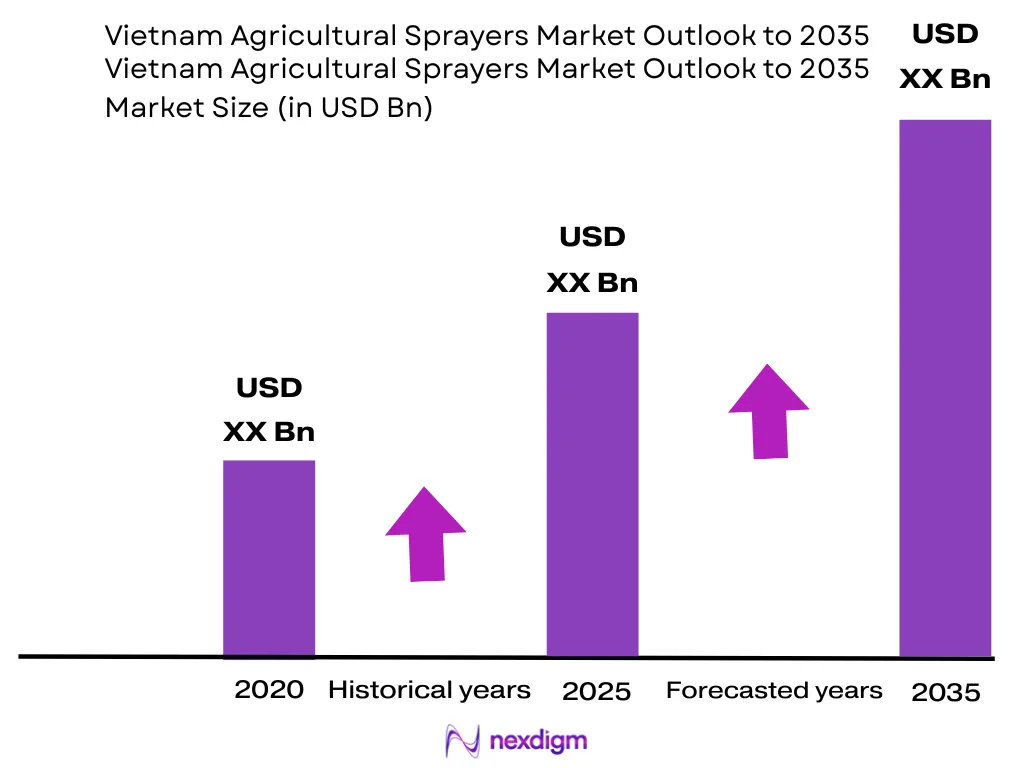
The Vietnam Agricultural Sprayers Market was valued at approximately USD ~ billion in 2024 based on a comprehensive assessment of agricultural machinery sales, crop protection equipment demand, and mechanisation trends across major farming regions. The market is primarily driven by Vietnam’s position as one of Southeast Asia’s most agriculturally productive nations and one of the world’s leading exporters of rice, coffee, rubber, pepper, and cashew. According to data published by the Ministry of Agriculture and Rural Development (MARD) and the General Statistics Office of Vietnam (GSO), total agricultural output continues to expand, with rice cultivation covering approximately 7.1 million hectares and export crop production sustaining strong growth across the Central Highlands and southern provinces. Rising government emphasis on agricultural modernisation, growing adoption of crop protection inputs to meet export quality standards, and increasing awareness of mechanised spraying solutions have accelerated demand for spraying equipment across both smallholder and commercial farming segments.
Market Segmentation
By Sprayer Type
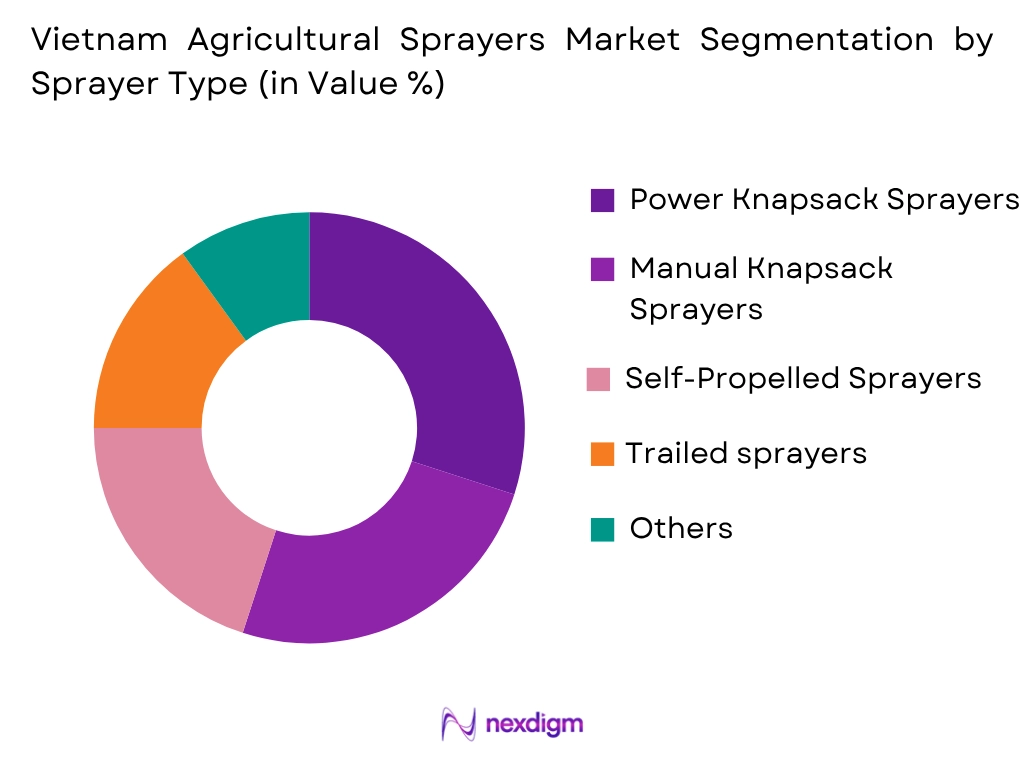
Vietnam Agricultural Sprayers Market is segmented by sprayer type into self-propelled sprayers, trailed sprayers, tractor-mounted boom sprayers, power knapsack sprayers, manual knapsack sprayers, motorised mist blowers, UAV/drone sprayers, and backpack and portable sprayers. Power knapsack and manual knapsack sprayers dominate the market in terms of unit volumes, reflecting Vietnam’s predominantly smallholder farm structure where average rice paddy landholdings in the Mekong River Delta and Red River Delta are typically small and fragmented. These portable sprayers are affordable, widely available through agri-input retail networks and agricultural cooperatives, and require minimal technical training to operate. However, UAV/drone sprayers are emerging as the most rapidly growing segment, particularly in the Mekong River Delta where large-scale rice paddies, flat terrain, and high crop protection intensity create ideal conditions for drone-based application. Additionally, motorised mist blowers are widely used in coffee, pepper, and rubber plantations across the Central Highlands due to their effectiveness in penetrating dense crop canopies.
By Crop Type
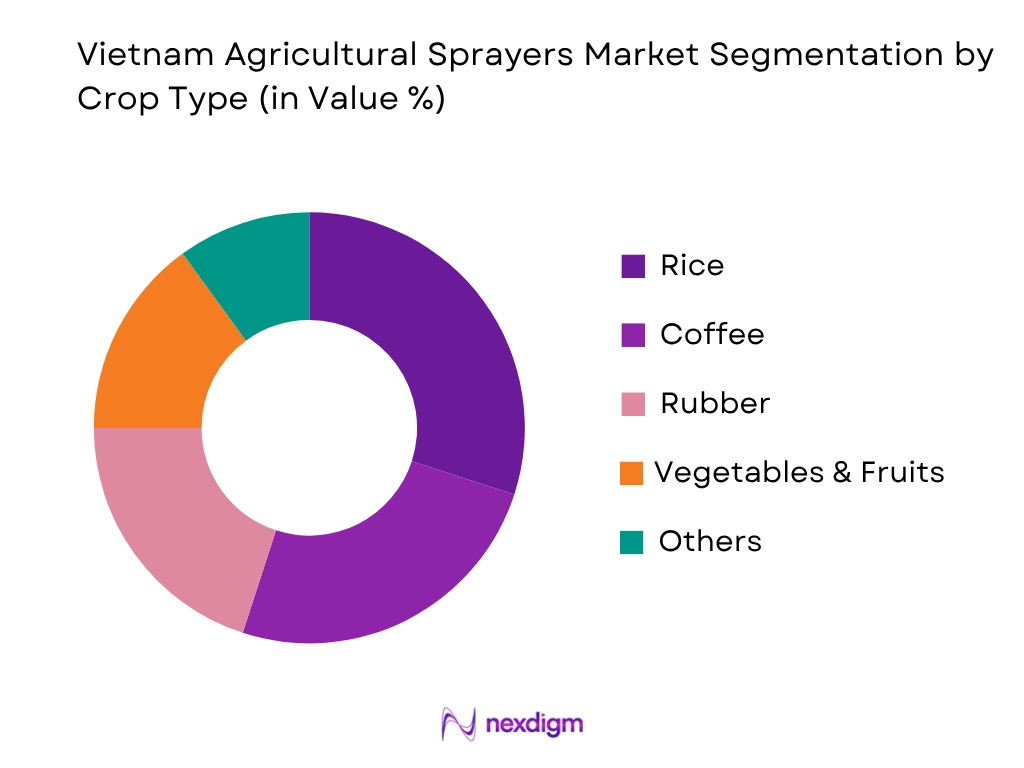
Vietnam Agricultural Sprayers Market is segmented by crop type into rice (paddy), coffee, rubber, vegetables and fruits, cassava, sugarcane, pepper, and other industrial and export crops. Rice cultivation accounts for the largest market share, reflecting Vietnam’s status as the world’s second or third largest rice exporter and its domestic food security priorities. Rice paddy farming across the Mekong River Delta and Red River Delta requires multiple spray applications per season for blast disease control, brown planthopper management, weed suppression, and foliar nutrition, generating high and recurring demand for spraying equipment. The Mekong River Delta alone accounts for over 50 percent of national rice production, making it the most important regional market for agricultural sprayers. Coffee cultivation across the Central Highlands provinces of Dak Lak, Gia Lai, Lam Dong, and Dak Nong represents the second most significant crop segment, requiring specialised motorised mist blowers and knapsack sprayers suited to robusta coffee tree canopy structures and steep terrain conditions.
Competitive Landscape
The Vietnam Agricultural Sprayers Market is characterised by the presence of Japanese, Chinese, and domestic Vietnamese agricultural equipment manufacturers. The competitive landscape is segmented between the mass-market knapsack and portable sprayer segment, dominated by Japanese brand names distributed through extensive agri-input retail networks, and the rapidly growing drone sprayer segment, where Chinese technology companies hold significant market presence. Domestic Vietnamese manufacturers occupy a competitive position in the mid-market segment, offering locally assembled and serviced equipment suited to Vietnamese farming conditions. Government procurement channels and agricultural cooperative purchasing further influence competitive dynamics, particularly in the rice-producing provinces of the Mekong River Delta and Red River Delta.
| Company | Establishment Year | Headquarters | Product Portfolio | Precision Agriculture Integration
|
Tank Capacity Range | Dealer Network Strength | After-Sales Support | Innovation Capability |
| Kubota Vietnam | 1890 | ~ | ~ | ~ | ~ | ~ | ~ | ~ |
| Yamaha Motor Vietnam | 1955 | ~ | ~ | ~ | ~ | ~ | ~ | ~ |
| DJI Agriculture (Vietnam) | 2006 | ~ | ~ | ~ | ~ | ~ | ~ | ~ |
| XAG (Vietnam Operations) | 2007 | ~ | ~ | ~ | ~ | ~ | ~ | ~ |
| Vietnam Engine & Agricultural Machinery Corp (VEAM) | 1990 | ~ | ~ | ~ | ~ | ~ | ~ | ~ |
Vietnam Agricultural Sprayers Market Analysis
Growth Drivers
Expanding Rice and Export Crop Production with Intensive Crop Protection Requirements
The Vietnam agricultural sprayers market is strongly underpinned by the country’s extensive and intensively managed agricultural production base. According to the Ministry of Agriculture and Rural Development (MARD) and the General Statistics Office of Vietnam, rice cultivation covers approximately 7.1 million harvested hectares annually, with three cropping seasons practised across the Mekong River Delta. Vietnam’s rice paddies face persistent pest and disease pressure including rice blast, bacterial leaf blight, brown planthopper, and stem borers, necessitating multiple spray applications per growing cycle. The Mekong River Delta provinces of An Giang, Kien Giang, Dong Thap, and Long An collectively account for the largest concentration of paddy cultivation and associated sprayer demand. Beyond rice, Vietnam’s export crop sector generates substantial incremental demand for spraying equipment. Coffee production across the Central Highlands covers approximately 700,000 hectares of predominantly robusta varieties, requiring regular fungicide and insecticide applications. Pepper, rubber, and cashew cultivation further contribute to the crop protection equipment market, particularly in Binh Phuoc, Dak Nong, and Ba Ria-Vung Tau provinces. The combination of intensive rice cultivation and growing high-value export crop production creates a diverse and sustained demand base for agricultural sprayers across Vietnam’s varied agricultural regions.
Government Agricultural Modernisation Programmes and Mechanisation Support
Vietnam’s government has consistently prioritised agricultural mechanisation as a strategic objective for improving rural productivity and reducing dependency on manual farm labour. The Ministry of Agriculture and Rural Development’s Resolution 26-NQ/TW on Agriculture, Farmers, and Rural Areas, alongside national agricultural restructuring programmes, has guided investment in mechanisation infrastructure across major farming regions. The Vietnam Bank for Agriculture and Rural Development (Agribank) and the Vietnam Bank for Social Policies provide preferential credit programmes supporting farm equipment purchases, including sprayers, for smallholder and cooperative borrowers. State-supported mechanisation programmes have targeted progressive increases in the mechanisation index across key agricultural operations, with spraying identified as a priority area for mechanisation improvement given the high labour intensity and occupational health risks associated with manual spray application. Additionally, provincial agricultural extension services and agricultural cooperatives have facilitated demonstration and adoption programmes for power knapsack sprayers, boom sprayers, and drone spraying services. The government’s commitment to improving food safety standards and meeting international export market requirements has further incentivised investment in precision and controlled-application spraying equipment, particularly among farmers producing rice, vegetables, and fruits for export markets.
Market Challenges
Fragmented Smallholder Farm Structure and Limited Investment Capacity
The Vietnam agricultural sprayers market faces a significant structural challenge arising from the country’s fragmented landholding pattern, particularly in the densely farmed Red River Delta and across upland agricultural regions. Despite land consolidation progress in the Mekong River Delta, where farm sizes tend to be larger and more amenable to mechanisation, average agricultural holdings across much of northern and central Vietnam remain small and often scattered across multiple non-contiguous plots. This fragmentation limits the operational scale necessary to justify investment in tractor-mounted boom sprayers, self-propelled sprayers, or high-value drone systems for individual farm households. According to the General Statistics Office of Vietnam, farm household income levels, while improving, remain constrained in many regions by limited commercialisation and market access. The high cost of advanced spraying equipment relative to annual farm income creates a substantial affordability barrier for individual smallholder purchasers, driving continued reliance on low-cost manual and power knapsack models. While agricultural cooperative and custom service models are gradually expanding equipment access, uneven cooperative development across provinces means that mechanisation benefits remain unevenly distributed. This structural constraint represents an ongoing challenge for market value expansion beyond the entry-level sprayer segment.
Seasonal Flooding, Tropical Weather Variability, and Equipment Durability Constraints
Vietnam’s tropical monsoon climate, characterised by distinct wet and dry seasons, typhoon exposure across the central coast, and periodic flooding events in the Mekong River Delta and Red River Delta, creates significant operational and durability challenges for agricultural spraying equipment. The Vietnam Meteorological and Hydrological Administration records indicate that annual flood events, particularly in the delta regions, can disrupt crop cultivation schedules, damage farm infrastructure, and destroy stored agricultural equipment. Saline intrusion events in the Mekong River Delta, which have intensified in recent years, further complicate spraying schedules and can affect equipment corrosion rates. Seasonal temperature and humidity extremes accelerate wear on mechanical components including pump seals, spray nozzles, and engine parts, increasing maintenance requirements and shortening equipment service life. The availability of qualified equipment repair technicians and spare parts supply chains remains uneven across rural provinces, particularly in the Central Highlands and northern upland regions. These climatic and maintenance challenges increase the total cost of equipment ownership and can dampen investment confidence among smallholder farmers and cooperative operators, representing a meaningful constraint on market development beyond major lowland agricultural centres.
Market Opportunities
Rapid Expansion of UAV Drone Spraying in Rice and Plantation Crop Regions
Agricultural drone spraying represents the most significant growth opportunity for the Vietnam Agricultural Sprayers Market over the forecast period. The Civil Aviation Authority of Vietnam (CAAV) has progressively established regulatory frameworks governing commercial agricultural drone operations, and the Ministry of Agriculture and Rural Development has incorporated drone spraying into its agricultural mechanisation promotion programmes. The Mekong River Delta provides near-ideal conditions for drone sprayer adoption given its extensive flat paddy areas, high cropping intensity, and persistent labour shortages as rural populations migrate toward urban and industrial employment. Drone sprayers operated by service providers and agricultural cooperatives offer farmers a cost-effective alternative to manual labour-intensive spray operations, with compelling per-hectare economics at appropriate utilisation rates. Chinese agricultural drone manufacturers including DJI Agriculture and XAG have established active distribution and service networks in Vietnam, making advanced drone technology accessible at competitive price points. Government-affiliated agricultural extension programmes and cooperative mechanisation initiatives have further facilitated drone sprayer demonstration and adoption across major rice-producing provinces. The applicability of drone spraying is also expanding beyond rice into coffee, pepper, and durian cultivation, broadening the addressable market for this technology segment within Vietnam’s diverse agricultural landscape.
Growing Demand for Export-Compliant and Residue-Managed Crop Protection Practices
Vietnam’s agricultural export sector, which encompasses rice, coffee, pepper, cashew, fruits, and vegetables destined for demanding international markets including the European Union, Japan, South Korea, and the United States, is creating growing demand for precision and controlled crop protection application technologies. International food safety and maximum residue limit (MRL) requirements imposed by importing countries have heightened awareness among Vietnamese exporters, trader organisations, and farmer groups of the importance of accurate pesticide dosing, spray timing, and application technology. Precision spraying equipment that enables accurate rate control, reduced chemical drift, and traceable application records is increasingly valued by export-oriented supply chains seeking compliance with international phytosanitary and food safety standards. The Vietnam Food Safety Law and associated technical regulations administered by MARD further reinforce requirements for responsible pesticide application practices. Agribusiness companies, export trading firms, and retailer-linked farming programmes supplying international markets are progressively embedding equipment standards into their farmer engagement and outreach activities, creating pull-through demand for advanced sprayer technologies. This convergence of export market requirements and domestic food safety regulation creates a compelling commercial opportunity for sprayer manufacturers and distributors offering precision application solutions suited to Vietnamese export crop production systems.
Future Outlook
The Vietnam Agricultural Sprayers Market is expected to experience strong growth over the forecast period, driven by continuing agricultural modernisation, rapid UAV/drone sprayer adoption, expanding agricultural cooperative mechanisation programmes, and increasing integration of Vietnamese agriculture into internationally certified export supply chains. Demand for advanced spraying systems is anticipated to accelerate as drone technology becomes more affordable and widely serviced, as labour scarcity in major agricultural regions intensifies, and as export market compliance requirements drive investment in precision application equipment. Technological developments including battery-powered smart knapsack sprayers, GPS-guided boom systems, telematics integration, and AI-enabled spray optimisation are expected to gain growing market acceptance. Sustained government commitment to agricultural restructuring, rural income improvement, and export competitiveness will continue shaping equipment investment patterns across Vietnam’s diverse and dynamic agricultural landscape.
Major Players
- Kubota Vietnam
- Yamaha Motor Vietnam (Agricultural Division)
- DJI Agriculture (Vietnam Operations)
- XAG (Vietnam Operations)
- Vietnam Engine & Agricultural Machinery Corp (VEAM)
- Cong Thanh Mechanical Engineering
- Vikyno (Vietnam Engine & Agricultural Machinery)
- Honda Power Products Vietnam
- Fujifilm Serimax Vietnam
- Bao Ve Thuc Vat An Giang (AGPPS)
- Thanh Hoa Mechanical Company
- Dong Thanh Agricultural Machinery
- EAVietnam (Agricultural Drone Services)
- Sky Drone Vietnam
- Hoa Phat Agricultural Machinery
Key Target Audience
- Agricultural Equipment Manufacturers and Importers
- Agricultural Machinery Distributors and Dealers
- Agricultural Cooperatives and Farmer Groups
- Precision Agriculture and Drone Technology Providers
- Crop Protection Chemical Manufacturers and Distributors
- Investments and Venture Capitalist Firms
- Government and Regulatory Bodies (Ministry of Agriculture and Rural Development, Civil Aviation Authority of Vietnam, Plant Protection Department, Agribank, Vietnam Bank for Social Policies)
- Agricultural Equipment Rental and Service Companies
Research Methodology
Step 1: Identification of Key Variables
The initial phase involves constructing an ecosystem map encompassing all major stakeholders within the Vietnam Agricultural Sprayers Market. This process includes extensive secondary research through industry publications, government agricultural databases, manufacturer reports, trade associations, and agricultural machinery statistics published by the Ministry of Agriculture and Rural Development and the General Statistics Office of Vietnam. The objective is to identify critical market variables including equipment demand, crop acreage, mechanisation rates, technology adoption, government programme impacts, and purchasing behaviour across diverse farming segments.
Step 2: Market Analysis and Construction
Historical market data relating to agricultural machinery sales, crop production trends, farm equipment penetration, and spraying technology adoption are collected and analysed. Demand-side assessment focuses on farm household purchasing patterns, agricultural cooperative procurement, and crop protection requirements across rice paddy, plantation, and horticultural farming systems. Supply-side analysis evaluates manufacturer revenues, importer volumes, dealer sales, production capacities, and distribution networks. Both approaches contribute to market size estimation and forecasting.
Step 3: Hypothesis Validation and Expert Consultation
Preliminary market findings and assumptions are validated through structured interviews with industry participants including agricultural equipment manufacturers, importers, distributors, cooperative managers, farm operators, agronomists, drone service providers, and industry associations. These consultations provide practical insights regarding market trends, technology adoption dynamics, government programme effectiveness, export crop compliance requirements, and future demand outlook, thereby strengthening the reliability of research findings.
Step 4: Research Synthesis and Final Output
The final stage involves triangulating information collected from primary interviews, secondary research sources, and proprietary databases. Market estimates are refined through cross-verification across multiple data points and stakeholder perspectives. Forecast models are developed using agricultural production outlooks, mechanisation programme targets, technology adoption trajectories, and investment patterns to generate comprehensive and reliable market intelligence for the Vietnam Agricultural Sprayers Market.

- Executive Summary
- Research Methodology (Market Definitions and Assumptions, Abbreviations, Market Sizing Approach, Top-Down Analysis, Bottom-Up Analysis, Demand-Side Assessment, Supply-Side Assessment, Primary Industry Interviews, Distributor and Dealer Validation, Farm-Level Survey Assessment, Data Triangulation, Forecasting Framework, Limitations and Future Conclusions)

- Definition and Scope
- Industry Evolution and Market Genesis
- Timeline of Technological Advancements in Agricultural Spraying
- Agricultural Equipment Value Chain Analysis
- Agricultural Sprayer Supply Chain Analysis

- Growth Drivers (Expansion of Rice and Export Crop Acreage, Growth in Crop Protection Chemical Usage, Rising Mechanisation Rate, Precision Agriculture Adoption, Government Support Programmes for Agricultural Modernisation)
- Market Challenges (High Equipment Costs Relative to Farm Income, Fragmented Smallholder Landholding Structure, Limited Access to Agricultural Finance, Equipment Maintenance and Repair Constraints, Climatic Variability and Seasonal Flooding Impacts)
- Market Opportunities (Drone Sprayer Penetration in Rice and Coffee Regions, Biological Input Application Services, Precision Farming Investments, Agricultural Cooperative Equipment Sharing Models, Sustainable and Export-Compliant Crop Protection Practices)
- Market Trends (Battery-Powered Knapsack Sprayer Adoption, GPS-Guided Boom Sprayers, Telematics Integration, AI-Based Spray Optimisation, Low-Drift Nozzle Technology)
- Government Regulations (Ministry of Agriculture and Rural Development Equipment Standards, Plant Protection Department Pesticide Regulations, Civil Aviation Authority of Vietnam Drone Regulations, National Technical Regulations on Sprayer Safety, Vietnam Food Safety Law Compliance for Export Crops)
- SWOT Analysis
- PESTLE Analysis
- Stakeholder Ecosystem
- Porter’s Five Forces Analysis
- Competition Ecosystem

- By Market Value (2020-2025)
- By Units Sold (2020-2025)
- By Average Selling Price (2020-2025)

- By Sprayer Type (In Value %)
Self-Propelled Sprayers
Trailed Sprayers
Tractor-Mounted Boom Sprayers
Power Knapsack Sprayers
Manual Knapsack Sprayers
Motorised Mist Blowers
Backpack and Portable Sprayers
UAV/Drone Sprayers - By Application (In Value %)
Herbicide Application
Fungicide Application
Insecticide Application
Foliar Fertiliser Application
Biological Inputs Application
- By Crop Type (In Value %)
Rice (Paddy)
Coffee
Rubber
Vegetables and Fruits
Cassava
Sugarcane
Pepper
Other Industrial and Export Crops - By Distribution Channel (In Value %)
OEM Direct Sales
Agricultural Equipment Dealers
Agri-Input Retail Networks and Agricultural Cooperatives
Government Procurement and Support Channels
Online Agricultural Equipment Platforms - By Region (In Value %)
Mekong River Delta (An Giang, Kien Giang, Dong Thap, Long An)
Red River Delta (Hanoi, Thai Binh, Nam Dinh, Hai Duong)
Central Highlands (Dak Lak, Lam Dong, Gia Lai, Dak Nong)
South East (Binh Duong, Dong Nai, Ba Ria-Vung Tau)
North Central Coast and Other Regions

- Market Share of Major Players (By Value, Units Sold, Sprayer Type, Crop Segment, Region)
- Cross Comparison Parameters (Boom Width Portfolio, Tank Capacity Range, Field Coverage Efficiency (ha/hr), Precision Spraying Capability, Variable Rate Application Integration, Dealer Network Strength, After-Sales Service Reach, Spray Drift Reduction Technology)
- Competitive Positioning Matrix (Technology Leadership, Pricing Competitiveness, Brand Recognition, Regional Presence)
- SWOT Analysis of Major Players
- Pricing Analysis by Sprayer Category and Capacity
- Detailed Profiles of Major Companies
Kubota Vietnam
Yamaha Motor Vietnam (Agricultural Division)
DJI Agriculture (Vietnam Operations)
XAG (Vietnam Operations)
Vietnam Engine & Agricultural Machinery Corp (VEAM)
Cong Thanh Mechanical Engineering
Vikyno (Vietnam Engine & Agricultural Machinery)
Honda Power Products Vietnam
Fujifilm Serimax Vietnam
Bao Ve Thuc Vat An Giang (AGPPS)
Thanh Hoa Mechanical Company
Dong Thanh Agricultural Machinery
EAVietnam (Agricultural Drone Services)
Sky Drone Vietnam
Hoa Phat Agricultural Machinery

- Farm Equipment Ownership and Utilisation Analysis (Hours of Operation, Spraying Frequency, Fleet Age, Seasonal Utilisation Rate)
- Farm Mechanisation Assessment (Mechanisation Index, Equipment Density per Hectare, Technology Adoption Rate)
- Purchasing Power and Investment Capacity Analysis (Farm Household Income, Access to Agricultural Credit Funds and Policy Banks, ROI Expectations, Capital Expenditure Trends)
- Crop Protection Spending Analysis (Chemical Input Spend, Application Cost per Hectare, Spray Frequency by Crop)
- Farmer Needs and Pain Point Assessment (Labour Availability, Input Efficiency, Downtime Reduction, Coverage Accuracy, Fuel Consumption)

- By Market Value (2026-2035)
- By Units Sold (2026-2035)
- By Average Selling Price (2026-2035)


 Request a Sample
 Ask for Customization
 Get a Quote
 Enquire Now