
 Download PDF
Market Overview
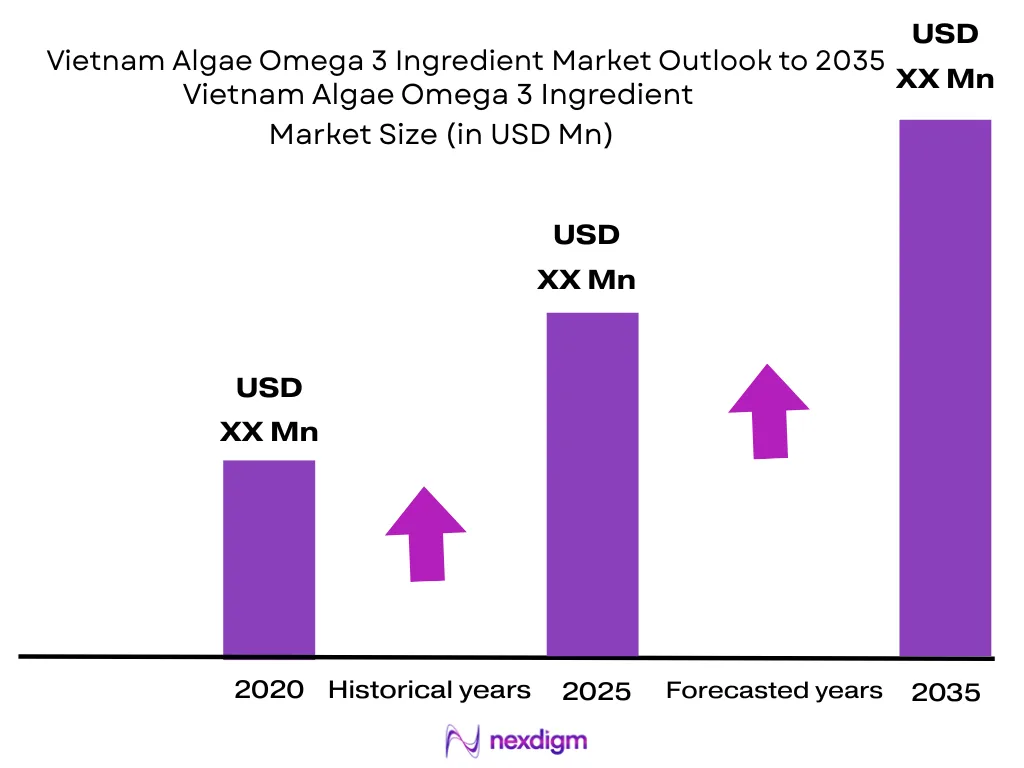
The Vietnam Algae Omega-3 Ingredient Market is valued at USD ~ million, calculated from the disclosed Vietnam algae oil value of USD ~ million and published annual growth trajectory for the adjacent algae oil market. Demand is supported by nutrition-grade DHA/EPA applications in supplements, infant nutrition, functional foods, pet nutrition, and aquafeed. Vietnam’s GDP reached USD 476.39 billion, GDP per capita reached USD 4,717.3, and the economy expanded by 7.1%, strengthening premium nutrition demand. Ho Chi Minh City, Hanoi, Can Tho, Dong Nai, Binh Duong, and the Mekong Delta dominate Vietnam algae omega-3 ingredient demand because they concentrate supplement importers, food processors, aquafeed manufacturers, dairy nutrition companies, and seafood exporters. Vietnam’s seafood output increased from 7.7 million tons to 9.8 million tons, while aquaculture output increased from 4.1 million tons to 5.9 million tons; the Mekong Delta accounts for 95% of pangasius production and 80% of shrimp production.
Market Segmentation
By Ingredient Type
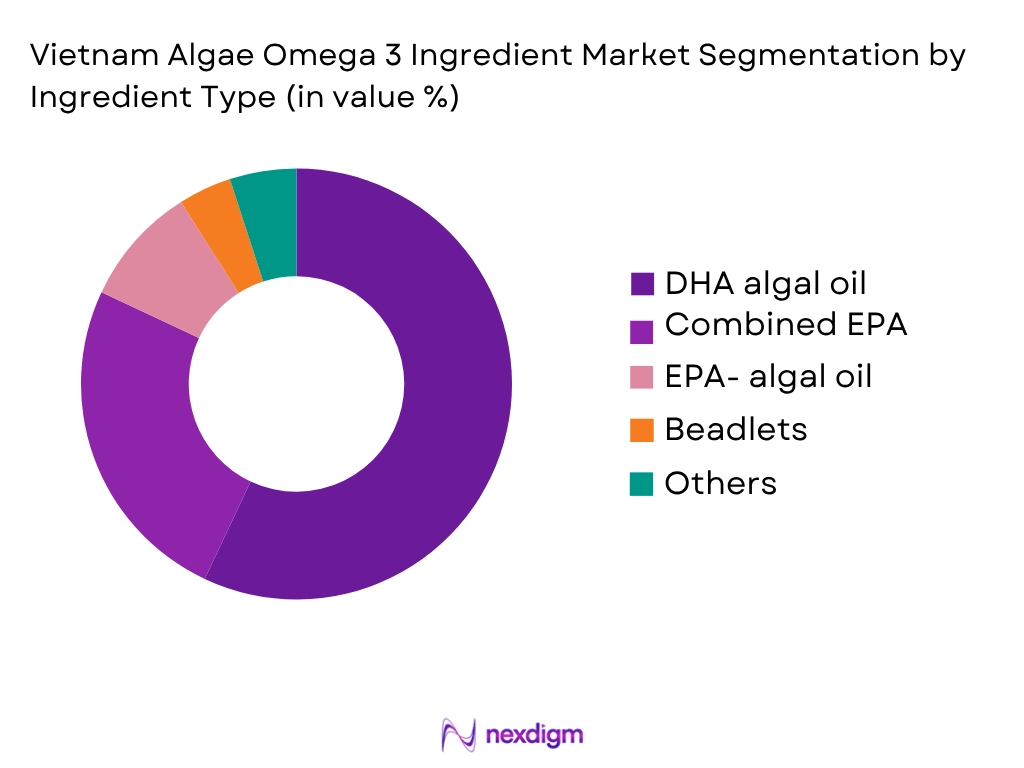
Vietnam Algae Omega-3 Ingredient Market is segmented by ingredient type into DHA-dominant algal oil, combined EPA+DHA algal oil, algal omega-3 powder and beadlets, EPA-dominant algal oil, and algal biomass and meal. DHA-dominant algal oil holds the dominant market share because it has the clearest application fit across infant formula, maternal supplements, children’s DHA products, cognition supplements, and eye-health formulations. In Vietnam, DHA has stronger consumer recognition than EPA because it is widely associated with child brain development and premium milk powder. DHA-rich algal oil also has better commercial readiness than EPA-rich algae inputs because major global suppliers offer established technical dossiers, stability data, food-grade documentation, and formulation support. This makes it easier for Vietnamese importers, supplement contract manufacturers, dairy nutrition players, and paediatric nutrition brands to incorporate algae-derived DHA into products without major consumer education risk.
By Application
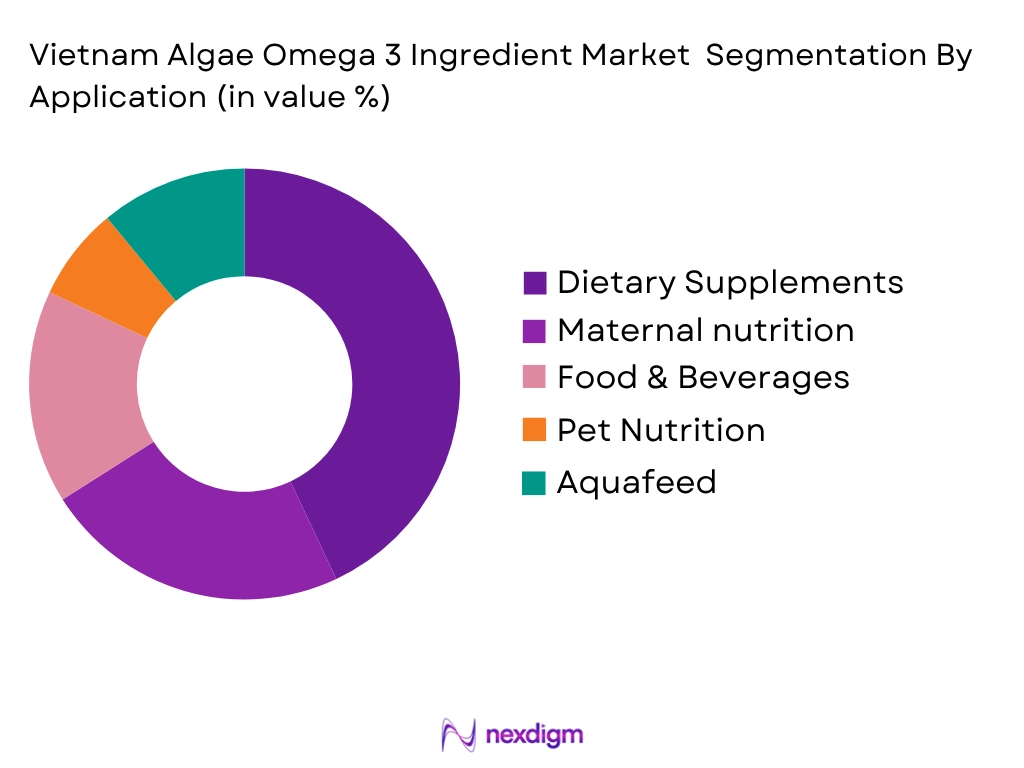
Vietnam Algae Omega-3 Ingredient Market is segmented by application into dietary supplements, infant and maternal nutrition, aquafeed, functional food and beverages, pet nutrition, and clinical nutrition. Dietary supplements hold the dominant market share because algae-derived omega-3 can be commercialised directly through capsules, softgels, gummies, liquid drops, and pregnancy DHA products. This application has lower formulation complexity than fortified beverages or aquafeed trials, while allowing brands to communicate fish-free, plant-based, contaminant-controlled, and sustainable DHA/EPA positioning. Vietnam’s urban wellness market is highly concentrated around pharmacy chains, imported supplement sellers, e-commerce platforms, and private-label health brands. These channels favour premium ingredients with clear label claims and supplier-backed documentation. Algal omega-3 also fits domestic consumer interest in child development, eye health, cardiovascular support, and maternal wellness, making supplements the fastest route from imported ingredient to commercial product.
Competitive Landscape
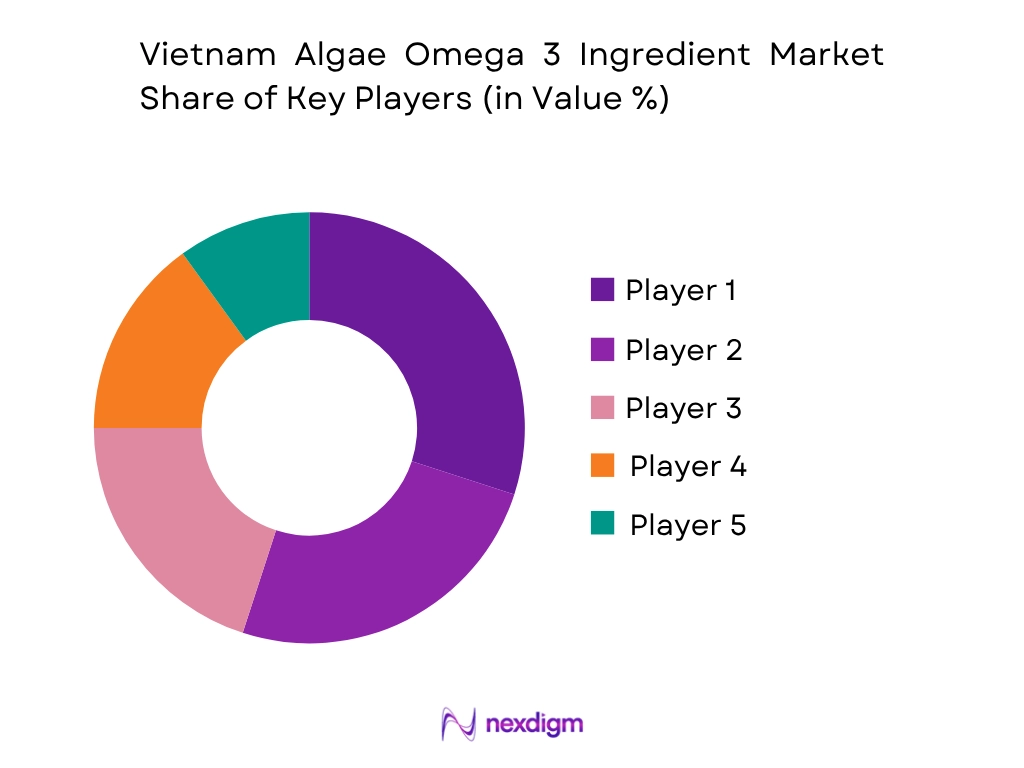
The Vietnam Algae Omega-3 Ingredient Market is led by global ingredient producers and regional distributors rather than large-scale domestic algal DHA/EPA manufacturers. dsm-firmenich, Corbion, Veramaris, Mara Renewables, and BASF have relevance because they supply algae-derived DHA/EPA, nutrition lipids, aquafeed omega-3 alternatives, or branded speciality ingredients. Vietnam’s local competition is concentrated in importers, food ingredient distributors, supplement contract manufacturers, and feed formulators that convert imported DHA/EPA oils or powders into capsules, milk powder, functional nutrition, and aquaculture feed products. dsm-firmenich positions life’sOMEGA as a plant-based EPA+DHA source, Corbion positions AlgaPrime DHA as an algae omega-3 alternative to fish oil, and Veramaris offers algal oil with 65% EPA and DHA for aquaculture feed.
| Company | Establishment Year | Headquarters | Market-Specific Ingredient | Technology Base | Key Vietnam Application | DHA/EPA Capability | Commercial Strength | Vietnam Relevance |
| dsm-firmenich | 2023 | Kaiseraugst, Switzerland / Maastricht, Netherlands | ~ | ~ | ~ | ~ | ~ | ~ |
| Corbion | 1919 | Amsterdam, Netherlands | ~ | ~ | ~ | ~ | ~ | ~ |
| Veramaris | 2018 | Delft, Netherlands | ~ | ~ | ~ | ~ | ~ | ~ |
| Mara Renewables | 2012 | Halifax, Canada | ~ | ~ | ~ | ~ | ~ | ~ |
| BASF | 1865 | Ludwigshafen, Germany | ~ | ~ | ~ | ~ | ~ | ~ |
Vietnam Algae Omega-3 Ingredient Market Analysis
Growth Drivers
Expansion of Aquaculture-Based Demand for Algae-Derived DHA/EPA
Vietnam Algae Omega-3 Ingredient Market is supported by a large aquaculture base that can absorb algae-derived DHA/EPA in shrimp, pangasius, marine fish and broodstock feed formulations. Vietnam’s official statistics reported total fishery production of 9,547.0 thousand tons and aquaculture output of more than 5.72 million tons, creating a substantial downstream feed ingredient base for sustainable lipid alternatives. Vietnam’s economy also provides scale for ingredient commercialisation, with World Bank-reported GDP of USD 476.39 billion and population of about 101.6 million. These indicators support wider adoption across feed mills, nutrition companies and ingredient importers.
Rising Premium Nutrition Demand Across Supplements and Infant Nutrition
Vietnam Algae Omega-3 Ingredient Market is driven by growing demand for DHA/EPA ingredients in pregnancy supplements, children’s DHA products, cognition supplements, eye-health products and premium milk powder. The country’s purchasing base is expanding, with World Bank reporting GDP per capita of USD 4,717.3 and total GDP of USD 476.39 billion, supporting higher-value nutrition consumption. Vietnam also has a large consumer base of about 101.6 million people, giving supplement and infant nutrition manufacturers a wide addressable market. Algal DHA is especially relevant because it supports fish-free, contaminant-controlled and vegetarian positioning in premium nutrition formulations.
Market Challenges
Import Dependency and Technical Documentation Burden
Vietnam Algae Omega-3 Ingredient Market faces a structural challenge because commercial DHA/EPA algal oils are largely supplied by global producers rather than domestic large-scale algae lipid manufacturers. This increases reliance on imported technical dossiers, certificates of analysis, origin documents, stability data and Vietnamese-compliant labels. Health supplement products exported to Vietnam must comply with Vietnamese authority requirements, including product registration and relevant documentation. The challenge is significant because the market serves a national consumer base of about 101.6 million people and a regulated nutrition economy supported by USD 476.39 billion in GDP. Documentation gaps can delay launches for supplements, infant nutrition and functional foods.
Aquafeed Adoption Requires Proof Across Large-Volume Production Systems
Vietnam Algae Omega-3 Ingredient Market faces adoption barriers in aquafeed because shrimp and pangasius producers require performance evidence before replacing conventional marine lipids. Vietnam’s fishery production reached 9,547.0 thousand tons, while aquaculture output exceeded 5.72 million tons, meaning feed reformulation affects large commercial production systems. Pangasius production alone reached 155.8 thousand metric tons in March, showing the scale at which ingredient decisions are made. Feed mills need digestibility, survival, growth and omega-3 retention validation before switching to algal DHA/EPA. The macro base is strong, with USD 476.39 billion GDP, but technical risk slows procurement conversion.
Market Opportunities
Feed-Grade Algal Omega-3 for Shrimp and Pangasius Export Supply Chains
Vietnam Algae Omega-3 Ingredient Market has a strong opportunity in feed-grade algae omega-3 because export-focused shrimp and pangasius producers face rising sustainability and traceability expectations. VASEP reported seafood export turnover of approximately USD 11.3 billion and noted growing emphasis on aquaculture products, processed products and value-added products. The Mekong Delta is commercially important because it accounts for 95% of pangasius production and 80% of shrimp production, giving algal omega-3 suppliers a geographically concentrated buyer base. With World Bank-reported GDP of USD 476.39 billion, Vietnam has the economic scale to support higher-value feed inputs in export-oriented aquaculture.
Microencapsulated Algal Omega-3 for Functional Foods and Powdered Nutrition
Vietnam Algae Omega-3 Ingredient Market has a future growth opportunity in microencapsulated DHA/EPA powders for milk powder, sachets, fortified beverages, infant foods and functional nutrition. This format addresses odour, oxidation and blending limitations that restrict direct oil use in food applications. The opportunity is supported by Vietnam’s large domestic base of about 101.6 million people and income capacity reflected in World Bank GDP per capita of USD 4,717.3. Vietnam’s fishery economy also provides category relevance, with official fishery production of 9,547.0 thousand tons, helping brands connect algae omega-3 with marine nutrition while avoiding fish-oil constraints.
Future Outlook
The Vietnam Algae Omega-3 Ingredient Market is expected to expand steadily as nutrition companies look for sustainable and contaminant-controlled alternatives to fish oil. The market is forecast to grow at 18.9% CAGR for 2026-2035, using the Vietnam algae oil growth trajectory as the closest available published benchmark. Growth will be led by DHA-focused infant nutrition, premium supplements, aquafeed sustainability, and functional food innovation. The strongest commercial opportunity will be in imported high-purity algal oil, microencapsulated powders, and feed-grade algal biomass.
Vietnam’s future algae omega-3 ingredient demand will be shaped by three buyer clusters. First, supplement and maternal nutrition companies will use algae DHA/EPA for premium capsules, gummies, pregnancy DHA, and children’s nutrition. Second, aquafeed players serving shrimp and pangasius exporters will test algae-based DHA/EPA and biomass to reduce dependence on marine fish oil. Third, functional food manufacturers will apply encapsulated algae omega-3 in dairy nutrition, powdered beverages, plant-based foods, and fortified sachets.
Major Players
- dsm-firmenich
- Corbion
- BASF
- Archer Daniels Midland
- Cargill
- Veramaris
- Mara Renewables
- Fermentalg
- Polaris Nutritional Lipids
- AlgiSys BioSciences
- Cellana
- Cyanotech Corporation
- Algarithm Ingredients
- DKSH Vietnam
- Brenntag Vietnam
Key Target Audience
- Nutraceutical and dietary supplement manufacturers
- Infant formula and maternal nutrition companies
- Aquafeed and seafood nutrition companies
- Functional food and beverage manufacturers
- Pet nutrition and veterinary supplement companies
- Specialty ingredient importers and distributors
- Investments and venture capitalist firms
- Government and regulatory bodies: Ministry of Health, Vietnam Food Administration, Ministry of Agriculture and Environment, Directorate of Fisheries, General Department of Vietnam Customs
Research Methodology
Step 1: Identification of Key Variables
The initial phase involves constructing an ecosystem map for the Vietnam Algae Omega-3 Ingredient Market. This includes global algal oil producers, Vietnamese ingredient importers, supplement manufacturers, infant nutrition companies, aquafeed producers, pet nutrition brands, functional food companies, and regulatory bodies. Key variables include ingredient type, DHA/EPA content, application, import route, grade, and end-user demand.
Step 2: Market Analysis and Construction
In this phase, historical and current data is compiled from algae oil benchmarks, seafood output, aquaculture production, supplement demand indicators, macroeconomic indicators, and supplier product portfolios. The analysis evaluates ingredient consumption across supplements, infant nutrition, aquafeed, functional foods, pet nutrition, and clinical nutrition to build a bottom-up market structure.
Step 3: Hypothesis Validation and Expert Consultation
Market hypotheses are validated through structured discussions with ingredient distributors, aquafeed formulators, nutrition product manufacturers, regulatory specialists, and supplement contract manufacturers. These consultations help verify buyer preference, import dependency, technical barriers, DHA/EPA formulation trends, product documentation requirements, and application-level adoption potential.
Step 4: Research Synthesis and Final Output
The final phase integrates desk research, company benchmarking, macroeconomic analysis, application mapping, and expert validation. Outputs are checked through top-down and bottom-up triangulation to ensure that market size, segmentation, competitor profiles, and future outlook reflect Vietnam-specific commercial realities rather than generic global algae omega-3 trends.

- Executive Summary
- Research Methodology (market definitions and assumptions, abbreviations, ingredient inclusion and exclusion criteria, algal oil equivalent conversion, DHA/EPA active content normalisation, top-down sizing approach, bottom-up supplier triangulation, ingredient distributor interviews, nutraceutical manufacturer interviews, aquafeed buyer interviews, infant nutrition formulation validation, Vietnam import channel assessment, regulatory review, price-per-active-kg benchmarking, data limitation mapping, forecast sensitivity framework)

- Definition and Scope
- Overview Genesis
- Evolution of Algae-Based DHA/EPA Ingredients
- Business Cycle
- Supply Chain and Value Chain Analysis

- Growth Drivers (seafood export orientation, aquafeed modernisation, rising urban wellness consumption, infant nutrition premiumisation, fish-oil substitution, vegan supplement adoption, functional food innovation, clean-label nutrition)
- Market Challenges (high ingredient cost, import dependency, low local production scale, limited EPA-rich supply, regulatory documentation, oxidation risk, cold-chain handling, consumer awareness gap)
- Opportunities (premium nutraceuticals, infant nutrition, aquafeed sustainability, pet supplements, functional food fortification, local distribution partnerships, algae biotech localisation)
- Market Trends (ingredient localisation, clean-label claims, DHA/EPA ratio differentiation, powder formats, aquafeed sustainability, branded ingredients, technical distribution)
- SWOT Analysis
- Porter’s Five Forces

- By Value (2020-2025)
- By Volume (2020-2025)
- By Average Ingredient Realisation (2020-2025)

- By Omega-3 Type (In Value %)
DHA-Dominant Algal Oil
EPA-Dominant Algal Oil
Combined EPA+DHA Algal Oil
High-Potency Algal Omega-3 Concentrates
Algal Omega-3 Powder and Beadlets - By Application (In Value %)
Dietary Supplements
Infant and Maternal Nutrition
Functional Food and Beverages
Aquafeed
Pet Nutrition - By Distribution Channel (In Value %)
Direct Sales from Global Ingredient Manufacturers
Vietnam Specialty Ingredient Distributors
Contract Manufacturers and Private-Label Producers
B2B Importers and Nutritional Lipid Traders - By Region (In Value %)
Ho Chi Minh City and Southern Key Economic Region
Hanoi and Northern Key Economic Region
Mekong Delta
Central Coastal Vietnam
Red River Delta

- Market Share of Major Players by Value and Volume (bulk algal oil sales, active DHA equivalent, active EPA equivalent, powder equivalent, feed-grade equivalent)
- Cross Comparison Parameters (DHA/EPA concentration range, DHA ratio capability, Vietnam regulatory dossier readiness, oxidation quality metrics, ingredient form portfolio, aquafeed trial compatibility, certification and traceability coverage, Vietnam distribution and technical support access)
- SWOT Analysis of Major Players
- Detailed Profiles of Major Companies
dsm-firmenich
Corbion
BASF
Archer Daniels Midland
Cargill
Veramaris
Mara Renewables
Fermentalg
Polaris Nutritional Lipids
AlgiSys BioSciences
Cellana
Cyanotech Corporation
Algarithm Ingredients
DKSH Vietnam
Brenntag Vietnam

- Market Demand and Utilisation
- Purchasing Power and Budget Allocation
- Regulatory and Compliance Requirements
- Needs, Desires and Pain Point Analysis
- Decision-Making Process

- By Value (2026-2035)
- By Volume (2026-2035)
- By Average Ingredient Realisation (2026-2035)


 Request a Sample
 Ask for Customization
 Get a Quote
 Enquire Now