
 Download PDF
Market Overview
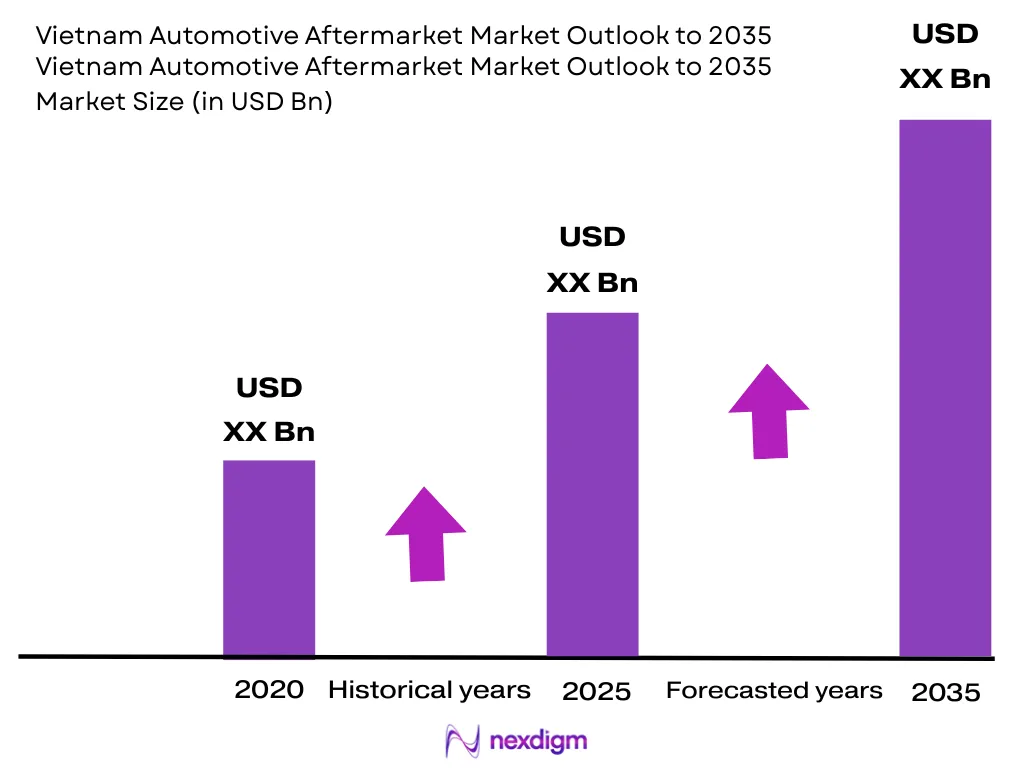
The Vietnam Automotive Aftermarket Market was valued at USD ~ Billion in 2024 and is anticipated to expand at a CAGR of ~% during 2026-2035. The market is primarily driven by rising vehicle parc and an aging vehicle fleet, growing middle-class income and urbanization, and continued expansion of the out-of-warranty vehicle base across the country. According to industry estimates, the Vietnam automotive aftermarket was valued at approximately USD ~ billion in 2025 and is projected to reach approximately USD ~ billion in 2026, growing to approximately USD ~ billion by 2031 at a CAGR of approximately 8.9% during 2026-2031. Within this, Tires accounted for approximately 28.4% of market share in 2025, while Two-Wheeler & Motorcycle-related parts is projected to grow at approximately 9.6% CAGR through 2031, reflecting continued expansion of organized retail and workshop chains, independent garage formalization exceeding 40% among urban operators, and rising vehicle inspection coverage across more than 60 provinces and cities.
Market Segmentation
By Product Type
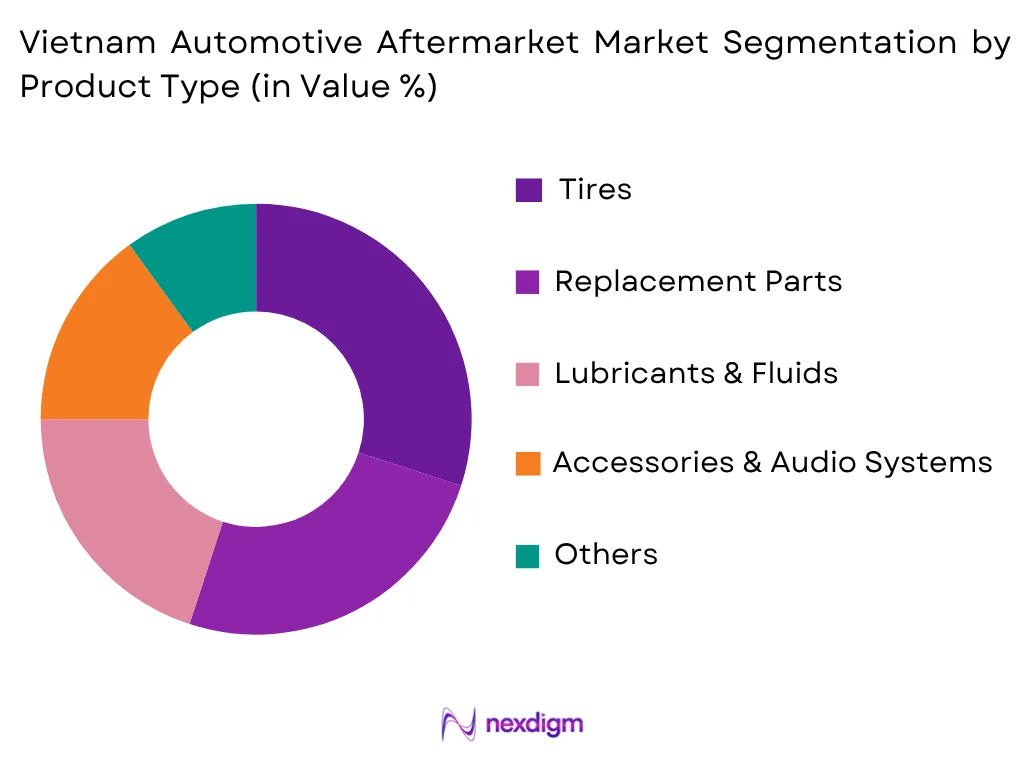
Among these, Tires continue to represent the largest product type category within the Vietnam Automotive Aftermarket Market, with Casumina, DRC, and Bridgestone Vietnam expanding dedicated distribution and retread networks to serve passenger car and commercial vehicle fleets. Replacement Parts remain a critical foundation of the market, with Robert Bosch Vietnam and Denso Vietnam continuing to expand localized component supply capacity across major distribution hubs in Hanoi, Ho Chi Minh City, and Da Nang to support growing vehicle parc. Lubricants & Fluids represent the fastest-growing product type category, driven by rising adoption of OEM-recommended service intervals, expanding organized workshop coverage, and distribution partnerships from providers such as Petrolimex Petroleum and Toyota Motor Vietnam, as vehicle owners increasingly prioritize part authenticity and warranty-backed service for high-mileage vehicles.
By Vehicle Type
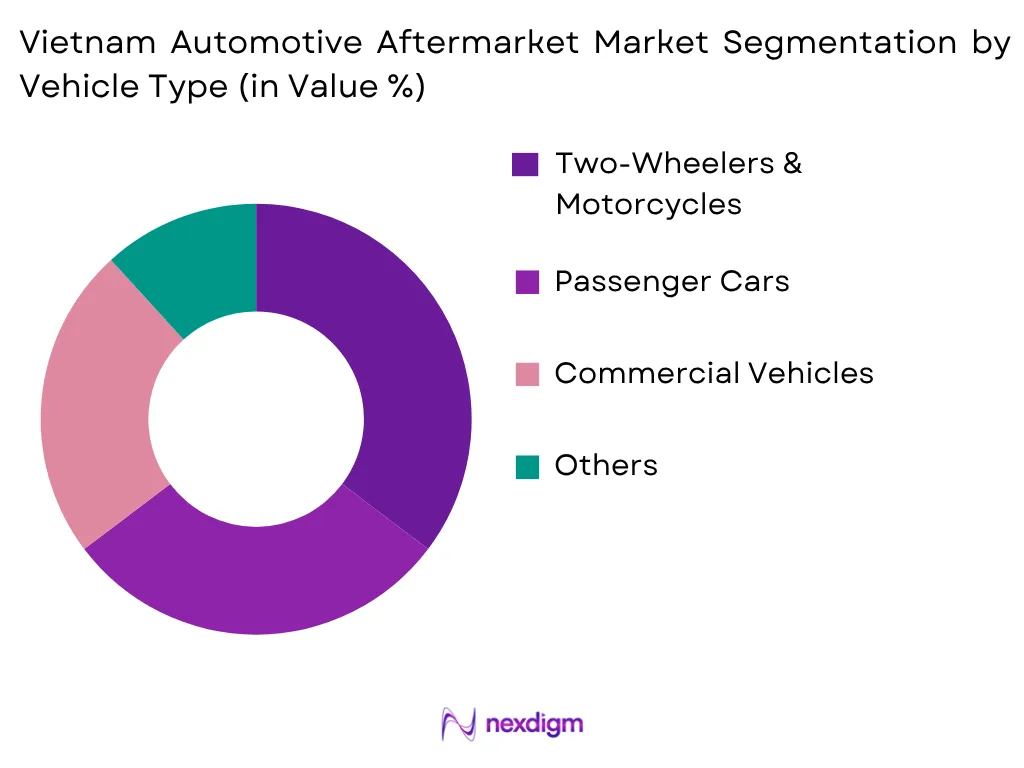
The Two-Wheelers & Motorcycles segment remains the largest vehicle type category within the Vietnam Automotive Aftermarket Market, encompassing the majority of routine maintenance, tire, and battery replacement activity distributed nationally through independent garages and organized service points, with providers such as Honda Vietnam-authorized networks and regional distributors supplying validated parts and consistent service coverage. The Passenger Cars segment is witnessing the fastest growth, driven by the expansion of urban vehicle ownership and the gradual mainstreaming of OEM-authorized service models that now account for more than 45% of urban passenger car servicing, particularly around the North and South regional hubs, with Toyota Motor Vietnam and THACO Auto expanding dedicated service networks and parts warehousing to serve this emerging segment. The Commercial Vehicles segment continues to grow steadily, supported by rising distribution of logistics and freight fleet maintenance across national and regional transport channels.
Competitive Landscape
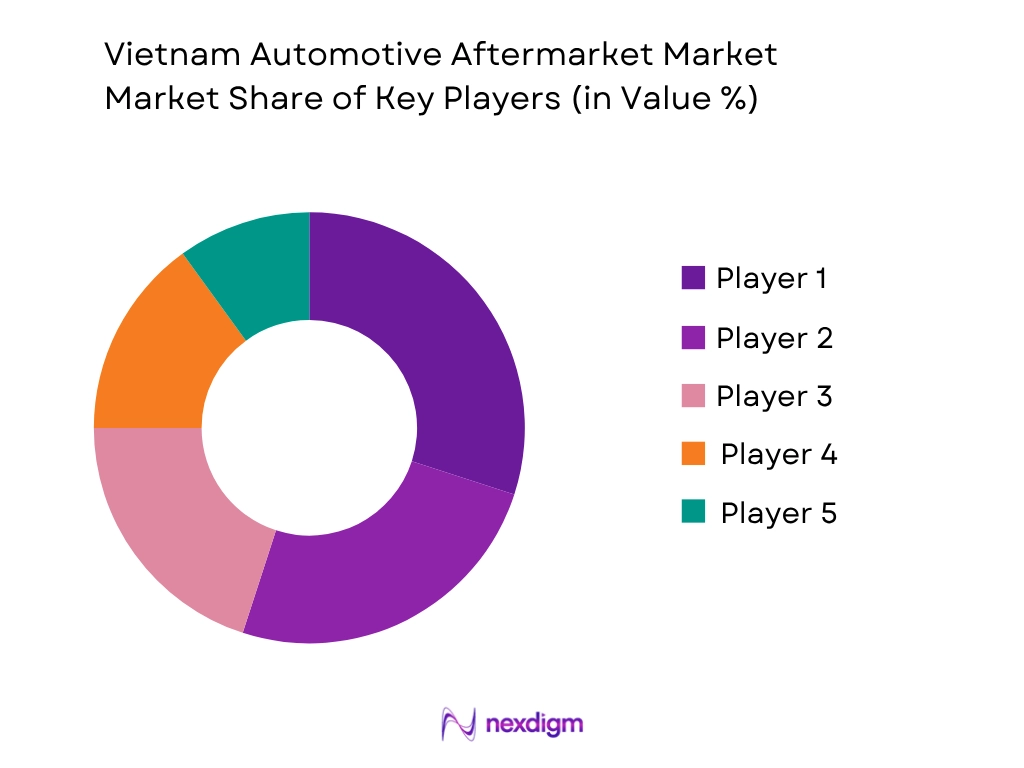
The Vietnam Automotive Aftermarket Market is moderately fragmented, with Robert Bosch Vietnam, Denso Vietnam, Toyota Motor Vietnam, THACO Auto, and VinFast together controlling a meaningful share of parts and service distribution volume, though the market continues to favor independent garages and regional distributors alongside the OEM-authorized networks. Competition is primarily based on part authenticity, service network coverage, price competitiveness, warranty support, and long-term relationships with vehicle owners and fleet operators. Robert Bosch Vietnam maintains a strong position through its deployment of localized manufacturing and distribution capacity and service coverage across more than 60 provinces and cities, while Denso Vietnam continues to expand its component production footprint across 100% of its Vietnam-based manufacturing lines and grow its two-wheeler parts segment to nearly 18% of total revenue. Toyota Motor Vietnam continues to advance its genuine parts and authorized service strategy, achieving customer retention gains of approximately 12% through digital service booking and facility expansion, while THACO Auto and VinFast compete on domestic parts localization and service network reach across more than 400 facilities combined. Global component suppliers including Continental, Bridgestone, and Kumho Tire continue to expand dedicated aftermarket distribution verticals to capture growing demand for end-to-end vehicle maintenance across the country, as Ministry of Transport and Vietnam Register regulatory requirements raise the compliance bar for smaller regional garages.
| Company | Establishment Year | Headquarters | Primary Product Portfolio | Distribution Channel Portfolio
|
Network Presence | Major End-Use Industries | Key Strategic Focus | Certifications & Compliance |
| Robert Bosch Vietnam Co., Ltd. | 1994 | ~ | ~ | ~ | ~ | ~ | ~ | ~ |
| Denso Vietnam Co., Ltd. | 2001 | ~ | ~ | ~ | ~ | ~ | ~ | ~ |
| Toyota Motor Vietnam | 1995 | ~ | ~ | ~ | ~ | ~ | ~ | ~ |
| THACO Auto (Truong Hai Auto Corporation) | 1997 | ~ | ~ | ~ | ~ | ~ | ~ | ~ |
| VinFast Trading and Production LLC | 2017 | ~ | ~ | ~ | ~ | ~ | ~ | ~ |
Vietnam Automotive Aftermarket Market Analysis
Growth Drivers
Rising Vehicle Parc and Aging Vehicle Fleet Demand
The Vietnam Automotive Aftermarket Market continues to be shaped decisively by the country’s accelerating vehicle ownership growth, with vehicle ownership having crossed 41 cars per 1,000 people in 2025, which is highly dependent on affordable, reliable, and locally accessible maintenance infrastructure. Vietnam’s position as one of Southeast Asia’s fastest-growing automotive markets, processing over 510,000 new vehicle sales annually, has long underscored the necessity for robust aftermarket service infrastructure, prompting companies to expand distribution capabilities and invest in domestic component manufacturing. According to industry estimates, the maturing organized retail and workshop landscape is lifting demand for authorized and semi-authorized service centers, particularly around the North and South regional hubs, while out-of-warranty vehicles accounting for more than 35% of the national vehicle parc is driving rising demand for independent garages, parts distributors, and dedicated service networks. The gradual expansion of two-wheeler and motorcycle ownership, supported by continued investment in domestic parts production, has directly encouraged specialty aftermarket providers to expand distribution capacity and service network electrification readiness.
Regulatory Support and Growth in Domestic Component Manufacturing
Regulations for maintaining compliant vehicle inspection and parts quality standards, including Vietnam Register vehicle inspection requirements and Ministry of Industry and Trade Supporting Industry Development Programme incentives, continue to be a critical driver of investment in validated aftermarket infrastructure across the country. Regulatory alignment on local content requirements is raising the compliance bar and pushing vehicle owners toward specialty aftermarket partners with proven quality track records, exemplified by Denso Vietnam expanding component production capacity and Toyota Motor Vietnam collaborating with the Ministry of Industry and Trade to develop domestic supplier networks. The continued expansion of the government’s target to raise locally produced component and spare part share to 55-60% of total demand by 2030 is also driving demand for domestic manufacturing capability, as vehicle owners increasingly source parts from validated local suppliers rather than relying on grey-market imports.
Market Challenges
Highly Unorganized Market and Grey Import Constraints
The Vietnam Automotive Aftermarket Market faces significant challenges from the highly unorganized nature of independent garages, grey-market imports, and inconsistent parts quality standards across a geographically diverse national network of urban and rural service points. Component specialists such as Casumina and DRC must continue to invest heavily in brand authentication and distribution-intensive infrastructure to support growing parts volumes, while counterfeit part circulation and regulatory pressure remain a persistent downside risk, requiring continued investment in quality certification and supplier verification to maintain service reliability. Rising replacement and maintenance costs remain a persistent operational challenge, as increasing part prices across tire and electrical categories can compromise affordability and trigger customer migration toward informal service channels, requiring continuous investment in cost-competitive distribution and contingency systems across the value chain.
Fragmented Garage Network and Counterfeit Parts Circulation
Fragmentation across independent garage networks in rural and low-density markets continues to increase deployment challenges across the Vietnam Automotive Aftermarket Market, as providers must maintain reliable parts availability across the final service leg to rural workshops and increasingly, mobile service points, despite significant distances and inconsistent provincial infrastructure outside major metropolitan corridors. Persistent circulation of counterfeit and substandard parts continues to constrain brand trust and increase warranty costs across the industry. Limited cold chain and logistics infrastructure present an additional operational challenge, as inconsistent parts distribution networks generate significant delivery delays, prompting regulatory and customer pressure for providers to transition toward validated and traceable supply chains. These operational bottlenecks continue to extend service timelines and increase costs across the industry, requiring providers to maintain larger regional distribution buffers and redundant warehousing capacity to offset network disruptions.
Market Opportunities
Growth in Organized Retail and Emerging Domestic Manufacturing
The gradually expanding organized retail and franchise workshop market in Vietnam presents substantial opportunities for companies developing specialized authorized and semi-authorized service capabilities beyond conventional independent garage servicing. Specialty providers with dense urban distribution networks are well positioned to capture growing demand for part authenticity and warranty-backed service as organized retail models move from major metropolitan pilots toward broader nationwide distribution across the country’s leading urban and industrial clusters. Expansion of domestic component and spare part manufacturing, including localized tire and electrical component production, presents a growing opportunity as vehicle owners and fleet operators face increasing pressure to reduce reliance on imported and grey-market parts while maintaining service affordability across the country’s expanding vehicle parc.
AI-Enabled Diagnostics, Electric Vehicle Growth, and Domestic Supply Chain Expansion
The continued expansion of AI and IoT-enabled diagnostics and predictive maintenance platforms presents significant opportunities for companies with strong technology and data analytics capabilities, as vehicle owners increasingly demand transparent service recommendations and predictive maintenance scheduling rather than reactive repair alone. Growth in electric vehicle and electric two-wheeler ownership, which requires specialized servicing capability comparable to leading regional automotive markets, is expanding the addressable market for specialty aftermarket providers as Vietnam continues to account for a growing share of Southeast Asian automotive aftermarket spending. Companies capable of combining strong domestic distribution coverage, regulatory compliance expertise, and advanced diagnostics technology are well positioned to capture growing demand as vehicle owners increasingly favor localized and traceable parts supply chains that shorten delivery distances and strengthen Vietnam’s position as a regional automotive aftermarket hub.
Future Outlook
The Vietnam Automotive Aftermarket Market is expected to witness robust expansion over the forecast period, supported by continued growth in vehicle ownership, out-of-warranty fleet expansion, regulatory quality compliance requirements, and rising organized retail and service chain distribution. Continued investment in domestic component manufacturing, AI-enabled diagnostics platforms, and traceable parts supply chains is expected to further strengthen the market’s competitive landscape. Growing emphasis on part authenticity and affordability, combined with continued consolidation and capacity expansion around Hanoi, Ho Chi Minh City, and Da Nang service corridors, will continue to reshape infrastructure investment decisions and competitive dynamics across the industry through 2035.
Major Players
- Robert Bosch Vietnam Co., Ltd.
- Denso Vietnam Co., Ltd.
- Toyota Motor Vietnam
- THACO Auto (Truong Hai Auto Corporation)
- VinFast Trading and Production LLC
- Casumina (Southern Rubber Industry JSC)
- DRC – Da Nang Rubber Joint Stock Company
- Bridgestone Vietnam
- Continental Vietnam
- Petrolimex Petroleum (PLC)
- Hyundai Thanh Cong Vietnam
- Ford Vietnam
- Kumho Tire Vietnam
- Yokohama Tyre Vietnam
- Phu Thai Cat Automotive Parts Distribution
Key Target Audience
- Vehicle Owners and Fleet Operators
- Specialty Parts Distributors and Independent Garages
- OEM-Authorized Dealers and Service Networks
- Domestic Component and Spare Part Manufacturers
- Investment and Venture Capitalist Firms
- Government and Regulatory Bodies (Ministry of Industry and Trade (MoIT), Vietnam Register, Ministry of Transport)
- Tire, Lubricant, and Electrical Component Suppliers
- Logistics, Distribution, and Warehousing Operators
Research Methodology
Step 1: Identification of Key Variables
The research process begins with identifying the complete ecosystem of the Vietnam Automotive Aftermarket Market, including specialty parts distributors, component manufacturers, service network operators, vehicle owners, and regulatory authorities. Extensive secondary research is conducted using company annual reports, government publications, regulatory agency disclosures, industry journals, and proprietary databases to determine the variables influencing market demand, pricing, parts volume, and technological developments.
Step 2: Market Analysis and Construction
Historical market information is collected and analyzed to estimate market size, parts volume, application-wise demand, and pricing trends. A combination of top-down and bottom-up approaches is used to estimate market revenues and validate segment-level performance. Consumption patterns across vehicle owners, fleet operators, and independent garages are evaluated to establish an accurate representation of the industry.
Step 3: Hypothesis Validation and Expert Consultation
The preliminary findings are validated through Computer-Assisted Telephone Interviews (CATIs) and structured discussions with parts distributors, service center operators, vehicle procurement managers, regulatory experts, and senior executives operating within Vietnam’s automotive aftermarket industry. These interviews help verify market assumptions, competitive developments, technology adoption trends, pricing dynamics, and future investment opportunities while refining the overall market estimates.
Step 4: Research Synthesis and Final Output
The final stage integrates insights obtained from primary interviews with quantitative information collected through secondary sources. Data triangulation techniques are applied to reconcile differences between supply-side and demand-side estimates, ensuring robust market forecasting. The report is then reviewed through multiple quality assurance checkpoints to deliver a comprehensive analysis covering market size, segmentation, competitive landscape, future outlook, and strategic recommendations for industry stakeholders.

- Executive Summary
- Research Methodology (Market Definitions and Assumptions, Abbreviations, Market Sizing Approach, Top-Down Analysis, Bottom-Up Analysis, Demand-Side Assessment, Supply-Side Assessment, Primary Industry Interviews, Secondary Research Validation, Data Triangulation, Forecasting Framework, Limitations and Future Conclusions)

- Definition and Scope
- Market Evolution and Industry Genesis
- Timeline of Major Industry Developments
- Automotive Aftermarket Industry Value Chain Analysis
- Supply Chain Analysis

- Growth Drivers (Rising Vehicle Parc and Aging Vehicle Fleet, Growing Middle-Class Income and Urbanization, Expansion of Out-of-Warranty Vehicle Base, Growth of Organized Retail and Service Chains, Rising Two-Wheeler and Motorcycle Ownership, Increasing Adoption of E-Commerce for Parts Distribution)
- Market Challenges (Highly Unorganized Market and Grey Imports, Price Sensitivity and Rising Replacement Costs, Fragmented Independent Garage Network, Counterfeit Parts Circulation, Limited Cold Chain and Logistics Infrastructure, Inconsistent Provincial-Level Regulatory Enforcement)
- Market Opportunities (Growth in Organized Retail and Franchise Workshop Models, Expansion of Domestic Component and Spare Part Manufacturing, AI and IoT-Enabled Diagnostics and Predictive Maintenance, Growth of E-Commerce Platforms for Aftermarket Parts, Expansion of Electric Vehicle Aftermarket Services, Nearshoring-Driven Regional Parts Supply Chain Development)
- Market Trends (Rise of Organized Workshop and Retail Chains, Growth in Online Parts Retail and Digital Marketplaces, Integration of Vehicle Diagnostics and Telematics, Consolidation Among Regional Parts Distributors, Expansion of Domestic Component Manufacturing, Increasing Demand for Electric Two-Wheeler and EV Aftermarket Parts)
- Government Regulations (Ministry of Industry and Trade (MoIT) Supporting Industry Development Programme, Vietnam Register Vehicle Inspection Standards, Import Tariff and Local Content Requirements, Ministry of Transport Vehicle Safety Regulations, Environmental Emission Standards for Aftermarket Parts, Consumer Protection Law on Auto Parts Warranty)
- Import and Export Analysis (Trade Volume, Major Import Sources, Export Destinations, HS Code Analysis, Trade Balance)
- Infrastructure Availability Analysis (Authorized Service Center Network Capacity, Independent Workshop Density, Parts Distribution and Warehousing Infrastructure, Domestic Component Manufacturing Capacity, Logistics and Last-Mile Parts Delivery Availability)
- Technology Landscape (OBD-Based Vehicle Diagnostics Systems, E-Commerce and Digital Parts Marketplaces, Telematics and Predictive Maintenance Platforms, 3D Printing for Aftermarket Component Prototyping, Electric Vehicle and Two-Wheeler Servicing Technology)
- Sustainability Assessment (Recycling and Responsible Disposal of Automotive Components, Remanufactured and Reconditioned Parts Adoption, Energy-Efficient Workshop Operations, Reduction of Counterfeit and Substandard Parts Circulation, Electric Vehicle Aftermarket Waste Management)
- PESTLE Analysis
- SWOT Analysis
- Porter’s Five Forces Analysis
- Stakeholder Ecosystem
- Competition Ecosystem

- By Market Value (2020-2025)
- By Volume of Parts Sold (2020-2025)
- By Average Pricing (2020-2025)

- By Product Type (In Value %)
Replacement Parts (Engine, Brake, Battery & Electrical)
Tires
Lubricants & Fluids
Accessories & Audio Systems - By Vehicle Type (In Value %)
Passenger Cars
Two-Wheelers & Motorcycles
Commercial Vehicles - By Distribution Channel (In Value %)
OEM-Authorized Service Centers
Independent Garages & Workshops
Online Retail
Organized Retail Chains - By Service Type (In Value %)
Do-It-For-Me (DIFM)
Do-It-Yourself (DIY) - By Region (In Value %)
North (Hanoi & the Red River Delta)
South (Ho Chi Minh City & the Southeast)
Central (Da Nang & the Central Coast)
Mekong Delta

- Market Share of Major Players (By Value, Volume, Product Type, Vehicle Type, Region Served)
- Cross Comparison Parameters (Product Portfolio Breadth, Distribution and Service Network Capacity, Regulatory Compliance Certifications, Network Coverage, Digital and Diagnostics Platform Capability, Customer Base, Innovation & New Product Launch Frequency, Sustainability Initiatives)
- SWOT Analysis of Major Players
- Pricing Analysis by Product Type and Vehicle Type
- Distribution & Service Network Capacity Analysis
- Network Footprint Analysis
- Distribution Network Analysis
- Innovation Benchmarking
- Detailed Profiles of Major Companies
Robert Bosch Vietnam Co., Ltd.
Denso Vietnam Co., Ltd.
Toyota Motor Vietnam
THACO Auto (Truong Hai Auto Corporation)
VinFast Trading and Production LLC
Casumina (Southern Rubber Industry JSC)
DRC – Da Nang Rubber Joint Stock Company
Bridgestone Vietnam
Continental Vietnam
Petrolimex Petroleum (PLC)
Hyundai Thanh Cong Vietnam
Ford Vietnam
Kumho Tire Vietnam
Yokohama Tyre Vietnam
Phu Thai Cat Automotive Parts Distribution

- Consumption Pattern Analysis (Parts Volume, Service Frequency Distribution, Vehicle Category Penetration, Seasonal Demand, Urban vs Rural Service Activity)
- Purchasing Criteria (Part Authenticity and Quality, Price Competitiveness, Service Turnaround Time, Warranty Coverage, Workshop Accessibility, Brand Trust)
- Procurement and Supplier Selection Analysis
- Compliance Adoption Assessment
- OEM-Authorized vs Independent Service Demand
- Product Attribute Preference Analysis (Part Durability, Fitment Accuracy, Price-to-Performance Ratio, Warranty Support, Local Availability, Brand Reputation)
- Customer Reliability and Risk Mitigation Expectations
- Pain Point Analysis
- Decision-Making Process

- By Market Value (2026-2035)
- By Volume of Parts Sold (2026-2035)
- By Average Pricing (2026-2035)


 Request a Sample
 Ask for Customization
 Get a Quote
 Enquire Now