
 Download PDF
Market Overview
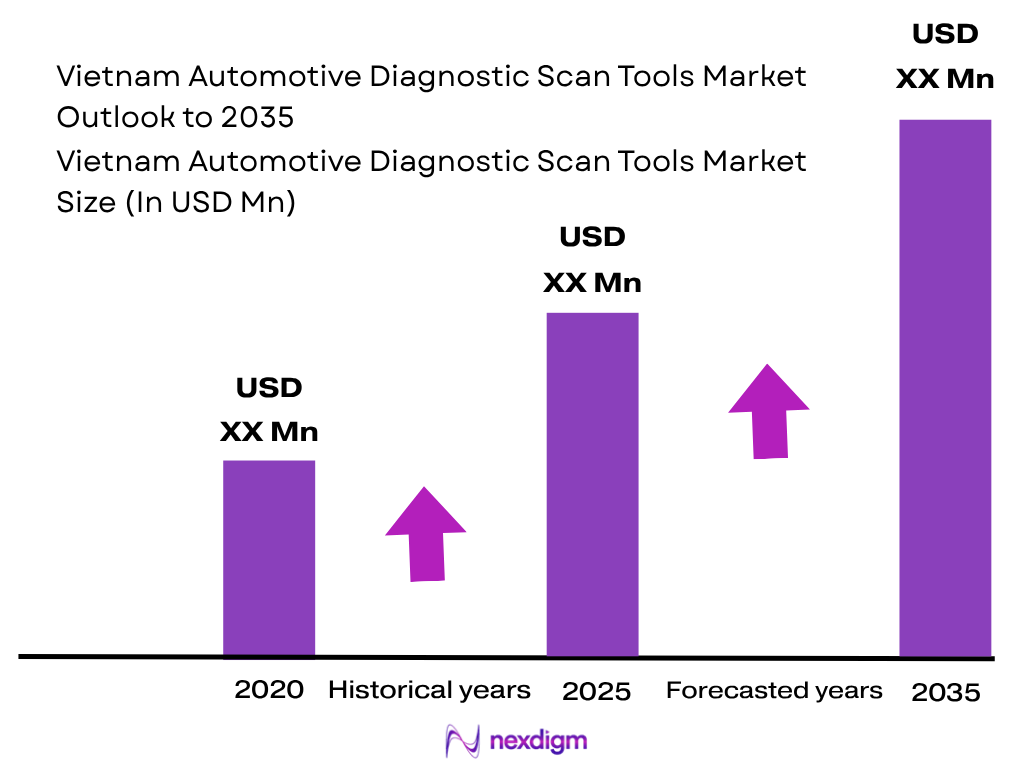
The Vietnam Automotive Diagnostic Scan Tools Market was valued at approximately USD ~ million in 2024 and is projected to expand at a CAGR of ~% during 2026–2035. Demand is supported by the increasing electronic content of vehicles, expansion of computerized vehicle diagnostics, growth of automotive repair activity, and rising requirements for faster fault identification. Current industry coverage identifies scanners, code readers, digital pressure testers, TPMS tools and battery analyzers as important diagnostic equipment categories, while wireless connectivity through Wi-Fi and Bluetooth is becoming increasingly relevant.
Ho Chi Minh City, Hanoi, Hai Phong, Da Nang and the broader southern industrial corridor represent the most important demand centers for automotive diagnostic scan tools because they combine vehicle density, dealership networks, independent workshops, commercial fleets and automotive-component activity. Ho Chi Minh City and Hanoi are particularly important because of their large concentrations of vehicle-service businesses and imported vehicles. Hai Phong benefits from manufacturing and logistics activity, while Da Nang provides an important central-region service market. Diagnostic equipment demand therefore follows the concentration of vehicles, workshops, dealerships and fleet-maintenance operations rather than being evenly distributed geographically. Import-trade data also identifies Ho Chi Minh City and Hanoi as major centers for automotive-related sourcing activity.
Market Segmentation
By Handheld Diagnostic Tool Type
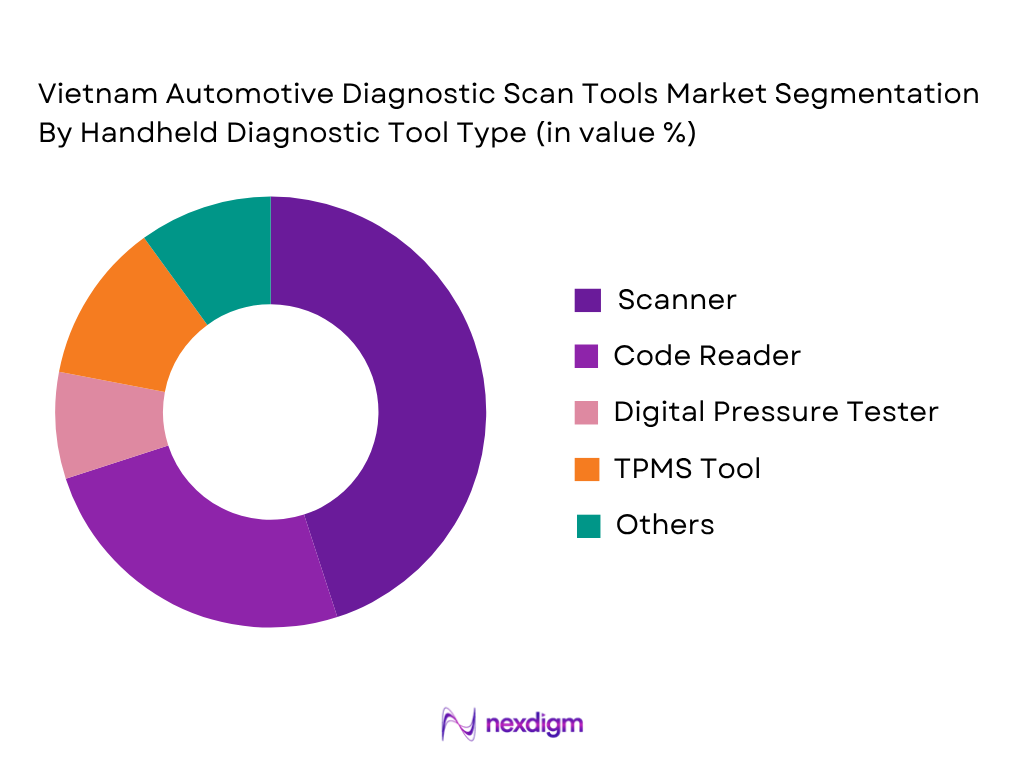
The Vietnam Automotive Diagnostic Scan Tools Market is segmented by handheld diagnostic tool type into professional diagnostic scanners, OBD-II code readers, digital pressure testers, TPMS diagnostic tools and battery analyzers. Professional scanners are expected to represent the dominant segment, with a 2024 market share of ~%, because they provide substantially broader diagnostic functionality than basic code readers. Modern professional scanners can communicate with multiple electronic control units and support functions such as live-data analysis, actuator testing, service resets, system diagnostics and, depending on the platform, ECU coding and programming. Vietnam’s increasingly electronics-intensive vehicle fleet makes comprehensive multi-system diagnostics more valuable for workshops serving different brands. Industry coverage specifically identifies scanners, code readers, digital pressure testers, TPMS tools and battery analyzers as key handheld categories in the Vietnamese market. The growth of passenger vehicles, commercial vehicles and increasingly sophisticated electronic systems should continue to favor equipment capable of performing multiple diagnostic functions from a single platform. Independent workshops also benefit from multi-brand coverage because they frequently service vehicles from several manufacturers rather than relying on one OEM-specific diagnostic platform.
By Connectivity Technology
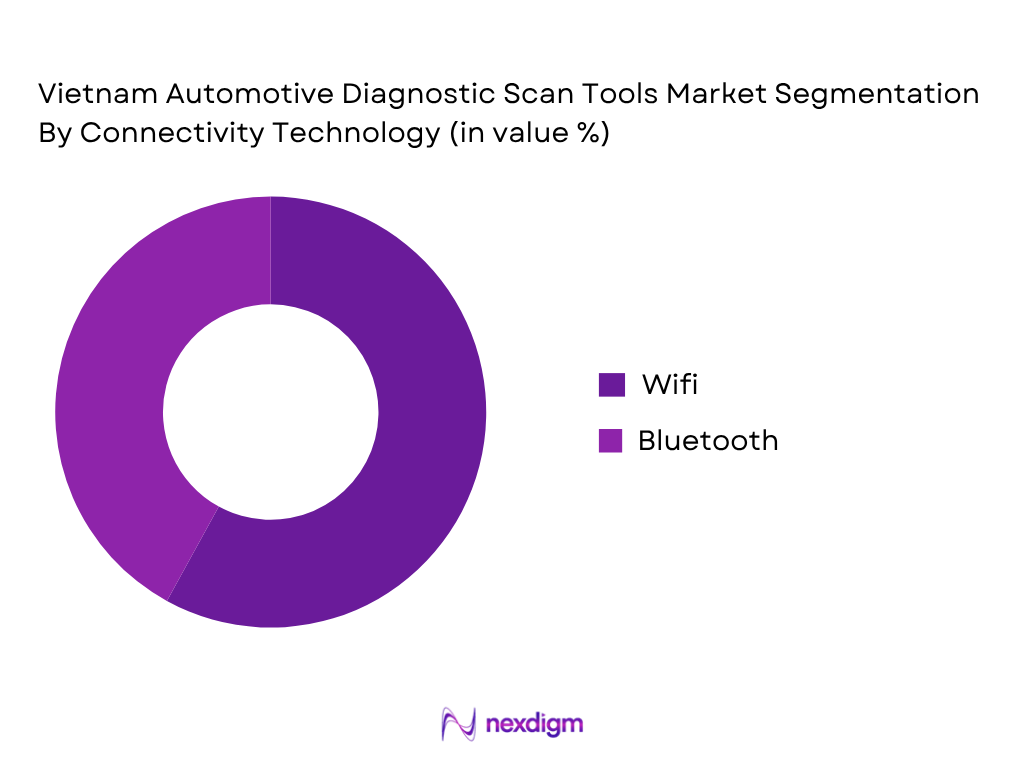
The Vietnam Automotive Diagnostic Scan Tools Market is segmented by connectivity into Wi-Fi-enabled, Bluetooth-enabled, USB/wired and other connected diagnostic systems. Wi-Fi-enabled diagnostic tools are expected to hold the leading position, with a 2024 market share of ~%, because wireless connectivity supports communication between diagnostic interfaces, tablets, workshop software and cloud-based services while reducing physical restrictions around the vehicle. Bluetooth remains highly relevant for compact OBD adapters and mobile diagnostic applications because of its low-complexity connection with smartphones and tablets. As Vietnamese workshops modernize, connectivity is increasingly linked to software updates, diagnostic data transfer, remote technical support and cloud-based vehicle information. Industry-specific market analysis already separates Vietnam’s diagnostic scan-tool market into Wi-Fi and Bluetooth connectivity categories, demonstrating that wireless capability is an established competitive dimension. Connected diagnostics also support a transition from standalone fault-code reading toward data-driven troubleshooting, service history management and remote assistance. This creates opportunities for suppliers offering diagnostic hardware bundled with software, subscription updates and connected workshop functions rather than hardware-only products.
Competitive Landscape
The Vietnam Automotive Diagnostic Scan Tools Market is characterized by international diagnostic-equipment manufacturers competing across professional workshop scanners, vehicle communication interfaces, TPMS equipment, ECU programming, heavy-duty diagnostics and connected software. Bosch, Snap-on, Autel, LAUNCH and TOPDON represent five significant benchmark competitors, while other international suppliers such as TEXA, HELLA GUTMANN, ACTIA, OBDSTAR and THINKCAR broaden competition across specialized and multi-brand diagnostic applications. Current Vietnam market coverage emphasizes the importance of technical capabilities, vehicle coverage, connectivity, software updates and workshop support in determining competitive positioning.
| Company | Establishment | Headquarters | Core Diagnostic Portfolio | EV Capability | ECU Coding/Programming | Connectivity | Workshop Support |
| Bosch | 1886 | Gerlingen, Germany | ~ | ~ | ~ | ~ | ~ |
| Snap-on | 1920 | Kenosha, Wisconsin, USA | ~ | ~ | ~ | ~ | ~ |
| Autel | 2004 | Shenzhen, China | ~ | ~ | ~ | ~ | ~ |
| LAUNCH | 1992 | Shenzhen, China | ~ | ~ | ~ | ~ | ~ |
| TOPDON | 2017 | Shenzhen, China | ~ | ~ | ~ | ~ | ~ |
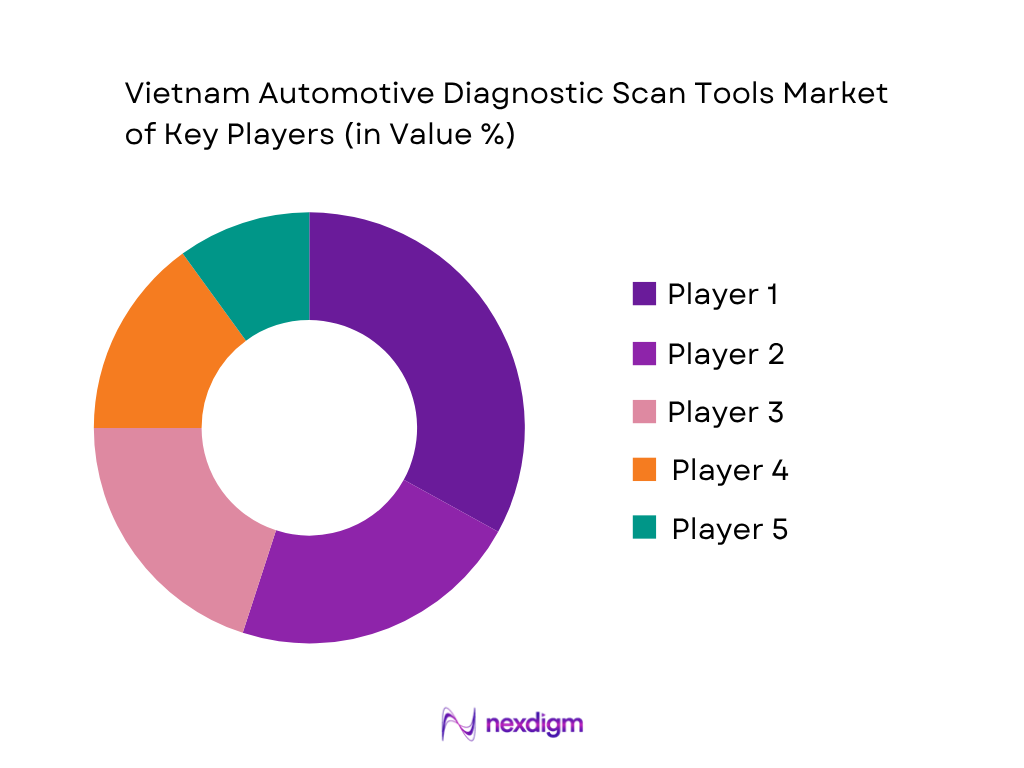
Vietnam Automotive Diagnostic Scan Tools Market Analysis
Growth Drivers
Increasing Vehicle Parc
Vietnam’s expanding vehicle base is strengthening the underlying requirement for automotive diagnostic scan tools because a larger installed fleet creates recurring demand for fault-code reading, ECU diagnostics, electrical testing, service resets and preventive maintenance. The Vietnam Automobile Manufacturers’ Association (VAMA) reported substantial vehicle sales activity across passenger and commercial categories, including 17,946 sedans, 30,419 SUVs, 11,296 crossovers and 19,998 MPVs in its January–June 2024 reporting. The broader economic environment also supports vehicle-service activity: World Bank data records Vietnam’s 2024 GDP at USD 476.39 billion, with GDP growth reaching 7.1%, while GDP per capita reached USD 4,717.3. Stronger economic activity supports vehicle utilization, business mobility and investment in automotive services. Diagnostic demand is particularly relevant because modern vehicles contain multiple electronically controlled systems, making conventional mechanical inspection insufficient for identifying many faults. The growing installed base also creates a recurring aftermarket requirement after warranty periods expire, benefiting independent workshops and multi-brand service centers. As vehicle ownership and utilization expand, workshops require diagnostic equipment that can cover different manufacturers, engine systems, transmission systems, ABS, airbags, body-control modules and electrical architectures. This makes fleet expansion a direct structural driver for Vietnam’s automotive diagnostic scan-tool demand.
Growing Electronic Content per Vehicle
Increasing electronic integration in Vietnam’s vehicle fleet is raising the need for professional diagnostic equipment capable of communicating with multiple electronic control units. Modern passenger and commercial vehicles increasingly depend on electronically controlled engine management, transmission, braking, airbag, body-control, infotainment and driver-assistance systems, meaning technicians require scan tools rather than relying exclusively on mechanical inspection. Vietnam’s strong industrial and technology expansion reinforces this transition: World Bank data shows USD 476.39 billion in GDP and USD 4,717.3 GDP per capita in 2024, while the World Bank reported that total exports increased 15.5% during 2024. The Ministry of Industry and Trade also reported that national electricity consumption reached a daily record of 1.025 billion kWh on June 14, 2024, illustrating the scale of industrial and economic activity supporting technology-intensive sectors. For diagnostic-tool suppliers, higher electronic complexity expands the addressable requirement from basic OBD code reading toward live-data monitoring, actuator testing, ECU coding, programming, battery-system diagnostics and advanced vehicle-system communication. The transition is particularly significant as Vietnam develops EV and hybrid mobility. The World Bank’s electric-mobility roadmap identifies EV production, charging infrastructure, electricity supply and skilled workforce development as critical pillars, indicating that future vehicle servicing will require increasingly specialized electronic diagnostic capabilities.
Market Challenges
High Cost of Advanced Diagnostic Equipment
The high acquisition requirement for professional diagnostic platforms can constrain adoption among smaller Vietnamese workshops, particularly outside the largest automotive-service centers. Advanced systems increasingly combine multi-brand vehicle communication, live-data analysis, bidirectional controls, ECU coding, programming, ADAS functions, TPMS diagnosis and EV battery-system capabilities, making them substantially more sophisticated than basic OBD readers. This creates a divide between workshops that can invest in comprehensive equipment and smaller operators that continue using lower-functionality tools. Vietnam’s economic indicators demonstrate a growing market but also highlight the importance of investment discipline: World Bank data places 2024 GDP per capita at USD 4,717.3, while consumer-price inflation was 3.6%. Workshop operators therefore have to evaluate diagnostic equipment against technician utilization, vehicle coverage, software-update requirements and expected service revenue rather than simply purchasing the most advanced platform. The challenge becomes more pronounced when equipment requires recurring software subscriptions or manufacturer-specific access for secure gateways and programming. Nevertheless, increasing vehicle electronics are gradually making advanced tools more necessary for competitive workshops. Suppliers can mitigate the barrier through tiered product portfolios, financing, subscription models and modular upgrades that allow workshops to begin with core diagnostics and subsequently add ADAS, EV, programming and connected capabilities as their customer base develops.
Shortage of Skilled Diagnostic Technicians
The increasing complexity of automotive electronics creates a skills constraint because sophisticated diagnostic scan tools require technicians capable of interpreting ECU data, electrical measurements, communication faults and system-level diagnostic results. Vietnam’s transition toward electric mobility makes this requirement more important because technicians must additionally understand high-voltage architectures, battery-management systems, charging systems and electric powertrains. The World Bank has specifically identified skilled EV workforce development as one of the five pillars required for Vietnam’s electric-mobility transition. Its roadmap also targets 50% of urban vehicles operating on electricity or green energy and 100% of urban buses and taxis operating on electricity or green energy by 2030. These changes increase the technical knowledge required across workshops. Vietnam’s economic expansion provides a supportive foundation for investment in workforce capability, with World Bank data recording 7.1% GDP growth in 2024 and GDP of USD 476.39 billion. However, economic expansion alone does not immediately create technicians with specialized diagnostic expertise. Workshops therefore face a need for continuous training in scan-tool operation, electrical diagnostics, ECU communication, ADAS calibration and EV safety procedures. Equipment suppliers that combine diagnostic hardware with structured training, technical databases and remote assistance can reduce this constraint and improve effective utilization of advanced scan tools across Vietnam’s aftermarket ecosystem.
Market Opportunities
Cloud-Based Diagnostics
Cloud-based diagnostics present an opportunity to move Vietnamese automotive workshops from standalone scan tools toward connected diagnostic ecosystems. Cloud-enabled platforms can support remote technical assistance, centralized diagnostic records, automatic software updates, vehicle-data management and access to continuously updated repair information. This opportunity is supported by Vietnam’s broader digital and economic development. World Bank data records 100,987,686 people in Vietnam in 2024 and GDP of USD 476.39 billion, creating a large addressable operating environment for connected automotive services. The country also recorded 7.1% GDP growth during the year, supporting continued investment in digitally enabled business infrastructure. For automotive workshops, cloud connectivity can reduce the operational burden associated with maintaining diagnostic databases across multiple devices and can improve access to manufacturer-specific information. It can also allow diagnostic results to be stored and retrieved across service locations, supporting dealership groups and multi-branch aftermarket networks. The opportunity becomes more significant as vehicle electronics and EV systems generate greater volumes of diagnostic information. The World Bank’s electric-mobility roadmap identifies charging infrastructure, electricity-system preparation and skilled workforce development as critical requirements, all of which increase the value of connected technical ecosystems. Diagnostic suppliers can therefore differentiate through cloud-based vehicle databases, remote diagnostics, guided troubleshooting, software-update delivery and centralized workshop-management integration rather than competing solely on physical scanner specifications.
EV Battery Diagnostics
EV battery diagnostics represent a significant opportunity as Vietnam moves toward electrified transportation and develops capabilities around EV production, charging infrastructure and specialized servicing. Battery diagnostics require capabilities beyond conventional OBD fault-code reading, including battery-management-system communication, cell and pack monitoring, state-of-charge and state-of-health assessment, high-voltage system diagnosis and thermal-system evaluation. The World Bank has identified five critical pillars for Vietnam’s electric-mobility transition: EV production, consumer demand, charging infrastructure, electricity-system readiness and skilled workforce development. Its roadmap targets 50% of urban vehicles powered by electricity or green energy and 100% of urban buses and taxis powered by electricity or green energy by 2030. These targets create a clear pathway toward greater requirements for specialized diagnostic infrastructure. Vietnam’s broader economic conditions further support investment: World Bank data records USD 476.39 billion GDP and USD 4,717.3 GDP per capita in 2024, while the IMF reported that the economy grew 7.1% in 2024 and that the current-account surplus reached 6.6% of GDP. As EV penetration develops, workshops will require diagnostic platforms capable of safely identifying battery, charging, inverter and high-voltage faults. Suppliers that establish EV-specific software databases, battery-test functions, high-voltage safety capabilities and technician training can position themselves ahead of the transition from conventional powertrain diagnostics to electrified vehicle diagnostics.
Future Outlook
The Vietnam Automotive Diagnostic Scan Tools Market is expected to move toward more sophisticated and connected diagnostic solutions as vehicle electronic architectures become increasingly complex. The expansion of EVs and hybrid vehicles will introduce new requirements involving battery-management systems, high-voltage systems, electric motors, charging systems and thermal management. Current market analysis specifically identifies EV and hybrid diagnostics as an emerging demand area because these vehicles require specialized diagnostic capabilities beyond conventional ICE systems.
The aftermarket should also become more technology-intensive as workshops seek faster fault identification and broader multi-brand coverage. Wireless scanners, cloud-based diagnostic platforms, AI-assisted troubleshooting, remote diagnostics and ECU programming are likely to become important areas of competition. Vietnam’s automotive sales trajectory provides a broader installed-base foundation for these services, with approximately 450,000 light vehicles sold in 2024, compared with approximately 369,000 in 2023.
Major Players
- Bosch Automotive Service Solutions
- Snap-on Incorporated
- Autel Intelligent Technology
- LAUNCH Tech
- TOPDON
- THINKCAR Tech
- OBDSTAR Technology
- XTOOL
- TEXA
- HELLA GUTMANN SOLUTIONS
- ACTIA
- PHINIA
- DG Technologies
- OTC Tools
- Innova Electronics
Key Target Audience
- Automotive Diagnostic Equipment Manufacturers
- Automotive Workshop and Repair-Service Networks
- Authorized Automotive Dealership Service Centers
- Automotive Component and Electronics Suppliers
- Commercial Fleet Maintenance Operators
- Automotive Aftermarket Distributors and Importers
- Investments and Venture Capitalist Firms
- Government and Regulatory Bodies (Ministry of Transport, Vietnam Register, Ministry of Industry and Trade)
Research Methodology
Step 1: Identification of Key Variables
The initial stage involves mapping the Vietnam Automotive Diagnostic Scan Tools ecosystem across equipment manufacturers, importers, distributors, workshops, dealerships, fleet operators and vehicle owners. Variables include diagnostic-tool adoption, vehicle parc, diagnostic functions, connectivity, software requirements, vehicle compatibility and EV diagnostic requirements. Secondary research is combined with industry databases and automotive sales information to establish the market framework.
Step 2: Market Analysis and Construction
Historical market information is compiled across diagnostic equipment types, connectivity technologies, vehicle categories, applications and end users. The analysis incorporates scanner volumes, code-reader deployment, TPMS equipment, battery analyzers, professional diagnostic platforms and connected diagnostic systems. Automotive sales and aftermarket indicators are used to establish the underlying demand base and validate bottom-up market construction. VAMA publishes monthly and annual vehicle-sales information that provides an important reference for the vehicle-demand environment.
Step 3: Hypothesis Validation and Expert Consultation
Market hypotheses are developed around workshop adoption, diagnostic-equipment replacement cycles, software subscriptions, EV diagnostic requirements and demand for advanced programming functions. These hypotheses are validated through discussions with diagnostic-equipment distributors, automotive technicians, workshop operators, dealership personnel and aftermarket participants. Expert inputs are used to test assumptions regarding product functionality, brand positioning, purchasing criteria and technology adoption.
Step 4: Research Synthesis and Final Output
The final analysis integrates top-down market calculations with bottom-up equipment and channel assessments. Competitive benchmarking is used to compare diagnostic functionality, vehicle coverage, EV capability, ECU programming, connectivity, software support and distribution reach. Data triangulation is then applied across industry sources, vehicle-sales information, trade indicators and expert inputs to produce the final market estimates, segmentation analysis and strategic recommendations.

- Executive Summary
- Research Methodology (Market Definition and Scope, Diagnostic Tool Ecosystem Mapping, Top-Down Market Sizing, Bottom-Up Market Construction, Workshop and Service-Center Assessment, Vehicle Parc Analysis, Demand-Side Assessment, Supply-Side Assessment, Import-Export Validation, Primary Industry Interviews, Distributor Mapping, Data Triangulation, Forecasting Framework, Assumptions and Limitations)

- Definition and Scope
- Market Evolution and Development of Automotive Diagnostic Equipment
- Vietnam Vehicle Diagnostics Ecosystem
- Automotive Diagnostic Value Chain
- Automotive Aftermarket Structure
- Independent Workshop Ecosystem
- Authorized Dealer and Service-Center Ecosystem

- Growth Drivers (Increasing Vehicle Parc, Growing Electronic Content per Vehicle, Expansion of Independent Workshops, Increasing Diagnostic Requirements for Modern Vehicles, EV and Hybrid Vehicle Adoption, Rising Demand for Faster Fault Identification)
- Market Challenges (High Cost of Advanced Diagnostic Equipment, Shortage of Skilled Diagnostic Technicians, Counterfeit and Grey-Market Devices, Software Update Dependency, Multi-Brand Vehicle Compatibility Issues, Limited Advanced Diagnostic Infrastructure Outside Major Cities)
- Market Opportunities (Cloud-Based Diagnostics, AI-Assisted Fault Detection, EV Battery Diagnostics, ADAS Calibration Equipment, ECU Programming Solutions, Connected Workshop Platforms, Heavy-Duty Vehicle Diagnostics)
- Market Trends (Wireless Diagnostic Scanners, Cloud-Based Diagnostic Software, Remote Diagnostics, AI-Assisted Troubleshooting, Secure Gateway Access, EV Battery Health Diagnostics, ADAS Calibration Integration)
- Technology Landscape (OBD-II, CAN Bus, DoIP, Automotive Ethernet, ECU Coding, ECU Programming, Pass-Thru Diagnostics, Secure Gateway Access, Battery Management System Diagnostics)
- Regulatory and Standards Landscape (Vietnam Vehicle Inspection Requirements, Emission Testing Requirements, Roadworthiness Standards, Automotive Repair Compliance, OBD and Vehicle Electronics Requirements, Data and Cybersecurity Requirements)
- Porter’s Five Forces Analysis
- PESTLE Analysis
- Stakeholder Ecosystem Analysis

- By Market Value (2020-2025)
- By Unit Volume (2020-2025)
- By Installed Diagnostic Equipment Base (2020-2025)
- By Average Revenue per Diagnostic Device (2020-2025)
- By Workshop Deployment Volume (2020-2025)
- By Professional vs. Consumer Diagnostic Equipment (2020-2025)

- By Diagnostic Tool Type (In Value %)
Professional Multi-Brand Diagnostic Scanners
OBD-II Code Readers
OEM-Specific Diagnostic Tools
Heavy-Duty and Commercial Vehicle Diagnostic Tools
TPMS Diagnostic and Programming Tools
Battery and Electrical System Analyzers
ECU Programming and Coding Tools - By Connectivity Technology (In Value %)
Wired Diagnostics
Wi-Fi-Enabled Diagnostics
Cloud-Connected Diagnostic Systems
USB-Connected Diagnostic Systems - By Vehicle Type (In Value %)
Passenger Cars
Light Commercial Vehicles
Heavy Commercial Vehicles
Buses
Electric Vehicles
Hybrid Electric Vehicles - By Diagnostic Application (In Value %)
Engine and Powertrain Diagnostics
Transmission Diagnostics
ABS and Brake System Diagnostics
Airbag and SRS Diagnostics
Body Control Module Diagnostics
ADAS Diagnostics and Calibration
Battery and EV System Diagnostics
TPMS Diagnostics
ECU Coding and Programming - By End User (In Value %)
Independent Automotive Workshops
Authorized Dealership Service Centers
Automotive Repair Chains
Commercial Fleet Maintenance Facilities
Vehicle Inspection and Testing Centers
Mobile Automotive Diagnostic Technicians
DIY Vehicle Owners

- Market Share Analysis of Major Players (By Revenue, Unit Sales, Diagnostic Tool Type, Vehicle Type, Application, End User)
- Cross Comparison Parameters (Multi-Brand Vehicle Coverage, Diagnostic Function Depth, ECU Coding and Programming Capability, ADAS Calibration Support, EV and Hybrid Diagnostic Capability, Heavy-Duty Vehicle Coverage, Software Update and Cloud Connectivity Capability, Local Distribution and Technical Support Network)
- SWOT Analysis of Major Players
- Detailed Profiles of Major Companies
Robert Bosch GmbH
Snap-on Incorporated
Autel Intelligent Technology Corp.
LAUNCH Tech Co., Ltd.
TOPDON
THINKCAR Tech
OBDSTAR Technology Co., Ltd.
XTOOL
FCAR Technology
TEXA S.p.A.
HELLA GUTMANN SOLUTIONS
PHINIA Inc.
ACTIA Group
DG Technologies
ANCEL

- Automotive Workshop Diagnostic Requirements
- Independent Workshop Adoption Analysis
- Authorized Service Center Requirements
- Commercial Fleet Diagnostic Requirements
- EV Workshop Diagnostic Requirements
- Purchasing Decision Parameters
- Diagnostic Equipment Replacement Cycle
- Technician Skill and Training Assessment

- By Market Value (2026-2035)
- By Unit Volume (2026-2035)
- By Installed Diagnostic Equipment Base (2026-2035)
- By Average Revenue per Diagnostic Device (2026-2035)
- By Workshop Deployment Volume (2026-2035)
- By Professional vs. Consumer Diagnostic Equipment (2026-2035)


 Request a Sample
 Ask for Customization
 Get a Quote
 Enquire Now