

 Download PDF
Market Overview
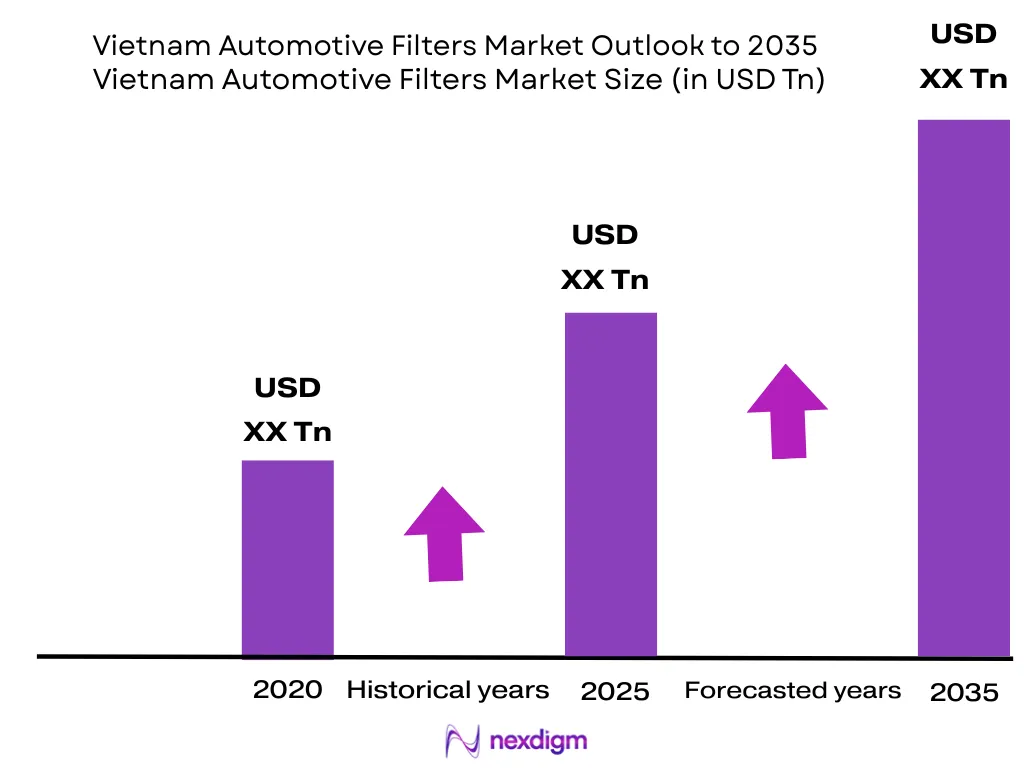
The Vietnam Automotive Filters Market is valued at approximately ~ trillion, compared with ~ trillion in the preceding reporting period. Demand is supported by VAMA-member automobile sales increasing from 301,989 units to 340,142 units, while motorcycle sales rose from 2,516,212 units to 2,653,607 units. Expanding vehicle ownership, recurring maintenance, Euro 5 systems, road freight, tropical operating conditions, and intensive motorcycle usage sustain demand for air, oil, fuel, cabin, and emission filters. Ho Chi Minh City, Hanoi, Hai Phong, Binh Duong, Dong Nai, Vinh Phuc, Bac Ninh, and Da Nang dominate the Vietnam Automotive Filters Market because they combine dense vehicle populations, manufacturing plants, industrial zones, ports, warehouses, and repair networks. Hanoi and Ho Chi Minh City generate substantial passenger, motorcycle, taxi, and delivery demand, while Hai Phong, Vinh Phuc, Binh Duong, and Dong Nai support vehicle assembly, component supply, freight transport, and original-equipment filtration requirements. Vietnam’s automotive filtration ecosystem covers engine-air filters, oil filters, fuel filters, cabin-air filters, transmission filters, crankcase filters, coolant filters, hydraulic filters, particulate filters, diesel exhaust fluid filters, air-dryer cartridges, battery-cooling filters, and electric-drive filtration products. These components protect engines, injection systems, occupants, transmissions, emission-control systems, and thermal circuits from dust, soot, water, metal particles, oil mist, pollen, gases, and other contaminants.
Market Segmentation
By Filter Type
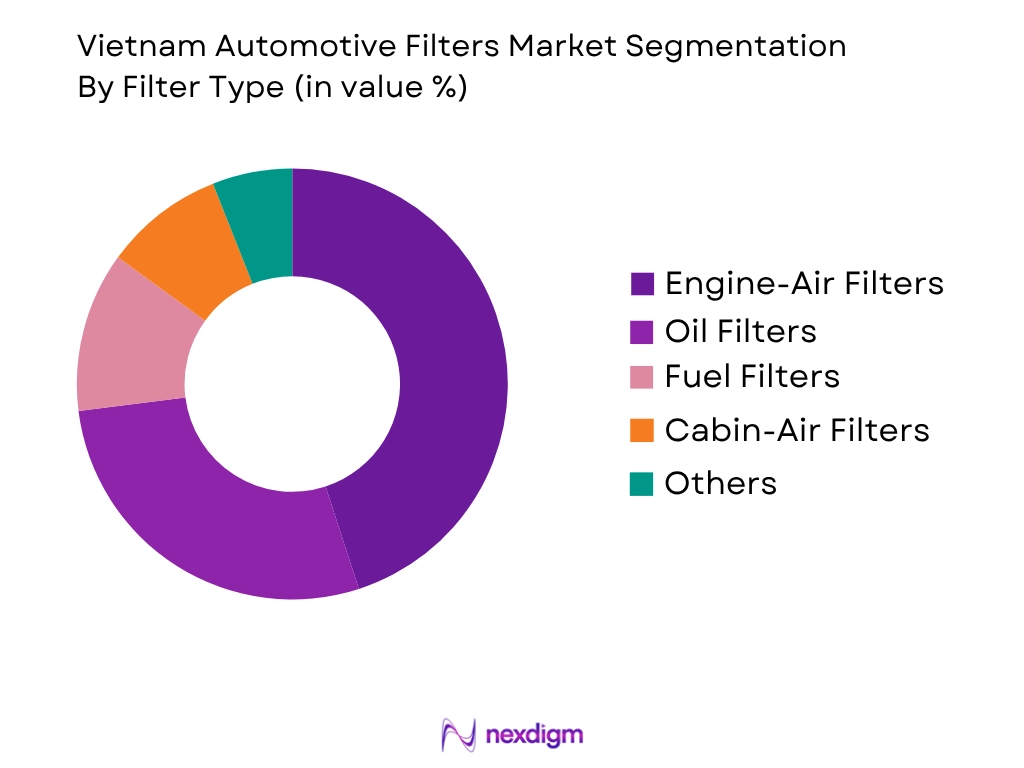
By filter type, the Vietnam Automotive Filters Market is segmented into engine-air filters, oil filters, fuel filters, cabin-air filters, emission-control filters, transmission and hydraulic filters, and other vehicle filters. Engine-air filters hold the dominant market share because Vietnam combines a large motorcycle installed base with expanding passenger, pickup, commercial, agricultural, and construction-vehicle usage. Air filters protect cylinders, pistons, airflow sensors, and turbochargers from abrasive particles. Tropical humidity, construction dust, industrial activity, road debris, and mixed urban–rural road conditions can increase media loading. Motorcycles and scooters create high replacement volumes through frequent daily use, while trucks and off-highway equipment require larger primary and safety elements with greater dust-holding capacity. Engine-air filters are also routinely inspected during servicing, making them easier for workshops to recommend than less visible components. Battery-electric vehicles gradually reduce this addressable category, but Vietnam’s large petrol and diesel population will preserve substantial replacement demand.
By Vehicle Type
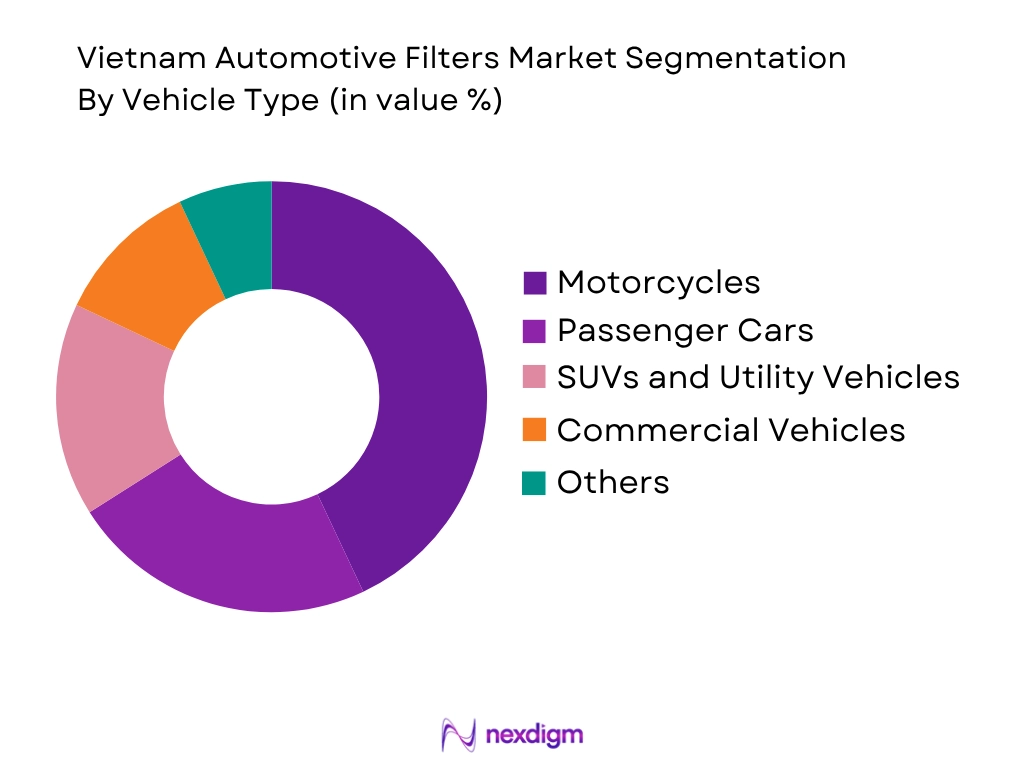
By vehicle type, the Vietnam Automotive Filters Market is segmented into motorcycles and scooters, passenger cars, SUVs and multipurpose vehicles, light commercial vehicles, trucks and buses, electric vehicles, and off-highway equipment. Motorcycles and scooters hold the dominant unit-volume share, supported by annual association-member sales of more than 2.65 million units and their central role in commuting, ride-hailing, food delivery, courier activity, and household mobility. Combustion motorcycles require air filtration and may use oil filters, screens, fuel strainers, or injection-system filtration depending on engine design. Their high utilisation, stop-start operation, humid conditions, and exposure to road dust create frequent servicing needs. Passenger cars and SUVs generate higher revenue per vehicle because they use cabin, oil, engine-air, fuel, transmission, and emission-system filters. Trucks and buses contribute disproportionately to premium fuel-water separators, heavy-duty air elements, lube filters, crankcase filters, coolant filters, and particulate-filter services.
Competitive Landscape
The Vietnam Automotive Filters Market includes global filtration specialists, Japanese and European automotive suppliers, heavy-duty filtration companies, domestic manufacturers, and imported aftermarket brands. MANN+HUMMEL, Bosch, DENSO, Donaldson, and MAHLE compete through OEM engineering, replacement catalogues, filter-media capability, distribution reach, and commercial-vehicle coverage. The market remains fragmented at retail level because premium international brands compete with genuine vehicle-manufacturer parts, Japanese aftermarket products, distributor private labels, and low-cost unverified filters.
| Company | Establishment Year | Headquarters | Core Filter Portfolio | Vehicle Coverage | Channel Position | Media Capability | Heavy-Duty Capability | EV Readiness |
| MANN+HUMMEL | 1941 | Ludwigsburg, Germany | ~ | ~ | ~ | ~ | ~ | ~ |
| Robert Bosch | 1886 | Gerlingen, Germany | ~ | ~ | ~ | ~ | ~ | ~ |
| DENSO | 1949 | Kariya, Japan | ~ | ~ | ~ | ~ | ~ | ~ |
| Donaldson Company | 1915 | Bloomington, Minnesota, United States | ~ | ~ | ~ | ~ | ~ | ~ |
| MAHLE | 1920 | Stuttgart, Germany | ~ | ~ | ~ | ~ | ~ | ~ |

Vietnam Automotive Filters Market Analysis
Growth Drivers
Expanding Automobile and Motorcycle Service Population
Vietnam’s growing automobile and motorcycle base is enlarging recurring demand for engine-air, oil, fuel, cabin, transmission, crankcase, and emission-control filters. Vietnam Automobile Manufacturers’ Association members sold 340,142 vehicles in 2024, compared with 301,989 vehicles in 2023, creating additional original-equipment installations and a larger future replacement pool. The motorcycle market provides even greater unit potential: Vietnam Association of Motorcycle Manufacturers members sold 2,653,607 motorcycles in 2024, compared with approximately 2,516,212 units in 2023. Motorcycles and scooters operate intensively in commuting, ride-hailing, courier, and food-delivery applications, exposing intake systems and lubricants to road dust, humidity, heat, and stop-start conditions. Passenger vehicles, SUVs, pickups, and vans use a wider filtration package that may include engine-air, oil, fuel, cabin, transmission, and emission-system filters, generating higher revenue per vehicle. Vietnam’s macroeconomic expansion strengthens this demand base. The World Bank recorded national GDP of USD 476.39 billion and GDP per capita of USD 4,717.3 in 2024, while real output grew by 7.1%. The IMF currently projects real GDP growth of 7.1% in 2026 for a population of 103.077 million people. Rising household income, freight activity, vehicle ownership, and servicing expenditure therefore support both authorised and independent filter replacement channels.
Euro 5 Systems and High-Utilisation Commercial Vehicles
More advanced emission-control and fuel-injection systems are increasing the technical importance of filtration in Vietnam’s passenger and commercial fleets. Newly manufactured, assembled, and imported vehicles are progressively subject to Level 5 emission requirements, broadly aligned with Euro 5 architecture. These vehicles use precise electronic injection, turbocharging, exhaust-gas recirculation, diesel particulate filters, selective catalytic reduction, crankcase ventilation, and onboard diagnostics. Their reliability depends on clean intake air, properly filtered lubricant, low-contaminant fuel, water separation, and controlled pressure across filter media. Commercial trucks, buses, delivery vans, port vehicles, and construction machinery create especially demanding operating conditions because they accumulate high mileage or engine hours under heavy loads. A restricted engine-air filter can increase turbocharger stress and soot formation, while water or particles in diesel can damage common-rail injectors and high-pressure pumps. The wider economy supports continued utilisation of these assets. Vietnam’s trade-to-GDP ratio is nearly 170, making manufacturing, port logistics, and road freight central to national activity. The World Bank reports that economic output expanded by 8.0% in 2025 and forecasts 6.8% growth in 2026, while the IMF places projected 2026 GDP at approximately USD 527.27 billion. This industrial and trade intensity supports demand for heavy-duty air filters, fuel-water separators, lube filters, coolant filters, crankcase systems, air-dryer cartridges, and particulate-filter servicing.
Market Challenges
Electric Vehicle and Electric Motorcycle Displacement
Rapid electrification is reducing the number of conventional filters installed in newly sold vehicles. Battery-electric cars do not require combustion-air filters, engine-oil filters, petrol or diesel fuel filters, crankcase filtration, or tailpipe particulate filters. Electric motorcycles similarly eliminate conventional engine-air and oil-filter demand, which is significant in Vietnam because motorcycles account for millions of annual vehicle transactions. The displacement risk is becoming material as domestic electric-vehicle production expands. VinFast’s electric-car deliveries reached approximately 97,399 units globally in 2024, with the majority sold domestically, before the company delivered 175,099 electric cars in Vietnam during 2025. Electric two-wheelers are also becoming more prominent in urban mobility and delivery services. This transition does not eliminate automotive filtration, but it shifts the opportunity toward cabin-air filters, battery-cooling filters, high-voltage battery vent protection, electric-drive lubrication filters, desiccants, and thermal-management filtration. Suppliers must therefore support a mixed vehicle population containing petrol motorcycles, diesel trucks, gasoline cars, hybrids, and battery-electric vehicles. Investment decisions are complicated because the conventional replacement market remains large while the new-vehicle mix changes quickly. The IMF projects Vietnam’s economy to expand by 7.1% in 2026, with consumer-price growth of 4.9%, supporting mobility demand but also increasing the cost of maintaining parallel product lines, tooling, inventories, and engineering programmes for both combustion and electric architectures.
Fragmented Aftermarket, Counterfeit Risk, and Fitment Complexity
Vietnam’s replacement market is fragmented across authorised dealerships, independent garages, motorcycle repair shops, parts retailers, roadside mechanics, fleet workshops, importers, and online sellers. This structure improves access but creates uneven product quality, technical knowledge, and traceability. Low-cost or counterfeit filters may contain insufficient media, weak pleat support, poor seals, incorrect bypass valves, or inadequate adhesives. These defects can cause restricted airflow, unfiltered oil circulation, fuel-system contamination, engine wear, warning lights, or premature filter failure. Fitment complexity is also increasing because Vietnam’s vehicle parc includes Japanese, Korean, European, American, Chinese, and domestic platforms with different engines, model years, fuel systems, and emission packages. VAMA members sold 340,142 vehicles in 2024, while VAMM members sold 2,653,607 motorcycles, adding millions of future filter applications to an already broad catalogue. A single model may require different oil, fuel, or cabin filters according to engine code, production location, or transmission type. Macroeconomic conditions add another pressure point. The IMF projects consumer-price growth of 4.9% in 2026, which may encourage some consumers and small fleet operators to delay preventive maintenance or choose unverified economy products. Organised suppliers must respond with QR authentication, VIN or model-based catalogues, installer training, tamper-resistant packaging, technical hotlines, and clear data on filtration efficiency, pressure drop, dirt-holding capacity, dimensions, and replacement intervals.
Market Opportunities
Premium Cabin-Air Filtration for Urban Pollution and Humidity
Cabin-air filtration offers one of the strongest powertrain-neutral opportunities in Vietnam because it remains necessary in petrol, diesel, hybrid, and battery-electric vehicles. Hanoi, Ho Chi Minh City, Hai Phong, Da Nang, Binh Duong, and Dong Nai expose vehicle occupants to road dust, industrial particles, pollen, traffic emissions, odours, and high humidity. Standard particulate filters can be upgraded to activated-carbon, antimicrobial, allergen-reduction, electrostatic, and multilayer products that capture finer contaminants and adsorb selected gases. The addressable vehicle base is expanding: VAMA-member sales reached 340,142 units in 2024, while Honda alone sold 28,267 automobiles, compared with approximately 23,754 units in 2023. Electric cars create a particularly attractive premium segment because their quieter cabins make ventilation noise, odour, and interior air quality more noticeable. Taxi, ride-hailing, corporate, and delivery fleets also operate air-conditioning systems for long periods, increasing filter loading and replacement frequency. Vietnam’s GDP per capita reached USD 4,717.3 in 2024, while the IMF projects the population at 103.077 million people in 2026, supporting a broader consumer market for upgraded maintenance products. Filter brands can commercialise this opportunity through seasonal replacement campaigns, workshop inspection programmes, activated-carbon product tiers, EV-specific cabin filters, digital service reminders, and independently tested particle-capture and airflow performance.
Connected Commercial Filtration and Predictive Fleet Maintenance
Vietnam’s logistics, bus, construction, agricultural, and industrial fleets create an opportunity for connected filtration and condition-based maintenance services. Heavy vehicles use multiple high-value components, including primary and safety air filters, oil filters, fuel-water separators, coolant filters, crankcase filters, hydraulic filters, air-dryer cartridges, diesel particulate filters, and urea-system filters. Sensors can monitor air-filter restriction, differential pressure, water in fuel, oil condition, and particulate-filter loading, allowing replacement based on actual operating condition rather than fixed calendar intervals. This can reduce unnecessary filter changes while preventing injector damage, excessive soot, turbocharger stress, and unplanned downtime. Vietnam’s economy is highly trade-oriented, with trade equivalent to nearly 170 units for every 100 units of GDP. The World Bank reports output growth of 8.0% in 2025 and forecasts 6.8% in 2026, indicating continued manufacturing, port, construction, and freight activity. The IMF projects 2026 GDP at approximately USD 527.27 billion, reinforcing the scale of the commercial operating environment. Suppliers can use current fleet demand to develop future revenue streams through telematics dashboards, automatic filter replenishment, mobile service, kilometre-based maintenance contracts, DPF cleaning, core exchange, and national workshop partnerships. Companies that combine durable filter media with digital diagnostics and provincial distribution can move beyond one-time component sales toward recurring cost-per-kilometre and fleet-availability programmes.
Future Outlook
The Vietnam Automotive Filters Market is forecast to expand at approximately ~ CAGR during the forecast period. Growth will be supported by rising automobile ownership, motorcycle replacement demand, commercial-fleet utilisation, stricter emission requirements, expanding authorised service networks, and increasing cabin-air-quality awareness. The market will not expand uniformly across all filter categories. Engine-air, oil, and fuel filters will remain substantial because of the large combustion-vehicle population, while electric mobility will create new demand for cabin, battery-cooling, vent, gearbox, and thermal-management filtration. Automobile sales will provide a growing service base. VAMA-member vehicle sales reached 340,142 units, an increase from 301,989 units in the previous reporting period. Each new combustion or hybrid vehicle creates immediate OEM demand and later enters the replacement cycle for oil, engine-air, cabin, fuel, and transmission products.
Major Players
- MANN+HUMMEL Vietnam
- Robert Bosch Vietnam
- MAHLE Aftermarket Vietnam
- DENSO Vietnam
- Donaldson Vietnam
- Parker Hannifin Vietnam
- Atmus Filtration Technologies
- Hengst Filtration
- UFI Filters
- Sogefi Filtration
- Sakura Filter Vietnam
- JS Asakashi
- K&N Engineering
- HIFILL Vietnam
- ACDelco Vietnam
Key Target Audience
- Automotive filter and filtration-module manufacturers
- Passenger, motorcycle, commercial, and electric-vehicle manufacturers
- Automotive parts importers, distributors, and retailers
- Authorised service centres and independent workshops
- Logistics, taxi, ride-hailing, delivery, bus, and municipal fleets
- Filter-media, activated-carbon, housing, seal, and sensor suppliers
- Investments and venture capitalist firms
- Government and regulatory bodies (Ministry of Construction, Ministry of Industry and Trade, Ministry of Science and Technology, Vietnam Register, Commission for Standards, Metrology and Quality, Ministry of Agriculture and Environment, and Vietnam Customs)
Research Methodology
Step 1: Identification of Key Variables
The first phase constructs an ecosystem map covering filter manufacturers, vehicle assemblers, motorcycle companies, media suppliers, distributors, workshops, fleets, regulators, and recyclers. Critical variables include vehicle sales, installed parc, filter content per vehicle, replacement intervals, propulsion type, emission architecture, price tier, and channel structure.
Step 2: Market Analysis and Construction
Historical automobile and motorcycle sales, vehicle production, replacement activity, fleet utilisation, and service-channel data are compiled. Top-down analysis estimates filtration revenue within the automotive-component ecosystem, while bottom-up analysis applies vehicle populations, filter quantities, replacement frequency, and average selling values.
Step 3: Supply-Side Assessment
Manufacturers and brands are assessed by product breadth, local manufacturing, OEM relationships, media technology, distribution reach, commercial-vehicle exposure, Euro 5 compatibility, and EV readiness. Product catalogues, distributor availability, and company disclosures are used to reconstruct organised supply.
Step 4: Demand-Side Assessment
Passenger owners, motorcycle riders, workshops, dealerships, ride-hailing operators, logistics fleets, bus operators, and off-highway users are evaluated by annual mileage, service behaviour, contamination exposure, brand preference, and price sensitivity.

- Executive Summary
- Research Methodology (Market Definitions and Assumptions, Automotive Filter Market Boundary, Abbreviations, Market Sizing Approach, Top-Down Analysis, Bottom-Up Analysis, Vehicle Parc–Based Demand Modelling, Filter Replacement Interval Assessment, OEM Installation Assessment, Aftermarket Sell-Out Assessment, Fleet Maintenance Assessment, Primary Industry Interviews, Data Triangulation, Forecasting Framework, Limitations and Future Conclusions)

- Definition and Scope
- Market Evolution and Industry Genesis
- Timeline of Major Industry Developments
- Automotive Filtration Technology Evolution
- Motorcycle, Passenger Vehicle and Commercial Vehicle Filtration Ecosystem

- Growth Drivers (Passenger Vehicle Expansion, Motorcycle Installed Base, Commercial Fleet Utilisation, Euro 5 Compliance, Preventive Maintenance Demand, Cabin Air Quality Awareness)
- Market Challenges (EV Transition, Extended Service Intervals, Informal Aftermarket, Counterfeit Risk, Imported Supply, Fitment Complexity)
- Market Opportunities (Cabin Filtration, Connected Filters, EV Thermal Management, Fleet Analytics, DPF Services, Sustainable Materials)
- Market Trends (Digital Fitment, Premium Cabin Filtration, Connected Maintenance, Longer Service Life, Sustainable Media, Omnichannel Retail)
- Government Regulations (Euro 5 Emission Standards, Vehicle Inspection, Type Approval, Product Safety, Waste Management, Workshop Compliance)
- SWOT Analysis
- Porter’s Five Forces Analysis
- PESTLE Analysis

- By Market Value (2020-2025)
- By Filter Unit Sales (2020-2025)
- By Original Equipment Revenue (2020-2025)

- By Filter Type (In Value %)
Engine Air Filters
Oil Filters
Fuel Filters
Cabin Air Filters
Transmission Filters - By Vehicle Type (In Value %)
Passenger Cars
Sports Utility Vehicles
Multipurpose Vehicles
Pickup and Utility Vehicles
Motorcycles - By Sales Channel (In Value %)
Vehicle Manufacturers
Tier-One Filtration System Suppliers
Authorised Vehicle Dealerships
Company-Owned Service Networks
National Automotive Parts Distributors - By Geographic Region (In Value %)
Northern Midlands and Mountain Areas
North Central and Central Coastal Region
Central Highlands
Southeast Vietnam
Mekong River Delta

- Market Share of Major Players (By Value, Unit Volume, Filter Type, Vehicle Application, Sales Channel)
- Cross Comparison Parameters (Engine Air–Oil–Fuel–Cabin–Transmission–Emission Filter Portfolio Breadth, Passenger–SUV–Motorcycle–Scooter–Commercial–Off-Highway Vehicle Coverage, Vietnam OEM Fitment and Integrated Filtration Module Capability, Filtration Efficiency–Pressure Drop–Dirt-Holding Capacity–Service-Life Performance, National Distributor–Workshop–Motorcycle Dealer–Commercial Fleet Network Reach, Synthetic–Nanofibre–Activated Carbon–Biofunctional Media Capability, Euro 5 DPF–SCR–Crankcase–Fuel Filtration Capability, EV Battery Cooling–Connected Monitoring–Private-Label–Sustainable Product Innovation)
- SWOT Analysis of Major Players
- Detailed Profiles of Major Companies
MANN+HUMMEL Vietnam
Robert Bosch Vietnam
MAHLE Aftermarket Vietnam
DENSO Vietnam
Donaldson Vietnam
Parker Hannifin Vietnam
Atmus Filtration Technologies
Hengst Filtration
UFI Filters
Sogefi Filtration
Sakura Filter Vietnam
JS Asakashi
K&N Engineering
HIFILL Vietnam
ACDelco Vietnam

- Individual Passenger Car Owner Analysis
- SUV and Multipurpose Vehicle Owner Analysis
- Motorcycle Owner Analysis
- Automatic Scooter Owner Analysis
- Electric Motorcycle Owner Analysis
- Battery Electric Vehicle Owner Analysis

- By Market Value (2026-2035)
- By Filter Unit Sales (2026-2035)
- By Original Equipment Revenue (2026-2035)


 Request a Sample
 Ask for Customization
 Get a Quote
 Enquire Now