

 Download PDF
Market Overview
The Vietnam automotive heat exchanger market covers thermal management components used across passenger vehicles, commercial vehicles, electric vehicles, and hybrid vehicles, including radiators, condensers, oil coolers, intercoolers, EGR coolers, HVAC heat exchangers, and battery cooling systems. The market is being shaped by Vietnam’s expanding automotive manufacturing ecosystem, increasing vehicle assembly activities, and rising adoption of electric mobility solutions requiring advanced thermal management technologies. Global automotive thermal management demand is increasingly shifting toward integrated cooling systems due to electrification and higher vehicle efficiency requirements.
Vietnam has emerged as a growing automotive manufacturing hub in Southeast Asia, supported by foreign direct investment, domestic vehicle production expansion, and increasing localization efforts. Automotive clusters around Hai Phong, Hanoi, Quang Nam, Binh Duong, and Ho Chi Minh City are driving demand for locally supplied components. The development of domestic EV manufacturing by companies such as VinFast and increasing participation of international suppliers are accelerating demand for battery thermal management and advanced heat exchanger technologies.
Market Segmentation
By Heat Exchanger Type
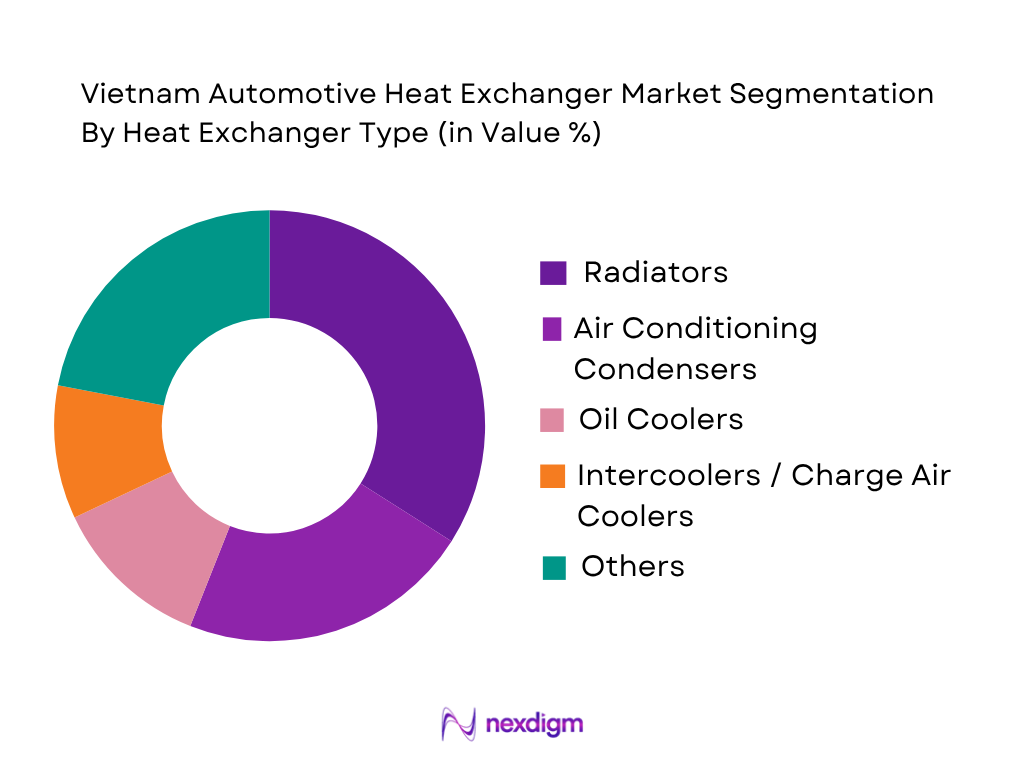
Radiators represent the leading segment due to their widespread application across internal combustion engine vehicles, commercial vehicles, and hybrid vehicles operating in Vietnam. Passenger cars and commercial vehicles continue to rely on conventional engine cooling systems, supporting sustained radiator demand. Additionally, Vietnam’s expanding logistics and transportation sectors are increasing demand for commercial vehicles requiring durable cooling solutions. However, EV adoption is gradually shifting supplier focus toward battery cooling and integrated thermal management systems.
By Vehicle Type
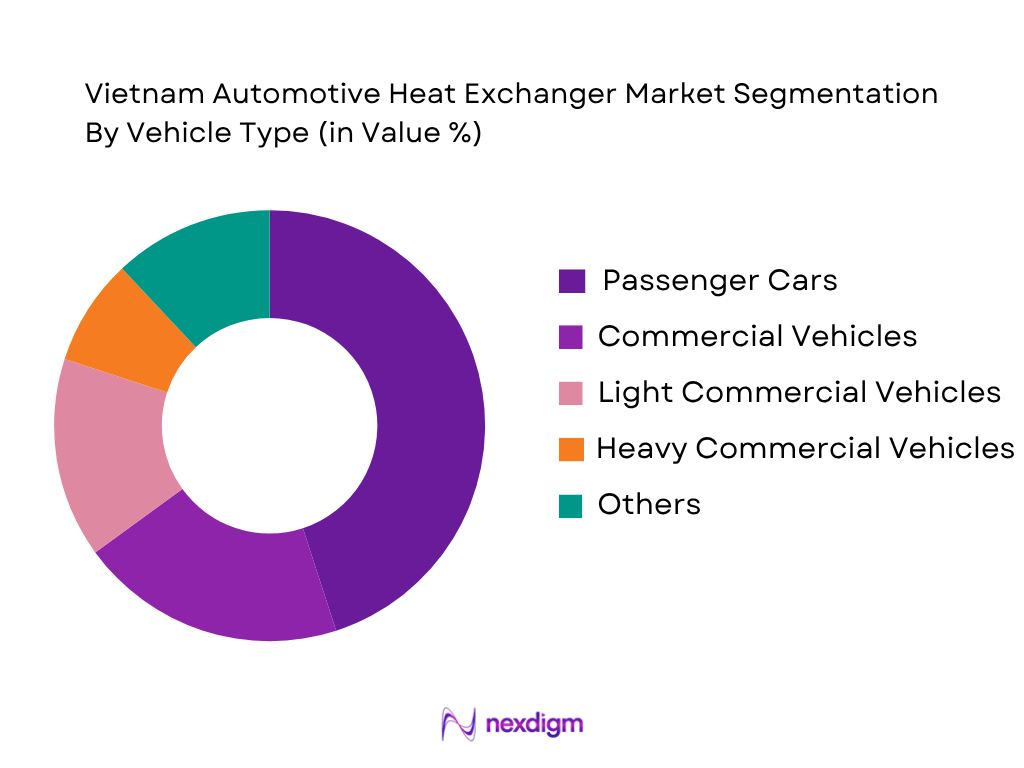
Passenger cars dominate automotive heat exchanger demand due to increasing vehicle ownership, urban mobility requirements, and expansion of domestic automobile production. Rising consumer preference for vehicles equipped with advanced air conditioning systems also increases demand for condensers and HVAC heat exchangers. The growing EV passenger vehicle segment is further creating opportunities for battery cooling systems and compact thermal modules. (LinkedIn)
Competitive Landscape
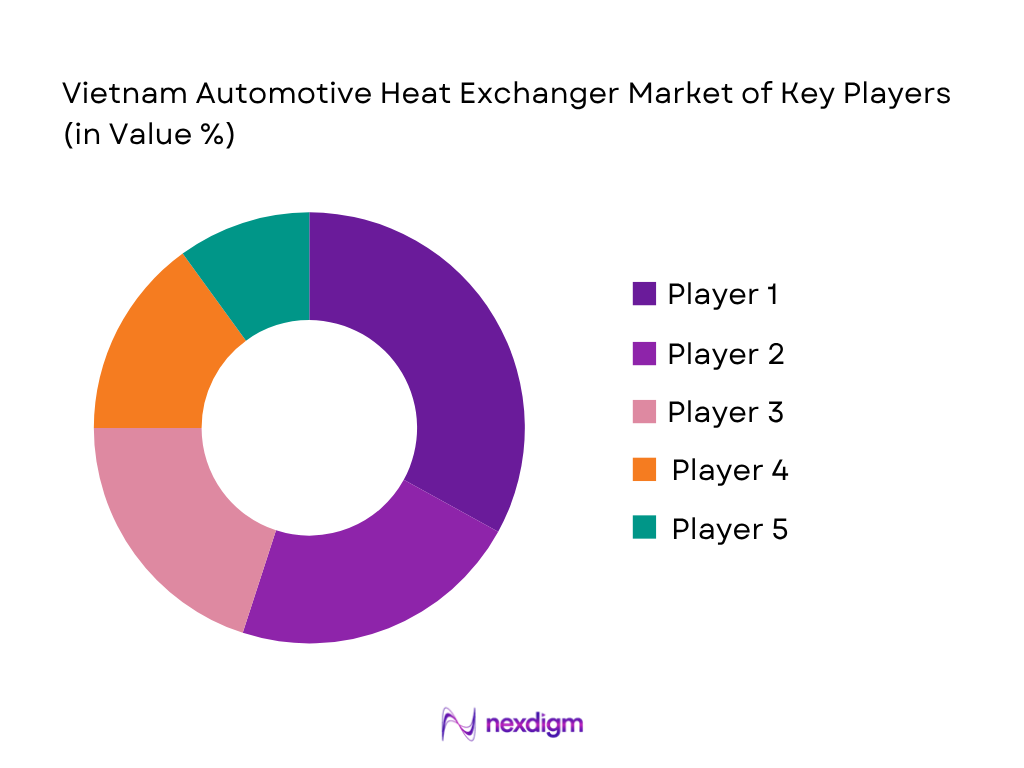
The Vietnam automotive heat exchanger market is moderately consolidated, with global Tier-1 automotive thermal management suppliers competing alongside regional component manufacturers. Companies with strong OEM relationships, aluminium brazing capabilities, EV thermal management expertise, and localized manufacturing facilities hold competitive advantages. Increasing EV production and automotive localization are encouraging suppliers to establish manufacturing and assembly capabilities within Vietnam.
| Company | Establishment Year | Headquarters | Product Portfolio | OEM Partnerships | EV Thermal Management Capability | Manufacturing Footprint | R&D Capability | Aftermarket Presence |
| Denso | 1949 | Japan | ~ | ~ | ~ | ~ | ~ | ~ |
| Valeo | 1923 | France | ~ | ~ | ~ | ~ | ~ | ~ |
| MAHLE | 1920 | Germany | ~ | ~ | ~ | ~ | ~ | ~ |
| Hanon Systems | 1986 | South Korea | ~ | ~ | ~ | ~ | ~ | ~ |
| Modine Manufacturing | 1916 | USA | ~ | ~ | ~ | ~ | ~ | ~ |
Vietnam Automotive Heat Exchanger Market Analysis
Growth Drivers
Increasing Vehicle Manufacturing Capacity
Vietnam’s expanding automotive manufacturing ecosystem is strengthening demand for automotive heat exchangers across passenger vehicles, commercial vehicles, and electric vehicles. The country recorded approximately 3.16 million registered motor vehicles in 2024, according to Vietnam’s Ministry of Transport, creating a large installed base requiring cooling and thermal management components. Vietnam’s GDP reached approximately USD 476 billion in 2024, according to the World Bank, reflecting continued industrial expansion and supporting automotive manufacturing investments. Automotive production clusters in Hai Phong, Quang Nam, Binh Duong, and Dong Nai are attracting OEMs and Tier-1 suppliers, increasing localized demand for radiators, condensers, oil coolers, and HVAC heat exchangers. The government’s automotive development strategy emphasizes increasing domestic production capability and component localization, encouraging manufacturers to establish local supply chains. Rising vehicle assembly activities, increasing domestic consumption, and export-oriented automotive manufacturing are supporting the requirement for advanced thermal management components. Heat exchanger suppliers are increasingly focusing on lightweight aluminium designs, compact cooling modules, and integrated thermal systems to meet evolving vehicle efficiency requirements.
Electric Vehicle Adoption
The accelerating adoption of electric vehicles in Vietnam is creating new demand for advanced automotive heat exchanger technologies, particularly battery cooling systems, power electronics cooling modules, and integrated thermal management solutions. Vietnam’s electric vehicle ecosystem is expanding rapidly, supported by domestic manufacturers and government initiatives promoting low-emission transportation. According to the International Energy Agency, global electric car sales exceeded 17 million units in 2024, increasing pressure on automotive suppliers to develop EV-specific thermal management technologies. Vietnam’s GDP growth of approximately 7.1 billion USD equivalent increase in economic output during 2024, according to World Bank indicators, supports consumer purchasing capability and industrial investment. Domestic EV manufacturer VinFast continues expanding electric vehicle production capacity, increasing demand for battery thermal management components. EV platforms require significantly different cooling architectures compared with internal combustion vehicles, including battery cooling plates, refrigerant-based thermal systems, and heat pump solutions. Automotive suppliers are therefore investing in EV-compatible heat exchanger technologies to support Vietnam’s transition toward electrified mobility.
Market Challenges
Dependence on Imported Advanced Components
Vietnam’s automotive heat exchanger industry faces challenges due to dependence on imported advanced thermal management components, manufacturing equipment, and specialized materials. While Vietnam has developed a growing automotive supplier base, high-precision components such as EV battery cooling modules, advanced aluminium brazed heat exchangers, and integrated thermal systems continue to rely significantly on international suppliers. According to the General Statistics Office of Vietnam, the country’s manufacturing sector accounted for approximately 24% of GDP in 2024, highlighting industrial growth but also the continued need for advanced imported technologies. Automotive component imports remain significant due to limited domestic capability in specialized manufacturing processes. Global automotive suppliers maintain technological advantages through established R&D networks, proprietary designs, and advanced production technologies. Vietnamese heat exchanger manufacturers face pressure to improve machining precision, aluminium processing capability, testing infrastructure, and engineering expertise to compete with international suppliers. Increasing localization requirements from OEMs create opportunities but also require substantial investments in technology development, supplier qualification, and manufacturing capabilities.
Raw Material Price Fluctuation
Fluctuations in aluminium, copper, and other raw material prices create challenges for automotive heat exchanger manufacturers operating in Vietnam. Aluminium is a critical material for modern automotive heat exchangers due to its lightweight properties, corrosion resistance, and thermal conductivity. According to the International Aluminium Institute, global aluminium production exceeded 72 million tonnes in 2024, reflecting strong industrial demand but continued exposure to energy costs and supply fluctuations. Vietnam’s manufacturing sector remains sensitive to imported raw material pricing because many high-grade aluminium alloys and specialized materials are sourced internationally. The World Bank reported continued volatility in global commodity markets during 2024 due to energy price changes, geopolitical factors, and supply chain disruptions. Heat exchanger manufacturers must manage material cost fluctuations while maintaining competitive pricing for OEM customers. Increasing adoption of aluminium-based EV cooling systems further increases exposure to raw material availability and processing costs. Companies are focusing on material optimization, recycling initiatives, and localized supply chain development to reduce dependency risks and improve production stability.
Market Opportunities
EV Battery Cooling Systems
The growing electric vehicle ecosystem in Vietnam is creating significant opportunities for battery cooling heat exchangers and advanced thermal management systems. Electric vehicles require precise temperature control to maintain battery performance, charging efficiency, and operational safety. According to the International Energy Agency, global electric vehicle stock surpassed 40 million units in 2023 and continued expanding during 2024, accelerating demand for EV-specific thermal technologies. Vietnam’s domestic EV manufacturing development, particularly through VinFast, is encouraging local suppliers to develop capabilities in battery cooling modules, coolant systems, and integrated thermal management solutions. The country’s GDP growth of approximately 7.1% in 2024, reported by the World Bank, supports industrial investment and technology adoption across manufacturing sectors. Battery cooling systems represent a higher-value opportunity compared with conventional engine cooling components because EV thermal architectures require multiple cooling loops for batteries, motors, and power electronics. Automotive suppliers investing in EV thermal technologies can benefit from increasing electrification trends and OEM localization strategies.
Advanced Thermal Management Modules
Vietnam’s automotive industry is creating opportunities for integrated thermal management modules that combine cooling, heating, and energy efficiency functions across conventional, hybrid, and electric vehicles. Modern vehicles increasingly require compact and intelligent thermal systems to improve fuel efficiency, battery performance, and passenger comfort. According to Vietnam’s Ministry of Industry and Trade, the country continues to prioritize supporting industries and automotive component development to strengthen domestic manufacturing capabilities. Global automotive trends show increasing adoption of integrated thermal systems combining radiators, condensers, heat pumps, and electronic cooling systems. The expansion of vehicle production clusters in northern and southern Vietnam provides opportunities for suppliers to establish localized manufacturing operations. Advanced aluminium heat exchangers, lightweight cooling modules, and smart thermal control systems are expected to gain importance as OEMs improve vehicle efficiency and electrification capability. Suppliers with strong engineering expertise, testing capabilities, and OEM partnerships are positioned to capture emerging demand from Vietnam’s evolving automotive ecosystem.
Future Outlook
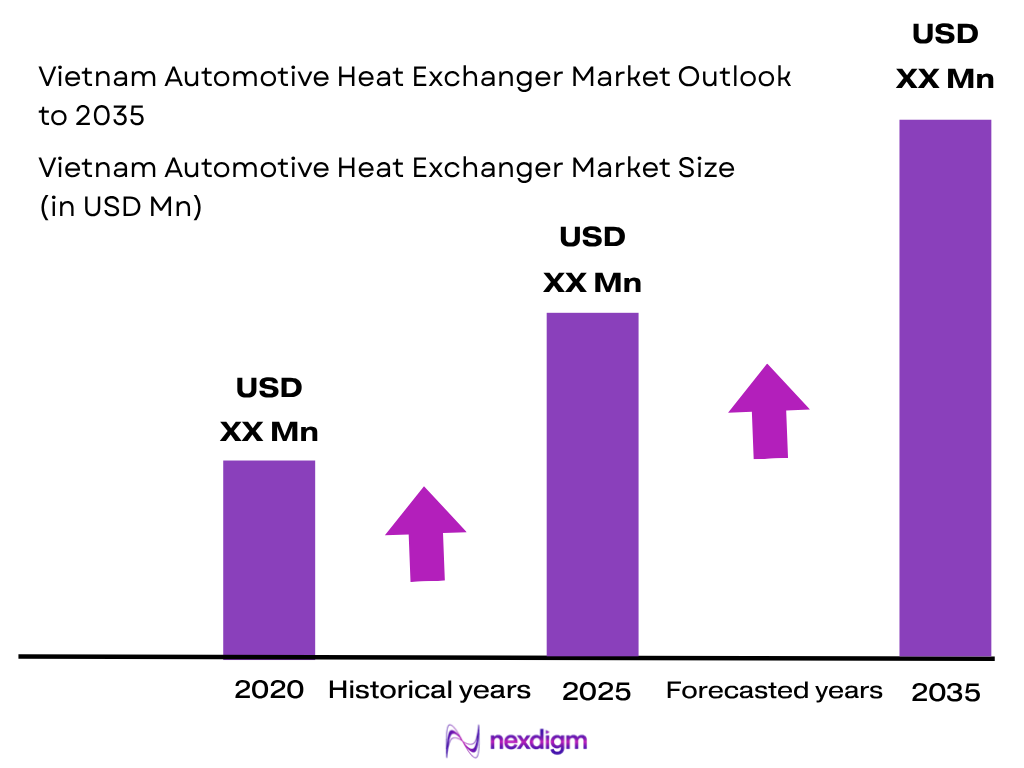
The Vietnam automotive heat exchanger market is expected to experience sustained growth due to automotive production expansion, increasing electrification, and rising demand for efficient thermal management systems. The transition toward electric mobility will create new opportunities for battery cooling heat exchangers, integrated thermal modules, and lightweight aluminium cooling solutions. Domestic automotive manufacturing development and increasing foreign supplier investments will support technology localization and supply chain development.
Major Players
- Denso Corporation
- Valeo
- MAHLE GmbH
- Hanon Systems
- Modine Manufacturing Company
- T.RAD Co., Ltd.
- Sanden Holdings Corporation
- Marelli
- Bosch
- Dana Incorporated
- Nissens Automotive
- Calsonic Kansei
- Subros Limited
- Pranav Vikas Group
- VinFast Automotive
Key Target Audience
- Automotive OEMs and Vehicle Manufacturers
- Tier-1 Automotive Component Suppliers
- Automotive Thermal Management System Manufacturers
- Electric Vehicle Manufacturers and Battery System Developers
- Automotive Component Investment and Venture Capital Firms
- Government and Regulatory Bodies (Vietnam Ministry of Industry and Trade, Ministry of Transport Vietnam)
- Automotive Manufacturing Companies and Assembly Plants
- Automotive Aftermarket Component Distributors
Research Methodology
Step 1: Identification of Key Variables
The research begins with mapping the Vietnam automotive heat exchanger ecosystem, including vehicle manufacturers, Tier-1 suppliers, component producers, aftermarket distributors, and EV technology providers. Secondary research is conducted to identify production trends, vehicle demand patterns, thermal management requirements, and supply chain structures.
Step 2: Market Analysis and Construction
Historical automotive production data, vehicle registration trends, component demand patterns, and supplier capacity information are analyzed to construct market estimates. Demand assessment includes evaluation of passenger vehicles, commercial vehicles, EV adoption, and replacement market requirements.
Step 3: Hypothesis Validation and Expert Consultation
Market assumptions are validated through discussions with automotive manufacturers, component suppliers, thermal management specialists, and industry participants. These interactions provide insights into supplier relationships, technology adoption, production capabilities, and future demand trends.
Step 4: Research Synthesis and Final Output
The final stage integrates primary and secondary research findings to validate market calculations. Supplier analysis, OEM demand assessment, technology trends, and competitive positioning are combined to develop a comprehensive Vietnam automotive heat exchanger market outlook.

- Executive Summary
- Research Methodology (Market Definition and Scope, Automotive Thermal Management Ecosystem Mapping, Market Sizing Framework, Top-Down Market Assessment, Bottom-Up Revenue Calculation, OEM Demand Analysis, Component Supplier Assessment, Production Volume Analysis, Vehicle Parc Evaluation, Primary Interviews with Automotive Manufacturers and Tier-1 Suppliers, Secondary Research Sources, Data Validation and Triangulation, Forecasting Methodology, Assumptions and Limitations)

- Definition and Scope
- Automotive Heat Exchanger Market Evolution and Industry Development Timeline
- Major Automotive Manufacturing Milestones and Thermal Component Industry Developments
- Vietnam Automotive Value Chain Analysis
- Automotive Thermal Management Supply Chain Analysis
- Heat Exchanger Manufacturing Ecosystem Analysis
- Role of OEMs, Tier-1 Suppliers, and Component Manufacturers

- Growth Drivers (Increasing Vehicle Manufacturing Capacity, Electric Vehicle Adoption, Automotive Export Expansion, Rising Thermal Management Requirements, Commercial Vehicle Growth, Localization of Automotive Components)
- Market Challenges (Dependence on Imported Advanced Components, Raw Material Price Fluctuation, Limited Domestic Heat Exchanger Technology Development, High Precision Manufacturing Requirements, Supply Chain Vulnerability, Increasing Competition Among Global Suppliers)
- Market Opportunities (EV Battery Cooling Systems, Advanced Thermal Management Modules, Lightweight Aluminium Heat Exchangers, Hybrid Vehicle Thermal Solutions, Automotive Component Localization, Smart Thermal Management Systems)
- Market Trends (Electrification of Vehicle Thermal Systems, Integrated Thermal Management Modules, Aluminium-Based Heat Exchanger Adoption, Compact Heat Exchanger Designs, Energy Efficient Cooling Systems, OEM Supplier Localization)
- Government Regulations and Industry Standards (Vietnam Automobile Development Strategy, Vehicle Emission Standards, Environmental Protection Regulations, Electric Vehicle Manufacturing Policies, Automotive Component Localization Programs, Vehicle Safety Standards)
- SWOT Analysis
- Porter’s Five Forces Analysis
- PESTLE Analysis

- By Market Value (2020-2025)
- By Production Volume (2020-2025)
- By Vehicle Production Demand (2020-2025)
- By Heat Exchanger Unit Consumption (2020-2025)
- By Average Selling Price (2020-2025)
- By OEM and Aftermarket Demand (2020-2025)

- By Heat Exchanger Type (In Value %)
Engine Radiators
Air Conditioning Condensers
Oil Coolers
Intercoolers / Charge Air Coolers
EGR Coolers
Battery Cooling Heat Exchangers
HVAC Heat Exchangers
Power Electronics Cooling Heat Exchangers - By Vehicle Type (In Value %)
Passenger Cars
Commercial Vehicles
Light Commercial Vehicles
Heavy Commercial Vehicles
Electric Vehicles
Hybrid Vehicles
Two-Wheelers and Three-Wheelers - By Propulsion Type (In Value %)
Internal Combustion Engine Vehicles
Battery Electric Vehicles
Hybrid Electric Vehicles
Plug-in Hybrid Electric Vehicles - By Material Type (In Value %)
Aluminium Heat Exchangers
Copper-Brass Heat Exchangers
Steel Heat Exchangers
Composite Material Heat Exchangers - By Sales Channel (In Value %)
OEM Supply
Tier-1 Automotive Suppliers
Replacement Market / Aftermarket
Authorized Service Centers
Independent Repair Workshops - By Region (In Value %)
Northern Vietnam
Central Vietnam
Southern Vietnam

- Market Share Analysis of Major Players (By Revenue, Heat Exchanger Type, Vehicle Segment, OEM Supply, Aftermarket Presence)
- Cross Comparison Parameters (Product Portfolio Breadth, Heat Exchanger Manufacturing Capacity, OEM Partnership Network, EV Thermal Management Capability, Aluminium Brazing Technology, Manufacturing Facility Presence, R&D and Testing Capability, Aftermarket Distribution Reach)
- SWOT Analysis of Major Players
- Pricing Analysis by Heat Exchanger Type and Vehicle Application
- Detailed Profiles of Major Companies
Global and Regional Automotive Heat Exchanger Manufacturers
Denso
Valeo
MAHLE
Hanon Systems
Modine Manufacturing Company
T.RAD Co., Ltd.
Sanden Holdings Corporation
Marelli
Bosch
Calsonic Kansei
Dana Incorporated
Nissens Automotive
Pranav Vikas Group
Subros Limited
Hanon Automotive Systems

- Vehicle Ownership Growth Assessment
- Automotive Manufacturing Demand Analysis
- EV Thermal Management Demand Assessment
- Aftermarket Demand Analysis
- Customer Preference Analysis

- By Market Value (2026-2035)
- By Production Volume (2026-2035)
- By Vehicle Production Demand (2026-2035)
- By Heat Exchanger Unit Consumption (2026-2035)
- By Average Selling Price (2026-2035)
- By OEM and Aftermarket Demand (2026-2035)


 Request a Sample
 Ask for Customization
 Get a Quote
 Enquire Now