

 Download PDF
Market Overview
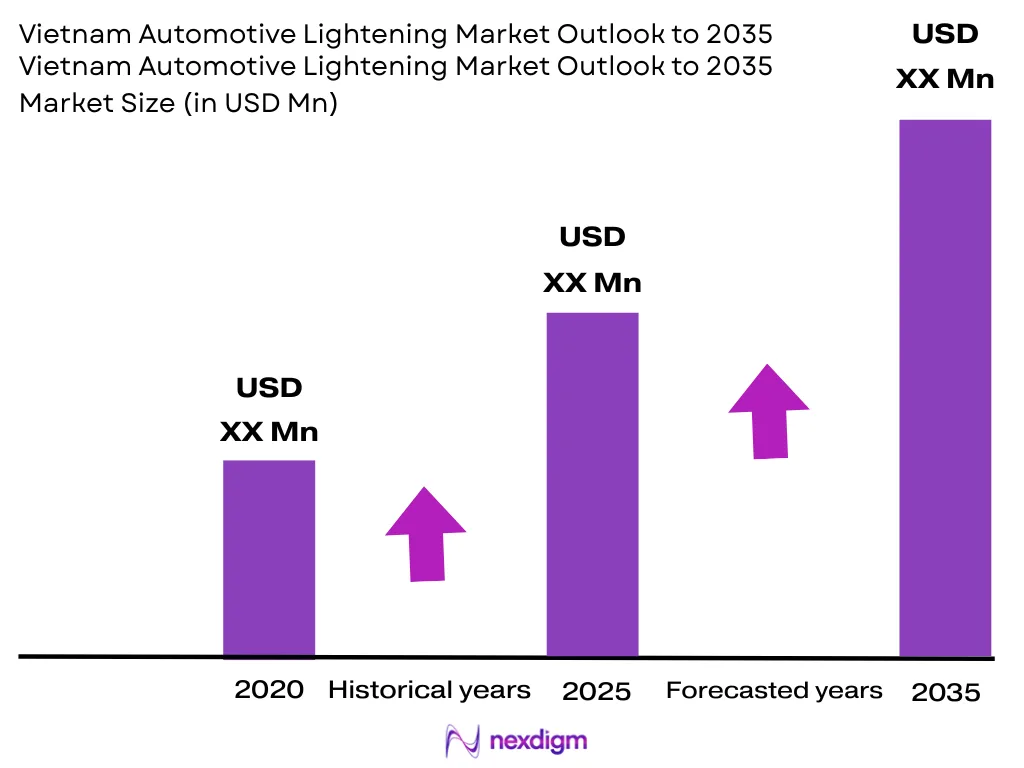
The Vietnam Automotive Lightening Market was valued at USD ~ Million in 2024 and is anticipated to expand at a CAGR of ~% during 2026-2035. The market is primarily driven by rapid growth in domestic passenger vehicle and two-wheeler ownership, expanding CKD assembly operations across the country’s automotive manufacturing base, and rising regulatory emphasis on vehicle lighting safety standards. According to industry estimates, the Vietnam Automotive Lightening Market was valued at approximately USD ~ million in 2025 and is projected to grow at a CAGR of approximately 11.4%, reaching approximately USD ~ million by 2032, while the broader Vietnam automotive components market is projected to grow from approximately USD 3,400 million in 2025 to USD 5,100 million by 2030 at a CAGR of approximately 8.5%. LED lighting penetration climbed to cover approximately 38% of new vehicle fitment in 2025 as domestic automakers and two-wheeler manufacturers increasingly transitioned away from halogen systems, generating sustained demand for automotive lighting hardware, electronic control modules, and aftermarket retrofit products across passenger, commercial, and two-wheeler segments.
Market Segmentation
By Vehicle Type
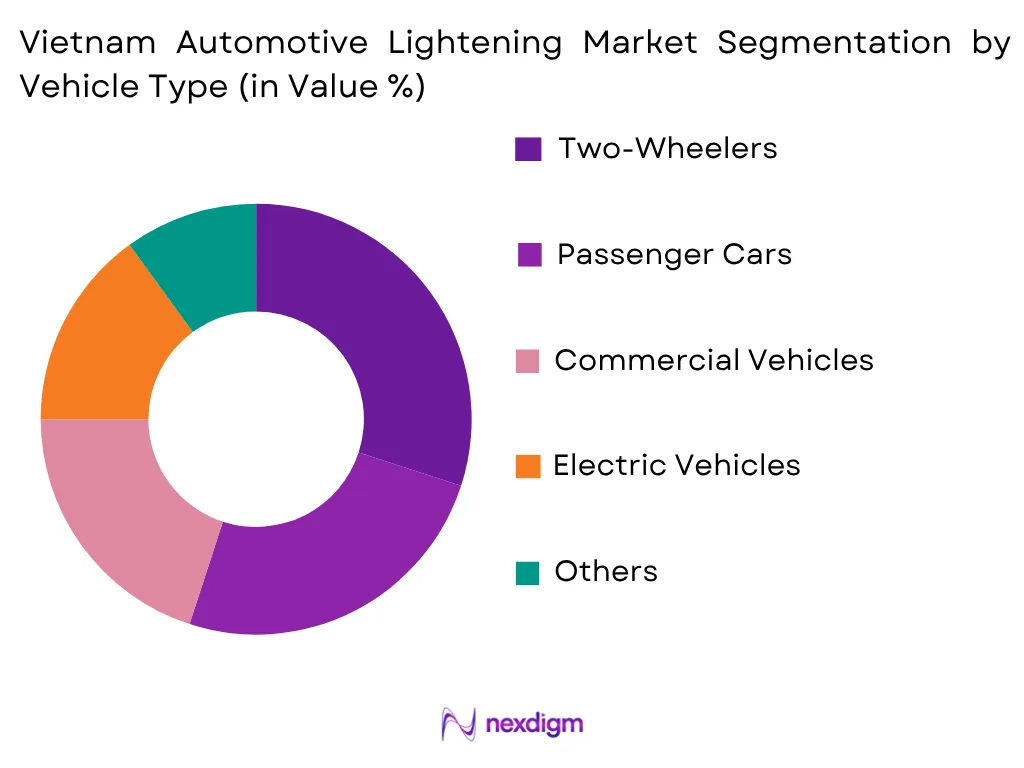
Two-wheelers continue to dominate the Vietnam Automotive Lightening Market by unit volume, reflecting the country’s status as one of Southeast Asia’s largest motorcycle and scooter markets, with Sunny Automotive Optech Vina and Varroc Lighting Systems Vietnam supplying headlamp and combination lamp assemblies to leading two-wheeler assemblers across Hanoi and the surrounding industrial belt. Passenger cars represent the fastest-growing vehicle segment by value, supported by rising full-LED headlamp adoption across VinFast’s domestic EV lineup and CKD models assembled by Hyundai Thanh Cong and other joint-venture automakers. Vietnam Stanley Electric continues to differentiate through its long-standing OEM lamp-assembly partnerships, positioning itself as a preferred supplier for both two-wheeler and passenger-vehicle platforms. Rang Dong Light Source and Vacuum Flask JSC has expanded into vehicle-grade LED components through its broader lighting manufacturing base, contributing to approximately 34% growth in domestically produced automotive LED modules between 2019 and 2025, supporting the shift toward locally sourced lighting content.
By Region
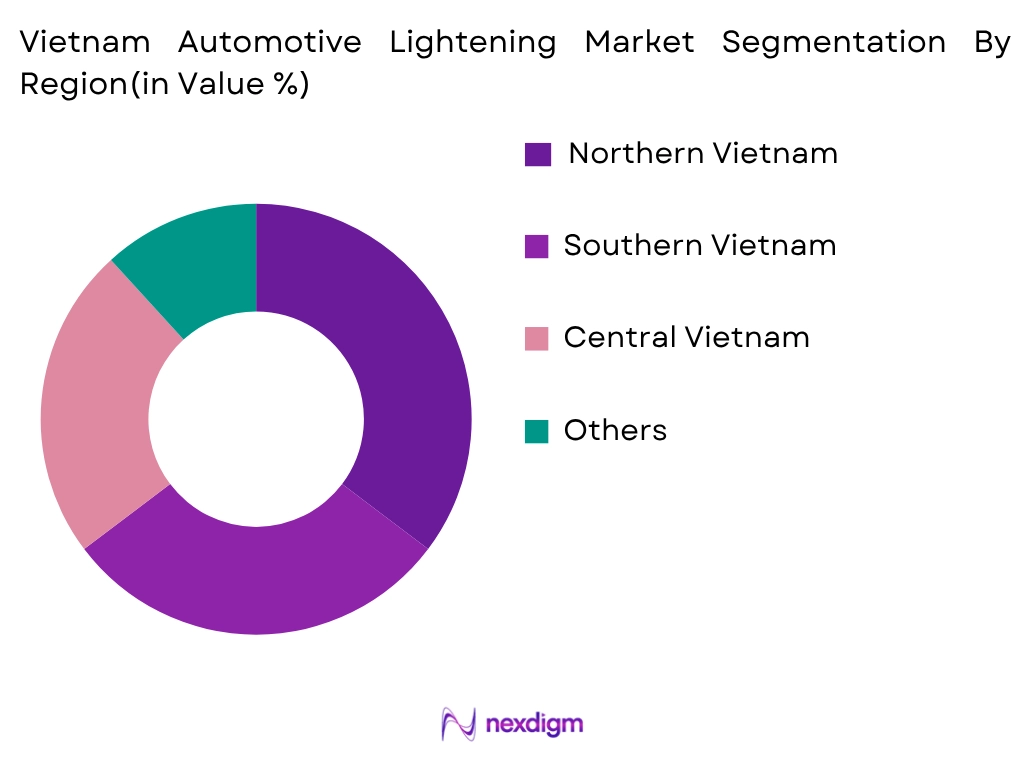
Northern Vietnam remains the largest regional market within the Vietnam Automotive Lightening Market by installed manufacturing base and revenue, given its concentration of two-wheeler and component assembly infrastructure across Hanoi, Vinh Phuc, and Bac Ninh, though rising labour costs and land constraints continue to push new supplier capacity toward adjoining provinces. Southern Vietnam is witnessing the fastest growth as passenger-vehicle assembly and EV component investment expand across Ho Chi Minh City and Dong Nai, with FORVIA HELLA Vietnam’s Ho Chi Minh City engineering centre supporting software and control-unit development for intelligent lighting systems used across regional OEM programmes. Domestic suppliers including Rang Dong continue scaling LED component capacity to capture growing aftermarket demand, while systems distributors leverage industrial-zone infrastructure to unlock previously underserved rural and provincial markets across Central Vietnam.
Competitive Landscape
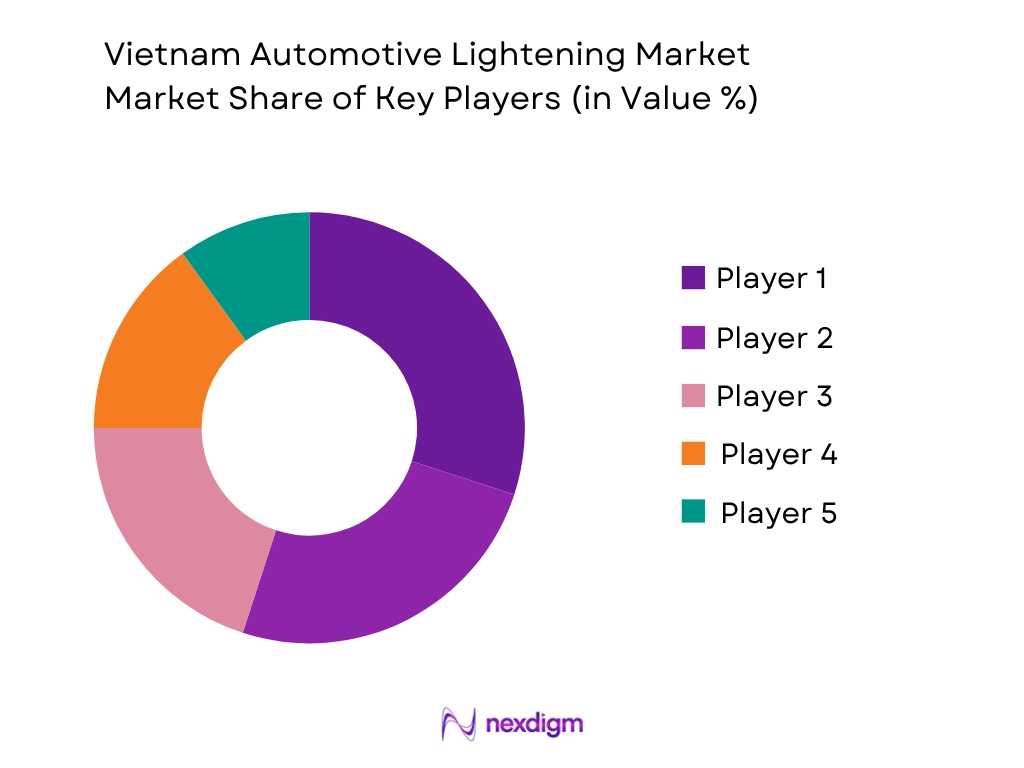
The Vietnam Automotive Lightening Market is moderately fragmented and increasingly competitive, with Vietnam Stanley Electric, Sunny Automotive Optech Vina, FORVIA HELLA Vietnam, Varroc Lighting Systems Vietnam, and Rang Dong together handling a substantial share of installed lighting value nationwide. Competition is primarily based on OEM partnership depth, component localisation level, product durability, pricing competitiveness, and regulatory compliance. Vietnam Stanley Electric maintains its position as a leading automotive lamp-assembly supplier by installed base and OEM channel penetration, serving as a preferred partner for two-wheeler and passenger-vehicle manufacturers through its longstanding manufacturing footprint in Hanoi. Sunny Automotive Optech Vina continues to compete on manufacturing scale and export-oriented production capacity, while FORVIA HELLA Vietnam targets the software and electronics layer of intelligent lighting systems through its Ho Chi Minh City development centre. Varroc Lighting Systems Vietnam leverages its two-wheeler lighting heritage through the Triom brand to compete on high-volume motorcycle and scooter lamp assemblies, while Rang Dong continues to expand its domestic LED component manufacturing base to reduce automakers’ reliance on imported lighting hardware and strengthen locally sourced supply chains.
| Company | Establishment Year | Headquarters | OEM Partnerships | LED/Adaptive Lightening Portfolio
|
Manufacturing Presence in Vietnam | Major End-Use Industries | Key Strategic Focus | Certifications & Compliance |
| Vietnam Stanley Electric Co., Ltd. | 1996 | ~ | ~ | ~ | ~ | ~ | ~ | ~ |
| Sunny Automotive Optech Vina Co., Ltd. | 2008 | ~ | ~ | ~ | ~ | ~ | ~ | ~ |
| FORVIA HELLA Vietnam Co., Ltd. | 2013 | ~ | ~ | ~ | ~ | ~ | ~ | ~ |
| Varroc Lighting Systems Vietnam (Triom) | 2018 | ~ | ~ | ~ | ~ | ~ | ~ | ~ |
| Rang Dong Light Source and Vacuum Flask JSC | 1961 | ~ | ~ | ~ | ~ | ~ | ~ | ~ |
Vietnam Automotive Lightening Market Analysis
Growth Drivers
Rising Vehicle Ownership and Domestic Assembly Expansion
The Vietnam Automotive Lightening Market continues to be shaped decisively by rapid growth in passenger vehicle and two-wheeler ownership, which have driven new component demand and assembly-capacity expansion across the country’s automotive manufacturing base as domestic income levels rise and urban mobility needs expand. Growing localisation priorities linked to government-backed domestic content targets, combined with continued growth of VinFast’s EV manufacturing programme, have further expanded the market’s addressable base of both OEM and aftermarket lighting demand. According to industry estimates, the Vietnam Automotive Lightening Market is projected to grow at a CAGR of approximately 11.4% from its 2025 base of approximately USD 210 million, propelled in part by rising CKD assembly volumes that are pushing automakers to prioritise locally sourced lighting components.
Regulatory Push Toward LED Adoption and Vehicle Safety Standards
The tightening of national technical regulations governing vehicle lighting safety continues to be a critical driver of market expansion, as automakers and two-wheeler manufacturers increasingly transition from halogen to LED lighting systems to meet updated brightness, visibility, and type-approval requirements. Government support for domestic component manufacturing, including incentives tied to localisation targets under Vietnam’s automotive industry development strategy, continues to expand workforce training and supplier capacity, positioning Vietnam as a growing hub for automotive lighting component manufacturing within Southeast Asia. Global and domestic suppliers are scaling LED production capacity to capture this regulatory-driven demand, illustrating the scale of investment being deployed to address the industry’s persistent component-localisation gap.
Market Challenges
Price Sensitivity and Aftermarket Import Dominance
The Vietnam Automotive Lightening Market faces significant challenges from intense price sensitivity across its predominantly two-wheeler-driven consumer base, which creates substantial competitive pressure for OEM-grade suppliers competing against low-cost imported aftermarket lighting products. The continued prevalence of unbranded and grey-market LED replacement lamps, largely sourced from cross-border trade, constrains pricing power and brand differentiation for established suppliers seeking to justify premium positioning through durability and compliance credentials. This price competition periodically delays the transition toward higher-margin adaptive and matrix-LED systems, requiring suppliers to balance affordability with performance to maintain market share.
Fragmented Supply Chain and Import Dependency
Fragmented component supply chains and continued import dependency for high-precision LED chips, optical lenses, and electronic control modules constrain delivery speed and cost stability, where domestic assemblers often rely on suppliers from China, South Korea, and Thailand to fill capacity and technology gaps that local manufacturing has not yet closed. Rising component and logistics costs continue to pressure project economics across the industry, particularly for OEM programmes requiring consistent, high-volume delivery of precision-engineered lighting assemblies.
Market Opportunities
Expansion of LED and Adaptive Lighting Adoption Across Domestic OEM Platforms
The continued expansion of full-LED and adaptive lighting adoption across VinFast’s domestic EV lineup and other CKD passenger-vehicle programmes presents substantial opportunities for lighting suppliers willing to invest in matrix-LED and sequential-signal technology beyond traditional halogen and basic-LED offerings, as premiumisation trends accelerate across Vietnam’s growing middle-income consumer base. Growth in domestically manufactured lighting control electronics is expanding the addressable market for suppliers capable of offering integrated hardware-software lighting systems alongside traditional lamp assemblies. Companies developing localised LED component manufacturing are well positioned to capture growing demand as automakers increasingly prioritise supply-chain resilience and reduced import dependency across their production networks.
Growth of Two-Wheeler LED Retrofit and Premiumisation
The growing consumer preference for LED retrofit and styling upgrades across Vietnam’s vast installed base of motorcycles and scooters presents a significant opportunity for aftermarket suppliers seeking to capture replacement-cycle demand while addressing rising consumer expectations for brightness, durability, and design differentiation. Growth of premium two-wheeler models equipped with factory-fitted LED lighting, led by suppliers such as Vietnam Stanley Electric and Varroc Lighting Systems Vietnam, is expanding the addressable market beyond entry-level halogen fitment, particularly across urban centres in Hanoi and Ho Chi Minh City. Expansion of domestic LED component manufacturing for small and mid-sized aftermarket distributors, which comprise a substantial share of Vietnam’s lighting retail channel, presents a significant opportunity for suppliers such as Rang Dong that combine manufacturing scale with distribution reach, positioning them to capture growing demand from price-conscious retrofit consumers.
Future Outlook
The Vietnam Automotive Lightening Market is expected to witness robust expansion over the forecast period, supported by continued growth in domestic vehicle ownership, VinFast-led EV manufacturing expansion, and the ongoing tightening of vehicle lighting safety regulations across the country’s automotive base. Continued investment in LED component localisation, adaptive lighting technology, and two-wheeler retrofit platforms is expected to further strengthen the market’s competitive landscape. Growing government emphasis on domestic automotive component manufacturing under Vietnam’s industry development strategy, alongside sustained regulatory and consumer-driven demand for LED adoption, will continue to reshape investment decisions and competitive dynamics across the industry through 2035.
Major Players
- Vietnam Stanley Electric Co., Ltd.
- Sunny Automotive Optech Vina Co., Ltd.
- FORVIA HELLA Vietnam Co., Ltd.
- Varroc Lighting Systems Vietnam (Triom)
- Rang Dong Light Source and Vacuum Flask JSC (Ralaco)
- Ford Vietnam
- Honda Vietnam
- Mazda Vietnam (THACO Mazda)
- Mercedes-Benz Vietnam
- Mitsubishi Motors Vietnam
- Nissan Vietnam
- Constellium
- Novelis
- ArcelorMittal
- POSCO Vietnam
- Nhon Trach Automotive Industry Corporation
Key Target Audience
- Automotive OEMs and Two-Wheeler Manufacturers
- Automotive Lighting Hardware and Electronics Providers
- Component Distributors and Aftermarket Retailers
- Original Equipment Manufacturers and Component Suppliers
- Investment and Venture Capitalist Firms
- Government and Regulatory Bodies (Ministry of Transport, Vietnam Register, Ministry of Industry and Trade)
- LED and Automotive Electronics Technology Providers
- Passenger Vehicle, Two-Wheeler, and Commercial Vehicle Facility Operators
Research Methodology
Step 1: Identification of Key Variables
The research process begins with identifying the complete ecosystem of the Vietnam Automotive Lightening Market, including lamp assembly manufacturers, LED component providers, systems distributors, and regulatory authorities. Extensive secondary research is conducted using company annual reports, government publications, regulatory agency disclosures, industry journals, and proprietary databases to determine the variables influencing market demand, pricing, unit shipments, and technological developments.
Step 2: Market Analysis and Construction
Historical market information is collected and analysed to estimate market size, unit shipment volume, vehicle-type demand, and pricing trends. A combination of top-down and bottom-up approaches is used to estimate market revenues and validate segment-level performance. Consumption patterns across OEM assemblers, aftermarket distributors, and two-wheeler manufacturers are evaluated to establish an accurate representation of the industry.
Step 3: Hypothesis Validation and Expert Consultation
The preliminary findings are validated through Computer-Assisted Telephone Interviews (CATIs) and structured discussions with lighting suppliers, OEM procurement executives, aftermarket distributors, regulatory experts, and senior executives operating within the Vietnam automotive lighting industry. These interviews help verify market assumptions, competitive developments, technology adoption trends, pricing dynamics, and future investment opportunities while refining the overall market estimates.
Step 4: Research Synthesis and Final Output
The final stage integrates insights obtained from primary interviews with quantitative information collected through secondary sources. Data triangulation techniques are applied to reconcile differences between supply-side and demand-side estimates, ensuring robust market forecasting. The report is then reviewed through multiple quality assurance checkpoints to deliver a comprehensive analysis covering market size, segmentation, competitive landscape, future outlook, and strategic recommendations for industry stakeholders.

- Executive Summary
- Research Methodology (Market Definitions and Assumptions, Abbreviations, Market Sizing Approach, Top-Down Analysis, Bottom-Up Analysis, Demand-Side Assessment, Supply-Side Assessment, Primary Industry Interviews, Data Triangulation, Forecasting Framework, Limitations and Future Conclusions)

- Definition and Scope
- Market Evolution and Industry Genesis
- Timeline of Major Industry Developments
- Automotive Lighting Value Chain Analysis
- Raw Material and Component Supply Chain Analysis
- New-Vehicle and Replacement Ecosystem Analysis
- Import, Warehousing and Distribution Framework

- Growth Drivers (Rapid Two-Wheeler and Passenger Vehicle Ownership Growth, Rising Domestic Automotive Assembly and CKD Production, Government LED and Vehicle Safety Regulations, Growth of VinFast and Domestic EV Manufacturing, Expansion of Foreign Direct Investment in Auto Component Manufacturing, Rising Consumer Preference for LED Retrofit and Styling Upgrades)
- Market Challenges (Price Sensitivity and Dominance of Low-Cost Aftermarket Imports, Fragmented Component Supply Chain and Import Dependency on China and Thailand)
- Market Opportunities (Expansion of LED and Adaptive Lighting Adoption Across Domestic OEM Platforms, Growth of Two-Wheeler LED Retrofit and Premiumisation)
- Market Trends (Rise of Full-LED Headlamp Adoption in Mid-Segment Passenger Cars, Growth of Motorcycle LED Lighting as a Premium Differentiator, Consolidation Among Component Suppliers Around VinFast’s Supply Chain, Increasing Localisation of Lighting Component Manufacturing, Expansion of Smart and Sequential Turn-Signal Lighting, Growth of Sustainability-Linked Manufacturing Practices)
- Government Regulations (National Technical Regulation on Vehicle Lighting Safety (QCVN), Ministry of Transport Vehicle Type-Approval Requirements, Decree on Domestic Auto Parts Localisation Incentives, Import Tariff Structure Under ATIGA and EVFTA, Vietnam Register Inspection Standards, Environmental and E-Waste Compliance for Lighting Components)
- Import and Export Analysis (Trade Volume, Major Import Sources, Export Destinations, HS Code Analysis, Trade Balance)
- Infrastructure Availability Analysis (Domestic Component Manufacturing Capacity, Skilled Automotive Electronics Workforce Availability, Industrial Zone and Supplier Park Infrastructure, Testing and Type-Approval Facility Access, Logistics and Port Connectivity for Component Trade)
- Technology Landscape (LED and Matrix-LED Headlamp Systems, Adaptive Front-Lighting Systems, Sequential and Dynamic Turn-Signal Technology, Two-Wheeler LED Retrofit Platforms, Smart Sensor-Integrated Lighting Modules)
- Sustainability Assessment (Energy-Efficient LED Transition from Halogen Systems, Reduced Material Waste Through Longer-Life Lighting Components, Recyclable Housing and Lens Material Adoption, Carbon Footprint Reduction Through Local Manufacturing, Sustainable Packaging and Logistics Practices)
- PESTLE Analysis
- SWOT Analysis
- Porter’s Five Forces Analysis
- Stakeholder Ecosystem
- Competition Ecosystem

- By Market Value (2020-2025)
- By Unit Shipments (2020-2025)
- By Average Selling Price (2020-2025)

- By Product Type (In Value %)
Headlamps
Tail & Rear Combination Lamps
Fog Lamps & Daytime Running Lamps
Interior & Ambient Lighting - By Technology (In Value %)
Halogen Lighting
LED Lighting
Xenon/HID Lighting
Laser & Adaptive Lighting Systems - By Vehicle Type (In Value %)
Two-Wheelers (Motorcycles & Scooters)
Passenger Cars
Commercial Vehicles
Electric Vehicles (Two- and Four-Wheeler) - By Sales Channel (In Value %)
OEM (Original Equipment)
Aftermarket - By Region (In Value %)
Northern Vietnam (Hanoi, Hai Phong, Vinh Phuc, Bac Ninh)
Southern Vietnam (Ho Chi Minh City, Dong Nai, Binh Duong)
Central Vietnam (Da Nang, Quang Nam)

- Market Share of Major Players (By Value, Unit Shipments, Product Type, Vehicle Type, Region Served)
- Cross Comparison Parameters (Product Portfolio Breadth, Manufacturing and R&D Capacity, National Distribution Coverage, OEM Partnership Depth, Component Localisation Level, Customer Base, Innovation & New Product Launch Frequency, Sustainability Initiatives)
- SWOT Analysis of Major Players
- Pricing Analysis by Product Type and Vehicle Segment
- Manufacturing & R&D Capacity Analysis
- Network Footprint Analysis
- Distribution Network Analysis
- Innovation Benchmarking
- Detailed Profiles of Major Companies
VinFast
Toyota Vietnam
THACO Auto
Hyundai Thành Công
Ford Vietnam
Honda Vietnam
Nissan Vietnam
Mitsubishi Motors Vietnam
Mazda Vietnam (THACO Mazda)
Mercedes-Benz Vietnam
Nhon Trach Automotive Industry Corporation
Constellium
Novelis
ArcelorMittal
POSCO Vietnam

- Consumption Pattern Analysis (OEM Fitment Volume, Aftermarket Replacement Cycles, Vehicle Type Penetration, Seasonal Demand Cycles, Urban vs Rural Purchase Behaviour)
- Purchasing Criteria (Price Competitiveness, Product Durability and Lifespan, Brightness and Visibility Performance, Ease of Installation, Warranty and After-Sales Support, Regulatory Compliance)
- Procurement and Supplier Selection Analysis
- OEM-Aligned vs Independent Aftermarket Supplier Adoption Assessment
- In-House Manufacturing vs Outsourced Component Sourcing Demand
- Product Attribute Preference Analysis (Light Output and Beam Pattern Quality, Product Lifespan, Cost Competitiveness, Ease of Retrofit, Design and Styling Appeal, After-Sales Support and Warranty)
- Consumer Reliability Expectations
- Pain Point Analysis
- Decision-Making Process

- By Market Value (2026-2035)
- By Unit Shipments (2026-2035)
- By Average Selling Price (2026-2035)


 Request a Sample
 Ask for Customization
 Get a Quote
 Enquire Now