

 Download PDF
Market Overview
The Vietnam Automotive Lubricants Market is valued at approximately ~ million, supported by a large motorcycle base, growing passenger-car ownership and recurring aftermarket servicing. VAMM member motorcycle sales increased from 2,516,212 units to 2,653,607 units, while Vietnam’s GDP expanded from USD 433.81 billion to USD 476.32 billion across the corresponding reporting periods. These fundamentals sustain demand for motorcycle oils, passenger-car motor oils, transmission fluids, greases and coolants.Ho Chi Minh City, Hanoi, Hai Phong and the Binh Duong–Dong Nai–Ba Ria-Vung Tau industrial corridor dominate Vietnam Automotive Lubricants Market activity due to vehicle concentration, workshops, manufacturing and petroleum infrastructure. Motorcycle sales increased from 2,516,212 units to 2,653,607 units, while national GDP rose from USD 433.81 billion to USD 476.32 billion. PVOIL additionally operates a 20,000-ton-per-year lubricant plant in Ho Chi Minh City, reinforcing southern Vietnam’s supply-chain importance.
Market Segmentation
By Vehicle Type
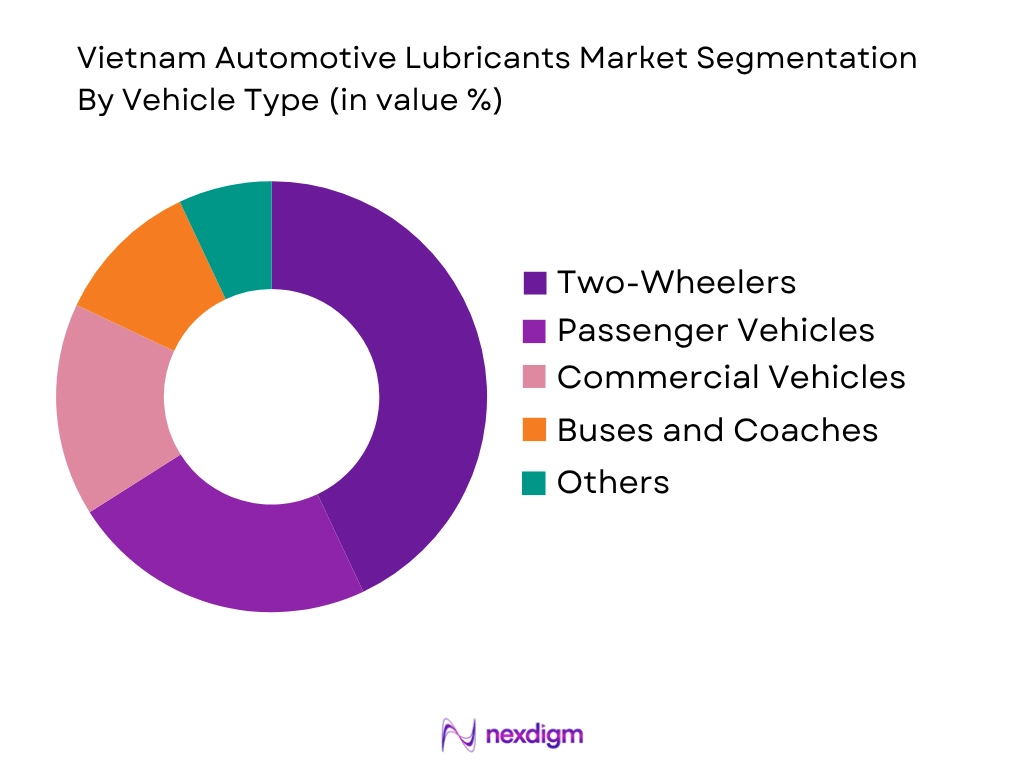
By vehicle type, the Vietnam Automotive Lubricants Market is segmented into motorcycles and scooters, passenger cars, commercial vehicles, buses and coaches, and off-highway vehicles. Motorcycles and scooters dominate the segment because two-wheelers remain deeply embedded in Vietnam’s commuting, delivery, ride-hailing and household mobility ecosystem. VAMM members sold 2,653,607 motorcycles in the latest complete reporting cycle, compared with 2,516,212 units in the preceding cycle. This creates recurring demand for four-stroke motorcycle engine oils, JASO MA/MA2 wet-clutch formulations, scooter-oriented JASO MB oils and final-drive fluids. Motorcycle servicing also occurs through an extensive network of authorized dealerships, independent garages, roadside workshops and parts retailers, enabling lubricant brands to reach customers throughout metropolitan and provincial markets. High motorcycle utilization in Ho Chi Minh City and Hanoi further supports replacement demand, particularly among delivery and ride-hailing users. Premium motorcycles and modern scooters are simultaneously encouraging migration from conventional mineral oils toward semi-synthetic and full-synthetic formulations.
By Lubricant Technology
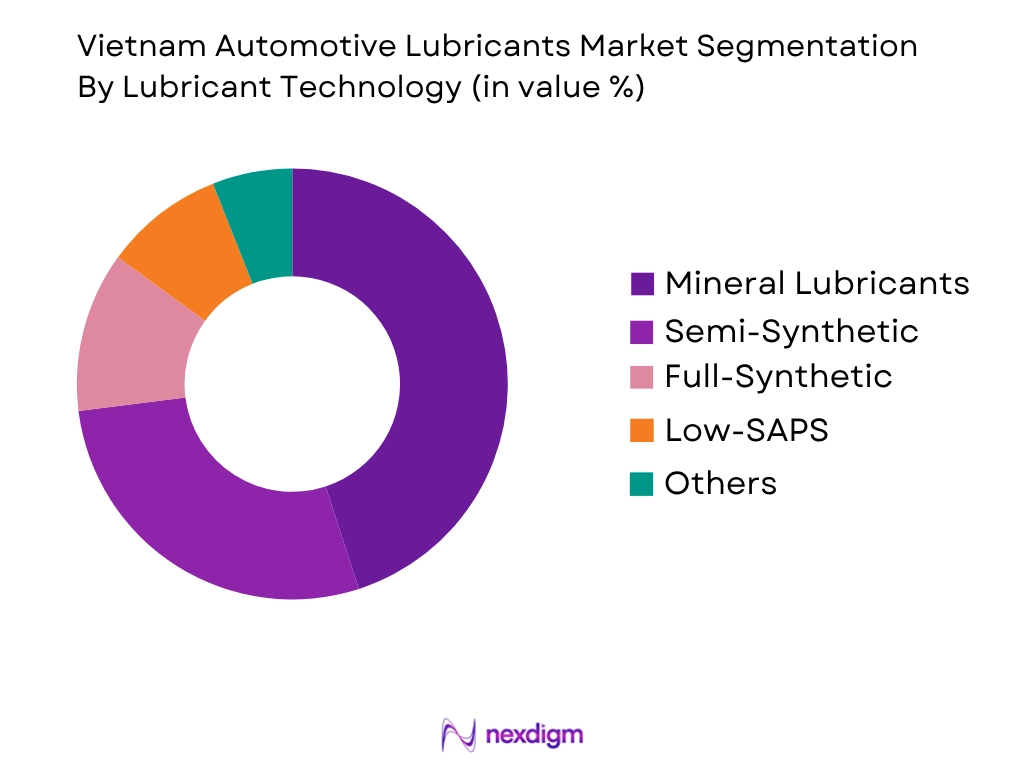
By lubricant technology, the Vietnam Automotive Lubricants Market is segmented into mineral, semi-synthetic, full-synthetic, low-viscosity specialty, re-refined and hybrid/EV-specific fluids. Mineral lubricants retain the largest installed demand base, supported by Vietnam’s large population of commuter motorcycles, older cars and price-sensitive independent-workshop customers. However, semi-synthetic and full-synthetic lubricants are gaining strategic importance as modern scooters, turbocharged passenger cars and newer commercial vehicles require improved oxidation resistance, deposit control and thermal stability. International suppliers already market dedicated motorcycle, passenger-car and heavy-duty portfolios in Vietnam, including Shell Advance, Shell Helix and Shell Rimula. The expanding EV population will gradually constrain conventional engine-oil consumption but simultaneously introduce electric drive-unit fluids, e-axle lubricants, bearing greases and battery thermal-management products. VinFast delivered 97,399 EVs globally, with its domestic market accounting for the overwhelming majority of deliveries, illustrating the pace at which Vietnam’s powertrain mix is changing.
Competitive Landscape
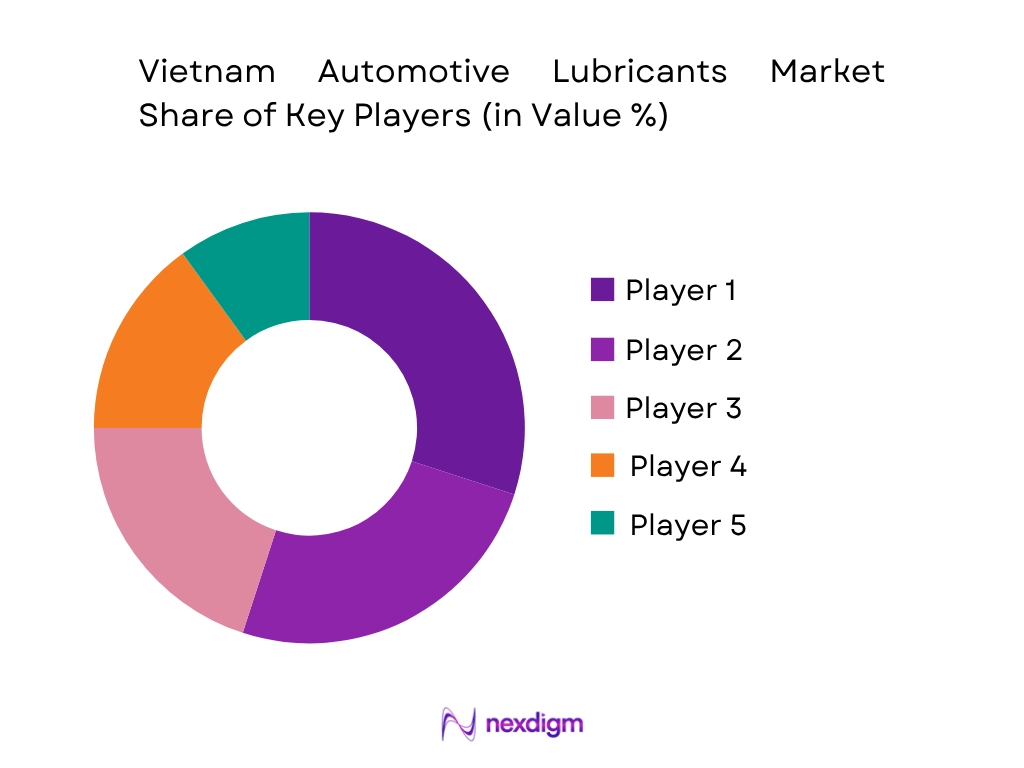
The Vietnam Automotive Lubricants Market combines multinational lubricant majors with established Vietnamese petroleum and petrochemical companies. Castrol BP Petco, Shell Vietnam, Petrolimex Petrochemical Corporation, PVOIL and AP Saigon Petro compete through motorcycle oils, passenger-car oils, heavy-duty lubricants, transmission products and workshop distribution. Local blending capability is strategically important: PVOIL operates a 20,000-ton-per-year plant, while AP Saigon Petro reports production exceeding 10 million litres annually and distribution across Vietnam.
| Company | Establishment Year | Headquarters | Core Automotive Brands | Motorcycle Lubricants | Passenger-Car Lubricants | Heavy-Duty Portfolio | Vietnam Manufacturing / Blending | Distribution Strength |
| Castrol | 1899 | London, UK | ~ | ~ | ~ | ~ | ~ | ~ |
| Shell | 1907 | London, UK | ~ | ~ | ~ | ~ | ~ | ~ |
| Petrolimex Petrochemical Corporation | 1994 | Hanoi, Vietnam | ~ | ~ | ~ | ~ | ~ | ~ |
| PVOIL | 2008 | Ho Chi Minh City, Vietnam | ~ | ~ | ~ | ~ | ~ | ~ |
| AP Saigon Petro | 2008 | Ho Chi Minh City, Vietnam | ~ | ~ | ~ | ~ | ~ | ~ |
Vietnam Automotive Lubricants Market Analysis
Growth Drivers
Large Motorcycle and Expanding Passenger-Vehicle Service Base
Vietnam’s automotive lubricant demand is structurally supported by the scale of its motorcycle and passenger-vehicle ecosystem, which continuously generates requirements for engine oils, scooter oils, gear oils, transmission fluids, coolants and greases. The Vietnam Association of Motorcycle Manufacturers recorded 2,653,607 motorcycle sales in 2024, including cub motorcycles, scooters, clutch motorcycles and sport motorcycles. In the automobile segment, Vietnam Automobile Manufacturers’ Association data show 295,979 vehicles sold by its members in 2024, comprising 220,295 passenger cars, 64,782 commercial vehicles, 7,748 buses, 1,036 special-purpose vehicles and 9,866 hybrid vehicles within reported categories. The service-fill implication is substantial because conventional motorcycles typically require recurring engine-oil replacement, while scooters create additional demand for dedicated JASO MB lubricants and final-drive oils. Passenger cars increasingly require API-compliant motor oils, automatic transmission fluids, CVT fluids and long-life coolants. Commercial vehicles support heavy-duty diesel oils and driveline products because freight operations involve greater mileage and engine loading. Vietnam’s macroeconomic base also supports continued mobility and vehicle maintenance. World Bank data place national GDP at USD 476.39 billion in 2024, GDP per capita at USD 4,717.3, and population at 100,987,686 people. These indicators provide a large consumer and commercial transport base for lubricant replacement. The strongest opportunity for suppliers is therefore not dependent on a single new-vehicle cycle; each ICE vehicle entering Vietnam’s parc generates years of subsequent workshop activity. Motorcycle workshops, OEM dealerships, fuel stations and independent repair centres consequently remain important lubricant distribution points, particularly in Hanoi, Ho Chi Minh City and surrounding industrial provinces.
Commercial Freight and High-Utilisation Mobility Supporting Heavy-Duty Lubricant Consumption
Vietnam’s expanding freight and passenger-transport activity provides another important growth driver because commercial vehicles consume lubricants under substantially higher duty cycles than privately operated vehicles. The National Statistics Office reported 1,917.9 million tonnes of freight transported during the first nine months of 2024, equivalent to 393.4 billion tonne-kilometres of freight traffic. Passenger transport over the same period reached 3,660.2 million passenger movements and 204.6 billion passenger-kilometres. These transport volumes create sustained requirements for heavy-duty diesel engine oils, axle oils, transmission fluids, greases and coolants across trucks, buses, vans and logistics fleets. VAMA data additionally show 64,782 commercial vehicles sold by members in 2024, including 57,034 trucks and 7,748 buses, while reported commercial-vehicle sales increased to 79,414 units in 2025, including 70,746 trucks and 8,668 buses. The growing vehicle base magnifies lubricant demand because commercial fleets are generally maintained according to mileage, engine hours and preventive-maintenance schedules rather than occasional consumer servicing. Long-distance freight corridors connecting Ho Chi Minh City, Dong Nai, Binh Duong, Hai Phong and Hanoi create concentrated opportunities for bulk lubricants, oil-analysis programs and extended-drain heavy-duty formulations. Vietnam’s broader economy provides a supportive backdrop: World Bank data put 2024 GDP at USD 476.39 billion and GDP per capita at USD 4,717.3, while the country had 100,987,686 residents. For lubricant manufacturers, the commercial segment is particularly attractive because one fleet relationship can create recurring demand across engine oils, differential lubricants, transmission fluids, chassis grease and cooling systems. Suppliers that combine technical support, fleet oil-condition monitoring, scheduled delivery and workshop training can therefore capture greater value than firms competing only through packaged retail engine oil.
Market Challenges
Rapid Electrification Reducing Conventional Engine-Oil Intensity
Vietnam’s accelerating electric-vehicle transition represents the most important long-term challenge for conventional automotive lubricant demand because battery-electric vehicles eliminate crankcase engine-oil changes and significantly simplify several mechanical lubrication systems. VinFast reported 97,399 electric vehicles delivered globally in 2024, with Vietnam identified as its primary market and principal source of demand. This development is particularly relevant because Vietnam’s lubricant industry has historically depended heavily on internal-combustion motorcycles and passenger vehicles. VAMM members sold 2,653,607 motorcycles in 2024, while VAMA members recorded 220,295 passenger-car sales during the same year. As battery-electric motorcycles, scooters and passenger cars replace ICE models, every substitution removes repeated future engine-oil service events from the lubricant aftermarket. The challenge is intensified by the simultaneous scale of Vietnam’s conventional vehicle parc, meaning suppliers cannot simply discontinue traditional products. They must finance parallel portfolios covering mineral and synthetic motorcycle oil, passenger-car motor oil, heavy-duty diesel oil and emerging EV-specific fluids. The latter include e-axle lubricants, reduction-gear fluids, electric-motor bearing greases, compressor oils and battery thermal-management fluids, which require different properties such as electrical compatibility, copper protection, low conductivity and thermal stability. The macroeconomic context means this transition is occurring in a sizeable mobility market: World Bank data place Vietnam’s 2024 population at 100,987,686, GDP at USD 476.39 billion, and GDP per capita at USD 4,717.3. The business challenge is therefore portfolio rebalancing rather than simple demand contraction. Companies overexposed to motorcycle engine oil or conventional passenger-car lubricants face greater disruption, while suppliers able to develop hybrid and EV fluid technologies can partially offset declining engine-oil intensity.
Fragmented Service Channels and Increasing Lubricant Specification Complexity
Vietnam’s automotive lubricant market faces a significant operational challenge from the combination of fragmented workshop distribution and increasingly complex vehicle-fluid specifications. VAMM members sold 2,653,607 motorcycles in 2024, covering cub, scooter, clutch and sport-bike configurations, while VAMA members reported 295,979 automobile sales, including 220,295 passenger cars, 64,782 commercial vehicles and 9,866 hybrid vehicles. These categories require substantially different lubricant chemistries and service procedures. Motorcycles may require JASO MA or MA2 oils for wet-clutch compatibility, scooters frequently require JASO MB engine oils plus dedicated final-drive lubricants, modern petrol cars may specify API SP and low-viscosity grades, commercial diesels require higher-detergency heavy-duty products, and automatic vehicles can require ATF, CVT or DCT-specific transmission fluids. Misapplication therefore carries higher technical risk than in a market dominated by a narrow set of engine designs. Vietnam’s aftermarket includes OEM dealerships, independent garages, roadside motorcycle mechanics, spare-parts retailers and petroleum stations, making consistent mechanic training and product authentication difficult across the entire distribution base. Increasing hybrid penetration adds another layer: VAMA recorded 9,866 hybrid vehicles in 2024, rising to 14,171 units in 2025 within its reported member sales. Such vehicles can have intermittent engine operation and specialised transmission requirements that do not align neatly with legacy maintenance practices. World Bank figures reinforce the scale of the challenge: Vietnam had 100,987,686 residents in 2024 and GDP per capita of USD 4,717.3, supporting millions of mobility-related service interactions across metropolitan and provincial markets. For lubricant companies, successful execution therefore requires detailed oil-finder systems, mechanic education, tamper-resistant packaging, QR authentication and distributor control. Without those capabilities, the increasing number of specifications can lead to incorrect fluid selection, customer dissatisfaction and brand dilution.
Market Opportunities
Premium Synthetic, Motorcycle and Transmission Fluid Expansion
Vietnam’s current vehicle structure creates a significant future opportunity for premium synthetic lubricants and specialised transmission products. VAMM members sold 2,653,607 motorcycles in 2024, giving lubricant suppliers a large installed pipeline of commuter motorcycles, scooters, clutch bikes and higher-performance models that will require repeated servicing. This vehicle mix supports segmentation beyond basic mineral oils into semi-synthetic and full-synthetic JASO MA2 motorcycle oils, JASO MB scooter products and application-specific gear fluids. Passenger vehicles create a second premiumisation opportunity. VAMA members reported 220,295 passenger-car sales in 2024, alongside 9,866 hybrids, while 2025 member sales included 218,974 passenger cars and 14,171 hybrids. Modern passenger vehicles increasingly use turbocharged petrol engines, smaller-displacement high-output engines, automatic transmissions, CVTs and hybrid systems that require tightly specified fluids. The addressable opportunity therefore extends to SAE 0W-20 and 5W-30 oils, API SP formulations, automatic transmission fluids, CVT fluids, DCT fluids and hybrid-compatible engine oils. Vietnam’s World Bank-reported GDP of USD 476.39 billion in 2024 and GDP per capita of USD 4,717.3 provide a macroeconomic foundation for consumers and fleets to migrate toward higher-specification products as vehicle technology becomes more sophisticated. Suppliers can increase future participation by building vehicle-specific lubricant recommendation systems, OEM approvals and mechanic-training programs rather than treating the market as a commodity oil business. Motorcycle workshops are particularly important because they provide repeated customer contact and can influence the transition from conventional mineral oil to higher-performance lubricants. The current sales base already gives manufacturers the installed vehicles necessary to support this strategy without relying on speculative future statistics.
EV Fluids, Hybrid Lubricants and Circular Used-Oil Solutions
Vietnam’s electrification and environmental transition creates a future growth opportunity for lubricant suppliers that expand from traditional engine oils into specialised EV fluids and circular lubricant services. VinFast delivered 97,399 electric vehicles globally in 2024, with Vietnam accounting for the company’s principal market, showing that electric drivetrains have already achieved meaningful commercial scale. At the same time, VAMA members recorded 9,866 hybrid vehicles in 2024 and 14,171 in 2025, establishing an expanding intermediate powertrain category that still requires engine oil but operates under different thermal and duty-cycle conditions from conventional vehicles. Hybrid engines can experience repeated shutdowns and restarts, making oxidation stability, moisture control and low-temperature protection increasingly relevant. Battery-electric vehicles eliminate crankcase oil but create demand for reduction-gear fluids, e-axle lubricants, electric-motor greases, compressor oils and battery thermal-management fluids. This gives traditional lubricant producers an opportunity to preserve technical relevance even as engine-oil intensity declines. Environmental regulation creates a parallel opportunity in circularity. Vietnam’s Ministry of Industry and Trade highlighted in 2024 that national environmental policy was tightening controls over waste and difficult-to-recycle material flows, while lubricant suppliers increasingly face pressure to improve product traceability and responsible waste handling. The country’s current automotive base provides substantial potential feedstock for organized used-oil collection: 2,653,607 motorcycles were sold by VAMM members in 2024 and 295,979 automobiles were sold by VAMA members. World Bank data add a macro foundation of USD 476.39 billion GDP and 100,987,686 people in 2024. Lubricant manufacturers can therefore develop closed-loop partnerships with dealerships, commercial fleets and workshops, combining fresh-oil supply with used-oil collection, documented transfer to licensed processors and eventual re-refined-base-oil incorporation where specifications permit. This creates differentiation through compliance, sustainability and customer retention rather than relying exclusively on product price.
Future Outlook
The Vietnam Automotive Lubricants Market is forecast to expand at approximately ~ CAGR during 2026-2035, although the composition of demand will change materially. Motorcycle oils will remain important, while passenger-car ownership, automatic transmissions, synthetic formulations and premium servicing will increase the technical value of lubricant consumption. At the same time, rapid electrification will gradually shift demand away from conventional crankcase oils toward thermal-management fluids, driveline lubricants and specialist greases. Motorcycle lubrication will remain a core addressable segment because VAMM members sold 2,653,607 units in the latest complete annual cycle. Vietnam’s combination of commuter motorcycles, scooters, ride-hailing drivers and delivery fleets creates frequent servicing occasions and supports extensive one-litre packaged lubricant distribution. Synthetic premiumisation should become increasingly important. Modern motorcycles require differentiated JASO MA2 and MB products, while newer passenger cars can require low-viscosity synthetic oils, turbocharger-compatible formulations and OEM-approved fluids. Suppliers that educate mechanics and simplify vehicle-to-oil selection should benefit from this increasing technical complexity.
Major Players
- Castrol BP Petco
- Shell Vietnam
- Petrolimex Petrochemical Corporation – PLC Lubricants
- PetroVietnam Oil Corporation – PVOIL LUBE
- AP Saigon Petro
- TotalEnergies Vietnam
- Caltex Vietnam – Havoline and Delo
- Motul Vietnam
- Idemitsu Lube Vietnam
- ENEOS Vietnam
- ExxonMobil – Mobil
- PETRONAS Lubricants International
- FUCHS Lubricants
- GS Caltex – Kixx
- SK Enmove – ZIC
Key Target Audience
- Automotive lubricant manufacturers and lubricant blenders
- Base-oil and lubricant additive suppliers
- Motorcycle, passenger-vehicle and commercial-vehicle OEMs
- Automotive lubricant distributors, dealers and workshop networks
- Ride-hailing, logistics, trucking and commercial fleet operators
- Used-oil collectors, recyclers and lubricant re-refiners
- Investments and venture capitalist firms
- Government and regulatory bodies (Ministry of Industry and Trade, Ministry of Construction, Ministry of Agriculture and Environment, Directorate for Standards, Metrology and Quality)
Research Methodology
Step 1: Identification of Key Variables
The initial phase develops an ecosystem map covering motorcycle and automobile OEMs, lubricant blenders, base-oil suppliers, additive companies, distributors, workshops, fleet operators and recyclers. Variables include vehicle parc, annual vehicle sales, sump capacity, annual mileage, lubricant drain intervals, SAE viscosity, API/JASO specifications and service-channel structure.
Step 2: Market Analysis and Construction
Historical automotive demand is mapped against lubricant consumption requirements for motorcycles, scooters, passenger cars, commercial vehicles and off-highway equipment. Factory-fill and service-fill demand are analysed separately, while engine oils, transmission fluids, gear oils, greases and coolants are assessed through product-specific consumption models.
Step 3: Hypothesis Validation and Expert Consultation
Market hypotheses are validated through computer-assisted telephone interviews with lubricant manufacturers, distributors, workshop operators, motorcycle mechanics, fleet-maintenance personnel and automotive industry participants. Interviews evaluate product substitution, synthetic penetration, oil-change behaviour, distribution margins, brand preferences, specification migration and emerging EV-fluid requirements.
Step 4: Research Synthesis and Final Output
The final phase triangulates bottom-up lubricant consumption with vehicle sales, manufacturing activity, supplier portfolios, blending capacity and macroeconomic indicators. VAMM data showing 2,653,607 motorcycle sales, World Bank macroeconomic indicators and supplier-level manufacturing evidence are used as external checkpoints before final market conclusions are developed.

- Executive Summary
- Research Methodology (Market Definitions and Assumptions, Abbreviations, Market Sizing Approach, Top-Down Analysis, Bottom-Up Analysis, Vehicle Parc Mapping, Motorcycle Installed Base Assessment, Passenger Vehicle Assessment, Commercial Vehicle Assessment, Lubricant Consumption per Vehicle, Oil Drain Interval Assessment, Factory-Fill Assessment, Service-Fill Assessment, Supply-Side Assessment, Primary Industry Interviews, Distributor and Workshop Interviews, Data Triangulation, Forecasting Framework, Limitations and Future Conclusions)

- Definition and Scope
- Market Evolution and Industry Genesis
- Evolution of Motorcycle Lubrication Ecosystem
- Development of Passenger Vehicle Lubrication Demand
- Commercial Vehicle Lubrication Ecosystem

- Growth Drivers (Large Motorcycle Installed Base, Scooter Usage, Passenger Vehicle Ownership, Commercial Freight Activity, Synthetic Premiumisation, OEM Service Expansion)
- Market Challenges (Base Oil Import Dependence, Counterfeit Products, EV Transition, Specification Complexity, Used-Oil Handling)
- Market Opportunities (Premium Motorcycle Oils, EV Fluids, Fleet Services, Used-Oil Recycling, Digital Distribution)
- Market Trends (Synthetic Migration, Scooter-Specific Oils, Low-Viscosity Grades, OEM Fluids, Digital Authentication, Electrification)
- Government Regulations (Product Quality, Vehicle Emissions, Waste Oil, Environmental Compliance, Product Labeling)
- SWOT Analysis
- Porter’s Five Forces Analysis
- PESTLE Analysis

- By Market Value (2020-2025)
- By Lubricant Consumption Volume (2020-2025)
- By Motorcycle Lubricant Value (2020-2025)

- By Product Type (In Value %)
Motorcycle Engine Oil
Scooter Engine Oil
Passenger Car Motor Oil
Heavy-Duty Diesel Engine Oil
Automatic Transmission Fluid - By Lubricant Technology (In Value %)
Mineral Lubricants
Semi-Synthetic Lubricants
Full-Synthetic Lubricants
Low-Viscosity Lubricants
Low-SAPS Lubricants - By Vehicle Type (In Value %)
Motorcycles
Scooters
Passenger Cars
SUVs and MPVs
Pickup Trucks - By Geography (In Value %)
Ho Chi Minh City and Southeast Vietnam
Hanoi and Red River Delta
Northern Manufacturing Corridor
Central Coast
Mekong Delta
Central Highlands


- Motorcycle Owner Analysis
- Scooter Owner Analysis
- Passenger Car Owner Analysis
- SUV and MPV Owner Analysis
- Ride-Hailing Car Fleet Analysis

- By Market Value
- By Lubricant Consumption Volume
- By Motorcycle Lubricant Value


 Request a Sample
 Ask for Customization
 Get a Quote
 Enquire Now