
 Download PDF
Market Overview
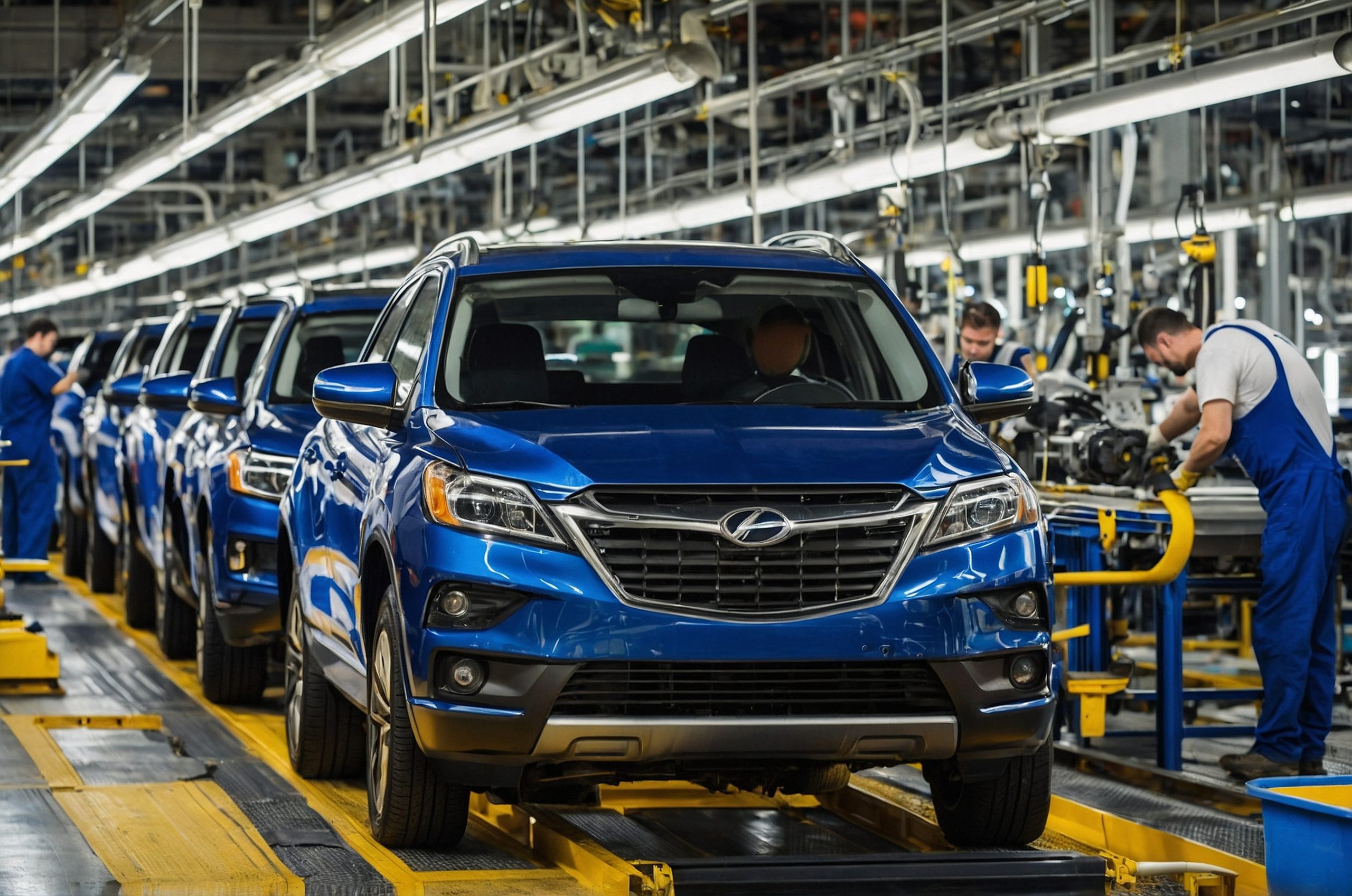
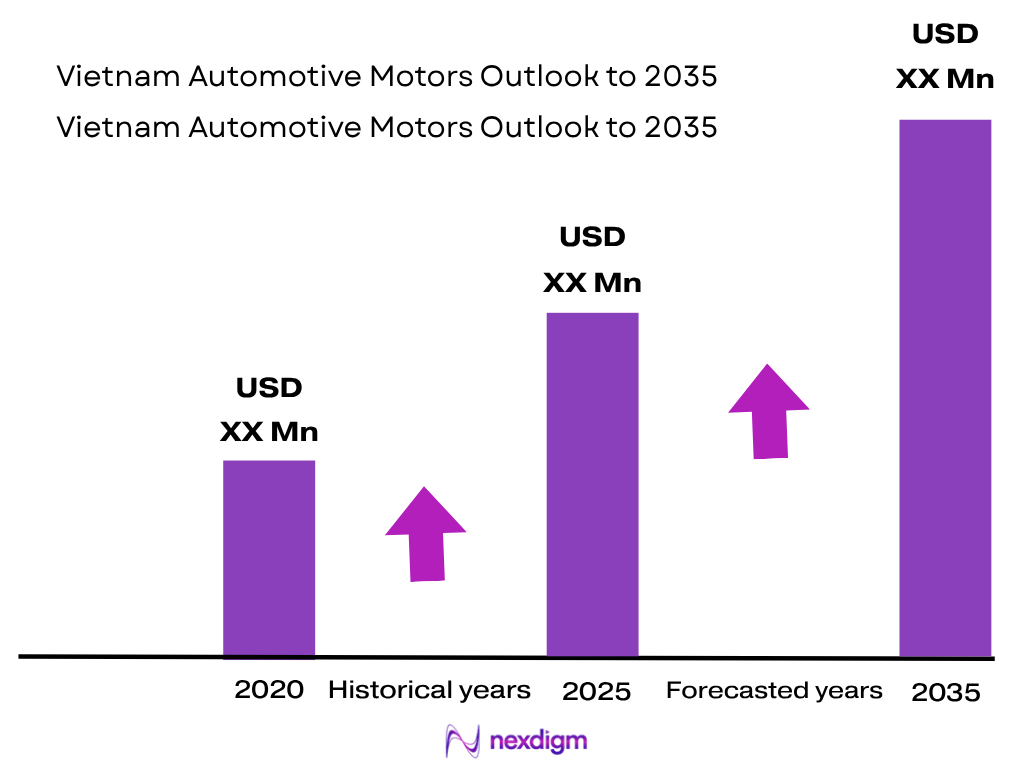
The Vietnam Automotive Motors Market is valued at ~USD X.X billion, based on the latest completed market assessment. Underlying vehicle demand remains substantial: VAMM members recorded 2,653,607 motorcycle sales in the latest full reporting cycle, compared with 2,516,212 units in the preceding cycle. VinFast additionally delivered 97,399 electric vehicles and 70,977 e-scooters, strengthening demand for traction motors, BLDC motors.
Vietnam’s automotive motors industry occupies a distinctive position within Southeast Asia because motor demand is generated simultaneously by a very large motorcycle population, expanding passenger-vehicle assembly, electric two-wheeler conversion and emerging battery-electric vehicle production. The addressable market consequently covers considerably more than EV traction motors. Starter motors, starting generators, alternators, cooling-fan motors, EPS motors, fuel-pump motors, HVAC blowers, wiper motors, window motors, actuator motors and increasingly sophisticated thermal-management motors form significant revenue pools.
Market Segmentation
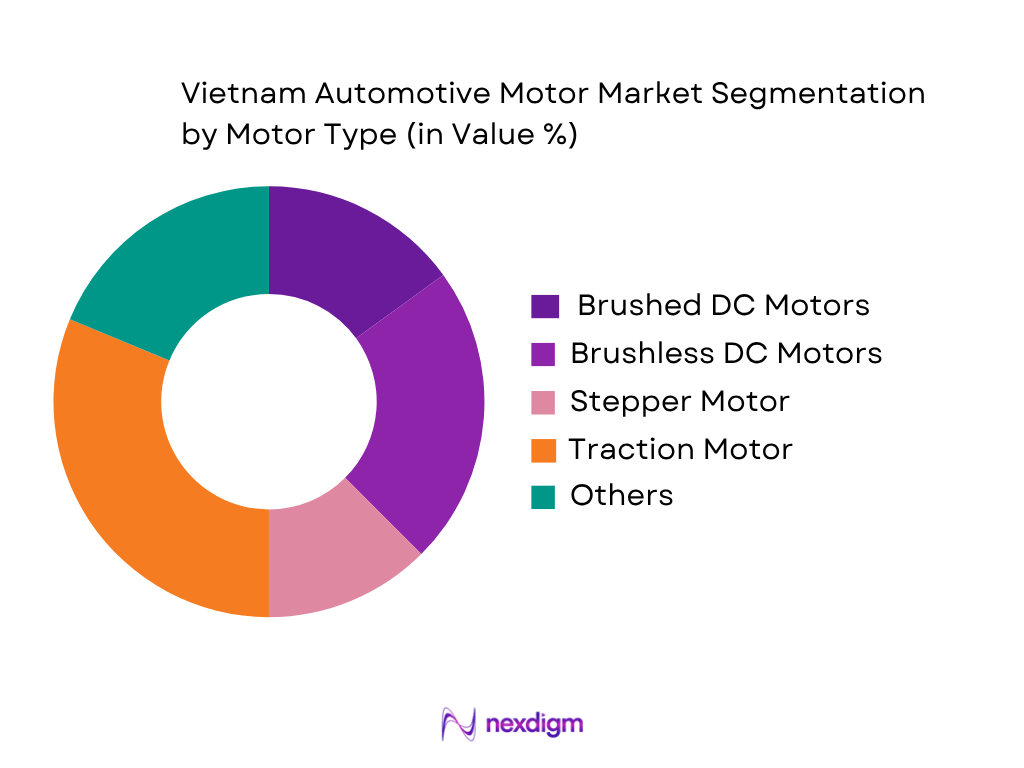
By Motor Type
The Vietnam Automotive Motors Market is segmented by motor application into traction motors, starter and generator motors, thermal-management and HVAC motors, EPS motors, pump motors, and body and auxiliary motors. Currently, starter and generator motors hold a dominant market share under application segmentation. Their leadership is linked primarily to Vietnam’s exceptionally large installed and annually sold ICE motorcycle fleet together with continuing production of conventional passenger and commercial vehicles. Motorcycle platforms require starter motors, AC generators and increasingly integrated starting-generator systems, creating high unit demand. Mitsuba’s Hung Yen operation directly manufactures starter motors, AC generators and starting generators for motorcycles, demonstrating the depth of this local demand base. Nevertheless, the segment’s long-term leadership is being challenged as electric two-wheelers and passenger EVs shift incremental value toward traction motors and thermal-management systems.
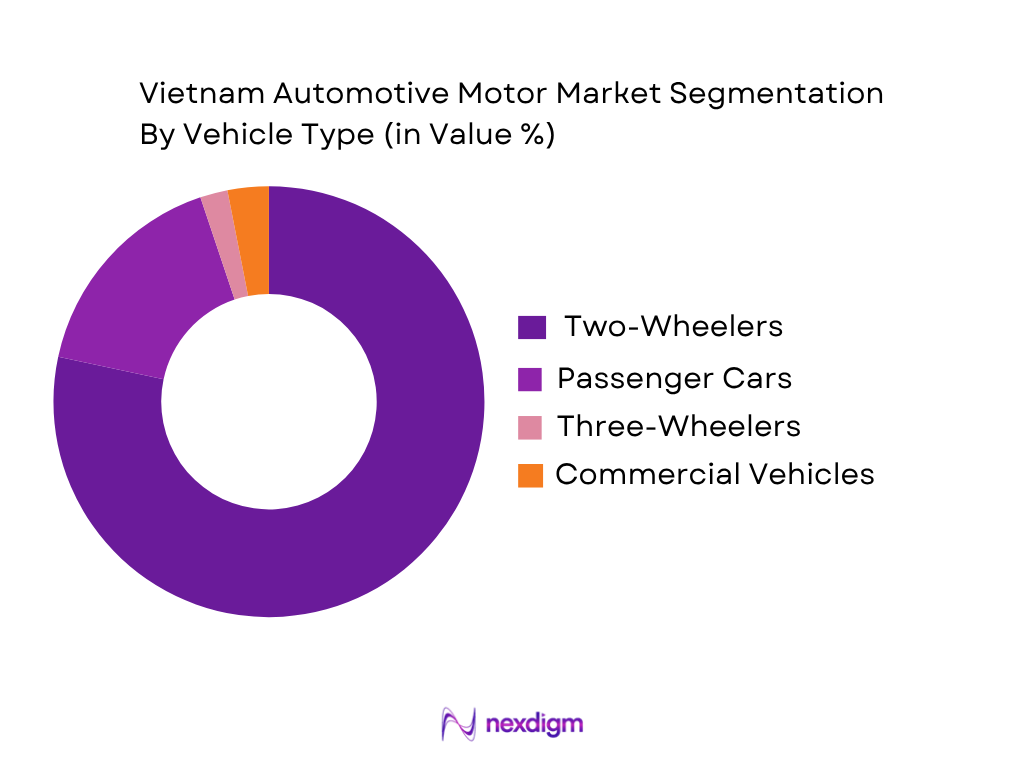
By Vehicle Type
The Vietnam Automotive Motors Market is segmented by vehicle type into motorcycles and electric two-wheelers, passenger cars, light commercial vehicles, medium and heavy commercial vehicles, and buses/special-purpose vehicles. Motorcycles and electric two-wheelers dominate the market by motor shipment volume, reflecting Vietnam’s deeply established two-wheeler mobility ecosystem. VAMM-member manufacturers alone sold more than 2.6 million motorcycles in the latest reporting cycle, substantially broadening demand for starter motors, generators, fuel-pump motors and electronic actuators. Electrification is adding a second layer of demand through hub motors, mid-drive traction motors, motor controllers and electric thermal-management equipment. Passenger vehicles generate greater motor value per vehicle because of higher comfort, safety and electrification content, but motorcycles remain particularly influential in unit terms because of their enormous production and replacement base.
Competitive Landscape
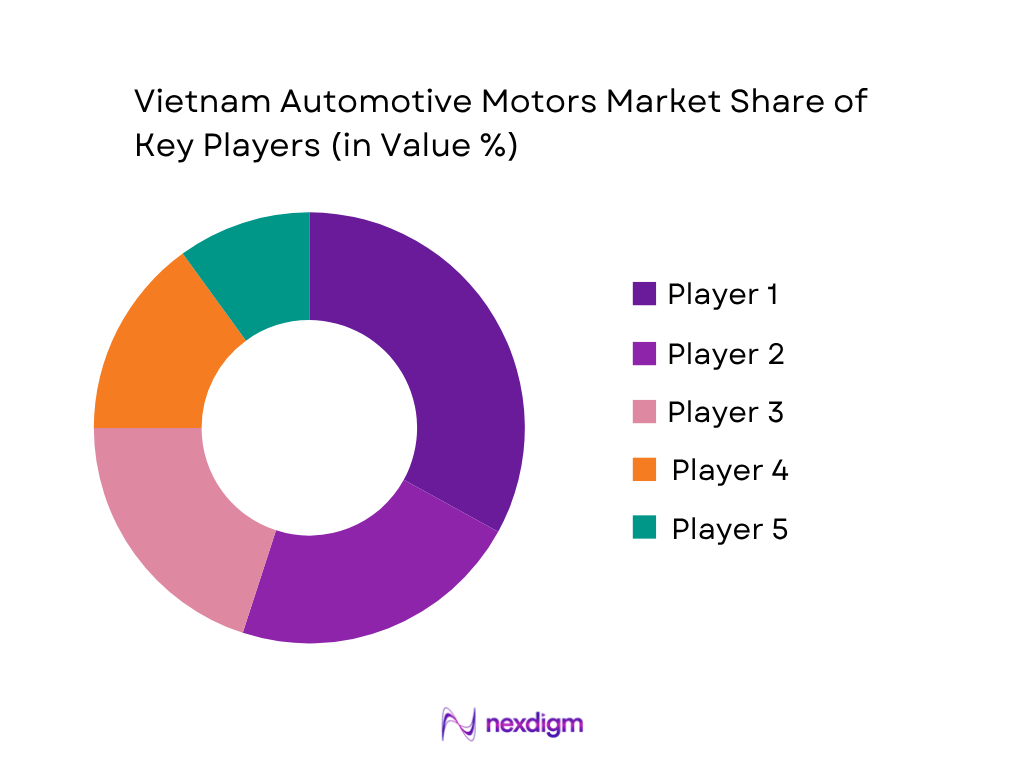
The Vietnam Automotive Motors Market contains a combination of Japanese precision-motor specialists, diversified global automotive suppliers and emerging electrification players. Mabuchi Motor, Mitsuba, Nidec, DENSO and Bosch constitute important participants in the broader motor and automotive-component ecosystem. Competition is shaped less by consumer branding and more by OEM nomination, production quality, motor efficiency, localization, engineering support, IATF-compliant manufacturing, cost competitiveness and the ability to migrate portfolios from conventional ICE applications toward electrified vehicle systems.
| Major Player | Establishment | Headquarters | Vietnam Footprint | Relevant Motor / Drive Capability | Key Automotive Applications | Manufacturing Orientation | Technology Position | Localization Position |
| Mabuchi Motor Co., Ltd. | 1954 | Chiba, Japan | ~ | ~ | ~ | ~ | ~ | ~ |
| Mitsuba Corporation | 1946 | Gunma, Japan | ~ | ~ | ~ | ~ | ~ | ~ |
| Nidec Corporation | 1973 | Kyoto, Japan | ~ | ~ | ~ | ~ | ~ | ~ |
| DENSO Corporation | 1949 | Aichi, Japan | ~ | ~ | ~ | ~ | ~ | ~ |
| Robert Bosch GmbH | 1886 | Gerlingen, Germany | ~ | ~ | ~ | ~ | ~ | ~ |
Vietnam Automotive Motors Market Analysis
Growth Drivers
EV Adoption and Automotive Electrification
Vietnam’s accelerating transition toward electric mobility is creating a direct demand base for traction motors, permanent-magnet synchronous motors, BLDC motors, electric pumps, cooling-fan motors, brake and steering actuators, HVAC motors and other electrically driven auxiliaries. VinFast delivered exactly 97,399 electric vehicles and 70,977 electric scooters during 2024, establishing a sizable domestic production and deployment base for electric propulsion components. The wider two-wheeler ecosystem remains equally important: Vietnam Association of Motorcycle Manufacturers members sold 2,653,607 motorcycles during 2024 and another 2,615,057 motorcycles during 2025. Although much of this installed base still uses internal-combustion powertrains, its scale provides an established manufacturing, vendor-development, distribution and component-sourcing platform that can progressively support electric motorcycles and scooters. Electrification also raises the number of electrical systems incorporated into individual vehicles because battery-electric platforms require propulsion motors as well as motorized battery-cooling pumps, radiator fans, HVAC systems, power steering and electronic actuators. Vietnam’s macroeconomic base reinforces this transition. The country generated USD 476.39 billion of GDP in 2024, served a population of 100,987,686 people, and recorded GDP per capita of USD 4,717.3, giving vehicle OEMs and motor suppliers an increasingly large industrial and consumer base. Vietnam also recorded total merchandise trade of USD 786.29 billion during 2024, demonstrating the scale of the manufacturing and import-export infrastructure available for motors, power electronics, windings, magnets and associated automotive components. Electrification therefore affects the Vietnam Automotive Motors Market at two levels: it creates entirely new propulsion-motor demand and simultaneously expands electric-motor content in auxiliary systems. Continued deployment of domestic EV platforms can consequently increase requirements for PMSM traction units, BLDC auxiliary motors, electric thermal-management assemblies and integrated motor-controller packages, while the existing two-wheeler ecosystem offers manufacturers a substantial platform from which electric-motor localization can develop.
Domestic Vehicle Production and Motor-Content Expansion
Expansion of Vietnam’s domestic automotive manufacturing ecosystem is another major driver because locally assembled vehicles require an increasingly broad set of electric motors across powertrain, chassis, cabin-comfort and safety applications. A modern automobile can contain approximately 30,000 individual parts and components, while automotive electronic architectures can use around 1,400 different semiconductor types, illustrating the component depth required when domestic production expands. Vietnam’s supporting-industry base included around 300 automotive supporting-industry enterprises in 2024, providing a foundation for deeper localization of motor housings, shafts, windings, connectors, sensors, pumps and electromechanical assemblies. At the same time, motorcycle manufacturing provides an unusually developed local component platform; the domestic mechanical-supporting industry has capabilities across motorcycles and motorcycle components, household mechanical products, automobiles and automotive parts. Demand is supported by the 2,653,607 motorcycles sold by the five VAMM members during 2024, creating large-scale requirements for starter-generator systems, fuel pumps, cooling equipment, actuators and electronic accessories even before accounting for the transition toward electric propulsion. The macroeconomic setting strengthens the business case for further automotive investment: Vietnam’s 2024 GDP reached USD 476.39 billion, GDP per capita stood at USD 4,717.3, and the national population reached 100,987,686. Vietnam’s total merchandise imports and exports reached USD 786.29 billion, supporting international sourcing of electrical steel, copper, semiconductors, magnets, bearings and production machinery while suppliers build domestic capabilities. Importantly, motor content per vehicle is expanding independently of propulsion technology. Conventional passenger vehicles increasingly incorporate electric power steering, powered seats, powered windows, HVAC blowers, cooling fans, fuel pumps, wiper motors and electronically controlled actuators. Hybrid and battery-electric vehicles add traction motors, battery-cooling pumps, electrically driven thermal systems and additional high-voltage auxiliaries. As Vietnam moves from basic assembly toward more sophisticated domestic production, motor manufacturers can therefore benefit both from greater vehicle output and from the rising number and technical complexity of electric motors installed within each vehicle platform.
Market Challenges
Low Component Localization and Dependence on Imported Motor Inputs
The principal structural constraint facing the Vietnam Automotive Motors Market is the limited domestic depth of advanced automotive-component manufacturing. Ministry of Industry and Trade information published in 2024 indicated that Vietnam’s automotive industry was importing components for a large portion of domestic vehicle production, while only around 300 enterprises operated within the automotive supporting-industry ecosystem. The technological challenge becomes clearer when viewed at vehicle level: manufacturing a complete automobile requires approximately 30,000 individual components, encompassing drivetrain, electronics, steering, braking, thermal-management, structural and cabin systems. For automotive motors specifically, this broad bill of materials translates into requirements for electrical steel laminations, copper windings, permanent magnets, bearings, shafts, sensors, controllers, semiconductor devices, connectors and precision-machined housings. Domestic suppliers remain more developed in comparatively conventional mechanical products than in advanced traction motors, motor controllers, power semiconductors and high-performance materials. Vietnam’s overall import structure demonstrates the scale of external sourcing available to manufacturing industries. During the first nine months of 2024 alone, imports of computers, electronic products and components reached USD 79.1 billion, while customs data for the first eight months recorded USD 63,383,748,893 of imported computers, electrical products, spare parts and components, 209,163 tonnes of copper worth USD 2,056,513,208, and 3,013,365 tonnes of iron and steel worth USD 2,934,878,003. These figures encompass industries beyond automotive manufacturing but indicate the extent to which Vietnam’s industrial system depends on externally sourced electronic and metallic inputs that are also fundamental to motor production. The challenge is particularly acute for PMSM traction motors, where consistent magnet characteristics, electrical-steel grades, winding quality, inverter compatibility and thermal performance must meet stringent automotive specifications. Vietnam’s USD 476.39 billion economy and USD 786.29 billion merchandise-trade base provide scale for industrial development, but motor suppliers seeking higher localization must develop qualified upstream vendors rather than relying indefinitely on imported high-value subcomponents. The gap consequently creates exposure to logistics disruptions, currency movements, international material availability and cross-border lead times for automotive OEM programs.
Semiconductor Dependency, Advanced-Motor Manufacturing and OEM Qualification Requirements
Producing an automotive motor is substantially more demanding than manufacturing a general-purpose electric motor because vehicle OEMs require repeatable performance across vibration, temperature, moisture, electromagnetic compatibility, electrical efficiency, noise, durability and functional-safety conditions. This creates a significant qualification barrier for Vietnamese suppliers attempting to enter traction motors, EPS motors, ADAS actuators and electronically controlled pump systems. Government-industry information indicates that one modern automobile contains hundreds of semiconductor-dependent functions and can incorporate around 1,400 types of chips, while Vietnam had not established a fully self-sufficient domestic automotive-chip supply chain. This dependency is material for automotive motors because modern systems increasingly combine the motor with position sensors, Hall devices, controllers, microcontrollers and power semiconductor modules. The scale of electronic imports underscores the problem. Vietnam imported USD 79.1 billion of computers, electronics and components during the first nine months of 2024, and customs statistics for the first eight months recorded USD 63,383,748,893 in the computers, electrical products, spare-parts and components category. The national automotive supporting-industry ecosystem consisted of only around 300 enterprises, which limits the pool of domestic suppliers capable of passing global OEM process audits and supporting high-volume quality requirements. Qualification is particularly demanding for safety-related motors such as electric power steering motors, brake-system actuators and ADAS-related actuators, where a field failure can affect vehicle control rather than merely passenger convenience. Advanced traction-motor manufacturing adds further requirements including precision stator lamination, controlled winding processes, magnet placement, rotor balancing, high-speed testing, insulation validation and thermal-management engineering. These barriers arise within an otherwise large manufacturing economy: Vietnam produced USD 476.39 billion of GDP in 2024 and managed USD 786.29 billion in merchandise trade. The challenge for the Vietnam Automotive Motors Market is therefore not a lack of industrial activity but the capability gap between general component manufacturing and automotive-grade production of high-speed, high-efficiency, electronically controlled motors. Suppliers must close this gap to secure OEM nominations and move into higher-technology propulsion and safety applications.
Market Opportunities
EV Traction Motors, PMSM and Integrated E-Axle Systems
The strongest forward opportunity for the Vietnam Automotive Motors Market lies in developing localized electric propulsion systems, particularly permanent-magnet synchronous motors, BLDC-based drive systems, integrated motor-inverter assemblies and e-axles. Current vehicle deployment provides a concrete industrial base for this opportunity rather than requiring reliance on future demand projections. VinFast delivered 97,399 electric vehicles during 2024, including 53,139 vehicles in the fourth quarter alone, demonstrating that Vietnamese EV production has already reached volumes capable of supporting specialized propulsion-component supply chains. The company also delivered 70,977 electric scooters during the same year, creating another application base for compact traction motors, hub-drive systems, mid-drive motors and motor controllers. Beyond pure EVs, Vietnam retains one of the region’s largest two-wheeler industrial ecosystems: five VAMM members sold 2,653,607 motorcycles during 2024 and 2,615,057 units during 2025. As manufacturers introduce electric alternatives into this established production and distribution network, existing suppliers of starters, generators, housings, shafts, bearings and electronic components can potentially migrate toward electric-drive components. The broader economy provides sufficient manufacturing scale for such localization. Vietnam’s GDP reached USD 476.39 billion in 2024, GDP per capita reached USD 4,717.3, and population stood at 100,987,686, supporting both industrial capacity and a large domestic mobility market. Vietnam additionally handled USD 786.29 billion of merchandise trade, enabling suppliers initially to import magnets, electrical steel, semiconductor modules and specialized production machinery while local capabilities develop. The opportunity is particularly attractive because traction motors concentrate significantly more engineering complexity than traditional small auxiliary motors: rotor design, magnet placement, winding architecture, inverter matching, cooling and high-speed NVH performance all create opportunities for higher-value manufacturing activities. Local production of PMSM units and integrated e-axles can therefore deepen Vietnam’s role in vehicle electrification, reduce reliance on completely imported propulsion assemblies and create export-capable supply relationships with domestic and foreign-invested OEMs operating in the country.
BLDC Auxiliary Motors, Electric Pumps, EPS and ADAS Actuators
A second substantial future opportunity lies in expanding Vietnam’s automotive-motor industry beyond propulsion into the growing number of electrically actuated systems used throughout passenger cars, commercial vehicles, motorcycles and EVs. This opportunity is supported by the current vehicle base. VAMM members sold 2,653,607 motorcycles during 2024, while VinFast delivered 97,399 electric vehicles and 70,977 electric scooters during the same period. These existing vehicle volumes require multiple electromechanical systems even before further electrification occurs. BLDC motors can serve cooling fans, HVAC blowers, battery thermal-management systems, electric water pumps and other high-duty-cycle applications; EPS systems require precise steering motors and controllers; ADAS and electronically controlled chassis functions create demand for compact actuators; and powered seats, windows, doors and wipers sustain high-volume demand for smaller DC and BLDC motors. The technical opportunity becomes stronger as vehicles adopt more electronics. Government-industry information indicates that a modern automobile contains roughly 30,000 individual components and can incorporate around 1,400 semiconductor types, illustrating the expanding interface between mechanical hardware and electronic control. Vietnam already possesses an industrial platform that can support this evolution: its 2024 GDP reached USD 476.39 billion, population reached 100,987,686, and merchandise trade totaled USD 786.29 billion. The country’s first eight months of 2024 also recorded USD 63,383,748,893 of imported computers, electrical products, spare parts and components, indicating substantial availability of electronics inputs and simultaneously highlighting room for deeper local integration. Auxiliary motors can provide a more accessible localization pathway than high-output traction motors because manufacturers can build capabilities progressively across stamping, winding, rotor assembly, electronic commutation, sensors and final system integration. As Vietnamese vehicle platforms incorporate more automated comfort, steering, braking and thermal-management functions, suppliers able to manufacture reliable high-efficiency BLDC motors, EPS units, electric pumps and precision actuators can move from low-value mechanical components into higher-value electromechanical modules while serving both domestic OEM programs and export-oriented automotive supply chains.
Future Outlook
The Vietnam Automotive Motors Market is forecast to expand at a ~X.X% CAGR, supported by rising vehicle electrification, domestic automotive manufacturing, two-wheeler electrification and greater use of electrically powered auxiliary systems. Motor value per vehicle is expected to increase as mechanical and hydraulic functions migrate toward electronic actuation. EV production will progressively redirect demand from starter-alternator systems toward traction motors, electric pumps and thermal-management motors. Local supplier development should simultaneously expand opportunities for components and complete motor assemblies.
A major structural change will come from electric two-wheelers. Vietnam already possesses a vast motorcycle manufacturing and supplier infrastructure, allowing suppliers to adapt existing capabilities toward hub motors, mid-drive motors, controllers and integrated electric powertrains. VinFast’s reported EV and e-scooter deliveries demonstrate that electrified mobility is becoming commercially relevant rather than remaining a niche technology category.
Major Players
- Mabuchi Motor Vietnam Ltd.
- Mitsuba Vietnam Co., Ltd.
- Nidec Vietnam Corporation
- DENSO Manufacturing Vietnam Co., Ltd.
- Robert Bosch Vietnam Co., Ltd.
- Hyundai KEFICO Vietnam Co., Ltd.
- MinebeaMitsumi / Minebea AccessSolutions Vietnam Ltd.
- Schaeffler Vietnam Co., Ltd.
- Yamaha Motor Electronics Vietnam Co., Ltd.
- Musashi Auto Parts Vietnam Co., Ltd.
- VinFast
- Honda Vietnam Co., Ltd.
- Yamaha Motor Vietnam Co., Ltd.
- THACO AUTO
- Hyundai Thành Công Vietnam
Key Target Audience
- Automotive Motor and E-Drive Manufacturers
- Passenger Vehicle, Commercial Vehicle and Two-Wheeler OEMs
- Automotive Tier-1 and Tier-2 Component Suppliers
- Electric Vehicle and Electric Two-Wheeler Manufacturers
- Permanent Magnet, Electrical Steel and Motor-Control Component Suppliers
- Automotive Distributors, Importers and Aftermarket Participants
- Investments and Venture Capitalist Firms
- Government and Regulatory Bodies (Ministry of Industry and Trade, Ministry of Construction, Ministry of Finance, National Statistics Office of Vietnam, Vietnam Register)
Research Methodology
Step 1: Identification of Key Variables
The research begins by constructing the complete Vietnam Automotive Motors Market ecosystem covering vehicle OEMs, motorcycle manufacturers, motor producers, Tier-1 suppliers, Tier-2 component manufacturers and importers. Secondary research is used to identify variables including vehicle production, vehicle sales, motors installed per vehicle, propulsion architecture, motor technology, localization levels and average motor realization. These variables establish the boundaries and analytical framework for subsequent market sizing.
Step 2: Market Analysis and Construction
Historical demand is analyzed through vehicle-production volumes, motorcycle sales, EV deliveries, automotive-component manufacturing and relevant trade indicators. A bottom-up model calculates addressable demand by multiplying vehicle volumes by motor penetration, average number of motors per platform and applicable motor values. A parallel top-down assessment uses automotive production, electrical-component content and domestic versus imported supply to test the resulting market structure.
Step 3: Hypothesis Validation and Expert Consultation
Preliminary hypotheses are validated through CATIs and structured interviews with automotive OEM personnel, motor manufacturers, Tier-1 suppliers, component distributors and procurement specialists. Interviews focus on OEM sourcing behavior, price bands, localization, motor specifications, supplier qualification, installed motor content and technology transitions. Particular attention is paid to reconciling traction-motor demand with the much larger volume base of motorcycle and auxiliary motor applications.
Step 4: Research Synthesis and Final Output
The final phase triangulates company information, association statistics, government publications, trade indicators and primary-industry feedback. Bottom-up motor demand is reconciled with the top-down automotive-component value pool, and inconsistencies are investigated at motor-application and vehicle-type levels. Forecast assumptions incorporate electrification, vehicle assembly, electric two-wheeler penetration, motor-content growth, localization and technology substitution before producing the final validated market outlook.

- Executive Summary
- Research Methodology (Market Definition, Motor Taxonomy, Scope Boundaries, Revenue Pool Construction, Unit-Volume Assessment, Motor Fitment Analysis, OEM Production Mapping, Top-Down Market Sizing, Bottom-Up Market Reconstruction, Primary Interviews, Secondary Research, Import–Export Validation, Supply-Side Mapping, Demand-Side Assessment, Data Triangulation, Forecasting Framework, Scenario Analysis, Sensitivity Analysis, Assumptions and Limitations)

- Definition and Scope
- Vietnam Automotive Industry Evolution
- Automotive Motor Industry Development Landscape
- Vietnam Automotive Manufacturing Ecosystem
- Automotive Motor Value Chain

- Growth Drivers (EV Adoption, Domestic Vehicle Production, Motor Content Expansion, Automotive Electrification, EPS Penetration, Thermal Management Electrification, ADAS Adoption, Supporting-Industry Development)
- Market Challenges (Low Component Localization, Imported Magnet Dependency, Electrical-Steel Availability, Semiconductor Dependency, OEM Cost Pressure, Limited Advanced-Motor Manufacturing, Technology Qualification Requirements, Supply-Chain Exposure)
- Market Opportunities (EV Traction Motors, E-Axles, BLDC Motors, PMSM, Auxiliary Motors, Electric Pumps, EPS Motors, ADAS Actuators, High-Efficiency Motor Systems)
- Government and Regulatory Environment (Automotive Industry Development Strategy, Supporting-Industry Development, EV Development Policies, Localization Targets, Environmental Regulations, Import Duties and Manufacturing Incentives)
- Porter’s Five Forces Analysis
- PESTLE Analysis
- SWOT Analysis

- By Market Value (2020-2025)
- By Motor Unit Volume (2020-2025)
- By Average Motor Selling Price (2020-2025)
- By Motor Content per Vehicle (2020-2025)
- By Vehicle Production (2020-2025)
- By Original Equipment Demand (2020-2025)

- By Motor Type (in value %)
Brushed DC Motors
Brushless DC Motors
Permanent-Magnet Synchronous Motors
Induction Motors
Stepper Motors
Switched Reluctance Motors
Axial-Flux Motors
Starter Motors
Alternators
Integrated Motor-Actuator Systems - By Vehicle Powertrain (in value %)
Internal Combustion Engine Vehicles
Mild Hybrid Electric Vehicles
Hybrid Electric Vehicles
Plug-in Hybrid Electric Vehicles
Battery Electric Vehicles
Fuel Cell Electric Vehicles - By Vehicle Type (in value %)
Passenger Cars
SUVs and Utility Vehicles
Two-Wheelers
Three-Wheelers
Light Commercial Vehicles
Medium Commercial Vehicles
Heavy Commercial Vehicles
Buses - By Motor Application (in value %)
Traction Motors
Starter Motors
Alternators
Electric Power Steering Motors
HVAC Blower Motors
Electric Compressor Motors
Cooling Fan Motors
Electric Water Pump Motors
Electric Oil Pump Motors
Fuel Pump Motors - By Functional Category (in value %)
Powertrain Motors
Chassis and Steering Motors
Thermal Management Motors
Body and Exterior Motors
Safety and ADAS Motors
Auxiliary and Utility Motors - By Motor Power Output (in value %)
Below 100 W
100–500 W
501 W–1 kW
1–5 kW
5–20 kW
21–100 kW
Above 100 kW

- Market Share of Major Players (By Revenue, Unit Volume, Motor Type, Application, Vehicle Type, Powertrain, OEM Supply and Aftermarket)
- Cross Comparison Parameters (Automotive Motor Portfolio Breadth, EV Traction Motor Capability, Motor Power Density, Motor Efficiency, OEM and Tier-1 Customer Coverage, Vietnam Manufacturing Footprint, Motor–Inverter Integration Capability, Localization and Component Sourcing Depth)
- SWOT Analysis of Major Players
- Detailed Profiles of Major Companies
DENSO Corporation
Nidec Corporation
Robert Bosch GmbH
Valeo SE
Marelli Holdings Co., Ltd.
Hitachi Astemo, Ltd.
Mitsubishi Electric Corporation
Johnson Electric Holdings Limited
Mabuchi Motor Co., Ltd.
MinebeaMitsumi Inc.
Mitsuba Corporation
BorgWarner Inc.
ZF Friedrichshafen AG
MAHLE GmbH
LG Magna e-Powertrain

- Vehicle Owner and User Profile Analysis
- Automotive Motor Usage Behavior
- Powertrain Preference Analysis
- EV Consumer Adoption Analysis
- Motor Technology Acceptance

- By Market Value (2026-2035)
- By Motor Unit Volume (2026-2035)
- By Average Motor Selling Price (2026-2035)
- By Motor Content per Vehicle (2026-2035)
- By Vehicle Production (2026-2035)
- By Original Equipment Demand (2026-2035)


 Request a Sample
 Ask for Customization
 Get a Quote
 Enquire Now