
 Download PDF
Market Overview
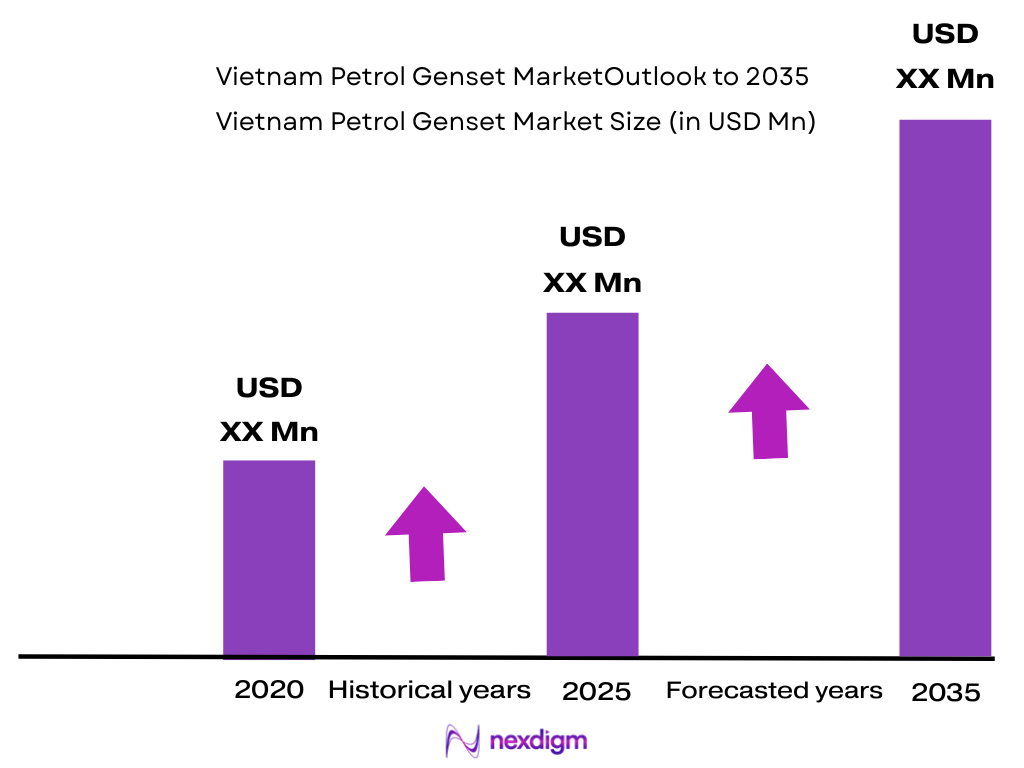
The Vietnam Petrol Genset Market is valued at approximately ~ million, supported by expanding electricity consumption, residential backup requirements, construction activity and small-business power needs. EVN electricity sales increased from 253.052 billion kWh to 275.95 billion kWh, demonstrating rising loads across households, manufacturing and commercial users. Growing electricity requirements, weather-related grid disruptions and demand for portable temporary power strengthen applications for compact gasoline generators, particularly in lower-output residential and mobile applications.Hanoi, Ho Chi Minh City, Hai Phong and the Bac Ninh industrial corridor constitute major demand centres because they combine dense households, workshops, construction projects, SMEs and manufacturing operations. Industrialisation is particularly strong around Bac Ninh, which attracted USD 5.12 billion in FDI compared with roughly USD 1.83 billion previously, while Hai Phong attracted about USD 4.94 billion. These locations generate demand for portable emergency and temporary power where continuous electricity availability is operationally important.
Market Segmentation
By Power Output
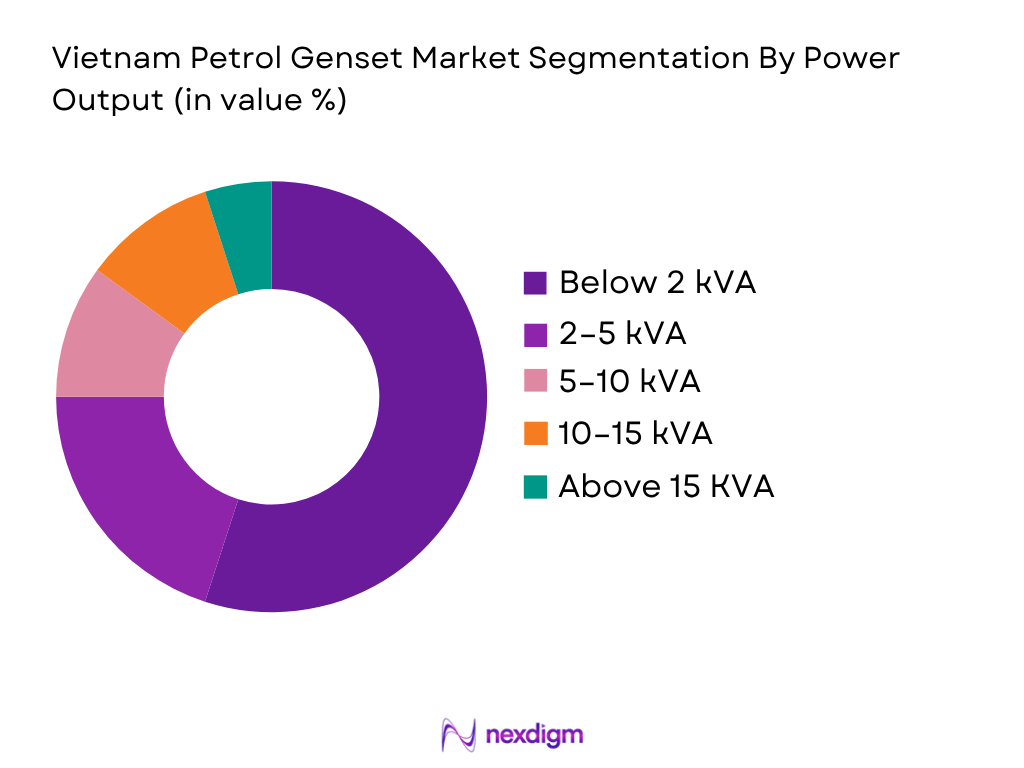
The Vietnam Petrol Genset Market is segmented into below 2 kVA, 2–5 kVA, 5–10 kVA and above 10 kVA petrol generator sets. The 2–5 kVA category holds the dominant market position because this capacity range addresses the broadest combination of residential, retail, workshop, agricultural and small construction-site requirements. It can support essential household lighting, refrigerators, fans, computers, pumps, selected power tools and small commercial equipment while remaining portable enough for temporary deployment. Honda Vietnam Power Products, for example, offers generator models spanning 1.0 kVA, 2.2 kVA and 5.5 kVA, demonstrating the commercial importance of compact and mid-sized gasoline generators within Vietnam. Petrol engines are particularly suitable in these lower-output applications because users generally prioritise portability, relatively simple operation, immediate starting and intermittent backup rather than continuous industrial baseload operation. Compact generators also suit Vietnam’s large number of small shops, household businesses and mobile contractors.
By Application
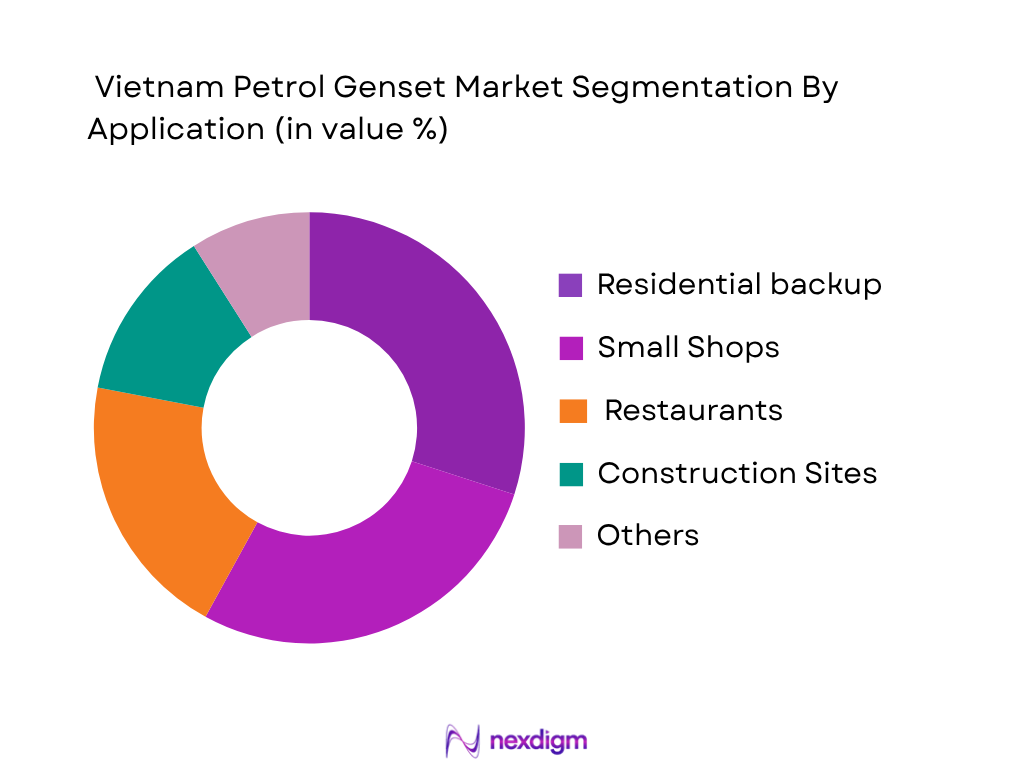
The Vietnam Petrol Genset Market is segmented into residential backup, commercial and retail establishments, construction and workshops, agriculture and rural applications, and recreational or mobile applications. Residential backup power holds the dominant position because gasoline generator sets are most competitive where power requirements are moderate, usage is intermittent and users value compact dimensions and ease of relocation. Vietnam’s electricity consumption continues expanding rapidly, with EVN power sales reaching 275.95 billion kWh compared with 253.052 billion kWh previously. Severe weather additionally reinforces residential resilience requirements; Typhoon Yagi caused widespread outages across northern Vietnam, disrupting millions of households and businesses. Compact generators allow households and small businesses to operate essential appliances, communications equipment, lighting and water pumps during interruptions. Inverter generators strengthen this proposition because they provide quieter operation and more stable electricity for electronics than conventional open-frame sets.
Competitive Landscape
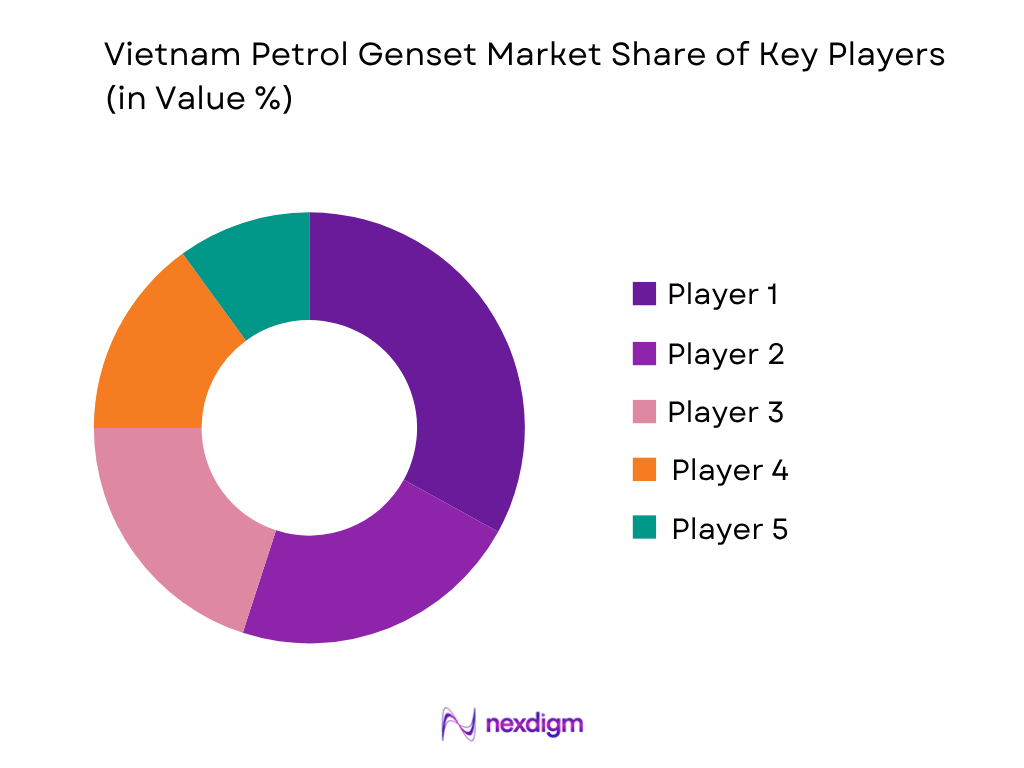
The Vietnam Petrol Genset Market combines established Japanese power-equipment manufacturers, international engine and generator brands and value-oriented imported equipment suppliers. Honda has a particularly visible formal presence through Honda Vietnam Power Products, offering compact inverter and conventional gasoline generators. Hyundai-branded units extend from small household systems into approximately 10 kW gasoline applications. Competition centres on rated output, fuel efficiency, engine reliability, inverter technology, noise control, automatic voltage regulation, portability and nationwide parts support rather than output capacity alone.
| Major Player | Establishment Year | Headquarters | Typical Petrol Genset Range | Inverter Capability | AVR / Voltage Control | Portable Product Strength | Engine Technology | Vietnam Distribution Position |
| Honda Motor Co. | 1948 | Tokyo, Japan | ~ | ~ | ~ | ~ | ~ | ~ |
| Yamaha Motor | 1955 | Iwata, Japan | ~ | ~ | ~ | ~ | ~ | ~ |
| Hyundai Power Products | 2006 | International brand network | ~ | ~ | ~ | ~ | ~ | ~ |
| Elemax / Sawafuji | 1908 | Gunma, Japan | ~ | ~ | ~ | ~ | ~ | ~ |
| Generac | 1959 | Wisconsin, USA | ~ | ~ | ~ | ~ | ~ | ~ |
Vietnam Petrol Genset Market Analysis
Growth Drivers
Increasing Requirement for Emergency Power During Grid Disruptions and Extreme Weather
Vietnam’s Petrol Genset Market is supported by the requirement for rapidly deployable backup electricity during storms, flooding and temporary grid failures. Vietnam Electricity reported that Typhoon Yagi and subsequent flooding disrupted electricity supply to approximately 6.1 million customers and affected 1,678 medium-voltage power lines during 2024; more than 6.03 million customers subsequently had supply restored. Events of this scale strengthen the practical role of compact petrol generators for households, workshops, roadside businesses, emergency-response teams and small commercial facilities that require temporary electricity for refrigeration, lighting, pumps, communication equipment and repair tools. Petrol units are particularly suitable for short-duration emergency deployment because small engines can be transported without the fixed infrastructure associated with permanent standby systems. The underlying economy also increases the value of maintaining continuity: the World Bank records Vietnam’s GDP at USD 476.39 billion in 2024 and approximately USD 514.7 billion in 2025. At the same time, EVN estimated electricity sales at 275.95 billion kWh during 2024, showing the scale of electricity-dependent economic activity. Consequently, disaster-related interruption risks create recurring demand for portable petrol gensets as resilience equipment rather than primary-generation assets, particularly among small businesses and households requiring immediate power restoration.
Growth in Construction, Manufacturing and Temporary Power Requirements
Expanding construction and manufacturing activity is another important driver for Vietnam’s petrol genset market because many temporary worksites require compact independent power before permanent grid connections are established or where equipment must operate away from fixed electrical infrastructure. Vietnam’s National Statistics Office reported that construction activity increased by 7.99% in the first quarter of 2025, compared with growth of 7.57% in the corresponding 2024 period. Industrial momentum has remained strong: the National Statistics Office reported that Vietnam’s industrial production index increased by 9.9% year-on-year in April 2026, demonstrating continued activity across manufacturing and industrial operations. Although large factories generally depend on grid electricity or higher-capacity diesel systems, petrol generators occupy a different niche in portable applications such as welding tools, lighting equipment, small compressors, pumps, electrical hand tools, mobile maintenance operations and temporary site offices. Electricity demand itself is rising alongside industrialisation. The Ministry of Industry and Trade reported a national peak load of 54,370 MW during the first eight months of 2025, illustrating the expanding power requirement associated with Vietnam’s industrial economy. World Bank data places national output at approximately USD 514.7 billion in 2025, reflecting a larger economic base supporting construction, workshops and small manufacturing enterprises. This combination supports demand for compact petrol units where mobility, quick deployment and moderate electrical loads are more important than continuous high-capacity operation.
Market Challenges
Improving Grid Reliability Reducing Routine Dependence on Small Backup Generators
Improving electricity access and grid reliability present a structural challenge to Vietnam’s Petrol Genset Market because petrol generators are most valuable where grid electricity is absent, unstable or temporarily interrupted. World Bank data indicates that electricity access reached 100.0% of Vietnam’s population in 2024, meaning the market is increasingly oriented toward emergency and temporary power instead of basic electrification. Grid-quality indicators are also improving in major economic centres. Vietnam Electricity reported that Ho Chi Minh City recorded a System Average Interruption Duration Index of only 25.5 minutes and a System Average Interruption Frequency Index of 0.28 interruptions per customer during 2024. In EVN Central Power Corporation’s service territory, annual average customer outage duration declined to 193 minutes in 2024. EVN subsequently established a technical objective of approximately 300 minutes for average annual customer outage duration during 2025 while continuing investment in safe and reliable network operations. These improvements reduce the economic justification for frequently operating petrol generators in cities where outages have become relatively short. Manufacturers therefore face a market where replacement purchasing may increasingly depend on emergency-preparedness behaviour, storms, construction activity and mobile applications instead of chronic supply shortages. Suppliers must consequently differentiate through portability, inverter output quality, automatic shutdown protection, compact dimensions, quieter operation and faster deployment rather than relying solely on shortcomings in national grid coverage.
Gasoline Transition, Emissions Pressure and Fuel-Compatibility Requirements
Vietnam’s transition toward cleaner gasoline creates an operational and product-development challenge for petrol genset manufacturers because engines, fuel systems and storage practices must remain compatible with evolving fuel specifications. The Ministry of Industry and Trade introduced E10 gasoline nationwide from June 1, 2026, making ethanol-blended gasoline a central part of the country’s fuel-distribution system. The scale of the transition is significant: national gasoline consumption is approximately 1 million cubic metres per month, while average gasoline demand was reported at around 32,000 cubic metres per day during the nationwide E10 introduction period. Petrol generator suppliers therefore need to address ethanol compatibility in carburettors, hoses, seals, tanks and fuel-storage systems, particularly because generators can remain unused for long periods between emergencies. Ethanol-blended fuel can make storage discipline and preventive maintenance more important for intermittently operated equipment. The transition is supported by a developing distribution system: 13 of 26 fuel wholesalers had invested in biofuel blending stations by May 2026, with combined capacity exceeding 1 million cubic metres per month. Environmental policy adds further pressure. World Bank data records Vietnam’s carbon dioxide emissions excluding land-use effects at 4.27 tonnes per capita in 2024, while national policy remains aligned with a net-zero pathway. Petrol genset manufacturers must therefore balance engine durability, emissions control and fuel compatibility while competing against batteries, solar-storage systems and cleaner backup technologies.
Market Opportunities
E10-Compatible, Inverter and Low-Emission Petrol Generator Development
Vietnam’s transition to nationwide E10 gasoline creates a clear product-development opportunity for manufacturers that adapt portable gensets specifically to the country’s changing fuel infrastructure. The Ministry of Industry and Trade states that nationwide E10 distribution commenced in 2026, against gasoline consumption of around 1 million cubic metres each month. Approximately 29,000 cubic metres of biofuel gasoline were consumed daily immediately after nationwide implementation compared with average gasoline demand of around 32,000 cubic metres per day, showing that ethanol-blended fuel rapidly became commercially relevant rather than remaining a pilot product. This creates scope for genset suppliers to differentiate with E10-compatible carburettors, corrosion-resistant fuel components, improved fuel seals, automatic low-oil shutdown, electronic fuel control and storage guidance designed for intermittent generator operation. The opportunity extends beyond basic compatibility. Manufacturers can combine updated petrol engines with inverter alternators that deliver cleaner electricity for laptops, routers, telecommunications devices, electronic control equipment and household appliances. Compact inverter architecture also allows suppliers to target residential users and mobile businesses that value lower noise and lighter equipment. Vietnam’s macroeconomic base supports premiumisation: World Bank data places GDP at approximately USD 514.7 billion in 2025, while industrial production continued expanding into 2026. Suppliers that position petrol gensets as technically advanced emergency-power products rather than commodity engines can therefore capture demand arising from changing fuel standards, sensitive electronic loads and increasingly sophisticated end-user expectations.
Disaster-Resilient Portable Power for Households, SMEs and Mobile Operations
A significant growth opportunity exists in positioning petrol gensets as disaster-resilience equipment for households, small enterprises, workshops, farms and mobile repair operations rather than as substitutes for Vietnam’s increasingly reliable national grid. Typhoon Yagi demonstrated the scale of short-term disruption that extreme weather can cause: approximately 6.1 million electricity customers were affected, alongside 1,678 medium-voltage lines, before EVN mobilised extensive restoration operations. The storm also caused reported material damage exceeding VND 81.7 trillion, highlighting the economic consequences of climate-related infrastructure disruption. These conditions provide a strong commercial case for portable petrol generators able to run essential loads such as water pumps, refrigerators, communications equipment, lighting and basic tools during emergency restoration periods. The opportunity is reinforced by Vietnam’s expanding power dependence: EVN estimated electricity sales at 275.95 billion kWh in 2024, while national peak demand subsequently reached 54,370 MW during 2025. Meanwhile, World Bank data records Vietnam’s population at approximately 100.99 million people in 2024 and GDP at USD 476.39 billion, creating a large economic base of residential and commercial electricity users. Manufacturers can target this need through lightweight wheel-mounted units, electric starting, weather-resistant controls, longer-runtime fuel tanks, inverter models and bundled transfer equipment suited to intermittent emergency use.
Future Outlook
The Vietnam Petrol Genset Market is expected to expand at approximately ~ CAGR during 2026–2035, supported by electricity-demand growth, construction activity, household resilience requirements and expanding small-business power consumption. The role of petrol generators will remain concentrated in portable and intermittent-duty applications rather than large industrial baseload installations, where diesel remains technically better suited. Demand will increasingly migrate toward quieter inverter models, electronically controlled engines, improved automatic voltage regulation and lower fuel consumption. Power-supply reliability is improving, but electricity demand continues rising rapidly. EVN’s sales increased to 275.95 billion kWh, and authorities have continued emphasising power-system preparedness as national peak loads rise. This preserves the economic rationale for backup systems among households, retailers, workshops and small industrial users. Environmental policy will also reshape petrol generator design. Vietnam is progressively tightening fuel and emissions requirements while transitioning toward cleaner energy systems. Petrol genset suppliers will therefore need to focus on improved combustion efficiency, E10-compatible fuel systems, electronic fuel management and lower noise and exhaust emissions. Honda Vietnam Power Products confirmed compatibility of its products with E10 gasoline, illustrating how fuel-transition readiness is becoming a product requirement.
Major Players
- Honda Vietnam Power Products
- Yamaha Motor
- Hyundai Power Products
- Elemax / Sawafuji Electric
- Generac Power Systems
- Briggs & Stratton
- Pramac
- Loncin Motor
- Lutian Machinery
- Total Tools
- Ingco
- Kipor Power
- Firman Power Equipment
- Huu Toan Corporation
- Mitsuyama
Key Target Audience
- Petrol generator manufacturers and engine manufacturers
- Generator distributors, importers and authorised dealers
- Construction contractors and infrastructure developers
- Residential backup-power equipment retailers
- Commercial establishments, workshops and SME owners
- Industrial parks, factories and facility-management operators
- Investments and venture capitalist firms
- Government and regulatory bodies
Research Methodology
Step 1: Identification of Key Variables
The first stage involves constructing the Vietnam Petrol Genset Market ecosystem covering manufacturers, gasoline-engine suppliers, importers, distributors, retailers, construction contractors, households and commercial users. Variables include rated and peak output, kVA/kW capacity, engine displacement, fuel-tank capacity, runtime, fuel consumption, inverter technology, AVR capability, noise output, starting system, portability and service availability.
Step 2: Market Analysis and Construction
Historical market demand is developed using bottom-up assessment of unit sales across household backup power, small commercial facilities, construction sites, workshops, agriculture and mobile applications. Supply-side analysis evaluates manufacturer product ranges, import availability and distribution density. Electricity-consumption data are incorporated because EVN power sales increased from 253.052 billion kWh to 275.95 billion kWh, establishing the underlying expansion of Vietnam’s electricity requirement.
Step 3: Hypothesis Validation and Expert Consultation
Initial market hypotheses are validated through computer-assisted telephone interviews and structured discussions with generator distributors, power-equipment dealers, construction contractors, electrical technicians and commercial users. Interviews assess capacity preferences, petrol-versus-diesel selection, expected runtime, noise considerations, maintenance frequency, inverter adoption, fuel compatibility and seasonal purchasing patterns associated with outages and storms.
Step 4: Research Synthesis and Final Output
Bottom-up demand calculations are reconciled with manufacturer product portfolios, electricity-demand indicators, construction activity and regional economic concentration. Honda’s 1.0–5.5 kVA portfolio and Hyundai’s gasoline offerings extending to approximately 10 kW provide reference points for capacity segmentation. Findings are then triangulated with EVN, National Statistics Office and government investment information before establishing market size, segmentation and long-term forecasts.

- Executive Summary
- Research Methodology (Market Definitions and Scope, Petrol Genset Classification, Top-Down Market Sizing, Bottom-Up Unit Demand Assessment, Import and Distributor Mapping, Power Rating Analysis, End-User Demand Assessment, Dealer and Contractor Interviews, Product Specification Benchmarking, Data Triangulation, Forecasting Framework, Research Limitations)

- Definition and Scope
- Market Evolution and Industry Genesis
- Evolution of Portable Petrol Generator Adoption
- Petrol Generator Industry Value Chain
- Import-to-Distributor-to-Dealer Supply Chain

- Growth Drivers (Rising Electricity Load Requirements, Requirement for Emergency Backup Power, Expansion of Small Businesses, Construction and Infrastructure Activity, Growth of Mobile Commercial Applications, Availability of Compact Petrol Gensets)
- Market Challenges (Grid Reliability Improvements Reducing Backup Usage Frequency, Competition from Diesel Generators, Rising Battery Energy Storage Adoption, Gasoline Storage and Safety Constraints, Noise and Exhaust Emissions, Dependence on Imported Generator Components)
- Market Opportunities (Inverter Generator Adoption, Low-Noise Residential Gensets, Compact Generator Demand among SMEs, Smart Generator Controls, Rental Power Applications, Contractor-Focused Portable Gensets, Remote Monitoring Integration)
- Market Trends (Shift toward Inverter Technology, Increased Electric-Start Adoption, Lower-Noise Generator Designs, Compact High-Power-Density Engines, AVR Integration, Digital Display Panels, Parallel Generator Capability, Eco-Throttle Systems)
- Government Regulations (Product Safety Requirements, Petrol Engine Emission Requirements, Import Compliance, Electrical Equipment Standards, Environmental Requirements, Noise Regulations, Fuel Storage Requirements)
- SWOT Analysis
- Porter’s Five Forces Analysis
- PESTLE Analysis

- By Market Value (2020-2025)
- By Unit Sales Volume (2020-2025)
- By Installed Petrol Generator Capacity (2020-2025)

- By Power Output Rating (In Value %)
Below 1 kVA
1–2 kVA
2–3 kVA
3–5 kVA
5–7.5 kVA
7.5–10 kVA - By Generator Technology (In Value %)
Conventional Open-Frame Petrol Generators
Silent Petrol Generators
Digital Inverter Generators
Portable Suitcase-Type Inverter Generators
Automatic Voltage Regulation Petrol Generators - By Application (In Value %)
Residential Emergency Backup
Small Shops and Retail Outlets
Restaurants and Foodservice Establishments
Construction Sites
Automotive Workshops and Repair Garages
Agriculture and Small Farm Applications - By Geography (In Value %)
Northern Vietnam
Red River Delta
Hanoi Metropolitan Area
Central Vietnam

- Market Positioning of Major Players (By Unit Sales, Product Category, Power Rating, Application and Distribution Reach)
- Cross Comparison Parameters (Rated Output Range, Engine Displacement and Engine Technology, Fuel Tank Capacity and Runtime, Inverter/AVR Capability, Noise Level and Acoustic Design, Starting System, Product Weight and Portability, Dealer and After-Sales Service Network)
- SWOT Analysis of Major Players
- Detailed Profiles of Major Companies
Honda Power Products
Elemax / Sawafuji Electric
Yamaha Motor
Hyundai Power Products
Lutian Machinery
Atlas Copco
Hữu Toàn Corporation
Total Tools
INGCO
Firman Power Equipment
Generac
Briggs & Stratton
Kohler
Pramac
Makita

- Residential Backup Power Behaviour
- Small Business Backup Requirements
- Construction Contractor Requirements
- Automotive Workshop Power Requirements
- Agricultural Application Analysis
- Rental Market Assessment

- By Market Value (2026-2035)
- By Unit Sales Volume (2026-2035)
- By Installed Petrol Generator Capacity (2026-2035)


 Request a Sample
 Ask for Customization
 Get a Quote
 Enquire Now