
 Download PDF
Market Overview
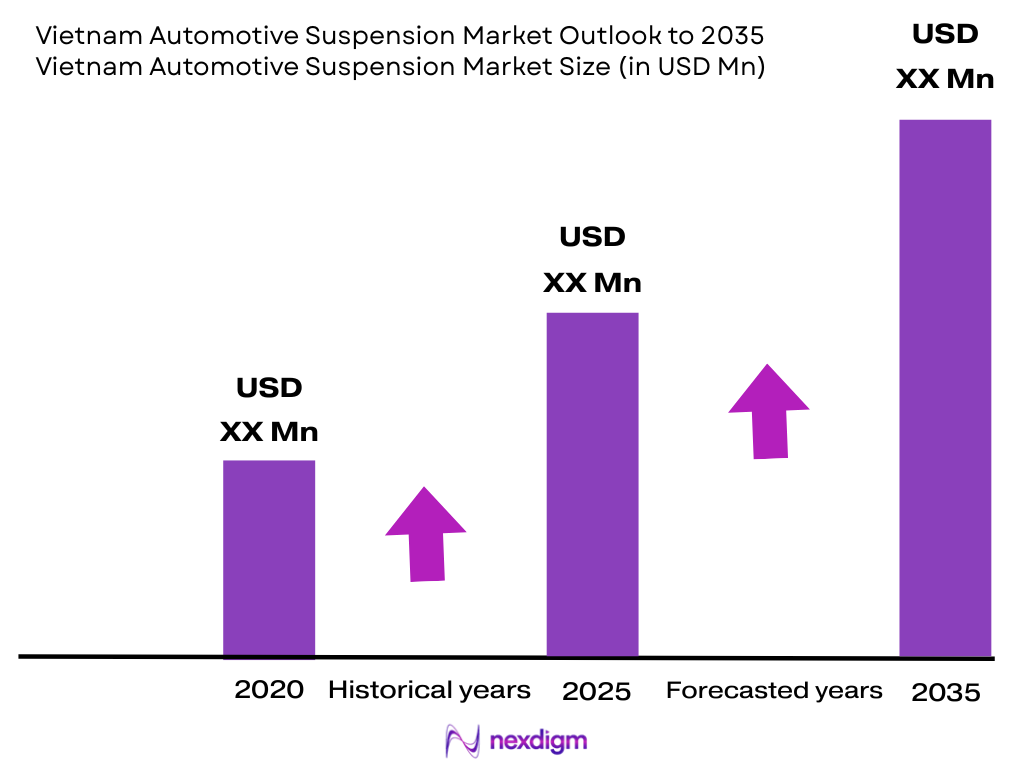
The Vietnam Automotive Suspension Market is valued at approximately USD ~ million, compared with USD ~ million in the preceding annual benchmark. VAMA-member vehicle sales increased from 301,989 units to 340,142 units, while passenger-car sales in the latest benchmark reached 257,900 units. Suspension demand is supported by domestic assembly, increasing SUV/crossover penetration, motorcycle ownership, replacement shocks and struts, commercial-vehicle activity and growing localisation of chassis components. Hai Phong, Hanoi–Vinh Phuc, Chu Lai, Ninh Binh, Ho Chi Minh City and Dong Nai dominate the Vietnam Automotive Suspension Market because these locations combine vehicle assembly, Tier suppliers, mechanical industries, ports and aftermarket distribution. VinFast operates its manufacturing complex at Cat Hai in Hai Phong, while THACO continues expanding its Chu Lai automotive and supporting-industry ecosystem. ZF Automotive Vietnam is also located inside the VinFast Supplier Park in Hai Phong. Vietnam’s automotive suspension ecosystem is becoming increasingly differentiated between conventional internal-combustion vehicles and a rapidly developing EV segment. VinFast delivered 97,399 electric vehicles globally in the latest annual benchmark and 70,977 electric scooters and e-bikes, with Vietnam accounting for a significant portion of the company’s activity. This expands local requirements for EV-calibrated springs, dampers, control arms, lightweight chassis parts and suspension systems engineered around battery mass.
Market Segmentation
By Vehicle Type
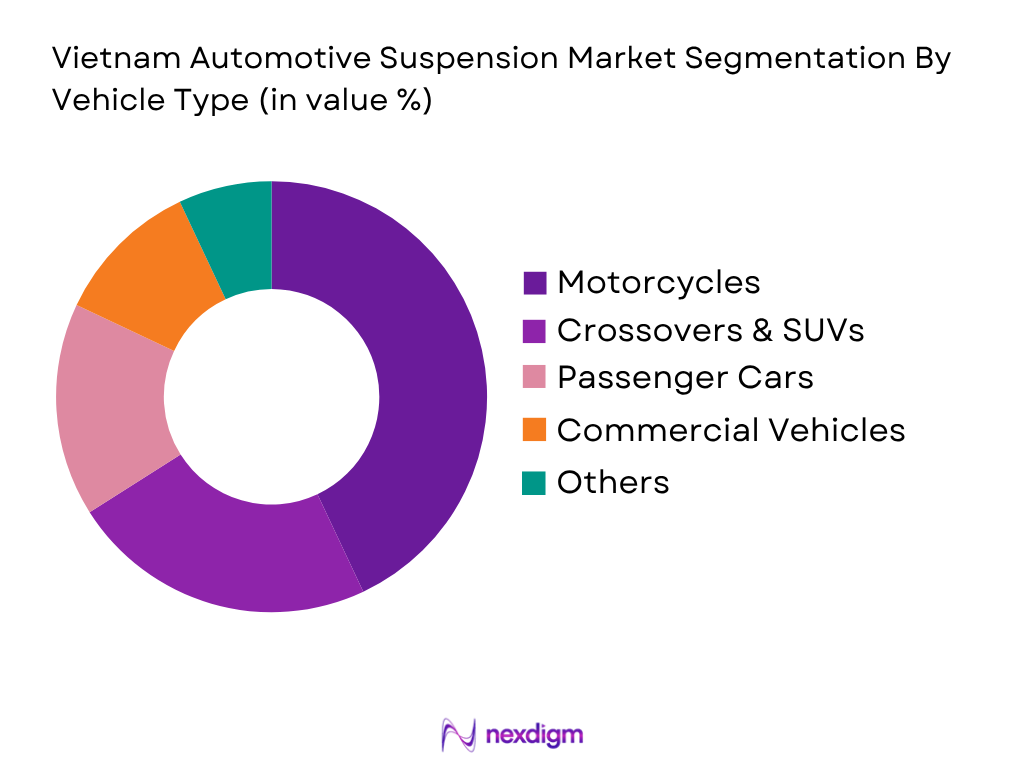
The Vietnam Automotive Suspension Market is segmented into passenger cars, crossovers and SUVs, motorcycles and scooters, commercial vehicles, and electric vehicles. Motorcycles and scooters hold the dominant analytical share by suspension units because Vietnam has an exceptionally large two-wheeler ecosystem and each motorcycle requires front suspension plus rear damping components. Passenger vehicles contribute higher value per vehicle through struts, control arms, springs, stabiliser systems and increasingly independent rear suspension. Crossovers and SUVs further increase suspension content because higher ground clearance, larger bodies and higher vehicle mass require stronger springs, greater suspension travel and enhanced body-roll control. Electric vehicles represent a rapidly emerging segment because VinFast delivered 97,399 EVs globally and 70,977 electric two-wheelers in the latest benchmark, creating a growing domestic installed base requiring EV-specific suspension calibration.
By Suspension Technology
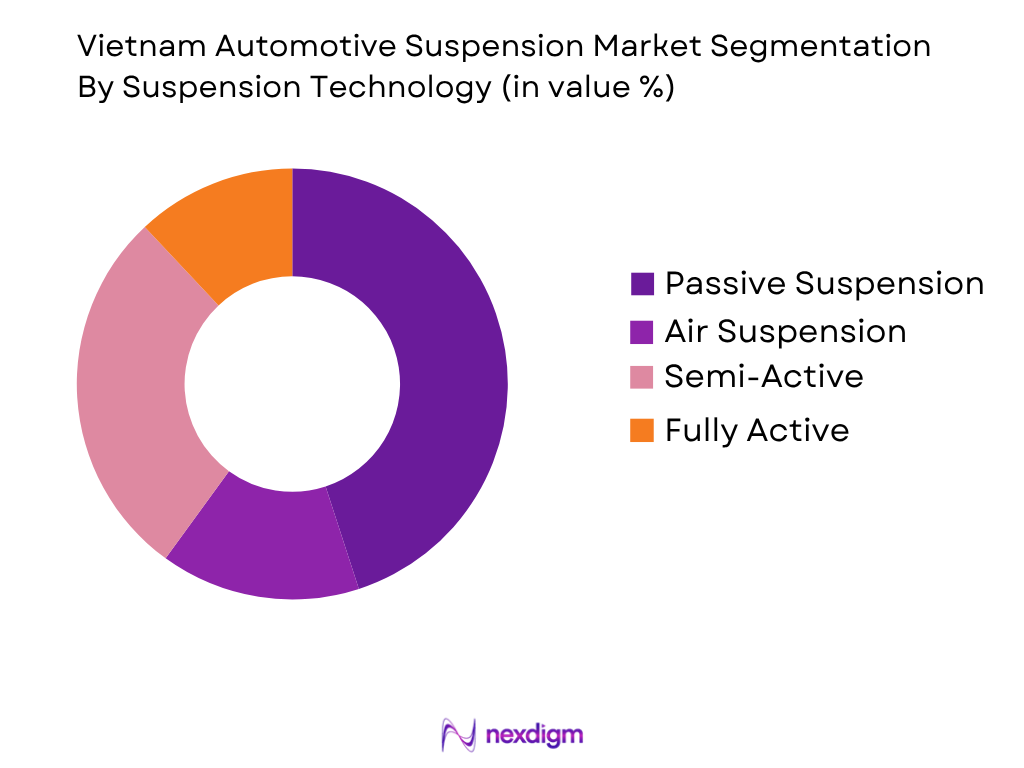
The Vietnam Automotive Suspension Market is segmented into passive suspension, semi-active/electronic suspension, air suspension and fully active suspension. Passive suspension holds the dominant analytical share because conventional hydraulic shocks, struts, coil springs, leaf springs and motorcycle forks remain standard across most locally assembled and imported vehicles. Vietnam also has established manufacturing activity from KYB and Astemo-linked operations, supporting local production of motorcycle and automotive suspension components. KYB established a motorcycle shock-absorber manufacturing subsidiary in Vietnam and continues listing KYB Manufacturing Vietnam in its Asian network, while Astemo operates manufacturing facilities in Hanoi and maintains suspension capability through its SHOWA and TOKICO heritage. Advanced electronic suspension remains concentrated in premium and newer EV applications but should expand as software-controlled chassis technology becomes more widely adopted.
Competitive Landscape
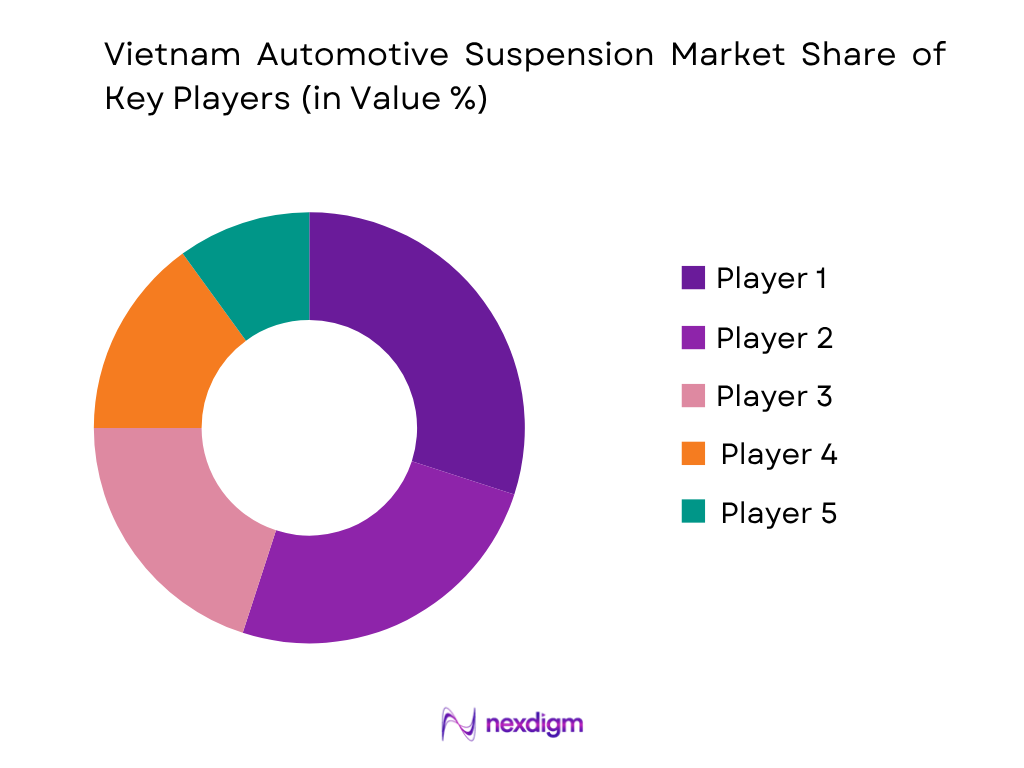
The Vietnam Automotive Suspension Market combines global suspension specialists, Japanese motorcycle-component manufacturers, European chassis Tier-1s and emerging domestic mechanical suppliers. KYB and Astemo have direct manufacturing footprints in Vietnam; ZF Automotive Vietnam operates from Hai Phong; global suppliers such as Tenneco/Monroe and HL Mando contribute advanced damping and electronic-suspension technologies through regional and OEM channels. Competition increasingly depends on localisation, OEM platform access, product durability, two-wheeler coverage, EV readiness and aftermarket distribution.
| Major Player | Establishment Year | Headquarters | Vietnam Presence | Key Suspension Products | Vehicle Coverage | Electronic Suspension Capability | Local Manufacturing Position | Competitive Strength |
| KYB Corporation | 1919 | Tokyo, Japan | ~ | ~ | ~ | ~ | ~ | ~ |
| Astemo Ltd. / SHOWA–TOKICO | 2021 current entity | Tokyo, Japan | ~ | ~ | ~ | ~ | ~ | ~ |
| ZF Friedrichshafen AG | 1915 | Friedrichshafen, Germany | ~ | ~ | ~ | ~ | ~ | ~ |
| Tenneco / Monroe | 1999 current Tenneco structure | Northville, USA | ~ | ~ | ~ | ~ | ~ | ~ |
| HL Mando Corporation | 1962 heritage | Seongnam, South Korea | ~ | ~ | ~ | ~ | ~ | ~ |
Vietnam Automotive Suspension Market Analysis
Growth Drivers
Expansion of Domestic Vehicle Demand, Assembly and SUV-Oriented Production
Vietnam’s automotive suspension demand is being supported by the recovery of domestic vehicle sales and the expansion of locally assembled passenger cars, crossovers, SUVs and commercial vehicles. Vietnam Automobile Manufacturers’ Association members recorded 340,142 vehicle sales in 2024, compared with 301,989 vehicles in 2023, adding a substantial new cohort requiring shock absorbers, struts, coil springs, wishbones, anti-roll bars, bushings and other chassis components. The effect is particularly important because the Vietnamese market is migrating toward crossovers, SUVs and MPVs, which generally require greater suspension travel, stronger springs and improved roll control than small passenger cars. Domestic production clusters in Hai Phong, Vinh Phuc, Ninh Binh and Chu Lai create additional original-equipment demand through VinFast, Toyota, Honda, Hyundai-linked production and THACO’s multi-brand assembly operations. THACO’s Chu Lai ecosystem alone combines vehicle assembly with mechanical and supporting-industry production, providing a base for localisation of springs, castings, machined components, rubber parts and other suspension inputs. VinFast’s manufacturing operation adds another high-volume chassis demand stream: the company delivered 97,399 electric vehicles globally in 2024, together with 70,977 electric scooters and e-bikes, and Vietnam remained the company’s principal market. Every additional locally manufactured EV requires suspension calibration around battery weight, axle loading and body-control requirements, increasing the technical content required from component suppliers. Vietnam’s broader macroeconomic conditions strengthen this manufacturing environment. World Bank data place national GDP at USD 476.39 billion in 2024, compared with approximately USD 433.86 billion in 2023, while GDP per capita reached USD 4,717.3. The IMF recorded real economic expansion of 7.1% in 2024, supported by exports, resilient foreign investment and domestic activity. Higher economic output supports vehicle purchases, freight transportation and automotive capital investment, while expanding disposable income encourages consumers to shift toward SUVs, higher-specification cars and premium motorcycles that carry more sophisticated suspension systems. Domestic manufacturing also benefits from Vietnam’s integration into regional supply chains, allowing suspension producers to serve both local assembly plants and export-oriented component operations. For suspension manufacturers, this combination of rising vehicle volumes and changing vehicle mix is particularly important: basic passive shock absorbers remain the largest unit opportunity, but multi-link systems, larger dampers, gas-charged units and higher-specification control arms are gaining strategic relevance. Suppliers with factories or just-in-time logistics near Hai Phong, Hanoi–Vinh Phuc and Chu Lai are positioned to participate directly in OEM platform programmes while also developing replacement-product networks for the growing installed vehicle parc.
EV Manufacturing, Industrial Investment and Suspension Technology Upgrading
Vietnam’s rapidly expanding electric-vehicle manufacturing ecosystem is increasing the technological requirements placed on automotive suspension suppliers. VinFast delivered 97,399 electric vehicles in 2024, compared with roughly 34,855 units in the preceding annual period, and also delivered 70,977 electric scooters and e-bikes. The scale of these deliveries is significant for suspension demand because battery-electric vehicles carry large battery packs beneath the passenger compartment, altering curb weight, axle loads, centre of gravity and vertical body dynamics. EV suspension therefore requires carefully calibrated spring rates, damper characteristics, bump-stop behaviour, bushing stiffness and ride height. Electric vehicles also reduce powertrain noise, making tyre impacts, suspension friction and bushing-related vibration more apparent to occupants, which creates demand for improved NVH characteristics and more sophisticated ride-control systems. Hai Phong is particularly important because the VinFast industrial complex has attracted chassis suppliers including ZF Automotive Vietnam, creating an industrial ecosystem in which vehicle assembly and advanced Tier-1 supply are geographically integrated. Wider manufacturing investment reinforces the opportunity. Vietnam’s Ministry of Planning and Investment reported USD 25.35 billion of disbursed foreign direct investment in 2024, the highest recorded annual level at the time. Processing and manufacturing attracted approximately USD 25.58 billion of registered FDI, demonstrating that industrial investors continue to expand Vietnam’s advanced-manufacturing capabilities. This investment is relevant to suspension suppliers because advanced damping increasingly requires precision machining, electronic valves, sensors, aluminium forgings, elastomers and automated quality control rather than only basic fabricated steel components. Vietnam’s supporting-industry ecosystem is gradually becoming capable of supplying more of these inputs domestically. The country’s macroeconomic base adds further support. World Bank data record USD 476.39 billion of GDP in 2024, GDP per capita of USD 4,717.3, and a population approaching 101 million people, while the IMF reports 7.1% real GDP growth. These indicators support both vehicle ownership and the industrial investment needed to move suspension manufacturing up the value chain. The technological opportunity extends beyond passenger EVs. Electric scooters and motorcycles require lightweight forks, compact rear dampers and suspension systems capable of supporting battery mass while preserving ride comfort on congested urban roads. Commercial electrification can eventually increase requirements for heavy-duty dampers and load-management systems. Consequently, the Vietnam Automotive Suspension Market is evolving from a market dominated almost entirely by conventional passive components into one where electronically controlled damping, lighter aluminium structures and software-integrated chassis systems can gradually gain relevance. Suppliers that establish local ride-tuning, durability testing and electronic calibration capability can position themselves for future VinFast and other electrified-platform programmes rather than remaining limited to low-value mechanical components.
Market Challenges
Dependence on Imported High-Technology Components and Limited Localisation Depth
One of the primary constraints in the Vietnam Automotive Suspension Market is that domestic assembly capability has developed faster than the local supply base for advanced suspension components. Vietnam can manufacture or assemble conventional mechanical parts such as basic dampers, motorcycle shock absorbers, springs, metal stampings and rubber products, but electronically controlled damper valves, sophisticated sensors, aluminium structural parts, high-precision piston systems and vehicle-motion electronics frequently rely on regional or imported supply chains. The Ministry of Industry and Trade has identified supporting-industry localisation as an ongoing structural challenge, with the broader localisation rate estimated at around 36 units of domestic content for every 100 units of relevant manufacturing value in parts of the industrial ecosystem. This matters particularly for suspension because high-value systems require close tolerances and rigorous vehicle-level validation. Vietnam’s automotive market sold 340,142 VAMA-member vehicles in 2024, but this domestic demand remains smaller than the production scale of Thailand, China or India, limiting the volume over which suppliers can amortise tooling, damper calibration rigs, durability laboratories and electronic-suspension development expenditure. The challenge is therefore not simply manufacturing components; it is reaching sufficient scale and engineering depth to satisfy multinational OEM qualification standards. Foreign direct investment provides industrial capacity but also demonstrates Vietnam’s dependence on global capital and supplier networks. The Ministry of Planning and Investment recorded USD 25.35 billion of realised FDI in 2024, while processing and manufacturing attracted USD 25.58 billion of registered investment. Much of this production is integrated into multinational value chains, meaning high-specification suspension assemblies can still be imported from Thailand, Japan, South Korea, China or Europe when local suppliers cannot meet quality or platform-volume requirements. EV development raises the technical barrier further. VinFast’s 97,399 EV deliveries in 2024 create growing demand for weight-optimised control arms, advanced dampers and chassis electronics, but those components require materials expertise, embedded software and sensor integration that are more difficult to localise than conventional springs. Vietnam’s macroeconomic development remains strong—World Bank data place GDP at USD 476.39 billion and the IMF records 7.1% growth—yet GDP per capita of USD 4,717.3 means vehicle affordability remains important, which limits how rapidly OEMs can pass advanced suspension costs through to end customers. Suppliers therefore face a difficult technology-cost equation: customers expect localisation to reduce cost, while the most advanced systems require significant investment before sufficient domestic volume is guaranteed. The companies best positioned to overcome this challenge are those that combine local manufacturing with access to regional engineering centres and global technology, allowing Vietnam-based operations to localise production progressively while retaining imported electronic or precision content where necessary.
Fragmented Vehicle Parc, Road-Condition Stress and Aftermarket Quality Complexity
Vietnam’s suspension aftermarket is difficult to serve because it combines a very large motorcycle population with passenger cars, SUVs, pickups, buses and trucks sourced from numerous Japanese, Korean, Vietnamese, American and European brands. This creates substantial variation in damper lengths, mounting points, spring rates, bushing dimensions, front-fork diameters and control-arm configurations. VAMA members alone sold 340,142 vehicles in 2024, while VinFast separately delivered substantial volumes outside the VAMA reporting structure. The motorcycle parc is considerably larger, meaning the national suspension ecosystem must support millions of front forks, rear shock absorbers, fork seals and related components across commuter motorcycles, scooters and increasingly electric two-wheelers. This product diversity creates a complex inventory problem for distributors and workshops. A supplier may need hundreds or thousands of SKUs to achieve meaningful national coverage, while slow-moving components tie up inventory and increase the risk that informal repair channels substitute generic or incorrectly matched parts. Road conditions also increase the operational burden placed on suspension components. Vietnam’s road network spans dense metropolitan corridors, expressways, provincial roads, mountainous routes and rural roads, creating widely varying shock loads, vibration and water exposure. Vehicles operating repeatedly on broken surfaces, potholes or heavily loaded commercial routes can experience accelerated bushing wear, damper deterioration, spring fatigue and ball-joint stress. Flooding and high humidity add corrosion and seal-protection requirements, particularly for motorcycle forks and underbody suspension components. EVs introduce another layer of complexity because battery weight changes replacement specifications. A conventional damper with broadly similar dimensions may not provide the correct damping curve for an electric vehicle, increasing the importance of accurate fitment data. VinFast’s 97,399 EV deliveries in 2024 and 70,977 electric two-wheeler deliveries mean EV-specific suspension components will increasingly enter maintenance channels over time. The broader economy is expanding rapidly, with World Bank GDP of USD 476.39 billion and an IMF-recorded 7.1% growth rate, but vehicle repair remains highly fragmented between authorised service centres, independent garages and small motorcycle workshops. This fragmentation creates quality-control challenges and supports continued use of low-cost unbranded components. Suspension failures are safety-relevant because worn dampers can reduce tyre contact, increase braking instability and worsen vehicle control, yet drivers may postpone replacement if the deterioration is gradual. The strategic challenge for established suppliers is therefore not only manufacturing reliable products but also ensuring correct national distribution, mechanic education, fitment identification and consumer recognition of suspension quality. Digital catalogues, QR-code authentication, model-specific fitment databases and workshop training can reduce incorrect installations and counterfeit substitution. Suppliers that combine organised distribution with proven durability under Vietnamese road conditions can differentiate more effectively than those competing primarily through low price.
Market Opportunities
Localisation of EV-Specific, Electronic and Lightweight Suspension Systems
Vietnam has a significant opportunity to move from conventional suspension assembly toward higher-value EV-specific chassis manufacturing as the domestic electric-vehicle ecosystem expands. Current data provide a substantial base for this opportunity without relying on future projections. VinFast delivered 97,399 electric vehicles globally in 2024, along with 70,977 electric scooters and e-bikes, while its Vietnam operations remained the largest contributor to these volumes. These production levels create an addressable demand base for coil springs, struts, dampers, control arms, bushings, subframes and chassis sensors designed around electric drivetrains. Battery-electric vehicles require suspension calibration capable of controlling greater vehicle mass while maintaining acceptable ride comfort and tyre contact. The opportunity therefore extends beyond replacing conventional components with stronger versions. Lightweight forged or cast aluminium control arms can offset part of the battery-weight penalty; hollow stabiliser bars reduce mass; electronically controlled dampers can reconcile comfort with tighter body control; and ride-height sensing can support aerodynamic management and battery protection. Vietnam already has evidence that advanced chassis localisation is viable. ZF Automotive Vietnam operates within the VinFast supplier ecosystem in Hai Phong, while KYB and Astemo maintain manufacturing operations that provide a foundation of local ride-control knowledge. Broader industrial investment also supports technology upgrading. The Ministry of Planning and Investment recorded USD 25.35 billion in realised FDI during 2024, while manufacturing and processing attracted approximately USD 25.58 billion of registered investment. This capital increases Vietnam’s capacity in precision machining, electronics, materials processing and automated manufacturing—capabilities directly relevant to modern suspension production. Macroeconomic expansion provides the domestic demand necessary to support localisation. World Bank data show GDP of USD 476.39 billion, GDP per capita of USD 4,717.3, and a population approaching 101 million, while IMF data show 7.1% real GDP expansion. The opportunity is strongest where suppliers can combine global suspension technology with local manufacturing economics. Instead of importing complete adaptive damper modules, companies could initially localise housings, rods, mounts, springs and final assembly, before progressively integrating electronic valves and control components. Similar localisation pathways exist for motorcycles, where Vietnam’s electric two-wheeler volumes create demand for compact, lightweight suspension systems. Domestic engineering capability in ride tuning and rough-road durability would further increase supplier value because Vietnam’s operating conditions differ from European or Japanese reference markets. If local suppliers develop validation capabilities alongside production, Vietnam can also become an export base for ASEAN suspension components rather than serving domestic platforms alone.
Formalisation of the Replacement Market and Motorcycle–SUV Upgrade Ecosystem
Vietnam’s growing installed vehicle base creates a substantial opportunity for organised suspension suppliers to capture replacement demand that is currently distributed across authorised service networks, independent garages, motorcycle workshops and informal parts channels. VAMA members sold 340,142 vehicles during 2024, up from 301,989 vehicles in the previous benchmark, while VinFast separately delivered large volumes of electric cars. Every annual sales cohort adds future replacement demand for shock absorbers, struts, bushings, ball joints, stabiliser links, springs and control arms. Motorcycle suspension represents an even broader unit opportunity because Vietnam has a deeply established two-wheeler mobility culture. VinFast alone delivered 70,977 electric scooters and e-bikes in 2024, in addition to the much larger installed base of internal-combustion motorcycles from established Japanese manufacturers. Front fork seals, fork tubes, hydraulic oil and rear shocks require periodic maintenance as mileage accumulates, particularly under urban stop-start conditions, high passenger loads and uneven road surfaces. Passenger SUVs create a higher-value replacement segment. These vehicles use larger dampers, more complex rear suspensions and increasingly premium chassis components, giving branded replacement suppliers opportunities to offer OE-equivalent or upgraded products rather than basic low-cost components. Commercial vehicles add another high-utilisation customer category because trucks and buses operate long hours and carry heavy axle loads, accelerating wear on dampers, leaf springs, torque rods and suspension bushings. The economic backdrop supports continued formalisation. World Bank data place Vietnam’s GDP at USD 476.39 billion in 2024 and GDP per capita at USD 4,717.3, while the IMF recorded real growth of 7.1%. Higher incomes and growing vehicle values make owners more willing to purchase branded safety-critical replacement components rather than the cheapest available parts. E-commerce and digital parts identification provide another pathway for formalisation because model-specific catalogues can match VIN, engine, trim and suspension configuration with the correct SKU. QR authentication and traceability can reduce counterfeit risk, while complete strut assemblies can simplify installation for workshops with limited specialist equipment. Suspension manufacturers can also create premium subsegments through monotube dampers, gas-charged motorcycle shocks, upside-down forks and SUV ride-control upgrades. The opportunity is therefore not simply replacing worn OE parts but segmenting the aftermarket by customer need: economy OE-equivalent parts for mass-market motorcycles and cars, high-durability products for commercial fleets, and premium adjustable products for enthusiasts and SUV owners. Companies that combine Vietnamese warehousing, national distribution, technical support and mechanic training can build durable brand preference while expanding the organised portion of the aftermarket.
Future Outlook
The Vietnam Automotive Suspension Market is expected to expand at approximately ~ CAGR during 2026–2035. Future growth should increasingly reflect higher suspension content per vehicle rather than only changes in vehicle sales. EV manufacturing, domestic localisation, SUV demand, motorcycle premiumisation and organised aftermarket replacement are expected to reshape the product mix. Vietnam’s automotive sales base has already recovered materially, with VAMA-member sales reaching 340,142 vehicles compared with 301,989 vehicles in the preceding annual benchmark. Passenger vehicles represented 257,900 units of the latest total, creating a substantial base for struts, shocks, control arms, springs and replacement components. Electrification should have an even larger structural effect. VinFast delivered 97,399 EVs globally during the latest annual period, while its domestic deliveries alone exceeded 10,000 EVs in the first month of the subsequent year. Battery-powered vehicles require suspension systems calibrated for heavier curb weights, battery-protection ground clearance and lower drivetrain noise. Localisation is another major factor. THACO is expanding its Chu Lai mechanical and supporting-industry ecosystem, while ZF, KYB and Astemo already provide evidence that international suspension and chassis manufacturers can operate within Vietnam’s industrial base. This creates a pathway from imported complete components toward local machining, assembly, springs, bushings, dampers and eventually electronic suspension. The macro environment is also supportive. Vietnam’s GDP expanded by 7.1% in the base period and reached USD 476.39 billion, while GDP per capita reached approximately USD 4,717. Continued income growth supports vehicle ownership, premiumisation and replacement expenditure.
Major Players
- ZF Friedrichshafen AG / ZF Automotive Vietnam
- Astemo Ltd. / SHOWA–TOKICO
- KYB Corporation / KYB Manufacturing Vietnam
- Tenneco / Monroe Ride Solutions
- HL Mando Corporation
- thyssenkrupp BILSTEIN
- BWI Group
- NHK Spring Co., Ltd.
- Sogefi Group
- BENTELER International
- Magna International
- Marelli
- Multimatic Inc.
- Hendrickson
- THACO Industries
Key Target Audience
- Passenger Vehicle and SUV Manufacturers
- Motorcycle and Scooter Manufacturers
- Electric Vehicle and Electric Two-Wheeler Manufacturers
- Suspension, Shock Absorber, Front Fork and Chassis Component Manufacturers
- Automotive Parts Importers, Distributors and Workshop Networks
- Commercial Vehicle Manufacturers and Fleet Operators
- Investments and Venture Capitalist Firms
- Government and Regulatory Bodies (Ministry of Industry and Trade, Ministry of Construction, Vietnam Register, Ministry of Finance, Hai Phong Economic Zone Authority and provincial industrial-zone authorities)
Research Methodology
Step 1: Identification of Key Variables
The initial phase develops a complete ecosystem map covering Vietnamese and foreign vehicle OEMs, suspension Tier-1 suppliers, shock absorber manufacturers, motorcycle component suppliers, importers, distributors and workshops. Key variables include vehicle assembly, suspension units per vehicle, local content, component type, replacement frequency, technology penetration and vehicle propulsion. Secondary research uses VAMA, World Bank, OEM and supplier disclosures to map vehicle demand and domestic manufacturing. Separate models are developed for passenger cars, motorcycles, commercial vehicles and EVs because suspension content differs materially among these categories.
Step 2: Market Analysis and Construction
The top-down approach evaluates Vietnam’s overall automotive chassis and component ecosystem before isolating suspension-related expenditure. The bottom-up model maps vehicle sales, domestic assembly and vehicle parc against shock absorbers, front forks, springs, linkages and electronic suspension required per vehicle. OE and aftermarket demand are treated independently. Imported products and locally manufactured components are also separated to identify localisation potential across Hai Phong, Hanoi–Vinh Phuc, Chu Lai and southern industrial clusters.
Step 3: Hypothesis Validation and Expert Consultation
Market hypotheses are validated through computer-assisted telephone interviews with suspension manufacturers, OEM sourcing teams, workshop operators, distributors, motorcycle parts companies and commercial fleet operators. These discussions assess platform sourcing, component fitment, replacement intervals, local production and imported-product dependence. Expert input is used to validate assumptions regarding EV-specific suspension requirements, motorcycle aftermarket demand, electronic suspension penetration and supplier qualification barriers.
Step 4: Research Synthesis and Final Output
Primary findings are triangulated with VAMA sales information, VinFast disclosures, World Bank data and supplier manufacturing footprints. The final market model estimates demand by suspension technology, vehicle type, component type, propulsion system, manufacturing source and sales channel. Forecast scenarios incorporate domestic vehicle assembly, VinFast EV production, motorcycle demand, local-content expansion, imported-component substitution and aftermarket replacement. Alternative cases test faster EV adoption and accelerated suspension localisation.

- Executive Summary
- Research Methodology (Market Definitions and Assumptions, Automotive Suspension Market Boundary, Abbreviations, Top-Down Market Sizing, Bottom-Up Vehicle Platform Mapping, Domestic Vehicle Assembly Assessment, Vehicle Parc Assessment, Suspension Units per Vehicle, OE Fitment Analysis, Replacement-Cycle Modelling, Passenger Vehicle Suspension Assessment, Two-Wheeler Front Fork Assessment, Commercial Vehicle Suspension Assessment, EV Suspension Assessment, Demand-Side Interviews, Supply-Side Interviews, OEM and Tier-1 Interviews, Distributor and Workshop Interviews, Import–Localisation Assessment, Data Triangulation, Forecasting Framework, Scenario Analysis, Limitations and Future Conclusions)

- Definition and Scope
- Market Evolution and Industry Genesis
- Evolution of Vietnam’s Automotive Assembly Ecosystem
- Evolution of Automotive Suspension Technology
- Vietnam Vehicle Manufacturing Ecosystem

- Growth Drivers (Domestic Vehicle Assembly, VinFast EV Manufacturing, THACO Localisation, Motorcycle Fleet, SUV Demand, Rough-Road Requirements, Replacement Demand, Export-Oriented Parts Production)
- Market Challenges (Import Dependence, OEM Cost Pressure, Small Local Supplier Scale, Electronic Complexity, Counterfeit Parts, Testing Capability, Technology Localisation, SKU Fragmentation)
- Market Opportunities (EV Suspension, Localisation, Semi-Active Damping, Motorcycle Premiumisation, Commercial Air Suspension, Export Manufacturing, Aftermarket Formalisation, Lightweighting)
- Market Trends (Localisation, Mono-Shock Adoption, USD Forks, Multi-Link Suspension, Electronic Damping, EV Calibration, Lightweighting, Connected Chassis)
- SWOT Analysis
- Porter’s Five Forces Analysis
- PESTLE Analysis

- By Market Value (2020-2025)
- By Suspension System Units (2020-2025)
- By Shock Absorber and Strut Units (2020-2025)

- By Suspension Technology (In Value %)
Passive Suspension Systems
Semi-Active Suspension Systems
Fully Active Suspension Systems
Air Suspension Systems
Adaptive Air Suspension Systems - By Vehicle Type (In Value %)
Hatchbacks
Sedans
Crossovers
Compact SUVs
Mid-Size SUVs - By Demand Type (In Value %)
Original Equipment Demand
Original Equipment Service Demand
Independent Replacement Demand
Fleet Maintenance Demand
Collision Repair Demand - By Region (In Value %)
Northern Vietnam
Red River Delta
North Central Vietnam
Central Vietnam
South Central Coast

- Market Share of Major Players by Market Value
- Cross Comparison Parameters (Vietnam OEM Platform Wins, Suspension Technology Portfolio Breadth, Passenger Vehicle–Two-Wheeler–Commercial Vehicle Coverage, Vietnam Manufacturing and Localisation Footprint, Shock Absorber–Strut–Front Fork Product Coverage, EV and High-Mass Vehicle Suspension Capability, Aftermarket Distributor–Workshop Reach, Electronic Suspension–Sensor–Vehicle Motion Control Capability)
- SWOT Analysis of Major Players
- Detailed Profiles of Major Companies
ZF Friedrichshafen AG / ZF Automotive Vietnam
Astemo Ltd. / SHOWA–TOKICO
KYB Corporation
Tenneco / Monroe Ride Solutions
HL Mando Corporation
thyssenkrupp BILSTEIN
BWI Group
NHK Spring Co., Ltd.
Sogefi Group
BENTELER International
Magna International
Marelli
Multimatic Inc.
Hendrickson
THACO Industries

- Ride Comfort Preference
- Ground-Clearance Requirement
- Urban Road Performance
- Rough-Road Performance
- SUV Body-Control Requirement

- By Market Value (2026-2035)
- By Suspension System Units (2026-2035)
- By Shock Absorber and Strut Units (2026-2035)


 Request a Sample
 Ask for Customization
 Get a Quote
 Enquire Now