
 Download PDF
Market Overview
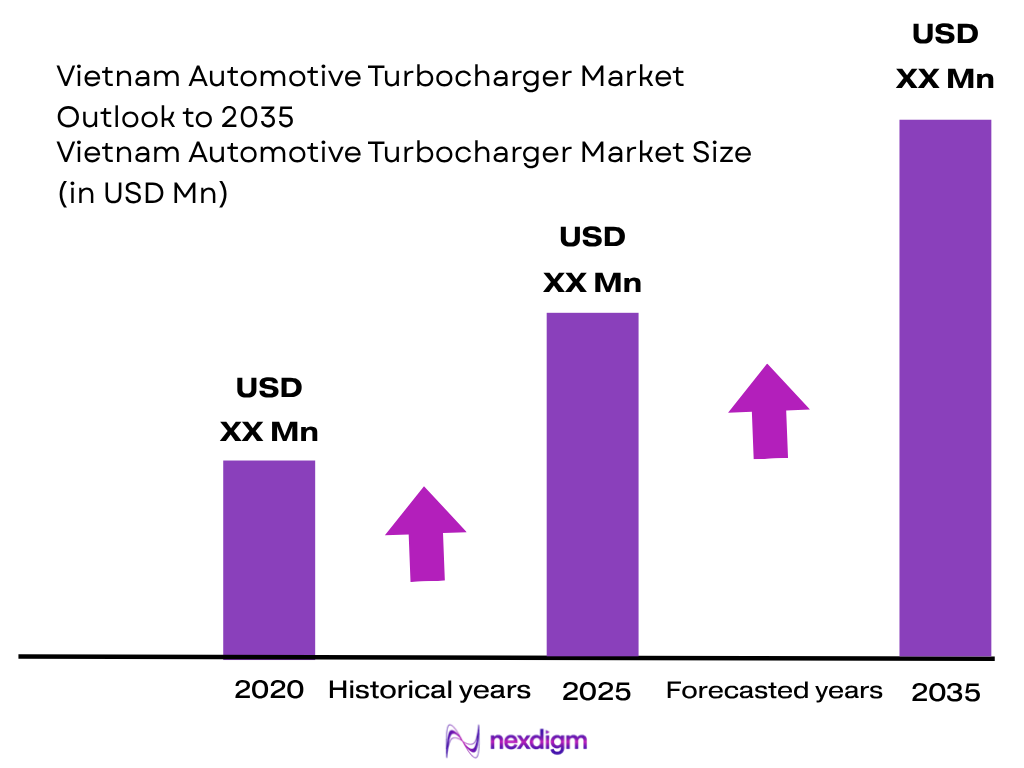
The Vietnam Automotive Turbocharger Market is valued at approximately ~USD XX million, based on the historical automotive demand framework. VAMA-member vehicle sales increased from 276,377 units in the preceding reporting period to 295,979 units in the latest reporting period. Commercial-vehicle sales increased from 60,729 units to 64,782 units, while truck sales moved from 54,819 units to 57,034 units, supporting OEM and replacement demand for diesel and gasoline turbochargers.
Hanoi-Vinh Phuc, Hai Phong-Quang Ninh, Chu Lai-Quang Nam, and Ho Chi Minh City-Dong Nai are the principal locations influencing the Vietnam Automotive Turbocharger Market because they combine automobile assembly, commercial-vehicle manufacturing, component distribution, fleet activity and aftermarket servicing. Market activity strengthened as VAMA-member passenger-vehicle sales moved from 214,619 units to 220,295 units, while commercial-vehicle sales increased from 60,729 units to 64,782 units, expanding turbocharger fitment and servicing opportunities around these automotive clusters.
Market Segmentation
By Turbocharger Technology
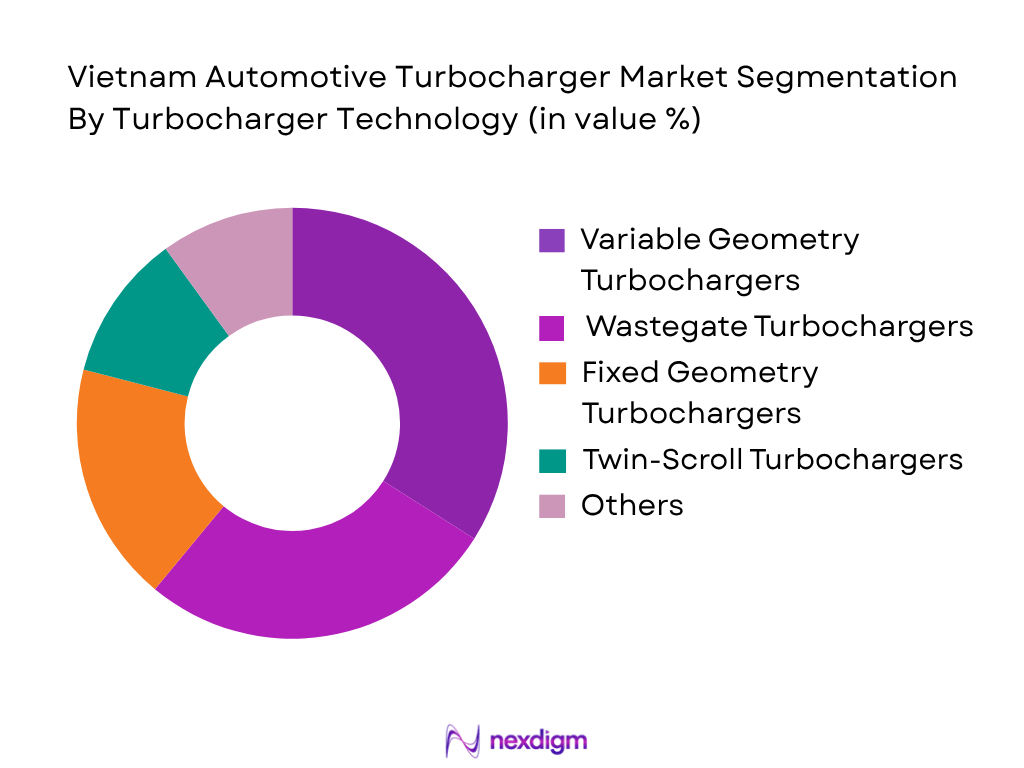
The Vietnam Automotive Turbocharger Market is segmented by technology into fixed geometry turbochargers, wastegate turbochargers, variable geometry turbochargers, twin-scroll turbochargers, two-stage and sequential turbocharging systems, and electrically assisted turbochargers. Variable geometry turbochargers represent the dominant subsegment because Vietnam has substantial exposure to turbo-diesel pickup trucks, light commercial vehicles, medium and heavy trucks, and buses. These applications require strong low-speed torque, controlled boost delivery and improved engine-air management under changing load conditions. Tightening exhaust-emission requirements further strengthens the relevance of variable-vane technologies because precise turbine flow management helps engine manufacturers coordinate turbocharging with exhaust-gas recirculation and aftertreatment strategies. Variable geometry systems are also important in the replacement market, where vane contamination, actuator faults and bearing deterioration create demand for complete turbochargers, CHRA assemblies, electronic actuators and specialized calibration services. Fixed and wastegate technologies nevertheless remain significant in simpler diesel and turbo-gasoline applications.
By Vehicle Type
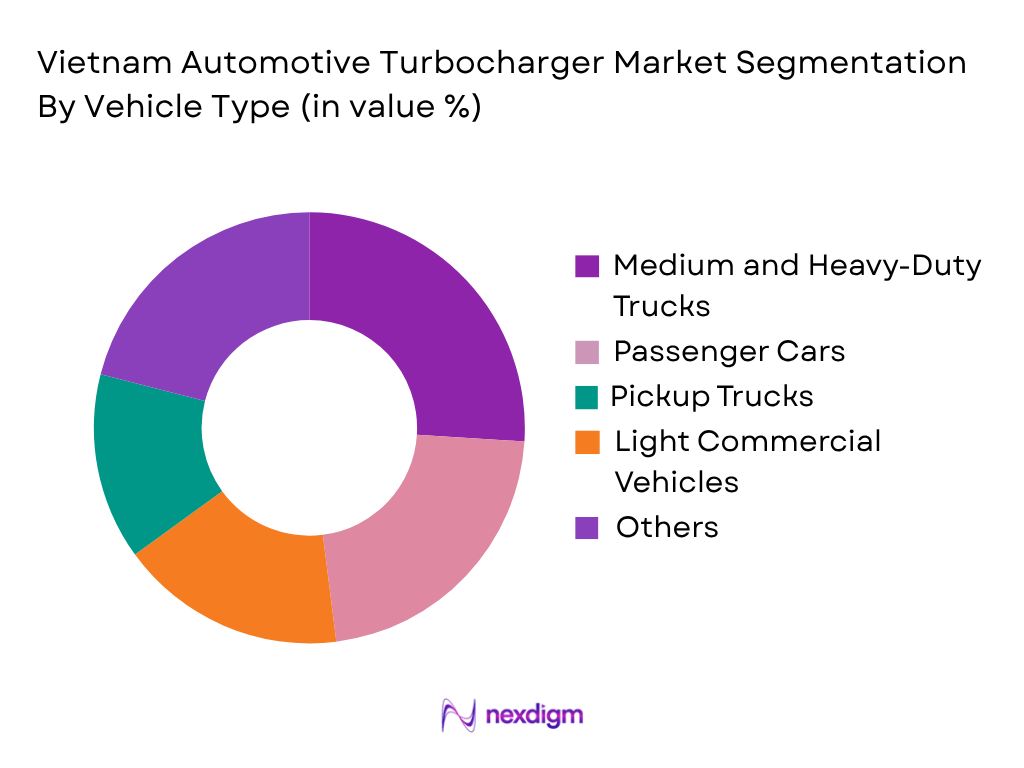
The Vietnam Automotive Turbocharger Market is segmented by vehicle type into passenger cars, SUVs and crossovers, pickup trucks, light commercial vehicles, medium and heavy-duty trucks, buses and coaches, and vocational vehicles. Commercial vehicles collectively form the most influential turbocharger application base, with medium and heavy trucks representing a particularly important individual segment because diesel engines remain fundamental to freight transportation, construction and industrial logistics. Turbocharging is effectively integral to modern commercial diesel engines because operators require high torque from relatively compact engines while maintaining fuel economy and emission performance. Pickup trucks and light commercial vehicles also create substantial demand because turbo-diesel engines are widely used for mixed passenger, cargo and business applications. Passenger vehicles support an increasingly differentiated market through downsized turbo-gasoline engines, while buses and vocational vehicles generate demanding turbocharger replacement requirements because of sustained operating hours, thermal loads and stop-start operating conditions.
Competitive Landscape
The Vietnam Automotive Turbocharger Market is characterized by global turbocharger technology companies serving the country principally through OEM programs, regional Asian production networks, authorized distributors and independent aftermarket channels. Garrett Motion, BorgWarner, Mitsubishi Heavy Industries, IHI and Cummins Turbo Technologies represent important competitive benchmarks because their portfolios span passenger, pickup, light-commercial and heavy-duty engine applications. Competition increasingly centers on variable geometry technology, electronic actuation, Euro 5-compatible engine applications, aftermarket parts availability and specialized technical support. Garrett alone operates an authorized network of more than 350 distributors across 165 countries, illustrating the scale of distribution infrastructure available to global turbocharger suppliers.
| Major Player | Establishment Year | Headquarters | VGT / VNT Capability | Gasoline Turbo Capability | Commercial Diesel Capability | Electronic Actuation | Replacement / Reman Capability | Vietnam / Asia Supply Relevance |
| Garrett Motion Inc. | 1954 | Rolle, Switzerland | ~ | ~ | ~ | ~ | ~ | ~ |
| BorgWarner Inc. | 1928 | Auburn Hills, USA | ~ | ~ | ~ | ~ | ~ | ~ |
| Mitsubishi Heavy Industries Ltd. | 1884 | Tokyo, Japan | ~ | ~ | ~ | ~ | ~ | ~ |
| IHI Corporation | 1853 | Tokyo, Japan | ~ | ~ | ~ | ~ | ~ | ~ |
| Cummins Turbo Technologies | 1919* | Columbus, USA | ~ | ~ | ~ | ~ | ~ | ~ |
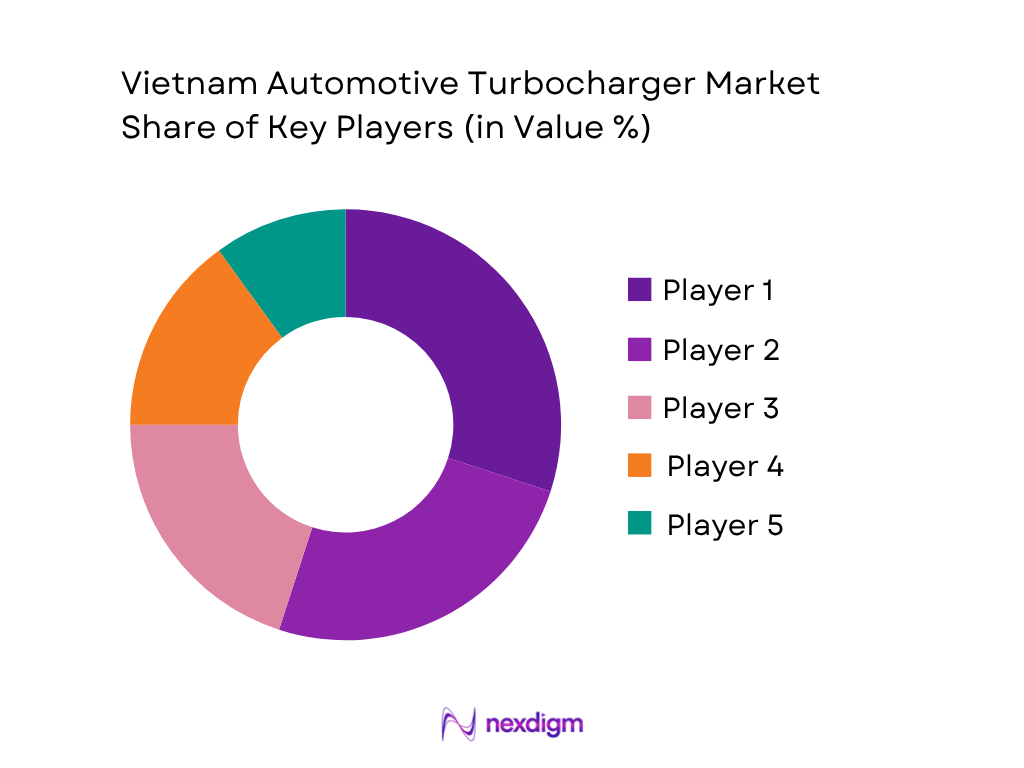
Vietnam Automotive Turbocharger Market Analysis
Growth Drivers
Expanding Commercial Vehicle and Truck Base Supports Turbocharger Fitment and Replacement Demand
Vietnam’s expanding commercial-vehicle ecosystem is a major growth driver for the Vietnam Automotive Turbocharger Market because modern pickups, light trucks, medium-duty trucks, heavy trucks and buses predominantly depend on turbocharged diesel engines for torque delivery and load-carrying capability. The Vietnam Automobile Manufacturers’ Association recorded 64,782 commercial vehicles and 57,034 trucks sold in 2024, compared with 60,729 commercial vehicles and 54,819 trucks in 2023. Momentum strengthened in 2025, when VAMA-member sales reached 79,414 commercial vehicles and 70,746 trucks, substantially enlarging the addressable population for OEM turbochargers, replacement assemblies, CHRAs, VGT actuators and servicing. The macroeconomic environment reinforces this commercial-vehicle requirement: World Bank data place Vietnam’s 2024 GDP at USD 476.39 billion, GDP per capita at USD 4,717.3, and population at 100,987,686 people. Freight transport, construction activity, industrial distribution and interprovincial logistics associated with an economy of this scale require durable commercial fleets. Consequently, turbocharger demand benefits not only when new vehicles enter service but also from intensive fleet utilization that creates recurring requirements for bearings, actuators, rotating assemblies and complete turbocharger replacements.
Domestic Automotive Production Is Expanding the OEM Base for Turbocharged Engines
Rising domestic automobile production is strengthening OEM opportunities for the Vietnam Automotive Turbocharger Market by increasing the number of locally assembled engines and vehicles requiring boosting systems. Vietnam’s Ministry of Industry and Trade reported that domestic factories produced 336,500 automobiles during the first 10 months of 2024, while production reached approximately 47,300 vehicles in November 2024, the highest monthly output recorded from the beginning of that year. The same government assessment showed increased production of engine-related equipment and automotive components, reinforcing development of Vietnam’s supporting-industry ecosystem. VAMA separately recorded 295,979 member vehicle sales in 2024, including 220,295 passenger cars, creating demand across turbo-gasoline cars, turbo-diesel pickups and commercial vehicles. World Bank data show Vietnam generated USD 476.39 billion of GDP in 2024, equivalent to USD 4,717.3 per person, supported by a population of 100,987,686. This combination of domestic assembly capacity and expanding vehicle demand creates a larger addressable base for wastegate turbochargers, variable-geometry systems, twin-scroll gasoline turbochargers, electronic actuators and OEM-linked replacement products, while encouraging deeper integration between vehicle manufacturers and regional turbocharger suppliers.
Market Challenges
Dependence on Imported Precision Turbocharger Systems Restricts Domestic Value Addition
Vietnam’s limited domestic capability in precision turbocharger manufacturing remains a major challenge because modern boosting systems require high-speed rotor balancing, turbine-wheel metallurgy, compressor-wheel machining, bearing engineering, electronic actuation and precise variable-vane calibration. The Ministry of Industry and Trade reported 336,500 domestically produced automobiles during the first 10 months of 2024, but its supporting-industry assessment continues to emphasize the need for greater localization of technologically advanced automotive components. Automotive wiring-component exports reached approximately USD 1.17 billion, demonstrating that Vietnam has already established scale in selected component categories, while more complex powertrain systems still provide room for localization. This gap becomes increasingly material as VAMA-member vehicle sales reached 295,979 units in 2024 and 313,359 units in 2025, increasing the number of vehicles requiring imported or regionally sourced powertrain components. World Bank data record Vietnam’s 2024 GDP at USD 476.39 billion and a population of 100,987,686, indicating a large manufacturing economy capable of supporting deeper supply-chain development. Until precision casting, balancing, electronic actuator production and turbocharger validation capabilities broaden locally, suppliers remain exposed to imported assemblies, regional production schedules and overseas component availability.
Electrification Creates Long-Term Substitution Pressure on Passenger-Vehicle Turbochargers
Vehicle electrification presents a structural challenge for the Vietnam Automotive Turbocharger Market because battery-electric drivetrains eliminate the exhaust-driven turbocharger entirely, gradually reducing potential fitment on sections of the passenger-vehicle fleet. This transition is developing alongside a still-large combustion-engine market: VAMA members sold 220,295 passenger cars in 2024, while passenger-car sales totaled 218,974 units in 2025. During the same 2025 reporting period, VAMA separately recorded 14,171 hybrid vehicles, illustrating the diversification of propulsion architectures available to Vietnamese buyers. Hybridization can preserve turbocharger applications where combustion engines remain part of the drivetrain, but full battery-electric adoption ultimately removes conventional turbocharging demand. Vietnam’s 2024 macroeconomic scale increases the relevance of this technology shift: the World Bank recorded USD 476.39 billion in GDP, USD 4,717.3 GDP per capita, and 100,987,686 residents, creating a substantial long-term mobility market in which powertrain technology decisions can materially reshape component demand. Turbocharger manufacturers therefore face the challenge of defending diesel and gasoline replacement businesses while developing electrically assisted boosting, fuel-cell air-management systems and other technologies capable of extending participation beyond conventional internal-combustion engines.
Market Opportunities
Euro 5 Vehicle Requirements Create Opportunities for Advanced Variable-Geometry Turbochargers
Vietnam’s tightening emissions framework creates a significant future opportunity for suppliers of variable-geometry turbochargers, electronic actuators and precisely controlled air-management systems. Government Decision 19/2024/QD-TTg, issued on 15 November 2024, specifies that newly imported and domestically manufactured automobiles continue applying Emission Level 5 from 1 January 2025, with Level 5 defined as corresponding to Euro 5. This regulatory environment increases technical requirements for combustion control, exhaust-gas management and turbocharger responsiveness, particularly in diesel pickups, trucks and buses. The addressable vehicle base is substantial: VAMA reported 57,034 truck sales and 7,748 bus sales in 2024, followed by 70,746 trucks and 8,668 buses in 2025. World Bank data indicate Vietnam generated USD 476.39 billion of GDP in 2024, with 100,987,686 residents and GDP per capita of USD 4,717.3. These current economic and vehicle indicators support future demand for electronically actuated VGT systems, vane assemblies, actuators, diagnostic tools and calibrated replacement turbochargers as fleets operating under stricter emission requirements increasingly require sophisticated boost-control technology rather than basic fixed-geometry systems.
Growing Vehicle Parc Creates Expansion Potential for Turbocharger Remanufacturing and Specialized Aftermarket Services
The expanding installed base of turbocharged vehicles creates a strong future opportunity for Vietnam’s turbocharger replacement, CHRA, remanufacturing and diagnostics ecosystem. VAMA-member sales totaled 295,979 vehicles in 2024 and increased to 313,359 vehicles in 2025. Within the turbocharger-intensive commercial segment, sales moved from 64,782 commercial vehicles and 57,034 trucks in 2024 to 79,414 commercial vehicles and 70,746 trucks in 2025. Each additional diesel pickup, truck or bus entering operation expands the future service population for turbine shafts, bearings, seals, compressor wheels, CHRA assemblies and electronic VGT actuators. Commercial fleets operating under freight, construction and distribution duty cycles are particularly relevant because sustained thermal and rotational loading increases the importance of preventive maintenance and technically competent repair. Vietnam’s macroeconomic foundation provides additional support: World Bank data place 2024 GDP at USD 476.39 billion, population at 100,987,686, and GDP per capita at USD 4,717.3. These current indicators support future expansion of certified remanufacturing centers, high-speed balancing capability, actuator calibration, genuine replacement-component distribution and specialized turbocharger workshops serving both commercial fleets and turbocharged passenger vehicles.
Future Outlook
The Vietnam Automotive Turbocharger Market is expected to expand at approximately ~X.X% CAGR during 2026–2035. Growth will be shaped by continued commercial-vehicle utilization, downsized turbo-gasoline engines, stricter emissions technology and a sizable replacement market. At the same time, vehicle electrification will progressively reduce the long-term addressable base for conventional exhaust-driven turbochargers in passenger vehicles.
Variable geometry turbocharging should remain one of the most strategically important technologies, particularly for diesel pickups, commercial vehicles, trucks and buses. Vietnam’s emissions framework recognizes Level 5 as corresponding to Euro 5, while the regulatory roadmap continues Level 5 requirements for newly manufactured and imported automobiles. This strengthens requirements for precise engine-air management, electronic actuation and coordination between turbocharging, fuel injection and exhaust aftertreatment. The passenger-vehicle segment should increasingly favor sophisticated turbo-gasoline systems rather than conventional large-displacement naturally aspirated engines. Twin-scroll turbochargers, low-inertia compressor systems, electronic wastegate control and integrated exhaust-manifold configurations can become more relevant as manufacturers seek stronger low-speed performance from smaller engines.
Major Players
- Garrett Motion Inc. – Fixed Geometry / Wastegate / VNT Turbochargers / Gasoline and Diesel Applications
- BorgWarner Inc. – Wastegate / Variable Turbine Geometry / Passenger and Commercial Vehicle Turbochargers
- Mitsubishi Heavy Industries Ltd. – Wastegate / Variable Geometry / Twin-Scroll Automotive Turbochargers
- IHI Corporation – Passenger Vehicle / Gasoline / Diesel Turbochargers / Compact Turbo Systems
- Cummins Turbo Technologies – Holset Fixed Geometry / Wastegate / VGT Commercial Vehicle Turbochargers
- BMTS Technology GmbH & Co. KG – Wastegate / Variable Geometry / Electrically Actuated Turbochargers
- Melett Ltd. / Wabtec Corporation – Turbocharger CHRA / Core Assemblies / Precision Repair Components
- Rotomaster International – Replacement Turbochargers / CHRA / Passenger and Commercial Vehicle Applications
- Turbo Energy Private Limited – Automotive Turbochargers / Diesel and Gasoline Engine Applications
- Weifu Tianli Turbocharging Technology Co., Ltd. – Commercial Vehicle / Diesel Engine / Passenger Vehicle Turbochargers
- Keyyang Precision Co., Ltd. – Automotive Turbochargers / Compressor and Turbine Assemblies
- E&E Turbo Co., Ltd. – Replacement Turbochargers / OEM OES IAM Systems / Remanufacturing Applications
- MAHLE GmbH – Turbocharger Systems / Engine Air Management / Replacement and Engine Component Solutions
- Fuyuan Turbocharger Co., Ltd. – Passenger Vehicle / Commercial Vehicle / Replacement Turbochargers / CHRA Assemblies
- Jrone Turbocharger – Replacement Turbochargers / CHRA / Turbo Repair Components / Independent Aftermarket
Key Target Audience
- Automotive Turbocharger Manufacturers and Boosting-System Suppliers
- Passenger Vehicle Pickup and Commercial Vehicle OEMs
- Diesel Engine and Powertrain Manufacturers
- Automotive Tier-1 and Tier-2 Component Manufacturers
- Turbocharger Distributors Remanufacturers and Automotive Aftermarket Networks
- Commercial Vehicle Fleet Operators and Fleet Maintenance Organizations
- Investments and Venture Capitalist Firms
- Government and Regulatory Bodies (Ministry of Construction, Vietnam Register, Ministry of Industry and Trade, Ministry of Finance, National Standards Committee)
Research Methodology
Step 1: Identification of Key Variables
The initial phase involves constructing an ecosystem map encompassing vehicle OEMs, engine manufacturers, turbocharger suppliers, distributors, remanufacturers, repair workshops and commercial fleets operating within the Vietnam Automotive Turbocharger Market. Desk research is used to identify critical variables including turbocharged vehicle population, diesel-gasoline mix, OEM turbo fitment, technology architecture, replacement cycles, imports and domestic supply capabilities.
Step 2: Market Analysis and Construction
Historical demand for the Vietnam Automotive Turbocharger Market is constructed through vehicle sales, domestic assembly, turbocharged-engine fitment and replacement requirements. Passenger, pickup, light-commercial and heavy-commercial applications are evaluated separately. Top-down automotive indicators are reconciled with bottom-up turbocharger installations, OE replacement requirements and aftermarket replacement cycles to create the market structure.
Step 3: Hypothesis Validation and Expert Consultation
Market hypotheses are subsequently validated through computer-assisted telephone interviews with automotive component suppliers, turbocharger specialists, distributors, fleet maintenance organizations and independent workshops. These consultations examine turbocharger replacement cycles, technology preferences, VGT penetration, OE versus aftermarket sourcing, CHRA usage, failure modes, remanufacturing activity and technical-service requirements across Vietnam.
Step 4: Research Synthesis and Final Output
The final research phase triangulates vehicle production, registration activity, vehicle class, engine architecture, turbocharger fitment and aftermarket replacement demand. Supplier-side information is reconciled with distributor, workshop and fleet-level observations to minimize double counting. The framework subsequently generates a validated assessment of OEM turbochargers, replacement systems, remanufactured units and technology-specific demand within the Vietnam Automotive Turbocharger Market.

- Executive Summary
- Research Methodology (Market Definition and Scope, Vietnam Automotive Turbocharger Taxonomy, Fixed Geometry and Variable Geometry Turbocharger Classification, Gasoline and Diesel Turbocharged Engine Mapping, Turbocharged Vehicle Parc Assessment, New Vehicle Registration Assessment, OEM Production and Turbocharger Fitment Mapping, Commercial Vehicle Turbocharger Demand Assessment, Passenger Vehicle Turbocharger Demand Assessment, Replacement and Remanufacturing Analysis, OE OES and Independent Aftermarket Mapping, Distributor and Turbocharger Service Network Assessment, Market Sizing Framework)

- Definition and Scope
- Vietnam Automotive Turbocharger Industry Evolution and Technology Development
- Automotive Turbocharger Manufacturing and Assembly Process
- Automotive Turbocharger Value Chain Analysis
- Vietnam Automotive Turbocharger Supply Chain Analysis
- Compressor Wheel, Turbine Wheel, CHRA, Bearing Housing, Turbine Housing,
- Actuator and Variable Vane Ecosystem Analysis
- Vietnam Turbocharged Vehicle and Engine Manufacturing Footprint and Localization Assessment
- OEM Procurement, Distributor and Automotive Turbocharger Service Framework

- Growth Drivers (Expansion of Turbocharged Commercial Vehicle Parc, Increasing Turbo-Gasoline Passenger Vehicle Adoption, Euro 5 Engine Technology Migration, Growth of Domestic Vehicle Assembly, Demand for Higher Engine Torque and Fuel Efficiency, Pickup and SUV Demand, Commercial Fleet Replacement, Expansion of Automotive Aftermarket)
- Market Challenges (High Dependence on Imported Turbocharger Systems, Limited Domestic Precision Turbo Manufacturing, Counterfeit and Low-Quality Replacement Turbochargers, VGT Actuator and Vane Failure Complexity, High-Speed Rotor Balancing Requirements, Turbo Oil Contamination and Lubrication Failures, ICE-to-BEV Transition Risk, Fragmented Independent Repair Ecosystem)
- Market Opportunities (Variable Geometry Turbocharger Replacement, Euro 5 Commercial Vehicle Turbochargers, Turbocharged Gasoline Engine Applications, Turbocharger Remanufacturing and CHRA Replacement, Electronic Actuator Diagnostics, Local Precision Component Manufacturing, Commercial Fleet Turbo Service Networks, ASEAN Turbocharger Parts Distribution)
- Market Trends (Variable Geometry Turbo Adoption, Electronic Turbo Actuation, Engine Downsizing and Boosting, Higher Boost Pressure Systems, Twin-Scroll Gasoline Turbochargers, Integrated Exhaust Manifold Turbo Systems, Two-Stage Commercial Diesel Turbocharging, Turbocharger Condition Diagnostics)
- Regulatory and Standards Landscape (Vietnam Register Vehicle Type Approval Requirements, Euro 5 Vehicle Emission Requirements, Vehicle Technical Safety and Environmental Protection Standards, Automotive Component Import Regulations, Supporting Industry Incentives, Automotive Import Tariff Framework, Exhaust Emission Inspection Requirements, Turbocharged Engine Compliance Requirements)
- SWOT Analysis
- Porter’s Five Forces Analysis
- PESTLE Analysis
- Stakeholder Ecosystem
- Competition Ecosystem

- By Market Value (2020-2025)
- By Automotive Turbocharger Installation Volume (2020-2025)
- By OEM Turbocharger Fitment Volume (2020-2025)
- By Replacement Turbocharger Volume (2020-2025)
- By Passenger Vehicle Turbocharger Volume (2020-2025)
- By Commercial Vehicle Turbocharger Volume (2020-2025)

- By Turbocharger Technology (In Value %)
Fixed Geometry Turbochargers
Wastegate Turbochargers
Variable Geometry Turbochargers
Variable Nozzle Turbochargers
Twin-Scroll Turbochargers
Two-Stage Turbocharging Systems
Sequential Turbocharging Systems
Twin-Turbo Systems
Electrically Actuated Turbochargers
Electric Turbochargers and E-Boosting Systems - By Vehicle Type (In Value %)
Passenger Cars
SUVs and Crossovers
Pickup Trucks
Multi-Purpose Vehicles
Light Commercial Vehicles
Medium-Duty Trucks
Heavy-Duty Trucks
Buses and Coaches
Construction and Vocational Trucks
Special-Purpose Vehicles
Government and Municipal Vehicles - By Fuel and Powertrain Type (In Value %)
Diesel Internal Combustion Vehicles
Turbocharged Gasoline Internal Combustion Vehicles
48V Mild Hybrid Turbocharged Vehicles
Full Hybrid Turbocharged Vehicles
Plug-In Hybrid Turbocharged Vehicles
Natural Gas Turbocharged Vehicles
Other Turbocharged Internal Combustion Powertrains - By Engine Displacement (In Value %)
Below 1.5-Liter Engines
1.5-Liter to 2.0-Liter Engines
Above 2.0-Liter to 3.0-Liter Engines
Above 3.0-Liter to 5.0-Liter Engines
Above 5.0-Liter to 8.0-Liter Engines
Above 8.0-Liter Engines - By Sales Channel (In Value %)
Vehicle OEM Direct Fitment
Engine Manufacturer Fitment
Original Equipment Service Channel
Authorized Turbocharger Distributors
Automotive Parts Distributors
Independent Automotive Aftermarket
Diesel Fuel-Injection and Turbo Specialists
Turbocharger Repair and Remanufacturing Workshops
Commercial Fleet Maintenance Networks
Online Automotive Parts Platforms - By Region (In Value %)
Hanoi Automotive Distribution and Service Cluster
Vinh Phuc Vehicle Assembly and Supplier Cluster
Hai Phong Automotive Manufacturing Cluster
Quang Ninh Automotive Manufacturing Cluster
Bac Ninh and Hung Yen Supporting Industry Cluster
Chu Lai-Quang Nam Automotive and Commercial Vehicle Cluster
Ho Chi Minh City Automotive Assembly and Aftermarket Cluster
Dong Nai Automotive Component Cluster
Other Vietnam

- Market Share of Major Players (By Revenue, Unit Volume, OEM Fitment, Diesel Turbochargers, Gasoline Turbochargers, Commercial Vehicle Applications, Passenger Vehicle Applications, Aftermarket Channel)
- Cross Comparison Parameters (Vietnam OEM Fitment and Turbocharged Engine Application Coverage, Fixed Wastegate and Variable Geometry Turbocharger Technology Breadth, Passenger SUV Pickup and Commercial Vehicle Application Coverage, Euro 5 Diesel and High-Temperature Gasoline Turbo Capability, Electronic Actuator VGT and Advanced Boost-Control Capability, Vietnam Authorized Distribution Parts Availability and Technical Support Network, Replacement CHRA Remanufacturing and Turbo Diagnostics Capability, ASEAN Supply Footprint Import Competitiveness and Future Low-Emission Boosting Readiness)
- SWOT Analysis of Major Players
- Competitive Positioning Matrix
- Product and Technology Portfolio Benchmarking
- Pricing and Distribution Network Benchmarking
- Market Entry Strategy Assessment
- Detailed Profiles of Major Companies
Garrett Motion Inc. – Fixed Geometry / Wastegate / VNT Turbochargers / Gasoline and Diesel Applications
BorgWarner Inc. – Wastegate / Variable Turbine Geometry / Passenger and Commercial Vehicle Turbochargers
Mitsubishi Heavy Industries Ltd. – Wastegate / Variable Geometry / Twin-Scroll Automotive Turbochargers
IHI Corporation – Passenger Vehicle / Gasoline / Diesel Turbochargers / Compact Turbo Systems
Cummins Turbo Technologies – Holset Fixed Geometry / Wastegate / VGT Commercial Vehicle Turbochargers
BMTS Technology GmbH & Co. KG – Wastegate / Variable Geometry / Electrically Actuated Turbochargers
Melett Ltd. / Wabtec Corporation – Turbocharger CHRA / Core Assemblies / Precision Repair Components
Rotomaster International – Replacement Turbochargers / CHRA / Passenger and Commercial Vehicle Applications
Turbo Energy Private Limited – Automotive Turbochargers / Diesel and Gasoline Engine Applications
Weifu Tianli Turbocharging Technology Co., Ltd. – Commercial Vehicle / Diesel Engine / Passenger Vehicle Turbochargers
Keyyang Precision Co., Ltd. – Automotive Turbochargers / Compressor and Turbine Assemblies
E&E Turbo Co., Ltd. – Replacement Turbochargers / OEM OES IAM Systems / Remanufacturing Applications
MAHLE GmbH – Turbocharger Systems / Engine Air Management / Replacement and Engine Component Solutions
Fuyuan Turbocharger Co., Ltd. – Passenger Vehicle / Commercial Vehicle / Replacement Turbochargers / CHRA Assemblies
Jrone Turbocharger – Replacement Turbochargers / CHRA / Turbo Repair Components / Independent Aftermarket

- Automotive Turbocharger Buyer Segmentation
- OEM and Engine Manufacturer Procurement Behaviour
- Turbocharger Supplier and Distributor Selection Criteria
- Fleet and Aftermarket Buyer Pain Points
- Turbocharger Technology Adoption Assessment
- Replacement and Repurchase Behaviour

- By Market Value (2026-2035)
- By Automotive Turbocharger Installation Volume (2026-2035)
- By OEM Turbocharger Fitment Volume (2026-2035)
- By Replacement Turbocharger Volume (2026-2035)
- By Passenger Vehicle Turbocharger Volume (2026-2035)
- By Commercial Vehicle Turbocharger Volume (2026-2035)


 Request a Sample
 Ask for Customization
 Get a Quote
 Enquire Now