
 Download PDF
Market Overview
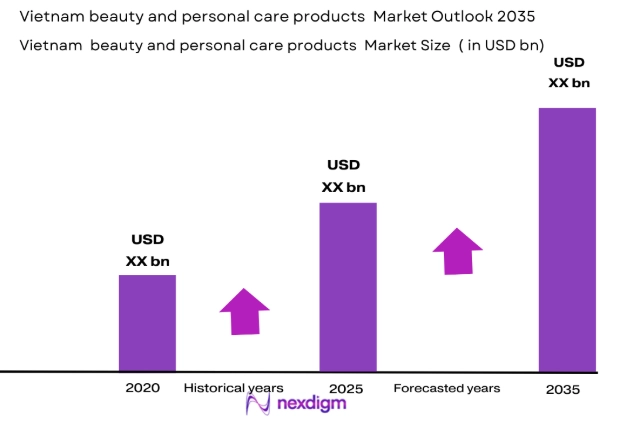
The Vietnam Beauty and Personal Care Products Market is valued at USD ~ billion, based on published Statista-based market tracking cited by B&Company. The market stood near USD 2.4 billion in the prior reported period and is supported by higher grooming expenditure, modern retail expansion, and digital beauty discovery. The forecast CAGR for the 2024-2030 period is assessed at around 3.0%, aligned with public forecast ranges of 2.7%-3.3%.
Ho Chi Minh City and Hanoi dominate Vietnam’s beauty and personal care products market because they concentrate affluent urban consumers, organized retail, e-commerce fulfilment, beauty clinics, salons, and global brand launches. Vietnam’s total retail sales reached VND 6,391 trillion, while monthly income per capita reached VND 5.4 million, supporting premium and masstige beauty purchases in these cities. Da Nang is also emerging due to tourism, modern retail, and younger consumers.
Market Segmentation
By Product Type
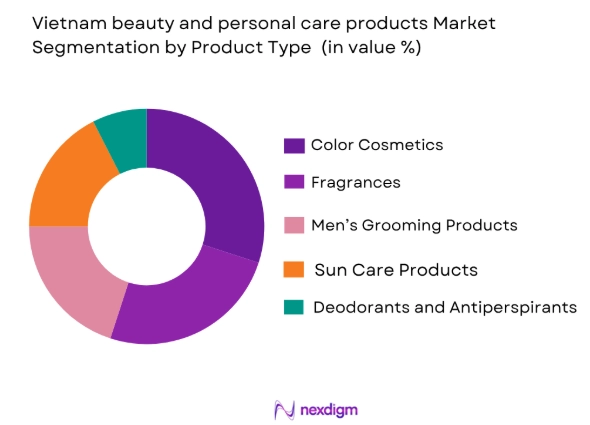
The Vietnam Beauty and Personal Care Products Market is segmented by product type into personal care products, skin care products, hair care products, color cosmetics, fragrances, and others. Personal care products hold the dominant market share because they include high-frequency, essential categories such as bath and shower, oral care, deodorants, and daily hygiene products. The segment benefits from wide household penetration, lower unit prices, strong availability across supermarkets, convenience stores, pharmacies, and e-commerce platforms, and repeat-purchase behavior. Skin care is the fastest-moving premium-oriented category, driven by K-beauty, J-beauty, dermatology-backed products, and sunscreen demand, but personal care remains larger because it addresses daily mass consumption across income groups.
By Distribution Channel
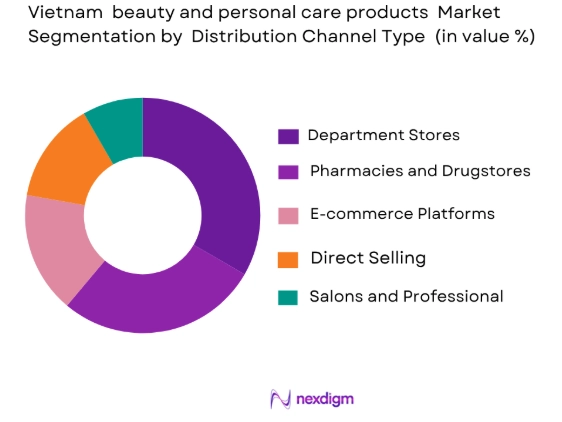
The Vietnam Beauty and Personal Care Products Market is segmented by distribution channel into e-commerce platforms, supermarkets and hypermarkets, beauty specialty stores, pharmacies and drugstores, direct selling, and salons and professional channels. E-commerce platforms dominate because Vietnamese consumers increasingly discover and purchase beauty products through Shopee, TikTok Shop, Lazada, and brand-owned online stores. Beauty is among Vietnam’s top online shopping categories, and price promotions, livestream selling, creator recommendations, and same-city logistics have made online platforms highly influential. Offline retail remains important for mass personal care and product testing, but e-commerce has become the primary growth channel for imported cosmetics, indie brands, and premium skin care.
Competitive Landscape
The Vietnam Beauty and Personal Care Products Market is competitive and fragmented, with global FMCG groups, Korean and Japanese beauty companies, pharmacy-led retailers, e-commerce-led D2C brands, and local natural beauty brands operating together. Unilever, L’Oréal, P&G, Shiseido, and LG Household & Health Care have strong brand portfolios and retail reach, while local brands such as Cocoon and Thorakao compete through natural ingredients, affordability, and Vietnamese identity.
| Company | Establishment Year | Headquarters | Key Categories | Vietnam Positioning | Core Channels | Product Strength | Marketing Focus | Sustainability / Compliance |
| Unilever Vietnam | 1995 | Ho Chi Minh City | ~ | ~ | ~ | ~ | ~ | ~ |
| L’Oréal Vietnam | 2007 | Ho Chi Minh City | ~ | ~ | ~ | ~ | ~ | ~ |
| Procter & Gamble Vietnam | 1994 | Ho Chi Minh City | ~ | ~ | ~ | ~ | ~ | ~ |
| Shiseido Vietnam | 2010s | Ho Chi Minh City | ~ | ~ | ~ | ~ | ~ | ~ |
| LG Household & Health Care Vietnam | 2010s | Ho Chi Minh City | ~ | ~ | ~ | ~ | ~ | ~ |
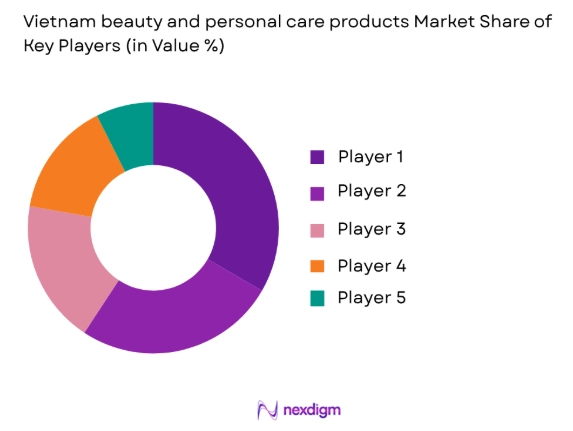
Vietnam Beauty and Personal Care Products Market Analysis
Growth Drivers
Rising Consumer Spending on Beauty and Personal Grooming
Vietnam’s beauty and personal care demand is supported by stronger household purchasing power and a larger formal retail base. The World Bank reported Vietnam’s GDP at USD 476.39 billion and GDP per capita at USD 4,717.3 in 2024, giving urban consumers more capacity for discretionary grooming products such as skin care, hair care, oral care, deodorants, and fragrances. The General Statistics Office reported total retail sales of goods and consumer services at VND 6.39 quadrillion in 2024, while average monthly income per capita reached VND 5.4 million, supporting repeat purchases of daily personal care products. Sources: World Bank, GSO.
Expansion of E-commerce and Social Commerce
Vietnam’s beauty and personal care products market is strongly supported by digital retail because beauty products are suited to search, comparison, creator-led discovery, and repeat online purchasing. The Ministry of Industry and Trade reported Vietnam’s e-commerce sector at USD 25 billion in 2024, while Vietnam E-Business Index 2025 reported 3.2 billion postal parcels in 2024, including around 2.4 billion packages linked to e-commerce. DataReportal recorded 78.44 million internet users in Vietnam in January 2024, creating a large reachable consumer base for cosmetics, skin care, and grooming brands. Sources: MoIT, VECOM, DataReportal.
Challenges
Regulatory Compliance and Product Safety Standards
Vietnam’s beauty and personal care companies face strict product compliance because cosmetics must align with Ministry of Health and ASEAN Cosmetic Directive requirements before circulation. The Drug Administration of Vietnam published updated ASEAN cosmetic annexes on 6 December 2024, covering Annex II banned substances, Annex III restricted substances, Annex IV permitted colorants, Annex VI preservatives, and Annex VII UV filters. Official DAV documents also require companies to manage product notification, ingredient restrictions, labelling, and safety documentation. This raises compliance workload for imported K-beauty, J-beauty, sun care, color cosmetics, and functional skin care brands. Sources: Drug Administration of Vietnam, Ministry of Health.
Counterfeit and Grey Market Beauty Products
Counterfeit and grey-market risks affect Vietnam’s beauty and personal care products market because fast-growing online commerce increases the number of sellers, parcels, and cross-border transactions requiring supervision. Reuters reported that Vietnam required Temu and Shein to register with the government by the end of November 2024 or face blocking, with authorities citing concerns about counterfeit products and aggressive discounting. The same enforcement context is relevant for cosmetics because online beauty sellers often trade imported skin care, fragrances, sunscreen, and makeup. Vietnam’s e-commerce value reached USD 25 billion in 2024, increasing the enforcement burden for product authenticity. Sources: Reuters, MoIT.
Opportunities
Clean Beauty and Sustainable Packaging
Clean beauty and sustainable packaging opportunities are supported by Vietnam’s expanding urban consumer base and tightening ingredient oversight. The World Bank reported Vietnam’s urban population at 40.2 per 100 people in 2024, while the National Statistics Office’s population projection data recorded an urban population of 38.7 million people in 2024. Urban consumers are more exposed to premium retail, pharmacies, dermatology clinics, branded e-commerce, and sustainability claims. At the same time, DAV’s updated ASEAN cosmetic annexes dated 6 December 2024 strengthen the case for cleaner formulations, transparent ingredients, and compliant packaging claims. Sources: World Bank, NSO, DAV.
Expansion of Cross-Border E-commerce Beauty Sales
Cross-border e-commerce creates a future growth opportunity for imported beauty, especially Korean, Japanese, French, and regional skin care brands. OEC trade data reported Vietnam imported beauty products under HS 3304 primarily from South Korea at USD 466 million, Singapore at USD 49.5 million, France at USD 48 million, Japan at USD 47.9 million, and China at USD 36.8 million in 2024. These import flows show strong demand for foreign cosmetics, while Vietnam’s e-commerce system handled around 2.4 billion e-commerce-linked parcels in 2024, supporting wider distribution of imported beauty products. Sources: OEC, VECOM.
Future Outlook
Over the next five to six years, the Vietnam Beauty and Personal Care Products Market is expected to expand steadily, supported by rising disposable income, urbanization, social commerce, and younger consumers’ interest in skin care routines. Growth will be strongest in skin care, sun care, men’s grooming, clean beauty, and premium personal care. E-commerce will remain a key route for product discovery and sales, while regulatory scrutiny will increase around claims, imports, product notification, and counterfeit products.Vietnam’s Ministry of Health and Drug Administration of Vietnam regulate cosmetic notifications and post-market surveillance, while Vietnam follows the ASEAN Cosmetic Directive framework. This will make compliance, product documentation, and label accuracy more important for imported and domestic brands.
Major Players
- Unilever Vietnam
- L’Oréal Vietnam
- Procter & Gamble Vietnam
- Shiseido Vietnam
- LG Household & Health Care Vietnam
- Amorepacific Vietnam
- Beiersdorf Vietnam
- Colgate-Palmolive Vietnam
- Johnson & Johnson Vietnam
- Rohto-Mentholatum Vietnam
- Estée Lauder Companies Vietnam
- Cocoon Vietnam
- Thorakao
- Hasaki
- Guardian Vietnam
Key Target Audience
- Beauty and personal care product manufacturers
- Cosmetic ingredient suppliers
- Retail chains and beauty specialty stores
- E-commerce and social commerce platforms
- Salons, spas, and dermatology clinics
- Importers and distributors of cosmetic products
- Investments and venture capitalist firms
- Government and regulatory bodies
Research Methodology
Step 1: Identification of Key Variables
The initial phase involves constructing an ecosystem map covering manufacturers, importers, distributors, retailers, online platforms, salons, and regulatory bodies in the Vietnam Beauty and Personal Care Products Market. This step uses secondary research, public databases, trade sources, and company information to identify major demand, supply, pricing, and regulatory variables.
Step 2: Market Analysis and Construction
Historical data is compiled for product categories, retail sales channels, pricing levels, import participation, and consumer demand patterns. Revenue estimates are constructed through a combination of top-down market sizing and bottom-up validation across product categories such as personal care, skin care, hair care, cosmetics, fragrances, and sun care.
Step 3: Hypothesis Validation and Expert Consultation
Market hypotheses are validated through interviews with brand managers, distributors, online beauty sellers, retail category heads, and industry specialists. These discussions help test assumptions related to channel mix, segment dominance, premiumization, consumer preferences, and regulatory barriers.
Step 4: Research Synthesis and Final Output
The final phase consolidates secondary data, expert inputs, competitive benchmarking, and channel-level assessment. The output is validated by comparing market size, company positioning, segment shares, and growth drivers with public industry sources and regulatory references to ensure consistency and reliability.

- Executive Summary
- Research Methodology (Market Definitions and Scope, Primary and Secondary Data Sources, Vietnam Regulatory Framework Reference, Product Classification Standards, Market Sizing Approach, Price Benchmarking Method, Forecasting Model Logic, Data Confidence and Margin of Error)

- Definition and Industry Scope
- Consumer Usage and Beauty Value Chain
- Retail and Distribution Structure
- Product Category Overview
- Supply Chain Flow from Manufacturers to End Consumers
- Regulatory and Safety Approval Framework in Vietnam

- Growth Drivers
Rising Consumer Spending on Beauty and Personal Grooming
Growing Demand for Korean, Japanese, and Natural Beauty Products
Expansion of E-commerce and Social Commerce
Influence of Social Media, KOLs, and Beauty Influencers
Rising Demand for Premium Skin Care, Sun Care, and Fragrances - Challenges
High Competition Among Domestic, Korean, Japanese, and Global Brands
Regulatory Compliance and Product Safety Standards
Price Sensitivity Among Mass-Market Consumers
Counterfeit and Grey Market Beauty Products
Sustainability and Packaging Compliance Pressure - Opportunities
Clean Beauty and Sustainable Packaging
Men’s Grooming Segment Expansion
Premiumization in Skin Care and Fragrances
Personalized Beauty and AI-Led Product Recommendations
Growth of Dermatology-Backed and Functional Beauty Products
Expansion of Cross-Border E-commerce Beauty Sales - Trends
K-Beauty and J-Beauty Influence
Natural, Herbal, and Organic Beauty Products
Vegan and Cruelty-Free Beauty Products
Hybrid Beauty and Skinification Products
Inclusive Beauty and Diverse Shade Ranges
Subscription-Based and Livestream Beauty Retail Models - Government and Industry Regulations
Cosmetic Product Notification Requirements
ASEAN Cosmetic Directive Compliance
Labelling and Ingredient Safety Standards
Import Regulations and Customs Requirements
Advertising and Claims Compliance - Swot Analysis
- Porter’s Five Forces

- By Market Value, 2020-2025
- By Product Volume, 2020-2025
- By Average Selling Price, 2020-2025
- By Product Category, 2020-2025

- By Product Type (In Value %)
Color Cosmetics
Fragrances
Men’s Grooming Products
Sun Care Products
Deodorants and Antiperspirants
- By Distribution Channel (In Value %)
Department Stores
Pharmacies and Drugstores
E-commerce Platforms
Direct Selling
Salons and Professional - By Price Segment (In Value %)
Mass Market Products
Premium Products
Luxury Products
Professional and Salon-Grade Products - By Gender (In Value %)
Women
Men
Unisex - By Age Group (In Value %)
Teenagers
Young Adults
Middle-Aged Consumers
Senior Consumers

- Market Structure
- Competitive Intensity and Entry Barriers
- Pricing Matrix by Product Category
- Product Portfolio Comparison
- Cross-Comparison Parameters (Company Overview, Regional Distribution Reach, Product Category Focus, Product Formulation and Technology Specs, Brand Positioning, Regulatory Approvals and Compliance, Average Selling Price Bands,
Channel Presence, Annual Revenue from Vietnam Operations, After-Sales and Customer Support Network, Marketing and Influencer Strategy, Sustainability Initiatives, Private Label and Retail Partnerships, Customer Satisfaction Scores) - SWOT Analysis of Key Competitors
- Pricing and Procurement Analysis
- Porter’s Five Forces Analysis
- Key Players
Unilever Vietnam
L’Oréal Vietnam
Procter & Gamble Vietnam
Shiseido Vietnam
Amorepacific Vietnam
LG Household & Health Care Vietnam
Beiersdorf Vietnam
Colgate-Palmolive Vietnam
Johnson & Johnson Vietnam
Rohto-Mentholatum Vietnam
Dove
Nivea
Maybelline
The Face Shop
Innisfree
Cocoon Vietnam
Thorakao
Hasaki
Guardian Vietnam
Watsons Vietnam

- Middle to upper-income, urban beauty-conscious consumers
- Demand for affordable and effective personal care solutions
- Preference for natural, dermatologically tested, Korean, and Japanese beauty products
- Premium services, discount options, and subscription models
- Seeking advanced, innovative, and personalized beauty products
- Social media-driven beauty trends and influencer recommendations

- By Market Value, 2026-2035
- By Product Volume, 2026-2035
- By Average Selling Price, 2026-2035
- By Product Category, 2026-2035


 Request a Sample
 Ask for Customization
 Get a Quote
 Enquire Now