

 Download PDF
Market Overview
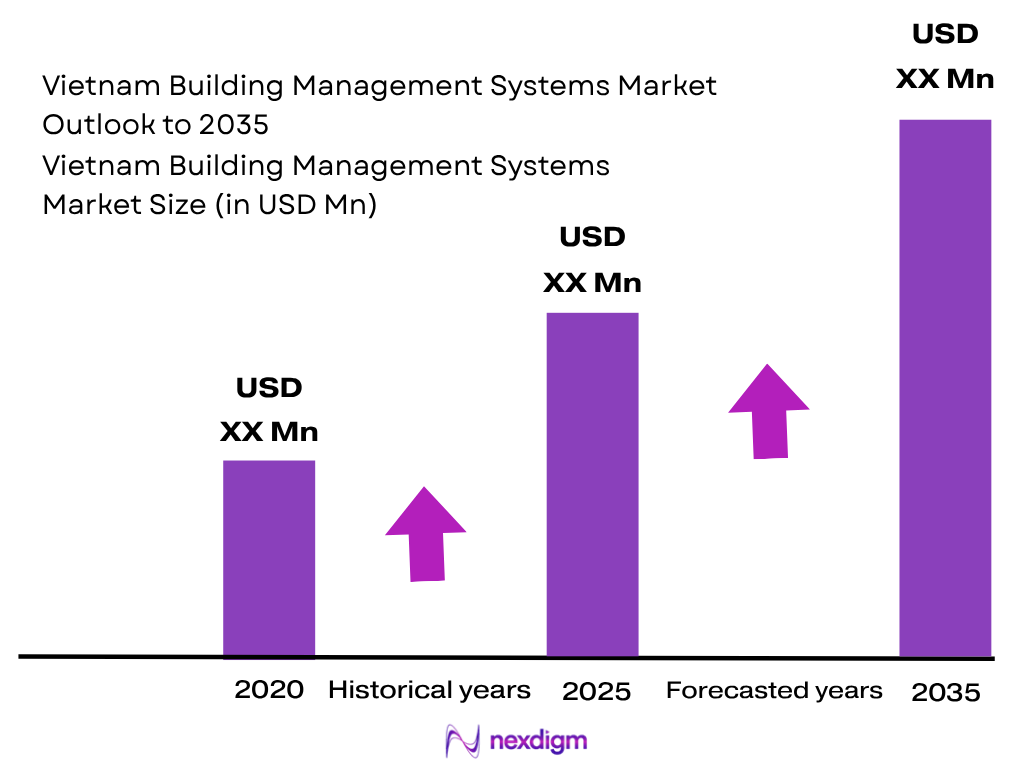
The Vietnam Building Management Systems Market is valued at approximately ~USD XX million, supported by rapid expansion in industrial, commercial and energy-intensive buildings. Registered foreign investment increased from USD 36.6 billion in the preceding annual observation to USD 38.23 billion in the latest period, while manufacturing attracted USD 25.58 billion. The construction sector simultaneously strengthened, reinforcing demand for HVAC automation, energy monitoring, smart metering and integrated building controls.
Ho Chi Minh City and Hanoi are the principal BMS demand centers because they concentrate premium offices, hotels, hospitals, malls, mixed-use complexes and data infrastructure, while Binh Duong, Bac Ninh, Hai Phong and Dong Nai benefit from manufacturing investment. Vietnam’s green-building stock expanded to 559 certified projects covering more than 13.6 million square metres, while Hanoi alone accounted for more than 2.16 million square metres. Ho Chi Minh City remained ahead, strengthening demand for automated, energy-managed buildings.
Market Segmentation
By Component Type
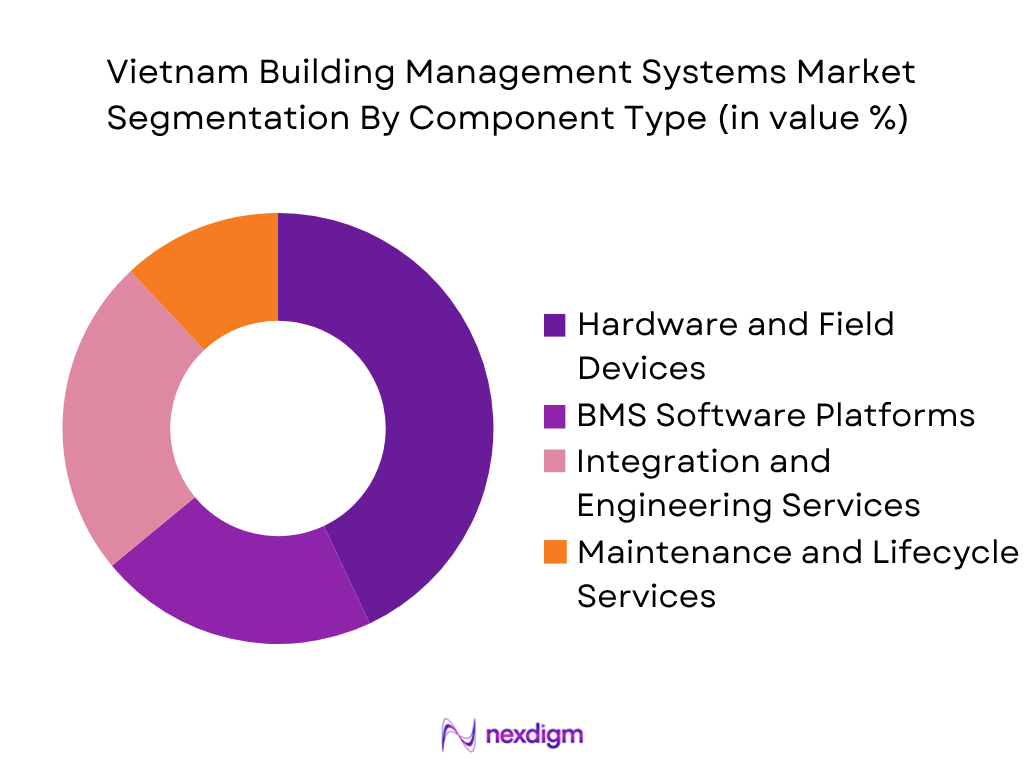
The Vietnam Building Management Systems Market is segmented into hardware, software platforms, integration and engineering services, and maintenance and lifecycle services. Hardware represents the dominant modeled segment, reflecting the significant physical automation content required to establish or modernize a BMS. Commercial towers, factories, hotels, hospitals and data centres require automation servers, DDC controllers, room controllers, temperature and humidity sensors, CO2 sensors, actuators, control valves, meters, gateways and control panels before higher-level software functions can operate effectively. Vietnam’s manufacturing expansion further supports hardware demand because sophisticated factories require large numbers of connected control points for HVAC, cleanrooms, utilities and electrical monitoring. The country attracted USD 25.58 billion of registered foreign investment into processing and manufacturing in the latest annual investment dataset. Modern BMS architectures are also becoming increasingly IP-based, but these platforms still rely on extensive field-level devices. Schneider Electric’s building platform, for example, integrates BACnet, Modbus, LonWorks, MQTT and IoT devices into a unified management environment.
By Building Type
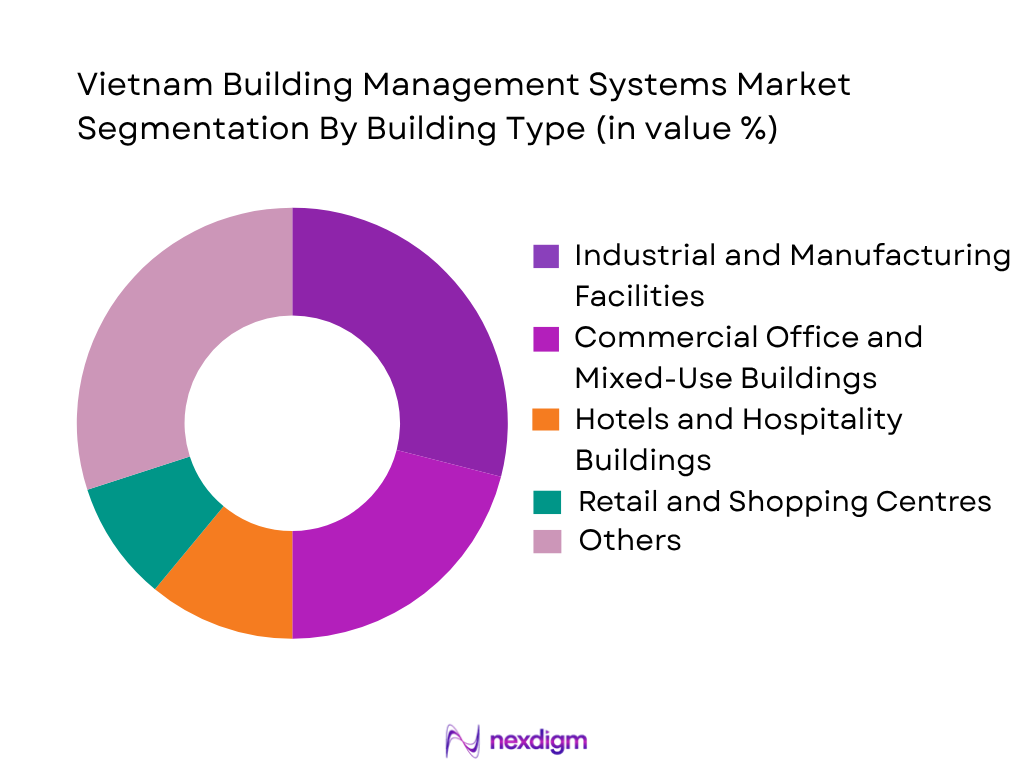
The Vietnam Building Management Systems Market is segmented into industrial and manufacturing facilities, commercial offices, mixed-use buildings, hotels and resorts, hospitals, retail properties, data centres, public buildings and high-rise residential developments. Industrial and manufacturing facilities represent the dominant modeled sub-segment, supported by Vietnam’s role as a regional electronics, electrical equipment and export-manufacturing platform. Foreign investors committed USD 25.58 billion to processing and manufacturing in the latest annual investment period, while accumulated manufacturing investment exceeded USD 299.8 billion before the end of the preceding reporting period. Modern factories require controlled temperatures, humidity, ventilation, chilled-water systems, utility monitoring, electrical distribution supervision and alarm management, producing significantly higher automation density than conventional buildings. Semiconductor and electronics facilities further increase BMS intensity because production environments require stable indoor conditions and continuous monitoring. Industrial growth in Bac Ninh, Binh Duong, Hai Phong, Dong Nai and surrounding manufacturing clusters therefore strengthens opportunities for integrated HVAC, smart metering, energy analytics and facility-management platforms.
Competitive Landscape
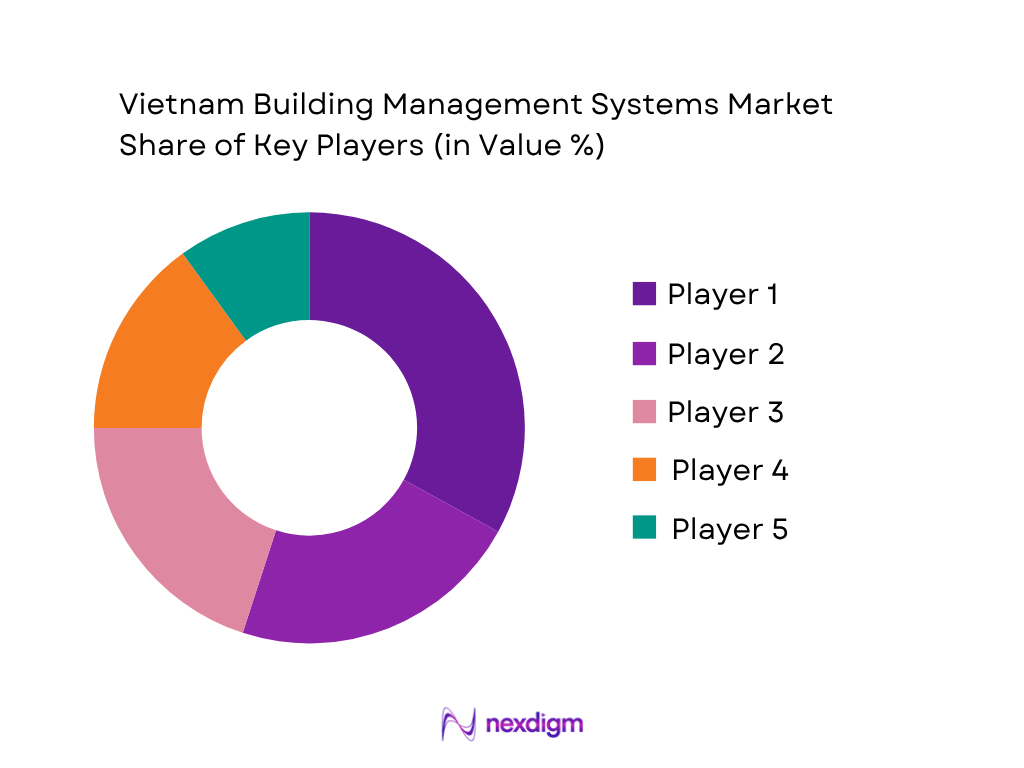
The Vietnam Building Management Systems Market includes multinational automation companies, HVAC-control specialists, electrical technology companies and domestic system integrators. Schneider Electric, Siemens, Honeywell, Johnson Controls and ABB are among the major international technology participants competing through integrated BMS platforms, controllers, HVAC automation, power monitoring, energy analytics and smart-building solutions. Competition increasingly depends on open-protocol interoperability, local commissioning support, cybersecurity, lifecycle service capability and the ability to integrate multiple building subsystems rather than supply standalone controls.
| Major Player | Establishment Year | Headquarters | Core BMS Platform | Protocol / Integration Capability | HVAC & Energy Management Capability | Cloud / Analytics Capability | Vietnam Market Presence | Key BMS Verticals |
| Schneider Electric | 1836 | Rueil-Malmaison, France | ~ | ~ | ~ | ~ | ~ | ~ |
| Siemens | 1847 | Munich/Berlin, Germany | ~ | ~ | ~ | ~ | ~ | ~ |
| Honeywell | 1906 | Charlotte, United States | ~ | ~ | ~ | ~ | ~ | ~ |
| Johnson Controls | 1885 | Cork, Ireland | ~ | ~ | ~ | ~ | ~ | ~ |
| ABB | 1988 | Zurich, Switzerland | ~ | ~ | ~ | ~ | ~ | ~ |
Vietnam Building Management Systems Market Analysis
Growth Drivers
Industrial Expansion and High-Technology Manufacturing Increasing Building Automation Demand
Vietnam’s expansion in industrial and high-technology manufacturing is increasing demand for Building Management Systems because modern factories require centralized control of HVAC, chilled-water networks, cleanroom conditions, electrical distribution, compressed air, indoor environmental quality, alarms, and energy consumption. The Ministry of Planning and Investment recorded USD 38.23 billion of registered foreign investment in 2024, including USD 25.58 billion directed to processing and manufacturing and 3,375 new foreign-invested projects. Vietnam also had 422 industrial zones across 61 provinces and cities, providing a large installed base for automation-intensive facilities. Electricity use reinforces the need for active energy management: EVN reported national power sales of 276,029 million kWh in 2024, including 142,416 million kWh consumed by industry, compared with 129,223 million kWh in 2023. Building automation can therefore support industrial customers through chiller optimization, equipment scheduling, sub-metering, utility monitoring, and centralized diagnostics. The wider macroeconomic environment supports continued investment, with World Bank data showing Vietnam’s GDP at USD 476.39 billion, GDP per capita at USD 4,717.3, and a population of 100,987,686 in 2024.
Rising Green Building Stock and Electricity Consumption Supporting Energy-Optimized BMS
The rapid expansion of certified green buildings is creating a stronger structural requirement for Building Management Systems capable of measuring, controlling, and documenting building performance. Vietnam recorded 559 certified green buildings with 13,579,588 square metres of certified floor area, while 163 additional green buildings were added during 2024. Ho Chi Minh City alone accounted for 3.4 million square metres of green-certified floor space, followed by Hanoi, Binh Duong, Bac Ninh, and Hai Phong. This expansion is directly relevant to BMS because certified projects commonly require continuous monitoring of HVAC, energy consumption, indoor environmental quality, and utility performance. EVN reported power sales of 276,029 million kWh in 2024, including 14,976 million kWh consumed by commercial establishments, hotels, and restaurants and 97,110 million kWh used by administrative and residential consumers. National electricity demand also reached a record 1.025 billion kWh in a single day during June 2024, with peak system capacity of 49,533 MW. The World Bank reported Vietnam’s GDP at USD 476.39 billion and population at 100,987,686, supporting continued urban building development and digital facility management adoption.
Market Challenges
Cybersecurity Exposure Increasing Complexity of Connected Building Management Systems
The increasing connectivity of Building Management Systems creates a significant cybersecurity challenge because modern BMS platforms increasingly integrate HVAC, electrical systems, access control, smart meters, IoT gateways, cloud applications, and enterprise networks. Vietnam’s Ministry of Information and Communications reported approximately 659,000 cyberattacks targeting Vietnamese organizations during 2024, highlighting the broader threat environment faced by connected operational technology. In the first six months of 2024, national monitoring systems recorded 90,033 security vulnerabilities across information systems belonging to Vietnamese agencies and organizations. Authorities also detected and handled 211,000 cyberattack warnings and 20 serious cybersecurity incidents during the same period, while ransomware incidents encrypted around 3 terabytes of data and caused estimated losses exceeding USD 10 million. These conditions make secure remote access, network segmentation, firmware management, encrypted communications, user authentication, and IT-OT separation increasingly important for BMS deployments. Vietnam’s connected economy is expanding rapidly, with the World Bank reporting 84 internet users per 100 people, GDP of USD 476.39 billion, and 100,987,686 residents in 2024, increasing the number of digitally connected buildings and operational systems requiring protection.
Integration Complexity Across Rapidly Expanding Industrial and Commercial Infrastructure
Vietnam’s Building Management Systems market faces integration complexity because facilities increasingly combine equipment supplied by multiple HVAC, electrical, metering, fire-safety, security, and automation vendors. The challenge is especially relevant in industrial facilities, where systems may involve hundreds or thousands of field devices communicating over BACnet, Modbus, KNX, proprietary networks, or IP-based platforms. Vietnam’s industrial base is already extensive, with 422 industrial zones across 61 provinces and cities, increasing the number of factories requiring coordinated automation architectures. The country attracted USD 25.58 billion of registered investment into processing and manufacturing during 2024 and approved 3,375 new foreign-invested projects across the economy. Electricity consumption further demonstrates the operational scale that BMS integrators must manage: industrial customers consumed 142,416 million kWh in 2024, while commercial, hotel, and restaurant users consumed 14,976 million kWh. The wider construction sector also expanded, with the National Statistics Office reporting strong construction activity alongside manufacturing growth. Against this backdrop, system integrators must handle protocol conversion, legacy equipment, controller replacement, commissioning, cybersecurity, and uninterrupted operations. World Bank data place Vietnam’s 2024 GDP at USD 476.39 billion and GDP per capita at USD 4,717.3, supporting continued capital investment but also increasing the technical complexity of the building stock.
Market Opportunities
Green Building Expansion Creating Future Demand for Advanced Energy Management Platforms
Vietnam’s expanding green-building ecosystem creates a strong future opportunity for BMS providers supplying energy management, smart metering, fault detection, indoor environmental monitoring, and automated HVAC optimization. The country had 559 certified green buildings covering 13,579,588 square metres of floor area, and 163 projects received green certification during 2024. Ho Chi Minh City accounted for 3.4 million square metres of certified green floor area, with Hanoi, Binh Duong, Bac Ninh, and Hai Phong also emerging as significant green-building locations. These current figures indicate a growing installed base of buildings that require continuous monitoring after commissioning rather than one-time equipment installation. Electricity system conditions further strengthen the relevance of BMS-based efficiency: nationwide daily consumption reached 1.025 billion kWh during a June 2024 record, while peak system demand reached 49,533 MW. EVN separately reported annual commercial, hotel, and restaurant electricity use of 14,976 million kWh. Such operating loads create opportunities for chiller optimization, occupancy-based control, demand management, and portfolio-level analytics. The World Bank recorded Vietnam’s 2024 GDP at USD 476.39 billion, GDP per capita at USD 4,717.3, and population at 100,987,686, providing a substantial economic and urban base for continued smart-building adoption.
Industrial Parks and Manufacturing Investment Creating a Pipeline for Smart Facility Automation
Vietnam’s large industrial-park network creates a future growth opportunity for Building Management Systems as factories adopt more sophisticated environmental control, energy monitoring, electrical supervision, and centralized facility management. The Ministry of Planning and Investment reported 422 industrial zones across 61 provinces and cities, demonstrating the national scale of the industrial real-estate platform. Foreign investment remains heavily concentrated in manufacturing: USD 25.58 billion of registered FDI entered processing and manufacturing during 2024, while total registered foreign investment reached USD 38.23 billion. The momentum continued into 2025, when registered foreign investment reached USD 38.42 billion and realized FDI reached USD 27.62 billion. Manufacturing and processing activity also generated substantial operational demand, with EVN reporting industrial electricity consumption of 142,416 million kWh in 2024. These conditions provide a strong pipeline for BMS applications in electronics plants, semiconductor facilities, industrial campuses, logistics buildings, and utility-intensive manufacturing operations. Opportunities include cleanroom monitoring, chilled-water optimization, smart metering, equipment alarms, utility dashboards, and enterprise-wide multi-factory monitoring. World Bank figures place Vietnam’s GDP at USD 476.39 billion in 2024 and USD 514.70 billion in 2025, reinforcing the economic scale supporting industrial digitalization and automation investment.
Future Outlook
The Vietnam Building Management Systems Market is expected to expand at approximately ~X.X% CAGR during 2026–2035, supported by rapid industrialization, smart-building adoption, energy-efficiency requirements and increasing digitization of building operations. Growth is expected to shift from conventional standalone HVAC control toward integrated platforms connecting energy, cooling, lighting, security and facility-management systems. Cloud connectivity, AI-assisted diagnostics, IoT sensors and multi-site building management will become increasingly important differentiators.
Industrial BMS should remain particularly important as Vietnam expands electronics, semiconductor, high-technology manufacturing and export-oriented industrial capacity. Manufacturing accounted for USD 25.58 billion of registered foreign investment in the latest annual dataset, creating a strong pipeline of facilities where HVAC reliability, electrical monitoring, utility control and environmental stability are operationally critical.
Major Players
- Schneider Electric Vietnam
- Siemens Vietnam
- Honeywell
- Johnson Controls
- ABB Vietnam
- Mitsubishi Electric Vietnam
- Azbil Vietnam Co., Ltd.
- Trane Vietnam
- Carrier Vietnam
- Delta Electronics
- Bosch Building Technologies
- Legrand Vietnam
- KPS Technology and Engineering
- AIControl Vietnam
- HDL Engineering Trading JSC
Key Target Audience
- Building Management Systems Manufacturers
- Building Automation System Integrators
- Property Developers and Commercial Real Estate Owners
- Industrial and Manufacturing Facility Operators
- Data Centre Owners and Operators
- Facility Management and Building Operations Companies
- Investments and Venture Capitalist Firms
- Government and Regulatory Bodies
Research Methodology
Step 1: Identification of Key Variables
The initial phase involves constructing a detailed ecosystem map covering BMS OEMs, controllers, sensors, software providers, system integrators, HVAC contractors, MEP companies, developers and facility operators. Desk research identifies critical variables such as building automation penetration, connected control points, hardware intensity, software deployment, HVAC integration, project type, vertical demand, protocol usage and lifecycle service requirements.
Step 2: Market Analysis and Construction
Historical market development is assessed through both top-down and bottom-up models. Top-down analysis considers commercial construction, industrial investment, manufacturing FDI, green-building development and data-centre activity, while bottom-up modelling estimates BMS hardware, software, integration and service revenue by building type. Project-level information is translated into controller counts, field-device requirements and typical system architecture.
Step 3: Hypothesis Validation and Expert Consultation
Market hypotheses are validated through computer-assisted telephone interviews and direct discussions with BMS manufacturers, automation system integrators, HVAC contractors, MEP professionals, facility managers and building owners. Interviews verify installed-base assumptions, competitive positioning, protocol preferences, controller density, modernization activity, software adoption, maintenance requirements and procurement structures across commercial, industrial and mission-critical facilities.
Step 4: Research Synthesis and Final Output
The final phase triangulates official construction and investment data, building-project information, company disclosures and primary interviews. Bottom-up equipment and installation estimates are reconciled with top-down spending patterns and supplier participation. The resulting model evaluates component mix, building applications, geographic demand, competitive positioning, modernization requirements and future adoption of cloud, IoT, AI and integrated energy-management technologies.

- Executive Summary
- Research Methodology (Market Definitions and Assumptions, Vietnam Building Management Systems Market Classification, Building Automation Scope, BMS Hardware Mapping, BMS Software Assessment, Building Controllers Assessment, Automation Server Assessment, Field Device Assessment, Sensor and Actuator Assessment, HVAC Controls Assessment, Lighting Controls Assessment, Energy Management Integration Assessment, Fire and Life-Safety Integration Assessment, Security and Access-Control Integration Assessment, Elevator and Vertical-Transportation Integration Assessment, Smart Metering Assessment, IoT Gateway Assessment, Cloud BMS Assessment, Edge-Control Assessment, BACnet Compatibility Assessment, Modbus Compatibility Assessment, KNX Compatibility Assessment, MQTT and API Integration Assessment, Cybersecurity Assessment, Building-Energy-Efficiency Assessment, Green Building Compliance Assessment, Supply-Side Assessment, Demand-Side Assessment, Top-Down Market Sizing, Bottom-Up Market Sizing, Primary Industry Interviews, Building Project Pipeline Assessment, Installed-Base Mapping, Data Triangulation, Forecasting Framework)

- Definition and Scope
- Vietnam Building Automation Industry Evolution and Development of Conventional BMS, Direct Digital Control Systems, HVAC Automation, Integrated Building Management Systems, Energy Management Systems, Smart Building Platforms, IoT-Enabled BMS, Cloud-Based Building Management, Edge-Control Systems, AI-Assisted Building Analytics, Digital-Twin-Enabled Building Operations, Integrated Security Platforms, Smart Metering, Occupancy-Based Controls, Demand-Controlled Ventilation, Remote Facility Management, Connected Building Ecosystems
- Building Management Systems Value Chain Analysis
- Building Management Systems Supply Chain Analysis
- Semiconductor and Electronics Suppliers, Sensor Manufacturers, Controllers and PLC Manufacturers, HVAC Control Vendors, Automation Server Providers, BMS Software Developers, IoT Platform Providers, Building Automation OEMs, System Integrators, MEP Contractors, Electrical Contractors, HVAC Contractors, Engineering Consultants, Property Developers, Building Owners, Facility Management Companies, Cloud Providers

- Growth Drivers (Commercial Building Development, Industrial Park Expansion, Electronics Manufacturing Investment, Data Centre Construction, Hotel and Hospitality Development, Smart Building Adoption, Energy-Efficiency Requirements, HVAC Optimization, Green Building Certification, Demand for Centralized Facility Control)
- Market Challenges (High Initial Automation Investment, Fragmented Legacy Building Systems, Proprietary Protocol Lock-In, System Integration Complexity, Skilled BMS Programmer Availability, Cybersecurity Risk, Imported Hardware Dependency, Building Owner Awareness, Retrofit Downtime, Inconsistent Maintenance Practices)
- Market Opportunities (Data Centre BMS, Semiconductor and Electronics Factory Automation, Green Building Retrofit, Existing BMS Modernization, Cloud BMS, AI-Based Fault Detection, Digital Twin Integration, Smart Hotels, Smart Hospitals, Industrial Energy Management, Multi-Site Portfolio Management, Cybersecure Open-Protocol BMS, Building-to-Grid Integration)
- Market Trends (BACnet/IP Adoption, MQTT Integration, Cloud-Based Building Monitoring, Edge Analytics, AI-Assisted Predictive Maintenance, IoT Sensor Deployment, Smart Metering Integration, Chiller Plant Optimization, Occupancy-Based Controls, Indoor Air Quality Monitoring, API-Based Integration, Mobile Facility Management, Digital Twins)
- Government Regulations and Standards (QCVN Building Energy Efficiency Requirements, Vietnam Energy Efficiency Regulations, Fire Prevention and Fighting Requirements, Electrical Safety Requirements, Cybersecurity Requirements, Building Technical Regulations, Green Building Compliance, LOTUS Certification, EDGE Certification)
- SWOT Analysis
- Porter’s Five Forces Analysis
- PESTLE Analysis
- Stakeholder Ecosystem
- Smart Building and BMS Project Ecosystem

- By Market Value (2020-2025)
- By Hardware Revenue (2020-2025)
- By Software Revenue (2020-2025)
- By Installation and Integration Services Revenue (2020-2025)
- By Maintenance and Lifecycle Services Revenue (2020-2025)
- By Number of BMS-Enabled Buildings (2020-2025)
- By Number of Connected BMS Control Points (2020-2025)
- By New-Build BMS Deployments (2020-2025)
- By Retrofit and Modernization Deployments (2020-2025)
- By Commercial Building BMS Installations (2020-2025)
- By Industrial Building BMS Installations (2020-2025)
- By Data Centre BMS Installations (2020-2025)

- By Component Type (In Value %)
BMS Software Platforms
Automation Servers
Direct Digital Controllers
Programmable Controllers
Room Controllers
Sensors and Transmitters
Actuators and Control Valves
IoT Gateways
Human-Machine Interfaces
Control Panels
Smart Meters
Networking and Communication Devices
Integration and Engineering Services
Maintenance and Digital Services - By System Architecture (In Value %)
Standalone Building Automation Systems
Centralized BMS
Distributed BMS
Web-Based BMS
IP-Based BMS
IoT-Enabled BMS
Cloud-Based BMS
Hybrid Cloud-Edge BMS
Enterprise Multi-Site Building Platforms
Digital-Twin-Integrated BMS - By Controlled Building System (In Value %)
HVAC and Chiller Plant Control
Air Handling and Ventilation Control
Lighting Control
Electrical Power Monitoring
Energy Management
Fire Alarm and Life-Safety Monitoring
Access Control and Security Integration
CCTV Integration
Elevator and Escalator Monitoring
Water Supply and Pump Control
Plumbing and Drainage Monitoring
Indoor Air Quality Monitoring
Smart Metering
Renewable Energy and Microgrid Integration
EV Charging Integration - By Building Type (In Value %)
Commercial Office Buildings
Mixed-Use Developments
Shopping Centres and Retail Buildings
Hotels and Resorts
Hospitals and Healthcare Facilities
Educational and Campus Buildings
Government and Public Buildings
Industrial and Manufacturing Facilities
Electronics and Semiconductor Plants
Data Centres
Logistics and Warehousing Facilities
Airports and Transportation Infrastructure
Residential High-Rise Buildings
Premium Condominiums
Smart Residential Developments - By Region (In Value %)
Ho Chi Minh City
Hanoi
Binh Duong
Dong Nai
Hai Phong
Bac Ninh
Da Nang
Ba Ria-Vung Tau
Hung Yen
Long An
Other Northern Vietnam
Other Central Vietnam
Other Southern Vietnam

- Market Share of Major Players (By Vietnam Revenue, Installed BMS Sites, Connected Control Points, Commercial Building Presence, Industrial Facility Presence, Data Centre Presence, Hardware Portfolio, Software Platform Presence, System Integration Capability, Service and Maintenance Network, HVAC Control Capability, Energy Management Capability, Open-Protocol Compatibility, Cloud and Remote Monitoring Capability)
- Cross Comparison Parameters (BMS Software Platform Breadth, BACnet-Modbus-KNX-MQTT Interoperability, HVAC and Chiller Optimization Capability, Energy Management and Smart Metering Capability, Cloud-Edge and Remote Monitoring Capability, Cybersecurity and Secure Building Network Capability, Vietnam System Integrator and Service Coverage, Data Centre and Mission-Critical Building Capability)
- SWOT Analysis of Major Players
- Competitive Positioning Matrix
- Major Companies
Schneider Electric Vietnam
Siemens Vietnam
Honeywell
Johnson Controls
ABB Vietnam
Mitsubishi Electric Vietnam
Azbil Vietnam Co., Ltd.
Trane Vietnam
Carrier Vietnam
Delta Electronics
Bosch Building Technologies
Legrand Vietnam
KPS Technology and Engineering
AIControl Vietnam
HDL Engineering Trading JSC

- Real Estate Developer BMS Requirement Assessment
- Commercial Property Owner Requirement Assessment
- Facility Management Company Requirement Assessment
- Industrial Manufacturer Requirement Assessment
- Data Centre Operator BMS Requirement Assessment
- Hotel Operator BMS Requirement Assessment
- Hospital BMS Requirement Assessment
- Retail Property BMS Requirement Assessment
- Government Building BMS Requirement Assessment
- Industrial Park Facility Requirement Assessment

- By Market Value (2026-2035)
- By Hardware Revenue (2026-2035)
- By Software Revenue (2026-2035)
- By Installation and Integration Services Revenue (2026-2035)
- By Maintenance and Lifecycle Services Revenue (2026-2035)
- By Number of BMS-Enabled Buildings (2026-2035)
- By Number of Connected BMS Control Points (2026-2035)
- By New-Build BMS Deployments (2026-2035)
- By Retrofit and Modernization Deployments (2026-2035)
- By Commercial Building BMS Installations (2026-2035)
- By Industrial Building BMS Installations (2026-2035)
- By Data Centre BMS Installations (2026-2035)


 Request a Sample
 Ask for Customization
 Get a Quote
 Enquire Now
