
 Download PDF
Market Overview
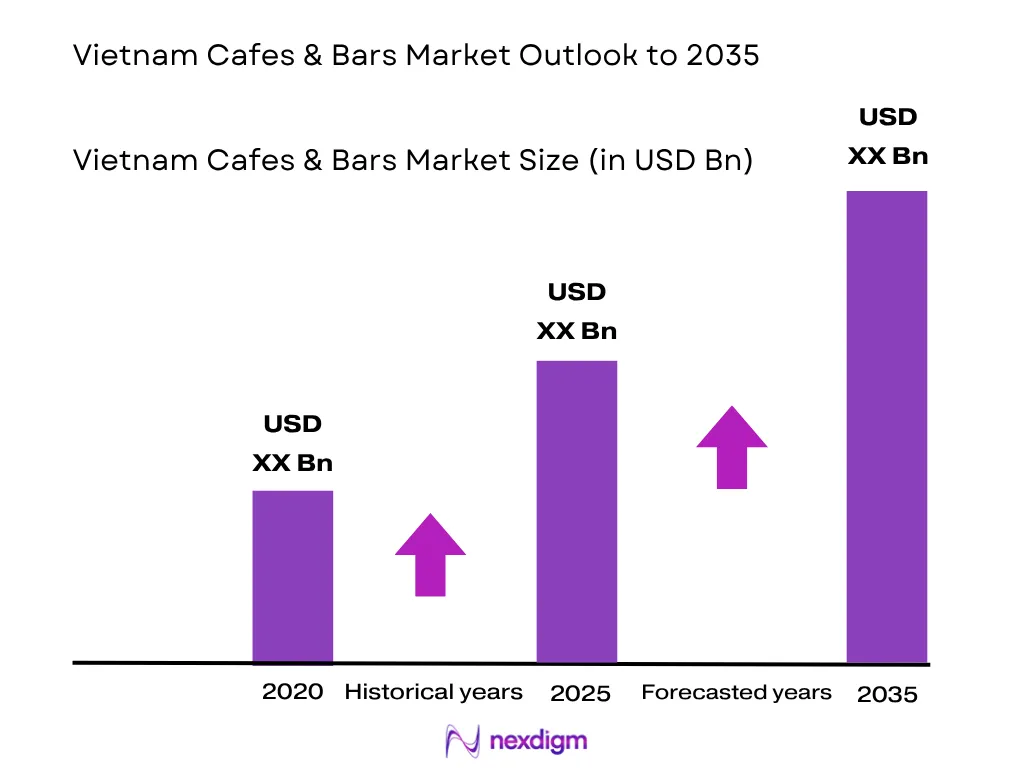
Explanation of market size and how it is driven: The Vietnam Cafes & Bars Market is valued at USD ~ billion. Vietnam foodservice sales reached USD ~ billion, with cafés/bars accounting for 18% of total foodservice sales and operating through more than 38,000 locations. The market is driven by urban café culture, beverage-led social occasions, delivery ordering, youth consumption, and tourism-led nightlife, supported by Vietnam’s broader 323,000+ foodservice outlets.
Ho Chi Minh City and Hanoi dominate the Vietnam Cafes & Bars Market because they combine dense office catchments, tourist spending, nightlife streets, mall-based chains, premium hotel F&B, and strong digital-ordering usage. Ho Chi Minh City received 6.1 million international visitors and 38 million domestic visitors, while Vietnam’s international arrivals increased from 12.6 million to 17.6 million, strengthening café, beer-bar, cocktail-bar, and late-night beverage demand in major urban hubs.
Market Segmentation
By Outlet Format
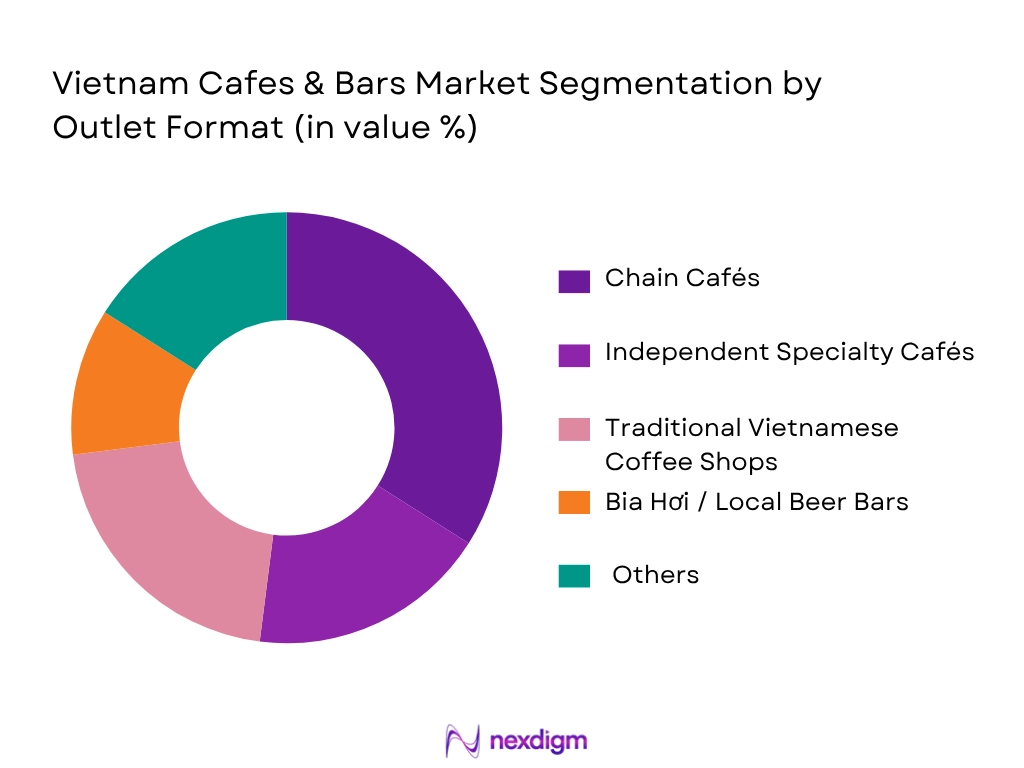
The Vietnam Cafes & Bars Market is segmented by outlet format into chain cafés, independent specialty cafés, traditional Vietnamese coffee shops, bia hơi/local beer bars, cocktail bars, hotel bars, rooftop lounges, and hybrid café-bar formats. Recently, chain cafés have maintained the dominant market share under this segmentation because operators such as Highlands Coffee, Phuc Long, Katinat, The Coffee House, Starbucks, and Trung Nguyên Legend have built standardized beverage menus, high-visibility stores, loyalty ecosystems, and convenient mall/high-street footprints. Chain cafés benefit from strong throughput across breakfast coffee, office breaks, student usage, takeaway orders, and app-based promotions. Their procurement scale also helps manage coffee, milk, tea, cup, syrup, and packaging costs better than small independent outlets. Nexdigm notes that cafés and bars represent more than 38,000 locations nationally, while large chains are increasingly central to organized beverage consumption.
By Beverage Type
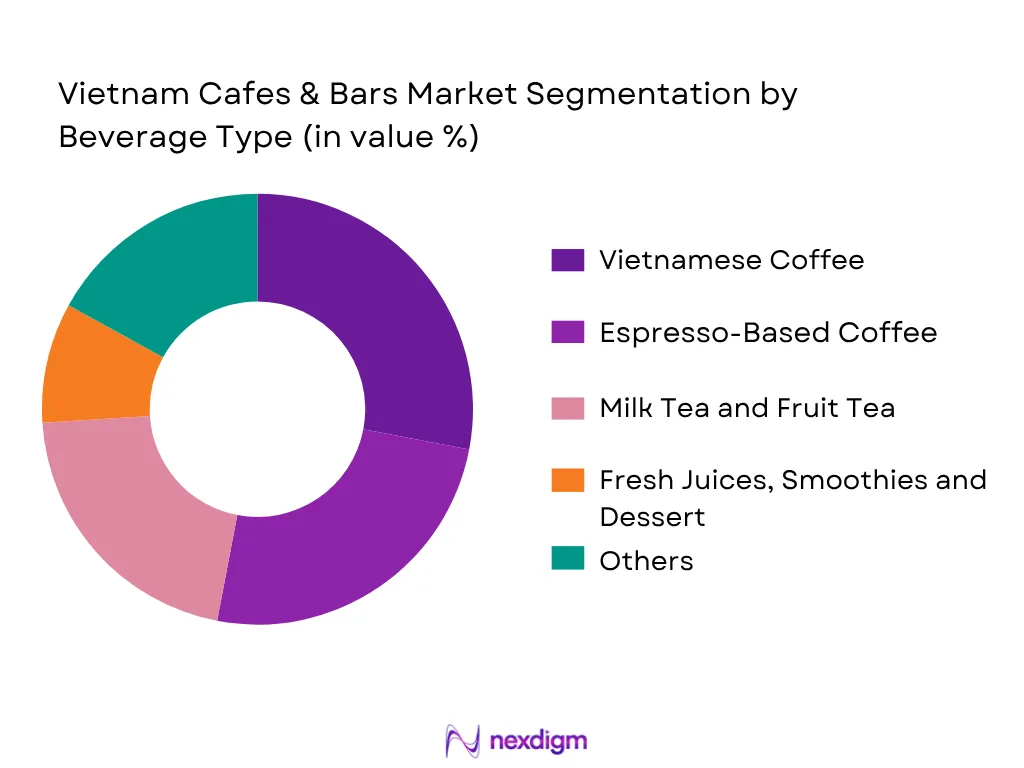
The Vietnam Cafes & Bars Market is segmented by beverage type into Vietnamese coffee, espresso-based coffee, milk tea and fruit tea, fresh juices, smoothies, beer, craft beer, cocktails, wine, spirits, cold brew, specialty coffee, and functional beverages. Recently, Vietnamese coffee has dominated the market share because it is embedded in daily consumption, available across traditional shops and organized chains, and carries strong cultural relevance through phin coffee, iced milk coffee, egg coffee, salt coffee, and coconut coffee. Its price accessibility supports high purchase frequency among students, office workers, and commuters, while premium cafés use local-origin robusta and specialty brewing to move the same base category into higher-margin formats. Imported roasted coffee increased from USD ~ million to USD ~ million, indicating rising premiumization alongside local coffee consumption.
Competitive Landscape
The Vietnam Cafes & Bars Market is competitive but increasingly organized around scalable café chains, local heritage coffee brands, premium tea-and-coffee concepts, and emerging craft beer operators. Domestic operators dominate everyday coffee occasions due to local taste familiarity, strong real-estate access, and affordable beverage pricing, while international brands compete in premium malls, business districts, tourist streets, and expatriate-heavy locations. Café chains also use delivery platforms, loyalty apps, seasonal menus, and food attachments to increase ticket size.
| Player | Establishment Year | Headquarters | Core Format | Beverage Focus | Store / Footprint Positioning | Service Model | Digital / Delivery Orientation | Market-Specific Differentiator |
| Highlands Coffee | 1999 | Ho Chi Minh City | ~ | ~ | ~ | ~ | ~ | ~ |
| Phuc Long Coffee & Tea | 1968 | Ho Chi Minh City | ~ | ~ | ~ | ~ | ~ | ~ |
| The Coffee House | 2014 | Ho Chi Minh City | ~ | ~ | ~ | ~ | ~ | ~ |
| Trung Nguyên Legend | 1996 | Ho Chi Minh City / Buon Ma Thuot heritage | ~ | ~ | ~ | ~ | ~ | ~ |
| Pasteur Street Brewing Company | 2014 | Ho Chi Minh City | ~ | ~ | ~ | ~ | ~ | ~ |
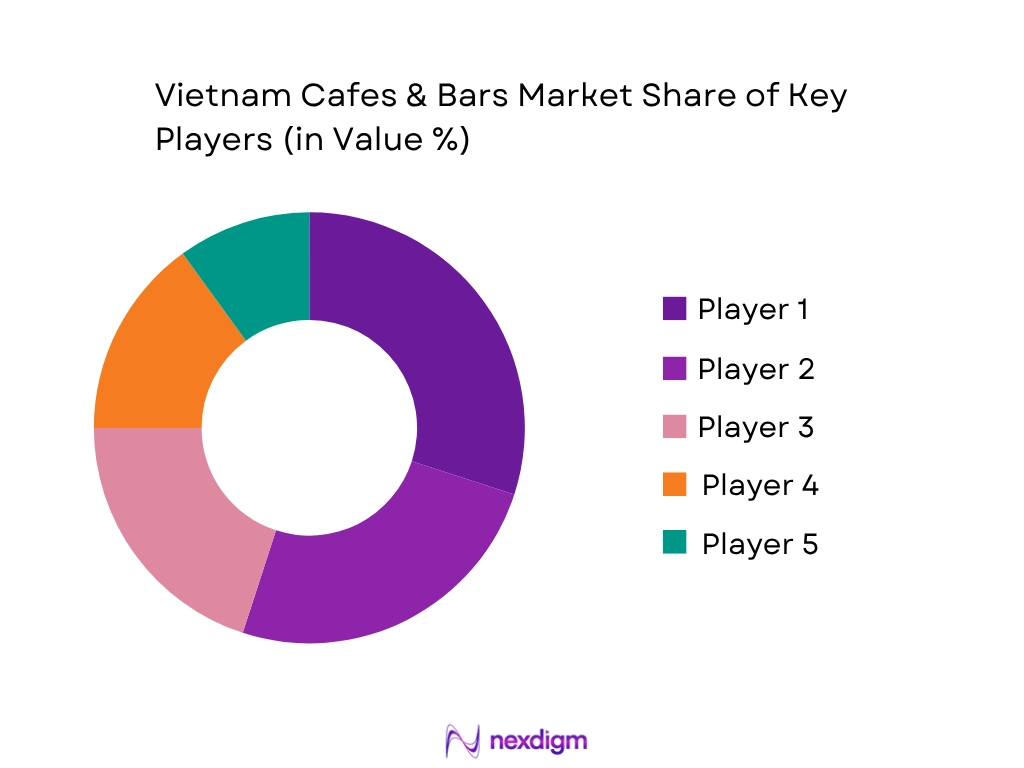
Vietnam Cafes & Bars Market Analysis
Growth Drivers
Urban Middle-Class Consumption
Urban middle-class consumption is a direct growth driver for the Vietnam Cafes & Bars Market because the country now has a large income base, dense city consumption zones, and rising out-of-home spending capacity. World Bank data records Vietnam’s population at 100,987,686 people and GDP at USD 476.39 billion, while GDP per capita stands at USD 4,717.3, creating a broad consumer base for daily coffee, tea, beer, and social beverage occasions. The same World Bank country dataset records internet usage at 84 people per 100 population, which supports app-led discovery, digital payments, delivery ordering, and loyalty programs used by café and bar chains. Vietnam’s National Statistics Office also reports GDP at current prices of VND 11,511.9 trillion, equivalent to USD 476.3 billion, and GDP per capita of VND 114 million per person, equivalent to USD 4,700, reinforcing that consumer-facing F&B demand is supported by a larger national income pool. For cafés and bars, this translates into frequent spending occasions from office workers, students, young professionals, freelancers, tourists, and higher-income urban consumers, especially in Ho Chi Minh City, Hanoi, Da Nang, Can Tho, and other cities with high street-retail density. The market implication is that café chains, traditional coffee shops, beer bars, and premium beverage operators can expand around weekday office traffic, weekend leisure, delivery catchments, and mixed-use urban developments.
Café Socialization Culture
Vietnam’s café socialization culture is supported by a large urban and digitally connected population, strong tourism recovery, and a national F&B ecosystem where cafés are used for work, study, meetings, dating, leisure, and tourist experiences. World Bank records Vietnam’s total population at 100,987,686 people, while the Vietnam Government Portal, citing the General Statistics Office, reports Vietnam’s population at 101,112,656 people as of April 1. These numbers create a large everyday consumer base for low-ticket, high-frequency beverage occasions. Tourism adds another café-and-bar demand layer: the Vietnam National Authority of Tourism states that Vietnam received more than 17.5 million international visitor arrivals, while General Statistics Office-linked reporting states that arrivals reached nearly 17.6 million. This matters for the Vietnam Cafes & Bars Market because cafés are embedded in tourist itineraries through Vietnamese iced coffee, egg coffee, salt coffee, coconut coffee, craft beer, rooftop bars, and nightlife districts. Ho Chi Minh City and Hanoi benefit most from commercial density, tourist discovery, coworking-style café usage, and evening socialization, while Da Nang, Hoi An, Nha Trang, and Phu Quoc benefit from coastal tourism and hospitality-led beverage consumption. Cafés function as third places rather than only refreshment outlets, so operators compete on ambience, seating comfort, Wi-Fi, air-conditioning, menu variety, brand identity, and social-media visibility.
Market Challenges
Rental Escalation
Rental escalation is a market-specific challenge because café and bar operators need high-footfall sites, but the same commercial districts are also targeted by restaurants, convenience stores, retailers, banks, pharmacies, hotels, coworking spaces, and entertainment tenants. Vietnam’s consumer-service economy creates concentrated pressure on prime locations: National Statistics Office-linked reporting states total retail sales of goods and consumer services reached VND 6,391 trillion, while accommodation and catering services generated nearly VND 734 trillion. These figures show why ground-floor high-street units, mall kiosks, corner shops, tourist streets, office podiums, and hotel-adjacent locations are heavily contested. For cafés and bars, location is not optional; it directly influences walk-in traffic, delivery radius, visibility, table occupancy, evening footfall, and tourist conversion. IMF data also shows Vietnam’s economy expanding with GDP at USD 527.27 billion and GDP per capita at USD 5.12 thousand in its latest 2026 country profile, strengthening the macro backdrop for service-sector tenancy competition. Chain cafés can spread site risk across networks, but single-location operators are more exposed to lease renewals, deposit requirements, relocation disruption, and reduced operating leverage in saturated commercial streets.
Outlet Cannibalization
Outlet cannibalization is a rising challenge in the Vietnam Cafes & Bars Market because organized café chains, traditional coffee shops, independent specialty cafés, beer bars, tea shops, dessert cafés, and hotel lounges increasingly compete for overlapping consumers in the same urban catchments. NEXDIGM’s foodservice report records more than 323,000 foodservice locations in Vietnam and more than 38,000 café and bar locations, creating dense competitive supply in high-demand neighborhoods. The same report places cafés and bars within a broader foodservice structure that also includes full-service restaurants, limited-service restaurants, canteens, kiosks, and street stalls, so beverage operators do not only compete with similar outlets but also with wider foodservice alternatives. The market-specific issue is that café occasions are repeatable but not unlimited: one office district, university cluster, tourist street, or residential zone can absorb only a certain number of coffee, tea, smoothie, beer, and cocktail venues before footfall fragments. Chain expansion can unintentionally transfer customers from one branch to another, while independent operators face reduced table turnover when multiple competitors launch nearby with similar cold coffee, fruit tea, milk tea, craft beer, or rooftop concepts. Vietnam’s population base of 100,987,686 people is large, but the most profitable demand is concentrated in major cities and tourist zones, increasing same-catchment overlap.
Opportunities
White Space Cities
White space cities offer future expansion potential for the Vietnam Cafes & Bars Market because demand is no longer limited to Ho Chi Minh City and Hanoi. The opportunity is strongest in Da Nang, Nha Trang, Hoi An, Phu Quoc, Can Tho, Hai Phong, Quang Ninh, and other urban-tourism corridors where consumers need branded cafés, reliable takeaway, family-friendly beverage outlets, rooftop bars, beach cafés, craft beer venues, and hybrid café-bar concepts. Current data supports this direction: Vietnam received more than 17.5 million international arrivals, and General Statistics Office-linked reporting states nearly 17.6 million foreign visitors, adding beverage demand beyond the two largest cities. National Statistics Office-linked retail reporting also shows accommodation and catering services generated nearly VND 734 trillion, while tourism and travel services generated VND 62.5 trillion, indicating that hospitality-linked consumption has enough scale to support café and bar growth in destination cities. For operators, white space is not only about opening more stores; it is about adapting formats to city type. Da Nang and Nha Trang favor beach, hotel, mall, and tourist-street formats; Can Tho and Mekong cities favor affordable Vietnamese coffee and family cafés; Phu Quoc supports resort, rooftop, beach-club, and premium bar formats; Hai Phong and Quang Ninh support industrial-worker, port-city, domestic tourism, and weekend leisure demand. The opportunity is to enter before rental competition and chain saturation reach the same level as core urban districts.
Premium Robusta Positioning
Premium Robusta positioning is a major opportunity because Vietnam has the agricultural base to move domestic coffee from everyday commodity consumption into specialty, single-origin, branded, and experience-led café offerings. NEXDIGM’s Coffee Annual reports estimated marketing-year coffee production at 29 million 60-kilogram bags, including 28 million bags of Robusta, confirming Vietnam’s strong supply foundation for café chains, specialty roasters, packaged coffee brands, and premium local beverage menus. Vietnam’s Ministry of Agriculture and Environment-linked reporting states the 2024–2025 crop year covered 731,900 hectares of coffee cultivation area, with 678,500 hectares under harvest and around 20,000 hectares of replanting area. These numbers support a distinct market opportunity: cafés can differentiate through Vietnamese Robusta rather than competing only on imported espresso-style formats. Premium Robusta can be positioned through phin brewing, cold brew, salt coffee, coconut coffee, egg coffee, pour-over Robusta, origin-specific The opportunity also extends to roasters, equipment suppliers, dairy alternatives, syrups, barista training providers, and franchised café brands. Premium Robusta allows domestic players to defend against international chains by building menus around local identity, supply reliability, and product storytelling.
Future Outlook
The Vietnam Cafes & Bars Market is expected to expand steadily as café chains move deeper into second-tier cities, specialty coffee becomes more mainstream, and bars benefit from tourism, hotel development, and premium nightlife. Digital payments, delivery aggregators, QR menus, loyalty apps, and social-media-led drink launches will continue to shape customer acquisition. The market will also be influenced by higher operating costs, rental inflation, staff retention pressure, alcohol licensing, and stricter food safety compliance.
Major Players
- Highlands Coffee
- Milano Coffee
- Phuc Long Coffee & Tea
- Trung Nguyên Legend / Trung Nguyên E-Coffee
- The Coffee House
- Katinat Saigon Kafé
- Cộng Cà Phê
- Starbucks Vietnam
- Phe La
- Cheese Coffee
- The Coffee Bean & Tea Leaf Vietnam
- ToCoToCo
- Gong Cha Vietnam
- Pasteur Street Brewing Company
- Heart of Darkness Brewery
Key Target Audience
- Café chain operators and franchise owners
- Bar, pub, brewery and nightlife venue operators
- Coffee roasters, tea processors and beverage ingredient suppliers
- Alcohol distributors, breweries and spirits importers
- Foodservice technology, POS, loyalty and delivery platform companies
- Real estate developers, mall operators and hospitality asset owners
- Investments and venture capitalist firms
- Government and regulatory bodies (Ministry of Industry and Trade, Ministry of Health, Ministry of Culture, Sports and Tourism, Vietnam National Authority of Tourism, General Statistics Office of Vietnam, Ho Chi Minh City Department of Tourism, Hanoi Department of Tourism)
Research Methodology
Step 1: Identification of Key Variables
The initial phase involves constructing an ecosystem map covering café chains, independent cafés, traditional coffee shops, bia hơi bars, cocktail bars, hotel lounges, breweries, distributors, landlords, delivery platforms, and regulators. This step uses desk research, public databases, company disclosures, menu reviews, store mapping, tourism statistics, and foodservice channel data. The key variables include outlet count, average ticket size, beverage mix, delivery contribution, city density, tourism exposure, and alcohol-service compliance.
Step 2: Market Analysis and Construction
The second phase compiles historical revenue, foodservice sales, cafés/bars channel contribution, outlet density, tourism movement, and city-level consumption indicators. Market value is constructed using a top-down approach from foodservice channel sales and a bottom-up approach based on outlet count, average daily transactions, average ticket size, and service-model mix. The analysis also considers dine-in, takeaway, delivery, and late-night consumption.
Step 3: Hypothesis Validation and Expert Consultation
Market hypotheses are validated through interviews with café operators, bar owners, roasters, beverage distributors, alcohol importers, equipment suppliers, delivery aggregators, landlords, and hospitality professionals. These consultations help test assumptions on gross margins, beverage throughput, peak dayparts, rental pressure, staff cost, menu engineering, and customer cohort behavior. The findings refine market sizing, segmentation, and competitive positioning.
Step 4: Research Synthesis and Final Output
The final phase integrates secondary research, primary inputs, pricing checks, menu benchmarking, city mapping, and competitor profiling into a validated market model. The output provides market size, growth outlook, segmentation, competitive benchmarking, regulatory context, target audience mapping, and strategic recommendations. Cross-validation is performed using both top-down foodservice revenue allocation and bottom-up outlet revenue estimation.

- Executive Summary
- Research Methodology (Market Definitions and Assumptions, Café and Bar Classification Framework, Chain vs Independent Outlet Mapping, Revenue Pool Estimation, Average Ticket Size Modelling, Outlet Density Benchmarking, Beverage Volume Estimation, Alcoholic vs Non-Alcoholic Spend Split, Top-Down Market Sizing Approach, Bottom-Up Outlet Revenue Approach, Primary Interviews with Café Operators, Delivery Platform Benchmarking, Mystery Shopping, Limitations and Forecast Assumptions)

- Definition and Scope
- Market Genesis and Evolution
- Vietnamese Café and Bar Culture Overview
- Timeline of Major Café Chains, Bar Formats and Beverage Concepts
- Business Cycle and Seasonality
- Supply Chain and Value Chain Analysis
- Demand Ecosystem Across Coffee, Tea, Beer, Cocktails and Nightlife
- Channel Structure: Dine-In, Takeaway, Delivery, Cloud Beverage Kitchens and Event Pop-Ups
- Urban Hotspot Mapping: Ho Chi Minh City, Hanoi, Da Nang, Nha Trang, Hoi An, Phu Quoc and Tier-2 Cities

- Growth Drivers (Urban Middle-Class Consumption, Café Socialization Culture, Tourism and Expat Demand, Local Coffee Heritage, Mall Retail Expansion, Digital Ordering and Loyalty Apps)
- Market Challenges (Rental Escalation, Outlet Cannibalization, Bar Licensing, Imported Alcohol Duties, Coffee Bean Cost Volatility, Labor Attrition, Noise and Operating-Hour Restrictions)
- Opportunities (White Space Cities, Premium Robusta Positioning, Local-Origin Coffee, Craft Beverage Menus, Nightlife Clusters, Experiential Retail)
- Market Trends (Menu Innovation, Store Design, Social Media Virality, Lifestyle Branding, Low-ABV Drinks, Sustainable Packaging, Delivery-Ready Beverages)
- Government Regulations (Alcohol Business License, On-Premise Retail Permit, Food Safety Certificate, VAT, Special Consumption Tax, Import Duties, Advertising Restrictions, Fire Safety, Music and Noise Compliance)
- Supply Chain and Procurement Analysis (Coffee Bean Sourcing, Dairy and Creamer Procurement, Alcohol Distribution, Ice and Water Quality, Glassware, POS Systems, Equipment Maintenance)
- Unit Economics Analysis (Average Ticket Size, Beverage Gross Margin, Labor-to-Sales Ratio, Rent-to-Sales Ratio, Table Turnover, Break-Even Outlet Revenue, Payback Period)
- Consumer Journey and Occasion Mapping (Morning Coffee, Office Break, Study Café, Afternoon Tea, Date Night, After-Work Drinks, Tourist Nightlife, Weekend Socializing)
- SWOT Analysis (Brand Equity, Local Coffee Heritage, Chain Scalability, Compliance Burden, Margin Sensitivity, Premiumization Potential)
- Porter’s Five Forces Analysis (Supplier Power, Buyer Power, Threat of Substitution, Threat of New Entrants, Competitive Rivalry)
- Stakeholder Ecosystem (Café Chains, Independent Operators, Roasters, Breweries, Alcohol Distributors, Landlords, Delivery Platforms, Tourism Operators, Regulators, Payment Providers)
- Competition Ecosystem (Domestic Chains, International Chains, Independent Specialty Cafés, Local Beer Bars, Craft Beer Taprooms, Cocktail Bars, Hotel Bars, Street Beverage Vendors)

- By Value (2020-2025)
- By Transaction Volume (2020-2025)
- By Number of Operational Outlets (2020-2025)
- By Average Ticket Size (2020-2025)
- By Average Revenue per Outlet (2020-2025)
- By Beverage Cup/Glass Volume (2020-2025)
- By Dine-In, Takeaway and Delivery Revenue Split (2020-2025)

- By Outlet Format (In Value %)
Chain Cafés
Independent Specialty Cafés
Traditional Vietnamese Coffee Shops
Bia Hơi / Local Beer Bars
Cocktail Bars and Speakeasies
Hotel Bars and Rooftop Lounges
Hybrid Café-Bar Concepts - By Beverage Type (In Value %)
Vietnamese Coffee
Espresso-Based Coffee
Cold Brew and Specialty Coffee
Milk Tea and Fruit Tea
Fresh Juices, Smoothies and Functional Beverages
Beer and Craft Beer
Wine, Spirits and Cocktails - By Service Model (In Value %)
Dine-In
Takeaway
Delivery Aggregator Orders
Self-Ordering Kiosks / App-Based Ordering
Subscription / Loyalty-Based Beverage Sale
Event Catering and Mobile Pop-Ups - By Consumer Group (In Value %)
Students and Gen Z Consumers
Urban Office Workers
Millennials and Young Professionals
Domestic Tourists
International Tourists and Expatriates
High-Income Premium Beverage Consumers - By Price Positioning (In Value %)
Mass-Market Value Outlets
Mid-Market Everyday Cafés
Premium Specialty Coffee Shops
Affordable Local Beer Bars
Premium Cocktail and Rooftop Bars
Luxury Hotel F&B Lounges - By Location Type (In Value %)
High-Street Retail
Shopping Malls
Office Districts
Tourist Streets and Nightlife Zones
University and Residential Catchments
Transport Hubs
Hotel and Resort Premises - By Region / City Cluster (In Value %)
Ho Chi Minh City
Hanoi
Da Nang
Nha Trang
Hoi An
Phu Quoc
Can Tho and Mekong Delta Urban Centers
Emerging Tier-2 and Tier-3 Cities

- Market Share of Major Players(By Value, Outlet Count, Transaction Volume, Delivery Orders and Social Visibility)
- Market Share by Outlet Format(Coffee Chains, Tea-Led Café Chains, Independent Specialty Cafés, Beer Bars, Cocktail Bars and Hotel Bars)
- Cross Comparison Parameters (Outlet Count and City Coverage, Average Ticket Size, Beverage Menu Breadth, Coffee/Alcohol Sourcing Model, Franchise vs Company-Owned Mix, Delivery and Loyalty App Penetration, Social Media Engagement, Store Format and Ambience Differentiation)
- Pricing Analysis of Major Players (Signature Coffee SKUs, Milk Tea SKUs, Combo Meals, Craft Beer Pours, Cocktail Prices, Happy-Hour Pricing, Delivery Mark-Ups)
- Menu Benchmarking of Major Players (Vietnamese Coffee, Espresso, Cold Brew, Tea, Fruit Beverages, Food Attach Rate, Beer, Cocktails, Desserts and Seasonal Launches)
- Expansion Strategy Benchmarking (Mall Stores, High-Street Stores, Kiosks, Flagship Stores, Franchise Units, Tourist-Zone Stores, Office-District Stores)
- SWOT Analysis of Major Players (Brand Recall, Store Network, Product Innovation, Cost Structure, Delivery Strength, Regulatory Exposure)
- Detailed Profiles of Major Companies
Highlands Coffee
Milano Coffee
Phuc Long Coffee & Tea
Trung Nguyên Legend / Trung Nguyên E-Coffee
The Coffee House
Katinat Saigon Kafé
Cộng Cà Phê
Starbucks Vietnam
Phe La
Cheese Coffee
The Coffee Bean & Tea Leaf Vietnam
ToCoToCo
Gong Cha Vietnam
Pasteur Street Brewing Company
Heart of Darkness Brewery

- Customer Demand and Utilization (Visit Frequency, Cups/Glasses per Visit, Daypart Split, Dine-In Duration, Weekend vs Weekday Demand)
- Purchasing Power and Budget Allocation (Average Monthly Beverage Spend, Ticket Size by Cohort, Alcohol Spend Share, Premium Upgrade Willingness)
- Needs, Desires and Pain Point Analysis (Taste Consistency, Seating Availability, Wi-Fi, Ambience, Hygiene, Price Transparency, Noise Level, Service Speed, Parking)
- Decision-Making Process (Brand Recall, Location Convenience, Social Media Discovery, Peer Recommendations, Delivery Ratings, Promotions and Loyalty Rewards)
- Consumer Cohort Analysis (Students, Office Workers, Freelancers, Tourists, Expatriates, Premium Nightlife Consumers)
- Occasion-Based Consumption Analysis (Breakfast Coffee, Work Café, Study Session, Business Meeting, Casual Hangout, Date Night, Bar-Hopping, Tourist Experience)

- By Value (2026-2035)
- By Transaction Volume (2026-2035)
- By Number of Operational Outlets (2026-2035)
- By Average Ticket Size (2026-2035)
- By Average Revenue per Outlet (2026-2035)
- By Beverage Cup/Glass Volume (2026-2035)
- By Dine-In, Takeaway and Delivery Revenue Split (2026-2035)


 Request a Sample
 Ask for Customization
 Get a Quote
 Enquire Now