
 Download PDF
Market Overview
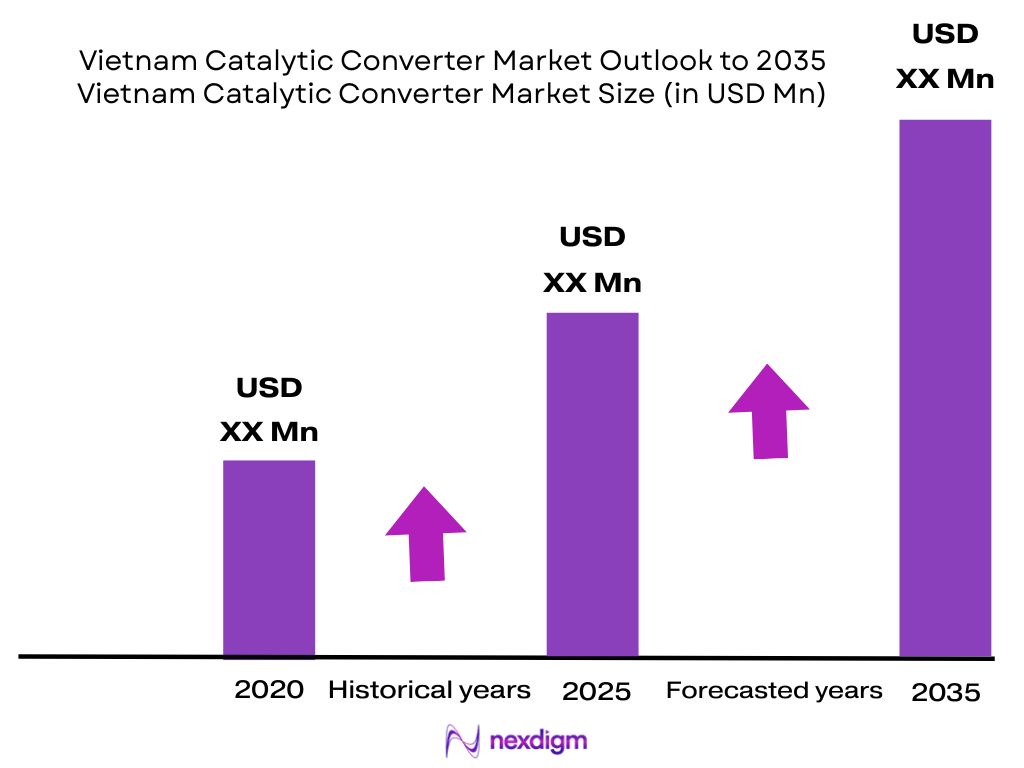
The Vietnam Catalytic Converter Market is valued at USD ~ million, supported by motorcycles, passenger cars, pickups, buses, and commercial vehicles using combustion engines. VAMA-member automobile sales increased from 301,989 units to 340,142 units across the two latest annual observations, while Vietnam’s GDP reached USD 476.39 billion and GDP per capita USD 4,717.3 in the latest period, supporting continued vehicle ownership and emissions-control demand. Hanoi, Ho Chi Minh City, Hai Phong, Vinh Phuc, Dong Nai, Binh Duong, and the Da Nang–Quang Nam/Chu Lai corridor dominate catalytic-converter activity because these locations concentrate vehicle ownership, assembly plants, motorcycle production, service networks, ports, and automotive suppliers. Vietnam’s population increased from approximately 100.35 million to 100.99 million across the two latest annual observations, while THACO’s domestic component complex spans 440,000 m², reinforcing the importance of industrial automotive clusters.
Market Segmentation
By Vehicle Type
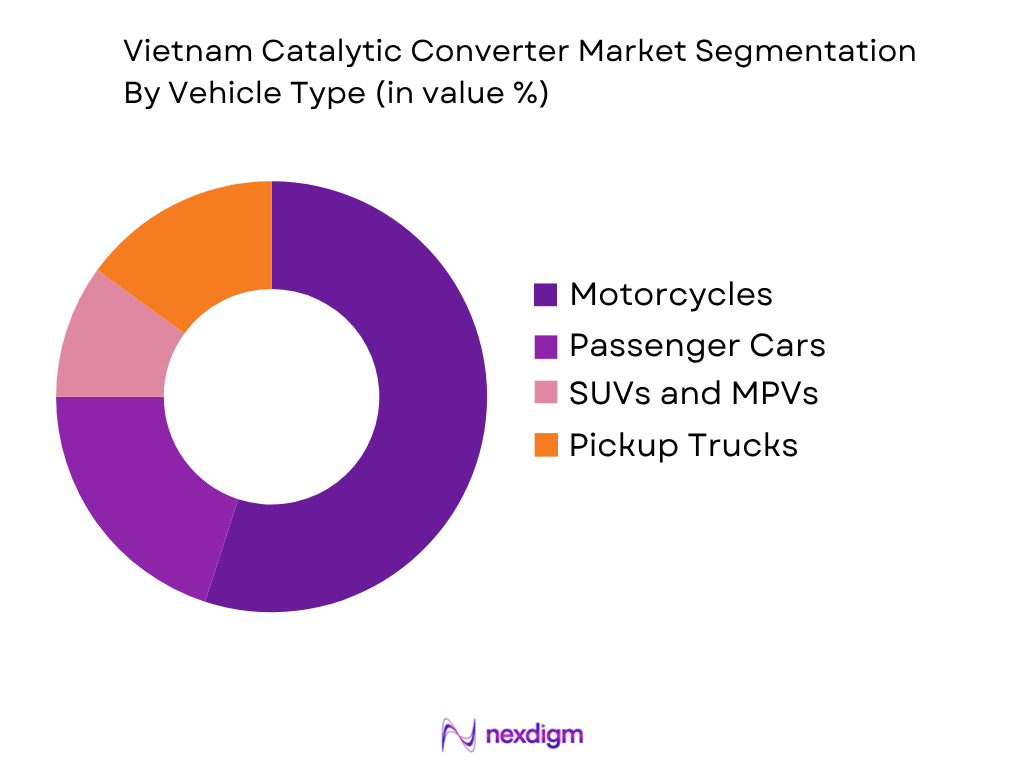
The Vietnam Catalytic Converter Market is segmented into motorcycles and scooters, passenger cars, SUVs and MPVs, pickup trucks, light commercial vehicles, buses, and medium/heavy commercial vehicles. Motorcycles and scooters dominate unit demand because two-wheelers remain fundamental to personal mobility in Vietnam and are produced and sold at volumes far above passenger cars. More than 2.02 million motorcycles were manufactured during the first eight months of 2024, while first-half motorcycle sales exceeded 1.20 million units. These vehicles typically use compact oxidation or three-way catalyst systems positioned near the engine to achieve rapid light-off. Although catalyst loading per motorcycle is lower than for cars, the size of the motorcycle parc gives the segment substantial cumulative demand for ceramic or metallic substrates, washcoats, palladium/rhodium formulations, exhaust assemblies, and eventual replacement units.
By Converter Type
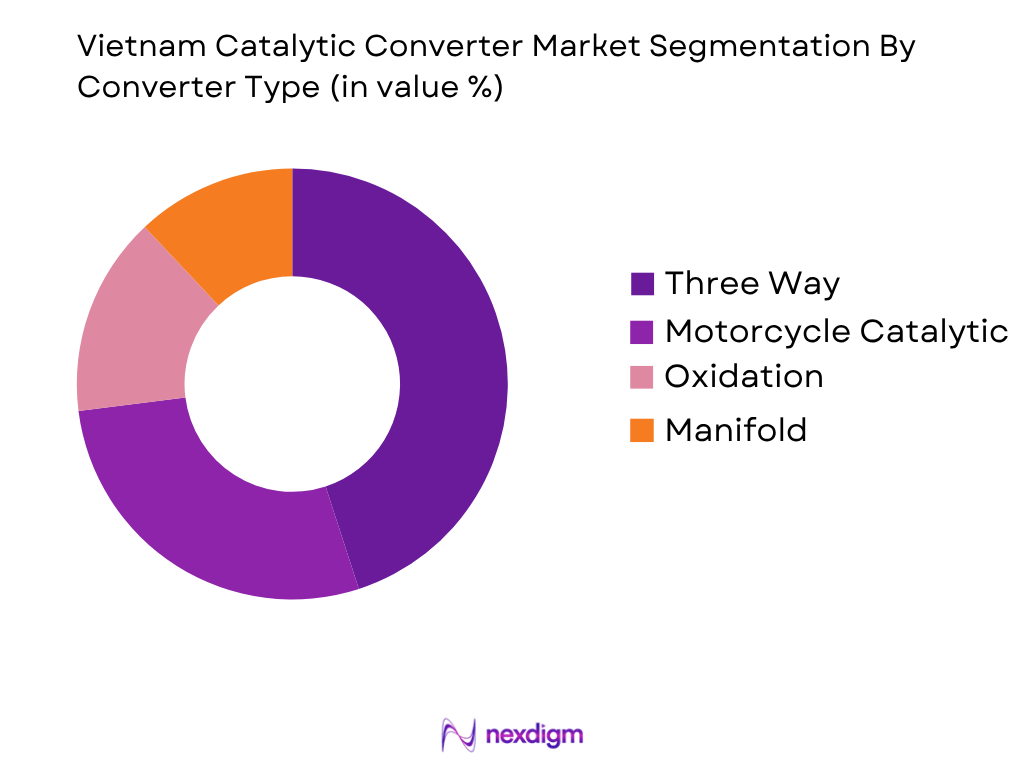
The Vietnam Catalytic Converter Market is segmented into three-way catalytic converters, motorcycle catalysts, close-coupled converters, diesel oxidation catalysts, manifold-integrated converters, and multi-brick aftertreatment systems. Three-way catalytic converters dominate by value because petrol passenger vehicles and many motorcycles require simultaneous conversion of carbon monoxide, hydrocarbons, and nitrogen oxides. Vietnam’s transition toward Euro 5-equivalent requirements has increased the importance of catalyst light-off, oxygen-storage capacity, substrate design, and appropriate PGM loading. VAMA has stated that its member manufacturers prepared vehicle portfolios to meet the national Euro 5 roadmap, meaning higher emission-control standards increasingly influence new-vehicle catalyst specifications. Close-coupled three-way systems are particularly relevant in urban driving because repeated low-speed operation makes rapid catalyst heating important for controlling cold-start emissions.
Competitive Landscape
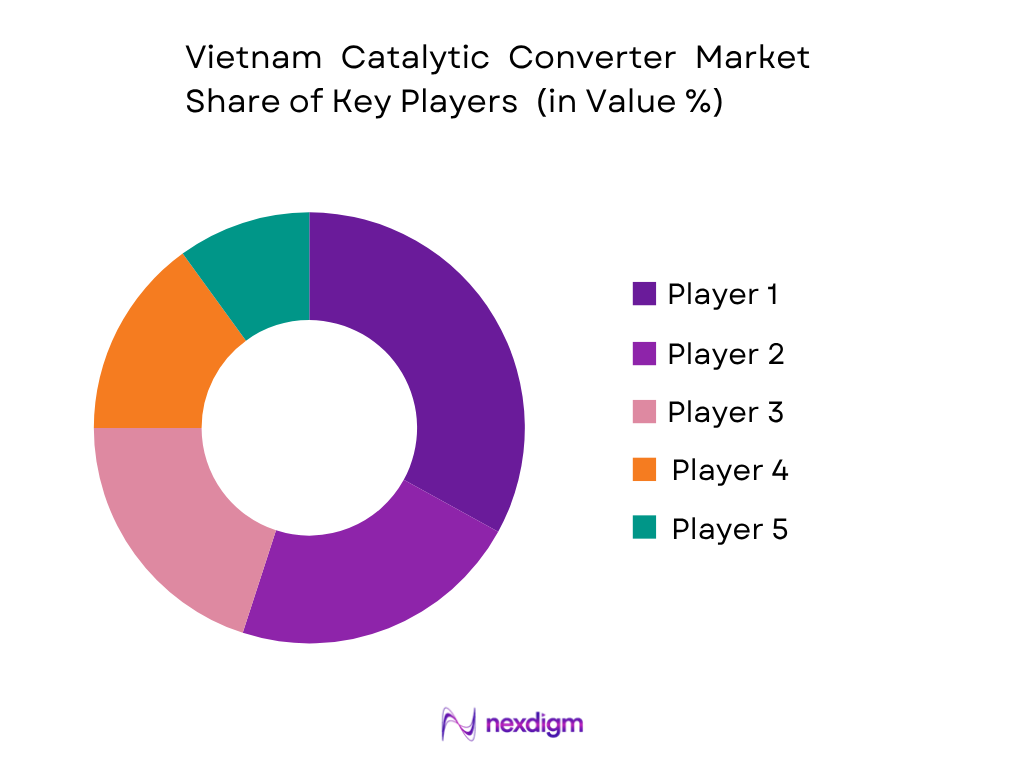
The Vietnam Catalytic Converter Market is served by global catalyst-technology and exhaust-system groups alongside local automotive-component manufacturers and ASEAN-linked suppliers. FORVIA, Tenneco, Eberspächer, BASF Environmental Catalyst and Metal Solutions, and Johnson Matthey represent important technology participants across catalyst coatings, complete exhaust aftertreatment, substrates, PGM chemistry, and OEM system integration. Domestic localization is developing around automotive clusters such as Chu Lai, where THACO Industries manufactures exhaust pipes and operates large-scale automotive-component facilities.
| Major Player | Establishment | Headquarters | Core Catalyst/Aftertreatment Offering | Vehicle Coverage | Catalyst/PGM Capability | Manufacturing Model | OEM Integration | Vietnam/ASEAN Relevance |
| FORVIA Clean Mobility | 2022 | Nanterre, France | ~ | ~ | ~ | ~ | ~ | ~ |
| Tenneco Clean Air | 1940 | Northville, Michigan, USA | ~ | ~ | ~ | ~ | ~ | ~ |
| Eberspächer / Purem | 1865 | Esslingen, Germany | ~ | ~ | ~ | ~ | ~ | ~ |
| BASF Environmental Catalyst & Metal Solutions | 1865 | Ludwigshafen, Germany | ~ | ~ | ~ | ~ | ~ | ~ |
| Johnson Matthey | 1817 | London, UK | ~ | ~ | ~ | ~ | ~ | ~ |
Vietnam Catalytic Converter Market Analysis
Growth Drivers
Tightening Emission Standards and Increasing Catalyst Technology Content per ICE Vehicle
Vietnam’s progressively tighter vehicle-emission framework is a direct growth driver for catalytic converters because new combustion vehicles increasingly require higher-performing exhaust-aftertreatment hardware rather than basic oxidation systems. Under Decision 19/2024/QĐ-TTg, newly imported and domestically manufactured automobiles continue to apply Level 5, equivalent to Euro 5, from 1 January 2025. The same decision requires newly manufactured and imported two-wheel motorcycles to move to Level 4 from 1 July 2026, while four-wheeled passenger and goods vehicles with engines and three-wheeled motorcycles must meet an emissions level of 0 from 1 January 2026, demonstrating that the government is simultaneously tightening combustion emissions and accelerating zero-emission categories. Euro 5 is materially relevant to converter suppliers because VAMA identifies stricter limits for gasoline vehicles, including 1.0 g/km CO, 0.3 g/km HC, 0.06 g/km NOx and 0.005 g/km particulate matter under its Euro 5 reference framework. VAMA also notes that Euro 5 cars incorporate OBD-linked emissions-control systems and components such as three-way catalytic converters, A/F sensors and oxygen sensors. These requirements raise the importance of catalyst light-off performance, palladium-rhodium formulation, oxygen-storage capacity, washcoat durability and precise calibration rather than merely increasing converter unit counts. Vietnam’s automotive demand base provides substantial scale for these technologies: VAMA-member vehicle sales reached 340,142 units in 2024, while the Vietnam Motor Show brought together 18 automobile and motorcycle brands and more than 50 supporting-industry brands, illustrating the breadth of the local vehicle and supplier ecosystem. The macroeconomic backdrop is also supportive. World Bank data put Vietnam’s 2024 GDP at USD 476.39 billion, GDP per capita at USD 4,717.29, and population at 100.99 million, while the IMF subsequently confirmed that the economy expanded 7.1% in 2024. These figures indicate a rapidly expanding consumer and industrial economy capable of supporting greater automobile ownership and more sophisticated emissions-control content. For the catalytic-converter industry, the key implication is that value creation is shifting toward higher-performance catalyst systems. Petrol passenger vehicles need improved three-way catalysts; diesel vehicles require DOC systems integrated with particulate filtration and selective catalytic reduction; motorcycles increasingly need compact high-efficiency catalyst substrates; and OBD-equipped vehicles create additional pressure to maintain catalyst performance over the useful life of the vehicle. Suppliers capable of combining Euro-compatible catalyst chemistry, vehicle-specific substrate design, sensor integration and local exhaust-system engineering are therefore positioned to capture a larger share of the emissions-control value chain as Vietnam’s regulatory framework becomes more demanding.
Expanding Automotive Production, Motorization and Domestic Supporting-Industry Capacity
Vietnam’s expanding automotive ecosystem is another major growth driver because catalytic converters are fitted across locally assembled petrol cars, SUVs, pickups, motorcycles and commercial vehicles, while rising component localization creates opportunities for domestic exhaust integration. VAMA-member automobile sales reached 340,142 vehicles in 2024, compared with 301,989 vehicles in 2023, showing a substantial increase in annual vehicle activity. The country also has a very large two-wheeler manufacturing base: motorcycle production exceeded 2.02 million units during the first eight months of 2024, meaning catalyst demand cannot be assessed solely through passenger cars. Motorcycles generally use smaller substrates and lower PGM loading than cars, but their very high production volume creates significant cumulative demand for coated monoliths, stainless-steel canning and close-coupled exhaust systems. Passenger vehicles contribute greater value per unit because larger engines, multiple catalyst bricks, gasoline direct injection, turbocharging, diesel aftertreatment and hybrid powertrains can require more complex systems. Vietnam’s supporting-industry capacity is also developing rapidly. THACO Industries operates an automotive-components complex covering around 440,000 square metres and representing approximately USD 500 million of investment, with manufacturing activities that include exhaust pipes and other vehicle components. Its chassis and body components factory has stated annual capacity of around 800,000 components, demonstrating that Vietnam already possesses industrial infrastructure capable of supporting deeper localization of exhaust assemblies and related emissions-control hardware. The significance for catalytic converters is that imported catalyst substrates or coated bricks can increasingly be integrated into locally manufactured pipes, manifolds, shells and complete hot-end assemblies rather than imported only as fully finished systems. This improves opportunities for local canning, welding, heat-shield production, flange fabrication and Tier-1 engineering. The macroeconomic environment provides additional justification: World Bank data show USD 476.39 billion GDP, USD 4,717.29 GDP per capita and 100.99 million population in 2024, while the IMF recorded 7.1% economic growth for the same year. The IMF also reported that the economy expanded another 6.9% year-on-year in the first quarter of 2025, indicating that Vietnam entered the subsequent period with strong industrial and consumer activity. A growing economy increases the stock of cars, commercial vehicles and motorcycles requiring emissions aftertreatment, while industrial investment strengthens the domestic supplier ecosystem serving Japanese, Korean and Vietnamese OEMs. This creates multiple demand pools for catalyst manufacturers: motorcycle converters for very high-volume production, three-way catalysts for petrol passenger vehicles, diesel oxidation catalysts for commercial vehicles, and higher-value hybrid catalyst systems. Furthermore, the combination of automotive clusters around Hanoi, Hai Phong, Vinh Phuc, Quang Nam, Ho Chi Minh City, Dong Nai and Binh Duong gives suppliers geographic access to both assembly plants and service networks. As vehicle production and supporting industries deepen, suppliers that can localize converter canning and exhaust-system integration while maintaining imported or regional access to advanced catalyst chemistry will have a stronger competitive position than firms dependent entirely on finished converter imports.
Market Challenges
Rapid Battery-Electric Vehicle and Electric Two-Wheeler Expansion Eliminating Converter Fitment
Electrification is the most important structural challenge for the Vietnam Catalytic Converter Market because every battery-electric car, scooter or bus eliminates the internal-combustion exhaust system and therefore removes catalytic-converter demand completely. This risk is no longer theoretical. VinFast delivered 97,399 electric vehicles globally during 2024, compared with much lower volumes in the previous year, and delivered 70,977 electric scooters and e-bikes during the same year. The company stated that Vietnam contributed significantly to these deliveries and that it became the leading all-electric automaker in the domestic market. Electrification accelerated further: VinFast reported 175,099 electric-car deliveries in Vietnam during 2025, including 27,649 vehicles in December alone. These numbers are highly relevant to catalyst suppliers because VinFast is not merely adding incremental vehicle sales; its battery-electric platforms directly displace petrol vehicles that otherwise would require three-way catalysts, oxygen sensors, exhaust manifolds and eventual aftermarket converters. The substitution risk is particularly pronounced in Vietnam because motorcycles and scooters constitute one of the largest road-mobility categories. Electric two-wheelers therefore attack the very segment that generates some of the highest catalytic-converter unit volumes. Government regulation reinforces the direction of travel. Decision 19/2024/QĐ-TTg requires four-wheeled passenger and goods vehicles with engines and certain three-wheeled motorcycles to meet an emissions level defined as 0 from 1 January 2026, clearly embedding zero-emission technologies within the official regulatory roadmap. Traditional two-wheel motorcycles are still permitted to use combustion engines under tighter standards, but the policy direction means catalyst manufacturers must account for a shrinking lifetime opportunity in some vehicle classes. Vietnam’s macroeconomic expansion makes this transition more feasible rather than slowing it. World Bank data show GDP of USD 476.39 billion, GDP per capita of USD 4,717.29, and population of 100.99 million in 2024, while the IMF confirmed 7.1% GDP growth. Higher incomes and stronger domestic manufacturing capacity increase consumers’ ability to adopt newer vehicle technologies and support investment in charging infrastructure. The challenge for catalytic-converter manufacturers is therefore one of portfolio concentration. Suppliers heavily exposed to small petrol motorcycles or conventional passenger vehicles face greater substitution risk than those diversified into hybrids, commercial diesel aftertreatment, high-age replacement converters and PGM recovery. A BEV does not merely remove one OEM catalyst sale—it also removes the future replacement converter, catalyst-efficiency diagnostics and end-of-life PGM recovery associated with that vehicle. The cumulative lifetime revenue loss is consequently larger than the initial component value suggests. Manufacturers will need to prioritize segments where combustion technology has a longer runway, such as hybrid vehicles, pickups, commercial fleets and motorcycles in regions where electric adoption remains slower, while simultaneously building recycling capabilities to extract additional value from the installed ICE vehicle base.
Imported PGM and Advanced Catalyst Dependence Combined with Fuel-Quality and Application Complexity
Vietnam’s catalytic-converter ecosystem faces a second important challenge from dependence on imported advanced catalyst materials and the technical requirements imposed by Euro 5-compatible vehicles. Platinum, palladium and rhodium are critical to modern automotive catalysts, but Vietnam does not possess a large domestic primary PGM mining base, meaning catalyst manufacturers and OEM suppliers remain exposed to international sourcing and refining networks. This matters because three-way catalyst performance depends on precise palladium-rhodium formulations, while diesel oxidation catalysts commonly use platinum-containing systems. The challenge extends beyond raw materials to fuel and operating compatibility. VAMA has warned that Euro 5 vehicles require appropriate fuel quality to protect sophisticated emissions-control equipment. Its technical guidance identifies components including three-way catalytic converters, fuel injectors, A/F sensors, oxygen sensors, DPF and SCR systems as potentially affected when vehicles use fuel below the required standard. VAMA also reported that more than 1,000 Petrolimex stations supplied Level 5 diesel at the time of its implementation guidance, while higher-grade petrol availability was more constrained and required expansion. This illustrates that catalyst performance in Vietnam depends not only on component design but also on the surrounding fuel-distribution ecosystem. High-sulfur or unsuitable fuel can impair catalyst activity, increase deposits, damage sensors and reduce the effectiveness of aftertreatment. Application complexity also increases as Vietnam’s vehicle base diversifies. The same market contains small motorcycles, turbocharged petrol cars, gasoline direct-injection vehicles, hybrids, pickups and diesel commercial vehicles, each requiring different substrate dimensions, washcoat chemistry, catalyst loading, oxygen-sensor placement and exhaust architecture. Euro 5 passenger cars therefore cannot rely on a single universal converter specification. Decision 19/2024/QĐ-TTg keeps newly assembled and imported automobiles at Level 5 from January 2025, meaning OEMs must maintain these technical requirements across all new combustion models. The 2024 macroeconomic backdrop underscores why supply resilience matters: World Bank data show a national economy of USD 476.39 billion supporting a population of 100.99 million, while IMF data show 7.1% GDP growth. A rapidly expanding economy requires stable automotive-component supply and can magnify disruption if imported catalyst materials or electronic sensors become constrained. The challenge is especially relevant for smaller aftermarket suppliers. OEM Tier-1 companies can source application-specific catalysts through global networks, but independent replacement suppliers may struggle to reproduce equivalent precious-metal loading, thermal durability and OBD compatibility. Low-quality aftermarket converters can trigger repeated check-engine warnings, failed emissions inspections or premature deterioration. This creates a need for stronger product traceability, vehicle-specific catalogs, verified substrate quality and technically competent garages. For the Vietnam Catalytic Converter Market, imported PGM exposure and emissions-system complexity therefore remain structural constraints even while vehicle demand expands. Firms that localize canning and exhaust assembly but maintain secure regional access to high-quality catalyst substrates and formulations will be better positioned than suppliers attempting aggressive cost reduction through under-loaded or non-validated converter products.
Market Opportunities
Hybrid Vehicle Catalysts and Higher-Standard Motorcycle Aftertreatment
Hybrid vehicles and higher-emission-standard motorcycles create a strong future opportunity for catalytic-converter suppliers because both categories retain combustion engines while requiring increasingly sophisticated emissions-control systems. Unlike battery-electric vehicles, full hybrids and plug-in hybrids still use petrol engines and therefore continue to require three-way catalytic converters. Their operating cycle can actually increase catalyst-engineering complexity: the engine frequently shuts down during electric driving, reducing exhaust temperature, and then restarts when additional power is required. Each restart places importance on rapid light-off, high oxygen-storage capacity and thermal retention. This creates an opportunity for low-mass substrates, close-coupled catalyst placement, high-performance ceria-zirconia washcoats and carefully optimized palladium-rhodium loading. Vietnam’s automotive market is becoming sufficiently large and technologically diverse to support this niche. VAMA-member sales reached 340,142 vehicles in 2024, while the Vietnam Motor Show featured 18 automobile and motorcycle brands and more than 50 supporting-industry brands, many presenting electrified or lower-emission technologies. The opportunity is also significant in motorcycles. Decision 19/2024/QĐ-TTg requires newly manufactured and imported two-wheeled motorcycles to adopt Level 4 emission standards from 1 July 2026, tightening requirements relative to the preceding Level 3 regime. Since motorcycles represent a much larger unit pool than cars in Vietnam, even modest increases in catalyst complexity can generate substantial incremental demand for coated substrates and integrated exhaust assemblies. Manufacturers can respond with smaller high-cell-density substrates, improved PGM dispersion and more effective close-coupled catalyst designs that reach operating temperature quickly during short urban journeys. These technologies are especially relevant in Hanoi and Ho Chi Minh City, where stop-start riding patterns make cold and low-temperature emissions important. The macroeconomic setting strengthens the commercial rationale. Vietnam’s 2024 GDP reached USD 476.39 billion, GDP per capita reached USD 4,717.29, population reached 100.99 million, and the IMF subsequently confirmed economic growth of 7.1%. Rising income and motorization enable consumers to move from basic motorcycles toward premium scooters, hybrid vehicles and higher-specification passenger cars, creating opportunities for higher-value emissions-control components. Importantly, hybrid catalyst demand can extend the useful life of the converter industry during electrification. A hybrid may reduce engine runtime, but it still requires compliant emissions aftertreatment and eventually generates replacement and recycling demand. For suppliers, the best strategy is therefore not to defend only conventional petrol engines but to specialize in the combustion systems that coexist with electrification. Vehicle-specific hybrid catalysts, Level 4 motorcycle converters and Euro 5 passenger-car systems can form a diversified portfolio with a longer remaining technology runway. Manufacturers capable of supplying high-performance substrates and catalyst formulations to both Japanese and Korean hybrid platforms and Vietnam’s large motorcycle OEM base will be positioned to capture the most defensible future growth within the catalytic-converter segment.
Localized Exhaust-System Manufacturing and Formal PGM Recovery
Localization of exhaust-system manufacturing and eventual formal recovery of precious metals offer another important opportunity because Vietnam already has a substantial automotive-component manufacturing base and a rapidly growing stock of catalyst-equipped vehicles. THACO Industries’ automotive-component complex spans roughly 440,000 square metres and represents around USD 500 million in investment, with production covering exhaust pipes and multiple mechanical vehicle components. This creates an industrial foundation for localized catalytic-converter canning even when sophisticated coated substrates continue to be sourced from regional or global suppliers. Instead of importing an entire catalyst assembly, domestic suppliers can fabricate stainless-steel shells, flanges, manifolds, heat shields and exhaust tubing and integrate imported coated monoliths locally. Such a model can reduce logistics complexity, improve OEM response times and increase domestic value addition without requiring Vietnam to immediately replicate the full PGM coating value chain. The opportunity is reinforced by vehicle volumes. VAMA-member vehicle sales reached 340,142 units in 2024, and motorcycle manufacturing exceeded 2 million units during the first eight months of the year, creating a large annual flow of new catalyst-equipped vehicles that will ultimately enter service, replacement and end-of-life cycles. As this parc ages, spent converters become a secondary source of platinum, palladium and rhodium. Formalizing collection through authorized dealers, garages, dismantlers and scrap processors can turn what is currently fragmented automotive waste into a strategic material stream. Even if final refining takes place regionally, Vietnam can develop domestic decanning, sorting, identification and assay operations to improve recovered value and traceability. This becomes increasingly relevant because the country’s growing electric vehicle fleet will gradually reduce new catalyst volumes, making recovery from the existing ICE parc strategically more important over time. The macroeconomic base supports industrial investment: World Bank data show USD 476.39 billion GDP in 2024, USD 4,717.29 GDP per capita, and 100.99 million people, while the IMF recorded 7.1% GDP growth. Vietnam also continued expanding strongly into 2025, with IMF data showing 6.9% year-on-year economic growth in the first quarter. Strong manufacturing growth, foreign investment and automotive localization provide a favourable environment for component suppliers to invest in higher-value processing. The opportunity extends beyond simple manufacturing. A localized circular model could link OEMs, service centres and recyclers: new converters are supplied through authorized networks, failed units are returned under a take-back program, their ceramic monoliths are sampled and processed, and recovered PGMs are sent to accredited refiners. This would improve material security, reduce leakage to informal scrap channels and create a clearer chain of custody for high-value metals. Vietnam’s automotive supporting industries can also leverage ASEAN supply chains, sourcing advanced substrates from regional partners while maintaining domestic canning and assembly. For companies evaluating entry into the Vietnam Catalytic Converter Market, localized exhaust integration combined with structured spent-converter recovery is therefore one of the most defensible opportunities because it creates value even as the powertrain mix gradually transitions toward electrification.
Future Outlook
The Vietnam Catalytic Converter Market is forecast to expand at ~ CAGR during 2026–2035 under the placeholder scenario. Growth should increasingly come from tighter emissions requirements, passenger-vehicle motorization, hybrid powertrains, commercial vehicles, replacement demand, and greater localization of automotive components. These drivers will operate against a rapidly growing battery-electric vehicle sector that removes catalytic converters entirely from the powertrain. Euro 5-equivalent regulation represents an important technology catalyst. VAMA has stated that member companies were prepared to introduce vehicles compliant with Vietnam’s Euro 5 roadmap, while newer technical regulations explicitly recognize catalytic converters as emissions-control components and reference Euro 5-or-higher requirements for applicable vehicle systems. This pushes OEMs toward improved substrates, oxygen-storage materials, catalyst coatings, thermal durability, and vehicle-specific exhaust calibration. Passenger-vehicle demand also supports the addressable market. VAMA-member sales increased from 301,989 vehicles to 340,142 vehicles between the latest two annual observations. Larger SUVs, MPVs, and pickups can require higher catalyst volumes or more complex aftertreatment architectures than motorcycles, supporting stronger value contribution even though their unit volumes are lower.
Major Players
- FORVIA Clean Mobility
- Tenneco Clean Air
- Eberspächer / Purem
- Bosal
- Umicore
- BASF Environmental Catalyst and Metal Solutions
- Johnson Matthey
- Corning Incorporated
- DENSO Corporation
- Cataler Corporation
- NGK Insulators
- IBIDEN
- Futaba Industrial
- Sango Co., Ltd.
- THACO Industries
Key Target Audience
- Catalytic Converter and Automotive Exhaust-System Manufacturers
- Motorcycle and Passenger Vehicle OEMs
- Automotive Tier-1 and Supporting-Industry Component Manufacturers
- Platinum-Group-Metal Suppliers, Refiners and Recyclers
- Automotive Parts Importers, Distributors and Service Networks
- Commercial Vehicle and Fleet Operators
- Investments and Venture Capitalist Firms
- Government and Regulatory Bodies (Ministry of Construction, Ministry of Industry and Trade, Ministry of Agriculture and Environment, Vietnam Register)
Research Methodology
Step 1: Identification of Key Variables
The initial phase constructs an ecosystem map encompassing automotive OEMs, motorcycle manufacturers, catalyst suppliers, PGM companies, exhaust-system manufacturers, importers, garages, distributors, and recyclers. Critical variables include vehicle production, motorcycle parc, Euro emission level, powertrain mix, converters per vehicle, substrate type, PGM loading, localization, vehicle age, and electric-vehicle substitution. Desk research uses VAMA statistics, official Vietnamese vehicle regulations, World Bank macroeconomic data, OEM disclosures, and supplier product information. Motorcycle, passenger-car, commercial-vehicle, and EV categories are separated to prevent overlap in addressable catalyst demand.
Step 2: Market Analysis and Construction
The top-down model begins with Vietnam’s combustion-powered vehicle production and registrations and applies converter content according to powertrain, emission standard, and vehicle type. Motorcycle catalysts are modeled separately because very high unit volumes coexist with lower catalyst content per vehicle. The bottom-up model maps OEM assembly, imported converter systems, domestic exhaust fabrication, component localization, aftermarket replacement, and potential spent-converter recovery. Import and domestic-manufacturing flows are reconciled so that catalyst coatings, substrates, and complete converter assemblies are not double counted.
Step 3: Hypothesis Validation and Expert Consultation
Market hypotheses are validated through CATIs with catalyst and exhaust-system suppliers, OEM procurement departments, automotive distributors, service workshops, component manufacturers, and recyclers. Interviews examine Euro-compliance specifications, substrate selection, PGM loading, supplier localization, replacement behaviour, and imported versus locally assembled systems. Particular attention is given to motorcycle catalysts, petrol three-way systems, commercial diesel aftertreatment, hybrid thermal management, and EV substitution. Conflicting information is checked against OEM sales and regulatory documentation before inclusion.
Step 4: Research Synthesis and Final Output
The final phase triangulates vehicle sales, emissions regulations, component-manufacturing capability, supplier information, and industry interviews to construct the Vietnam Catalytic Converter Market model. Demand is segmented by converter type, vehicle type, powertrain, emissions standard, substrate, catalyst chemistry, fitment, supply source, and distribution channel. Forecast scenarios incorporate passenger-vehicle motorization, motorcycle electrification, hybrid adoption, tighter emissions standards, automotive localization, PGM supply, replacement demand, and BEV penetration. Base-case, accelerated-EV, hybrid-led, and localization scenarios are used to test long-term market resilience.

- Executive Summary
- Research Methodology (Market Definitions and Assumptions, Abbreviations, Catalytic Converter Market Boundary, Vehicle-Parc Mapping, Motorcycle and Passenger Vehicle Mapping, Converter-per-Vehicle Assessment, Euro-Equivalent Emission Standard Mapping, OEM Production Assessment, Import Supply Mapping, Replacement Cycle Analysis, PGM Loading Assessment, Market Sizing Approach, Top-Down Analysis, Bottom-Up Analysis, Demand-Side Assessment, Supply-Side Assessment, OEM and Distributor Interviews, Garage and Recycler Interviews, Data Triangulation, Forecasting Framework, Scenario Analysis, Limitations and Future Conclusions)

- Definition and Scope
- Evolution of Automotive Catalytic Emission Control in Vietnam
- Transition toward Euro-Equivalent Vehicle Emission Standards
- Evolution of Three-Way Catalyst Technology
- Catalytic Converter Role in Petrol, Hybrid, Diesel and Alternative-Fuel Powertrains

- Growth Drivers (Large Motorcycle Parc, Passenger Vehicle Motorization, Stricter Euro-Equivalent Emission Standards, Expansion of Domestic Vehicle Assembly, Hybrid Vehicle Introduction, Commercial Vehicle Demand, Catalyst Localization, In-Use Emission Compliance)
- Market Challenges (Battery-Electric Vehicle Expansion, Electric Motorcycle Substitution, Imported PGM Dependence, Limited Domestic Catalyst-Coating Capacity, Fragmented Aftermarket, Informal Scrap Collection, Vehicle-Specific Application Complexity, Imported Converter Dependence)
- Market Opportunities (Motorcycle Catalyst Upgradation, Hybrid Three-Way Catalysts, Euro 5-Equivalent Replacement Demand, Domestic Converter Canning, Commercial Vehicle DOC Systems, PGM Recycling, ASEAN Supply-Chain Integration, Low-PGM Catalyst Formulations)
- Market Trends (Higher Cell-Density Substrates, Close-Coupled Catalysts, PGM Thrifting, Palladium-Platinum Substitution, Hybrid Thermal Management, Imported-to-Localized Exhaust Assembly, Digital Vehicle Diagnostics, Recycled-PGM Usage)
- SWOT Analysis
- Porter’s Five Forces Analysis
- PESTLE Analysis

- By Market Value (2020-2025)
- By Catalytic Converter Unit Volume (2020-2025)
- By OEM-Fitted Converter Volume (2020-2025)

- By Converter Type (In Value %)
Three-Way Catalytic Converters
Motorcycle Oxidation and Three-Way Catalysts
Close-Coupled Catalytic Converters
Manifold-Integrated Catalytic Converters
Underfloor Catalytic Converters - By Vehicle Type (In Value %)
Motorcycles
Scooters
Passenger Cars
SUVs and MPVs
Pickup Trucks - By Powertrain Type (In Value %)
Conventional Petrol Vehicles
Petrol Hybrid Vehicles
Plug-in Hybrid Vehicles
Diesel Vehicles
LPG and Alternative-Fuel ICE Vehicles - By Sales Channel (In Value %)
OEM Vehicle Manufacturing and Assembly
OEM Dealership Replacement
Tier-1/OES Supply
Independent Automotive Parts Distributors
Authorized Service Centres - By Region (In Value %)
Red River Delta
Hanoi Metropolitan Region
Northern Key Economic Region
Hai Phong–Quang Ninh Industrial Corridor
Central Vietnam

- Market Share of Major Players by Value
- Cross Comparison Parameters (Vietnam Euro-Equivalent Vehicle Application Coverage, Motorcycle-Passenger Vehicle-Commercial Vehicle Catalyst Portfolio Breadth, Platinum-Palladium-Rhodium Formulation Capability, Ceramic/Metallic Substrate and Washcoat Engineering Capability, OEM Emission-Compliance and Vehicle-Calibration Capability, Vietnam/ASEAN Manufacturing and Exhaust-Assembly Footprint, OEM-Dealer-Aftermarket Distribution Reach, PGM Recycling and Closed-Loop Material Capability)
- SWOT Analysis of Major Players
- Detailed Profiles of Major Companies
FORVIA Clean Mobility
Tenneco Clean Air
Eberspächer / Purem
Bosal
Umicore
BASF Environmental Catalyst and Metal Solutions
Johnson Matthey
Corning Incorporated
DENSO Corporation
Cataler Corporation
NGK Insulators
IBIDEN
Futaba Industrial
Sango Co., Ltd.
THACO Industries

- Automotive OEM Procurement
- Motorcycle OEM Procurement
- Tier-1 Exhaust-System Supplier Procurement
- Importer and Distributor Demand
- Authorized Dealer Demand

- By Market Value (2026-2035)
- By Catalytic Converter Unit Volume (2026-2035)
- By OEM-Fitted Converter Volume (2026-2035)


 Request a Sample
 Ask for Customization
 Get a Quote
 Enquire Now