

 Download PDF
Market Overview
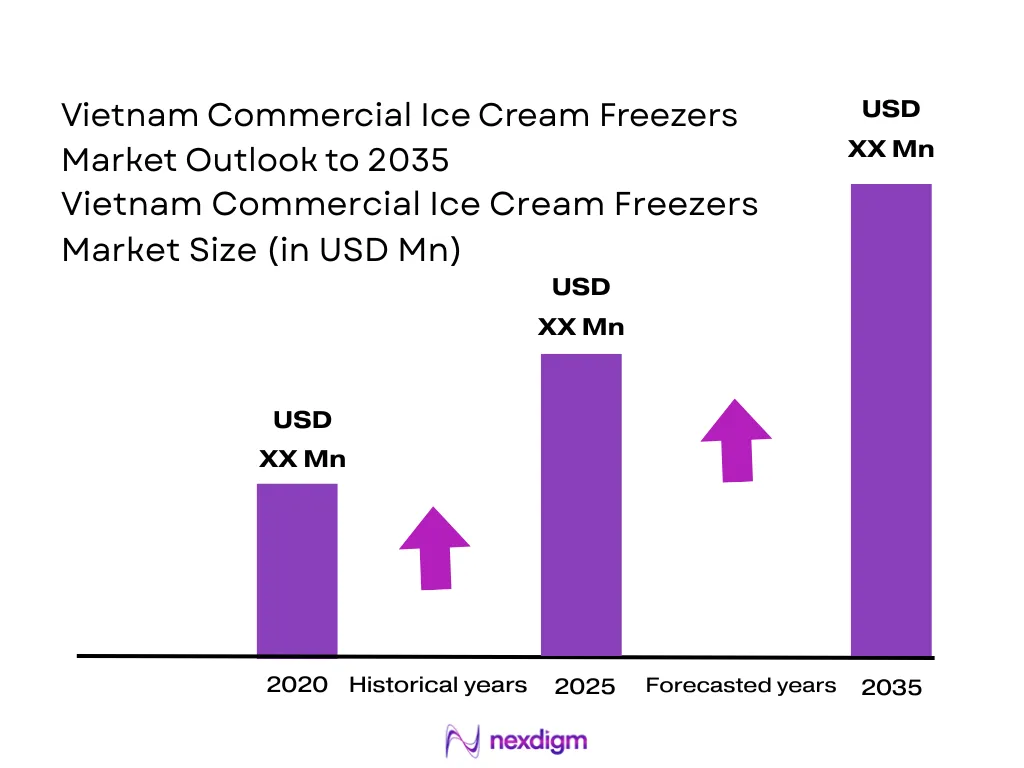
The commercial ice cream freezers market globally is valued at USD ~ million in 2024 according to an industry market dataset that tracks freezer deployments in foodservice and retail operations, noting strong adoption tied to frozen dessert consumption and refrigeration growth in retail channels. In Vietnam, the ice cream market—which provides the primary demand base for freezers—was valued at USD 229.04 million in 2024 and reflects rising consumption of frozen desserts driven by urban lifestyles and expanding retail presence in the country. This demand in frozen products necessitates commercial freezers in supermarkets, ice cream parlors, and quick‑service restaurants, making Vietnam an emerging market for commercial freezer units through retail modernization, tourism growth, and improving cold‑chain logistics. In Vietnam, major urban centers such as Ho Chi Minh City and Hanoi dominate ice cream consumption and consequent freezer demand because these cities house denser populations, higher disposable incomes, and greater penetration of modern retail and foodservice outlets. HCMC in particular has a robust tourism industry and is a hub for international and domestic ice cream brands, supporting continuous freezer deployments for impulse retail and hospitality segments. At a regional level, countries in Asia‑Pacific—especially China, India, and Japan—lead commercial freezer adoption due to large consumer bases for ice cream products and rapid modern retail expansion, which drives freezer purchases across diverse end users including supermarkets, cinemas, and QSR chains, thus shaping procurement and supply patterns in neighboring Vietnam and beyond.
Market Segmentation
By Product Type
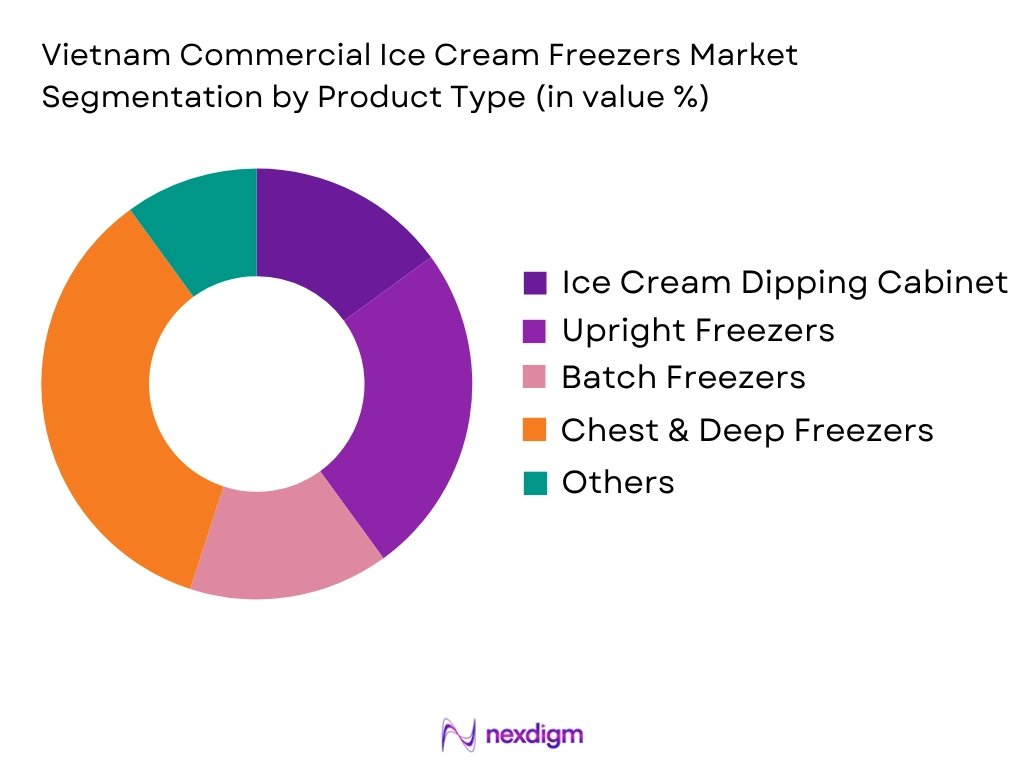
The Vietnam Commercial Ice Cream Freezers Market is dominated by chest & deep freezers, which hold the largest share in 2024. Chest & deep freezers are widely preferred because they are the most cost‑effective solution for bulk storage and impulse retail formats where ice cream products are sold in bulk or high turnover environments such as supermarkets and convenience stores. These units facilitate large volume storage, lower energy usage compared to upright designs, and are simpler to maintain, which aligns with the demand patterns in emerging markets like Vietnam where cost efficiency and ease of serviceability are key purchasing factors. Upright and glass display freezers are gaining ground in modern retail outlets where visual merchandising of ice cream drives sales. However, chest units remain dominant due to legacy installation preferences and broader utility in independent ice cream parlors and roadside outlets where floor space is limited and turnover of packaged frozen products is high. The rising number of supermarkets and organized convenience retailers in urban centers like Ho Chi Minh City and Hanoi also influences the preference for deeper storage capacities that chest freezers offer. Gelato and batch freezers, while significant in premium dessert parlors and specialty cafes, remain smaller due to niche adoption and higher unit costs compared to core retail formats.
By End User Channel
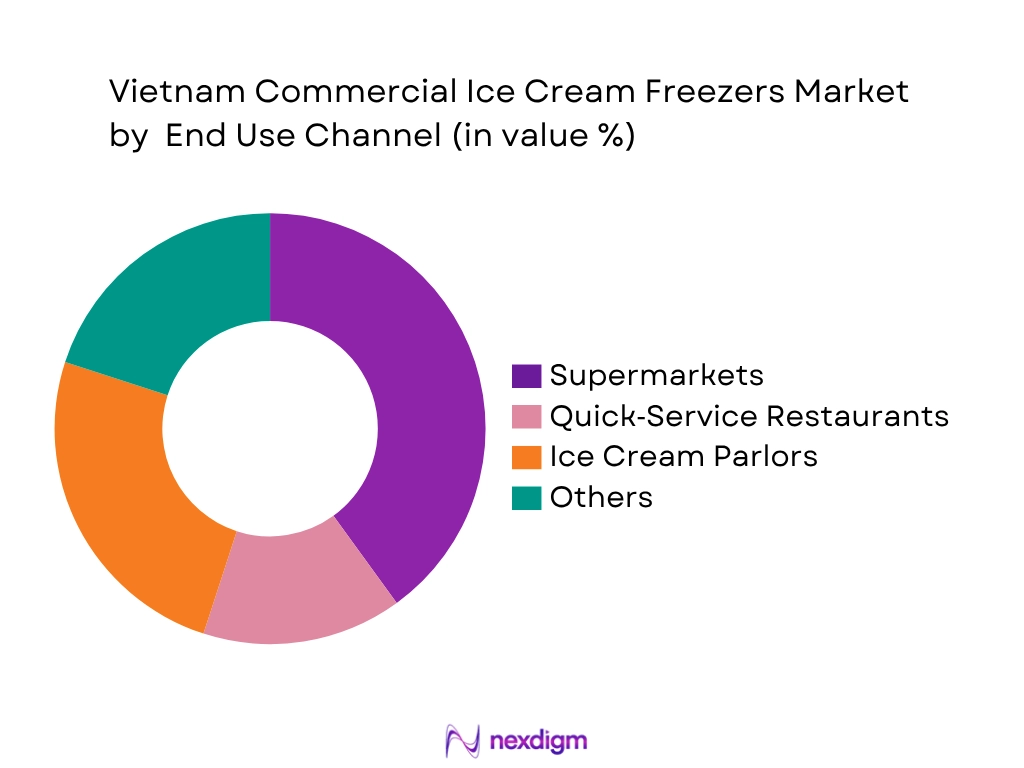
Under end‑user segmentation, supermarkets and grocery retail outlets dominate commercial ice cream freezer demand in Vietnam as of 2024. This dominance arises because supermarkets and modern grocery chains serve as focal points for frozen dessert sales including packaged ice cream, tubs, and impulse novelties. Retailers leverage freezers as both storage units and sales drivers—placing them near aisles and point‑of‑sale areas to encourage impulse purchases during grocery shopping. Retail expansion in urban areas like Hanoi and Ho Chi Minh City, supported by modernization of retail formats and the presence of both international and local ice cream brands, increases freezer deployment needs. Ice cream parlors and gelaterias form the second largest end‑user category, driven by experiential consumption and premium offerings, but their unit requirements are smaller in number compared to broad retail networks. Quick‑service restaurants adopt freezers as dessert menu upsells, especially in busy food zones, while convenience stores and fuel station outlets optimize compact freezer units for on‑the‑go customers. The emergent e‑commerce / dark store segment reflects growing online grocery orders that require reliable cold storage before last‑mile delivery.
Competitive Landscape
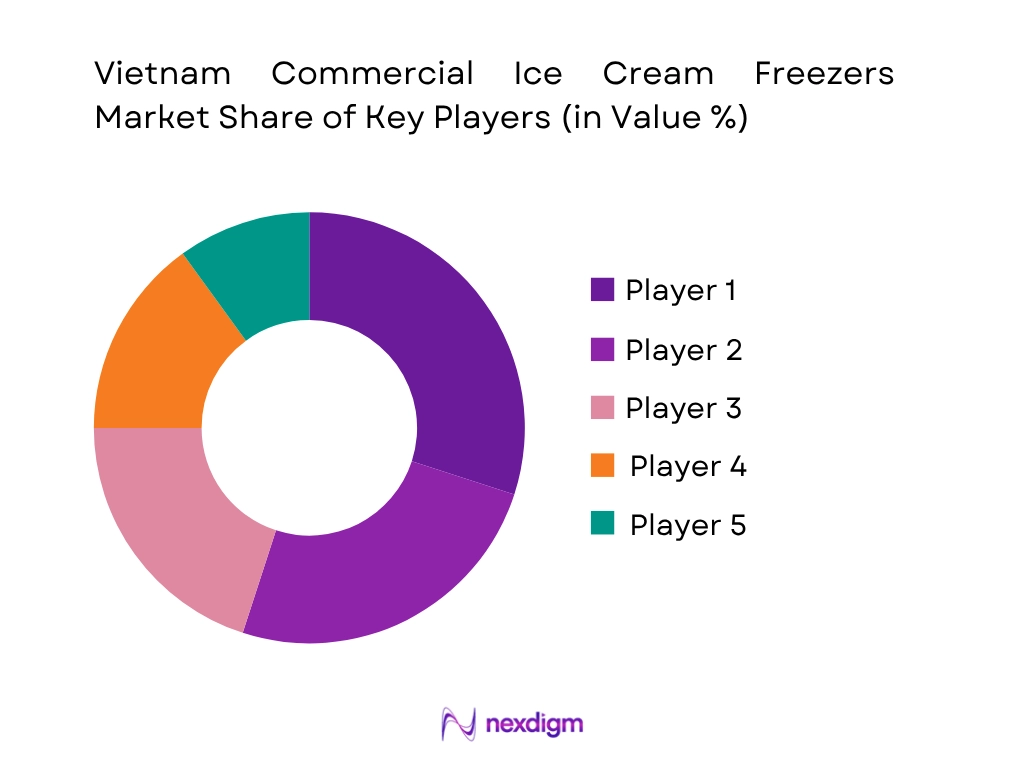
The Vietnam Commercial Ice Cream Freezers Market is influenced globally by large refrigeration equipment manufacturers and regionally by distributors integrating tailored solutions for emerging markets. This consolidation highlights the significant influence of established international freezer OEMs alongside regional supply networks that support sales, service, and compliance with energy and refrigerant standards. Competitors differentiate on product range, energy efficiency, service footprint, and after‑sales support for food retail and hospitality buyers.
| Company | Establishment Year | Headquarters | Product Range Depth | Cooling Technology | Energy Efficiency Compliance | Distribution Network | Service & After‑Sales |
| Hussmann | 1907 | USA | ~ | ~ | ~ | ~ | ~ |
| Electrolux Professional | 1919 | Sweden | ~ | ~ | ~ | ~ | ~ |
| True Manufacturing | 1945 | USA | ~ | ~ | ~ | ~ | ~ |
| AHT Cooling Systems | 1945 | Austria | ~ | ~ | ~ | ~ | ~ |
| Haier | 1984 | China | ~ | ~ | ~ | ~ | ~ |
Vietnam Commercial Ice Cream Freezers Market Outlook to 2035
Growth Drivers
Rising Household Consumption Expenditure and Retail Expansion
Vietnam’s macroeconomic environment demonstrates significant purchasing power that underpins demand for refrigerated equipment such as commercial ice cream freezers. Vietnam’s household final consumption expenditure at 6,201,832,000,000 Vietnamese đồng in nominal terms reflects aggregate consumer spending on goods and services including food and beverage purchases. This figure—reported by the World Bank’s final consumption dataset—shows rising domestic expenditure which supports food retail growth and correlates with increasing purchases of perishables requiring frozen storage. Alongside this, Vietnam’s GDP valued at USD 476,388,000,000 and a GDP per capita of USD 4,717.3 point to rising aggregate incomes and greater consumer discretionary spending. Retail networks in the country are extensive: the Vietnam retail food market comprised over 665,000 outlets generating USD 55,000,000,000 in retail revenues, according to the USDA Foreign Agricultural Service Annual Report. These outlets include supermarkets and convenience stores that require ice cream freezers to stock frozen desserts, meat products, and chilled beverages. Increased consumer demand for frozen and impulse products at both modern trade and traditional retail drives commercial ice cream freezer adoption, making retail expansion and household consumption clear demand engines for the freezer sector.
Urbanization and Demographic Scale Supporting Frozen Dessert Consumption
Vietnam’s demographic trends and urbanization significantly shape demand for commercial ice cream freezers. The total population of 100,987,686 people in 2024, as reported by the World Bank, indicates a large consumer base that increasingly adopts modern consumption patterns including frozen desserts and convenience food products. Urban centers such as Ho Chi Minh City and Hanoi house a disproportionate share of this population and are focal points for modern retail formats, international foodservice brands, and lifestyle outlets that stock ice cream and refrigerated treats year‑round. Vietnam’s labor force of approximately 52.89 million persons and low unemployment rate of 1.6 percent reflect active consumer engagement in the economy, supporting discretionary spending that favors dining out and impulse purchases at supermarkets or airports. The demographic transition with a rising working‑age population also boosts demand for convenience food and beverages, which are typically stored and displayed in commercial freezers. The presence of a youthful urban middle class with stable incomes increases the consumption of ice creams, gelatos, and frozen novelties, thereby expanding the need for high‑performance chest freezers, upright display units, and specialized batch freezers in retail and foodservice settings across urban corridors and secondary cities.
Market Challenges
Energy Costs and Refrigeration Infrastructure Limitations
Despite solid demand signals, one significant challenge for the Vietnam Commercial Ice Cream Freezers Market stems from operational and infrastructure constraints tied to energy supply and refrigeration requirements. Commercial freezers require reliable electrical power and consistent cooling, and Vietnam’s industrial energy consumption per capita registered approximately 1,023.06 kilograms of oil equivalent (kgoe) according to Datacommons energy statistics, indicating moderate consumption capacity but also rising energy demands across sectors. The country’s retail and hospitality sectors often operate with tight energy budgets and variable electricity supply costs, especially in less urbanized provinces where grid pressures and peak load charges can escalate operating expenses. Refrigeration infrastructure, including cold‑chain logistics, remains unevenly developed outside major metropolitan areas, creating gaps in distribution continuity for frozen goods that must be mitigated with local storage solutions and additional freezer units. In smaller towns, intermittent supply and higher per‑unit energy tariffs challenge the cost efficiency of deploying advanced freezers and obtaining consistent compressor performance. These infrastructure challenges make it more difficult for independent retailers and foodservice outlets to sustain freezer operations year‑round, thereby limiting market expansion into low‑density regions. The maturity of supporting refrigeration ecosystems—including service networks, spare parts supply, and technician availability—lags behind the demand for freezer installations, especially as modern units become more technologically complex.
Seasonal Demand Variability and Inventory Management Complexity
Another structural challenge in the Vietnam Commercial Ice Cream Freezers Market is the pronounced seasonality of consumer demand for frozen desserts and related products. Unlike essential refrigerated goods, ice cream consumption spikes during warmer months or festive periods and declines during cooler periods, leading to fluctuating freezer utilization rates across retail and foodservice outlets. Vietnam’s population experiences hot seasonal peaks that drive impulse purchases of frozen desserts, but this creates inventory management complexity for retailers who must balance over‑stocking risks with demand surges. Retailers must use freezer space for other products during off‑peak seasons to optimize utility, which complicates capacity planning and can lead to inefficient use of costly refrigerated real estate. This variability exacerbates working capital demands as freezer owners allocate budget for utilities and stock replenishment during peak months while incurring under‑utilization costs in slower periods, especially in secondary cities where consumer demand is less predictable. Additionally, the cost of spoilage for perishable inventory that extends beyond ice cream—such as frozen seafood and chilled desserts—adds complexity to freezer usage decisions. Retailers and foodservice operators must invest in sophisticated inventory rotation and temperature monitoring systems to prevent loss, but such investments increase operational barriers for smaller vendors. Consequently, seasonal demand variability remains a persistent challenge for stable deployment of commercial ice cream freezers.
Market Opportunities
Growth of Organized Retail and Foodservice Outlets
Vietnam’s expanding organized retail and foodservice landscape presents a clear opportunity for commercial ice cream freezer suppliers. The retail food market’s USD 55,000,000,000 in sales across 665,000 outlets reflects a broad distribution network where frozen products can be stocked and merchandised. Retail modernization—including larger supermarket chains and convenience store rollouts in urban and peri‑urban areas—creates structured demand for display freezers and storage units to support diversified product assortments. Modern trade formats rely on high‑visibility glass door freezers for impulse products like ice cream, chilled drinks, and packaged desserts. Similarly, the growth of quick‑service restaurants, coffee chains, and dessert parlors amplifies need for specialized freezers that maintain product quality and support differentiated menu offerings. As foodservice outlets emphasize extended opening hours and diversified menus, freezer units become essential for maintaining product inventories, enhancing service consistency, and meeting customer expectations for chilled and frozen dessert availability. The ongoing expansion of retail infrastructure in cities with increasing household consumption expenditure fosters a broader procurement base for freezer OEMs, distributors, and leasing partners. This shift from traditional wet markets to organized retail provides both scale and repeat demand for commercial freezers tailored to extended use cycles and high turnover environments.
Enhancement of Cold‑Chain Logistics and Urban Distribution Networks
Investment in cold‑chain logistics and urban distribution enhancements offers a strategic opportunity to accelerate commercial ice cream freezer adoption across Vietnam. Improvements in refrigerated transport and storage infrastructure enable retailers to stock a wider variety of perishable goods, including premium ice cream brands that require specific temperature controls. As urban distribution hubs in Ho Chi Minh City and Hanoi extend their service reach, smaller cities gain access to consistent refrigerated supplies, enabling retail and foodservice outlets to maintain freezer inventories reliably. The expansion of cold‑chain capacity reduces spoilage risk for frozen products and supports efficient restocking cycles, which in turn justifies investment in freezers with greater storage capacity and advanced control systems. Furthermore, enhanced cold‑chain logistics encourage brand owners of frozen desserts to expand product portfolios and penetration in remote regions, creating sustained demand for freezer units at the retail level. In urban supply clusters, improved logistics networks allow foodservice operators to adopt specialized freezers that support gelato, soft‑serve, and batch production requirements without compromising product integrity. Growth in warehousing and hub‑and‑spoke refrigeration systems thus strengthens the commercial case for freezer procurement and utilization as a core asset in retail and hospitality operations.
Future Outlook
The Vietnam Commercial Ice Cream Freezers Market is expected to sustain growth driven by the expansion of organized retail, continued modernization of foodservice outlets, and growing consumer demand for frozen desserts. Increasing disposable incomes and a youthful demographic base in urban regions support higher consumption of ice creams and gelato, which in turn drives the requirement for commercial freezer units across supermarkets, convenience stores, cafes, and QSRs. Improvements in urban logistics and cold‑chain infrastructure will enable producers and retailers to place freezer units deeper into secondary cities and growing towns. Sustainability considerations such as energy‑efficient compressors and low‑GWP refrigerants will shape future product specifications as food retailers and QSR chains pursue cost efficiencies and compliance with evolving environmental standards. Market strategies by freezer OEMs focusing on smart monitoring technologies and remote diagnostics will improve uptime and reduce operational costs for buyers, enhancing overall market demand and technology adoption.
Major Players
- Hussmann
- Electrolux Professional
- True Manufacturing
- Haier
- AHT Cooling Systems
- TurboAir
- Metalfrio Solutions
- Tecfrigo
- Beverage Air
- Summit Commercial
- Illinois Tool Works (ITW)
- Samsung (Commercial Division)
- LG (Commercial Cooling)
- Local Vietnam OEMs & Distributors
- Imported Asian Refrigeration Brands
Key Target Audience
- Retail & Grocery Chain Procurement Heads
- Foodservice & Hospitality Equipment Buyers
- Commercial Freezer OEM Product Strategy Teams
- Cold‑Chain & Logistics Infrastructure Investors
- Retail & QSR Facility Managers
- Energy Efficiency Compliance Officers
- Investments and Venture Capitalist Firms
- Government and Regulatory Bodies
Research Methodology
Step 1: Identification of Key Variables
Begin with defining the scope of the Vietnam Commercial Ice Cream Freezers Market, including product categories, end users, and geographic priorities. Desk research was undertaken using verified secondary sources, industry publications, and macroeconomic data to map demand fundamentals.
Step 2: Market Analysis and Construction
Compile historical shipment and sales data for freezer equipment across retail and foodservice segments. Analyze ice cream consumption trends in Vietnam as a demand driver for freezer installations, and identify patterns by segment and channel.
Step 3: Hypothesis Validation and Expert Consultation
Engage with industry suppliers, retail buyers, and foodservice operators to validate market assumptions, product adoption patterns, and technology preferences. Insights were used to refine demand estimates and segment definitions.
Step 4: Research Synthesis and Final Output
Integrate quantitative data with qualitative insights to finalize market sizing, competitive dynamics, and future outlook. Cross‑validate assumptions using secondary reports and expert consultations to ensure accuracy and relevance for business decision‑making.

- Executive Summary
- Research Methodology (Market Definitions & Assumptions, Abbreviations, Vietnam Base Case Calibration, Macro‑Economic Benchmarking, Secondary Data Sources, Primary Interviews with Retail & Foodservice Buyers, Forecasting Approach, Limitations)

- Definition and Scope
- Market Genesis and Adoption Trends
- Business Cycle and Usage Patterns
- Supply Chain and Value Chain Analysis

- Growth Drivers(Increasing Frozen Dessert Consumption, Retail Modernization, Urbanization, Cold Chain Expansion)
- Market Challenges(Cold‑Chain Infrastructure Gaps, High Operational Costs, Seasonal Consumption Variability)
- Market Opportunities(Retail Modern Trade Penetration, Energy‑Efficient Tech Adoption, Foodservice Dessert Expansion)
- Trends & Innovations(IoT Smart Monitoring, Energy Efficiency Standards, Low‑GWP Refrigerants)
- Regulatory, Standards & Compliance Landscape
- SWOT Analysis
- Porter’s Five Forces

- By Market Valuation by Revenue (2020-2025)
- By Volume Demand (2020-2025)
- By Average Equipment Unit Pricing (2020-2025)

- By Freezer Type (In Value %)
Chest Freezers
Upright/Glass Display Freezers
Batch/Soft‑Serve Freezers
Portable/Compact Units - By End‑User Channel (In Value %)
Supermarkets & Hypermarkets
Independent Ice Cream Parlors
Quick Service Restaurants
Convenience Stores & Gas Station Stops - By Sales & Supply Channel (In Value %)
Manufacturer OEM Direct
Distributor/Dealer Network
E‑commerce Sales,
Leasing/Freezer‑as‑a‑Service Contracts - By Cooling Technology (In Value %)
Static/Direct Expansion
Remote Glycol Loop
Forced‑Air Circulation
IoT‑Enabled Smart Controls

- Cross Comparison Parameters(Company Overview, Product Portfolio Breadth, Cooling Technology Depth, Refrigerant & Energy Efficiency Standards Compliance, Distribution & Service Network Coverage, Installed Base Density, After‑Sales Service Response Time, Warranty & Support Policies)
- Pricing & SKU Benchmarking by Freezer Type
- Competitive SWOT Profiles
- Company Profiles of Top Market Players
Hussmann
True Manufacturing
Haier
AHT Cooling Systems
Metalfrio Solutions
Tecfrigo
Electrolux Professional
Beverage Air (North American Refrigeration)
TurboAir (Energy‑Efficient Freezers)
Gram Commercial (Premium Freezers)
Summit Commercial (Compact Freezers)
Hoshizaki (Commercial Cooling Equipment)
Samsung / LG (Vietnam Commercial Cooling Lines)
Vietnam Local OEMs & Distributors (Regional Supply)
Imported Asian Freezer Brands (Japan/Korea/China)

- Retail Demand Drivers & Expansion Planning
- Purchasing Priorities & Budget Allocations
- Operational Constraints & Compliance Requirements
- End‑User Pain Points
- Decision‑Making & Procurement Patterns

- By Product Type Outlook (2026-2035)
- By Capacity Band Outlook (2026-2035)
- By Technology Adoption Outlook (2026-2035)
- By End‑User Channel Outlook (2026-2035)


 Request a Sample
 Ask for Customization
 Get a Quote
 Enquire Now