
 Download PDF
Market Overview
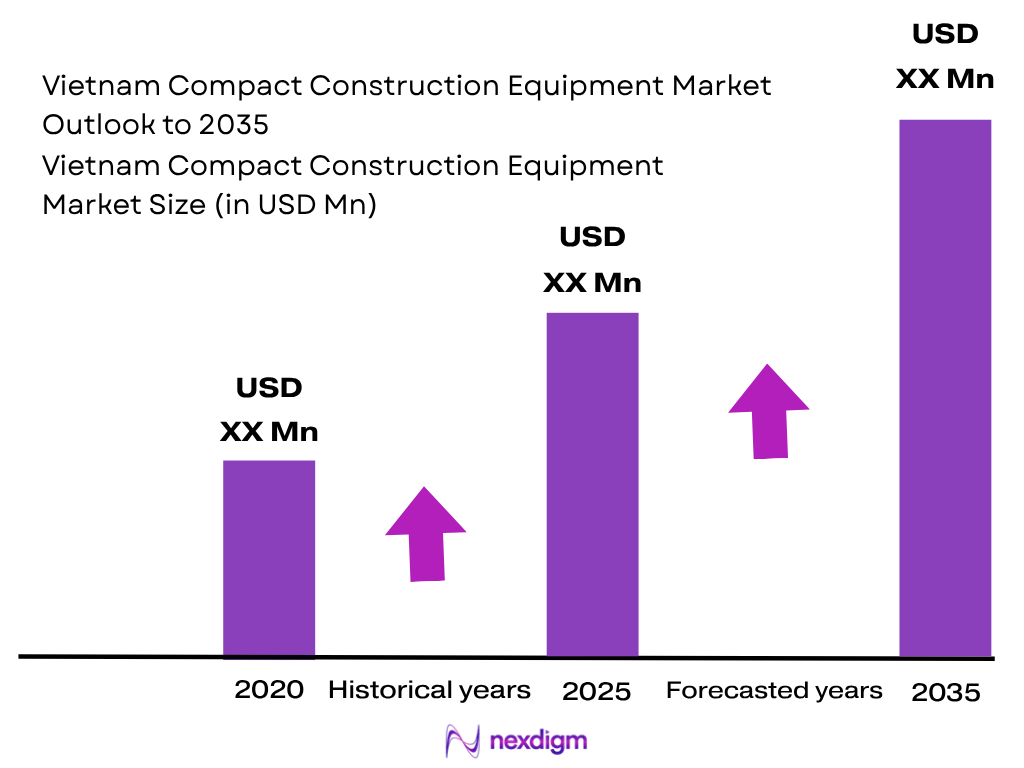
The Vietnam Compact Construction Equipment Market is valued at approximately ~USD XX million in 2024, supported by expanding construction, manufacturing and infrastructure activity. Vietnam’s construction sector recorded growth of 7.87%, while total GDP reached VND 11,511.9 trillion (USD 476.3 billion). Industry and construction collectively represented 37.64% of economic output, compared with 37.58% in the preceding period, strengthening utilization conditions for mini excavators, compact loaders and small earthmoving machinery.
Hanoi, Ho Chi Minh City and the surrounding northern and southern industrial corridors constitute major demand centers for compact construction equipment because they concentrate housing development, industrial investment and infrastructure construction. Vietnam recorded 937 commercial housing projects comprising about 403,349 units under construction during the fourth quarter, including 216,945 units in northern Vietnam and 79,507 units in southern Vietnam. The country also attracted USD 25.35 billion of realized FDI, supporting factory and industrial-site construction around these urban-industrial clusters.
Market Segmentation
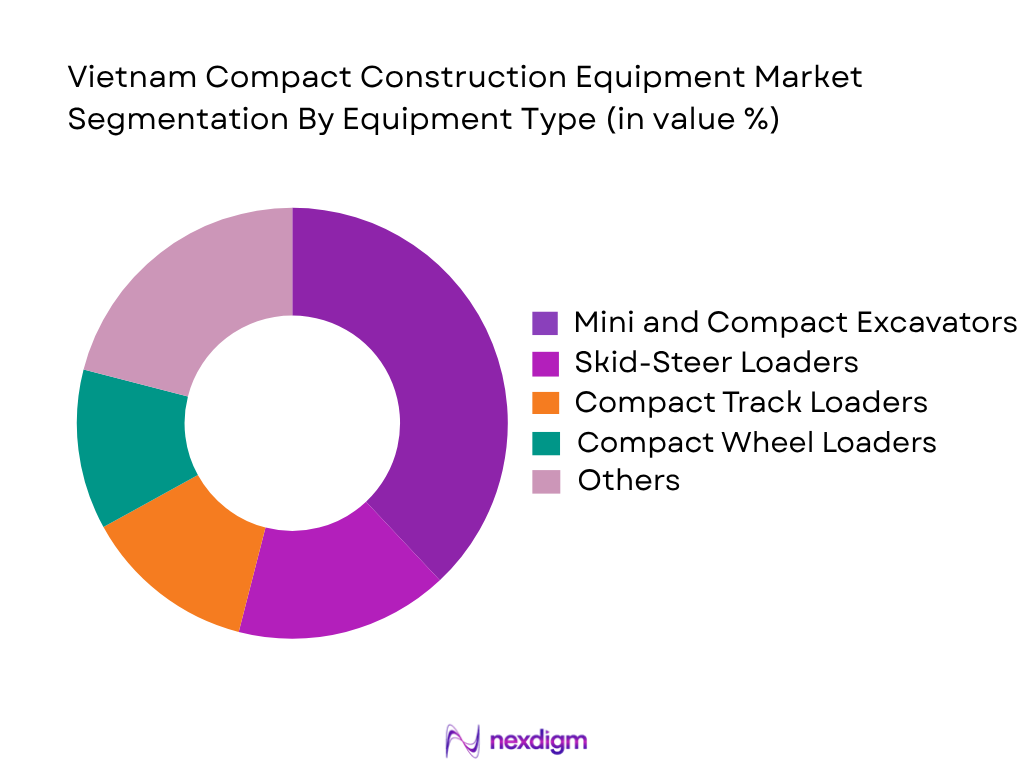
By Equipment Type
The Vietnam Compact Construction Equipment Market is segmented by equipment type into mini and compact excavators, skid-steer loaders, compact track loaders, compact wheel loaders, backhoe loaders, compact telehandlers and other compact equipment. Mini and compact excavators constitute the leading equipment category because Vietnam’s construction environment increasingly requires excavation machinery capable of operating on urban sites, industrial facilities, utility corridors and smaller infrastructure projects. Their compact dimensions, digging capability and availability of zero-tail-swing configurations make them suitable for drainage, foundations, utility trenches and confined projects. Infrastructure development also creates recurring excavation requirements, while housing construction provides another broad application base. Compact loaders represent an important secondary segment because buckets, forks, breakers and other hydraulic attachments enable contractors to use one machine for multiple operations. Vietnam’s distributor-driven equipment ecosystem also provides access to Japanese, Chinese, Korean, European and American machinery, supporting a wide selection of compact platforms for contractors with different operating requirements.
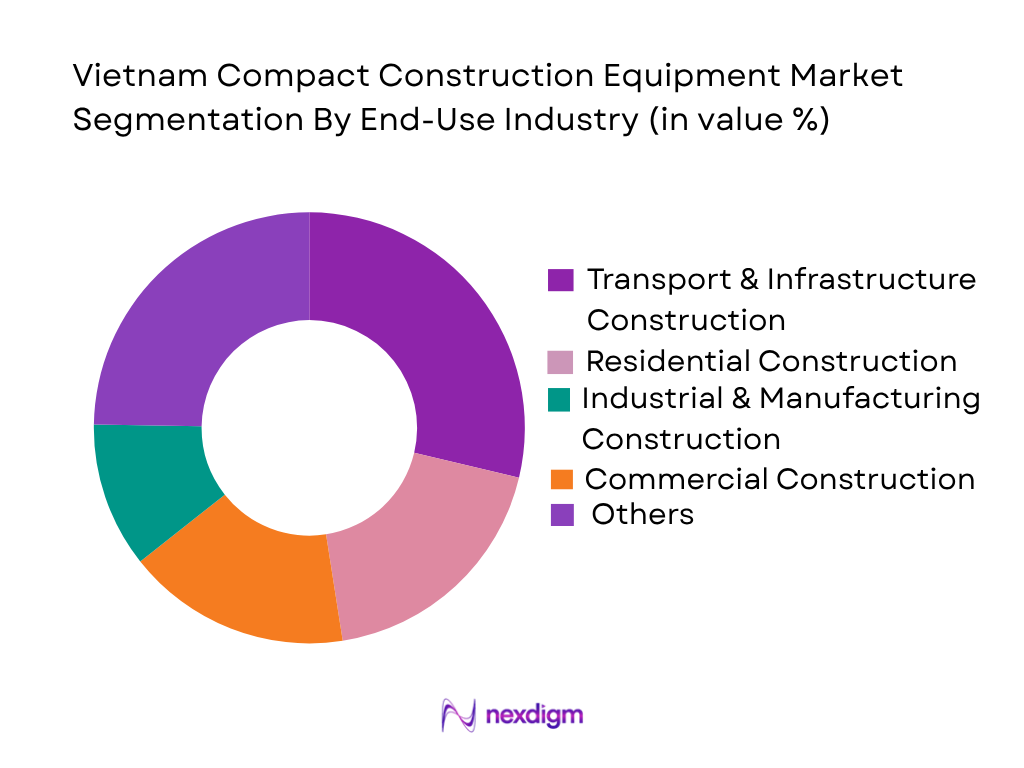
By End-Use Industry
The Vietnam Compact Construction Equipment Market is segmented by end-use industry into transport infrastructure construction, residential construction, commercial construction, industrial and manufacturing construction, utility and energy infrastructure, municipal works, agriculture and equipment rental. Transport and infrastructure construction represents the leading demand segment, supported by Vietnam’s continuing development of expressways, roads, drainage networks, urban infrastructure and associated civil works. Compact excavators and loaders complement larger machines on projects requiring roadside excavation, trenching, material movement, landscaping and finishing activities. Industrial construction is another strategically important segment because Vietnam attracted USD 38.23 billion of registered foreign investment during 2024, while manufacturing and processing received nearly USD 25.58 billion. Realized FDI reached USD 25.35 billion, creating demand for factories, supporting infrastructure, utilities and industrial-site preparation. Residential development further broadens equipment utilization: the Ministry of Construction reported 79 newly licensed commercial housing projects representing approximately 38,345 units and 69 completed projects representing around 23,041 units during 2024.
Competitive Landscape
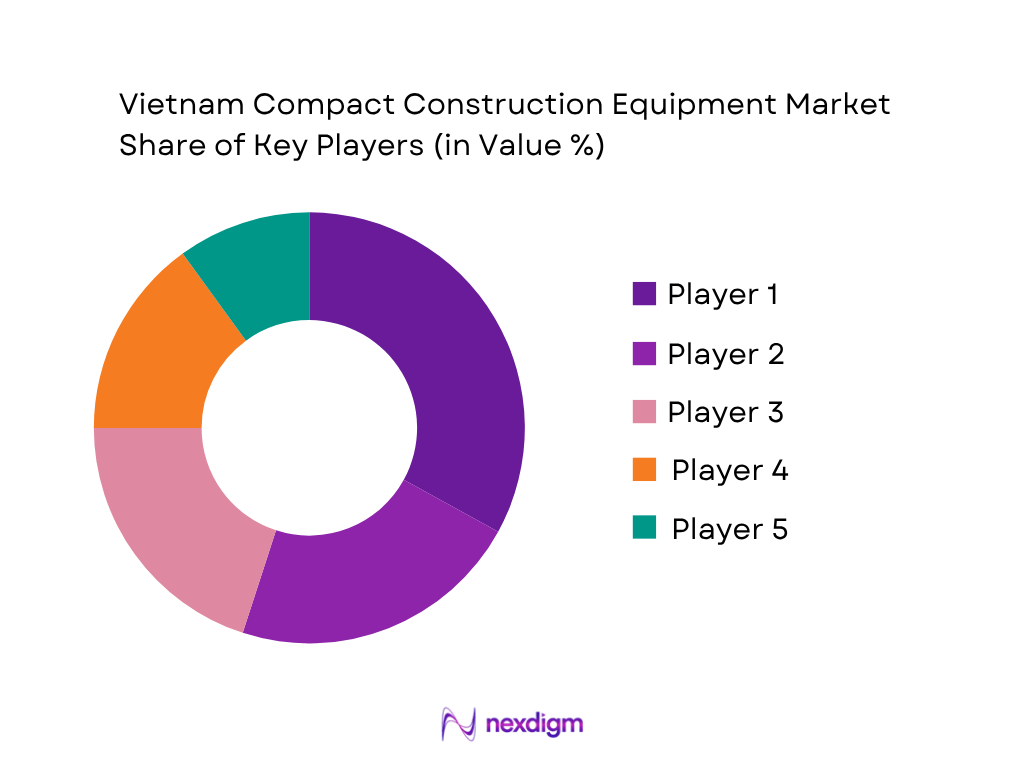
Vietnam’s compact construction equipment landscape combines Japanese, Chinese, Korean, European and American OEMs operating largely through distributors and local service organizations. Competition is increasingly shaped by mini-excavator range, engine and hydraulic performance, equipment durability, acquisition accessibility, spare-parts availability and nationwide service support. The importance of distribution is particularly pronounced: Marubeni Heavy Equipment identifies itself as Komatsu’s exclusive authorized dealer in Vietnam, while SANY maintains operations and service presence across northern, central and southern Vietnam.
| Major Player | Established | Headquarters | Relevant Compact Equipment | Core Technology | Key Compact Performance Focus | Attachment Capability | Vietnam Market Route | Major Applications |
| Caterpillar | 1925 | Irving, Texas, USA | ~ | ~ | ~ | ~ | ~ | ~ |
| Komatsu | 1921 | Tokyo, Japan | ~ | ~ | ~ | ~ | ~ | ~ |
| SANY | 1989 | Changsha, China | ~ | ~ | ~ | ~ | ~ | ~ |
| LiuGong | 1958 | Liuzhou, China | ~ | ~ | ~ | ~ | ~ | ~ |
| Kubota | 1890 | Osaka, Japan | ~ | ~ | ~ | ~ | ~ | ~ |
Vietnam Compact Construction Equipment Market Analysis
Growth Drivers
Expansion of Infrastructure and Construction Activity
Vietnam’s accelerating infrastructure and construction activity is strengthening the utilization base for mini excavators, skid-steer loaders, compact wheel loaders, backhoe loaders and other compact machinery. The National Statistics Office reported total economy-wide realized investment of VND 3,692.1 trillion in 2024, including VND 1,019.3 trillion from the state sector, VND 2,064.2 trillion from the non-state sector and VND 608.6 trillion from foreign-invested enterprises. Vietnam’s economy generated USD 476.39 billion in GDP, while GDP per capita reached USD 4,717.3, according to the World Bank. The Ministry of Construction recorded 937 commercial housing projects representing approximately 403,349 units under construction during the fourth quarter, alongside 497 land-development projects comprising about 39,781 plots. Vietnam also registered 15,800 newly established construction enterprises, broadening the contractor base capable of purchasing, leasing and operating compact machinery. These construction pipelines require excavation, trenching, grading, loading, landscaping and utility installation, activities where compact equipment offers maneuverability advantages over full-size machinery. The VND 1,019.3 trillion of state-sector investment is especially relevant because public infrastructure programs generate recurring earthmoving requirements across roads, drainage networks and urban utilities. A contractor ecosystem containing thousands of newly established construction businesses also supports demand for smaller machines that can be transported between multiple worksites. Compact excavators can operate effectively around buildings and underground utility corridors where available working space restricts conventional excavators. Compact loaders similarly provide contractors with one machine platform capable of handling multiple attachments. Collectively, infrastructure capital deployment, active residential construction and contractor formation create a strong operational foundation for compact equipment deployment.
Manufacturing and Foreign Investment Driving Industrial Construction
Vietnam’s expanding manufacturing ecosystem is creating a substantial industrial application base for compact construction equipment used in factory construction, site preparation, drainage installation, internal roads, utilities and plant expansion. The National Statistics Office recorded USD 38.23 billion of registered foreign investment in 2024, while realized foreign direct investment reached USD 25.35 billion, the highest recorded level reported for the period. Vietnam registered 3,375 newly licensed FDI projects, indicating a broad pipeline of facilities requiring construction and supporting infrastructure. Across the domestic economy, 19,095 new manufacturing enterprises were established, while more than 8,800 manufacturing enterprises returned to operation. Industry and construction employed approximately 17.4 million people, adding around 167,000 workers during the year. The World Bank placed Vietnam’s total GDP at USD 476.39 billion and population at 100,987,686, highlighting the scale of the domestic industrial economy supporting equipment demand. Compact excavators and loaders are particularly applicable to industrial parks because they can undertake foundation preparation, trench excavation, material movement, maintenance and utility work within space-constrained factory environments. The 3,375 newly licensed foreign-investment projects also broaden the addressable construction pipeline beyond traditional residential and public works. Manufacturing facilities typically require repeated equipment deployment during initial site development, factory expansion and subsequent maintenance activities. Compact machinery can work around installed production buildings and utility networks where larger machines have restricted access. Multi-attachment compatibility further enables contractors to deploy the same machine for excavation, breaking, grading and material movement. Consequently, continued manufacturing investment supports both initial equipment deployment and recurring aftermarket utilization.
Market Challenges
High Dependence on Capital Equipment and Imported Machinery Ecosystems
Vietnam’s compact construction equipment sector faces structural exposure to imported machinery, components, hydraulic systems and replacement parts, making equipment availability sensitive to the country’s broader import and logistics environment. Vietnam recorded total merchandise trade of USD 786.29 billion in 2024, demonstrating the exceptionally large cross-border goods flow on which industrial supply chains depend. At the same time, the country had 157,240 newly established enterprises, including 36,778 businesses in industry and construction, creating a fragmented customer environment where many equipment buyers are smaller contractors rather than large fleet operators. The construction sector alone recorded 15,800 newly established businesses, while nearly 9,900 construction enterprises returned to operation during the year. This fragmented contractor structure can complicate nationwide equipment distribution, parts stocking, technical training and maintenance coverage. Vietnam’s population reached 100,987,686, while GDP per capita stood at USD 4,717.3, according to World Bank data. For compact-equipment OEMs, distributors and rental companies, these conditions increase the importance of localized spare-parts inventories, technician networks, refurbishment capabilities and regional service facilities. Compact machines depend on hydraulic pumps, electronic controllers, engines, undercarriage components, filters and specialized attachments, meaning parts availability directly influences fleet uptime. Contractors operating several machines across dispersed worksites require rapid service intervention because an immobilized excavator or loader can interrupt excavation and material-handling schedules. The presence of 36,778 new industry and construction enterprises further expands the number of customers requiring technical support. Distributors therefore need sufficient warehousing capacity and trained technicians rather than relying solely on equipment imports. Developing stronger local aftermarket infrastructure remains critical for reducing downtime associated with imported-component lead times.
Fragmented Contractor Base and Business Turnover
Vietnam’s compact construction equipment market must address a highly fragmented contractor ecosystem in which equipment utilization and procurement capacity differ considerably between major infrastructure companies and smaller construction businesses. The National Statistics Office recorded 15,800 newly established construction enterprises in 2024, but the wider economy simultaneously experienced substantial enterprise turnover. Approximately 100,100 enterprises temporarily suspended operations, around 76,200 enterprises stopped operating while awaiting dissolution procedures, and more than 21,600 enterprises completed dissolution procedures. This operating environment can constrain purchases of specialized compact machines among smaller contractors and increase dependence on equipment rental, used machinery and project-based procurement. Nevertheless, nearly 9,900 construction enterprises returned to operation, indicating continued churn rather than simple contraction of the contractor base. Vietnam employed 51.9 million people, including approximately 17.4 million workers across industry and construction, illustrating the substantial labor and contractor ecosystem that equipment suppliers must serve. For manufacturers and distributors, fragmented demand requires flexible financing arrangements, smaller machine configurations, extensive dealer coverage, dependable parts inventories and rental partnerships rather than reliance exclusively on direct sales to major contractors. The contrast between 15,800 new construction businesses and 9,900 returning construction enterprises demonstrates the continuously changing composition of the potential customer base. Smaller contractors may require equipment only during specific excavation or site-preparation phases, making permanent fleet ownership less operationally necessary. This increases the strategic importance of rental channels and dealer-managed equipment fleets. Manufacturers also need machines capable of handling multiple attachments so contractors can maximize utilization across different jobs. Strong resale, refurbishment and aftermarket networks can further support equipment circulation between contractors with different utilization profiles.
Market Opportunities
Compact Equipment Deployment Across Housing and Urban Development
Vietnam’s active residential construction pipeline creates an opportunity for greater adoption of compact excavators, skid-steer loaders and compact wheel loaders in confined urban projects. Ministry of Construction data recorded 937 commercial housing projects with approximately 403,349 units under construction during the fourth quarter of 2024. Northern Vietnam accounted for 366 projects involving approximately 216,945 units, central Vietnam had 407 projects with 106,897 units, and southern Vietnam recorded 189 projects with 79,507 units. Across the full year, 79 commercial housing projects comprising approximately 38,345 units received new licenses, while 69 projects representing around 23,041 units were completed. Social housing provides another equipment-demand channel: 28 projects containing 20,284 units were completed, while 23 projects comprising 25,399 units were licensed and commenced construction. The wider social-housing pipeline contained 645 projects representing 581,218 units at the reporting point. Such development creates recurring requirements for foundation excavation, utility trenches, drainage, landscaping, material handling and site finishing. The presence of 403,349 commercial housing units under construction indicates a substantial physical worksite base where compact machinery can complement larger earthmoving equipment. Dense housing projects frequently contain narrow spaces between structures, temporary access routes and underground utility corridors that favor smaller machine dimensions. Social housing construction further expands the number of standardized, repetitive jobs where fleet utilization can be optimized. Compact loaders equipped with buckets, forks and grading attachments can perform several tasks without requiring multiple dedicated machines. Equipment suppliers can therefore target residential developers, civil contractors, landscaping contractors and rental companies with application-specific machine and attachment packages.
Expansion of Rental Fleets and Multi-Purpose Compact Machinery
Vietnam’s large and fragmented construction-business population creates a clear opportunity for rental fleets and multi-purpose compact equipment capable of serving contractors without requiring permanent machine ownership. The country recorded 36,778 newly established industry and construction enterprises in 2024, including 15,800 construction companies, while almost 9,900 construction businesses returned to operation. At the same time, total realized investment across the economy reached VND 3,692.1 trillion, creating a broad underlying project base across infrastructure, industrial facilities, housing and utilities. Vietnam also employed approximately 17.4 million people in industry and construction, providing a large operational ecosystem for machinery deployment. The opportunity is particularly relevant for compact excavators, skid-steer loaders and compact track loaders because hydraulic attachments allow individual machines to undertake excavation, loading, grading, breaking, trenching and material-handling tasks across different projects. Equipment-rental companies can therefore improve machine utilization by moving units between housing, road, industrial and municipal worksites. The 15,800 newly formed construction businesses provide a sizeable potential customer pool for rental models because emerging contractors may need machinery before developing permanent fleets. Nearly 9,900 returning construction businesses add another customer category requiring flexible access to equipment as operations restart. Attachment-based machines allow rental companies to generate utilization from the same power unit across several construction activities. Rental fleets can also introduce contractors to newer compact-equipment technologies without requiring immediate ownership. For OEMs and distributors, this creates recurring opportunities across machine supply, attachments, replacement parts, preventive maintenance, fleet telematics, technician services and used-equipment remarketing.
Future Outlook
The Vietnam Compact Construction Equipment Market is projected to expand at approximately ~XX% CAGR during 2026-2035, supported by transport infrastructure, industrial construction, urban redevelopment, utility networks and increasing mechanization of smaller construction activities. Mini excavators should remain strategically important because Vietnam’s increasingly dense urban construction environment favors maneuverable machinery capable of operating in restricted areas. Demand is also expected to become more technology-oriented, with equipment selection increasingly incorporating fuel efficiency, hydraulic attachment compatibility, remote diagnostics, telematics and lifecycle support. Expansion of equipment rental and professionally managed fleets can further improve access to compact machinery among smaller contractors that do not require continuous machine ownership.
Industrial construction provides an additional structural opportunity. Vietnam had 42,002 valid FDI projects with USD 502.8 billion in registered capital at the end of 2024, while accumulated realized foreign investment reached approximately USD 322.5 billion. Manufacturing and processing represented more than USD 308.76 billion of accumulated registered foreign investment, sustaining a substantial base of factories and supporting infrastructure requiring construction machinery.
Major Players
- Caterpillar Inc.
- Komatsu Ltd.
- Hitachi Construction Machinery
- Volvo Construction Equipment
- SANY Group
- XCMG Machinery
- LiuGong Machinery
- JCB
- DEVELON
- HD Hyundai Construction Equipment
- Kobelco Construction Machinery
- Kubota Corporation
- CASE Construction Equipment
- Takeuchi Manufacturing
- Yanmar Construction Equipment
Key Target Audience
- Compact Construction Equipment Manufacturers
- Construction Equipment Importers and Authorized Distributors
- Infrastructure and Civil Construction Contractors
- Industrial and Manufacturing Facility Developers
- Equipment Rental and Fleet Management Companies
- Component, Hydraulic System and Attachment Manufacturers
- Investments and Venture Capitalist Firms
- Government and Regulatory Bodies (Ministry of Construction, Ministry of Finance, Ministry of Industry and Trade, Vietnam Register)
Research Methodology
Step 1: Identification of Key Variables
The initial phase involves constructing an ecosystem map covering OEMs, equipment importers, authorized distributors, independent dealers, contractors, rental companies, attachment suppliers and aftermarket providers within the Vietnam Compact Construction Equipment Market. Secondary research identifies critical variables including equipment imports, construction activity, mini-excavator demand, installed fleet, replacement cycles, industrial investment, infrastructure activity and equipment utilization.
Step 2: Market Analysis and Construction
Historical market analysis combines top-down construction and investment indicators with bottom-up equipment-level assessment. Mini excavators, skid-steer loaders, compact track loaders, compact wheel loaders, backhoe loaders and related equipment are evaluated independently. Import dependence, new-versus-used machinery, dealer networks, rental procurement and application-specific utilization are assessed to construct the overall Vietnam Compact Construction Equipment Market framework.
Step 3: Hypothesis Validation and Expert Consultation
Market hypotheses are validated through CATIs and structured interviews with equipment distributors, OEM representatives, contractors, rental fleet operators, spare-parts providers and machinery service companies. Discussions examine machine utilization, equipment replacement, contractor preferences, Japanese versus Chinese equipment positioning, used-equipment competition, attachment adoption, parts availability and regional differences in demand.
Step 4: Research Synthesis and Final Output
Primary findings are triangulated with official construction, FDI, housing and industrial statistics and equipment-company information. Bottom-up estimates based on machine categories and distribution channels are reconciled with top-down construction indicators. The final output establishes market structure, equipment segmentation, competitive positioning, end-user requirements and the longer-term outlook for Vietnam’s compact construction equipment industry.

- Executive Summary
- Research Methodology (Market Definition and Scope, Vietnam Compact Construction Equipment Market Classification, Compact Equipment Technology Mapping, Mini Excavator Assessment, Compact Track Loader Assessment, Skid-Steer Loader Evaluation, Compact Wheel Loader Assessment, Backhoe Loader Evaluation, Compact Telehandler Assessment, Operating Weight Classification, Engine Power Assessment, Rated Operating Capacity Analysis, Digging Depth Assessment, Bucket Capacity Analysis, Hydraulic System Evaluation, Attachment Compatibility Assessment, Equipment Utilization Analysis, Fuel Efficiency Assessment, Rental Fleet Assessment, New and Used Equipment Analysis, Import Dependency Assessment, Dealer and Distributor Network Mapping, Aftermarket Parts Assessment, Maintenance and Service Capability Analysis, Supply-Side Assessment, Demand-Side Assessment, Top-Down Market Sizing, Bottom-Up Market Sizing, Primary Industry Interviews, Data Triangulation, Forecasting Framework)

- Definition and Scope
- Vietnam Compact Construction Equipment Industry Evolution and Development of Mini Excavators, Compact Excavators, Skid-Steer Loaders, Compact Track Loaders, Compact Wheel Loaders, Backhoe Loaders, Compact Telehandlers, Mini Loaders, Zero-Tail-Swing Excavators, Short-Tail-Swing Excavators, Hydraulic Attachment-Based Equipment, Low-Emission Compact Equipment, Telematics-Enabled Equipment, Construction Equipment Digitalization, Advanced Compact Construction Equipment Technologies
- Compact Construction Equipment Value Chain Analysis
- Compact Construction Equipment Supply Chain Analysis
- Engine and Powertrain Suppliers, Hydraulic Component Manufacturers, Steel and Structural Component Suppliers, Undercarriage and Track Suppliers, Tire Manufacturers, Bucket and Attachment Manufacturers, Global Construction Equipment OEMs, Vietnamese Equipment Importers, Authorized Equipment Distributors, Independent Machinery Dealers, Used Equipment Importers, Equipment Rental Providers, Spare Parts Suppliers, Maintenance and Repair Providers, Infrastructure Contractors, Residential Contractors, Industrial Construction Contractors, Utility Contractors, Municipal and Public Works End Users

- Growth Drivers (Expressway and Transport Infrastructure Development, Urban Construction Expansion, Industrial Park Development, FDI-Linked Factory Construction, Increasing Mechanization of Small Construction Sites, Utility Network Expansion, Rising Demand for Maneuverable Construction Equipment, Contractor Productivity Requirements)
- Market Challenges (Dependence on Imported Construction Equipment, Used Machinery Competition, Spare Parts Availability, Skilled Equipment Operator Constraints, Dealer Service Coverage Outside Major Cities, Equipment Financing Accessibility, Maintenance Requirements, Fragmented Contractor Base)
- Market Opportunities (Mini Excavator Adoption, Urban Utility Construction, Expressway Supporting Works, Industrial Park Construction, Equipment Rental Expansion, Battery-Electric Compact Equipment Introduction, Attachment-Based Equipment Utilization, Telematics and Fleet Management Solutions)
- Market Trends (Zero-Tail-Swing Excavator Adoption, Chinese Construction Equipment OEM Expansion, Japanese Used Equipment Presence, Hydraulic Attachment Adoption, Dealer Network Expansion, Remote Equipment Diagnostics, Telematics-Enabled Fleet Monitoring, Fuel-Efficient Engines, Equipment Rental Adoption)
- Government Regulations and Standards (Construction Machinery Import Requirements, Used Machinery Import Regulations, Vietnam Technical Regulations, Occupational Safety Requirements, Non-Road Equipment Emission Requirements, Equipment Inspection Requirements, Customs and Import Procedures, Construction Site Safety Standards)
- SWOT Analysis
- Porter’s Five Forces Analysis
- PESTLE Analysis
- Stakeholder Ecosystem
- Competition Ecosystem

- By Market Value (2020-2025)
- By New Compact Construction Equipment Unit Sales (2020-2025)
- By Compact Construction Equipment Import Volume (2020-2025)
- By Installed Equipment Base (2020-2025)
- By Average Selling Price per Equipment Unit (2020-2025)
- By Mini Excavator Unit Sales (2020-2025)
- By Skid-Steer and Compact Track Loader Unit Sales (2020-2025)
- By Compact Wheel Loader Unit Sales (2020-2025)
- By Backhoe Loader Unit Sales (2020-2025)
- By Rental Fleet Equipment Procurement Volume (2020-2025)

- By Equipment Type (In Value %)
Mini and Compact Excavators
Skid-Steer Loaders
Compact Track Loaders
Compact Wheel Loaders
Backhoe Loaders
Compact Telehandlers
Mini Loaders
Compact Compaction Equipment - By Operating Weight (In Value %)
Below 2 Tons
2-4 Tons
4-6 Tons
6-8 Tons
8-10 Tons
Above 10 Tons within Compact Equipment Classification - By Application (In Value %)
Excavation and Trenching
Loading and Material Handling
Site Preparation and Grading
Road and Drainage Construction
Utility Installation
Demolition and Site Clearance
Landscaping and Property Development
Industrial Material Handling
Compaction Applications
Agricultural and Rural Infrastructure Applications - By End-Use Industry (In Value %)
Transport Infrastructure Construction
Residential Construction
Commercial Construction
Industrial and Manufacturing Facility Construction
Utility and Energy Infrastructure
Municipal and Public Works
Agriculture
Landscaping and Property Development
Mining and Quarry Support Operations
Equipment Rental Industry - By Region (In Value %)
Northern Vietnam
Red River Delta
Hanoi
Hai Phong
Quang Ninh
Central Vietnam
Da Nang
Southern Vietnam
Ho Chi Minh City
Dong Nai
Rest of Vietnam

- Market Share of Major Players (By Vietnam Revenue, Compact Equipment Unit Sales, Mini Excavator Portfolio, Compact Loader Portfolio, Operating Weight Coverage, Dealer Network Coverage, Installed Equipment Base, Infrastructure Contractor Presence, Rental Fleet Presence, Attachment Portfolio, Spare Parts Availability, Aftermarket Service Capability, Customer Base)
- Cross Comparison Parameters (Mini Excavator Operating Weight Range, Maximum Digging Depth Capability, Rated Operating Capacity and Lift Performance, Engine Power and Fuel Efficiency, Hydraulic Flow and Attachment Compatibility, Compact Equipment Product Portfolio Breadth, Dealer and Aftermarket Service Network Coverage, Telematics and Fleet Management Capability)
- SWOT Analysis of Major Players
- Competitive Positioning Matrix
- Compact Construction Equipment Technology and Application Benchmarking
- Mini Excavator Digging Performance and Operating Weight Assessment
- Compact Loader Hydraulic Performance and Attachment Compatibility Assessment
- New versus Used Compact Construction Equipment Assessment
- Vietnam Dealer Network and Aftermarket Service Capability Assessment
- Major Companies
Caterpillar Inc.
Komatsu Ltd.
Hitachi Construction Machinery Co., Ltd.
Volvo Construction Equipment
SANY Group
XCMG Machinery
LiuGong Machinery
JCB
DEVELON
Hyundai Construction Equipment
Kobelco Construction Machinery
Kubota Corporation
CASE Construction Equipment
Takeuchi Manufacturing
Yanmar Compact Equipment

- Infrastructure Contractor Requirement Assessment
- Residential Construction Equipment Demand Analysis
- Commercial Construction Equipment Requirement Assessment
- Industrial Construction Contractor Assessment
- Utility Contractor Equipment Requirement Assessment
- Road Construction Equipment Application Assessment
- Rental Fleet Procurement Assessment
- Municipal and Public Works Equipment Assessment
- Agricultural Compact Equipment Requirement Assessment
- New versus Used Equipment Purchasing Assessment
- Compact Equipment Performance Requirement Assessment (Operating Weight, Engine Power, Bucket Capacity, Digging Depth, Breakout Force, Rated Operating Capacity, Hydraulic Flow, Turning Radius, Ground Pressure, Attachment Compatibility)

- By Market Value (2026-2035)
- By New Compact Construction Equipment Unit Sales (2026-2035)
- By Installed Equipment Base (2026-2035)
- By Average Selling Price per Equipment Unit (2026-2035)
- By Mini Excavator Unit Sales (2026-2035)
- By Skid-Steer and Compact Track Loader Unit Sales (2026-2035)
- By Compact Wheel Loader Unit Sales (2026-2035)
- By Backhoe Loader Unit Sales (2026-2035)
- By Battery-Electric Compact Equipment Unit Sales (2026-2035)
- By Rental Fleet Equipment Procurement Volume (2026-2035)


 Request a Sample
 Ask for Customization
 Get a Quote
 Enquire Now