

 Download PDF
Market Overview
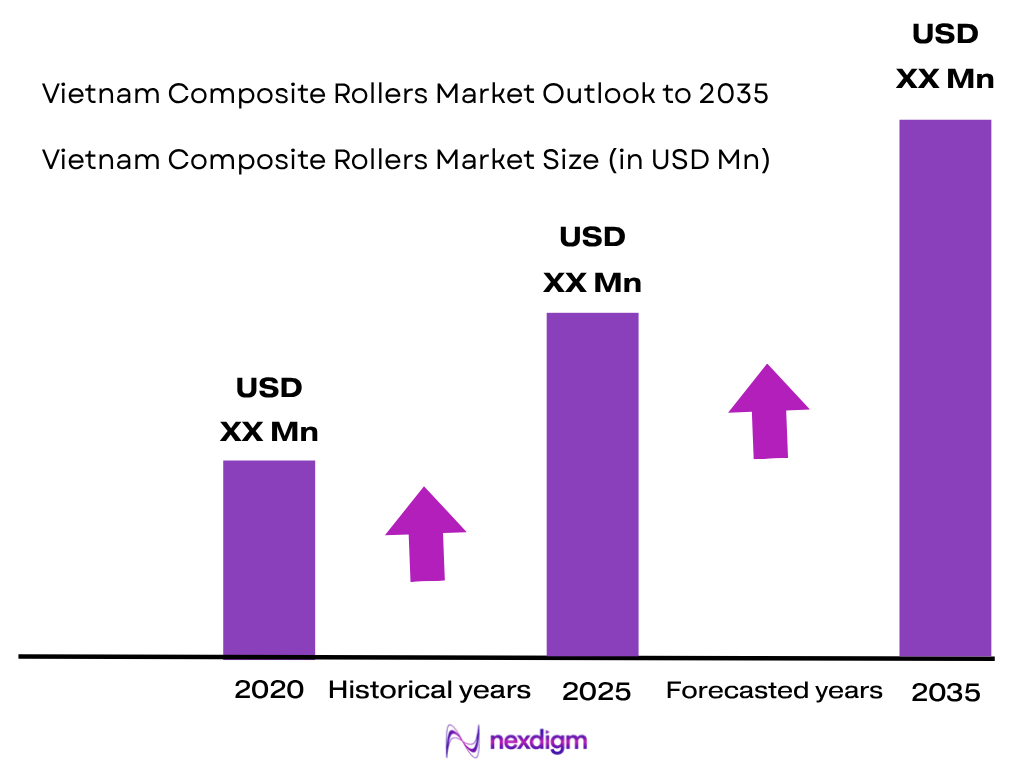
The Vietnam Composite Rollers Market is valued at ~USD XX million based on industry assessment, with demand supported by the expansion of manufacturing industries, increasing adoption of lightweight industrial components, and modernization of production equipment. The market is driven by the replacement of conventional metal rollers with composite alternatives offering lower weight, improved rotational efficiency, corrosion resistance, and longer operating life. The growing presence of textile, packaging, plastic processing, and industrial automation sectors continues to influence composite roller adoption across Vietnam.
The Vietnam Composite Rollers Market is concentrated in major industrial locations including Ho Chi Minh City, Binh Duong, Dong Nai, Hanoi, and Hai Phong due to their developed manufacturing infrastructure and presence of export-oriented production facilities. Southern Vietnam remains a major industrial hub because of its strong textile, packaging, electronics, and machinery manufacturing ecosystem. Northern Vietnam is gaining importance due to foreign direct investment inflows, industrial park development, and expansion of advanced manufacturing facilities requiring precision-engineered components.
Market Segmentation
By Fiber Material Type
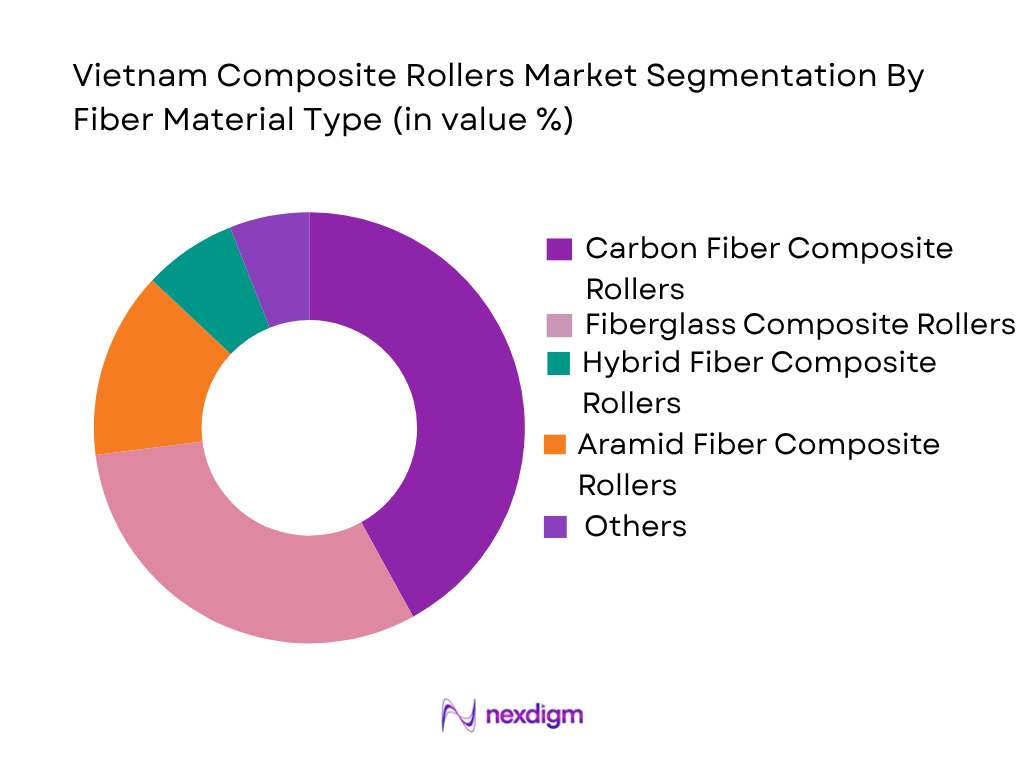
The Vietnam Composite Rollers Market is segmented by fiber material type into carbon fiber composite rollers, fiberglass composite rollers, hybrid fiber composite rollers, aramid fiber composite rollers, basalt fiber composite rollers, and natural fiber composite rollers. Carbon fiber composite rollers represent the leading segment due to their superior mechanical strength, lightweight structure, high stiffness, and ability to support high-speed industrial operations. Industries such as textile processing, printing, packaging, and plastic film manufacturing increasingly adopt carbon fiber rollers because they reduce machine inertia, improve production efficiency, and enable precise web handling. Fiberglass composite rollers are also widely used due to their lower cost and suitability for standard industrial applications where extreme performance requirements are not necessary.
By Application Industry
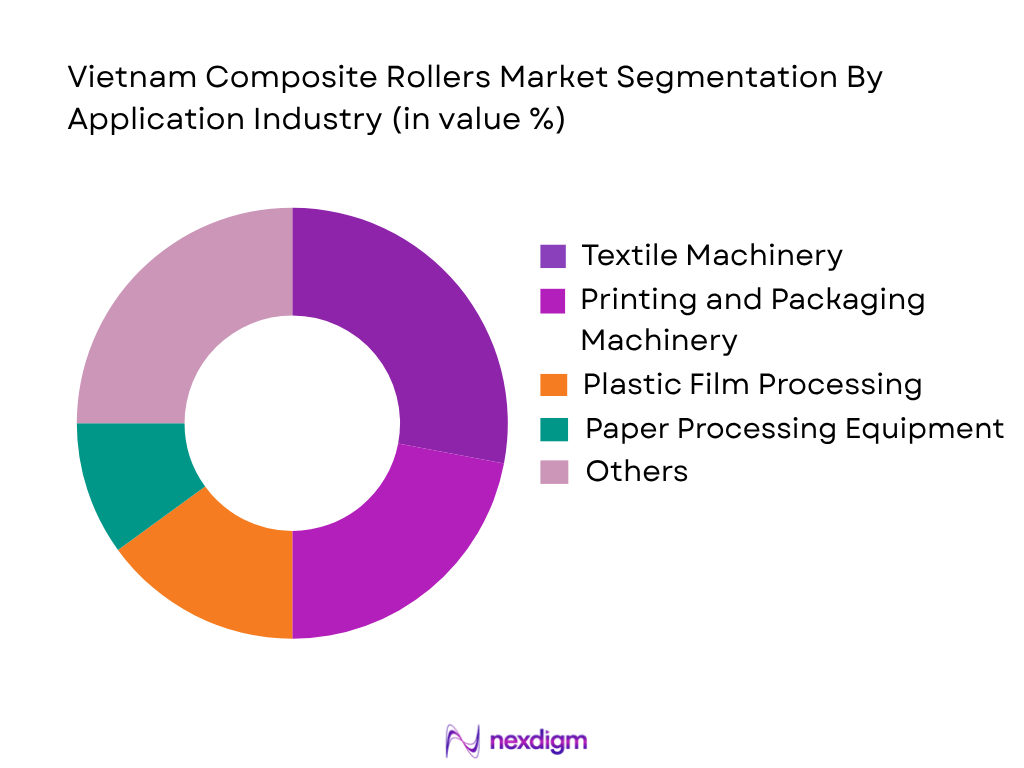
The Vietnam Composite Rollers Market is segmented by application industry into textile machinery, printing and packaging machinery, paper processing equipment, plastic film manufacturing, battery manufacturing equipment, electronics manufacturing, automotive manufacturing, food processing equipment, and renewable energy equipment. Textile machinery applications account for a significant portion of demand due to Vietnam’s established textile and garment production base. Composite rollers are increasingly utilized in textile processing lines because they provide lightweight operation, reduced vibration, improved tension control, and enhanced machine productivity. The printing and packaging sector is another major application area due to increasing flexible packaging production and demand for high-speed converting machinery. Growth in electronics and battery manufacturing is expected to create additional opportunities for precision composite roller applications.
Competitive Landscape
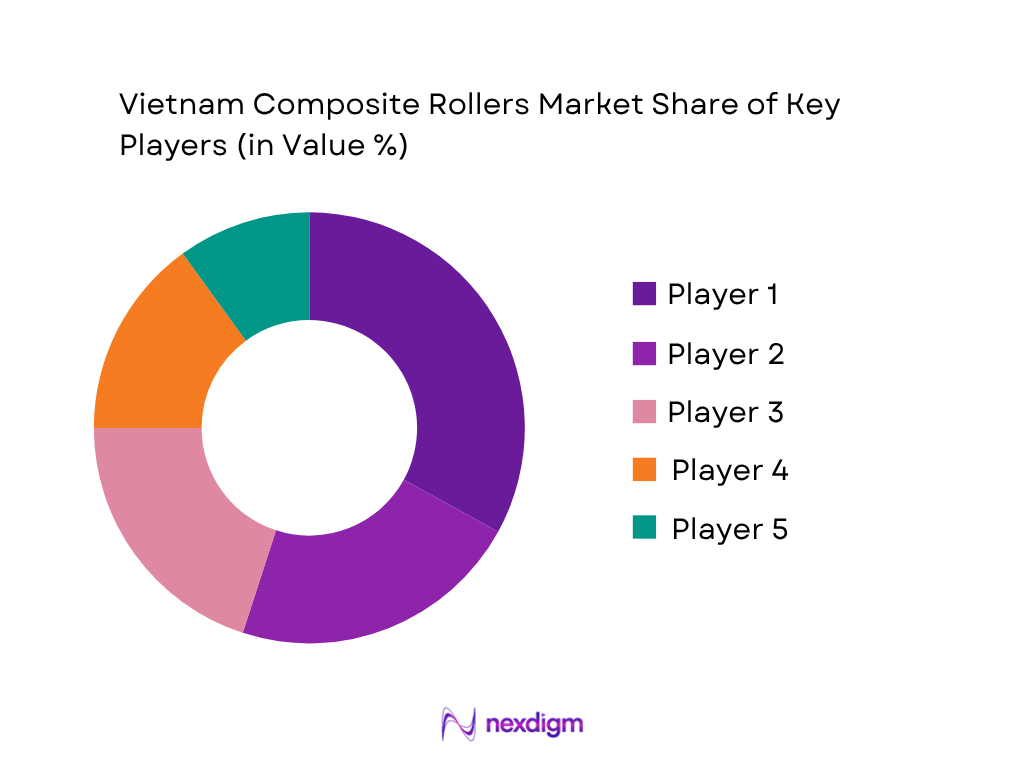
The Vietnam Composite Rollers Market consists of international composite roller manufacturers, industrial equipment suppliers, and advanced material companies supplying solutions to manufacturing industries. Competition is influenced by composite material expertise, manufacturing technology, customization capability, product durability, and ability to support industrial applications requiring lightweight and high-speed roller solutions. Major global companies participate through direct supply, regional partnerships, and industrial equipment networks.
| Company | Establishment Year | Headquarters | Product Portfolio | Composite Roller Technology Capability | Manufacturing Process Expertise | Key End-Use Industries Served | Customization Capability | Global Presence |
| Double E Company | 1972 | Westborough, Massachusetts, USA | ~ | ~ | ~ | ~ | ~ | ~ |
| Menges Roller Company | 1966 | Wauconda, Illinois, USA | ~ | ~ | ~ | ~ | ~ | ~ |
| American Roller Company LLC | 1938 | Stow, Ohio, USA | ~ | ~ | ~ | ~ | ~ | ~ |
| Voith GmbH & Co. KGaA | 1867 | Heidenheim, Germany | ~ | ~ | ~ | ~ | ~ | ~ |
| Maxcess International | 1995 | Oklahoma City, Oklahoma, USA | ~ | ~ | ~ | ~ | ~ | ~ |
| Kadant Inc. | 1991 | Westford, Massachusetts, USA | ~ | ~ | ~ | ~ | ~ | ~ |
| Webex Inc. | 1979 | Neenah, Wisconsin, USA | ~ | ~ | ~ | ~ | ~ | ~ |
| Western Machine Works | 1983 | Portland, Oregon, USA | ~ | ~ | ~ | ~ | ~ | ~ |
Vietnam Composite Rollers Market Analysis
Growth Drivers
Expansion of Manufacturing and Export-Oriented Industrial Production
The Vietnam Composite Rollers Market is benefiting from the country’s rapid manufacturing expansion, particularly in industries that require lightweight, high-speed, and durable roller solutions such as textiles, packaging, plastics, electronics, and industrial processing. Vietnam’s manufacturing sector accounted for 24% of GDP in 2024, according to the World Bank, demonstrating the increasing contribution of industrial production to economic activity. The General Statistics Office of Vietnam reported that the industrial production index increased by 8.4% in 2024, with the manufacturing and processing sector growing by 9.6%. Within key industries relevant to composite roller applications, textile production increased by 12.1%, rubber and plastic product manufacturing increased by 24.9%, and electronic product manufacturing increased by 8.3%. These industrial expansions are increasing demand for advanced roller systems used in continuous production lines, web processing equipment, and automated machinery. Additionally, Vietnam recorded total merchandise exports of USD 405.53 billion in 2024, supported by strong performance in electronics, machinery, and textile exports, which require efficient manufacturing infrastructure. The increasing scale of export-oriented production facilities is encouraging manufacturers to adopt composite rollers to improve machine efficiency, reduce rotational load, and support high-speed operations. General Statistics Office of Vietnam
Growth of Textile, Packaging, and High-Speed Processing Industries
The Vietnam Composite Rollers Market is supported by increasing demand from textile machinery, printing, packaging, and flexible material processing industries where precision roller performance is essential. Vietnam’s textile and garment industry generated approximately USD 37.04 billion in export turnover in 2024, representing a major manufacturing ecosystem requiring advanced production equipment. Textile processing facilities increasingly utilize lightweight composite rollers for applications involving fabric handling, tension control, and high-speed production operations. According to Vietnam’s National Statistics Office, the processing and manufacturing sector experienced strong industrial recovery, with manufacturing output increasing by 9.6% in 2024. The packaging and plastic processing industries also represent significant demand contributors, as Vietnam recorded plastic and rubber product manufacturing growth of 24.9% in industrial production during the same period. Composite rollers support these industries by improving operational stability, reducing machine vibration, and enabling faster processing speeds compared with conventional metal rollers. Vietnam’s total goods trade reached USD 786.29 billion in 2024, with machinery, electronics, textiles, and manufactured products representing major trade categories, reflecting the continued expansion of industrial production capacity that requires advanced components such as composite rollers. Government of Vietnam
Market Challenges
Dependence on Imported Composite Materials and Limited Domestic Manufacturing Capability
The Vietnam Composite Rollers Market faces challenges due to dependence on imported advanced composite materials, particularly carbon fiber, specialized resins, and high-performance reinforcement materials. Vietnam’s industrial growth has increased demand for imported production inputs, with the country recording USD 380.76 billion in imports in 2024, including significant volumes of machinery, equipment, electronic components, and industrial materials. According to the General Statistics Office of Vietnam, production-related goods accounted for USD 356.43 billion of imports in 2024, representing the majority of imported goods and highlighting Vietnam’s dependence on external industrial supply chains. Composite roller manufacturing requires specialized knowledge in fiber selection, resin formulation, filament winding, curing processes, and precision balancing, which limits the number of domestic suppliers capable of producing advanced solutions. The absence of a broad local ecosystem for high-performance composite manufacturing can increase dependence on international suppliers for critical materials and technologies. This challenge affects supply reliability, customization speed, and adoption among smaller industrial manufacturers that require localized technical support. General Statistics Office of Vietnam
Technical Complexity and Adoption Barriers Among Traditional Industrial Users
The Vietnam Composite Rollers Market experiences adoption challenges due to technical complexity associated with composite material selection, manufacturing processes, maintenance requirements, and compatibility with existing industrial machinery. Many traditional manufacturing facilities continue using conventional steel or aluminum rollers because their production systems and maintenance practices are designed around metallic components. Vietnam’s industrial sector is expanding rapidly, but the transition toward advanced materials requires technical capabilities in engineering design, dynamic balancing, surface treatment, and application-specific performance evaluation. The National Statistics Office reported that Vietnam’s industrial production index increased by 8.4% in 2024, indicating strong industrial growth; however, the adoption of specialized components varies across industries depending on technological maturity and investment capacity. Composite rollers require manufacturers and end users to understand performance factors such as rotational speed capability, load requirements, thermal stability, and corrosion resistance. Industries with limited technical resources may face difficulties in evaluating the long-term operational advantages of composite solutions. Additionally, Vietnam’s import structure showed USD 48.9 billion in machinery, equipment, and spare part imports in 2024, reflecting continued reliance on external industrial technologies and components. Government of Vietnam
Market Opportunities
Localization of Advanced Industrial Component Manufacturing
The Vietnam Composite Rollers Market presents opportunities through increasing localization of industrial component manufacturing and development of domestic advanced material capabilities. Vietnam’s manufacturing sector contributed 24% of GDP in 2024, according to World Bank data, highlighting the country’s position as a major production hub in Southeast Asia. The government’s focus on industrial development and increasing foreign direct investment in manufacturing is creating demand for locally available precision components. Vietnam recorded merchandise exports of USD 405.53 billion in 2024, with major contributions from electronics, machinery, textiles, and manufactured goods that require efficient production systems. As industrial companies expand local operations, demand is increasing for suppliers capable of providing customized composite rollers, maintenance services, and application engineering support. Domestic development of composite roller manufacturing can reduce dependence on imported components and improve supply chain responsiveness for textile, packaging, electronics, and industrial machinery companies. The increasing complexity of manufacturing operations creates opportunities for local companies to invest in composite fabrication technologies, precision machining capabilities, and engineering expertise to serve expanding industrial applications. Government of Vietnam
Increasing Adoption in Electronics, Battery, and Advanced Manufacturing Applications
The Vietnam Composite Rollers Market has significant opportunities from the expansion of advanced manufacturing industries requiring precision equipment and lightweight components. Vietnam’s electronics, computers, and component exports reached USD 72.6 billion in 2024, increasing 26.6% compared with the previous year, according to the General Statistics Office of Vietnam. The growth of electronics manufacturing, semiconductor-related activities, and emerging battery production facilities is increasing demand for specialized machinery components capable of operating with high precision and reliability. Composite rollers are suitable for these applications because they provide low inertia, dimensional stability, corrosion resistance, and improved performance in automated production environments. Vietnam’s manufacturing and processing sector grew by 9.6% in 2024, while industrial equipment and machinery imports reached USD 48.9 billion, demonstrating continued investment in production infrastructure. The expansion of high-value manufacturing facilities creates opportunities for composite roller suppliers to serve applications beyond traditional textile and packaging industries. Increasing focus on automation, precision manufacturing, and export-oriented industrial production is expected to support broader adoption of advanced composite roller technologies across Vietnam’s industrial ecosystem. General Statistics Office of Vietnam
Future Outlook
Over the next decade, the Vietnam Composite Rollers Market is expected to experience steady growth driven by industrial expansion, increasing manufacturing automation, and rising demand for lightweight performance materials. The development of textile, packaging, electronics, and battery manufacturing industries will create additional opportunities for composite roller adoption. Manufacturers are expected to focus on customized designs, advanced fiber materials, and improved production technologies.
Major Players
- Double E Company
- C.R. Products Inc.
- Menges Roller Company
- Webex Inc.
- Western Machine Works
- American Roller Company LLC
- Coastal Enterprises Inc.
- Kinetic Co.
- Advance Composite Structures
- Carbon Axis
- Reifenhäuser Group
- Voith GmbH & Co. KGaA
- Kadant Inc.
- Maxcess International
- TSE Troller AG
Key Target Audience
- Composite roller manufacturers and industrial component suppliers
- Textile machinery manufacturers and textile processing companies
- Printing and packaging equipment manufacturers
- Plastic film and flexible packaging manufacturers
- Battery manufacturing equipment producers
- Investments and venture capitalist firms (Industrial technology funds, advanced materials investment firms, manufacturing-focused private equity investors)
- Government and regulatory bodies (Ministry of Industry and Trade of Vietnam, Ministry of Science and Technology of Vietnam, Vietnam Directorate for Standards, Metrology and Quality)
- Industrial automation and machinery solution providers
Research Methodology
Step 1: Identification of Key Variables
The initial phase involves developing a comprehensive ecosystem map covering raw material suppliers, composite roller manufacturers, machinery producers, and industrial end users within the Vietnam Composite Rollers Market. This stage incorporates extensive desk research through industry databases, trade publications, company reports, and manufacturing intelligence sources to identify critical market variables.
Step 2: Market Analysis and Construction
This phase focuses on compiling and analyzing historical market information related to composite roller demand, production capabilities, application adoption, pricing structures, and industry consumption patterns. Market sizing is developed through assessment of manufacturing activities, import trends, replacement demand, and end-use industry requirements.
Step 3: Hypothesis Validation and Expert Consultation
Market assumptions are validated through discussions with composite roller manufacturers, industrial machinery companies, material suppliers, and end-user industries. These consultations provide operational insights regarding technology adoption, purchasing decisions, application requirements, and competitive dynamics affecting the Vietnam Composite Rollers Market.
Step 4: Research Synthesis and Final Output
The final stage involves consolidating primary and secondary research findings to develop a validated market assessment. Industry insights are integrated with quantitative analysis to ensure accuracy in segmentation, competitive benchmarking, market sizing, and future growth evaluation.

- Executive Summary
- Research Methodology (Market Definition and Scope, Vietnam Composite Rollers Market Classification, Composite Roller Technology Mapping, Carbon Fiber Composite Roller Assessment, Fiberglass Composite Roller Evaluation, Hybrid Fiber Composite Roller Analysis, Polymer Matrix Composite Evaluation, Thermoset Composite Assessment, Thermoplastic Composite Assessment, Filament Winding Technology Assessment, Pultrusion Manufacturing Analysis, Compression Molding Evaluation, Resin Transfer Molding Assessment, Roller Design and Engineering Assessment, Surface Treatment and Coating Evaluation, Load Bearing Capability Analysis, Dynamic Balancing Assessment, Rotational Speed Performance Evaluation, Thermal Resistance Assessment, Corrosion Resistance Assessment, Weight Reduction Analysis, Industrial Application Mapping, Manufacturing Capability Assessment, Domestic Production Assessment, Import Dependency Assessment, Supply-Side Assessment, Demand-Side Assessment, Top-Down Market Sizing, Bottom-Up Market Sizing, Primary Industry Interviews, Data Triangulation, Forecasting Framework)

- Definition and Scope
- Vietnam Composite Rollers Industry Evolution and Development of Carbon Fiber Rollers, Fiberglass Composite Rollers, Lightweight Industrial Rollers, High-Speed Web Processing Rollers, Non-Metallic Industrial Rollers, Corrosion-Resistant Composite Rollers, Textile Machinery Rollers, Printing and Converting Rollers, Packaging Machinery Rollers, Paper Processing Rollers, Plastic Film Processing Rollers, Battery Manufacturing Rollers, Electronics Manufacturing Rollers, Advanced Composite Manufacturing Technologies
- Composite Rollers Value Chain Analysis
- Composite Rollers Supply Chain Analysis
- Carbon Fiber Suppliers, Glass Fiber Manufacturers, Resin System Suppliers, Epoxy and Polymer Matrix Suppliers, Composite Material Producers, Filament Winding Equipment Providers, Composite Roller Manufacturers, Precision Machining Providers, Surface Finishing Providers, Industrial Machinery Integrators, Textile Machinery Manufacturers, Printing Equipment Manufacturers, Packaging Equipment Manufacturers, Paper Processing Equipment Manufacturers, Plastic Film Machinery Manufacturers, Battery Manufacturing Equipment Suppliers, Industrial End Users

- Growth Drivers (Expansion of Textile Manufacturing Industry, Growth of Flexible Packaging Production, Increasing Industrial Automation Adoption, Rising Demand for Lightweight Machinery Components, Growing Replacement of Metal Rollers, Increasing High-Speed Processing Line Installation, Growth of Electronics and Battery Manufacturing)
- Market Challenges (High Composite Material Costs, Dependence on Imported Carbon Fiber Materials, Limited Domestic Composite Manufacturing Expertise, High Initial Investment Compared with Metal Rollers, Limited Awareness Among Small and Medium Enterprises, Technical Skill Shortage in Composite Fabrication)
- Market Opportunities (Localization of Composite Roller Manufacturing, Growth of Export-Oriented Manufacturing Facilities, Battery Manufacturing Expansion, Development of Customized Industrial Rollers, Adoption in Advanced Manufacturing Industries, Foreign Investment in Industrial Production)
- Market Trends (Carbon Fiber Composite Adoption, Lightweight Industrial Equipment Development, High-Speed Web Processing Demand, Advanced Filament Winding Adoption, Customized Roller Engineering Solutions, Sustainable Composite Material Development)
- Government Regulations and Standards (Vietnam Manufacturing Development Policies, Industrial Product Quality Standards, Import Regulations for Composite Materials, Environmental Compliance Requirements, Machinery Safety Standards, Industrial Manufacturing Standards)
- SWOT Analysis
- Porter’s Five Forces Analysis
- PESTLE Analysis
- Stakeholder Ecosystem
- Competition Ecosystem

- By Market Value (2020-2025)
- By Composite Roller Production Volume (2020-2025)
- By Installed Roller Units (2020-2025)
- By Average Selling Price per Roller Unit (2020-2025)
- By Carbon Fiber Composite Roller Consumption Volume (2020-2025)
- By Fiberglass Composite Roller Consumption Volume (2020-2025)
- By Textile Machinery Application Volume (2020-2025)
- By Printing and Packaging Application Volume (2020-2025)
- By Plastic Film Processing Application Volume (2020-2025)
- By Paper and Pulp Processing Application Volume (2020-2025)
- By Battery Manufacturing Application Volume (2020-2025)

- By Fiber Material Type (In Value %)
Carbon Fiber Composite Rollers
Fiberglass Composite Rollers
Aramid Fiber Composite Rollers
Hybrid Fiber Composite Rollers
Basalt Fiber Composite Rollers
Natural Fiber Composite Rollers - By Resin Matrix Type (In Value %)
Epoxy Matrix Composite Rollers
Polyester Matrix Composite Rollers
Vinyl Ester Matrix Composite Rollers
Polyurethane Matrix Composite Rollers
Thermoplastic Composite Rollers
High-Temperature Resin Composite Rollers - By Application (In Value %)
Textile Machinery
Printing and Converting Machinery
Packaging Machinery
Paper and Pulp Processing Equipment
Plastic Film and Flexible Packaging Equipment
Battery Manufacturing Equipment
Electronics and Semiconductor Processing Equipment
Food Processing Equipment
Automotive Manufacturing Equipment
Renewable Energy Manufacturing Equipment - By End-Use Industry (In Value %)
Textile Industry
Printing Industry
Packaging Industry
Paper Manufacturing Industry
Plastic Film Manufacturing Industry
Battery Production Industry
Electronics Manufacturing Industry
Automotive Industry
Food and Beverage Processing Industry
Renewable Energy Industry - By Region (In Value %)
Northern Vietnam
Central Vietnam
Southern Vietnam
Hanoi Region
Ho Chi Minh City Region
Binh Duong Region
Dong Nai Region
Rest of Vietnam

- Market Share of Major Players (By Vietnam Revenue, Composite Roller Product Portfolio, Carbon Fiber Technology Capability, Fiberglass Composite Capability, Manufacturing Capacity, Roller Design Capability, Application Coverage, Industry Presence, Customization Capability, Surface Treatment Capability, Technical Support Capability, Distribution Network, Customer Base)
- Cross Comparison Parameters (Fiber Material Technology Capability, Roller Weight Reduction Performance, Maximum Operating Speed Capability, Thermal Resistance Performance, Corrosion Resistance Capability, Load Bearing Capacity, Manufacturing Process Expertise, Industry-Specific Application Experience)
- SWOT Analysis of Major Players
- Competitive Positioning Matrix
- Major Companies
Double E Company
C.R. Products Inc.
Menges Roller Company
Webex Inc.
Western Machine Works
American Roller Company LLC
Coastal Enterprises Inc.
Kinetic Co.
Advance Composite Structures
Carbon Axis
Reifenhäuser Group
Voith GmbH & Co. KGaA
Kadant Inc.
Maxcess International
TSE Troller AG

- Textile Machinery Manufacturer Requirement Assessment
- Printing and Packaging Machinery Demand Analysis
- Paper Manufacturing Roller Requirement Assessment
- Plastic Film Processing Application Assessment
- Battery Manufacturing Equipment Requirement Analysis
- Electronics Manufacturing Application Assessment
- Industrial Automation Requirement Analysis
- High-Speed Production Line Requirement Analysis
- Composite Performance Requirement Assessment (Weight Reduction, Durability, Thermal Stability, Corrosion Resistance, Load Capacity)

- By Market Value (2026-2035)
- By Composite Roller Production Volume (2026-2035)
- By Installed Roller Units (2026-2035)
- By Average Selling Price per Roller Unit (2026-2035)
- By Carbon Fiber Composite Roller Consumption Volume (2026-2035)
- By Fiberglass Composite Roller Consumption Volume (2026-2035)
- By Textile Machinery Application Volume (2026-2035)
- By Printing and Packaging Application Volume (2026-2035)
- By Plastic Film Processing Application Volume (2026-2035)
- By Paper and Pulp Processing Application Volume (2026-2035)
- By Battery Manufacturing Application Volume (2026-2035)


 Request a Sample
 Ask for Customization
 Get a Quote
 Enquire Now