
 Download PDF
Market Overview
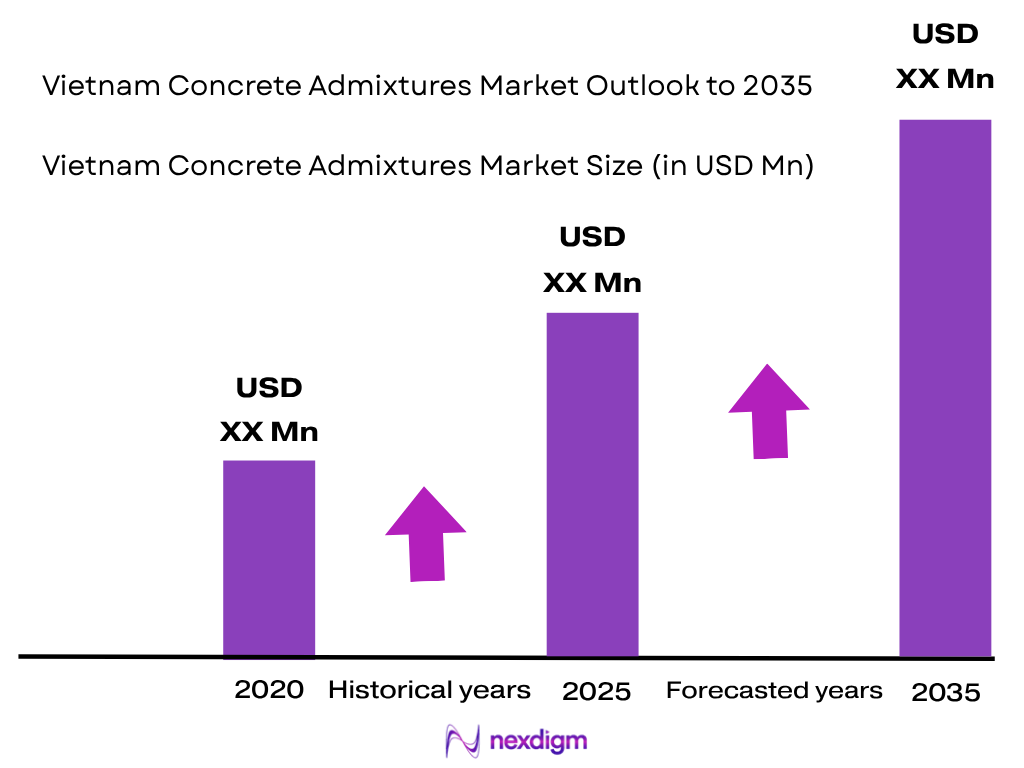
The Vietnam Concrete Admixtures Market is valued at approximately ~USD XX million, supported by expanding infrastructure, ready-mix concrete, industrial construction and high-rise development. Construction value added accelerated from 7.06% growth to 7.87% growth across the two latest comparable annual periods, while total realized social investment increased from VND 3,423.5 trillion to VND 3,692.1 trillion, strengthening consumption of superplasticizers, retarders, accelerators and durability-enhancing admixtures.
Ho Chi Minh City, Hanoi, Dong Nai, Binh Duong, Hai Phong and the surrounding industrial belts dominate concrete-admixture demand because they concentrate high-rise projects, factories, logistics facilities, transport infrastructure and ready-mix production. Realized foreign direct investment increased from USD 23.18 billion to USD 25.35 billion across the latest two comparable periods, while Long Thanh Airport construction spans approximately 1,810 hectares, reinforcing southern Vietnam’s demand for high-performance, pumped and durability-oriented concrete systems.
Market Segmentation
By Product Type
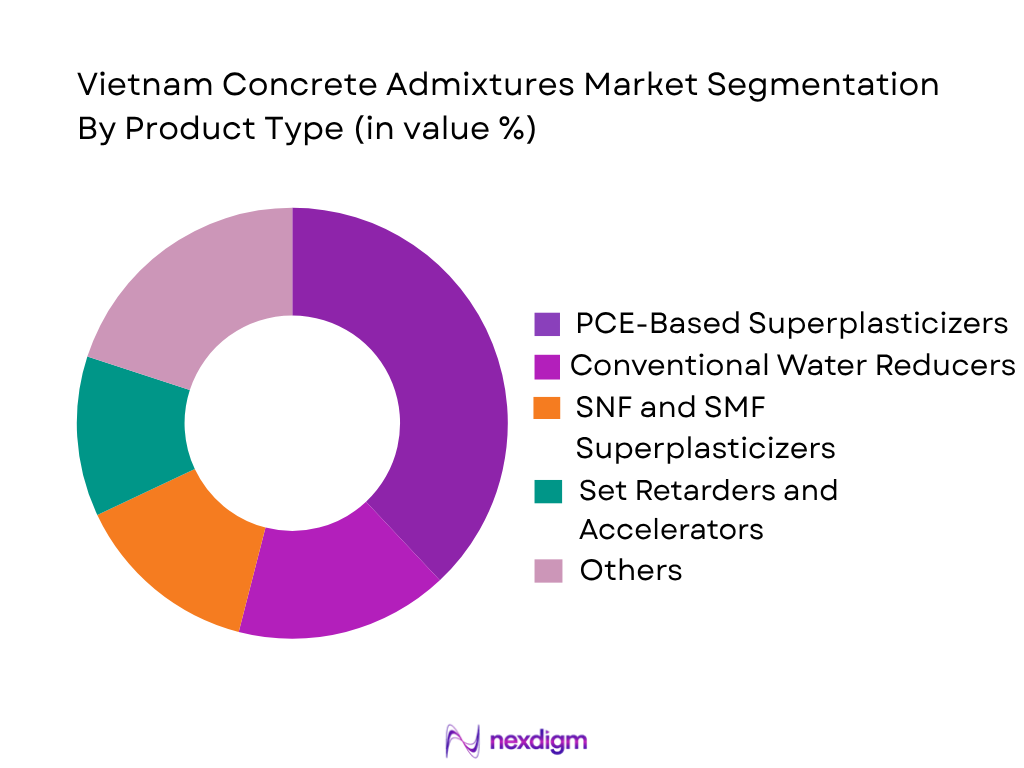
The Vietnam Concrete Admixtures Market is segmented by product type into polycarboxylate ether superplasticizers, conventional water reducers, SNF/SMF superplasticizers, set retarders and accelerators, waterproofing admixtures, viscosity modifiers and other specialty systems. Polycarboxylate ether-based superplasticizers hold the dominant market share because Vietnam’s increasingly complex concrete applications require substantial water reduction together with extended workability. High-rise pumping, expressways, bridges, metro infrastructure, precast components and industrial floors require lower water-cement ratios without sacrificing placement performance. Vietnam’s construction sector expanded strongly in the latest reported period, while total social investment exceeded VND 3,692 trillion, increasing exposure to large concrete-intensive projects. PCE technology is particularly suited to modern ready-mix operations because polymer structure can be adjusted for water reduction, early strength or long slump retention. It also supports self-compacting and high-strength concrete used in technically demanding structures. Sika Vietnam identifies superplasticizers, retarders, accelerators and durability enhancers among its ready-mix solutions, demonstrating the breadth of chemical-admixture requirements in the country’s concrete production ecosystem.
By Concrete Type
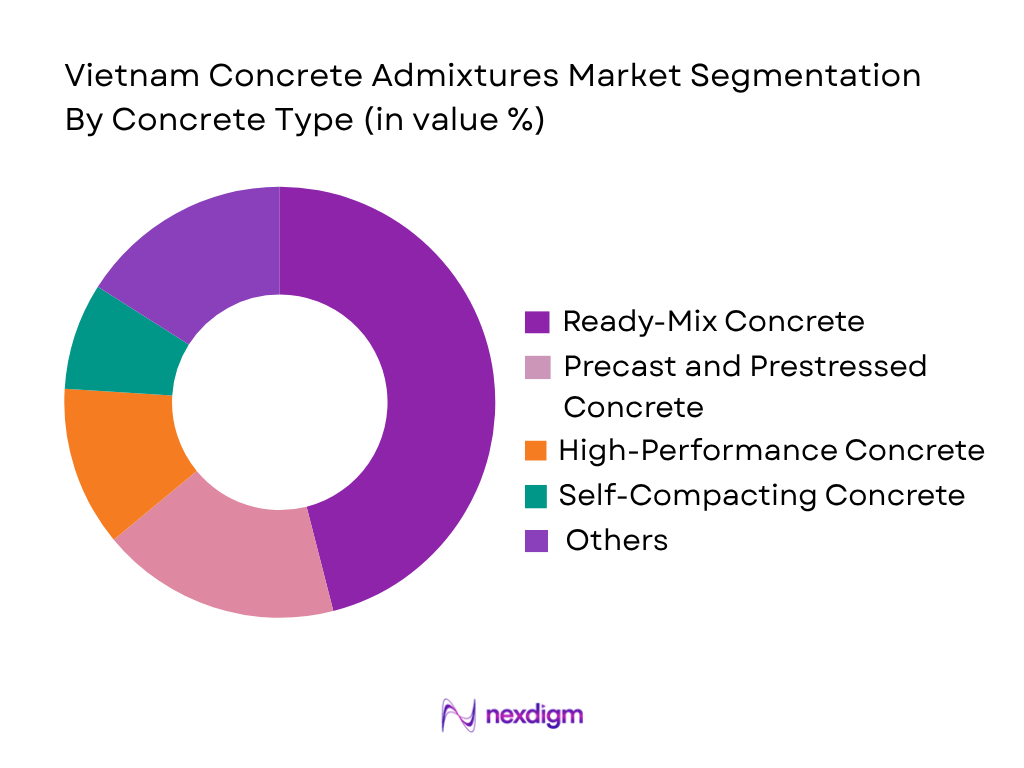
The Vietnam Concrete Admixtures Market is segmented by concrete type into ready-mix concrete, precast and prestressed concrete, self-compacting concrete, high-performance concrete, mass concrete, shotcrete and other specialty concrete. Ready-mix concrete represents the dominant segment because rapid urban construction increasingly relies on centralized batching, controlled mix designs and pumpable concrete rather than site-mixed material. Ready-mix producers require predictable slump retention during transport, water reduction for strength development, set control during hot-weather placement and compatibility with locally available cement and aggregates. The segment is particularly important in Ho Chi Minh City, Hanoi, Binh Duong, Dong Nai and major infrastructure corridors where high-rise projects and large civil works consume substantial concrete volumes. Ready-mix admixture portfolios from major suppliers typically include plasticizers, high-range water reducers, retarders, accelerators and durability enhancers. Vietnam’s construction value added expanded by 7.87% in the latest annual period, while industry and construction together represented a major component of national economic activity, reinforcing the importance of efficient centralized concrete production.
Competitive Landscape
The Vietnam Concrete Admixtures Market combines international construction-chemical groups with regional and domestic manufacturers offering water reducers, PCE superplasticizers, workability-retention systems, accelerators, waterproofing products and concrete-performance solutions. Sika, Master Builders Solutions, Fosroc, Mapei and Chryso compete through chemistry breadth, cement compatibility, technical laboratories, local formulation capability and project-site service. Supplier differentiation is increasingly based on solving specific mix-design problems rather than simply supplying standard liquid admixtures.
| Company | Establishment Year | Headquarters | Superplasticizer Capability | Slump-Retention Capability | Precast Solutions | Durability / Waterproofing | Technical Mix Support | Vietnam / Regional Presence |
| Sika | 1910 | Baar, Switzerland | ~ | ~ | ~ | ~ | ~ | ~ |
| Master Builders Solutions | 1909 | Mannheim, Germany | ~ | ~ | ~ | ~ | ~ | ~ |
| Fosroc | 1972 | Dubai, UAE | ~ | ~ | ~ | ~ | ~ | ~ |
| Mapei | 1937 | Milan, Italy | ~ | ~ | ~ | ~ | ~ | ~ |
| Chryso | 1942 | France | ~ | ~ | ~ | ~ | ~ | ~ |
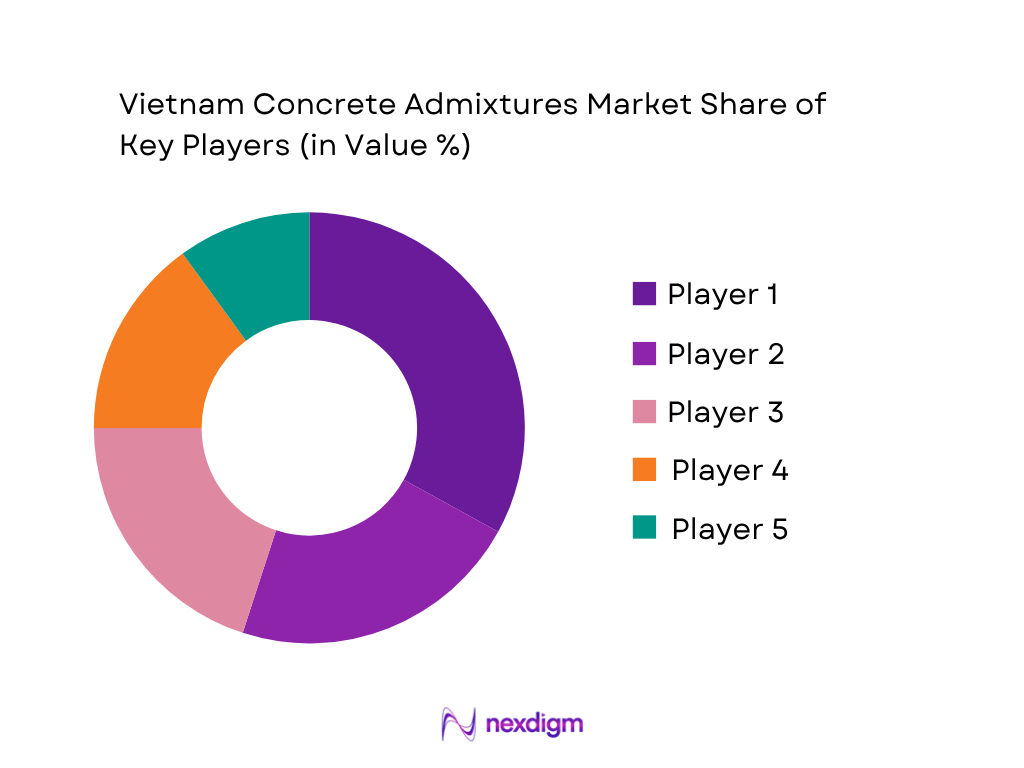
Vietnam Concrete Admixtures Market Analysis
Growth Drivers
Infrastructure Construction and Public Investment Supporting High-Performance Concrete Demand
Vietnam’s infrastructure build-out is a major growth driver for concrete admixtures because expressways, bridges, airports, metro systems, drainage infrastructure and industrial corridors require large volumes of pumpable, high-strength and durable concrete. Total social investment reached VND 3,692.1 trillion in 2024, including VND 1,019.3 trillion from the state sector, creating a substantial construction base for superplasticizers, retarders, accelerators and viscosity modifiers. State development expenditure reached VND 529.1 trillion, while Vietnam’s GDP stood at approximately USD 476.39 billion in 2024 and GDP per capita reached USD 4,717.3, providing macroeconomic support for large infrastructure programs. Concrete used in bridges, viaducts and mass foundations typically requires controlled setting, extended workability and low water-cement ratios, increasing the technical importance of admixtures beyond basic water reduction. The same demand extends to airport pavements and underground structures, where durability and placement consistency are critical. For admixture suppliers, infrastructure construction therefore supports not only higher consumption volumes but also migration toward higher-value PCE superplasticizers, long-slump-retention systems, shrinkage-control solutions and project-specific mix optimization services.
Industrial Expansion and Foreign Direct Investment Increasing Ready-Mix and Precast Consumption
Vietnam’s industrial expansion is strengthening concrete admixture demand because new electronics plants, factories, logistics parks, warehouses and supporting infrastructure increasingly rely on ready-mix, precast and high-performance concrete. Realized foreign direct investment reached USD 25.35 billion in 2024, while total registered foreign investment reached USD 38.23 billion. Foreign investors operated across 56 provinces and cities, with Bac Ninh receiving nearly USD 5.12 billion of registered investment and Hai Phong approximately USD 4.94 billion, reinforcing northern Vietnam as a major industrial construction corridor. Vietnam’s GDP reached about USD 476.39 billion in 2024, while GDP per capita stood at USD 4,717.3, supporting continued urban and manufacturing development. Industrial projects require concrete with controlled slump, high early strength, low shrinkage and strong surface performance, particularly for factory floors, precast columns, piles and utility structures. These requirements favour PCE-based superplasticizers, accelerators, shrinkage reducers and multi-functional admixture packages. As industrial construction spreads across Bac Ninh, Hai Phong, Dong Nai, Binh Duong and Long An, admixture suppliers with local technical laboratories and ready-mix relationships are positioned to benefit from higher specification intensity.
Market Challenges
Dependence on Imported Chemical Feedstocks and Formulation Inputs
Vietnam’s concrete admixture industry faces a material supply-chain challenge because advanced PCE superplasticizers depend on chemical feedstocks such as acrylic acid derivatives, polyether monomers, specialty surfactants and functional polymers that are often linked to international supply chains. Vietnam imported goods worth approximately USD 380.76 billion in 2024, with the foreign-invested sector accounting for USD 240.65 billion of imports. The country’s total merchandise trade reached USD 786.29 billion, showing the scale of cross-border dependence for industrial inputs. This is relevant to admixture formulators because disruptions in monomer or specialty polymer supply can affect local blending schedules, inventory requirements and product consistency. Vietnam’s GDP of about USD 476.39 billion in 2024 and GDP per capita of USD 4,717.3 support expanding domestic construction demand, but the local admixture sector still requires reliable access to imported performance chemicals. Suppliers must therefore maintain safety stocks, qualify multiple feedstock sources and manage compatibility across changing raw-material batches. This challenge is especially important for PCE-based systems, where molecular structure directly affects water reduction, slump retention and cement compatibility.
Cement Compatibility and Concrete Performance Variability Across Projects
Vietnam’s broad construction base creates a technical challenge because concrete admixtures must perform consistently across different cement sources, aggregate gradations, supplementary cementitious materials and site conditions. Total social investment reached VND 3,692.1 trillion in 2024, while construction activity expanded across infrastructure, industrial and urban projects, increasing the number of concrete mix designs that admixture suppliers must support. Registered foreign investment reached USD 38.23 billion, with investment spread across 56 provinces and cities, which further increases regional variation in cement, aggregates and concrete production practices. Vietnam’s GDP reached approximately USD 476.39 billion in 2024, reflecting an economy large enough to sustain diverse building activity but also a fragmented technical environment for admixture application. PCE superplasticizers are sensitive to cement mineralogy, sulfate balance and fine-particle content, and inappropriate formulation can produce rapid slump loss, delayed setting or excessive viscosity. As more high-rise and infrastructure concrete is pumped over long distances, suppliers must conduct local cement compatibility trials, adjust dosage and often customize polymer blends. This raises the importance of technical service capability alongside product manufacturing.
Market Opportunities
Expansion of PCE Superplasticizers for High-Performance and Pumped Concrete
Vietnam’s current construction and investment profile creates a strong future opportunity for wider adoption of PCE-based superplasticizers, particularly in ready-mix, high-rise and infrastructure concrete. Total social investment reached VND 3,692.1 trillion in 2024, while realized foreign direct investment reached USD 25.35 billion, supporting continued demand for factories, transport infrastructure, mixed-use developments and urban construction. Vietnam’s GDP stood at approximately USD 476.39 billion, with GDP per capita at USD 4,717.3, providing a broad economic foundation for increasingly sophisticated concrete applications. PCE chemistry offers strong water reduction, extended slump retention and improved pumpability compared with older conventional water reducers, making it suitable for long-distance transport, high-rise pumping and lower water-cement-ratio mixes. Current industrial concentration in provinces such as Bac Ninh and Hai Phong, which attracted approximately USD 5.12 billion and USD 4.94 billion of registered foreign investment respectively, further expands the addressable base for engineered concrete. This supports future opportunities in tailored PCE polymers, hot-weather slump-retention systems, self-compacting concrete admixtures and plant-level mix optimization services.
Low-Carbon Concrete and Cement-Efficiency Admixture Solutions
Vietnam’s scale of construction creates an emerging opportunity for admixtures that enable lower cement intensity while maintaining workability, strength and durability. Total social investment reached VND 3,692.1 trillion in 2024, with VND 2,064.2 trillion coming from the non-state sector and VND 608.6 trillion from the foreign-invested sector, indicating a broad project base in which material-efficiency technologies can be deployed. Vietnam’s GDP reached approximately USD 476.39 billion in 2024, while merchandise trade totalled USD 786.29 billion, reflecting a highly industrialised and globally connected construction materials environment. Advanced superplasticizers can help reduce mixing water and support lower clinker content by improving dispersion in mixes containing fly ash, slag or other supplementary cementitious materials. This becomes increasingly relevant for international developers and manufacturers seeking more efficient concrete specifications across factories, logistics facilities and infrastructure assets. The opportunity extends to shrinkage reducers, durability enhancers and viscosity modifiers that help lower-cement mixes remain workable and stable. For admixture suppliers, the strongest future positioning will come from combining chemical formulation with cement-compatibility testing and quantified mix-design optimization rather than selling commodity water reducers alone.
Future Outlook
The Vietnam Concrete Admixtures Market is projected to expand at approximately ~XX.X% CAGR during 2026–2035, supported by infrastructure construction, urbanization, industrial investment, airport and transport development, and increasing use of performance-engineered concrete. Demand is expected to shift progressively toward PCE-based superplasticizers, extended slump-retention systems, high-early-strength products and admixtures designed for low-carbon cementitious mixes.
Infrastructure will remain a major demand platform because expressways, airports, bridges, metro lines, ports and industrial infrastructure require concrete with tight specifications for pumpability, early strength, durability and setting time. Long Thanh International Airport alone involves a construction footprint of approximately 1,810 hectares, demonstrating the scale of large concrete-intensive developments.
Major Players
- Sika Vietnam
- Master Builders Solutions Vietnam
- Saint-Gobain Fosroc Vietnam
- Mapei Vietnam
- GCP Applied Technologies Vietnam
- Chryso Vietnam
- Kao Vietnam
- MUHU Vietnam
- Euclid Chemical
- Normet Vietnam
- Kryton Vietnam
- Cemkrete Vietnam
- Vinkems
- BestMix Corporation
- SilkRoad Hanoi JSC
Key Target Audience
- Concrete Admixture and Construction Chemical Manufacturers
- Ready-Mix Concrete Producers
- Precast and Prestressed Concrete Manufacturers
- Cement Manufacturers
- Infrastructure, EPC and General Contractors
- Property and Industrial Developers
- Investments and Venture Capitalist Firms
- Government and Regulatory Bodies (Ministry of Construction, Ministry of Finance, Ministry of Industry and Trade, Directorate for Standards Metrology and Quality)
Research Methodology
Step 1: Identification of Key Variables
The initial phase involves constructing an ecosystem map encompassing admixture manufacturers, chemical suppliers, cement producers, ready-mix companies, precast manufacturers, contractors and infrastructure developers. Core variables include concrete volume, admixture dosage, PCE penetration, cement type, slump-retention requirement, water reduction, application type, regional construction activity and customer procurement structure.
Step 2: Market Analysis and Construction
Historical market development is evaluated through top-down and bottom-up models. The top-down approach assesses construction value, infrastructure investment, cement demand, industrial development and real-estate activity. The bottom-up model evaluates ready-mix and precast concrete volumes, average admixture dosage, product chemistry, project specifications, customer mix and consumption per cubic metre of concrete.
Step 3: Hypothesis Validation and Expert Consultation
Market hypotheses are validated through structured interviews with concrete-admixture manufacturers, ready-mix producers, precast plants, cement companies, concrete technologists and contractors. Consultations assess product usage, PCE versus conventional chemistry, slump-retention requirements, cement compatibility, dosage practices, project specifications, supplier qualification and technical-service requirements.
Step 4: Research Synthesis and Final Output
The final stage triangulates primary findings with official construction and investment indicators, company product portfolios, infrastructure pipelines and concrete-technology benchmarks. Bottom-up admixture-consumption estimates are reconciled with top-down construction activity to develop market segmentation, competitive positioning, technology trends and the final outlook for the Vietnam Concrete Admixtures Market.

- Executive Summary
- Research Methodology (Market Definitions and Assumptions, Vietnam Concrete Admixtures Market Classification, Chemical Admixture Scope, Water-Reducing Admixture Assessment, High-Range Water Reducer Assessment, Superplasticizer Assessment, Polycarboxylate Ether Assessment, Sulfonated Naphthalene Formaldehyde Assessment, Sulfonated Melamine Formaldehyde Assessment, Retarding Admixture Assessment, Accelerating Admixture Assessment, Air-Entraining Admixture Assessment, Waterproofing Admixture Assessment, Shrinkage-Reducing Admixture Assessment, Corrosion-Inhibiting Admixture Assessment, Viscosity-Modifying Admixture Assessment, Ready-Mix Concrete Assessment, Precast Concrete Assessment, Infrastructure Concrete Assessment, Cement Compatibility Assessment, Slump Retention Assessment, Water Reduction Assessment, Early Strength Assessment, Setting-Time Assessment, Chloride Content Assessment, TCVN 8826 Compliance Assessment, ASTM C494 Compatibility Assessment, Supply-Side Assessment, Demand-Side Assessment, Top-Down Market Sizing, Bottom-Up Market Sizing, Primary Industry Interviews, Construction Project Pipeline Assessment, Cement and Ready-Mix Consumption Assessment, Data Triangulation, Forecasting Framework)

- Definition and Scope
- Vietnam Concrete Admixtures Industry Evolution and Development of Conventional Water Reducers, Lignosulfonate-Based Admixtures, SNF-Based Superplasticizers, SMF-Based Superplasticizers, Polycarboxylate Ether Superplasticizers, Slump-Retention Admixtures, Set Retarders, Accelerators, Air-Entraining Agents, Waterproofing Admixtures, Viscosity-Modifying Agents, Shrinkage-Reducing Admixtures, Corrosion Inhibitors, Self-Compacting Concrete Admixtures, High-Performance Concrete Systems, Low-Carbon Concrete Admixture Solutions, Ready-Mix and Precast Admixture Packages
- Concrete Admixtures Value Chain Analysis
- Concrete Admixtures Supply Chain Analysis
- Petrochemical Feedstock Suppliers, Acrylic Acid Suppliers, Polyether Monomer Suppliers, Formaldehyde Suppliers, Naphthalene Feedstock Suppliers, Lignosulfonate Suppliers, Specialty Polymer Manufacturers, Admixture Formulators, Local Blending Plants, Cement Manufacturers, Ready-Mix Concrete Producers, Precast Concrete Manufacturers, Infrastructure Contractors, General Contractors, Property Developers, Concrete Testing Laboratories, Construction Chemical Distributors, Technical Service Providers

- Growth Drivers (Expressway Construction, Metro Development, High-Rise Urbanization, Industrial Park Expansion, Data Centre Construction, Airport Development, Port Infrastructure, Ready-Mix Concrete Penetration, Precast Construction Growth, Demand for High-Strength Concrete, Pumpability Requirements, Faster Construction Cycles, Low Water-Cement Ratio Adoption)
- Market Challenges (Cement Chemistry Variability, Aggregate Quality Variability, PCE-Cement Compatibility Issues, Slump Loss in Hot Weather, Raw Material Import Dependence, Polyether Monomer Price Volatility, Local Formulation Quality Variation, Skilled Concrete Technologist Availability, Over-Dosage Risk, Inconsistent Site Batching, Admixture Storage Stability, Contractor Price Sensitivity)
- Market Opportunities (PCE-Based Superplasticizers, Long Slump-Retention Admixtures, Infrastructure-Grade High-Performance Concrete, Self-Compacting Concrete, Precast and Prestressed Concrete Admixtures, Data Centre Concrete Solutions, Low-Carbon Concrete Admixtures, Waterproofing Admixtures, Shrinkage-Reducing Systems, Corrosion Inhibitors, Local PCE Synthesis, Technical Concrete Optimization Services)
- Market Trends (Shift from SNF to PCE Technology, High Slump-Retention PCE Adoption, Ready-Mix Concrete Optimization, Lower Water-Cement Ratios, High Early-Strength Concrete, Self-Compacting Concrete Adoption, Multi-Functional Admixture Packages, Low-Clinker Concrete Compatibility, BIM-Linked Concrete Specification, Digital Concrete Quality Control, Automated Admixture Dosing, Low-Carbon Concrete Formulation)
- Government Regulations and Standards (TCVN 8826 Chemical Admixtures for Concrete, TCVN Concrete and Reinforced Concrete Requirements, Ministry of Construction Standards, Construction Material Quality Regulations, Construction Material Product Conformity Requirements, Industrial Chemical Handling Requirements, Environmental Requirements for Chemical Manufacturing)
- SWOT Analysis
- Porter’s Five Forces Analysis
- PESTLE Analysis
- Stakeholder Ecosystem
- Concrete Production and Construction Project Ecosystem

- By Market Value (2020-2025)
- By Consumption Volume (2020-2025)
- By Average Admixture Dosage per Cubic Metre (2020-2025)
- By Water-Reducing Admixture Consumption (2020-2025)
- By Superplasticizer Consumption (2020-2025)
- By Retarding Admixture Consumption (2020-2025)
- By Accelerating Admixture Consumption (2020-2025)
- By Waterproofing Admixture Consumption (2020-2025)
- By Viscosity-Modifying Admixture Consumption (2020-2025)
- By Ready-Mix Concrete Admixture Consumption (2020-2025)
- By Precast Concrete Admixture Consumption (2020-2025)
- By Infrastructure Concrete Admixture Consumption (2020-2025)

- By Product Type (In Value %)
Normal Water-Reducing Admixtures
High-Range Water Reducers
Polycarboxylate Ether Superplasticizers
Sulfonated Naphthalene Formaldehyde Superplasticizers
Sulfonated Melamine Formaldehyde Superplasticizers
Set-Retarding Admixtures
Set-Accelerating Admixtures
Air-Entraining Admixtures
Waterproofing Admixtures
Viscosity-Modifying Admixtures
Shrinkage-Reducing Admixtures
Corrosion-Inhibiting Admixtures
Multi-Functional Admixture Packages - By Chemical Base (In Value %)
Polycarboxylate Ether
Sulfonated Naphthalene Formaldehyde
Sulfonated Melamine Formaldehyde
Lignosulfonates
Acrylic Polymer Systems
Silicate-Based Systems
Calcium Nitrate and Nitrite Systems
Organic Retarder Systems
Specialty Surfactants
Hybrid Polymer Chemistries - By Concrete Type (In Value %)
Ready-Mix Concrete
Precast Concrete
Prestressed Concrete
Self-Compacting Concrete
High-Strength Concrete
High-Performance Concrete
Mass Concrete
Pumped Concrete
Shotcrete
Underwater Concrete
Fiber-Reinforced Concrete
Low-Carbon Concrete - By End-Use Construction (In Value %)
Residential Buildings
High-Rise Residential Towers
Commercial Buildings
Office Developments
Retail and Mixed-Use Projects
Industrial and Manufacturing Facilities
Data Centres
Warehouses and Logistics Facilities
Hotels and Hospitality
Healthcare Facilities
Educational Buildings
Public and Institutional Buildings - By Region (In Value %)
Ho Chi Minh City
Hanoi
Binh Duong
Dong Nai
Hai Phong
Quang Ninh
Da Nang
Bac Ninh
Long An
Ba Ria-Vung Tau
Mekong Delta
Northern Industrial Belt
Central Vietnam
Other Provinces

- Market Share of Major Players (By Vietnam Revenue, Consumption Volume, Ready-Mix Concrete Penetration, Precast Concrete Penetration, Infrastructure Project Exposure, PCE Superplasticizer Portfolio, SNF Product Portfolio, Waterproofing Admixture Portfolio, Local Manufacturing Capacity, Technical Service Capability, Regional Distribution Coverage, Key Account Base, Major Project References)
- Cross Comparison Parameters (Concrete Admixture Product Portfolio Breadth, PCE Superplasticizer and Slump-Retention Technology Capability, Ready-Mix and Precast Concrete Application Expertise, Infrastructure and High-Performance Concrete Project Experience, Local Manufacturing and Blending Capacity, Cement Compatibility Testing and Technical Laboratory Capability, Nationwide Distribution and Project-Site Technical Support Coverage, Low-Carbon Concrete and Multi-Functional Admixture Innovation Capability)
- SWOT Analysis of Major Players
- Competitive Positioning Matrix
- Major Companies
Sika Vietnam
Master Builders Solutions Vietnam
Saint-Gobain Fosroc Vietnam
Mapei Vietnam
GCP Applied Technologies Vietnam
Chryso Vietnam
Kao Vietnam
MUHU Vietnam
Euclid Chemical
Normet Vietnam
Kryton Vietnam
Cemkrete Vietnam
Vinkems
BestMix Corporation
SilkRoad Hanoi JSC

- Ready-Mix Producer Requirement Assessment
- Precast Manufacturer Requirement Assessment
- Infrastructure Contractor Requirement Assessment
- High-Rise Contractor Requirement Assessment
- Cement Producer Collaboration Assessment
- Property Developer Concrete Performance Requirement Assessment
- Industrial Project Requirement Assessment
- Concrete Technologist Specification Assessment
- Admixture Dosage Optimization Requirement Assessment
- Slump Retention Requirement Assessment
- Early Strength Requirement Assessment
- Durability Requirement Assessment
- Technical Service Requirement Assessment
- Customer Pain Point Analysis

- By Market Value (2026-2035)
- By Consumption Volume (2026-2035)
- By Average Admixture Dosage per Cubic Metre (2026-2035)
- By Water-Reducing Admixture Consumption (2026-2035)
- By Superplasticizer Consumption (2026-2035)
- By Retarding Admixture Consumption (2026-2035)
- By Accelerating Admixture Consumption (2026-2035)
- By Waterproofing Admixture Consumption (2026-2035)
- By Viscosity-Modifying Admixture Consumption (2026-2035)
- By Ready-Mix Concrete Admixture Consumption (2026-2035)
- By Precast Concrete Admixture Consumption (2026-2035)
- By Infrastructure Concrete Admixture Consumption (2026-2035)


 Request a Sample
 Ask for Customization
 Get a Quote
 Enquire Now
