
 Download PDF
Market Overview
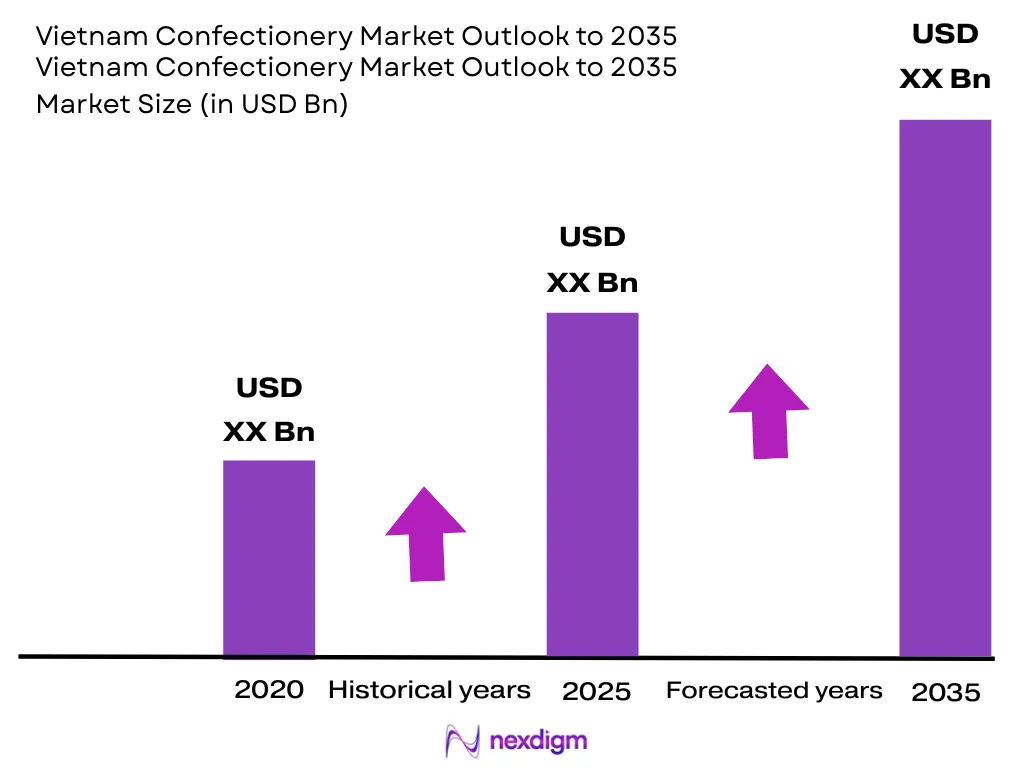
The Vietnam confectionery market was valued at USD ~ billion in 2024 and is projected to expand at a CAGR of ~% during the 2026–2035 forecast period. According to industry statistics published by the Vietnam Confectionery Association and the General Statistics Office of Vietnam (GSO), Vietnam’s confectionery industry continues to be one of the fastest-growing segments within the broader packaged food sector, supported by a population of approximately 98 million people and one of Southeast Asia’s most dynamic consumer markets. Data from market research agencies including Euromonitor indicates that sugar confectionery and traditional festive products such as mooncakes continue to command significant market share, while chocolate confectionery and premium imported products are growing at a significantly faster rate among Vietnam’s expanding urban middle class. Growth is supported by rising disposable income, strong Tet and Mid-Autumn Festival gifting traditions, product innovation, and rapidly expanding modern retail and e-commerce penetration.
Market Segmentation
By Product Type
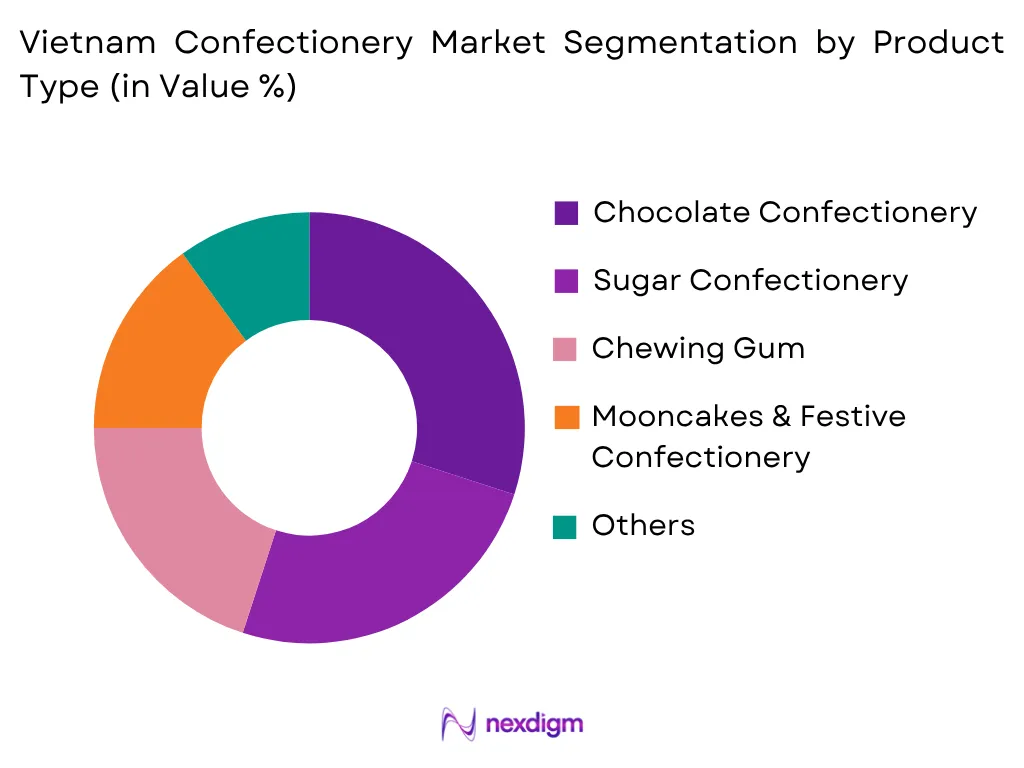
Sugar confectionery and mooncakes jointly command a significant share of the Vietnam confectionery market, with traditional festive products holding deep cultural significance, particularly the mooncakes consumed during the Mid-Autumn Festival (Tet Trung Thu), which represents one of Vietnam’s largest single confectionery demand events of the year. Chocolate confectionery, meanwhile, continues to grow at a faster pace driven by rising disposable income, increasing urbanisation, and the cultural embedding of chocolate gifting during Tet (Lunar New Year), Valentine’s Day, and Christmas. Large domestic and multinational manufacturers including Mondelez Kinh Do, Bibica Corporation, Perfetti Van Melle Vietnam, and Orion Vietnam continue introducing innovative flavours, premium festive collections, and limited-edition seasonal offerings that attract both value-conscious and increasingly affluent urban consumers. Vietnam imports the substantial majority of its cocoa bean and derivative requirements, supporting a growing domestic chocolate manufacturing industry centred around Ho Chi Minh City and surrounding industrial zones. Continuous investments in premium mooncake collections, filled chocolate products, and modern packaging formats have further strengthened the segment’s growth while expanding its presence across traditional trade, modern retail, and rapidly growing e-commerce platforms.
By Distribution Channel
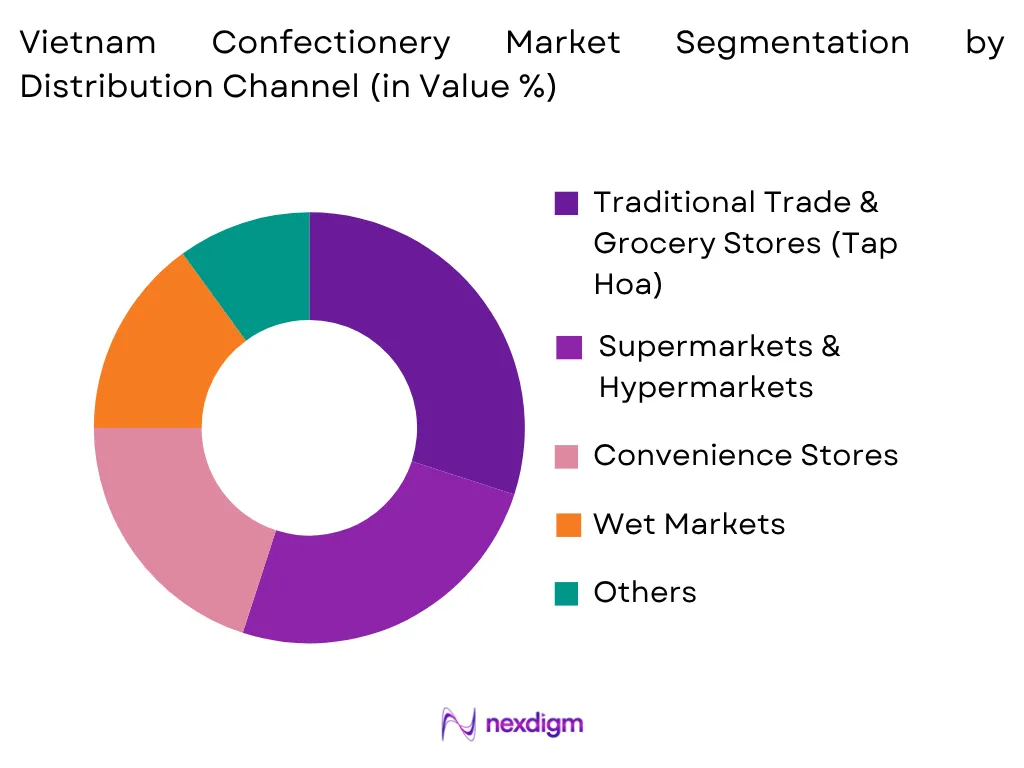
Traditional trade and grocery stores, locally known as tap hoa, account for a substantial share of confectionery sales in Vietnam because they provide deep, hyperlocal distribution reach across urban, semi-urban, and rural markets throughout the country. These small-format neighbourhood stores maintain strong procurement relationships with both domestic and multinational confectionery manufacturers through extensive distributor networks, and capitalise on impulse purchasing through prominent shelf and counter placement of confectionery items. Modern retail, including supermarkets and hypermarkets such as VinMart (WinMart), Co.opmart, Aeon, and Lotte Mart, continues to expand its share rapidly in Hanoi, Ho Chi Minh City, and other major urban centres, offering consumers extensive product assortments and dedicated premium confectionery and imported chocolate sections. Convenience stores, including international chains such as Circle K and GS25 alongside domestic operators, have proliferated rapidly across Vietnam’s major cities, providing additional impulse-purchase access points for confectionery products. E-commerce and quick commerce platforms including Shopee, Lazada, and grocery delivery applications are experiencing rapid growth among Vietnam’s young and digitally connected urban consumer base, particularly for premium and gifting-oriented confectionery purchases. Festive season merchandising during Tet and the Mid-Autumn Festival further boosts sales volumes significantly across both traditional and modern retail formats, with mooncake sales in particular driving substantial seasonal retail activity each autumn.
Competitive Landscape
The Vietnam confectionery market is moderately fragmented, with multinational manufacturers competing alongside well-established domestic companies that hold particularly strong positions in traditional festive products such as mooncakes. Global companies such as Mondelez Kinh Do, Perfetti Van Melle Vietnam, and Nestlé Vietnam leverage extensive distribution networks and international brand recognition, while domestic companies including Bibica Corporation, Huu Nghi Food, Orion Vietnam, and Haihaco maintain strong consumer loyalty through deep cultural product relevance, particularly during Tet and Mid-Autumn Festival seasons, alongside competitive pricing for everyday confectionery products. Continuous investments in premium mooncake collections, imported chocolate ranges, modern packaging, and omnichannel retail strategies, including rapid expansion into e-commerce and quick commerce, remain key competitive differentiators.
| Company | Establishment Year | Headquarters | Primary Protein Focus | Processing Facilities
|
Export Presence | Production Integration | Sustainability Programs | Value-Added Product Portfolio |
| Mondelez Kinh Do | 1993 | ~ | ~ | ~ | ~ | ~ | ~ | ~ |
| Bibica Corporation | 1999 | ~ | ~ | ~ | ~ | ~ | ~ | ~ |
| Perfetti Van Melle Vietnam | 1996 | ~ | ~ | ~ | ~ | ~ | ~ | ~ |
| Huu Nghi Food Joint Stock Company | 1997 | ~ | ~ | ~ | ~ | ~ | ~ | ~ |
| Nestlé Vietnam | 1995 | ~ | ~ | ~ | ~ | ~ | ~ | ~ |
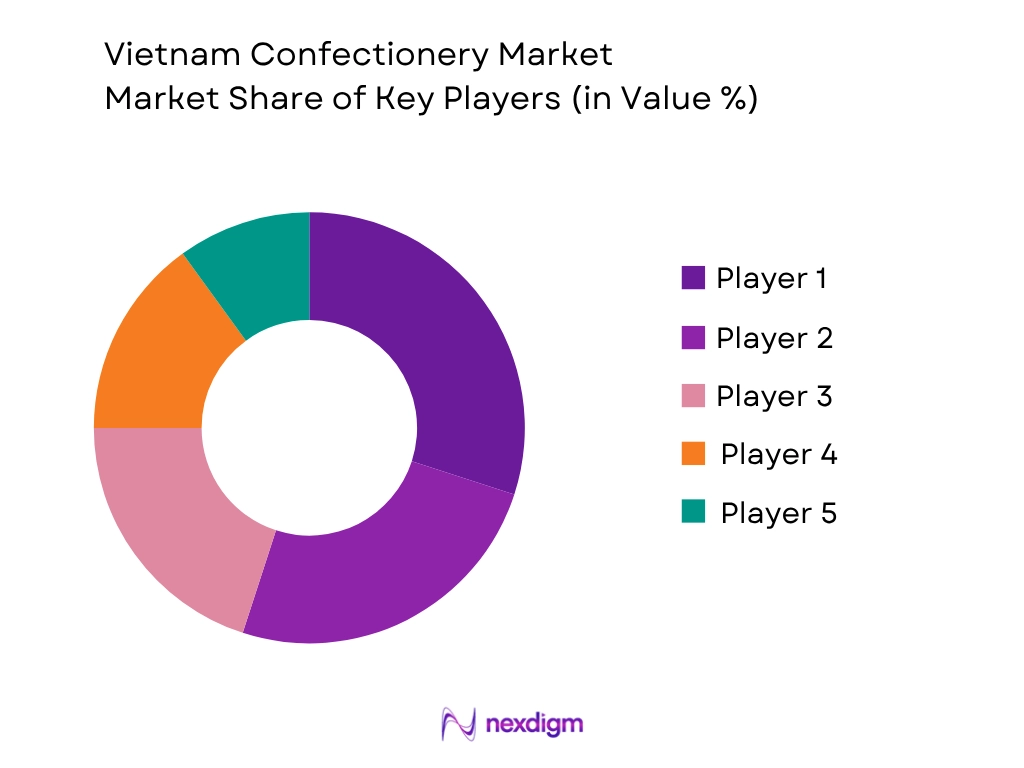
Vietnam Confectionary Market Analysis
Growth Drivers
Rising Urbanisation, Middle-Class Incomes, and Strong Festive Gifting Culture
Vietnam’s sustained economic growth and rapid urbanisation continue to be among the most fundamental drivers of expanding confectionery consumption. According to the World Bank, Vietnam’s GDP reached approximately USD 430 billion in 2024, maintaining one of Southeast Asia’s highest growth rates at approximately 6–7% annually over the past decade, which has progressively elevated household incomes and discretionary spending capacity across the population. The General Statistics Office of Vietnam (GSO) reported that the country’s urban population now exceeds 40% of the total population of approximately 98 million people, with urban households consistently demonstrating higher per capita spending on packaged confectionery, premium chocolate, and festive gifting products. Confectionery gifting holds exceptional cultural significance in Vietnam, with the Tet Lunar New Year and Mid-Autumn Festival representing the two largest annual demand events for the industry, during which mooncakes, premium chocolate gift boxes, and assorted candy hampers are exchanged extensively among family, friends, and business relationships. The IMF projects Vietnam to sustain robust economic growth through 2035, underpinning continued increases in domestic demand for both affordable mass-market confectionery and premium imported chocolate products. Rising affluence among Vietnam’s growing urban middle class, combined with increasing exposure to international confectionery trends through social media, e-commerce, and outbound travel, continues to drive demand for premium and internationally inspired confectionery formats across Hanoi, Ho Chi Minh City, and other major urban centres.
Expanding Modern Retail and Convenience Store Penetration
The rapid expansion of modern retail infrastructure and convenience store networks has significantly strengthened confectionery accessibility and premiumisation across Vietnam. According to the Vietnam Retailers Association, modern retail formats including supermarkets, hypermarkets, and convenience store chains have expanded considerably over the past decade, with international and domestic convenience store operators including Circle K, GS25, VinMart+ (WinMart+), and Bach Hoa Xanh proliferating rapidly across Hanoi, Ho Chi Minh City, and increasingly into secondary cities. The GSO estimates Vietnam’s urban population continues to grow steadily, supporting sustained demand for modern retail formats offering extensive confectionery assortments, dedicated premium and imported chocolate sections, and convenient impulse-purchase positioning. The World Bank projects Vietnam’s economy to maintain strong growth momentum, supporting continued investment in retail infrastructure, cold chain logistics, and modern distribution systems. Large retailers increasingly dedicate shelf space to premium chocolates, festive mooncake collections, and imported confectionery products, while convenience stores capitalise on impulse purchases through checkout merchandising and single-serve formats targeting Vietnam’s young, time-constrained urban consumer base. E-commerce platforms including Shopee and Lazada are further transforming product accessibility, enabling manufacturers to reach digitally engaged consumers directly with premium and gifting-oriented confectionery offerings. These developments allow confectionery companies to broaden geographic reach, improve product availability, launch exclusive seasonal collections, and strengthen consumer engagement across Vietnam’s rapidly modernising retail landscape.
Market Challenges
Cocoa Supply Volatility and Import Dependency
Vietnamese confectionery manufacturers continue facing significant challenges arising from cocoa supply volatility and near-total dependency on imported cocoa beans and derivatives, given the absence of meaningful domestic cocoa cultivation. According to the International Cocoa Organization (ICCO), global cocoa production fell to approximately 4.37 million tonnes during the latest reporting period, with end-of-season stocks declining to nearly 1.27 million tonnes, the lowest stock-to-grinding ratio recorded in decades. Cocoa futures prices on the ICE exchange reached record highs during 2024, more than doubling year-over-year, directly increasing input costs for Vietnamese chocolate manufacturers. Vietnam imports the substantial majority of its cocoa bean, cocoa butter, and cocoa liquor requirements primarily from West African producing nations and neighbouring Southeast Asian origins, exposing domestic manufacturers to global supply disruption risks, currency fluctuation on the Vietnamese Dong, and West African crop disease and weather variability. The shortage has forced Vietnamese processors to compete globally for limited cocoa supplies while passing higher input costs through to consumers via reduced pack sizes and price increases. Manufacturers must therefore manage procurement risks, diversify sourcing strategies across multiple origin countries, improve supply-chain resilience through forward contracting, and invest in long-term partnerships with international cocoa-producing cooperatives to maintain stable production and ensure uninterrupted availability of chocolate products across Vietnam’s price-sensitive retail channels.
Intense Price Competition and Seasonal Demand Concentration
Vietnam’s confectionery market faces structural challenges arising from intense price competition, including from imported and smuggled products entering through informal cross-border channels, alongside significant seasonal demand concentration around the Tet Lunar New Year and Mid-Autumn Festival periods. According to the Vietnam Confectionery Association, the domestic market faces persistent competitive pressure from lower-priced confectionery products imported informally from neighbouring China, which can undercut domestically manufactured and officially imported products on price while creating quality control and food safety enforcement challenges for regulatory authorities. The General Department of Vietnam Customs has periodically intensified enforcement efforts against smuggled confectionery products, but the porous nature of Vietnam’s land borders with China continues to present ongoing challenges for legitimate market participants. Additionally, Vietnam’s confectionery demand is heavily concentrated around two major festive periods — Tet and the Mid-Autumn Festival — creating significant production planning, inventory management, and cash flow challenges for manufacturers who must scale production dramatically ahead of these concentrated demand windows while managing excess capacity during the remainder of the year. This seasonal concentration is particularly pronounced in the mooncake segment, where products have limited shelf life and unsold festive season inventory typically cannot be carried over, creating significant forecasting and waste management challenges. Manufacturers must therefore invest in sophisticated demand forecasting, flexible manufacturing capacity, and diversified product portfolios extending beyond festive occasions to manage these structural seasonal and competitive pressures.
Market Opportunities
Premiumisation and Mooncake Innovation
Vietnam’s evolving consumer preferences are creating substantial opportunities for premium confectionery products and continued innovation within the country’s culturally significant mooncake segment. With a population of approximately 98 million and a rapidly expanding urban middle class, Vietnam provides a large and growing addressable market for manufacturers introducing premium chocolates, imported confectionery, and innovative mooncake formats. Rising disposable income and growing exposure to international confectionery trends have encouraged greater spending on indulgent products with perceived quality and premium positioning, particularly among younger urban consumers in Hanoi and Ho Chi Minh City. The World Bank estimates Vietnam’s GDP at approximately USD 430 billion in 2024, supporting stronger household expenditure on premium packaged foods and festive gifting products. Within the mooncake segment specifically, leading manufacturers including Mondelez Kinh Do, Bibica, and Kido Group continue innovating with premium ingredients, contemporary flavours such as matcha, durian, and salted egg yolk custard, luxury packaging, and limited-edition collaborations that command significant price premiums over traditional formats during the Mid-Autumn Festival season. Premium gifting has also become increasingly important during Tet, creating opportunities for manufacturers to introduce artisanal chocolate collections, personalised gift boxes, and limited-edition products. Expansion of specialty confectionery boutiques and direct-to-consumer digital platforms further enables companies to target affluent urban consumers with differentiated offerings. Manufacturers investing in product innovation, premium packaging, and festive collection development are therefore well positioned to capture future demand while strengthening brand loyalty across Vietnam’s culturally rich confectionery market.
Export Market Diversification Under Free Trade Agreements
Vietnam’s expanding network of free trade agreements presents significant opportunities for confectionery manufacturers to diversify beyond the domestic market and access premium export destinations. According to the Ministry of Industry and Trade, the entry into force of the EU-Vietnam Free Trade Agreement (EVFTA) in 2020, alongside the Comprehensive and Progressive Agreement for Trans-Pacific Partnership (CPTPP) and the Regional Comprehensive Economic Partnership (RCEP), has progressively reduced tariff barriers and expanded preferential market access for Vietnamese food and confectionery exports across major global economies. Vietnamese confectionery manufacturers, including Bibica and Mondelez Kinh Do, have begun expanding export activities to ASEAN neighbours and select international markets, leveraging Vietnam’s competitive manufacturing costs and improving food safety certification standards. The growing reputation of Vietnamese manufacturing quality, combined with preferential trade agreement access, creates opportunities for confectionery companies to position Vietnam as a regional manufacturing and export hub, similar to the country’s success in other food and beverage export categories. Continued investment in international food safety certifications, export-oriented manufacturing capacity, and overseas distribution partnerships is expected to support Vietnamese confectionery manufacturers in capturing incremental export revenue opportunities across ASEAN, the European Union, and other strategically important markets through 2035, complementing continued strong growth in the domestic market.
Future Outlook
The Vietnam confectionery market is expected to witness sustained growth throughout the forecast period, supported by rising disposable incomes, deepening urbanisation, and Vietnam’s deeply embedded Tet and Mid-Autumn Festival gifting traditions. Manufacturers are increasingly investing in premium chocolate formats, innovative mooncake collections, modern packaging, and rapidly expanding e-commerce and convenience retail distribution channels. Growing penetration of organised modern retail in major urban centres, continued innovation in festive gifting products, and expanding export opportunities under EVFTA, CPTPP, and RCEP trade agreements are expected to create additional growth opportunities. Continued investments in supply chain diversification, food safety compliance, and premium product development will further strengthen long-term market competitiveness across Vietnam’s culturally distinctive confectionery landscape.
Major Players
- Mondelez Kinh Do
- Bibica Corporation
- Perfetti Van Melle Vietnam
- Huu Nghi Food Joint Stock Company
- Nestlé Vietnam
- Orion Vietnam
- Haihaco (Hai Ha Confectionery)
- Lotte Confectionery Vietnam
- Tan Tan Group
- Phaner Confectionery
- Vinabico
- Phạm Nguyên Confectionery
- Tuong An Confectionery
- Vietnam Sugar Confectionery JSC
- Kido Group (Confectionery Division)
Key Target Audience
- Confectionery Manufacturers
- Chocolate Manufacturers
- Cocoa Processors
- Sugar and Ingredient Suppliers
- Modern Retail Chains and Food Distributors
- Packaging Material Manufacturers
- Investments and Venture Capitalist Firms
- Government and Regulatory Bodies (Ministry of Health (MOH), Vietnam Food Administration (VFA), Vietnam Confectionery Association, General Department of Vietnam Customs)
Research Methodology
Step 1: Identification of Key Variables
The research begins by identifying the major stakeholders across the Vietnam confectionery value chain, including cocoa suppliers, ingredient manufacturers, confectionery producers, distributors, retailers, and consumers. Extensive secondary research is conducted using government publications, industry associations, trade databases, company reports, and proprietary databases to establish the key variables influencing market performance.
Step 2: Market Analysis and Construction
Historical market information is compiled and evaluated to estimate the overall market size, product penetration, production volumes, consumption trends, pricing dynamics, and revenue generation across major confectionery categories. Both demand-side and supply-side indicators are analyzed using bottom-up and top-down market sizing approaches to ensure comprehensive market coverage.
Step 3: Hypothesis Validation and Expert Consultation
Preliminary market estimates and analytical assumptions are validated through Computer Assisted Telephone Interviews (CATIs) and structured discussions with confectionery manufacturers, cocoa processors, distributors, retail executives, procurement specialists, and industry experts. These interviews provide valuable commercial insights that strengthen the reliability of market estimates.
Step 4: Research Synthesis and Final Output
The final stage integrates primary research findings with secondary information to develop a comprehensive assessment of market size, segmentation, competitive landscape, consumer behavior, and future opportunities. Multiple validation techniques, including data triangulation and cross-verification, are employed to ensure the consistency, accuracy, and credibility of the final market report.

- Executive Summary
- Research Methodology (Market Definitions and Assumptions, Abbreviations, Market Taxonomy, Market Sizing Approach, Top-Down Analysis, Bottom-Up Analysis, Demand-Side Assessment, Supply-Side Assessment, Primary Industry Interviews, Secondary Research Validation, Data Triangulation, Forecasting Framework, Limitations and Future Conclusions)

- Definition and Scope
- Market Evolution and Industry Genesis
- Timeline of Major Industry Developments
- Industry Value Chain Analysis
- Supply Chain Analysis

- Growth Drivers (Rising Urbanisation and Middle-Class Incomes, Strong Mid-Autumn Festival and Tet Gifting Culture, Expanding Modern Retail and Convenience Store Penetration, Product Innovation and Local Flavour Adaptation, Rising Demand for Premium and Imported Confectionery, Free Trade Agreement Market Access for Exports)
- Market Challenges (Volatility in Cocoa and Sugar Prices, Import Dependency for Cocoa Derivatives, Intense Price Competition from Local and Chinese Imports, Health Concerns Regarding Sugar Intake, Seasonal Demand Concentration Around Tet and Mid-Autumn Festival, Counterfeit and Smuggled Product Competition, Cold Chain Infrastructure Gaps)
- Market Opportunities (Premiumisation and Imported Chocolate Growth, Mooncake Innovation and Premium Festive Gifting, Sugar-Free and Functional Confectionery, Export Market Diversification Under EVFTA and CPTPP, Modern Retail and E-Commerce Expansion, Plant-Based Confectionery)
- Market Trends (Premiumisation Among Urban Consumers, Mid-Autumn Festival Mooncake Premiumisation, Clean Label Ingredients, Limited Edition Festive Products, Functional and Fortified Confectionery, Sustainable Packaging Adoption, Reduced Sugar Formulations, Modern Trade Channel Growth)
- Government Regulations (Ministry of Health (MOH) Food Safety Standards, Vietnam Food Administration (VFA) Regulations, Nutritional Labelling Requirements, Allergen Declaration Requirements, Food Additive Regulations, Packaging Compliance Standards, Import Duty Regulations Under FTAs)
- Cocoa Supply and Pricing Analysis (Cocoa Bean Imports, Cocoa Butter Prices, Cocoa Liquor Supply, Processing Capacity, Price Transmission Analysis)
- Sugar Supply Analysis (Domestic Sugarcane Availability, Sugar Cost Trends, Alternative Sweetener Adoption)
- Seasonal Demand Analysis (Tet Lunar New Year, Mid-Autumn Festival, Valentine’s Day, Christmas, Wedding Season Gifting)
- Retail Shelf Space Analysis (Modern Trade Penetration, Category Allocation, Promotional Displays, Checkout Placement)
- Innovation Landscape (Flavour Innovation, Texture Innovation, Functional Ingredients, Packaging Innovation, Premium Launches)
- Sustainability Analysis (Rainforest Alliance Adoption, Cocoa Traceability, Sustainable Packaging, Carbon Reduction Initiatives)
- SWOT Analysis
- Porter’s Five Forces Analysis
- PESTLE Analysis
- Stakeholder Ecosystem
- Competition Ecosystem

- By Market Value (2020-2025)
- By Volume Consumption (2020-2025)
- By Average Selling Price (2020-2025)

- By Product Type (In Value %)
Chocolate Confectionery
Sugar Confectionery (Candy)
Chewing Gum
Mooncakes & Festive Confectionery
Biscuits with Confectionery Filling
Premium & Gourmet Confectionery
Filled and Molded Chocolates
Countlines and Chocolate Bars - By Ingredient Type (In Value %)
Cocoa-Based Confectionery
Sugar-Based Confectionery
Sugar-Free Confectionery
Functional & Fortified Confectionery
Organic & Natural Confectionery
Plant-Based & Vegan Confectionery - By Distribution Channel (In Value %)
Traditional Trade & Grocery Stores (Tap Hoa)
Supermarkets & Hypermarkets
Convenience Stores
Wet Markets
Specialty Confectionery & Gift Stores
Cash & Carry Wholesale
E-Commerce & Quick Commerce
Direct-to-Consumer - By Packaging Type (In Value %)
Flexible Packs
Flow Wraps
Boxes
Pouches
Gift Packs
Multipacks
Sustainable Packaging - By Region (In Value %)
Red River Delta (North)
North Central & Central Coast
Southeast (Ho Chi Minh City Region)
Mekong River Delta (South)

- Market Share Analysis (By Value, Volume, Product Category, Distribution Channel, Price Segment)
- Cross Comparison Parameters (Chocolate Portfolio Breadth, Sugar Confectionery Portfolio, Annual New Product Launches, Cocoa Processing Capability, Distribution Reach Across Vietnam, Festive Product Portfolio Strength, Premium Product Mix, Manufacturing Capacity)
- SWOT Analysis of Major Players
- Pricing Analysis (By SKU, Product Type, Cocoa Content, Premium Positioning, Pack Size)
- Detailed Profiles of Major Companies
Mondelez Kinh Do
Bibica Corporation
Perfetti Van Melle Vietnam
Huu Nghi Food Joint Stock Company
Nestlé Vietnam
Orion Vietnam
Haihaco (Hai Ha Confectionery)
Lotte Confectionery Vietnam
Tan Tan Group
Phaner Confectionery
Vinabico
Phạm Nguyên Confectionery
Tuong An Confectionery
Vietnam Sugar Confectionery JSC
Kido Group (Confectionery Division)

- Consumption Pattern Analysis (Consumption Frequency, Chocolate Preference, Sugar Confectionery Preference, Festive Buying Behaviour, Household Penetration)
- Demographic Consumption Analysis (Age, Gender, Income Level, Household Size, Urban-Rural Distribution)
- Household Expenditure Analysis
- Premium vs Mass Market Consumption Analysis
- Brand Loyalty Analysis
- Health & Wellness Purchase Behaviour
- Product Attribute Preference Analysis (Taste, Cocoa Content, Texture, Sugar Content, Brand Reputation, Packaging, Price, Ingredients)
- Impulse Purchase Behaviour
- Online vs Offline Purchase Behaviour
- Consumer Pain Point Analysis
- Purchase Decision-Making Process

- By Market Value (2026-2035)
- By Volume Consumption (2026-2035)
- By Average Selling Price (2026-2035)


 Request a Sample
 Ask for Customization
 Get a Quote
 Enquire Now