

 Download PDF
Market Overview
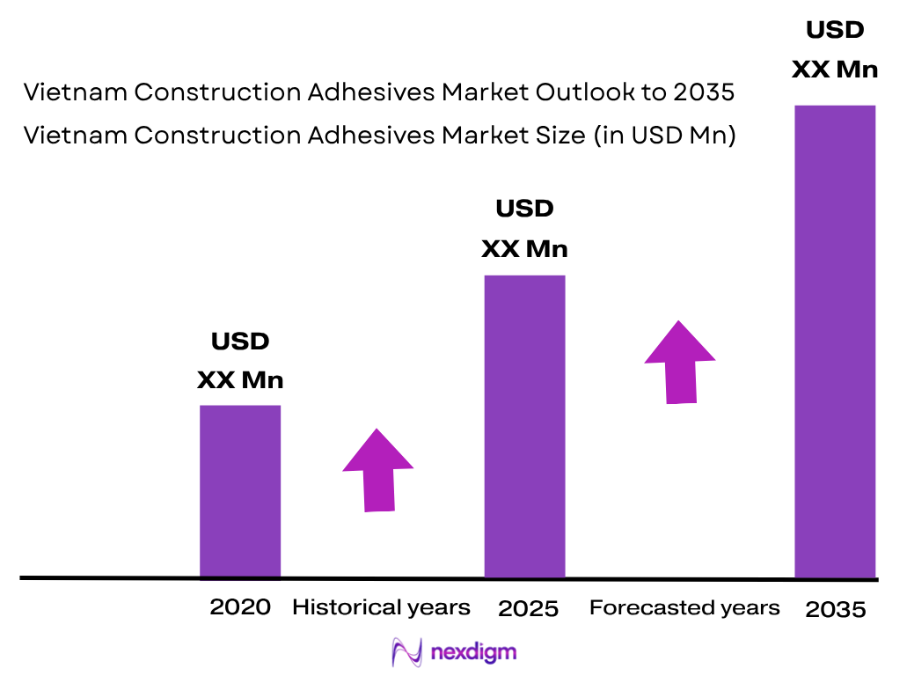
The Vietnam Construction Adhesives Market is valued at approximately ~USD XX million, supported by residential construction, industrial investment, tile installation and infrastructure development. Vietnam’s GDP expanded from VND 10,221.8 trillion to VND 11,511.9 trillion, while GDP per capita increased from USD 4,284.5 to USD 4,700 across the two latest observations. Construction activity strengthened alongside this expansion, supporting consumption of tile adhesives, flooring adhesives, lightweight-block bonding systems and structural chemical anchors.
Ho Chi Minh City, Hanoi, Bac Ninh, Hai Phong, Binh Duong and Dong Nai dominate the Vietnam Construction Adhesives Market because they combine housing, industrial parks, electronics manufacturing and infrastructure construction. Foreign investment remained heavily concentrated in these corridors, with Bac Ninh receiving USD 5.12 billion, Hai Phong USD 4.94 billion and Ho Chi Minh City more than USD 3.04 billion in the latest annual observation, reinforcing adhesive demand from factories, residences and commercial buildings.
Market Segmentation
By Product Type
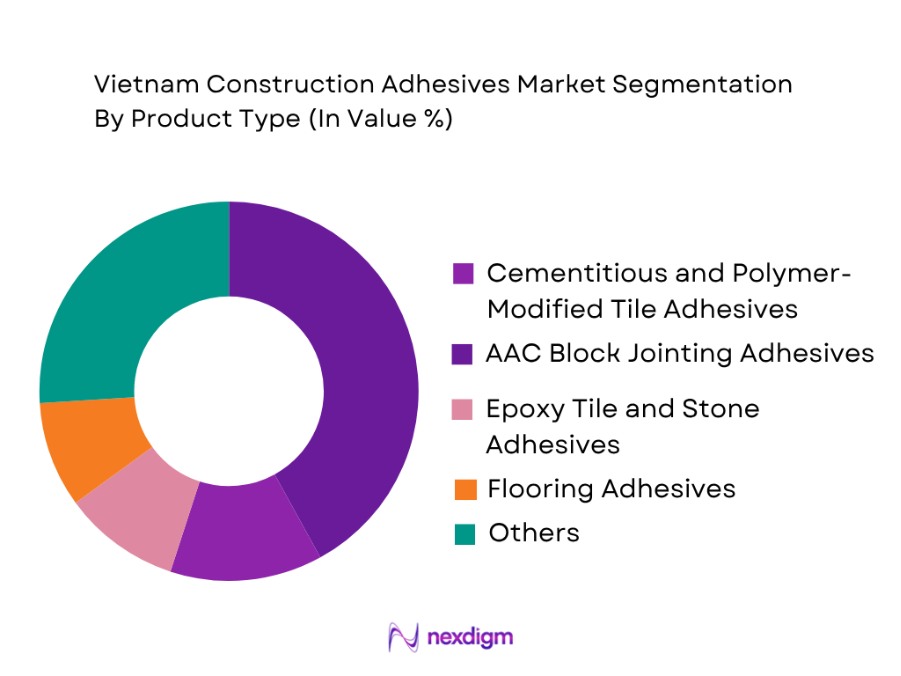
The Vietnam Construction Adhesives Market is segmented into cementitious tile adhesives, polymer-modified tile adhesives, flexible tile adhesives, epoxy systems, lightweight-block jointing adhesives, flooring adhesives, structural anchoring adhesives, polyurethane adhesives and hybrid polymer systems. Cementitious and polymer-modified tile adhesives hold the dominant modeled market share because tile remains extensively used across apartments, individual houses, commercial buildings, hotels and institutional developments. Polymer modification improves adhesion to low-absorption porcelain and homogeneous tiles while enabling thinner installation layers and more controlled performance than conventional site-mixed cement mortar. The relevance of this category is reinforced by Vietnam’s housing pipeline: the Ministry of Construction reported 937 commercial housing projects representing approximately 403,349 units under construction in the fourth quarter, alongside 69 completed projects containing roughly 23,041 units over the full year. Each completed residential unit creates significant tile and stone installation demand across floors, bathrooms, kitchens, balconies and common areas.
By Application
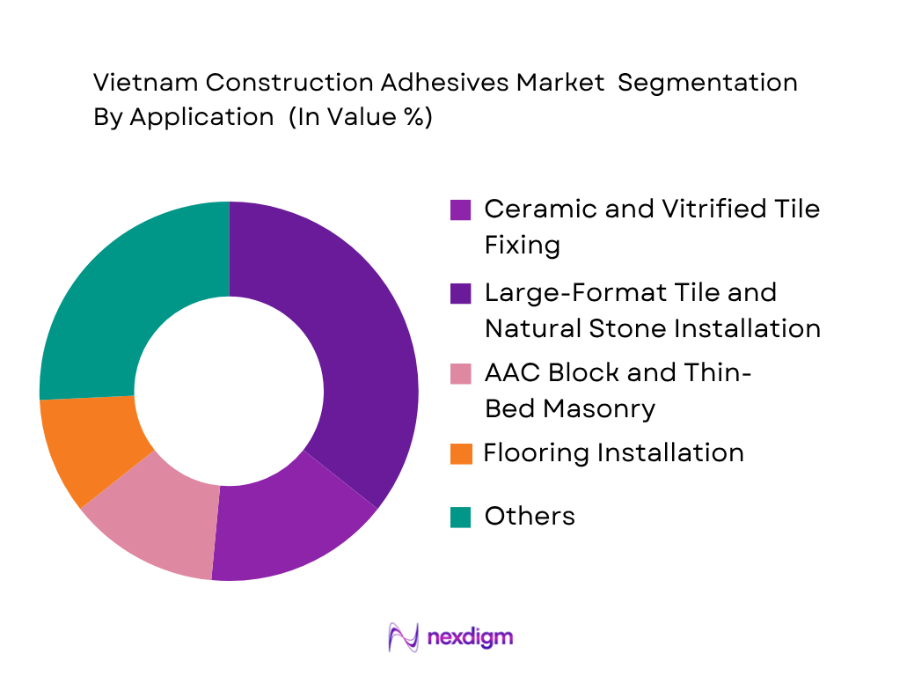
The Vietnam Construction Adhesives Market is segmented into ceramic tile fixing, porcelain and homogeneous tile installation, large-format tile and natural stone, lightweight block bonding, flooring, structural anchoring, interior fit-out and industrial construction. Ceramic, porcelain and homogeneous tile fixing represents the dominant modeled application because residential and commercial buildings extensively use tiled finishes while higher-grade projects increasingly require factory-produced adhesives rather than conventional cement-sand beds. Large-format surfaces increase requirements for tensile adhesion, extended open time, reduced vertical slip and deformability, further increasing polymer content. Residential construction remains substantial, with 79 newly licensed commercial housing projects representing approximately 38,345 units and 69 completed projects representing approximately 23,041 units in the latest full-year housing data. Social-housing development adds another installation base, with 20,284 units completed and 25,399 units newly licensed or started during the same period. This pipeline supports continuing demand for thin-bed tile adhesives, flexible formulations and renovation-grade bonding products.
Competitive Landscape
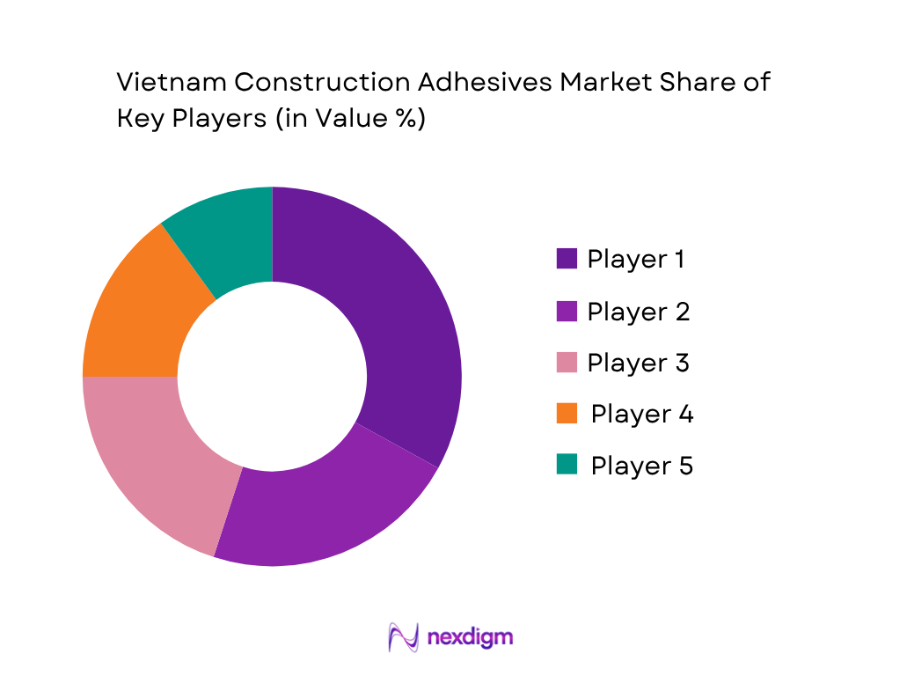
The Vietnam Construction Adhesives Market includes multinational construction-chemical suppliers, tile-installation specialists and local producers competing across cementitious, polymer-modified, epoxy and structural systems. Sika, Saint-Gobain Weber, MAPEI, LATICRETE and ARDEX are positioned around technical performance, local or regional production, contractor support, specification capability and premium tile systems. Competition increasingly centers on large-format tile performance, local manufacturing, industrial project exposure and applicator education rather than basic cementitious bonding alone.
| Major Player | Establishment Year | Headquarters | Tile & Stone Adhesives | Large-Format / Flexible Systems | Vietnam Manufacturing / Presence | Industrial / Flooring Capability | Structural Bonding Capability | Technical Support |
| Sika | 1910 | Baar, Switzerland | ~ | ~ | ~ | ~ | ~ | ~ |
| Saint-Gobain Weber | 1900 | Courbevoie, France | ~ | ~ | ~ | ~ | ~ | ~ |
| MAPEI | 1937 | Milan, Italy | ~ | ~ | ~ | ~ | ~ | ~ |
| LATICRETE | 1956 | Bethany, Connecticut, USA | ~ | ~ | ~ | ~ | ~ | ~ |
| ARDEX | 1949 | Witten, Germany | ~ | ~ | ~ | ~ | ~ | ~ |
Vietnam Construction Adhesives Market Analysis
Growth Drivers
Urban Housing Expansion is Increasing Tile, Masonry and Interior Adhesive Consumption
Vietnam’s large housing pipeline is expanding demand for cementitious tile adhesives, polymer-modified products, lightweight-block jointing adhesives and interior construction bonding systems. The Ministry of Construction reported 937 commercial housing projects representing about 403,349 units under construction in the fourth quarter of 2024, while 69 commercial housing projects containing approximately 23,041 units were completed during the year. Social housing added another significant construction base, with 28 projects totaling 20,284 units completed, 23 projects totaling 25,399 units licensed or started, and 113 projects representing 142,450 units receiving investment-policy approval. This volume creates recurring adhesive consumption across ceramic and porcelain flooring, bathrooms, kitchens, wall finishes, AAC masonry and common areas. Large multi-unit developments increasingly favor factory-mixed products because standardized adhesives provide controlled bond strength, thinner application layers and repeatable performance across thousands of similar installations. Vietnam’s broader macroeconomic scale supports this construction demand: World Bank data record 2024 GDP of USD 476.39 billion, GDP per capita of USD 4,717.3, and population of 100,987,686, while the IMF recorded nominal GDP at approximately VND 11,277 trillion for 2024.
Manufacturing FDI and Industrial Construction Drive Higher-Performance Adhesive Demand
Vietnam’s expanding manufacturing base is creating direct demand for industrial flooring adhesives, epoxy bonding systems, panel adhesives, chemical anchors and specialty construction products used in electronics, semiconductor, factory and warehouse projects. The Ministry of Planning and Investment reported USD 38.23 billion of foreign investment commitments in 2024, including 3,375 newly licensed projects worth USD 19.7 billion and 1,539 projects receiving USD 14 billion of additional capital. Processing and manufacturing alone attracted USD 25.58 billion, making it the largest recipient of foreign investment. These projects require technically controlled construction environments where adhesives are used for resilient flooring, cleanroom finishes, wall panels, insulation and equipment anchoring rather than only conventional tile installation. Industrial expansion also supports housing, logistics and commercial construction around Bac Ninh, Hai Phong, Binh Duong and Dong Nai, widening downstream adhesive consumption. Vietnam’s macroeconomic fundamentals reinforce this development base: World Bank data place 2024 GDP at USD 476.39 billion and population at 100,987,686, while the IMF recorded nominal GDP of approximately VND 11,277 trillion. The combination of foreign-funded manufacturing assets and a large domestic construction economy supports continued movement toward specification-based construction adhesives.
Market Challenges
Traditional Installation Practices and Execution Variability Create Adhesive Performance Risk
Vietnam’s transition from site-mixed cement-sand mortar toward engineered construction adhesives is constrained by varying contractor practices, substrate preparation and installation quality. The challenge is magnified by the scale of active construction: the Ministry of Construction recorded 937 commercial housing projects representing approximately 403,349 units under construction, alongside 645 social-housing projects representing 581,218 units at different development stages. Applying tile adhesive across such a large number of projects requires correct mixing-water ratios, proper trowel selection, adequate adhesive coverage, substrate cleaning and observance of open time. Incorrect practices can cause hollow areas, tile detachment and insufficient adhesion, particularly with low-absorption porcelain and large-format surfaces that depend more heavily on polymer modification than conventional ceramic products. Construction activity remained strong in 2025, with the National Statistics Office reporting construction value added growth of 7.99 in the first quarter compared with 7.57 in the corresponding 2024 period, increasing pressure on project execution capacity. At the macroeconomic level, World Bank data record 2024 GDP of USD 476.39 billion and GDP per capita of USD 4,717.3, while the IMF recorded nominal GDP at roughly VND 11,277 trillion, underscoring the scale across which installation quality must be standardized.
Imported Polymer and Chemical Inputs Expose Formulators to Supply-Chain Risk
Vietnamese construction adhesive manufacturers remain exposed to imported polymer and chemical feedstocks because polymer-modified tile adhesives, acrylic systems, epoxies and polyurethane formulations depend on specialty materials that are not fully sourced domestically. Vietnam Customs data show that during the first eight months of 2024 the country imported 2,573,611 tonnes of plastics worth USD 4.154 billion, alongside USD 3.185 billion of chemicals and USD 2.988 billion of chemical products. A separate customs reporting period recorded cumulative plastic imports reaching 4,639,863 tonnes worth USD 6.458 billion, illustrating the scale of external material flows entering Vietnam’s manufacturing economy. Construction-adhesive formulations represent only part of these broad categories, but the figures demonstrate substantial dependence on international polymer and chemical supply networks. For adhesive producers, disruptions can affect availability of redispersible polymer powders, cellulose ethers, acrylics, epoxy components, polyurethane intermediates and additives used to control workability and adhesion. The macroeconomic scale makes supply continuity important: World Bank data place Vietnam’s 2024 GDP at USD 476.39 billion and population at 100,987,686, while IMF data record nominal GDP of approximately VND 11,277 trillion. Local formulation and inventory resilience therefore remain critical competitive requirements.
Market Opportunities
Large-Format Tile, Social Housing and Renovation Can Expand Polymer-Modified Adhesive Adoption
Large-format porcelain, tile-on-tile renovation and standardized housing construction create a substantial future opportunity for higher-performance construction adhesives in Vietnam. The Ministry of Construction recorded 79 newly licensed commercial housing projects representing approximately 38,345 units and 69 completed projects containing about 23,041 units during 2024. Social housing provides an additional demand platform: 28 projects totaling 20,284 units were completed, 23 projects with 25,399 units were licensed or started, and the wider national program contained 645 projects representing 581,218 units. These current projects create a large installed surface area for ceramic, porcelain and stone finishes while also expanding the future refurbishment base. Larger tile formats require improved tensile adhesion, deformability, slip resistance and extended open time, creating greater technical value than conventional mortar installation. Tile-on-tile systems can also reduce demolition during bathroom, kitchen and commercial renovation, supporting polymer-rich adhesive formulations. Vietnam’s economic base supports continued premiumization: World Bank data record 2024 GDP of USD 476.39 billion, GDP per capita of USD 4,717.3, and population of 100,987,686, while the IMF records nominal GDP near VND 11,277 trillion. These current indicators support future expansion of organized, performance-classified adhesive systems.
Industrial Flooring, Structural Anchoring and Prefabricated Bonding Offer Higher-Value Growth
Vietnam’s industrial investment base creates a strong future opportunity for epoxy flooring adhesives, chemical anchors, polyurethane systems and prefabricated-component bonding. The Ministry of Planning and Investment recorded USD 25.58 billion of foreign investment in processing and manufacturing during 2024 within total registered foreign investment of USD 38.23 billion. The same year generated 3,375 newly licensed foreign-invested projects and 1,539 projects receiving additional capital, indicating continuing development and expansion of factories and industrial facilities. These buildings require adhesives beyond conventional tile installation, including resilient and cleanroom flooring, insulation-panel bonding, threaded-rod anchoring, rebar dowelling and equipment foundation systems. Industrialized construction also provides favorable conditions for prefabricated adhesive bonding because factory assembly allows controlled substrate preparation, consistent adhesive thickness and repeatable cure conditions. Construction activity remained strong into 2025, when the National Statistics Office recorded construction value added growth of 7.99 in the first quarter and manufacturing growth of 9.28, providing a current operating base for further specialty product penetration. World Bank data place Vietnam’s 2024 GDP at USD 476.39 billion, while IMF data record nominal GDP of approximately VND 11,277 trillion. These current industrial and macroeconomic indicators support future movement toward higher-value specification-led construction adhesives.
Future Outlook
The Vietnam Construction Adhesives Market is forecast to expand at approximately ~X.X% CAGR during 2026–2035, supported by urban housing, industrial FDI, infrastructure construction, premium tile formats and gradual conversion from traditional mortar to factory-produced adhesives. Higher-performance polymer-modified, epoxy and structural products should gain importance as industrial and residential projects move toward tighter technical specifications and faster construction cycles. Vietnam’s underlying construction sector provides a substantial base. The General Statistics Office reported that construction activity expanded strongly in 2024, while industry and construction together remained one of the largest components of economic output. GDP at current prices reached VND 11,511.9 trillion, equivalent to USD 476.3 billion, compared with VND 10,221.8 trillion and USD 430 billion in the preceding year. This expansion increases the overall pool of residential, commercial, industrial and public structures requiring adhesive-based installation systems.
Major Players
- Sika Vietnam
- Saint-Gobain Weber Vietnam
- MAPEI Vietnam
- LATICRETE Vietnam
- ARDEX Vietnam
- Fosroc Vietnam
- Master Builders Solutions Vietnam
- Dow Vietnam
- Henkel Vietnam
- Bostik Vietnam / Arkema
- Vinkems
- KOVA Trading
- Dulux Professional / AkzoNobel Vietnam
- Viglacera Construction Materials
- INSEE Vietnam
Key Target Audience
- Construction Adhesive and Construction Chemical Manufacturers
- Tile, Ceramic and Natural Stone Manufacturers
- Real Estate Developers and General Contractors
- Industrial Park Developers and Manufacturing Facility Contractors
- Building Material Distributors and Tile Dealers
- Flooring, Tile and Interior Installation Contractors
- Investments and Venture Capitalist Firms
- Government and Regulatory Bodies (Ministry of Construction, Directorate for Standards Metrology and Quality, Ministry of Finance, Vietnam Association for Building Materials, Provincial Departments of Construction)
Research Methodology
Step 1: Identification of Key Variables
The initial phase involves developing an ecosystem map covering adhesive manufacturers, dry-mix producers, resin suppliers, tile manufacturers, distributors, developers and applicators. Secondary research is used to identify variables including construction activity, tile format, polymer loading, adhesive classification, project type, industrial investment, local production and traditional mortar substitution.
Step 2: Market Analysis and Construction
Historical data for the Vietnam Construction Adhesives Market are assessed through top-down and bottom-up approaches. Top-down analysis evaluates housing, construction output, industrial FDI and infrastructure development, while bottom-up analysis models adhesive demand using installed tile areas, lightweight-block usage, flooring applications, structural anchors, project counts and application-specific material consumption.
Step 3: Hypothesis Validation and Expert Consultation
Market hypotheses are validated through computer-assisted telephone interviews with adhesive manufacturers, dry-mix producers, distributors, tile companies, contractors and applicators. These consultations assess polymer-modified adhesive adoption, large-format tile requirements, regional channel structures, contractor preferences, industrial specifications and technical performance expectations.
Step 4: Research Synthesis and Final Output
The final stage triangulates Ministry of Construction housing data, national economic indicators, foreign-investment statistics, company disclosures and primary interviews. Bottom-up consumption models are reconciled with top-down construction activity to produce a consistent market framework covering product categories, applications, regions, competitors, distribution channels and future opportunities.

- Executive Summary
- Research Methodology (Market Definitions and Assumptions, Vietnam Construction Adhesives Market Boundary, Cementitious versus Polymer Adhesive Classification, Tile Adhesive Assessment, Stone Adhesive Assessment, Flooring Adhesive Assessment, AAC and Lightweight Block Adhesive Assessment, Construction Bonding Agent Assessment, Epoxy Adhesive Assessment, Polyurethane Adhesive Assessment, Acrylic Adhesive Assessment, Hybrid Polymer Adhesive Assessment, Structural Anchoring Adhesive Assessment, Interior Panel Adhesive Assessment, Roofing and Insulation Adhesive Assessment, Prefabricated Construction Adhesive Assessment, Ceramic and Porcelain Tile Assessment, Large-Format Tile Assessment, Natural Stone Assessment, TCVN 7899 / ISO 13007 Compliance Mapping, Green-Building and Low-VOC Assessment, Applicator Mapping, Dealer and Distributor Mapping, Supply-Side Assessment, Demand-Side Assessment, Top-Down Market Sizing, Bottom-Up Market Sizing, Primary Industry Interviews, Construction Project Pipeline Assessment, Data Triangulation, Forecasting Framework)

- Definition and Scope
- Evolution of Construction Adhesive Technology in Vietnam, Transition from Site-Mixed Cement-Sand Mortar to Factory-Mixed Tile Adhesives, Cementitious Tile Adhesive Development, Polymer-Modified Tile Adhesives, Porcelain and Homogeneous Tile Adhesives, Large-Format Tile Adhesives, Natural Stone Adhesives, Epoxy Adhesives, AAC and Lightweight Block Jointing Adhesives, Flooring Adhesives, Structural Anchoring Systems, Polyurethane Construction Adhesives, Hybrid Polymer Adhesives, Prefabricated Construction Bonding, Low-VOC Adhesives, Industrial Construction Adhesive Systems
- Construction Adhesives Industry Value Chain Analysis
- Construction Adhesives Supply Chain Analysis
- Cement Suppliers, Silica Sand Suppliers, Redispersible Polymer Powder Suppliers, Cellulose Ether Suppliers, Acrylic Polymer Suppliers, Epoxy Resin Suppliers, Polyurethane Raw Material Suppliers, Specialty Additive Suppliers, Adhesive Manufacturers, Dry-Mix Mortar Plants, Local Blenders, Importers, Packaging Suppliers, Construction Chemical Distributors, Tile and Sanitaryware Dealers, Hardware Retailers, Contractors, Tile Applicators, Flooring Contractors, Industrial Contractors, Property Developers, Architects and Specifiers

- Growth Drivers (Urban Housing Development, Industrial and Manufacturing Construction, Electronics and Semiconductor Facilities, Residential Renovation, Porcelain Tile Adoption, Large-Format Tile Installation, Industrial Park Expansion, Factory-Mixed Construction Products, Skilled-Labor Productivity Requirements, Premium Tile and Stone Installation, Infrastructure Development, Specification-Based Construction)
- Market Challenges (Traditional Cement-Sand Mortar Competition, Low-Cost Local Products, Incorrect Adhesive Selection, Poor Substrate Preparation, Incorrect Mixing Water, Inadequate Adhesive Coverage, Applicator Skill Variation, Imported Polymer Dependence, Product Standard Awareness, Tile Detachment Risk, High Humidity Application Conditions, Regional Quality Variation)
- Market Opportunities (Large-Format Tile Adhesives, Flexible Exterior Adhesives, Lightweight Block Jointing Adhesives, Epoxy Tile and Stone Systems, Tile-on-Tile Renovation Adhesives, Low-VOC Construction Adhesives, Structural Anchoring Systems, Industrial Flooring Adhesives, Prefabricated Construction Bonding, Natural Stone Adhesives, Fast-Setting Adhesives, Contractor Training and Certification, Tier-II City Expansion)
- Market Trends (Polymer-Modified Cementitious Adhesives, Thin-Bed Tile Installation, ISO 13007 / TCVN 7899 Performance Classification, Flexible Large-Format Tile Adhesives, Tile-on-Tile Renovation, Factory-Mixed Mortars, Lightweight Block Adhesives, Ready-to-Use Adhesives, Low-Dust Formulations, Low-VOC Products, Structural Chemical Anchors, Digital Product Selection Tools)
- Government Regulations and Standards (TCVN 7899-1 / ISO 13007-1 Tile Adhesive Classification, TCVN 7899-2 Tile Adhesive Test Methods, Ministry of Construction Building Material Requirements, QCVN Construction Material Requirements, Product Conformity Requirements, Fire Safety Requirements for Building Materials, Green-Building Material Considerations, Occupational Chemical Safety and Labelling Requirements)
- SWOT Analysis
- Porter’s Five Forces Analysis
- PESTLE Analysis
- Stakeholder Ecosystem

- By Market Value (2020-2025)
- By Construction Adhesive Consumption Volume (2020-2025)
- By Cementitious Tile Adhesive Consumption (2020-2025)
- By Polymer-Modified Tile Adhesive Consumption (2020-2025)
- By Epoxy Adhesive Consumption (2020-2025)
- By Polyurethane Adhesive Consumption (2020-2025)
- By AAC and Lightweight Block Adhesive Consumption (2020-2025)
- By Flooring Adhesive Consumption (2020-2025)

- By Product Type (In Value %)
Cementitious Tile Adhesives
Polymer-Modified Tile Adhesives
Flexible Tile Adhesives
Epoxy Tile and Stone Adhesives
AAC and Lightweight Block Jointing Adhesives
Structural Anchoring Adhesives
Flooring Adhesives
Polyurethane Construction Adhesives
Acrylic Construction Adhesives - By Resin and Chemistry Type (In Value %)
Cementitious Polymer-Modified Systems
Redispersible Polymer Powder-Based Systems
Acrylic Polymer-Based Adhesives
Epoxy Resin-Based Adhesives
Polyurethane-Based Adhesives
Silyl-Modified Polymer Adhesives
Hybrid Polymer Adhesives
Vinyl Acetate and PVA Systems
Reactive Methacrylate Adhesives
Synthetic Resin Bonding Agents
Specialty Mineral-Polymer Systems - By Application (In Value %)
Ceramic Tile Fixing
Porcelain and Homogeneous Tile Fixing
Large-Format Tile Installation
Natural Stone Fixing
Wall Tile Installation
Floor Tile Installation
Tile-on-Tile Applications
Exterior Façade Tile Fixing
Swimming Pool Tile Fixing
AAC and Lightweight Block Jointing
Flooring Installation - By Construction Activity (In Value %)
New Residential Construction
New Commercial Construction
Industrial and Manufacturing Construction
Infrastructure Construction
Residential Renovation
Commercial Refurbishment - By Building Type (In Value %)
Apartments and High-Rise Residential Buildings
Individual Houses and Villas
Commercial Offices
Shopping Malls and Retail Buildings
Hotels and Resorts
Hospitals and Healthcare Facilities
Educational Buildings
Industrial Factories
Electronics and Semiconductor Facilities

- Market Share of Major Players (By Vietnam Revenue, Construction Adhesive Volume, Tile Adhesive Portfolio, Large-Format Tile Adhesive Portfolio, Flooring Adhesive Exposure, Structural Anchoring Portfolio, Residential Construction Exposure, Industrial Construction Exposure, Infrastructure Exposure, Local Manufacturing Footprint, Distributor Network, Applicator Network, Project Specification Presence, Technical Support Coverage)
- Cross Comparison Parameters (Tile Stone and Construction Adhesive Portfolio Breadth, TCVN 7899 and ISO 13007 Performance Capability, Large-Format Porcelain and Exterior Tile Adhesive Capability, Flooring Lightweight Block and Structural Bonding Capability, Vietnam Manufacturing and Dry-Mix Production Footprint, Dealer Distributor and Applicator Network Reach, Low-VOC Industrial and Premium Polymer Technology Capability, Technical Specification Applicator Training and Jobsite Support Capability)
- SWOT Analysis of Major Players (Technology Portfolio, Manufacturing, Distribution, Brand Positioning, Contractor Reach)
- Major Companies
Sika Vietnam
Saint-Gobain Weber Vietnam
MAPEI Vietnam
LATICRETE Vietnam
ARDEX Vietnam
Fosroc Vietnam
Master Builders Solutions Vietnam
Dow Vietnam
Henkel Vietnam
Bostik Vietnam / Arkema
Vinkems
KOVA Trading
Dulux Professional / AkzoNobel Vietnam
Viglacera Construction Materials
INSEE Vietnam

- Property Developer Requirement Assessment
- General Contractor Requirement Assessment
- Tile Applicator Requirement Assessment
- Flooring Contractor Requirement Assessment
- Interior Fit-Out Contractor Requirement Assessment
- Industrial Contractor Requirement Assessment
- Infrastructure Contractor Requirement Assessment
- Architect and Specification Requirement Assessment
- Tile Manufacturer Partnership Assessment
- Dealer and Distributor Requirement Assessment
- Product Standard Requirement Assessment
- Applicator Training Requirement Assessment
- Technical Site Support Requirement Assessment

- By Market Value (2020-2025)
- By Construction Adhesive Consumption Volume (2020-2025)
- By Cementitious Tile Adhesive Consumption (2020-2025)
- By Polymer-Modified Tile Adhesive Consumption (2020-2025)
- By Epoxy Adhesive Consumption (2020-2025)
- By Polyurethane Adhesive Consumption (2020-2025)
- By AAC and Lightweight Block Adhesive Consumption (2020-2025)
- By Flooring Adhesive Consumption (2020-2025)


 Request a Sample
 Ask for Customization
 Get a Quote
 Enquire Now