
 Download PDF
Market Overview
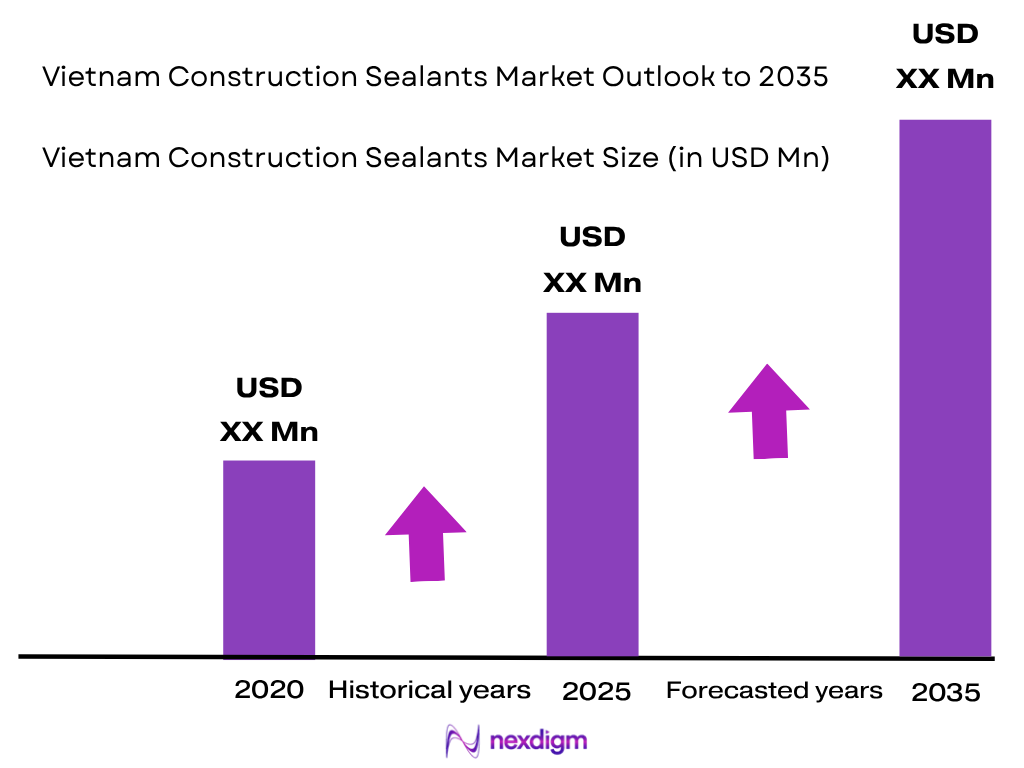
The Vietnam Construction Sealants Market is valued at approximately ~USD XX million, supported by residential projects, industrial facilities, façade construction and infrastructure. Social-housing completions increased from 13,864 units in the preceding reporting period to 20,284 units in the latest period, while newly started or permitted social-housing units increased from approximately 22,399 units to 25,399 units. These developments expand demand for façade, concrete-joint, sanitary and weatherproofing sealants.
Dominant Construction Locations: Ho Chi Minh City, Hanoi, Bac Ninh, Hai Phong, Binh Duong and Dong Nai dominate Vietnam Construction Sealants demand because they combine high-rise construction, industrial parks, electronics manufacturing and infrastructure development. Ho Chi Minh City attracted more than USD5.85 billion of registered FDI in the preceding period, while Bac Ninh attracted USD5.12 billion and Hai Phong USD4.94 billion in the latest period, supporting factory, warehouse and building-envelope demand.
Market Segmentation
By Sealant Chemistry
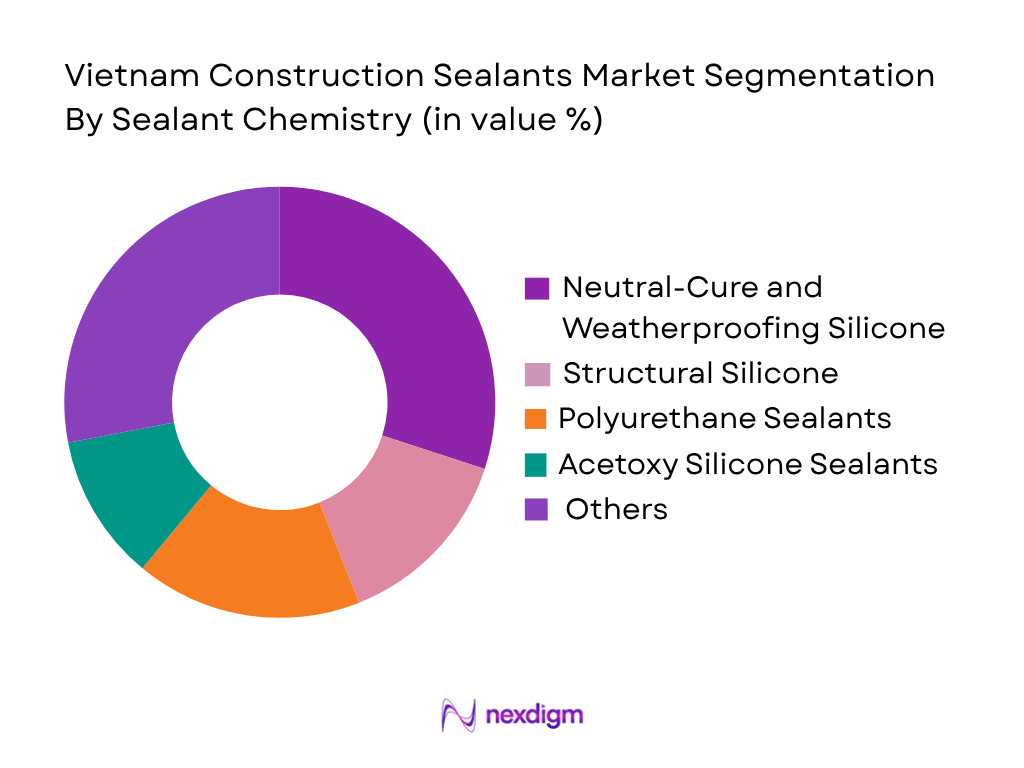
The Vietnam Construction Sealants Market is segmented into neutral-cure silicone, acetoxy silicone, structural silicone, polyurethane, acrylic, polysulfide, MS polymer, silyl-modified polymer, hybrid polymer and butyl sealants. Silicone sealants hold the dominant position because Vietnam’s dense urban construction increasingly uses aluminium-framed windows, glazed façades, curtain walls, sanitary fittings and exterior weatherproofing systems. Neutral silicone is particularly important where sealants contact coated aluminium, glass, concrete or sensitive façade materials because it provides broad substrate compatibility and strong resistance to UV exposure and tropical weathering. Structural silicone has an additional role in high-rise façade construction, while acetoxy silicone remains common in sanitary and general-purpose applications. Polyurethane products are important for concrete joints, floors and civil-engineering applications, while MS polymer and hybrid systems are gaining relevance where contractors require elastic bonding and sealing in one product. Local product ranges from major suppliers already cover neutral silicone, façade joint products and polyurethane civil-engineering sealants.
By Application
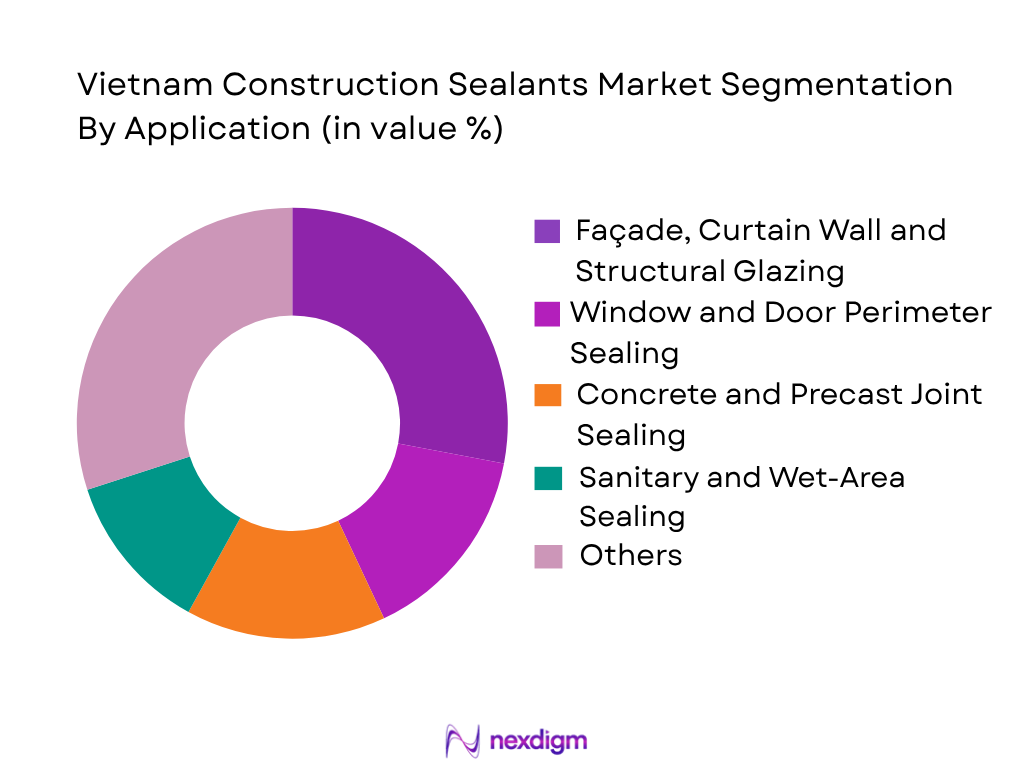
The Vietnam Construction Sealants Market is segmented into curtain-wall and façade sealing, window and door perimeter sealing, concrete and precast joints, sanitary applications, industrial flooring, roofing, firestopping and infrastructure joints. Façade and glazing applications represent the dominant subsegment because Vietnam’s major cities continue to add apartment towers, offices, hotels, shopping centres and mixed-use buildings where large glazed surfaces require structural glazing and perimeter weatherproofing. Sealants in these applications must accommodate thermal movement, heavy rainfall, high humidity and UV exposure. Concrete and precast joint sealing is another important demand pool as industrial facilities, logistics buildings and infrastructure expand. Vietnam had 431 industrial and export-processing zones covering around 132,300 hectares by mid-2024, with 301 zones operating, creating a broad base for floor joints, wall panels and factory-building sealant demand. Infrastructure applications are also growing through airport, expressway and metro development.
Competitive Landscape
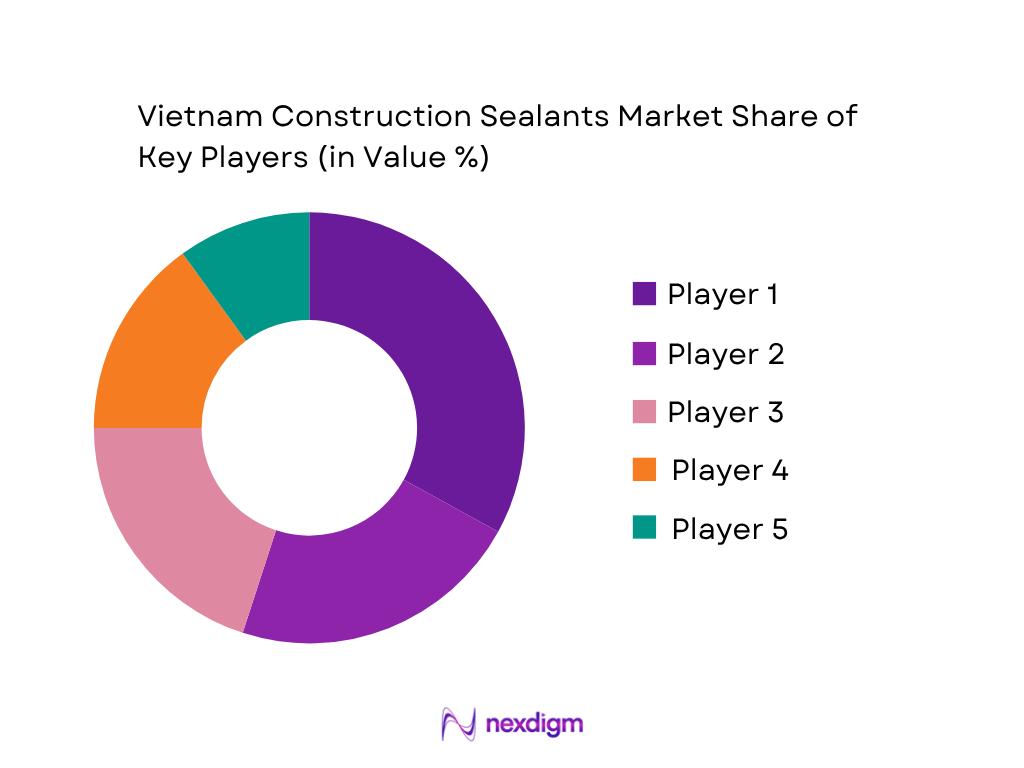
The Vietnam Construction Sealants Market includes multinational construction-chemical companies, specialist silicone manufacturers and regional suppliers. Competition is shaped by structural glazing credentials, tropical-weather durability, neutral-cure silicone breadth, polyurethane joint technologies, distributor reach and local technical support. Companies with Vietnam manufacturing, warehousing or technical laboratories have an advantage because façade and infrastructure projects require product compatibility testing, joint design support and reliable local supply. Sika, for example, operates from Dong Nai and has offices in Ho Chi Minh City, Hanoi and Da Nang as well as a Bac Ninh plant, while offering neutral silicone, façade joint and polyurethane civil-engineering systems.
| Major Player | Establishment Year | Headquarters | Structural Glazing Capability | PU Joint Sealants | Hybrid / MS Polymer Capability | Tropical Weathering Portfolio | Vietnam Presence | Technical Support |
| Sika | 1910 | Baar, Switzerland | ~ | ~ | ~ | ~ | ~ | ~ |
| MAPEI | 1937 | Milan, Italy | ~ | ~ | ~ | ~ | ~ | ~ |
| Dow / DOWSIL | 1897 | Midland, USA | ~ | ~ | ~ | ~ | ~ | ~ |
| Wacker Chemie | 1914 | Munich, Germany | ~ | ~ | ~ | ~ | ~ | ~ |
| KCC | 1958 | Seoul, South Korea | ~ | ~ | ~ | ~ | ~ | ~ |
Vietnam Construction Sealants Market Analysis
Growth Drivers
High-Rise Housing and Urban Construction Are Expanding Building-Envelope Sealant Demand
Vietnam’s Construction Sealants Market is being supported by sustained residential and commercial development, particularly in Hanoi, Ho Chi Minh City and surrounding urban corridors. The Ministry of Construction recorded 69 completed commercial housing projects with 23,041 units in 2024, while 79 newly licensed projects contained 38,345 units and 937 projects with 403,349 units remained under construction. Social housing added another 20,284 completed units and 25,399 units that were licensed or started during the same period. These volumes translate directly into demand for neutral-cure silicone, structural glazing sealants, window-perimeter sealants, sanitary products and concrete-joint systems. High-rise apartments and mixed-use buildings also require weatherproofing capable of accommodating façade movement, UV exposure and heavy rainfall. Vietnam’s macroeconomic base strengthened alongside this construction activity. World Bank data record USD476.39 billion of nominal GDP and USD4,717.3 GDP per capita in 2024. The combination of a large active housing pipeline and expanding urban construction creates recurring consumption across glazing, façade, bathroom, balcony, precast and concrete-joint applications, favoring higher-performance sealants over basic general-purpose caulking products.
Industrial Parks and Manufacturing Investment Are Driving Specialized Joint-Sealing Applications
Vietnam’s rapid industrialization is creating substantial sealant demand in factories, warehouses, electronics facilities and logistics developments. Government data show 431 industrial and export-processing zones covering approximately 132,300 hectares in 2024, including 301 operational zones and around 89,900 hectares of industrial land. Foreign-invested manufacturing activity also remained strong: processing and manufacturing attracted USD25.58 billion of registered foreign investment in 2024, while total foreign investment reached USD38.23 billion across 3,375 newly approved projects and 1,539 capital-adjustment projects. These facilities require polyurethane and hybrid sealants for industrial floors, precast panels, metal-cladding joints, clean rooms, roofing interfaces and external building envelopes. Electronics and semiconductor-related facilities also place higher demands on low-emission, durable and chemically resistant sealing systems. World Bank data record Vietnam’s 2024 nominal GDP at USD476.39 billion and GDP per capita at USD4,717.3. The industrial pipeline therefore supports not only higher sealant volumes but also a shift toward specification-driven systems that deliver movement accommodation, chemical resistance, moisture protection and long-term adhesion under demanding factory operating conditions.
Market Challenges
Dependence on Imported Polymers and Chemical Inputs Creates Supply-Chain Exposure
Vietnam’s Construction Sealants Market remains exposed to imported polymer and chemical feedstocks because silicone polymers, polyurethane intermediates, specialty plasticizers, catalysts and additives are not fully sourced domestically. National Statistics Office data show Vietnam imported USD380.76 billion of goods in 2024, including USD356.43 billion of production inputs. Imported plastics alone reached USD11.8 billion, while machinery and industrial inputs also remained substantial, illustrating the broader dependence of domestic manufacturing on overseas raw materials. This matters for sealant producers because formulation consistency depends on specific silicone, PU, acrylic and hybrid-polymer chemistries that cannot always be substituted without affecting adhesion, curing behavior or weathering performance. Industrial and building demand is meanwhile expanding, with 431 industrial and export-processing zones and 937 commercial housing projects containing 403,349 units under construction during the same period. World Bank data place Vietnam’s nominal GDP at USD476.39 billion in 2024 and GDP per capita at USD4,717.3. Suppliers therefore need diversified sourcing, stronger local inventories and regional warehousing to protect contractors from disruptions that can delay façade, flooring and joint-sealing work on fast-moving projects.
Tropical Weather and Severe Natural Events Raise Durability and Application Risks
Vietnam’s tropical climate creates a major technical challenge for construction sealants because high humidity, intense rainfall, UV exposure and repeated thermal movement can accelerate adhesion loss, surface degradation and joint failure if products are poorly specified or installed. Government disaster-management data recorded 10 storms, 240 heavy-rain and flood events, 278 thunderstorms and hail events, and 17 heatwave periods in 2024. Natural disasters damaged or destroyed approximately 296,800 homes, while total property damage reached nearly VND89.25 trillion. Typhoon Yagi alone caused widespread infrastructure and building damage across northern Vietnam, emphasizing the importance of durable façade, window, roofing and concrete-joint sealing systems. These conditions also complicate application because wet substrates, high surface moisture and rapidly changing weather can affect primer performance and cure quality. Vietnam’s World Bank-recorded nominal GDP stood at USD476.39 billion in 2024, with GDP per capita of USD4,717.3. The scale of construction activity means weather-related failures can create substantial maintenance exposure, increasing the need for UV-resistant neutral silicone, low-modulus polyurethane and hybrid sealants designed specifically for tropical exterior conditions.
Market Opportunities
Transport Infrastructure Creates Future Scope for High-Durability Joint Sealants
Vietnam’s current transport-infrastructure buildout creates a strong future opportunity for sealants used in airports, expressways, bridges, concrete pavements and associated buildings. The transport sector reported that 8 road projects were started and 7 were completed in 2024, bringing the national expressway network to more than 2,021 kilometres. Long Thanh International Airport also reached intensive construction activity, with more than 6,000 personnel and 2,200 pieces of equipment mobilized on site during 2024. At the passenger terminal, construction teams had already completed major reinforced-concrete structural works, creating subsequent demand for façade, glazing, flooring, expansion-joint and weatherproofing systems. Such projects require products capable of handling repeated movement, water exposure, traffic loads, fuels and chemicals, opening space for polyurethane, polysulfide and high-performance hybrid formulations. World Bank data record Vietnam’s nominal GDP at USD476.39 billion in 2024 and GDP per capita at USD4,717.3. Current infrastructure activity therefore provides an installed project base from which suppliers can expand into higher-specification pavement, terminal, bridge and transportation-joint applications without relying on speculative future project volumes.
Local Manufacturing and Specialty Sealant Formulation Offer a Clear Localization Opportunity
Vietnam’s expanding industrial base creates an opportunity for local sealant manufacturing, cartridge filling, private-label production and climate-specific product formulation. The country had 431 industrial and export-processing zones covering 132,300 hectares in 2024, including 301 operating zones, providing a broad manufacturing ecosystem for construction chemicals and packaging. Foreign investment also supplied a large potential customer and supplier base, with USD38.23 billion of registered foreign capital and USD25.58 billion directed into processing and manufacturing. At the same time, Vietnam imported USD356.43 billion of production inputs, including USD11.8 billion of plastics, indicating substantial dependence on imported industrial materials and creating room for greater domestic value addition. Local sealant production could shorten delivery times, support smaller project-specific batches and allow curing speed, viscosity and weather resistance to be adapted to Vietnamese humidity and temperature conditions. World Bank data show nominal GDP of USD476.39 billion in 2024 and GDP per capita of USD4,717.3. These conditions support future growth for manufacturers combining local blending and packaging with technical services for façades, industrial floors, precast construction and infrastructure joints.
Future Outlook
The Vietnam Construction Sealants Market is expected to expand at approximately ~X.X% CAGR during 2026-2035, supported by continued urbanization, industrial investment, infrastructure execution and adoption of higher-performance building-envelope technologies. Demand is expected to move gradually from commodity acetoxy silicone toward neutral-cure, structural silicone, polyurethane and hybrid technologies.
Industrial construction will remain particularly important. Vietnam had 436 industrial parks operating or under development in late 2024, with more than 300 operational parks employing over 4.16 million people. These facilities create recurring demand for floor joints, panel joints, clean-room sealing and weatherproofing products.
Major Players
- Sika Vietnam Ltd.
- Mapei Vietnam Ltd.
- Dow / DOWSIL Construction Solutions
- Wacker Chemicals Vietnam
- KCC (Vietnam) Co., Ltd.
- Momentive Performance Materials
- Bostik Vietnam Company Limited / Arkema
- Henkel Vietnam
- H.B. Fuller
- 3M Vietnam
- Fosroc Vietnam / Regional Solutions
- Saint-Gobain Vietnam
- Soudal
- Tremco CPG Asia Pacific
- Shin-Etsu Silicone
Key Target Audience
- Construction Sealant and Construction Chemical Manufacturers
- Glass, Aluminium and Curtain-Wall Fabricators
- Façade, Glazing and Waterproofing Contractors
- Residential, Commercial and Industrial Property Developers
- Infrastructure, Airport and Civil Engineering Contractors
- Investments and Venture Capitalist Firms
- Government and Regulatory Bodies (Ministry of Construction, Ministry of Industry and Trade, Ministry of Finance, Civil Aviation Authority of Vietnam, Directorate for Roads of Vietnam)
- Construction Chemical Importers and Distributors
Research Methodology
Step 1: Identification of Key Variables
The initial phase involves constructing an ecosystem map covering silicone producers, polyurethane suppliers, sealant manufacturers, importers, façade fabricators, contractors, developers and industrial-project stakeholders. Secondary and proprietary databases are reviewed to identify chemistry mix, application exposure, local production, imported supply and regional construction activity. The main variables include joint length, sealant consumption, cure chemistry, movement class, application type and project specification.
Step 2: Market Analysis and Construction
Historical demand is analyzed across residential towers, commercial buildings, industrial facilities, airports, metro projects and civil infrastructure. The top-down methodology evaluates national construction, housing, industrial park and FDI activity, while the bottom-up approach assesses manufacturer sales, distributor throughput and typical consumption by application. Findings are reconciled across silicone, polyurethane, acrylic, polysulfide and hybrid product categories.
Step 3: Hypothesis Validation and Expert Consultation
Market assumptions are validated through computer-assisted telephone interviews and structured discussions with sealant suppliers, façade contractors, glass fabricators, applicators, developers and construction chemical distributors. Interviews examine chemistry selection, joint design, tropical-weather performance, primer usage and purchasing practices. These consultations help differentiate low-cost retail silicone from specification-driven structural glazing, infrastructure and industrial applications.
Step 4: Research Synthesis and Final Output
The final stage triangulates government construction statistics, industrial investment data, project pipelines, manufacturer disclosures and primary interviews. Demand is cross-checked by chemistry, application, region and end-user segment. Forecasting incorporates urban housing, industrial park development, high-rise glazing, Long Thanh Airport, transport infrastructure and increasing adoption of MS polymer and specialized silicone technologies to establish the final Vietnam Construction Sealants Market outlook.

- Executive Summary
- Research Methodology (Market Definitions and Assumptions, Vietnam Construction Sealants Market Classification, Silicone Sealant Scope, Polyurethane Sealant Assessment, MS Polymer and Hybrid Sealant Assessment, Acrylic Sealant Assessment, Polysulfide Sealant Assessment, Structural Glazing Sealant Assessment, Weatherproofing Sealant Assessment, Window and Door Sealant Assessment, Concrete Joint Sealant Assessment, Precast Joint Sealant Assessment, Flooring Joint Sealant Assessment, Sanitary Sealant Assessment, Firestop Sealant Assessment, Roofing Sealant Assessment, Infrastructure Sealant Assessment, Movement Capability Assessment, Shore Hardness Assessment, Modulus Assessment, UV Resistance Assessment, Weathering Resistance Assessment, Water Immersion Resistance Assessment, Fuel and Chemical Resistance Assessment, Tropical Climate Performance Assessment, Substrate Compatibility Assessment, Local Manufacturing Assessment, Import Assessment, Supply-Side Assessment, Demand-Side Assessment, Top-Down Market Sizing, Bottom-Up Market Sizing, Primary Industry Interviews, Construction Project Pipeline Assessment, Distributor Mapping, Contractor Mapping, Data Triangulation, Forecasting Framework)

- Definition and Scope
- Vietnam Construction Sealants Industry Evolution and Development of Acetoxy Silicone Sealants, Neutral-Cure Silicone Sealants, Structural Silicone Glazing Systems, Weatherproofing Sealants, Polyurethane Joint Sealants, Self-Leveling PU Sealants, Acrylic Sealants, Polysulfide Sealants, MS Polymer Sealants, Hybrid Sealant-Adhesives, Non-Staining Stone Sealants, Sanitary Anti-Fungal Sealants, Firestop Sealants, Precast Joint Sealants, Flooring Joint Sealants, Airport and Pavement Sealants, Infrastructure Sealants and Low-VOC Building Envelope Systems
- Construction Sealants Value Chain Analysis
- Construction Sealants Supply Chain Analysis
- Silicone Polymer Suppliers, Silane Suppliers, Polyurethane Prepolymer Suppliers, Acrylic Polymer Suppliers, Polysulfide Resin Suppliers, Plasticizer Suppliers, Mineral Filler Suppliers, Catalyst and Additive Suppliers, Sealant Manufacturers, Local Blenders, Cartridge and Sausage Packaging Suppliers, Importers, Distributors

- Growth Drivers (High-Rise Residential Construction, Commercial Building Development, Industrial Park Expansion, Electronics Manufacturing Facilities, Data Centre Construction, Expressway Expansion, Airport Development, Metro and Rail Construction, Curtain Wall Adoption, Precast Construction, Aluminium and Glass Façade Usage, Building Renovation)
- Market Challenges (Low-Cost Silicone Competition, Counterfeit and Substandard Products, Imported Silicone and Polymer Feedstock Dependence, Tropical Climate Exposure, Improper Joint Design, Inconsistent Surface Preparation, Installer Skill Gaps, Primer Misapplication, Sealant Compatibility Failures, Stone Staining Risk, Project Specification Enforcement, Price-Based Contractor Procurement)
- Market Opportunities (Structural Silicone Glazing, Neutral-Cure Weatherproofing Sealants, MS Polymer Sealants, Hybrid Sealant-Adhesives, Non-Staining Stone Sealants, Industrial Flooring Sealants, Airport and Expressway Joint Sealants, Firestop Sealants, Data Centre Sealants, Low-VOC Interior Sealants, Local Sealant Manufacturing, Automated Façade Fabrication)
- Market Trends (Neutral Silicone Adoption, Two-Component Structural Glazing, MS Polymer Growth, Hybrid Bond-and-Seal Products, Low-Modulus PU Sealants, Non-Staining Stone Sealants, Anti-Fungal Sanitary Sealants, Low-VOC Formulations, Sausage-Pack Adoption, Primerless Adhesion, Factory Glazing, Sustainable Sealant Packaging)
- Government Regulations and Standards (Vietnam Building Code Requirements, Ministry of Construction Material Regulations, QCVN Building Requirements, TCVN Construction Material Standards, Fire Safety Requirements, Chemical Safety and SDS Requirements, VOC and Indoor Air Quality Requirements, Façade and Glazing Requirements, Construction Product Conformity Requirements, Occupational Safety Requirements)
- SWOT Analysis
- Porter’s Five Forces Analysis
- PESTLE Analysis
- Stakeholder Ecosystem
- Construction Sealants Manufacturing and Project Ecosystem

- By Market Value (2020-2025)
- By Sealant Consumption Volume (2020-2025)
- By Silicone Sealant Consumption (2020-2025)
- By Polyurethane Sealant Consumption (2020-2025)
- By MS Polymer and Hybrid Sealant Consumption (2020-2025)
- By Acrylic Sealant Consumption (2020-2025)
- By Polysulfide Sealant Consumption (2020-2025)
- By Structural Glazing Sealant Consumption (2020-2025)
- By Weatherproofing Sealant Consumption (2020-2025)

- By Sealant Chemistry (In Value %)
Acetoxy Silicone Sealants
Neutral-Cure Silicone Sealants
Structural Silicone Sealants
Polyurethane Sealants
Acrylic Sealants
Polysulfide Sealants
MS Polymer Sealants
Silyl-Modified Polymer Sealants
Hybrid Polymer Sealants
Butyl Sealants
Other Specialty Construction Sealants - By Product Type (In Value %)
General-Purpose Silicone Sealants
Structural Glazing Sealants
Weatherproofing Sealants
Window and Door Sealants
Construction Joint Sealants
Self-Leveling Floor Sealants
Precast Joint Sealants
Sanitary and Anti-Fungal Sealants
Non-Staining Stone Sealants
Firestop Sealants
Roofing Sealants
Airport and Pavement Sealants
Industrial Chemical-Resistant Sealants
Hybrid Bond-and-Seal Products - By Application (In Value %)
Curtain Wall Structural Glazing
Façade Weather Sealing
Window and Door Perimeter Sealing
Concrete Expansion Joints
Precast Panel Joints
Floor Construction Joints
Roof and Roof-Edge Sealing
Bathroom and Kitchen Sealing
Swimming Pool and Wet-Area Sealing
Natural Stone Joint Sealing
Metal and Composite Panel Joints
Glass Partition Sealing
Industrial Floor Joints
Road and Bridge Joints
Airport Pavement and Runway Joints - By Performance Requirement (In Value %)
High Movement Accommodation
Low-Modulus Elasticity
High-Modulus Structural Performance
UV and Weather Resistance
Tropical Heat Resistance
High Humidity Resistance
Water Immersion Resistance
Chemical Resistance
Fuel Resistance
Non-Staining Performance
Anti-Fungal Performance
Fire Resistance
Paintability
Low-VOC Performance
Rapid Skin Formation - By Region (In Value %)
Ho Chi Minh City
Hanoi
Binh Duong
Dong Nai
Bac Ninh
Hai Phong
Da Nang
Quang Ninh
Hung Yen
Long An
Ba Ria-Vung Tau
Central Vietnam
Northern Industrial Corridor
Southern Industrial Corridor
Mekong Delta

- Market Share of Major Players (By Vietnam Revenue, Sealant Consumption Volume, Silicone Sealant Portfolio, Polyurethane Sealant Portfolio, MS Polymer and Hybrid Portfolio, Structural Glazing Exposure, Weatherproofing Sealant Sales, Concrete Joint Exposure, Infrastructure Sealant Exposure, Sanitary Sealant Sales, Industrial Project Exposure, Local Manufacturing Capability, Warehouse Presence, Distributor Network, Technical Support and Specification Presence)
- Cross Comparison Parameters (Structural Silicone and Curtain-Wall Glazing Capability, Silicone PU and Hybrid Sealant Chemistry Breadth, Tropical Weathering and High-Humidity Performance, Façade Precast and Concrete Joint Application Coverage, Vietnam Manufacturing Warehousing and Distribution Presence, Infrastructure Airport and Industrial Joint-Sealing Capability, Contractor Training Joint-Design and Technical Support Capability, Low-VOC Firestop and Sustainable Sealant Portfolio)
- SWOT Analysis of Major Players
- Competitive Positioning Matrix
- Major Companies
Sika Vietnam Ltd.
Mapei Vietnam Ltd.
Dow / DOWSIL Construction Solutions
Wacker Chemicals Vietnam
KCC (Vietnam) Co., Ltd.
Momentive Performance Materials
Bostik Vietnam Company Limited / Arkema
Henkel Vietnam
H.B. Fuller
3M Vietnam
Fosroc Vietnam / Regional Solutions
Saint-Gobain Vietnam
Soudal
Tremco CPG Asia Pacific
Shin-Etsu Silicone

- Façade Contractor Requirement Assessment
- Glass and Aluminium Fabricator Requirement Assessment
- General Contractor Procurement Assessment
- Precast Contractor Requirement Assessment
- Flooring Contractor Requirement Assessment
- Infrastructure Contractor Requirement Assessment
- Industrial Developer Requirement Assessment
- Residential Developer Sealant Specification Assessment
- Commercial Developer Requirement Assessment
- Architect and Façade Consultant Specification Assessment
- Airport Contractor Requirement Assessment
- Sanitary Installer Requirement Assessment
- Technical Support Requirement Assessment
- Joint Design and Application Training Requirement Assessment

- By Market Value (2026-2035)
- By Sealant Consumption Volume (2026-2035)
- By Silicone Sealant Consumption (2026-2035)
- By Polyurethane Sealant Consumption (2026-2035)
- By MS Polymer and Hybrid Sealant Consumption (2026-2035)
- By Acrylic Sealant Consumption (2026-2035)
- By Polysulfide Sealant Consumption (2026-2035)
- By Structural Glazing Sealant Consumption (2026-2035)
- By Weatherproofing Sealant Consumption (2026-2035)


 Request a Sample
 Ask for Customization
 Get a Quote
 Enquire Now
