

 Download PDF
Market Overview
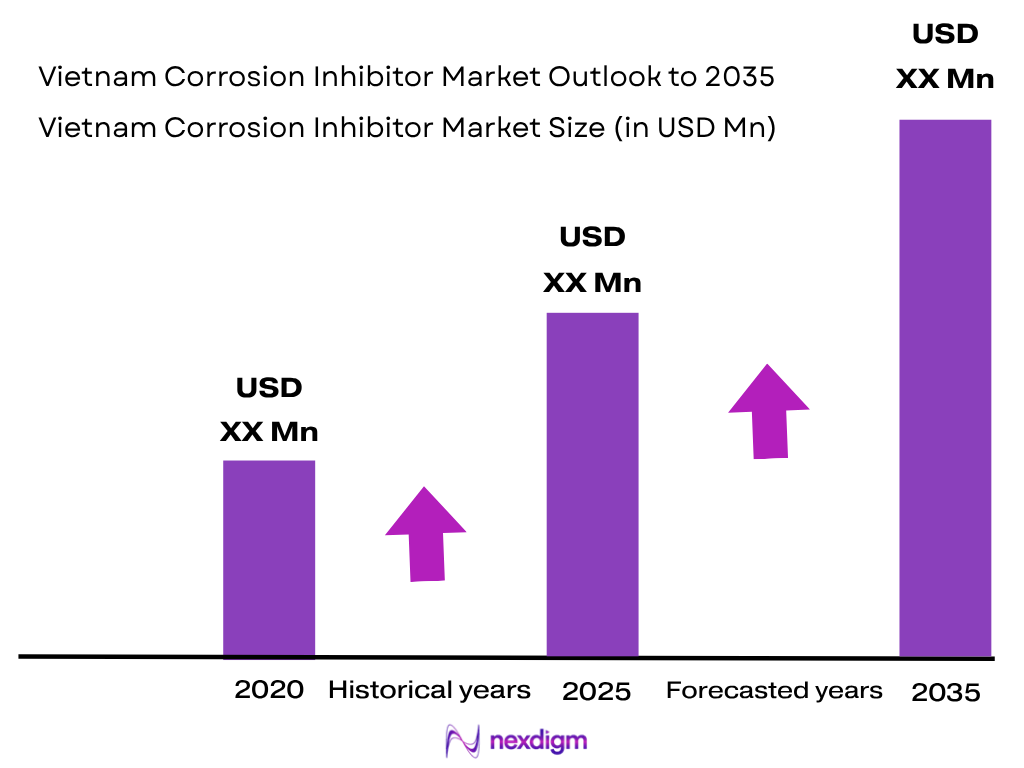
The Vietnam Corrosion Inhibitor Market is valued at approximately USD ~XX million, based on historical demand assessment across oil and gas, refining, industrial water treatment, power generation and metal processing. Petrovietnam’s latest oil-and-gas production reached 16.19 million tonnes of oil equivalent, while the preceding operating period recorded 10.41 million tonnes of crude oil production and 7.47 billion cubic metres of gas, sustaining corrosion-control requirements across tubing, pipelines, processing equipment and water systems.
Ba Ria-Vung Tau, Quang Ngai, Thanh Hoa, Ho Chi Minh City and the southern manufacturing corridor dominate Vietnamese corrosion-inhibitor demand because they concentrate offshore petroleum support, refineries, petrochemicals, steel processing and industrial plants. Dung Quat Refinery processed 6.6 million tonnes of crude oil in the latest operating period, while national registered foreign investment increased from USD 36.6 billion to USD 38.23 billion, expanding the industrial asset base requiring cooling-water, process and metal-corrosion protection.
Market Segmentation
By Chemistry Type
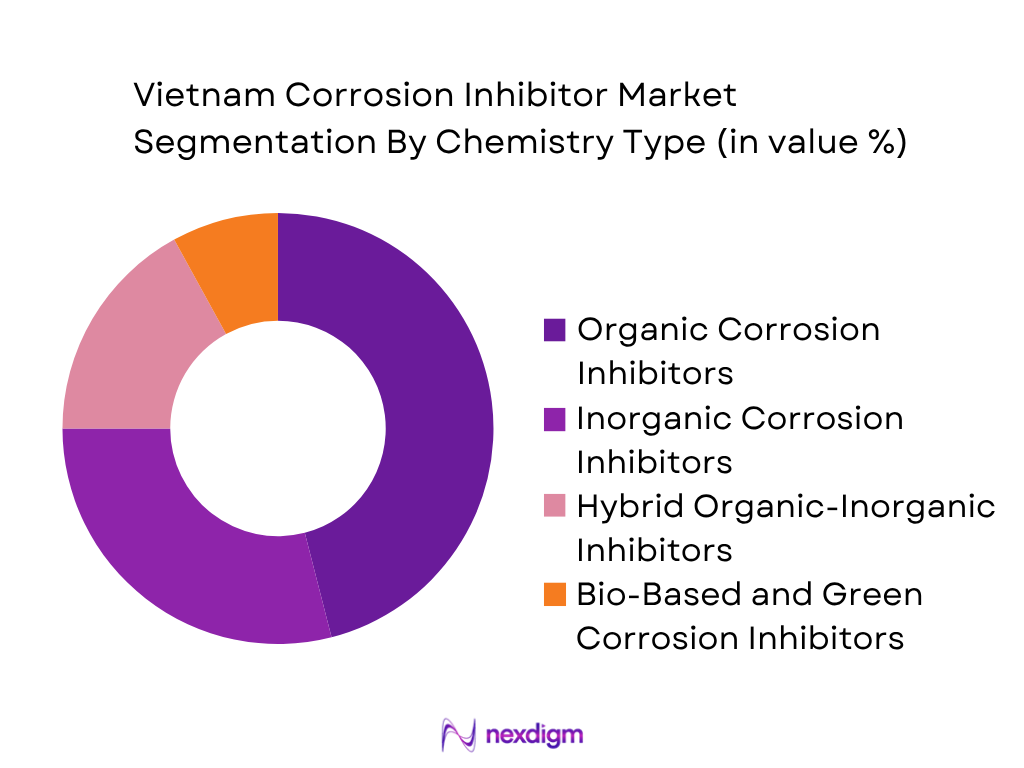
The Vietnam Corrosion Inhibitor Market is segmented into organic corrosion inhibitors, inorganic corrosion inhibitors, hybrid organic-inorganic inhibitors and bio-based or green inhibitors. Organic corrosion inhibitors hold the dominant position because Vietnam’s offshore petroleum, refining, petrochemical and industrial-water applications require film-forming chemistries capable of protecting carbon-steel equipment exposed to hydrocarbons, produced water, carbon dioxide, chlorides and chemically aggressive process streams. Imidazolines, amines, quaternary compounds, carboxylates and azoles are particularly relevant where continuous chemical injection or adsorption-based protective films are required. The importance of organic systems is reinforced by Vietnam’s sizeable petroleum-production and processing infrastructure, where corrosion management must operate without interrupting production. Inorganic systems remain important in cooling towers, closed water circuits and concrete applications, while hybrid programs combine several mechanisms for complex water chemistry. Green inhibitor formulations are emerging, but qualification, chemical stability and large industrial reference bases remain important barriers to rapid substitution in critical hydrocarbon and process applications.
By End-Use Industry
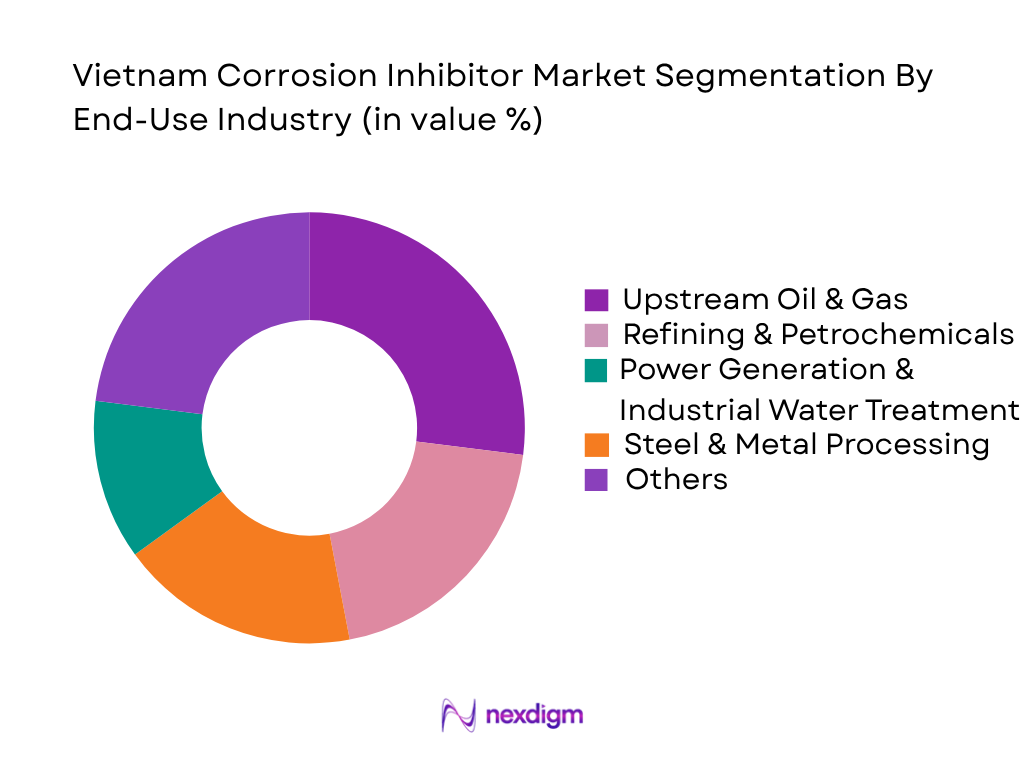
The Vietnam Corrosion Inhibitor Market is segmented into upstream oil and gas, refining and petrochemicals, power generation and industrial water treatment, steel and metal processing, marine and shipbuilding, construction infrastructure and other manufacturing industries. Oil and gas, refining and petrochemical applications represent the leading value segment because corrosion inhibitors are continuously or periodically required in production tubing, flowlines, gathering systems, process equipment, storage, refinery overhead systems and cooling circuits. Vietnam’s offshore production environment exposes carbon-steel assets to produced water, carbon dioxide, chlorides and other corrosive species, making chemical inhibition a recurring operating requirement rather than a one-time treatment. Refinery operations further create demand for neutralizing, film-forming and water-system corrosion programs. Power and industrial water treatment form another major segment because cooling towers, boilers and closed loops require protection against oxygen-driven corrosion and mixed-metal attack, while Vietnam’s expanding manufacturing base increases the number of treated industrial water systems.
Competitive Landscape
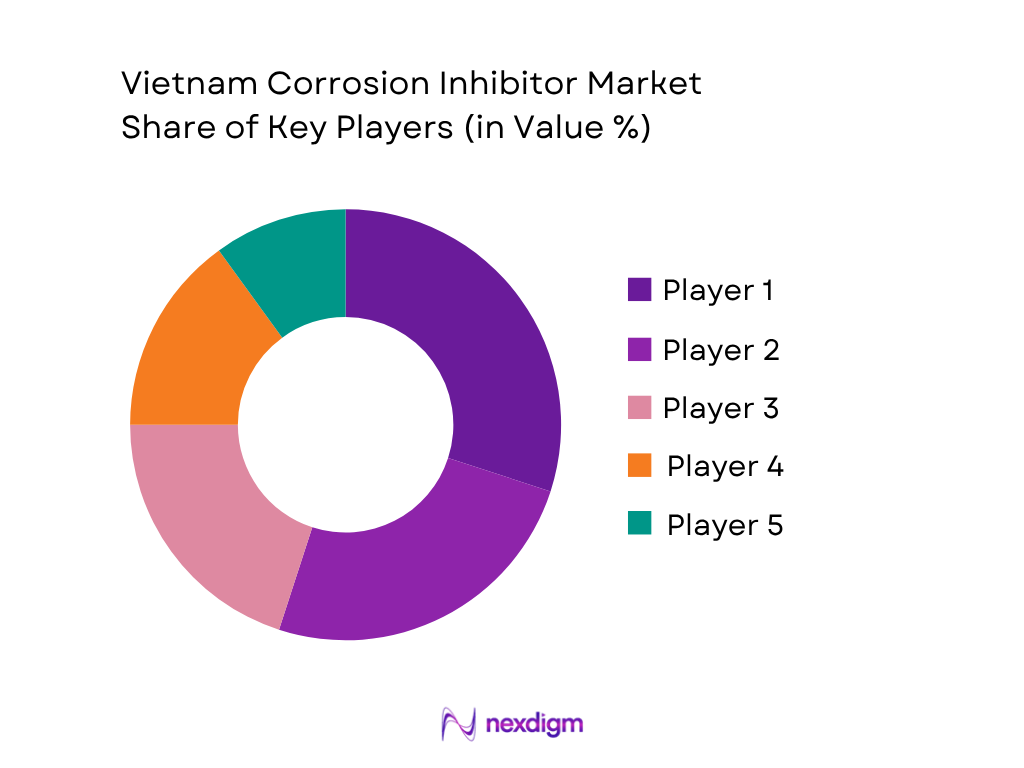
The Vietnam Corrosion Inhibitor Market has a fragmented competitive structure spanning multinational water-treatment companies, oilfield production-chemical suppliers, specialty chemical manufacturers, construction-chemical companies and domestic formulators. Competition differs materially by application: oilfield suppliers compete on field qualification and production-chemistry expertise, industrial-water companies compete on dosing and monitoring programs, while concrete and metal-protection companies emphasize chloride resistance, surface treatment and long-duration protection. Local inventory, technical troubleshooting and formulation flexibility are important differentiators because corrosion conditions vary by fluid chemistry and industrial asset.
| Major Player | Establishment Year | Headquarters | Core Corrosion Chemistry | Key Vietnam Applications | Oil & Gas Capability | Water Treatment Capability | Metal/Concrete Protection | Technical Service Position |
| Kurita Water Industries | 1949 | Tokyo, Japan | ~ | ~ | ~ | ~ | ~ | ~ |
| Nalco Water / Ecolab | 1923 | St. Paul, USA | ~ | ~ | ~ | ~ | ~ | ~ |
| Baker Hughes | 1987* | Houston, USA | ~ | ~ | ~ | ~ | ~ | ~ |
| Henkel | 1876 | Düsseldorf, Germany | ~ | ~ | ~ | ~ | ~ | ~ |
| Sika | 1910 | Baar, Switzerland | ~ | ~ | ~ | ~ | ~ | ~ |
Vietnam Corrosion Inhibitor Market Analysis
Growth Drivers
Expanding Oil, Gas, Refining and Petrochemical Asset Base
Vietnam’s hydrocarbon infrastructure is a major demand driver for oil-soluble and water-dispersible corrosion inhibitors used in production tubing, flowlines, pipelines, separators, refinery overhead systems, heat exchangers and cooling circuits. Petrovietnam reported 16.19 million tonnes of oil-equivalent production in 2024, alongside 15.2 million tonnes of oil-equivalent reserve additions and 3 new oil and gas discoveries, sustaining requirements for corrosion management across offshore and processing assets. Dung Quat Refinery produced more than 6.6 million tonnes of products in 2024 despite completing a 50-day major turnaround, demonstrating the scale and operating intensity of refinery equipment exposed to corrosive hydrocarbons, water, salts and process contaminants. Continuous operation increases demand for film-forming amines, imidazoline formulations, neutralizing chemistry and corrosion-monitoring programs that reduce equipment deterioration and unplanned shutdown risks. Vietnam’s wider economic base also supports industrial maintenance expenditure: World Bank data place national 2024 GDP at USD 476.39 billion, GDP per capita at USD 4,717.3, and population at 100,987,686. These operating and macroeconomic indicators establish a substantial recurring requirement for corrosion-control chemicals rather than purely project-based consumption.
Expansion of Manufacturing, Power and Industrial Water Systems
Vietnam’s rapidly expanding industrial equipment base is increasing corrosion-inhibitor consumption across cooling towers, boilers, closed-loop water systems, process piping, heat exchangers, fabricated metal equipment and production utilities. The National Statistics Office reported that industrial production expanded strongly in 2024, with processing and manufacturing remaining the principal industrial growth engine, while Vietnam Electricity estimated total national power production and imports at 309.16 billion kWh. Foreign investment provides another indication of new corrosion-sensitive industrial assets entering operation: the Ministry of Planning and Investment recorded USD 38.23 billion in registered foreign investment, including USD 25.58 billion directed into processing and manufacturing and USD 25.35 billion in realized foreign investment. These projects introduce additional water-treatment loops, boilers, metalworking equipment, chemical processing lines and utility systems requiring phosphonates, molybdates, nitrites, azoles and blended corrosion-and-scale-control formulations. World Bank data record Vietnam’s 2024 GDP at USD 476.39 billion, GDP per capita of USD 4,717.3, and population of 100,987,686, reinforcing the scale of industrialization supporting chemical-treatment demand. The expanding installed base consequently generates both initial-treatment requirements and recurring inhibitor replenishment opportunities.
Market Challenges
Dependence on Imported Chemicals and Specialty Corrosion-Control Inputs
Vietnam’s corrosion-inhibitor industry faces a material supply-chain challenge because advanced formulations rely on specialty amines, imidazolines, phosphonates, azoles, polymers and functional chemical intermediates that are frequently sourced through international supply chains. Vietnam Customs recorded USD 7.58 billion of chemical imports during the first eleven months of 2024, together with USD 7.03 billion of chemical-product imports. The broader National Statistics Office reported USD 380.76 billion of merchandise imports in 2024, while production-oriented imports reached USD 356.43 billion, illustrating the economy’s substantial dependence on imported industrial inputs. For corrosion-inhibitor formulators, this dependency can complicate formulation consistency, active-ingredient availability, supplier qualification and inventory planning, particularly where oilfield, refinery or high-performance industrial applications require narrowly specified chemistry rather than interchangeable commodity materials. Domestic blending can localize final products, but it does not automatically eliminate upstream reliance on specialized active ingredients. At the macroeconomic level, World Bank data record Vietnam’s 2024 GDP at USD 476.39 billion, GDP per capita at USD 4,717.3, and population at 100,987,686. The challenge therefore lies in building deeper local chemical capability while maintaining internationally qualified performance across critical corrosion environments.
Complex Corrosion Conditions and Increasing Technical Qualification Requirements
Vietnamese corrosion-inhibitor suppliers must address widely different operating environments, ranging from offshore hydrocarbon production and refinery process streams to high-temperature boilers, cooling water, steel processing and chloride-exposed concrete infrastructure. Petrovietnam’s 16.19 million tonnes of oil-equivalent production in 2024 reflects a large upstream system where carbon steel can encounter produced water, carbon dioxide, dissolved salts and changing fluid composition. Dung Quat Refinery simultaneously produced more than 6.6 million tonnes of products and executed a 50-day turnaround, highlighting the technical importance of maintaining refinery piping, exchangers and process units under demanding operating conditions. Electricity production and imports reached an estimated 309.16 billion kWh, adding substantial boiler, cooling-water and auxiliary-system exposure across the power sector. A single corrosion-inhibitor chemistry cannot optimally address all these environments; suppliers require application laboratories, compatibility testing, dosage optimization, corrosion coupons, probe monitoring and field engineering to validate treatment performance. World Bank data put Vietnam’s 2024 GDP at USD 476.39 billion, GDP per capita at USD 4,717.3, and population at 100,987,686. Consequently, technical qualification and application engineering remain significant barriers for smaller formulators attempting to compete in critical industrial systems.
Market Opportunities
Localization of Specialty Corrosion Inhibitor Formulation and Industrial Chemical Supply
Vietnam has a strong future opportunity to expand domestic formulation of oilfield inhibitors, cooling-water packages, boiler corrosion treatments, metal-protection fluids and multifunctional corrosion-and-scale inhibitors. Current trade data demonstrate a sizeable industrial chemical supply base that can support localization: Vietnam Customs recorded USD 7.58 billion of chemical imports and USD 7.03 billion of chemical-product imports during the first eleven months of 2024. Meanwhile, registered foreign investment reached USD 38.23 billion, with processing and manufacturing attracting USD 25.58 billion, while realized foreign investment reached USD 25.35 billion. This combination of imported chemical inputs and expanding industrial customers creates room for local blending, application-specific formulation, laboratory testing, smaller batch production and strategically positioned inventory. Local suppliers can particularly target formulations optimized for Vietnam’s offshore production fluids, refinery water chemistry, tropical cooling systems and metal-processing requirements instead of relying solely on standardized imported finished products. World Bank data record 2024 GDP of USD 476.39 billion, GDP per capita of USD 4,717.3, and a population of 100,987,686. These current indicators support future development of domestic specialty-chemical capabilities, technical service laboratories and corrosion-treatment platforms serving Vietnam and neighboring ASEAN industrial markets.
Integrated Corrosion Monitoring and Treatment Services for Industrial Assets
Vietnam’s growing industrial installed base creates an opportunity to move beyond standalone inhibitor sales toward integrated corrosion monitoring, automated dosing, chemical optimization and asset-integrity services. Petrovietnam reported 16.19 million tonnes of oil-equivalent production, 15.2 million tonnes of reserve additions and 3 new discoveries in 2024, creating operating environments where inhibitor performance can be continuously evaluated through coupons, probes, fluid analysis and injection-system monitoring. Dung Quat Refinery produced more than 6.6 million tonnes of products while successfully completing a 50-day turnaround, demonstrating a large base of critical equipment where corrosion control can be incorporated into maintenance planning. Vietnam Electricity reported estimated system power production and imports of 309.16 billion kWh, expanding the addressable base for boiler-water, cooling-water and closed-loop corrosion-control services. Manufacturing investment provides an additional pathway, with USD 25.58 billion of registered foreign investment flowing into processing and manufacturing. World Bank data place Vietnam’s 2024 GDP at USD 476.39 billion, GDP per capita at USD 4,717.3, and population at 100,987,686. These existing assets support future demand for service-led contracts combining corrosion chemistry, dosing hardware, monitoring, failure analysis and preventive maintenance rather than commodity chemical supply alone.
Future Outlook
The Vietnam Corrosion Inhibitor Market is expected to expand at approximately ~XX% CAGR during 2026-2035, driven by increasingly complex industrial assets and greater emphasis on equipment reliability. Offshore field development, refinery operations, manufacturing investment, power and industrial-water systems, coastal infrastructure and export-oriented metal production will sustain demand. The market is also expected to shift toward multifunctional, lower-toxicity formulations supported by corrosion monitoring, automated dosing and application-specific technical services.
Oilfield corrosion management will remain strategically important because Vietnam continues to operate a substantial offshore production system. Petrovietnam reported production of 16.19 million tonnes of oil equivalent and reserve additions of 15.2 million tonnes of oil equivalent, alongside three new discoveries. Mature fields require increasingly disciplined asset-integrity programs as water cut, fluid chemistry and operating conditions evolve, creating opportunities for imidazoline-based and amine-based inhibitors, batch treatments, continuous-injection systems and corrosion-monitoring services.
Major Players
- Kurita-GK Vietnam
- Nalco Water / Ecolab Vietnam
- LANXESS
- Baker Hughes
- Italmatch Chemicals
- Henkel
- Cortec Corporation
- Sika Vietnam
- Fosroc Vietnam / Saint-Gobain
- Master Builders Solutions
- CRC Industries / CRC Vietnam
- HexaChem
- Thuan Phong Co., Ltd.
- SLB
- Vietnam-Russia Tropical Centre / MCI-VN Technology
Key Target Audience
- Corrosion Inhibitor and Specialty Chemical Manufacturers
- Oil & Gas, Refinery and Petrochemical Operators
- Industrial Water Treatment and Power Generation Companies
- Steel, Metal Processing, Marine and Shipbuilding Companies
- EPC Contractors, Plant Maintenance and Asset-Integrity Service Providers
- Investments and Venture Capitalist Firms
- Government and Regulatory Bodies (Ministry of Industry and Trade, Ministry of Agriculture and Environment, Vietnam Chemicals Agency, Directorate for Standards Metrology and Quality)
- Private Equity Firms, Strategic Chemical Investors and Industrial Conglomerates
Research Methodology
Step 1: Identification of Key Variables
The initial phase constructs a Vietnam-specific corrosion-control ecosystem covering chemical formulators, importers, oilfield service companies, industrial water-treatment providers, distributors, EPC contractors and end-users. Critical variables include offshore hydrocarbon production, refinery throughput, industrial cooling-water systems, boilers, steel processing, marine exposure and reinforced-concrete assets. These variables define the demand drivers used in subsequent top-down and bottom-up market assessment.
Step 2: Market Analysis and Construction
Historical demand is developed through parallel top-down and bottom-up models. The top-down assessment uses petroleum production, refinery operations, industrial investment, power and manufacturing activity, while the bottom-up model assesses supplier revenues, inhibitor consumption, typical dosage requirements, treated-system populations and application-specific replacement or replenishment patterns. Results are reconciled across chemistry, end-use industry and application medium.
Step 3: Hypothesis Validation and Expert Consultation
Market hypotheses are validated through computer-assisted telephone interviews with corrosion engineers, production-chemistry specialists, water-treatment companies, chemical distributors, refinery personnel, plant-maintenance executives and infrastructure contractors. Interviews validate inhibitor selection criteria, treatment frequency, dosage practices, imported versus locally formulated supply, technical qualification requirements and demand for monitoring. Findings are used to refine segment allocations and eliminate inconsistencies in secondary data.
Step 4: Research Synthesis and Final Output
Primary findings are triangulated against Petrovietnam operating statistics, government investment data, refinery disclosures, trade flows and company information. Bottom-up chemical-consumption calculations are checked against end-use asset populations to prevent double counting between oilfield, refinery, cooling-water and process applications. The resulting dataset is then used to produce market sizing, segmentation, competitive positioning and the long-term Vietnam Corrosion Inhibitor Market forecast.

- Executive Summary
- Research Methodology (Market Definition and Scope, Vietnam Corrosion Inhibitor Market Classification, Corrosion Inhibitor Demand Assessment, Active Chemical Consumption Mapping, Oilfield Corrosion Inhibitor Demand Assessment, Cooling Water and Boiler Treatment Demand Assessment, Domestic Formulation and Blending Capacity Assessment, Import Dependency Analysis, Organic and Inorganic Active Chemical Assessment, Corrosion Inhibitor Formulation and Dosing Technology Mapping, Installed Process Equipment Base Assessment)

- Definition and Scope
- Vietnam Corrosion Inhibitor Industry Evolution and Development of Oilfield Production Chemicals, Industrial Water Treatment Inhibitors, Metal Protection Chemicals and Reinforced Concrete Corrosion Control Ecosystem
- Organic Corrosion Inhibitor, Inorganic Corrosion Inhibitor, Film-Forming Inhibitor, Volatile Corrosion Inhibitor, Migrating Corrosion Inhibitor and Corrosion-and-Scale Control Industry Structure
- Vietnam Corrosion Inhibitor Value Chain Analysis
- Vietnam Corrosion Inhibitor Supply Chain Analysis
- Organic Chemical Supplier, Inorganic Chemical Supplier, Specialty Additive Manufacturer, Corrosion Inhibitor Formulator, Importer, Industrial Distributor, Water Treatment Contractor, Oilfield Chemical Service Provider, EPC Contractor and Industrial End-User Ecosystem Analysis
- Corrosion Inhibitor Integration Across Offshore Oil and Gas, Refining, Petrochemicals, Chemicals, Power Generation, Industrial Water Treatment, Steel and Metal Processing, Marine, Reinforced Concrete Infrastructure and General Manufacturing Applications

- Growth Drivers (Offshore Oil and Gas Corrosion Control Requirements, Refinery and Petrochemical Equipment Protection, Expansion of Industrial Cooling Water Treatment, Boiler and Steam-System Asset Protection, Growing Steel and Metal Processing Activity, Coastal and Marine Corrosion Exposure, Industrial Plant Reliability Requirements, Reinforced Concrete Infrastructure Durability Requirements, Increasing Preventive Maintenance Adoption)
- Market Challenges (Dependence on Imported Specialty Organic Inhibitors, Raw Material and Active Chemical Import Dependency, Oilfield Chemical Qualification Requirements, Variable Produced-Water Chemistry, High-Chloride Marine Exposure, Corrosion Monitoring Capability Constraints, Chemical Dosage Optimization Requirements, Environmental Restrictions on Conventional Inhibitor Chemistries, Fragmented Industrial Chemical Distribution, Technical Service and Application Expertise Requirements)
- Market Opportunities (Locally Formulated Oilfield Corrosion Inhibitors, Cooling Tower Corrosion-and-Scale Inhibitor Packages, Refinery Process Corrosion Control Programs, Green and Bio-Based Corrosion Inhibitors, Migrating Corrosion Inhibitors for Coastal Concrete, Volatile Corrosion Inhibitor Solutions for Metal Exports)
- Market Trends (Imidazoline-Based Film-Forming Inhibitors, Phosphonate-Zinc Cooling Water Programs, Low-Phosphorus Water Treatment Chemistry, Mixed Organic-Inorganic Inhibitors, Volatile Corrosion Inhibitors, Migrating Concrete Corrosion Inhibitors, Bio-Based Corrosion Inhibitors, Multi-Functional Corrosion-and-Scale Control)
- Regulatory and Standards Landscape (Vietnam Law on Chemicals, National Technical Regulations for Chemical Safety, Environmental Protection Requirements, Industrial Wastewater Requirements, Petroleum Facility Safety Requirements, Offshore Chemical Qualification Requirements, Hazardous Chemical Storage and Transportation Requirements)
- SWOT Analysis
- Porter’s Five Forces Analysis
- PESTLE Analysis
- Stakeholder Ecosystem
- Competition Ecosystem

- By Market Value (2020-2025)
- By Corrosion Inhibitor Consumption Volume (2020-2025)
- By Oil and Gas Corrosion Inhibitor Consumption Volume (2020-2025)
- By Cooling Water Corrosion Inhibitor Consumption Volume (2020-2025)
- By Boiler and Process Water Corrosion Inhibitor Consumption Volume (2020-2025)
- By Domestic Corrosion Inhibitor Formulation Value (2020-2025)
- By Domestic Corrosion Inhibitor Formulation Volume (2020-2025)
- By Corrosion Inhibitor Import Value (2020-2025)
- By Average Selling Price (2020-2025)

- By Chemistry Type (In Value %)
Organic Corrosion Inhibitors
Imidazoline-Based Corrosion Inhibitors
Amine-Based Corrosion Inhibitors
Quaternary Ammonium Compound-Based Inhibitors
Carboxylate-Based Corrosion Inhibitors
Azole-Based Corrosion Inhibitors
Phosphonate-Based Corrosion Inhibitors
Nitrite-Based Corrosion Inhibitors
Molybdate-Based Corrosion Inhibitors
Silicate-Based Corrosion Inhibitors
Zinc-Based Corrosion Inhibitors
Phosphate-Based Corrosion Inhibitors
Hybrid Organic-Inorganic Corrosion Inhibitors
Bio-Based and Green Corrosion Inhibitors - By Inhibitor Mechanism (In Value %)
Anodic Corrosion Inhibitors
Cathodic Corrosion Inhibitors
Mixed Corrosion Inhibitors
Film-Forming Corrosion Inhibitors
Adsorption-Type Corrosion Inhibitors
Passivating Corrosion Inhibitors
Volatile Corrosion Inhibitors
Migrating Corrosion Inhibitors
Oxygen Scavenger-Assisted Corrosion Control Systems - By Application Medium (In Value %)
Oilfield Produced Water
Crude Oil and Hydrocarbon Systems
Natural Gas and Condensate Systems
Cooling Water Systems
Boiler Feedwater and Steam Systems
Closed-Loop Water Systems
Acid Cleaning and Pickling Solutions
Metalworking Fluids
Lubricants and Functional Fluids
Marine and Seawater Systems
Reinforced Concrete Systems
Temporary Metal Preservation Systems - By End-Use Industry (In Value %)
Upstream Oil and Gas
Midstream Pipelines and Storage
Petroleum Refining
Petrochemicals and Chemicals
Power Generation
Industrial Water Treatment
Fertilizer Manufacturing
Steel and Metal Processing
Metalworking and Machinery Manufacturing
Marine and Shipbuilding
Automotive and Components
Electronics Manufacturing
Reinforced Concrete Infrastructure
Pulp and Paper
General Manufacturing - By Asset and Equipment Application (In Value %)
Oil and Gas Production Tubing
Flowlines and Gathering Systems
Crude Oil and Gas Pipelines
Storage Tanks
Refinery Process Units
Heat Exchangers
Cooling Towers
Boilers and Steam Systems
Process Piping
Pressure Vessels and Reactors
Pumps and Compressors
Metal Components and Machinery
Reinforcing Steel in Concrete
Marine Equipment and Structures

- Market Share of Major Players (By Vietnam Revenue, Corrosion Inhibitor Sales Volume, Product Chemistry, Oil and Gas Exposure, Industrial Water Treatment Exposure, Refinery and Petrochemical Exposure, Vietnam Formulation and Distribution Footprint, Technical Service and Corrosion Monitoring Coverage)
- Cross Comparison Parameters (Vietnam Corrosion Inhibitor Revenue, Organic-Inorganic-VCI-MCI Chemistry Portfolio Breadth, Oil and Gas-Refinery-Water Treatment Application Coverage, CO2-H2S-Chloride Corrosion Control Capability, Vietnam Formulation-Blending and Local Inventory Capability, Cooling Water-Boiler-Metal Protection Product Coverage, Vietnam Distribution-Dosing-Monitoring and Field-Service Footprint, End-User Qualification-Laboratory Testing and Application Engineering Capability)
- SWOT Analysis of Major Players
- Competitive Positioning Matrix
- Corrosion Inhibitor Chemistry and Product Portfolio Benchmarking
- Pricing and Corrosion Inhibitor Product Category Benchmarking
- Formulation, Blending, Chemical Dosing and Corrosion Monitoring Technology Assessment
- End-Use Industry and Critical Corrosion Application Exposure Assessment
- Domestic Formulation Versus Imported Corrosion Inhibitor Supply Positioning
- Detailed Profiles of Major Companies
Kurita-GK Vietnam
Nalco Water / Ecolab Vietnam
LANXESS
Baker Hughes
Italmatch Chemicals
Henkel
Cortec Corporation
Sika Vietnam
Fosroc Vietnam / Saint-Gobain
Master Builders Solutions
CRC Industries / CRC Vietnam
HexaChem
Thuan Phong Co., Ltd.
SLB
Vietnam-Russia Tropical Centre / MCI-VN Technology

- Oil and Gas Operator Corrosion Inhibitor Procurement Assessment
- Refinery Corrosion Control Chemical Requirement Analysis
- Petrochemical and Chemical Plant Corrosion Inhibitor Requirement Assessment
- Pipeline and Storage Asset Corrosion Control Procurement Analysis
- Power Generation Cooling Water and Boiler Corrosion Inhibitor Assessment
- Industrial Water Treatment Corrosion-and-Scale Inhibitor Requirement Analysis
- Steel and Metal Processing Corrosion Protection Assessment
- Marine and Shipbuilding Corrosion Protection Requirement Analysis
- Reinforced Concrete Infrastructure Corrosion Inhibitor Assessment
- Industrial Manufacturing Metal Protection Chemical Requirement Assessment

- By Market Value (2026-2035)
- By Corrosion Inhibitor Consumption Volume (2026-2035)
- By Oil and Gas Corrosion Inhibitor Consumption Volume (2026-2035)
- By Cooling Water Corrosion Inhibitor Consumption Volume (2026-2035)
- By Boiler and Process Water Corrosion Inhibitor Consumption Volume (2026-2035)
- By Domestic Corrosion Inhibitor Formulation Value (2026-2035)
- By Domestic Corrosion Inhibitor Formulation Volume (2026-2035)
- By Corrosion Inhibitor Import Value (2026-2035)
- By Average Selling Price (2026-2035)


 Request a Sample
 Ask for Customization
 Get a Quote
 Enquire Now