

 Download PDF
Market Overview
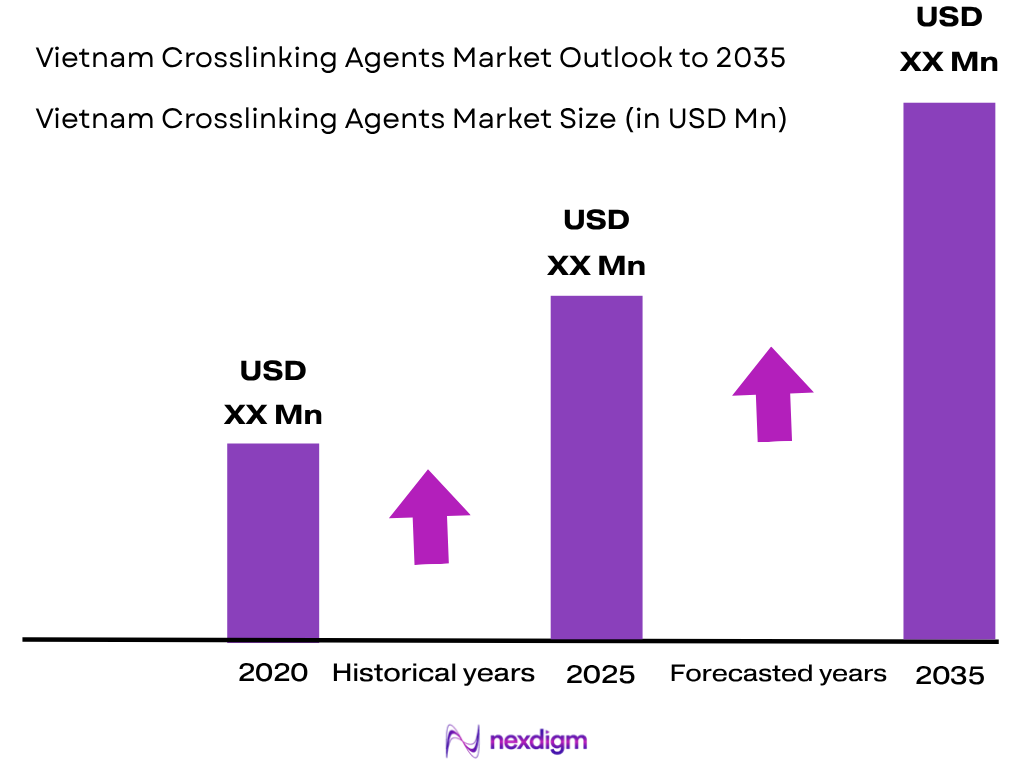
The Vietnam Crosslinking Agents Market is valued at ~USD XX billion, based on industry analysis, and is projected to expand at a forecasted CAGR of ~XX% during 2026-2035. The market is supported by increasing demand from coatings, adhesives, sealants, elastomers, and polymer modification applications. Growth is closely linked with Vietnam’s expanding manufacturing ecosystem, automotive production, electronics manufacturing, construction activities, and foreign direct investment-driven industrial expansion. Crosslinking agents are increasingly used to improve chemical resistance, durability, thermal stability, adhesion, and mechanical performance of polymer systems used across industrial applications. Vietnam’s specialty chemical ecosystem continues expanding due to manufacturing growth and increased demand for high-performance materials. (Ken Research)
The Vietnam Crosslinking Agents Market is concentrated around industrial regions including Ho Chi Minh City, Binh Duong, Dong Nai, Hanoi, and Hai Phong due to their strong manufacturing base, industrial parks, export-oriented production facilities, and chemical processing activities. Southern Vietnam, particularly the Ho Chi Minh City industrial cluster, dominates specialty chemical demand because of its concentration of manufacturing facilities, coatings producers, and export-processing zones. Northern Vietnam is gaining importance due to electronics manufacturing and foreign-invested industrial projects requiring advanced polymer and coating technologies
Market Segmentation
By Chemistry Type
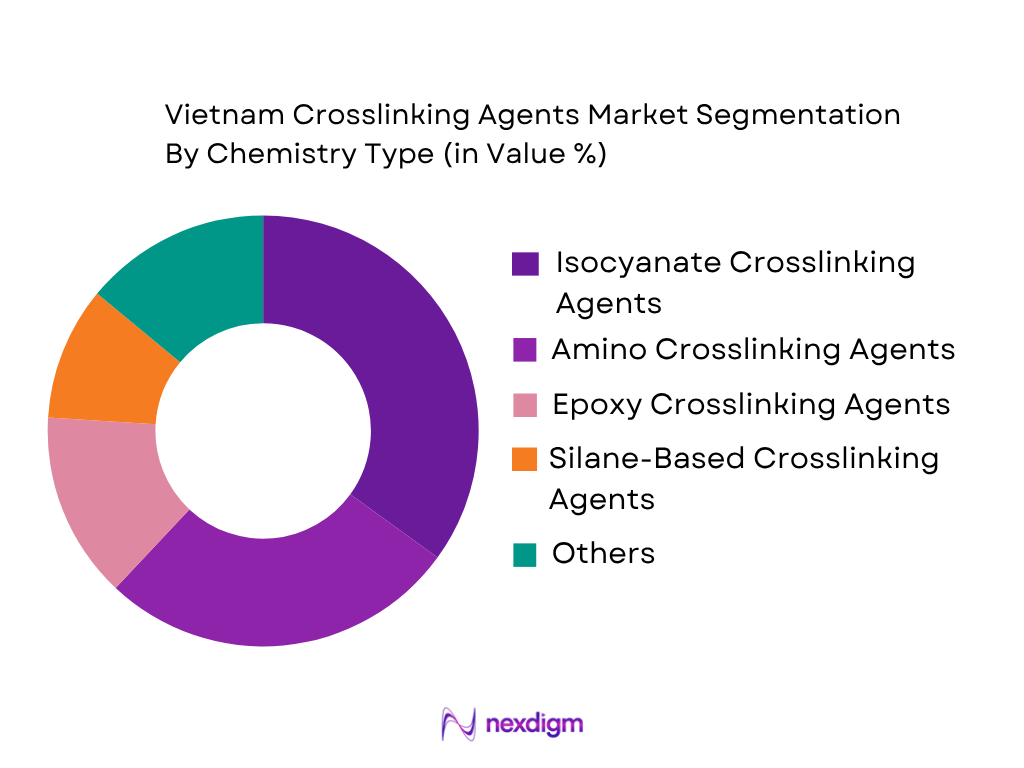
The Vietnam Crosslinking Agents Market is segmented by chemistry type into amino crosslinking agents, isocyanate crosslinking agents, epoxy crosslinking agents, silane-based crosslinking agents, carbodiimide crosslinkers, peroxide crosslinkers, and specialty crosslinking systems. Isocyanate crosslinking agents represent the leading segment due to their extensive use in polyurethane coatings, automotive finishes, industrial protective coatings, adhesives, and sealants. These crosslinkers provide superior adhesion, chemical resistance, flexibility, and durability, making them suitable for industrial applications. Increasing demand for high-performance coatings in automotive, manufacturing, and construction industries continues supporting adoption of polyurethane-based crosslinking systems. Amino crosslinkers also maintain significant demand due to their compatibility with acrylic and polyester resin systems used in decorative and industrial coatings.
By Application
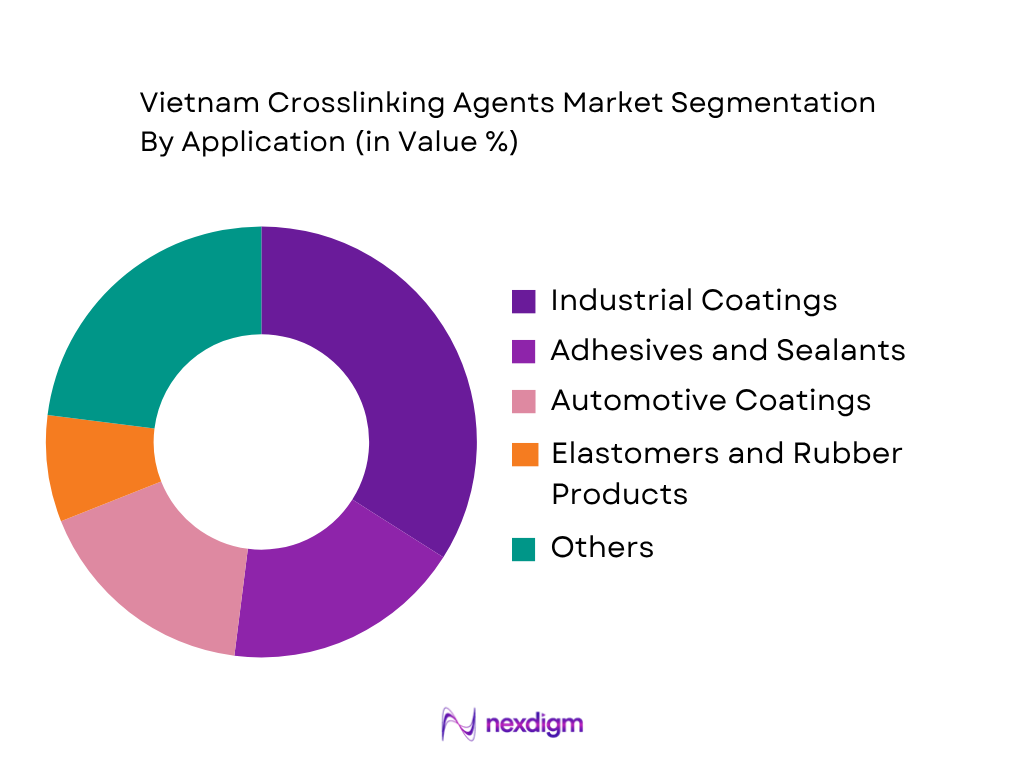
The Vietnam Crosslinking Agents Market is segmented by application into industrial coatings, automotive coatings, construction coatings, adhesives and sealants, elastomer products, plastics and polymer compounds, composites, and specialty applications. Industrial coatings represent the dominant application segment due to Vietnam’s rapid industrialization, manufacturing expansion, and increasing requirement for corrosion-resistant and durable surface protection systems. Crosslinking agents are essential in protective coatings used for factories, machinery, infrastructure, and industrial equipment. Automotive coatings are also gaining importance due to Vietnam’s expanding vehicle manufacturing ecosystem and demand for high-quality finishes. Adhesives and sealants represent another growing application area due to increasing usage in construction, electronics, automotive assembly, and industrial bonding systems.
Competitive Landscape
The Vietnam Crosslinking Agents Market includes global specialty chemical manufacturers and regional suppliers serving coatings, adhesives, polymer, and industrial customers. Competition is influenced by chemistry portfolio strength, technical formulation capabilities, local distribution networks, regulatory compliance, and ability to support multinational manufacturing customers. Companies supplying advanced coating and polymer solutions benefit from Vietnam’s growing industrial manufacturing base, particularly in automotive, electronics, construction, and export-oriented production sectors.
| Company | Establishment Year | Headquarters | Major Crosslinking Technologies | Primary Applications | Manufacturing Capability | Sustainability Focus | Distribution Network | Key Strength |
| BASF Vietnam | 1865 | Germany | ~ | ~ | ~ | ~ | ~ | ~ |
| Covestro Vietnam | 2015 | Germany | ~ | ~ | ~ | ~ | ~ | ~ |
| Evonik Vietnam | 2007 | Germany | ~ | ~ | ~ | ~ | ~ | ~ |
| Huntsman Vietnam | 1970 | USA | ~ | ~ | ~ | ~ | ~ | ~ |
| Allnex Vietnam | 2013 | Netherlands | ~ | ~ | ~ | ~ | ~ | ~ |

Vietnam Crosslinking Agents Market Analysis
Growth Drivers
Expansion of Automotive Manufacturing and Growth of Industrial Coatings Applications
The expansion of Vietnam’s automotive manufacturing ecosystem and industrial production base is increasing demand for crosslinking agents used in automotive coatings, protective coatings, adhesives, and polymer modification systems. Vietnam produced approximately 3.2 million motor vehicles in 2024, according to the Vietnam Automobile Manufacturers’ Association (VAMA), supporting demand for advanced coating technologies that improve corrosion resistance, durability, surface hardness, and chemical performance. Crosslinking agents including polyurethane, amino, and epoxy systems are widely used in automotive coating formulations and industrial protective applications. Vietnam’s manufacturing sector attracted approximately USD 25.35 billion in registered foreign direct investment in 2024, according to the Ministry of Planning and Investment, strengthening demand for industrial materials used in factories, machinery, electronics, and automotive production facilities. Industrial parks across Ho Chi Minh City, Binh Duong, Dong Nai, and Hai Phong are expanding manufacturing capacity, creating opportunities for specialty chemical suppliers. Increasing requirements for high-performance coatings in automotive, machinery, and export-oriented manufacturing applications are supporting adoption of crosslinking technologies that enhance coating lifespan and polymer performance.
Increasing Foreign Direct Investment in Manufacturing and Development of Industrial Parks
Vietnam’s strong foreign investment inflows into manufacturing and industrial infrastructure are creating long-term demand opportunities for crosslinking agents used in coatings, adhesives, sealants, and polymer applications. The country recorded approximately USD 38.23 billion in total registered foreign direct investment in 2024, according to the Ministry of Planning and Investment, with manufacturing and processing industries receiving the largest portion of investment activity. These investments are driving expansion of industrial facilities requiring protective coatings, flooring systems, equipment coatings, and polymer-based construction materials. Vietnam had more than 400 industrial parks in operation and development stages by 2024, according to government industrial development data, creating continuous demand for chemical products used in manufacturing environments. Crosslinking agents support these applications by improving resistance to chemicals, moisture, temperature variation, and mechanical stress. Growth of electronics, machinery, automotive components, and consumer goods manufacturing facilities is increasing consumption of advanced coating and adhesive systems. The expansion of industrial zones and foreign-invested manufacturing facilities is strengthening demand for specialty chemical solutions across Vietnam’s industrial ecosystem.
Market Challenges
Dependence on Imported Specialty Chemicals and Volatility in Chemical Raw Material Supply
The Vietnam Crosslinking Agents Market faces supply chain challenges due to significant dependence on imported specialty chemical intermediates and advanced polymer materials. Vietnam’s chemical industry continues importing various high-value chemical inputs required for specialty formulations, including isocyanates, epoxy intermediates, and advanced additives used in crosslinking systems. According to Vietnam General Department of Customs trade data, chemical product imports remained a major component of industrial material imports during 2024 due to limited domestic production of certain specialty chemicals. Global fluctuations in petrochemical feedstocks also affect raw material availability because many crosslinking agents rely on petroleum-derived intermediates. The International Energy Agency reported continued uncertainty in global energy markets during 2024, influencing petrochemical supply conditions. These supply chain factors create challenges for manufacturers in maintaining consistent raw material availability, controlling production planning, and meeting customer requirements. Companies operating in coatings, adhesives, automotive materials, and polymer processing industries increasingly require reliable supply networks, encouraging manufacturers to improve sourcing strategies and develop localized chemical production capabilities.
Environmental Regulations on Chemical Formulations and Limited Domestic Advanced Chemical Production Capability
Vietnam’s crosslinking agents industry faces challenges from increasing environmental compliance requirements and limited domestic manufacturing capabilities for advanced specialty chemical formulations. The government continues strengthening chemical safety and environmental management through regulations implemented by agencies including the Ministry of Natural Resources and Environment and the Ministry of Industry and Trade. Chemical manufacturers must comply with requirements related to hazardous substances, emissions control, workplace safety, and responsible chemical handling. Vietnam’s chemical manufacturing sector remains concentrated in basic chemicals, while advanced specialty chemicals such as high-performance crosslinking agents often require imported technologies and specialized production expertise. According to the General Statistics Office of Vietnam, manufacturing contributed significantly to industrial output in 2024, increasing demand for improved environmental standards across industrial supply chains. Crosslinking agent producers face pressure to develop low-emission formulations, safer chemical systems, and sustainable alternatives while maintaining performance requirements. Limited domestic capability in advanced chemical synthesis increases reliance on multinational suppliers and creates challenges for local companies seeking to expand specialty chemical production.
Market Opportunities
Development of Sustainable Crosslinking Agents and Growth of Low VOC Coating Systems
The increasing adoption of sustainable manufacturing practices and environmentally compliant coatings is creating opportunities for development of low-VOC and sustainable crosslinking agents in Vietnam. Industrial users are increasingly seeking coating technologies that provide durability while reducing environmental impact. Vietnam’s commitment to sustainable industrial development has increased focus on cleaner production methods and environmentally responsible materials. The country generated approximately 67 million tonnes of municipal solid waste in 2024, according to environmental management authorities, increasing attention toward sustainability and resource efficiency across industries. Crosslinking agent manufacturers can benefit from rising demand for water-based coatings, bio-based chemical solutions, and advanced polymer systems with reduced emissions. Industrial coatings, construction materials, and automotive applications require improved performance while meeting environmental requirements. Sustainable crosslinking technologies, including low-formaldehyde amino systems, water-compatible crosslinkers, and bio-derived chemical solutions, provide opportunities for suppliers to serve evolving customer requirements. Increasing adoption of environmentally responsible manufacturing practices across industrial parks and export-oriented facilities supports future demand for advanced crosslinking technologies.
Expansion of Electric Vehicle Manufacturing and Advanced Composite Material Adoption
The growth of electric vehicle manufacturing and advanced composite material applications is creating new opportunities for crosslinking agent suppliers in Vietnam. The country recorded more than 100,000 electric vehicle registrations in 2024, supported by increasing adoption of electric mobility solutions and investments in domestic vehicle manufacturing. Electric vehicles require advanced polymer materials, battery protection coatings, adhesives, and lightweight composite components where crosslinking agents improve mechanical strength, thermal stability, and chemical resistance. Vietnam’s electronics manufacturing sector also continues expanding, with electronics exports exceeding USD 126 billion in 2024, according to Vietnam customs trade data, increasing demand for specialty adhesives, coatings, and polymer materials. Advanced composites are increasingly used in automotive components, electronics housings, industrial equipment, and aerospace-related applications. Crosslinking technologies enable improved performance of composite materials by enhancing bonding strength and durability. Growth of electric mobility, electronics production, and high-performance material applications creates opportunities for specialty chemical manufacturers developing advanced crosslinking solutions for next-generation industrial applications.
Future Outlook
Over the next decade, the Vietnam Crosslinking Agents Market is expected to show steady growth driven by manufacturing expansion, foreign direct investment, automotive production, and increasing demand for advanced coating technologies. Growth will be supported by industrial infrastructure development, electronics manufacturing expansion, and increasing adoption of high-performance polymer systems. Demand for low-VOC, sustainable, and application-specific crosslinking technologies is expected to create new opportunities for specialty chemical manufacturers.
Major Players
- BASF Vietnam
- Covestro Vietnam
- Evonik Vietnam
- Huntsman Vietnam
- Allnex Vietnam
- Eastman Chemical Company
- Arkema Vietnam
- Mitsubishi Chemical Group
- Momentive Performance Materials
- Hexion
- DIC Corporation
- Solvay Vietnam
- LANXESS Vietnam
- Wanhua Chemical Group
- Azelis Vietnam
Key Target Audience
- Crosslinking Agent Manufacturers and Specialty Chemical Producers
- Paint and Coating Manufacturers
- Automotive Coating Manufacturers and Component Suppliers
- Adhesive and Sealant Manufacturers
- Polymer Compounders and Resin Producers
- Investments and Venture Capitalist Firms
- Government and Regulatory Bodies (Vietnam Chemicals Agency, Ministry of Natural Resources and Environment, Ministry of Industry and Trade)
- Industrial Chemical Distributors and Specialty Material Suppliers
Research Methodology
Step 1: Identification of Key Variables
The initial phase involves developing an ecosystem map covering chemical suppliers, crosslinking agent manufacturers, polymer producers, coating formulators, adhesive manufacturers, distributors, and end-use industries. Extensive desk research is conducted using industry databases, regulatory publications, trade information, and company disclosures to identify variables affecting market demand, supply conditions, and technology adoption.
Step 2: Market Analysis and Construction
In this phase, historical market information related to crosslinking chemistry consumption, application penetration, and industrial demand is compiled and analyzed. The assessment includes amino, isocyanate, epoxy, silane, and specialty crosslinking technologies across coatings, adhesives, polymers, elastomers, and composite applications.
Step 3: Hypothesis Validation and Expert Consultation
Market assumptions are validated through discussions with manufacturers, coating formulators, polymer processors, distributors, and industry specialists. These consultations provide insights into product requirements, formulation trends, customer preferences, technology adoption, and competitive developments within Vietnam’s chemical industry.
Step 4: Research Synthesis and Final Output
The final stage includes verification of collected information through industry interactions and cross-validation using bottom-up and top-down approaches. The analysis is structured to provide insights into market size, segmentation, competitive landscape, growth factors, opportunities, and strategic recommendations.

- Executive Summary
- Research Methodology (Market Definitions and Assumptions, Abbreviations, Market Sizing Approach, Top-Down Analysis, Bottom-Up Analysis, Demand-Side Assessment, Supply-Side Assessment, Primary Industry Interviews, Data Triangulation, Forecasting Framework, Crosslinking Chemistry Mapping, Polymer Application Assessment, Resin Compatibility Analysis, End-Use Industry Demand Evaluation, Specialty Chemical Manufacturing Analysis, Import Dependency Assessment, Regulatory Compliance Assessment, Limitations and Future Conclusions)

- Definition and Scope
- Market Evolution and Industry Genesis Timeline
- Crosslinking Agents Industry Value Chain Analysis
- Crosslinking Agents Supply Chain Analysis

- Growth Drivers (Expansion of Automotive Manufacturing, Growth of Industrial Coatings Applications, Increasing Foreign Direct Investment in Manufacturing, Expansion of Construction Activities, Rising Demand for Durable Polymer Materials, Growth of Adhesive and Sealant Applications, Increasing Electronics Manufacturing Activities, Development of Industrial Parks)
- Market Challenges (Dependence on Imported Specialty Chemicals, Volatility in Chemical Raw Material Supply, Environmental Regulations on Chemical Formulations, Limited Domestic Advanced Chemical Production Capability, Health and Safety Requirements for Chemical Handling, Competition from Alternative Polymer Technologies, Complex Formulation Requirements)
- Market Opportunities (Development of Sustainable Crosslinking Agents, Growth of Low VOC Coating Systems, Expansion of Electric Vehicle Manufacturing, Advanced Composite Material Adoption, Electronics Manufacturing Growth, High Performance Adhesive Demand, Aerospace Material Applications, Specialty Chemical Innovation)
- Market Trends (Increasing Adoption of Water-Based Crosslinking Systems, Sustainable Polymer Technologies, Advanced Polyurethane Systems, Low VOC Coating Development, Bio-Based Chemical Solutions, Lightweight Material Adoption, Smart Coating Technologies, High Performance Polymer Engineering)
- Government Regulations and Standards (Vietnam Chemical Law Requirements, Ministry of Natural Resources and Environment Chemical Regulations, Industrial Safety Standards, Environmental Protection Regulations, VOC Emission Guidelines, Chemical Storage and Handling Requirements, Product Quality Standards)
- SWOT Analysis
- Porter’s Five Forces Analysis
- PESTLE Analysis

- By Market Value (2020-2025)
- By Volume Consumption (2020-2025)
- By Crosslinking Agent Consumption Volume (2020-2025)
- By Coatings Application Consumption Volume (2020-2025)
- By Adhesives and Sealants Application Consumption Volume (2020-2025)

- By Chemistry Type (In Value %)
Amino Crosslinking Agents
Melamine Formaldehyde Crosslinkers
Urea Formaldehyde Crosslinkers
Benzoguanamine Crosslinkers
Isocyanate Crosslinking Agents
Blocked Isocyanates
Aliphatic Isocyanates
Aromatic Isocyanates
Epoxy Crosslinking Agents
Silane-Based Crosslinking Agents
Carbodiimide Crosslinking Agents
Peroxide Crosslinking Agents
Other Specialty Crosslinking Agents - By Polymer System Compatibility (In Value %)
Polyurethane Systems
Acrylic Polymer Systems
Epoxy Resin Systems
Polyester Resin Systems
Vinyl Polymer Systems
Silicone Polymer Systems
Rubber and Elastomer Systems
Thermosetting Polymer Systems - By Application (In Value %)
Automotive Coatings
Industrial Protective Coatings
Construction and Architectural Coatings
Adhesives and Sealant
Elastomer and Rubber Products
Plastic Compounding Applications
Composite Manufacturing
Electronics and Electrical Applications
Specialty Polymer Applications - By End-Use Industry (In Value %)
Automotive Manufacturing
Construction and Infrastructure
Paints and Coatings Industry
Adhesive and Sealant Manufacturing
Electronics and Electrical Industry
Packaging Industry
Industrial Equipment Manufacturing
Aerospace and Defense Applications
Medical and Healthcare Applications
Consumer Goods Manufacturing - By Functionality (In Value %)
Chemical Resistance Enhancement
Thermal Stability Improvement
Mechanical Strength Enhancement
Abrasion Resistance Improvement
Weatherability Enhancement
Moisture Resistance Improvement
Crosslink Density Optimization - By Form Type (In Value %)
Liquid Crosslinking Agents
Powder Crosslinking Agents
Solid Crosslinking Agents
Water-Based Crosslinking Systems
Solvent-Based Crosslinking Systems
Reactive Crosslinking Systems

- Market Share of Major Players (By Vietnam Revenue, Crosslinking Agent Sales Volume, Chemistry Type, Polymer Compatibility, Application Segment, End-Use Industry, Production Capacity, Import Dependency, Distribution Network Coverage)
- Cross Comparison Parameters (Crosslinking Chemistry Portfolio Breadth, Specialty Chemical Manufacturing Capability, Polymer Compatibility Range, Production Capacity and Manufacturing Footprint, Automotive Coating Industry Exposure, Sustainable Crosslinking Technology Capability, Technical Formulation Support Capability, Distribution Network and Customer Service Coverage)
- SWOT Analysis of Major Players
- Detailed Profiles of Major Companies
BASF Vietnam
Covestro Vietnam
Evonik Vietnam
Huntsman Vietnam
Allnex Vietnam
Eastman Chemical Company
Arkema Vietnam
Mitsubishi Chemical Group
Momentive Performance Materials
Hexion
DIC Corporation
Solvay Vietnam
LANXESS Vietnam
Wanhua Chemical Group
Azelis Vietnam

- Automotive Coating Manufacturer Demand Assessment
- Industrial Coating Producer Procurement Analysis
- Construction Coating Manufacturer Requirement Assessment
- Adhesive and Sealant Producer Application Assessment
- Polymer Compounder Crosslinking Requirement Analysis
- Elastomer Manufacturer Performance Requirement Assessment

- By Market Value (2026-2035)
- By Volume Consumption (2026-2035)
- By Crosslinking Agent Consumption Volume (2026-2035)
- By Coatings Application Consumption Volume (2026-2035)
- By Adhesives and Sealants Application Consumption Volume (2026-2035)


 Request a Sample
 Ask for Customization
 Get a Quote
 Enquire Now