
 Download PDF
Market Overview
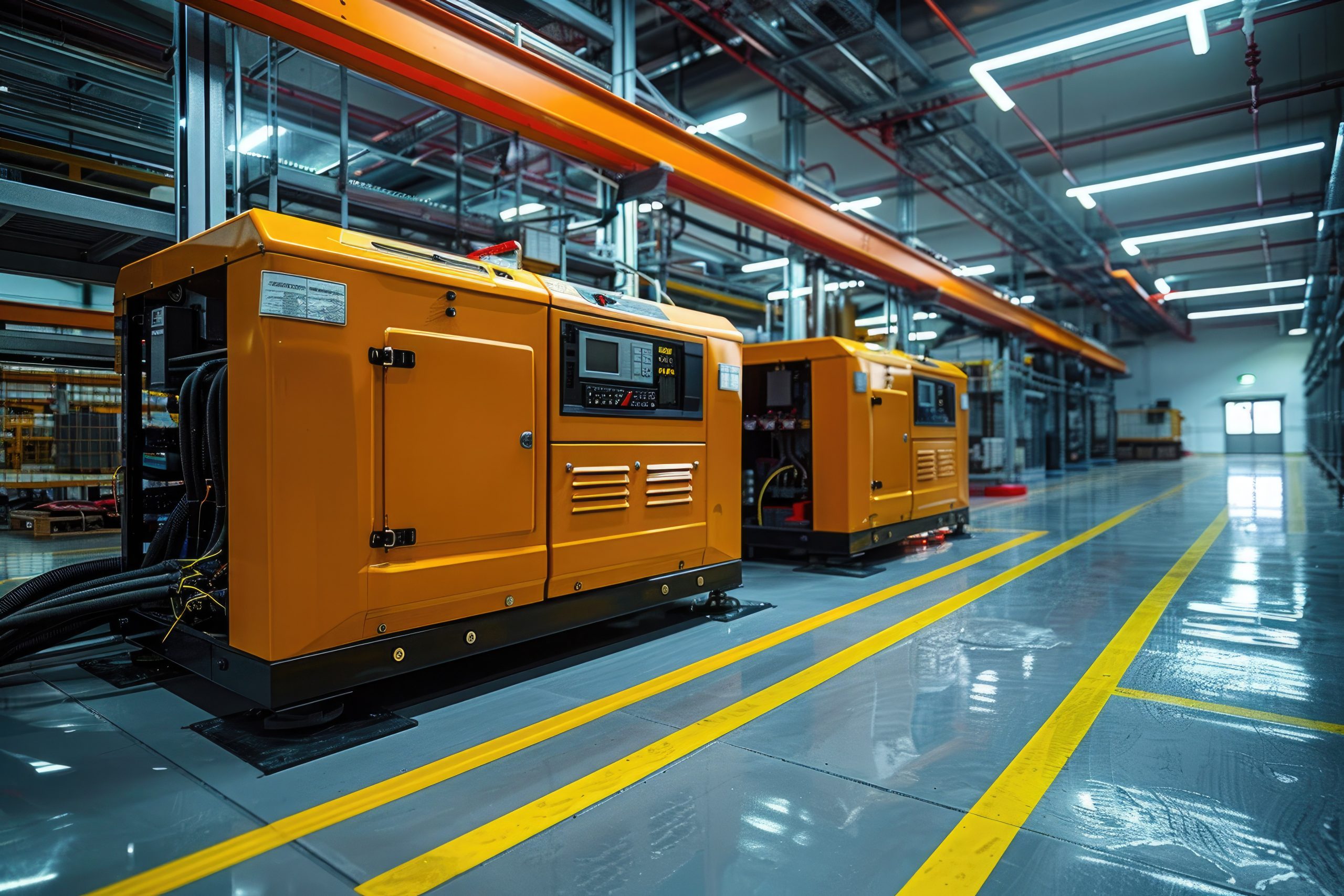
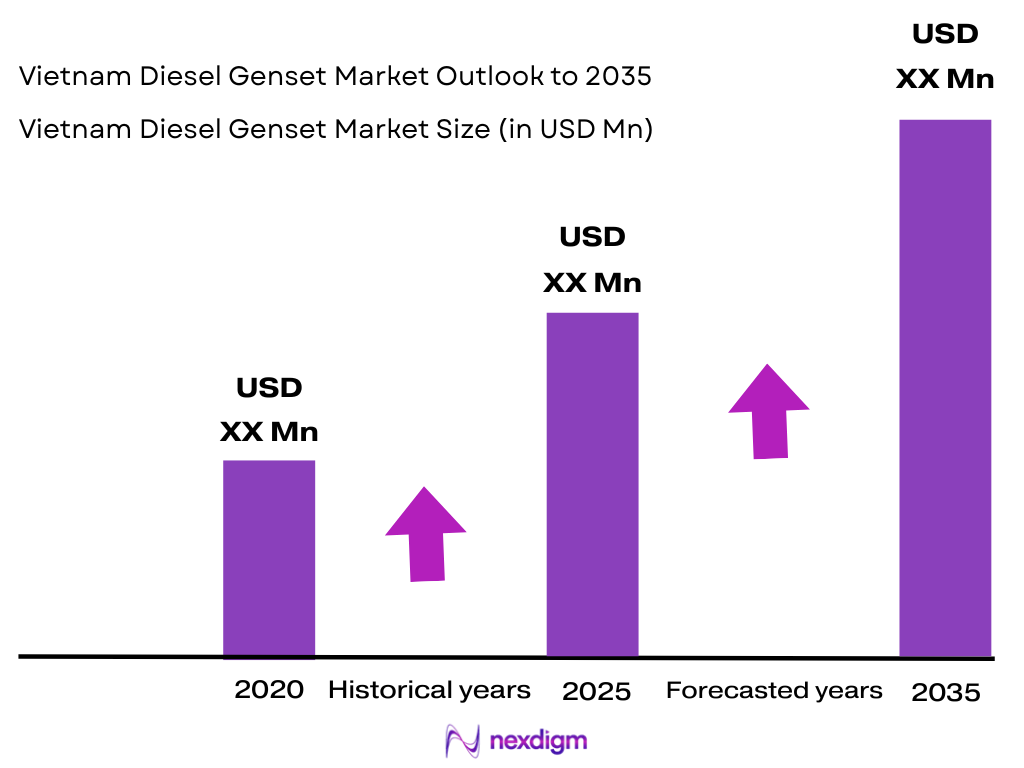
The Vietnam Diesel Genset Market is valued at approximately ~ million, supported by national electricity generation and imports increasing from 280.6 billion kWh to 309.7 billion kWh, while installed generation capacity expanded from 80,555 MW to approximately 82,400 MW. Rising industrial electricity consumption, manufacturing expansion, data infrastructure, commercial buildings and critical facilities are increasing requirements for standby diesel generation where uninterrupted power continuity remains operationally important. Ho Chi Minh City, Hanoi, Bac Ninh-Bac Giang and the Binh Duong-Dong Nai industrial corridor dominate diesel genset demand because they concentrate factories, logistics centres, industrial parks, commercial properties and technology infrastructure. Vietnam’s industrial-zone network expanded from approximately 422 industrial zones to 436, with more than 300 operational parks supporting over 4.16 million direct jobs. This dense industrial infrastructure creates substantial demand for standby and prime diesel generator systems across manufacturing and mission-critical facilities.
Market Segmentation
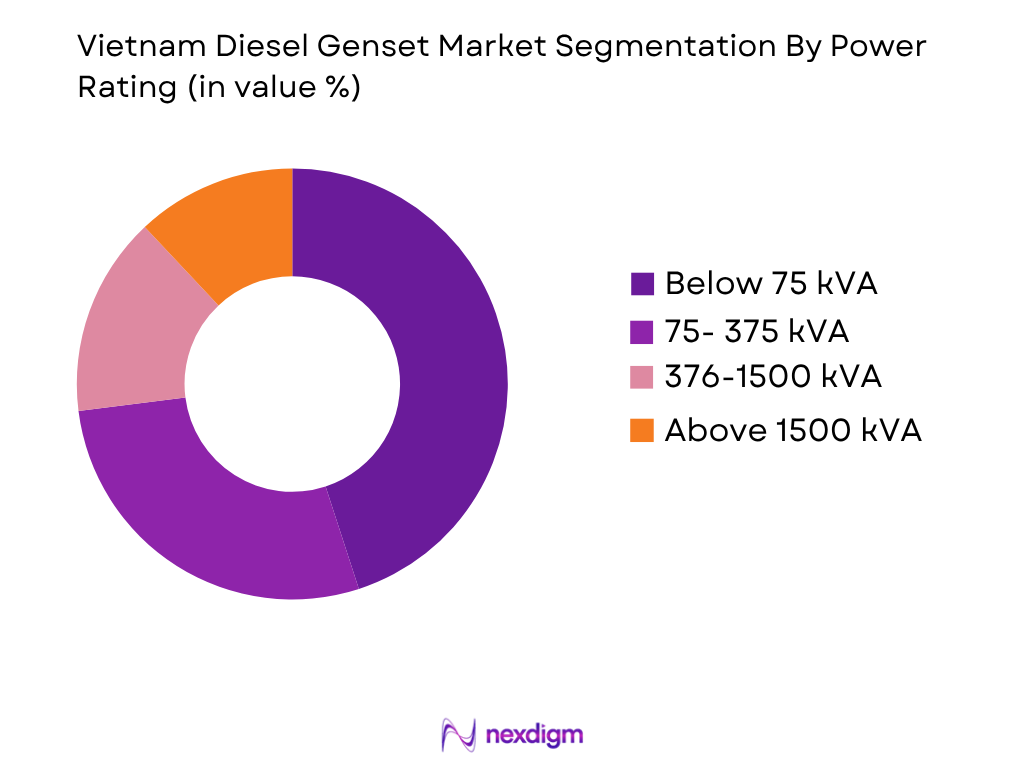
By Power Rating
The Vietnam Diesel Genset Market is segmented into below 75 kVA, 75–375 kVA, 376–750 kVA, 751–1,500 kVA and above 1,500 kVA generator sets. Recently, the 75–375 kVA category has maintained a dominant position because this range serves a wide combination of factories, workshops, hotels, commercial buildings, warehouses, retail facilities, telecommunications installations and medium-sized enterprises. Vietnam’s industrial ecosystem contains hundreds of industrial parks and a broad base of small and medium manufacturing facilities, making medium-capacity standby systems especially relevant. These generators offer sufficient power for critical machinery, lighting, elevators, pumps, refrigeration systems and building services while remaining easier to install than multi-megawatt systems. They also support both prime and emergency-duty configurations. Cummins, Caterpillar and other global suppliers provide extensive products within and around this rating range, reflecting its broad application across industrial and commercial standby power requirements.
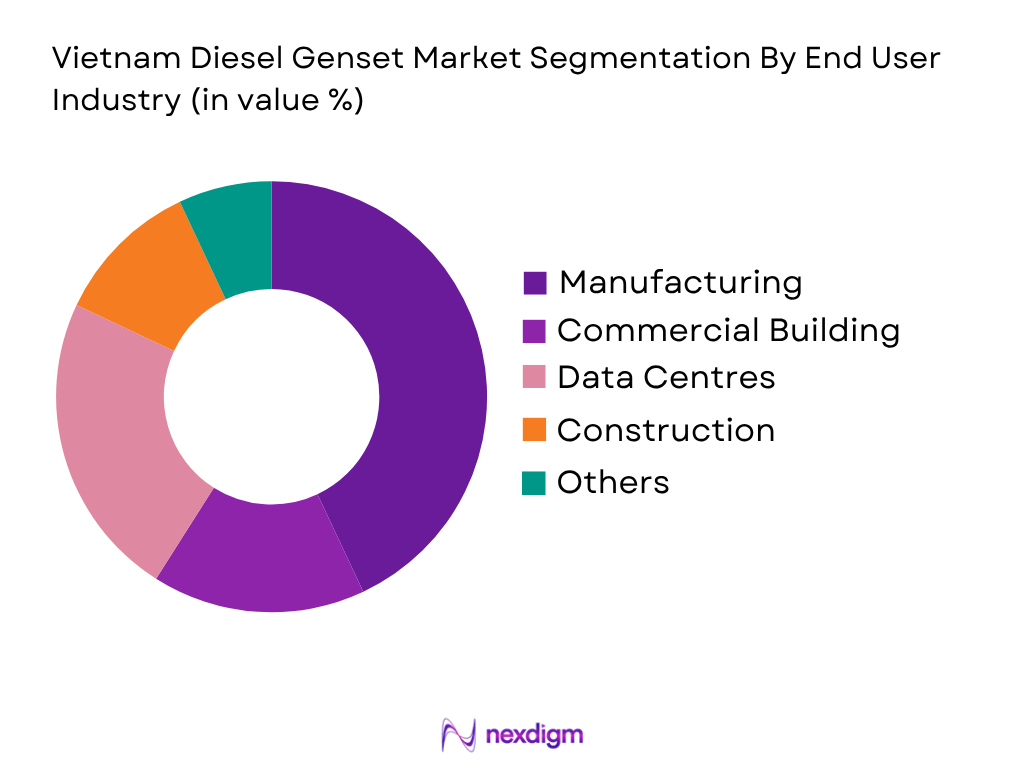
By End-User Industry
The Vietnam Diesel Genset Market is segmented into manufacturing and industrial facilities, commercial buildings, data centres and telecommunications, healthcare, construction and infrastructure, hospitality and retail, and other applications. Manufacturing and industrial facilities represent the dominant segment because uninterrupted electricity is essential for electronics production, textiles, machinery, food processing, components and export-oriented manufacturing operations. Vietnam has 436 industrial parks, with more than 300 operating, creating a large installed base of factories requiring standby power protection. Electricity consumption from the industry and construction category recorded particularly strong expansion during the first half of the reference period as national electricity demand accelerated. Diesel gensets provide an established backup option because they can start quickly, carry large motor loads and operate independently of the grid during interruptions. Industrial users also deploy multiple synchronized gensets where redundancy is required, substantially increasing installed generator capacity per facility.
Competitive Landscape
The Vietnam Diesel Genset Market features multinational engine and power-system manufacturers competing through authorized distributors, engineering contractors and generator assemblers. Cummins and Caterpillar benefit from extensive integrated engine-generator portfolios and global service capabilities, while Mitsubishi, Rolls-Royce mtu and Rehlko compete strongly in industrial and mission-critical applications. Competition centres on fuel efficiency, power density, automatic transfer capability, controller functionality, acoustic performance, synchronization capability and lifecycle service support rather than generator hardware alone. Cummins’ global diesel portfolio extends to 3,750 kVA, while Caterpillar and mtu maintain products for substantial commercial and industrial loads.
| Major Player | Establishment Year | Headquarters | Diesel Genset Power Coverage | Prime/Standby Capability | Engine-Alternator Integration | Digital Controls & Remote Monitoring | Acoustic/Weather Enclosure Capability | Service & Parts Infrastructure |
| Cummins Inc. | 1919 | Indiana, USA | ~ | ~ | ~ | ~ | ~ | ~ |
| Caterpillar Inc. | 1925 | Texas, USA | ~ | ~ | ~ | ~ | ~ | ~ |
| Mitsubishi Heavy Industries | 1884 | Tokyo, Japan | ~ | ~ | ~ | ~ | ~ | ~ |
| Rolls-Royce Power Systems / mtu | 1909 heritage | Friedrichshafen, Germany | ~ | ~ | ~ | ~ | ~ | ~ |
| Rehlko | 1873 heritage | Wisconsin, USA | ~ | ~ | ~ | ~ | ~ | ~ |
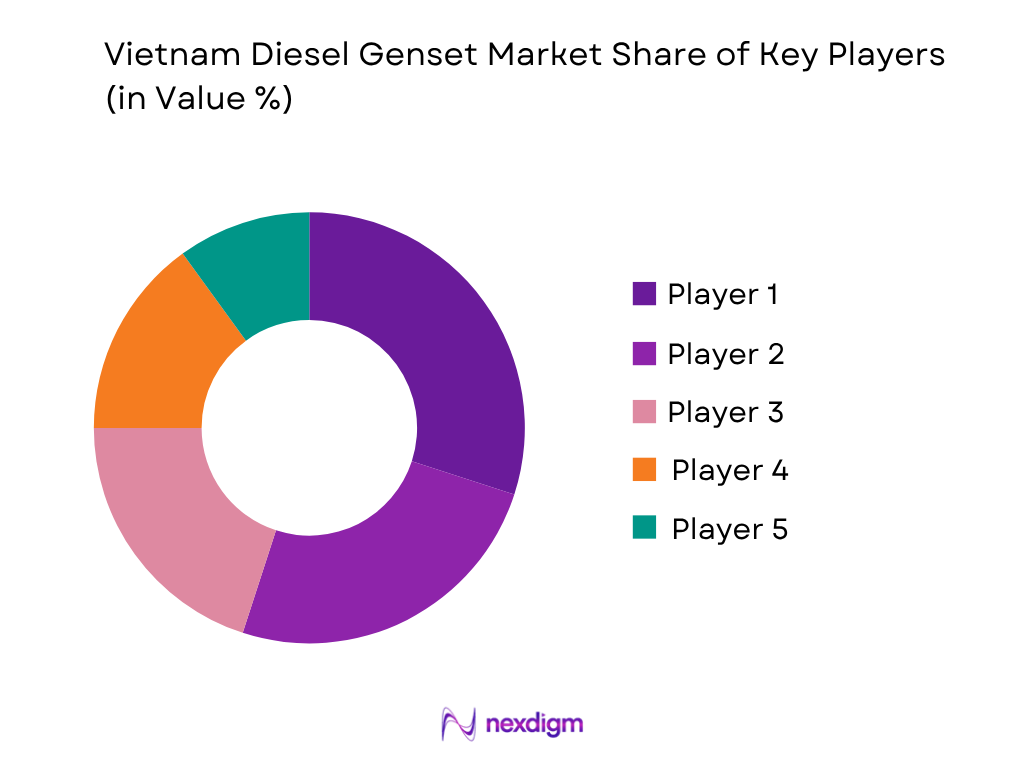
Vietnam Diesel Genset Market Analysis
Growth Drivers
Rapid Manufacturing Expansion and Rising Industrial Power Requirements
Vietnam’s manufacturing-led economic expansion is creating a strong operating environment for and mobile diesel gensets used as standby and temporary power at factories, industrial parks, warehouses, workshops and infrastructure sites. World Bank data places Vietnam’s nominal GDP at USD 476.39 billion in 2024, while the IMF reported that the economy continued expanding strongly into 2025, with output increasing 6.9 percentage points year-on-year in the first quarter. Industrial expansion is particularly relevant because Vietnam attracted USD 25.58 billion of foreign investment into processing and manufacturing during 2024, while the country ended the period with 42,002 valid foreign-invested projects carrying USD 502.8 billion in cumulative registered capital. Electricity requirements have consequently increased alongside factory utilisation. EVN recorded system electricity production and imports of 151.74 billion kWh during the first six months of 2024 and industrial-construction electricity consumption grew strongly during the same period. For diesel genset suppliers, expanding electronics, machinery, -component, textile, food-processing and export manufacturing creates demand for emergency generation capable of preventing production-line shutdowns, protecting process equipment and supporting temporary construction loads. Industrial estates also require mobile gensets during facility commissioning, grid maintenance and electrical-system upgrades. With manufacturing investment continuing to deepen, high-utilisation industrial customers represent one of the strongest structural demand pools for Vietnam’s diesel genset industry.
Higher Peak Electricity Loads and Business Continuity Requirements
Rapid electricity-demand growth is strengthening demand for diesel gensets as backup systems for commercial buildings, factories, logistics facilities, telecommunications equipment and critical infrastructure. Vietnam’s national electricity system recorded a peak load of 49,533 MW in June 2024, while maximum daily electricity consumption reached 1.02 billion kWh. By August 2025, national peak demand had climbed to 54,370 MW, and the northern power system alone recorded 28,167 MW. In May 2026, the national system reached another record of 57,120 MW, demonstrating the speed at which peak-load requirements are rising. These developments matter directly to the diesel genset segment because rising loads increase the commercial importance of backup-generation capacity even when the main grid remains stable. Manufacturing operations, data infrastructure, retail complexes, hospitals, hotels, logistics centres and telecom facilities cannot always tolerate interruptions caused by grid faults, transformer failures, storms or maintenance. Vietnam’s total installed national power capacity stood at approximately 82,400 MW toward the end of 2024, showing that generating infrastructure is expanding but must serve rapidly increasing demand. The Ministry of Industry and Trade subsequently directed measures capable of reducing at least 3,000 MW of peak load during stressed periods in 2026. This operating environment supports demand for automatic-transfer-switch diesel gensets, containerised sets, trailer-mounted units and synchronized multi-generator systems where uptime is operationally critical.
Market Challenges
Tighter Energy-Efficiency and Emissions Policy Pressure
The Vietnam Diesel Genset Market faces increasing pressure from national energy-transition and electricity-efficiency policies that encourage businesses to reduce fossil-fuel consumption and improve overall energy performance. Vietnam’s power system is rapidly adding lower-carbon generation while government agencies are intensifying demand-side management. During 2026, the Ministry of Industry and Trade was tasked with pursuing at least a 3-point reduction equivalent in national electricity consumption against baseline demand, while peak summer programmes targeted 3,000 MW of load reduction during periods of supply-demand stress. Vietnam has also become increasingly dependent on imported energy: the Ministry of Industry and Trade reported that the country has been a net energy importer since 2015 and imported-energy dependence reached a volume equivalent to 43.9 units per 100 units of total energy requirement in 2025. This raises strategic concerns around diesel dependence for distributed generation. For genset manufacturers and fleet operators, regulatory direction increases the importance of fuel-efficient engines, electronic fuel injection, optimized load management, low-emission combustion systems and hybrid integration. Diesel generators that run at low loads for prolonged periods may also experience inefficient fuel combustion and maintenance issues, strengthening customer interest in right-sized systems and intelligent controllers. Large industrial users are increasingly required to consider energy management rather than treating diesel generation as an unrestricted operating source. Consequently, suppliers must position diesel gensets primarily around emergency resilience, mobile applications and critical backup while progressively improving fuel efficiency and emissions performance.
Rapid Grid Expansion Reducing Dependence on Routine Generator Operation
Vietnam’s continued investment in electricity generation and transmission represents a structural challenge to diesel gensets used for routine or prime-power applications. EVN and its subsidiaries started 47 power-grid projects and completed and energized 57 projects spanning 110 kV to 500 kV during the first half of 2024, while the nationwide electricity system had expanded to approximately 82,400 MW of installed capacity by the end of that year. Grid reliability efforts continued through 2025 and 2026, with the Ministry of Industry and Trade reporting that electricity supply broadly met demand even when national peak demand reached 54,370 MW in 2025 and 57,120 MW during the May 2026 heatwave. Improved grid coverage and transmission capacity reduce the economic rationale for continuously operated diesel generation in industrial and commercial locations that previously experienced supply constraints. Vietnam already has electricity access covering nearly its entire population, with World Bank data recording access for approximately 99.8 people out of every 100 in the latest available national observation. Diesel genset vendors therefore face a shift from continuous-power applications toward standby, emergency and temporary generation. This changes equipment utilization patterns and purchasing criteria: buyers increasingly prioritize fast-start capability, automatic transfer switches, remote monitoring, low standby maintenance requirements and dependable operation during infrequent emergencies rather than maximizing annual running hours.
Market Opportunities
Smart Controllers, Remote Monitoring and High-Efficiency Diesel Gensets
Vietnam’s increasingly sophisticated industrial base creates an opportunity for diesel genset suppliers to move from conventional mechanical sets toward electronically controlled systems incorporating remote monitoring, automatic synchronization and predictive maintenance. The industrial-production environment provides an existing demand foundation: Vietnam’s industrial production index recorded strong expansion through 2024, while processing and manufacturing attracted USD 25.58 billion in foreign investment and total cumulative foreign-invested capital reached USD 502.8 billion across 42,002 valid projects. Electricity infrastructure is simultaneously becoming more digitally managed. During the first six months of 2024, EVN transmitted 121.47 billion kWh through the national transmission network while operating increasingly complex high-voltage infrastructure. This environment creates future demand for generators capable of communicating with building-management systems, industrial control rooms and remote fleet-management platforms. Intelligent controllers can track engine temperature, fuel level, battery condition, load, operating hours and maintenance intervals while enabling remote start-stop functions. Multiple gensets can also be synchronized to adjust operating capacity according to actual load rather than keeping oversized engines continuously running. For factories, data facilities, hospitals and logistics centres, this improves reliability while limiting unnecessary diesel consumption. Manufacturers offering digital dashboards, remote alarms, automatic transfer switches, load-sharing controllers and predictive-service support can therefore differentiate from suppliers competing mainly on engine displacement and rated output.
Industrial Parks, Data Infrastructure and Critical-Facility Backup Power
Vietnam’s expansion of export manufacturing, digital infrastructure and large commercial facilities presents a future growth opportunity for diesel gensets designed primarily for emergency and mission-critical applications. The opportunity can be supported by current economic indicators rather than speculative future demand. Vietnam generated USD 476.39 billion of GDP in 2024, while GDP per capita reached approximately USD 4,717; World Bank data subsequently places economic output at approximately USD 514.7 billion in 2025. Manufacturing remains central to this expansion, with processing and manufacturing attracting USD 25.58 billion of FDI during 2024. At the same time, electricity demand is placing progressively larger loads on infrastructure: national peak demand increased from 49,533 MW in 2024 to 54,370 MW in 2025 and reached 57,120 MW during a 2026 heatwave. These conditions favor high-reliability diesel backup systems for semiconductor and electronics facilities, data centres, hospitals, telecommunications installations, logistics warehouses, manufacturing plants and commercial complexes where short interruptions can disrupt operations or damage equipment. The opportunity is likely to concentrate on higher-specification systems rather than basic generators, including N+1 configurations, automatic synchronization, sound-attenuated enclosures, day tanks, integrated fuel systems and remote-control platforms. Diesel gensets can increasingly operate as resilience assets that complement the grid rather than substitute for it, giving manufacturers scope to expand through turnkey engineering, installation, maintenance contracts and mission-critical power solutions.
Future Outlook
The Vietnam Diesel Genset Market is forecast to expand at approximately ~ CAGR during 2026–2035, supported by industrialization, increasing electricity requirements, data-centre expansion, urban infrastructure development and growing requirements for resilient backup power. Vietnam’s electricity system is expanding rapidly, yet demand is also increasing sharply. Total installed power capacity reached approximately 82,400 MW, while electricity generation and imports reached approximately 309.7 billion kWh. Continued manufacturing expansion means businesses will remain highly sensitive to even short-duration interruptions. Future diesel gensets are expected to become increasingly integrated with solar PV, battery energy storage and intelligent energy-management systems. Rather than operating continuously, diesel generators will increasingly provide emergency backup, black-start capability and support during extended low-renewable-generation periods. Rolls-Royce mtu has already illustrated a Vietnam microgrid configuration combining 2 MWp of solar PV, 5 MWh of battery storage and 2.4 MW of diesel generation, demonstrating how diesel capacity can remain important within hybrid energy architectures. Emission efficiency, noise control, automated synchronization and remote condition monitoring will also influence procurement. High-end users such as semiconductor plants, data centres, hospitals and electronics factories will increasingly evaluate generators as part of integrated power-resilience systems rather than standalone machines.
Major Players
- Cummins Inc.
- Caterpillar Inc.
- Mitsubishi Heavy Industries
- Rolls-Royce Power Systems / mtu
- Rehlko
- Perkins Engines Company
- FG Wilson
- Volvo Penta
- Yanmar Holdings
- Denyo Co., Ltd.
- HIMOINSA
- Baudouin
- Atlas Copco
- Generac Power Systems
- Doosan Bobcat
Key Target Audience
- Diesel generator manufacturers and assemblers
- Industrial park developers and manufacturing companies
- Data centre and telecommunications infrastructure operators
- Hospitals and healthcare facility operators
- Commercial real estate and hospitality developers
- Engineering, procurement and construction companies
- Investments and venture capitalist firms
- Government and regulatory bodies (Ministry of Industry and Trade, Electricity Regulatory Authority of Vietnam, Ministry of Construction, Ministry of Science and Technology)
Research Methodology
Step 1: Identification of Key Variables
The initial phase involves developing an ecosystem map covering diesel genset OEMs, engine manufacturers, alternator suppliers, generator assemblers, distributors, EPC companies, industrial users and service providers in the Vietnam Diesel Genset Market. Critical variables include installed kVA, standby versus prime duty, running hours, engine displacement, fuel consumption, generator efficiency, industrial power requirements and application-specific redundancy.
Step 2: Market Analysis and Construction
Historical market demand is constructed through both top-down and bottom-up analysis. Industrial parks, manufacturing establishments, commercial facilities, telecommunications sites, hospitals, data centres and infrastructure projects are mapped against typical genset capacity requirements. Electricity demand, installed generating capacity and grid development are assessed to understand the relationship between economic expansion and backup-power requirements. EVN reported nationwide capacity of approximately 82,400 MW and electricity output of roughly 309.7 billion kWh around the base period.
Step 3: Hypothesis Validation and Expert Consultation
Initial demand hypotheses are validated through CATIs and structured interviews with generator distributors, electrical contractors, industrial facility managers, data-centre operators, construction companies and maintenance providers. Discussions examine preferred power ratings, operating hours, fuel consumption, load factors, standby requirements, generator replacement cycles, service contracts, acoustic specifications, synchronization requirements and brand-selection criteria.
Step 4: Research Synthesis and Final Output
The final phase triangulates demand-side capacity requirements against OEM product ranges, import flows, distributor activity, industrial-zone development and electricity-sector statistics. Cummins, Caterpillar, mtu and other manufacturers are analyzed according to power range, fuel efficiency, controls, service support and application capability. The resulting dataset is reconciled to create the historical market model, segmentation structure and long-term forecast scenario for the Vietnam Diesel Genset Market.

- Executive Summary
- Research Methodology (Market Definition and Scope, Diesel Genset Classification Framework, Top-Down Market Sizing, Bottom-Up Unit Shipment Assessment, Installed Base Analysis, kVA-Based Demand Estimation, Import and Local Assembly Assessment, End-User Demand Mapping, Distributor and Dealer Interviews, EPC and Rental Operator Interviews, Data Triangulation, Forecast Modelling, Scenario Analysis, Research Limitations)

- Definition and Scope
- Market Evolution and Industry Genesis
- Evolution of Standby and Prime Power Demand
- Diesel Generator Industry Value Chain
- Diesel Engine–Alternator–Controller Ecosystem

- Growth Drivers (Industrial Park Expansion, Manufacturing Continuity Requirements, Data Center Backup Power, Telecom Network Expansion, Infrastructure Construction, Commercial Facility Backup Demand)
- Market Challenges (Diesel Fuel Dependence, Emissions Compliance, Noise Restrictions, Generator Maintenance Complexity, Grid Reliability Improvement, Alternative Backup Technologies)
- Market Opportunities (High-Efficiency Engines, Data Center Gensets, Rental Power, Hybrid Diesel-Battery Systems, Local Assembly, Remote Monitoring, Industrial Power Solutions)
- Market Trends (Electronic Engine Management, Smart Controllers, Remote Monitoring, Synchronization, Sound Attenuation, Hybridization, Modular Generator Plants)
- Government Regulations (Stationary Engine Emissions, Environmental Protection, Noise Limits, Fuel Quality, Electrical Installation Safety, Fire Protection, Industrial Facility Compliance)
- SWOT Analysis (Diesel Reliability, Installed Service Base, Fuel Dependency, Emission Pressure, Hybridization Opportunity, Competitive Imports)
- Porter’s Five Forces Analysis (OEM Rivalry, Engine Supplier Power, Distributor Influence, Buyer Bargaining Power, Alternative Backup Technologies)
- PESTLE Analysis (Industrial Policy, Economic Expansion, Data Infrastructure, Generator Technology, Environmental Regulation, Energy Transition)

- By Market Value (2020-2025)
- By Unit Shipments (2020-2025)
- By Installed Diesel Genset Capacity (2020-2025)

- By Power Rating (In Value %)
Below 20 kVA
20–75 kVA
76–200 kVA
201–500 kVA
501–1,000 kVA
Above 1,000 kVA - By Application (In Value %)
Emergency Standby Power
Prime Power
Continuous Power
Temporary and Rental Power
Peak Load Support - By End User (In Value %)
Manufacturing Plants and Industrial Parks
Data Centers and Cloud Infrastructure
Telecommunication Towers and Network Facilities
Commercial Buildings and Office Complexes
Hotels and Hospitality Facilities - By Region (In Value %)
Northern Vietnam
Hanoi Metropolitan Area
Hai Phong–Quang Ninh Industrial Corridor
Bac Ninh–Bac Giang Manufacturing Corridor
Central Vietnam

- Market Positioning of Major Generator Suppliers
- Cross Comparison Parameters (Rated Power Range in kVA, Fuel Consumption Across Load Levels, Engine and Alternator Platform, Control Panel and ATS Capability, Synchronization and Parallel Operation Capability, Acoustic Enclosure and Noise Performance, Vietnam Dealer and After-Sales Service Coverage, Remote Monitoring and Preventive Maintenance Capability)
- SWOT Analysis of Major Players
- Detailed Profiles of Major Companies
SBM Corporation – SBMPOWER
Denyo Vietnam Co., Ltd.
MHI Engine System Vietnam Co., Ltd. – Mitsubishi Generator Systems
Cummins Inc.
Caterpillar Inc.
FG Wilson
Kohler Energy / Rehlko
Atlas Copco
Yanmar Holdings Co., Ltd.
HIMOINSA
Perkins Engines Company Limited
Volvo Penta
Moteurs Baudouin
FPT Industrial
Hyundai Infracore / Doosan Engine Platform

- Manufacturing Industry Demand Assessment
- Industrial Park Power Backup Assessment
- Data Center Generator Demand Analysis
- Telecommunication Backup Power Analysis
- Hospital and Healthcare Power Reliability Analysis

- By Market Value (2026-2035)
- By Unit Shipments (2026-2035)
- By Installed Capacity (2026-2035)


 Request a Sample
 Ask for Customization
 Get a Quote
 Enquire Now