

 Download PDF
 Download PDF
Market Overview
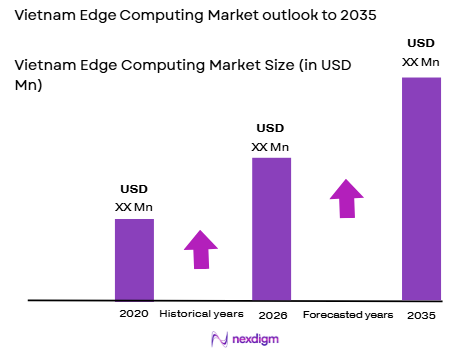
Vietnam’s edge computing market reached approximately USD ~ million based on a recent historical assessment, driven by accelerating 5G rollout, industrial digitalization, and hyperscale cloud localization strategies. Telecommunications operators and data center providers expanded distributed compute nodes to support latency-sensitive enterprise applications, video analytics, and IoT workloads. Government digital transformation programs and smart city deployments also stimulated localized processing demand, while multinational manufacturers increased on-site compute capacity to optimize automation and real-time monitoring across production environments.
Ho Chi Minh City and Hanoi dominate deployment due to dense telecom infrastructure, concentration of data centers, and strong enterprise digital adoption across finance, manufacturing, and retail sectors. Southern industrial corridors including Binh Duong and Dong Nai attract edge deployments supporting export-oriented manufacturing clusters requiring low-latency automation and quality analytics. Coastal regions such as Da Nang emerge as regional digital hubs through smart city initiatives and subsea connectivity, enabling distributed compute expansion aligned with tourism, logistics, and public service modernization.
Market Segmentation
By Product Type
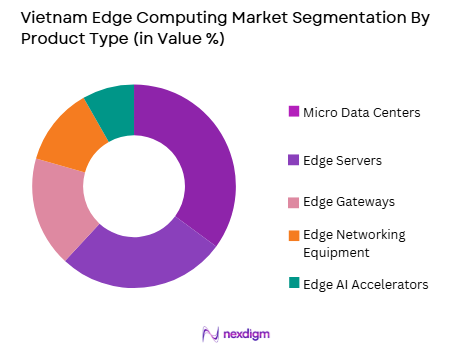
Vietnam Edge Computing market is segmented by product type into edge servers, edge gateways, micro data centers, edge AI accelerators, and edge networking equipment. Recently, micro data centers has a dominant market share due to factors such as telecom edge rollout, modular deployment flexibility, and suitability for distributed industrial and urban environments. Operators and enterprises prefer integrated micro facilities combining compute, storage, cooling, and power within compact enclosures deployable near base stations or factories. Manufacturing zones and smart city nodes require localized compute resilience, which micro data centers provide with reduced latency and reliable uptime. Global vendors increasingly localize modular designs for Southeast Asian climates and energy constraints, improving adoption economics. Telecom providers integrate micro data centers with 5G edge clouds to support enterprise services including private networks and real-time analytics. Government digital infrastructure programs also emphasize decentralized compute architectures, further reinforcing micro data center demand across municipal and industrial applications.
By Application
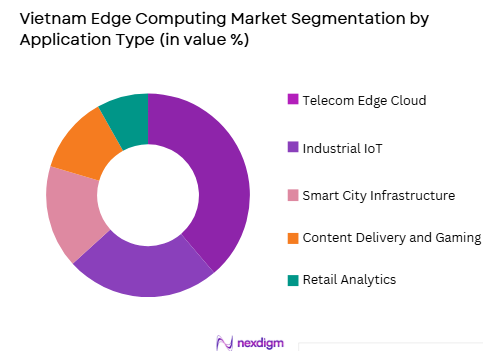
Vietnam Edge Computing market is segmented by application into telecom edge cloud, industrial IoT, smart city infrastructure, content delivery and gaming, and retail analytics. Recently, telecom edge cloud has a dominant market share due to factors such as 5G service expansion, enterprise edge services, and distributed network architecture evolution. Telecommunications operators deploy edge nodes across metropolitan and regional networks to deliver ultra-low-latency services for enterprises and consumers. Multi-access edge computing platforms enable private 5G, video optimization, and AR-VR services demanded by manufacturing, media, and logistics sectors. Telecom providers also leverage edge infrastructure to localize data processing and reduce backbone congestion costs. Enterprise customers increasingly procure managed edge services from telecom operators rather than building independent infrastructure. National digital transformation initiatives and spectrum investments accelerate telecom-led edge deployments across major cities and industrial regions, consolidating telecom edge cloud as the leading application segment.
Competitive Landscape
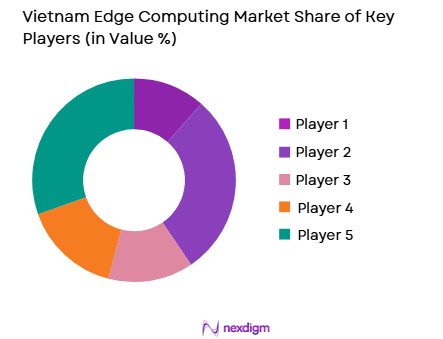
Vietnam’s edge computing market shows moderate consolidation with telecom operators and global infrastructure vendors shaping deployment patterns. International technology firms provide hardware platforms and orchestration software, while domestic telecom companies control last-mile infrastructure and enterprise access. Strategic partnerships between data center operators, telecom providers, and cloud companies accelerate distributed edge rollout. Competition centers on integrated solutions combining compute, connectivity, and managed services tailored to manufacturing, smart city, and enterprise latency-sensitive applications.
| Company Name | Establishment Year | Headquarters | Technology Focus | Market Reach | Key Products | Revenue | Edge Deployment Model |
| Viettel Group | 1989 | Vietnam | ~ | ~ | ~ | ~ | ~ |
| VNPT | 1995 | Vietnam | ~ | ~ | ~ | ~ | ~ |
| FPT Corporation | 1988 | Vietnam | ~ | ~ | ~ | ~ | ~ |
| Dell Technologies | 1984 | USA | ~ | ~ | ~ | ~ | ~ |
| Huawei | 1987 | China | ~ | ~ | ~ | ~ | ~ |
Vietnam Edge Computing Market Analysis
Growth Drivers
5G Network Expansion and Telecom Edge Cloud Investment
Vietnam’s nationwide 5G rollout has catalyzed extensive investment in distributed computing nodes deployed close to radio access networks to support latency-critical services and enterprise connectivity models. Telecom operators are transforming traditional centralized core networks into multi-access edge computing architectures that enable localized data processing for applications such as industrial automation, autonomous systems, and immersive media services. Enterprises increasingly require ultra-reliable low-latency connectivity to operate robotics, machine vision, and predictive maintenance platforms within smart factories, prompting telecom providers to integrate edge compute resources with private 5G offerings. Government digital infrastructure strategies emphasize nationwide high-speed connectivity and data localization capabilities, encouraging telecom operators to expand edge nodes across urban and industrial regions. The rise of cloud gaming, augmented reality, and real-time analytics applications further increases the need for geographically distributed processing resources to maintain user experience quality. Telecom companies monetize edge infrastructure through enterprise edge services, including localized cloud hosting and data processing solutions delivered on subscription models. Global technology vendors collaborate with Vietnamese telecom firms to deploy standardized MEC platforms that accelerate commercialization of edge services. These developments collectively position telecom-led edge cloud expansion as a primary structural driver of Vietnam’s edge computing market growth trajectory.
Industrial Digitalization and Smart Manufacturing Adoption
Vietnam’s manufacturing sector is undergoing rapid digital transformation as multinational and domestic firms integrate automation, robotics, and real-time analytics to improve productivity and supply chain resilience. Edge computing enables localized processing of sensor data, machine vision streams, and operational analytics within factories, reducing latency and ensuring deterministic response required for automated production systems. Export-oriented industries such as electronics, automotive components, and textiles increasingly deploy industrial IoT platforms that rely on on-premise or near-premise compute nodes to maintain operational continuity and data sovereignty. Industrial parks across southern economic zones adopt edge infrastructure to support predictive maintenance, energy optimization, and quality inspection applications. Manufacturers prefer edge deployments over centralized cloud processing due to network reliability concerns and strict performance requirements of industrial control systems. Government programs promoting Industry 4.0 adoption and digital manufacturing competitiveness encourage enterprises to invest in localized compute infrastructure. Technology integrators and equipment vendors embed edge processing within industrial machinery and control platforms, accelerating adoption across production lines. As industrial automation intensifies across Vietnam’s manufacturing ecosystem, demand for resilient and low-latency edge computing environments continues to expand significantly.
Market Challenges
High Infrastructure and Energy Costs of Distributed Edge Deployments
Edge computing deployment in Vietnam involves substantial capital expenditure associated with installing distributed compute nodes, power systems, cooling infrastructure, and secure enclosures across multiple geographic locations. Unlike centralized data centers, edge architectures require numerous small-scale facilities, increasing cumulative hardware, site acquisition, and maintenance costs for telecom operators and enterprises. Energy supply reliability and efficiency constraints further complicate deployment economics, particularly in industrial zones and secondary cities where grid stability and cooling efficiency vary. Operators must implement redundant power and environmental control systems to ensure uptime, raising operational expenditure. Hardware import dependence and currency fluctuations increase procurement costs for advanced edge servers and accelerators sourced from global vendors. Skilled workforce shortages in distributed infrastructure management and cybersecurity also elevate operational risk and cost. Enterprises evaluating edge investments often face uncertain return timelines due to evolving application ecosystems and monetization models. These financial and operational constraints slow adoption beyond major urban and industrial hubs, presenting a structural challenge for nationwide edge infrastructure expansion.
Limited Edge Application Ecosystem and Integration Complexity
Vietnam’s edge computing market faces constraints arising from a still-maturing application ecosystem and integration challenges across heterogeneous enterprise environments. Many potential enterprise use cases such as autonomous logistics, immersive media, and AI-driven public services remain in early deployment stages, limiting immediate demand for localized compute infrastructure. Enterprises often lack in-house expertise to design, deploy, and manage edge architectures integrated with legacy IT and operational technology systems. Interoperability issues between hardware platforms, orchestration software, and telecom network interfaces complicate deployment and increase integration costs. Standardization across multi-vendor edge environments remains limited, slowing ecosystem development and cross-platform compatibility. Small and medium enterprises particularly face barriers due to technical complexity and resource constraints, reducing broad market penetration. Telecom operators and technology vendors must invest heavily in developer ecosystems, middleware platforms, and managed services to enable scalable adoption. Until a robust application marketplace and standardized frameworks mature, the pace of edge computing deployment across Vietnam will remain constrained relative to potential demand.
Opportunities
Smart City and Urban Digital Infrastructure Expansion
Vietnam’s major cities are advancing smart infrastructure programs involving intelligent transport systems, surveillance analytics, environmental monitoring, and connected public services that require localized data processing capabilities. Edge computing provides real-time analytics and decision-making close to sensors and cameras deployed across urban environments, enabling responsive municipal services and traffic optimization. City administrations increasingly adopt distributed compute nodes to process video analytics and IoT data locally, reducing latency and bandwidth requirements on central networks. Smart mobility initiatives including connected traffic signals and autonomous transport pilots depend on localized processing to ensure safety and performance. Public safety and disaster monitoring systems also leverage edge infrastructure to enable rapid response and data sovereignty compliance. Telecom operators and system integrators collaborate with municipalities to deploy edge platforms integrated with 5G networks and urban sensor grids. Government funding for digital urbanization and smart governance further stimulates adoption of distributed computing nodes across city infrastructure. As Vietnam’s urban population and digital service expectations rise, smart city edge deployments present substantial long-term growth opportunities.
Edge Enabled Digital Services and Industry Specific Platforms
Vietnam’s evolving digital economy creates opportunities for edge computing providers to deliver specialized platforms tailored to industry verticals such as healthcare, logistics, retail, and media. Localized processing supports telemedicine diagnostics, automated warehousing, personalized retail analytics, and immersive entertainment services that require low latency and data locality. Service providers can develop edge-based analytics and AI inference platforms delivered as managed services to enterprises lacking infrastructure expertise. Content delivery networks and gaming providers increasingly deploy edge nodes to enhance user experience and reduce latency across regional markets. Industry-specific edge platforms integrated with sensors and enterprise software enable new digital service models and revenue streams. Vietnamese technology firms and startups can innovate on top of telecom edge infrastructure, building localized applications optimized for domestic industries. Partnerships between cloud providers, telecom operators, and vertical solution developers accelerate ecosystem growth. These developments position edge computing as a foundational layer for Vietnam’s next phase of digital service innovation and industry modernization.
Future Outlook
Vietnam’s edge computing market is expected to expand rapidly as 5G networks mature and industrial digitalization accelerates across manufacturing and urban infrastructure. Telecom operators will scale distributed edge clouds nationwide, while enterprises adopt localized processing for automation and analytics. Smart city initiatives and digital public services will drive municipal deployments. Partnerships among telecom, cloud, and technology vendors will deepen ecosystem maturity. Regulatory emphasis on data localization and digital sovereignty will further support edge infrastructure growth.
Major Players
- Viettel Group
- VNPT
- FPT Corporation
- CMC Corporation
- MobiFone
- VNG Corporation
- CMC Telecom
- Viettel IDC
- ST Telemedia Global Data Centres
- NTT DATA
- Dell Technologies
- Hewlett Packard Enterprise
- Huawei Technologies
- Cisco Systems
- Lenovo
Key Target Audience
- Telecom operators
- Data center operators
- Cloud service providers
- Manufacturing enterprises
- Smart city solution providers
- Investments and venture capitalist firms
- Government and regulatory bodies
- Digital infrastructure investors
Research Methodology
Step 1: Identification of Key Variables
Key supply and demand variables including telecom infrastructure density, industrial digitalization level, enterprise IT spending, and smart city deployment intensity were identified. Edge hardware shipments, node deployment patterns, and application adoption indicators were mapped to quantify distributed compute demand across regions and sectors.
Step 2: Market Analysis and Construction
Bottom-up assessment combined vendor revenues, telecom edge node deployments, and enterprise infrastructure spending to construct market size. Segmentation was derived from product shipments, telecom investments, and industry adoption trends across manufacturing, urban infrastructure, and digital services.
Step 3: Hypothesis Validation and Expert Consultation
Industry interviews with telecom operators, data center providers, and system integrators validated deployment trends, cost structures, and adoption drivers. Technical experts confirmed application maturity levels, infrastructure requirements, and regulatory influences affecting Vietnam’s edge computing ecosystem.
Step 4: Research Synthesis and Final Output
Validated quantitative and qualitative insights were synthesized into market models, forecasts, and competitive analysis. Cross-verification ensured consistency across infrastructure deployments, enterprise adoption trends, and technology supply chains to produce final market intelligence outputs.

- Executive Summary
- Research Methodology (Definitions, Scope, Industry Assumptions, Market Sizing Approach, Primary & Secondary Research Framework, Data Collection & Verification Protocol, Analytic Models & Forecast Methodology, Limitations & Research Validity Checks)

- Market Definition and Scope
- Value Chain & Stakeholder Ecosystem
- Regulatory / Certification Landscape
- Sector Dynamics Affecting Demand
- Strategic Initiatives & Infrastructure Growth

- Growth Drivers
Nationwide 5G rollout and telecom edge infrastructure expansion
Industrial digitalization across manufacturing and logistics sectors
Rising demand for low-latency computing in smart city and IoT deployments - Market Challenges
Limited domestic edge infrastructure expertise and integration capability
High capital and operational cost of distributed compute deployments
Fragmented enterprise digital maturity across industry segments - Market Opportunities
Expansion of regional data center corridors in Ho Chi Minh City and Hanoi
Growth of Industry 4.0 and smart manufacturing initiatives
Cross-border digital connectivity with ASEAN cloud ecosystems - Trends
Telecom–cloud partnerships enabling distributed edge services
Adoption of AI-enabled industrial edge analytics platforms
Deployment of modular micro data centers in urban hubs - Government regulations
National Digital Transformation Program infrastructure mandates
Data localization and cybersecurity compliance requirements
Telecom licensing for edge-enabled 5G services - SWOT analysis
- Porters five forces

- By Market Value, 2020-2025
- By Installed Units, 2020-2025
- By Average System Price, 2020-2025
- By System Complexity Tier, 2020-2025

- By System Type (In Value%)
Multi-access Edge Computing Platforms
Industrial Edge Servers
Micro Data Centers
Edge Gateways and Routers
Edge AI Acceleration Modules - By Platform Type (In Value%)
Telecom Network Edge
Enterprise On-Premise Edge
Cloud-Integrated Edge
Industrial IoT Edge
Smart City Edge Infrastructure - By Fitment Type (In Value%)
On-Premise Edge Deployments
Carrier-Hosted Edge Nodes
Colocation Edge Facilities
Embedded Device-Level Edge
Modular Containerized Edge - By EndUser Segment (In Value%)
Telecommunications Operators
Manufacturing and Industrial Firms
Government and Smart City Agencies
Retail and E-Commerce Platforms
Energy and Utilities Providers - By Procurement Channel (In Value%)
Direct OEM Procurement
Telecom Operator Managed Services
System Integrator Deployment Contracts
Cloud Provider Edge Offerings
Government Infrastructure Tenders

- Market Share Analysis
- Cross Comparison Parameters (Deployment Scale, Industry Focus, Edge Architecture, Integration Capability, Regional Presence, Telecom Partnership Depth, Data Center Proximity, Managed Services Portfolio, Edge AI Capability, Local Support Infrastructure)
- SWOT Analysis of Key Competitors
- Pricing & Procurement Analysis
- Key Players
Viettel Group
VNPT Technology
FPT Telecom
CMC Telecom
Dell Technologies
Hewlett Packard Enterprise
Cisco Systems
Huawei Technologies Vietnam
Nokia Vietnam
Schneider Electric Vietnam
ST Telemedia Global Data Centres Vietnam
EdgeConneX Vietnam
VNG Cloud
AWS Vietnam
Microsoft Vietnam

- Telecom operators drive early deployment through 5G network edge rollouts
- Manufacturing firms adopt edge for automation and machine analytics
- Government smart city programs require localized processing infrastructure
- Energy and utilities integrate edge for grid monitoring and control

- Forecast Market Value, 2026-2035
- Forecast Installed Units, 2026-2035
- Price Forecast by System Tier, 2026-2035
- Future Demand by Platform, 2026-2035


 Request a Sample
 Ask for Customization
 Get a Quote
 Enquire Now