
 Download PDF
Market Overview
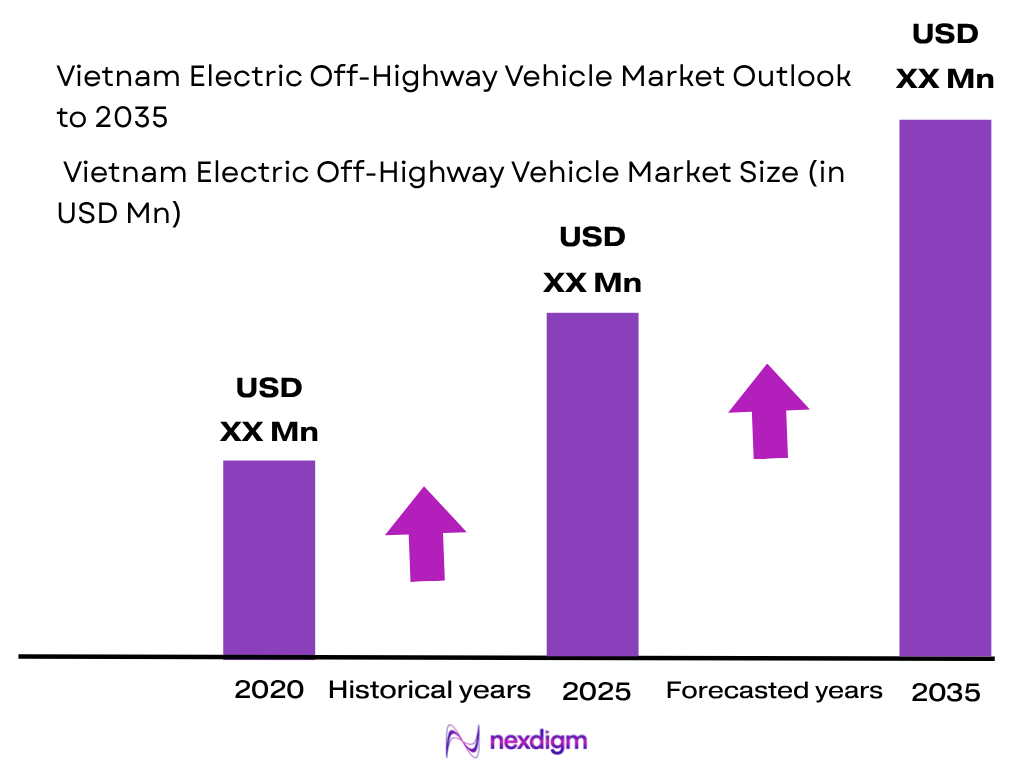
The Vietnam Electric Off-Highway Vehicle Market is valued at approximately USD ~ million in 2024, with the market supported by industrial expansion, construction activity, agricultural mechanization, warehousing and logistics modernization. Vietnam’s GDP reached VND 11,511.9 trillion in 2024, equivalent to USD 476.3 billion, while GDP per capita reached USD 4,700, providing a broader economic base for equipment investment. Industrial production increased 8.4, manufacturing and processing increased 9.6, and construction value added increased 7.87, strengthening demand for electric forklifts, loaders, excavators, aerial work platforms and other off-highway equipment.
Ho Chi Minh City, Hanoi, Hai Phong, Bac Ninh, Binh Duong and Dong Nai represent the principal demand centers for electric off-highway vehicles because they combine manufacturing facilities, logistics parks, ports, warehouses, construction activity and industrial clusters. The concentration of export-oriented manufacturing is particularly important for electric forklifts and warehouse equipment, while construction-intensive areas create opportunities for compact electric excavators, loaders and access platforms. Vietnam’s manufacturing value added represented 24 of GDP in 2024 according to World Bank data, highlighting the importance of industrial operations to the equipment ecosystem.
Market Segmentation
By Vehicle Type
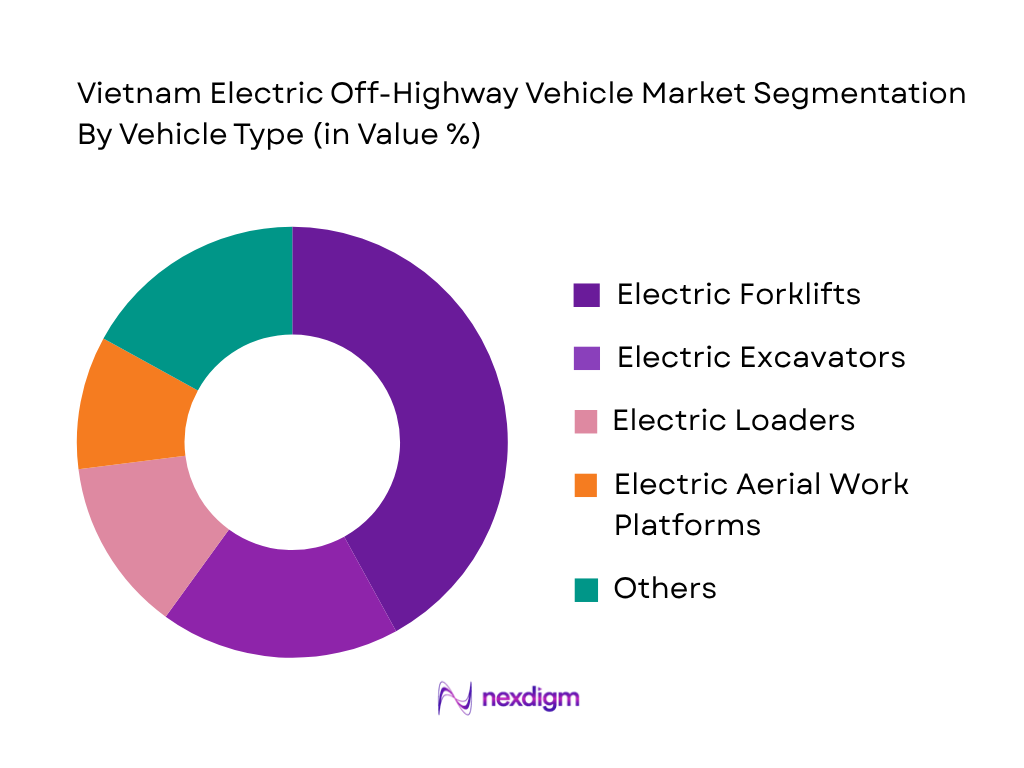
The Vietnam Electric Off-Highway Vehicle Market is segmented by vehicle type into electric forklifts, electric excavators, electric loaders, electric aerial work platforms, electric tractors and other electric material-handling and construction vehicles. Electric forklifts are expected to represent the dominant sub-segment, supported by concentrated demand from manufacturing plants, warehouses, logistics facilities, retail distribution centers and industrial parks. Vietnam’s manufacturing and processing sector expanded 9.6 in 2024, while industrial production increased 8.4, creating a broad installed base for internal material movement and warehouse handling. The electric forklift segment also benefits from comparatively predictable operating cycles, centralized charging locations and indoor applications where zero tailpipe emissions and lower noise provide direct operational advantages. Electric excavators and loaders have strong potential in urban construction and infrastructure projects, but their adoption is more constrained by battery capacity, charging infrastructure and demanding outdoor duty cycles. The growing logistics ecosystem further supports electric material-handling equipment, with transportation and warehousing value added increasing 10.82 in 2024.
By End-Use Industry
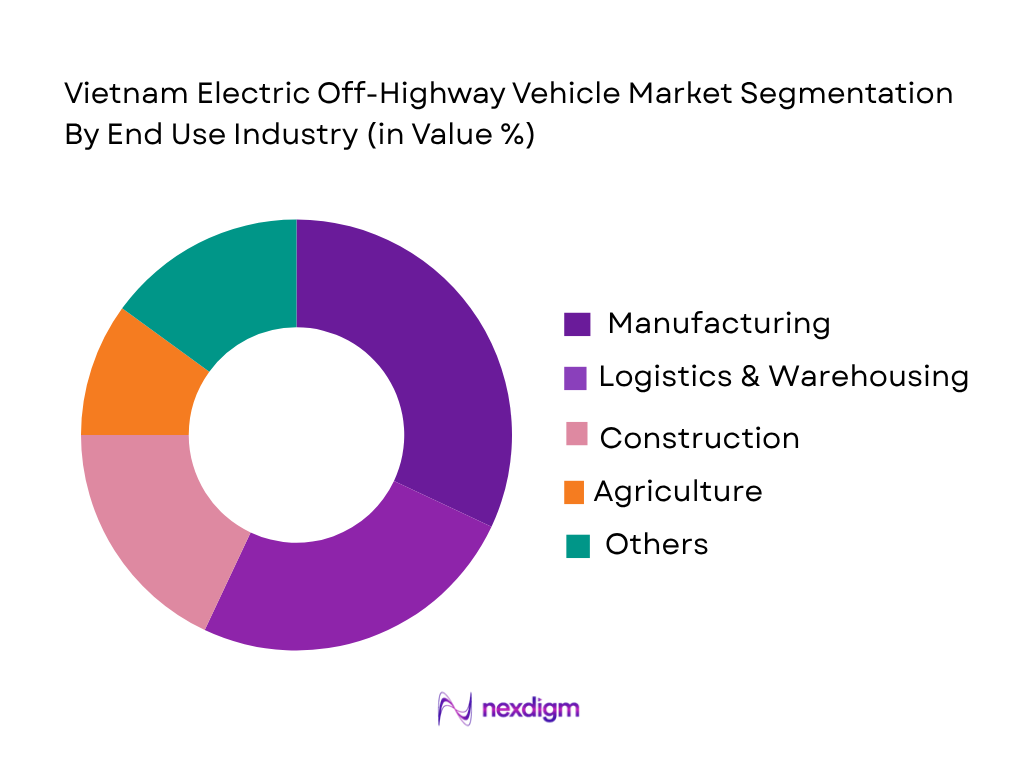
The Vietnam Electric Off-Highway Vehicle Market is segmented by end-use industry into manufacturing, logistics and warehousing, construction, agriculture, mining and quarrying, ports and material handling, utilities and infrastructure, and other industrial applications. Manufacturing is expected to remain the leading end-use segment because Vietnam has developed a large export-oriented production ecosystem covering electronics, machinery, furniture, food processing, textiles and automotive-related manufacturing. The country’s manufacturing and processing sector expanded 9.6 in 2024, while production of electronic, computer and optical products increased 8.3 and motor-vehicle production increased 21.1. These activities require continuous movement of components, finished goods, pallets and production materials, supporting electric forklifts and compact material-handling vehicles. Logistics and warehousing represents another significant demand pool as transportation and warehousing value added increased 10.82 in 2024. Agriculture also remains relevant because Vietnam recorded 7.13 million hectares of rice cultivation and 43.46 million tonnes of rice production, supporting opportunities for electric utility vehicles and specialized agricultural equipment.
Competitive Landscape
The Vietnam Electric Off-Highway Vehicle Market is characterized by a combination of global material-handling manufacturers, construction-equipment companies, electric-equipment specialists and regional suppliers. Competition is concentrated around vehicle reliability, battery technology, charging compatibility, after-sales coverage, product breadth and ability to customize equipment for Vietnamese industrial applications. International manufacturers such as Toyota Material Handling, Jungheinrich, Hyster-Yale, Crown and Mitsubishi Logisnext have established positions in electric material handling, while companies such as Komatsu and Manitou provide broader industrial and construction equipment capabilities.
| Company | Established | Headquarters | Electric Product Focus | Battery Technology | Key End Users | Distribution/Service | Customization Capability | Telematics |
| Toyota Material Handling | 1955 | Japan | ~ | ~ | ~ | ~ | ~ | ~ |
| Jungheinrich AG | 1953 | Germany | ~ | ~ | ~ | ~ | ~ | ~ |
| Hyster-Yale Materials Handling | 1929 | USA | ~ | ~ | ~ | ~ | ~ | ~ |
| Crown Equipment Corporation | 1945 | USA | ~ | ~ | ~ | ~ | ~ | ~ |
| Mitsubishi Logisnext | 1967 | Japan | ~ | ~ | ~ | ~ | ~ | ~ |
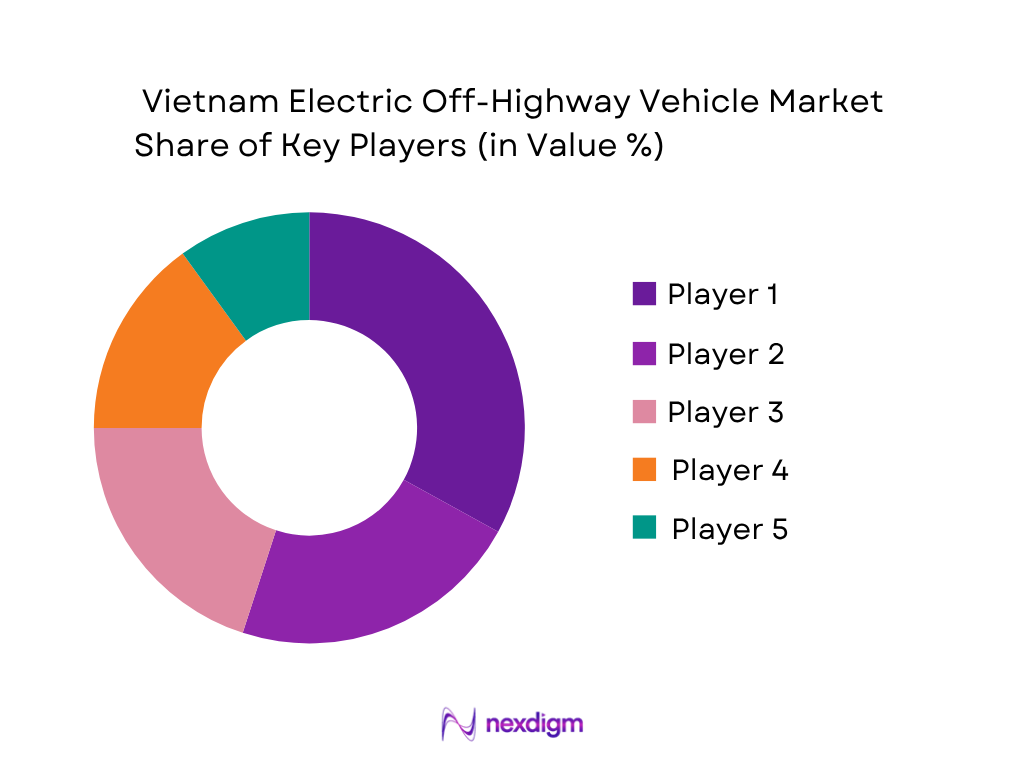
Vietnam Electric Off-Highway Vehicle Market Analysis
Growth Drivers
Industrial Manufacturing and Electronics Expansion
Vietnam’s industrial base is creating a strong operating environment for electric off-highway equipment, particularly forklifts, warehouse vehicles, compact loaders and other equipment used inside factories and industrial parks. The National Statistics Office of Vietnam reported that GDP reached USD 476.3 billion in 2024, while industrial and construction value added increased 8.24. Industrial production increased 8.4, and manufacturing and processing increased 9.6, strengthening the underlying demand pool for material-handling and low-emission equipment. Electronics is particularly relevant: exports of electronics, computers and components reached USD 72.6 billion, while imports of the same category reached USD 107.1 billion, demonstrating the scale of component-intensive manufacturing activity. The machinery, equipment and spare-parts export category also reached USD 52.3 billion. These production networks require continuous internal movement of components, pallets, finished products and materials, creating applications for electric forklifts and compact industrial vehicles. The National Statistics Office also reported average machinery and equipment utilization of 74.4 among manufacturing and processing enterprises in the fourth quarter of 2024, indicating substantial installed industrial capacity. As manufacturers expand automation and seek cleaner factory environments, electric off-highway vehicles can increasingly replace conventional equipment in predictable indoor and depot-based duty cycles.
Construction, Warehousing and Agricultural Mechanization
Construction, logistics and agriculture provide complementary demand pools for Vietnam’s electric off-highway vehicle market. The National Statistics Office reported construction value added growth of 7.87 in 2024, while transportation and warehousing value added increased 10.82, strengthening the requirement for material-handling, loading, lifting and site-support equipment. Agricultural activity also remains substantial: Vietnam recorded 7.13 million hectares of rice cultivation and 43.46 million tonnes of rice output in 2024, alongside 3.82 million hectares of perennial crops. These operating conditions create potential applications for electric agricultural tractors, utility vehicles and compact machinery, particularly where equipment operates close to farms, storage facilities or processing sites. Urban development provides another demand channel because compact electric excavators and loaders are suitable for work in confined construction environments where noise and local exhaust emissions are operational concerns. Logistics modernization further supports electric forklifts and warehouse equipment as industrial parks and distribution facilities expand. Vietnam’s GDP growth of 7.09 in 2024 and household income of approximately VND 5.4 million per person per month indicate an expanding economic base supporting investment across industrial and commercial infrastructure. Together, manufacturing, construction, logistics and agriculture create multiple equipment-use environments, reducing dependence on a single application and supporting gradual electrification across off-highway vehicle categories.
Market Challenges
Acquisition Requirements and Charging Infrastructure Gaps
High initial equipment requirements and uneven charging availability remain important barriers to wider electric off-highway vehicle adoption in Vietnam, particularly for construction, agriculture and heavy-duty applications. The National Statistics Office reported that industrial and construction value added increased 8.24 in 2024, indicating expanding equipment demand, but customers must still evaluate battery capacity, charging time, equipment utilization and replacement requirements before shifting from diesel or conventional machinery. Charging infrastructure is most straightforward inside factories, warehouses and logistics centers where equipment follows predictable routes and can return to a fixed charging point. Rural and construction applications are more difficult because machinery can operate far from dedicated electrical infrastructure. World Bank data shows electricity access at 99.8 of the population in 2023, demonstrating broad national access, but this does not mean every agricultural site, quarry, construction project or remote industrial location has the high-capacity electrical connection required for rapid charging of heavy equipment. Battery runtime is another constraint for excavators, loaders and other high-load machinery because intensive duty cycles can require substantial energy throughout a working shift. Vietnam’s manufacturing and processing enterprises operated at average machinery and equipment utilization of 74.4 in the fourth quarter of 2024, illustrating why industrial buyers may require dependable equipment availability. Suppliers therefore need to combine vehicles with charging systems, battery-management technology and service support rather than treating the vehicle as a standalone product.
Heavy-Duty Duty Cycles and Imported Component Dependence
Electric off-highway vehicles face greater technical constraints when deployed in demanding construction, quarrying, agriculture and infrastructure applications because high-load duty cycles place substantial requirements on batteries, electric motors, thermal management and drivetrain components. Vietnam’s industrial sector remains deeply integrated with imported production inputs. The National Statistics Office recorded USD 356.43 billion of imports of production materials and equipment in 2024, representing the overwhelming majority of total imports; machinery, equipment and spare parts accounted for USD 48.9 billion, while electronics, computers and components reached USD 107.1 billion. This highlights the scale of imported equipment and component dependence surrounding Vietnam’s manufacturing ecosystem. For electric off-highway vehicles, dependence can extend to battery cells, power electronics, motors, controllers, charging hardware and specialized components. Import exposure can lengthen replacement-part lead times and complicate after-sales support when equipment operates far from major industrial centers. Residual-value uncertainty adds another challenge because the electric-equipment market is still developing and buyers have limited historical evidence regarding battery degradation, second-life value and used-equipment pricing. Technical service capability is equally important because electric drivetrains require different diagnostic and maintenance skills from conventional hydraulic and internal-combustion equipment. These constraints can make fleet operators cautious about deploying electric equipment in high-utilization applications until service networks, battery support and component availability become more established.
Market Opportunities
Electric Mini Excavators and Compact Electric Loaders
Urban construction and infrastructure development create a strong opportunity for compact electric machinery designed for confined worksites, indoor construction and projects where low noise and zero tailpipe emissions are operational advantages. Vietnam’s construction value added increased 7.87 in 2024, while overall GDP increased 7.09, demonstrating continued economic activity supporting construction equipment utilization. Compact electric excavators can address applications such as utility installation, building renovation, landscaping and urban infrastructure where conventional diesel machines can face restrictions related to noise, emissions and indoor operation. Electric loaders can similarly serve warehouses, recycling facilities, agricultural processing sites and construction projects requiring frequent short-distance movements. The opportunity is strengthened by Vietnam’s dense industrial and urban development environment, where equipment may operate near factories, commercial buildings and residential areas. Electric machines can also be paired with mobile charging systems where fixed charging infrastructure is unavailable. Agriculture provides an additional application base: the country cultivated 7.13 million hectares of rice and produced 43.46 million tonnes of rice in 2024, while perennial-crop land reached 3.82 million hectares. Compact electric utility and agricultural machinery can therefore address selected farm, storage and processing applications. The strongest opportunity is likely to emerge where operating cycles are predictable, daily utilization is high and charging can be centralized. Manufacturers that combine compact dimensions, battery-management systems, rapid charging and local technical support can position electric equipment as a practical solution rather than simply an emissions-reduction alternative.
Electric Forklifts, Agricultural Tractors and Equipment-as-a-Service
Electric forklifts represent an immediate opportunity because Vietnam’s expanding manufacturing and logistics ecosystem provides controlled operating environments where charging can be centralized and equipment utilization can be monitored. Manufacturing and processing activity increased 9.6 in 2024, industrial production increased 8.4, and transportation and warehousing value added increased 10.82, creating a broad customer base across factories, warehouses, distribution centers and industrial parks. Agricultural electrification provides a parallel opportunity through electric tractors and utility equipment. Vietnam recorded 3.82 million hectares of perennial crops and 43.46 million tonnes of rice output in 2024, indicating a large agricultural operating base where selected low-duty applications can be electrified. Business-model innovation can accelerate adoption where customers are reluctant to make large equipment commitments. Battery leasing can separate battery ownership from machinery acquisition, while equipment-as-a-service can bundle vehicles, charging, maintenance and replacement support into an operating arrangement. Mobile charging can address applications where fixed infrastructure is impractical, including construction and agricultural sites. Vietnam’s electricity access reached 99.8 in the latest World Bank indicator available for 2023, providing a broad foundation for electrification, although high-capacity charging remains application-specific. The combination of electric forklifts, agricultural equipment, mobile charging, battery leasing and service-based ownership therefore creates an opportunity to reduce adoption barriers while expanding the addressable range of electric off-highway applications.
Future Outlook
The Vietnam Electric Off-Highway Vehicle Market is expected to expand steadily through increasing industrial automation, warehouse modernization, construction electrification and the gradual adoption of zero-emission equipment. The strongest near-term adoption is expected in controlled environments such as factories, warehouses, logistics centers and industrial parks where charging infrastructure can be centralized. Construction, agriculture and infrastructure applications should develop as battery performance and charging networks improve. Vietnam’s industrial production increased 8.4 in 2024, while manufacturing consumption increased 11.3, providing a strong current industrial base for future electric equipment adoption.
Future demand is also likely to shift toward lithium-ion platforms, fast charging, regenerative braking, battery-management systems, remote monitoring and integrated fleet-management solutions. Equipment suppliers capable of combining vehicles with charging, telematics, maintenance and financing solutions should have an advantage in large industrial accounts. Electric equipment adoption will remain highly application-specific, with total cost of ownership, duty cycle, battery runtime, charging access and after-sales support determining conversion from diesel, LPG and conventional internal-combustion equipment.
Major Players
- Toyota Material Handling
- Jungheinrich AG
- Hyster-Yale Materials Handling
- Crown Equipment Corporation
- Mitsubishi Logisnext
- KION Group AG
- Doosan Bobcat
- Clark Material Handling Company
- Yale Materials Handling Corporation
- Hangcha Group
- EP Equipment
- Komatsu Ltd.
- Manitou Group
- Hyundai Construction Equipment
- SANY Group
Key Target Audience
- Material-handling equipment manufacturers and distributors
- Construction equipment manufacturers and dealers
- Manufacturing and industrial companies
- Logistics, warehousing and distribution operators
- Agricultural machinery companies and equipment distributors
- Investments and venture capitalist firms
- Government and regulatory bodies (Ministry of Industry and Trade, Ministry of Construction, Ministry of Transport, Ministry of Agriculture and Environment)
- Ports, industrial-park developers and infrastructure operators
Research Methodology
Step 1: Identification of Key Variables
The initial phase involves mapping Vietnam’s electric off-highway vehicle ecosystem across equipment manufacturers, importers, distributors, fleet operators, industrial users, construction companies, agricultural users, battery suppliers and charging-infrastructure providers. Secondary research incorporates official Vietnamese industrial, construction, agricultural and trade statistics to identify the variables influencing equipment adoption.
Step 2: Market Analysis and Construction
Historical market information is compiled across vehicle categories, battery technologies, applications, operating environments and customer groups. The analysis evaluates equipment deployment, replacement demand, fleet modernization, electrification potential and application suitability across manufacturing, logistics, construction, agriculture, ports and other industrial environments.
Step 3: Hypothesis Validation and Expert Consultation
Market hypotheses are validated through discussions with equipment distributors, fleet managers, construction-equipment specialists, warehouse operators, manufacturers and application engineers. These consultations are used to assess purchasing criteria, vehicle utilization, charging requirements, replacement cycles, technical barriers and the suitability of electric equipment for different duty cycles.
Step 4: Research Synthesis and Final Output
The final stage triangulates bottom-up company and application information with official macroeconomic and industrial indicators. Market estimates are cross-checked against vehicle categories, end-use applications, equipment deployment patterns and supplier activity to produce a consolidated assessment of Vietnam’s electric off-highway vehicle ecosystem.

- Executive Summary
- Research Methodology (Market Definition, Vehicle Classification, Scope Boundaries, Historical Reconstruction, Unit-Sales Assessment, Revenue Assessment, Top-Down Market Sizing, Bottom-Up Market Sizing, OEM-Level Validation, Dealer and Distributor Assessment, Fleet-Level Demand Analysis, Primary Interviews, Secondary Research, Data Triangulation, Forecasting Framework, Scenario Modelling, Assumptions and Limitations)

- Definition and Scope
- Evolution of Off-Highway Vehicle Electrification in Vietnam
- Vietnam Off-Highway Vehicle Ecosystem
- Electric Off-Highway Vehicle Value Chain
- Vietnam Manufacturing and Industrial Base
- Construction and Infrastructure Equipment Ecosystem
- Agricultural Mechanization Ecosystem
- Material-Handling and Warehouse Electrification Ecosystem

- Growth Drivers (Industrial Manufacturing Expansion, Electronics Manufacturing, Construction and Infrastructure Investment, Warehouse and E-Commerce Expansion, Agricultural Mechanization, Urban Development, Environmental Regulations, Fleet Modernization)
- Market Challenges (High Acquisition Requirements, Charging Infrastructure Gaps, Battery Runtime, Rural Electricity Availability, Heavy-Duty Duty Cycles, Imported Component Dependence, Limited Electric Service Expertise, Residual-Value Uncertainty)
- Market Opportunities (Electric Mini Excavators, Electric Forklifts, Electric Agricultural Tractors, Compact Electric Loaders, Electric Quarry Equipment, Electric Road Machinery, Mobile Charging, Battery Leasing, Equipment-as-a-Service)
- Emerging Technology Trends (LFP Battery Adoption, High-Voltage Systems, Fast Charging, Electric Hydraulics, Regenerative Braking, Integrated Powertrains, Thermal Management, Remote Diagnostics)
- Government and Regulatory Analysis (Green Growth Strategy, Net-Zero Commitments, EV Development Policies, Environmental Standards, Industrial Decarbonisation, Battery Safety, Charging Standards)
- Porter’s Five Forces Analysis
- PESTLE Analysis
- SWOT Analysis

- By Market Value (2020-2025)
- By Unit Sales (2020-2025)
- By Battery Capacity (2020-2025)
- By Power Output (2020-2025)
- By Equipment Weight (2020-2025)
- By End User (2020-2025)
- By Charging Configuration (2020-2025)
- By Geography (2020-2025)

- By Equipment Type (in value %)
Electric Excavators
Electric Mini Excavators
Electric Wheel Loaders
Electric Backhoe Loaders
Electric Skid-Steer Loaders
Electric Track Loaders
Electric Cranes
Electric Dumpers
Electric Forklifts
Electric Agricultural Tractors
Electric Mining Equipment
Electric Road Construction Equipment
Electric Utility and Specialty Vehicles - By Application (in value %)
Construction
Infrastructure Development
Agriculture
Mining and Quarrying
Manufacturing
Warehousing and Logistics
Road Construction
Ports and Industrial Yards
Forestry
Municipal and Utility Operations - By Propulsion Technology (in value %)
Battery Electric
Hybrid Electric
Plug-in Hybrid Electric
Fuel-Cell Electric
Hydrogen Combustion
Other Alternative Powertrains - By Battery Capacity (in value %)
Below 50 kWh
50–150 kWh
151–300 kWh
301–500 kWh
Above 500 kWh - By Power Output (in value %)
Below 50 kW
50–100 kW
101–200 kW
201–400 kW
Above 400 kW - By Equipment Weight (in value %)
Below 5 Tons
5–10 Tons
10–20 Tons
20–40 Tons
Above 40 Tons

- Market Share of Major Players (By Revenue, Unit Sales, Equipment Type, Application, Propulsion Technology, Battery Capacity, Equipment Weight and Geography)
- Cross Comparison Parameters (Electric Equipment Portfolio Breadth, Electric Model Count, Battery Capacity Range, Maximum Power Output, Operating Runtime, Charging Technology Capability, Vietnam Dealer and Service Network Coverage, Telematics and Autonomous Technology Capability)
- SWOT Analysis of Major Players
- Detailed Profiles of Major Companies
Caterpillar
Komatsu
Volvo Construction Equipment
Hitachi Construction Machinery
JCB
SANY
XCMG
Hyundai Construction Equipment
Doosan Bobcat
Kobelco Construction Machinery
Toyota Industries Corporation
Mitsubishi Logisnext
Jungheinrich
BYD
John Deere

- Total cost of ownership
- Operational suitability
- Reliability and uptime
- Environmental performance
- Technology Adoption Preferences
- Price Sensitivity and Total Cost of Ownership

- By Market Value (2026-2035)
- By Unit Sales (2026-2035)
- By Battery Capacity (2026-2035)
- By Power Output (2026-2035)
- By Equipment Weight (2026-2035)
- By End User (2026-2035)
- By Charging Configuration (2026-2035)
- By Geography (2026-2035)


 Request a Sample
 Ask for Customization
 Get a Quote
 Enquire Now