
 Download PDF
 Download PDF
Market Overview
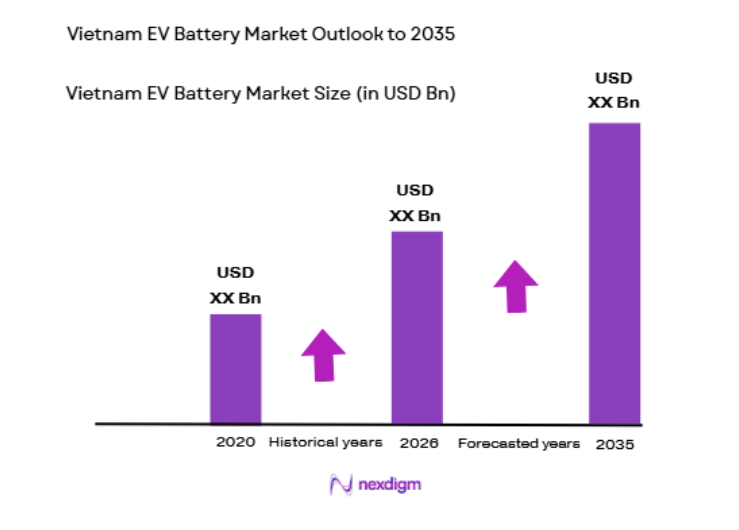
Based on a recent historical assessment, the Vietnam EV Battery Market reached approximately USD ~ billion in value, driven by the rapid expansion of domestic electric vehicle production, strong policy alignment with green mobility, and increasing investments in battery manufacturing capacity. The market is primarily supported by the expansion of local EV manufacturers, supply chain localization efforts, and growing demand for lithium-ion batteries used in passenger electric vehicles, electric buses, and electric two-wheelers across Vietnam’s developing electric mobility ecosystem.
Hanoi and Ho Chi Minh City dominate the Vietnam EV Battery Market due to strong electric vehicle deployment, large consumer bases, and concentrated investments from domestic EV manufacturers and battery ecosystem partners. Northern industrial provinces including Hai Phong and Bac Ninh also play an influential role because of manufacturing clusters, logistics infrastructure, and proximity to major automotive production facilities. Regional collaboration with South Korea, China, and Japan further strengthens Vietnam’s battery manufacturing capabilities through technology transfer, supply chain partnerships, and industrial investment.
Market Segmentation
By Battery Type
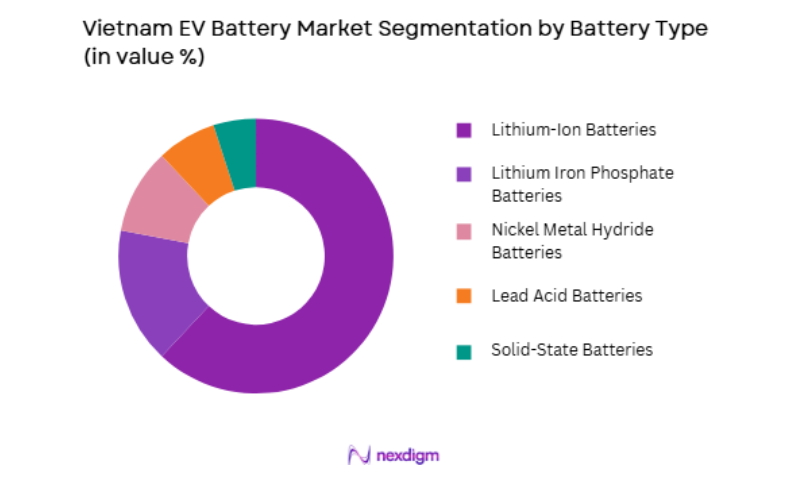
Vietnam EV Battery Market is segmented by product type into Lithium-Ion Batteries, Nickel Metal Hydride Batteries, Lead Acid Batteries, Solid-State Batteries, and Lithium Iron Phosphate Batteries. Recently, Lithium-Ion Batteries have a dominant market share due to their higher energy density, longer lifecycle, and compatibility with modern electric vehicle architectures. Local EV manufacturer VinFast relies heavily on lithium-ion technology through partnerships with international battery firms, which has significantly accelerated adoption within the domestic EV ecosystem. Lithium-ion batteries also support faster charging cycles and improved range performance, making them suitable for passenger vehicles and electric buses deployed across Vietnamese urban transportation networks. Additionally, continued investments in gigafactory-scale production facilities and battery pack assembly operations have improved supply availability and lowered per-unit costs.
By Vehicle Type
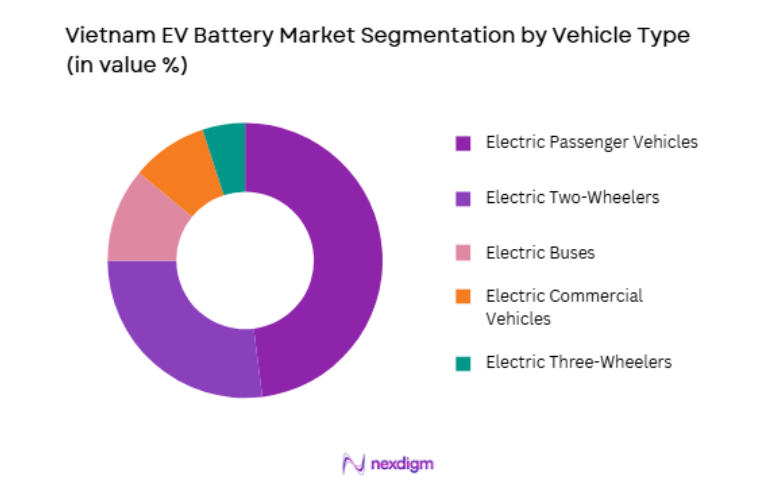
Vietnam EV Battery Market is segmented by vehicle type into Electric Passenger Vehicles, Electric Two-Wheelers, Electric Buses, Electric Commercial Vehicles, and Electric Three-Wheelers. Recently, Electric Passenger Vehicles have a dominant market share due to increasing consumer demand for private electric mobility and the rapid expansion of domestic EV manufacturing. VinFast’s passenger EV models have significantly accelerated battery demand as the company continues scaling production and expanding distribution networks. Passenger EVs also benefit from stronger government incentives and growing charging infrastructure availability across urban regions. Rising consumer awareness regarding emissions reduction and long-term operating cost savings further supports passenger EV adoption. Additionally, partnerships with global battery suppliers ensure consistent battery supply for passenger vehicle manufacturing lines.
Competitive Landscape
The Vietnam EV Battery Market remains moderately concentrated, with domestic manufacturers collaborating closely with international battery technology companies to strengthen supply chain capabilities. Strategic joint ventures, technology licensing agreements, and battery manufacturing investments have accelerated the development of a localized battery ecosystem. Major players focus on lithium-ion battery technology, battery management systems, and scalable battery pack assembly lines to support growing EV production volumes. As the market expands, consolidation is expected through partnerships between EV manufacturers, battery cell producers, and energy storage technology providers.
| Company Name | Establishment Year | Headquarters | Technology Focus | Market Reach | Key Products | Revenue | Battery Chemistry Focus |
| VinES Energy Solutions | 2021 | Vietnam | ~ | ~ | ~ | ~ | ~ |
| VinFast | 2017 | Vietnam | ~ | ~ | ~ | ~ | ~ |
| LG Energy Solution | 2020 | South Korea | ~ | ~ | ~ | ~ | ~ |
| Samsung SDI | 1970 | South Korea | ~ | ~ | ~ | ~ | ~ |
| CATL | 2011 | China | ~ | ~ | ~ | ~ | ~ |
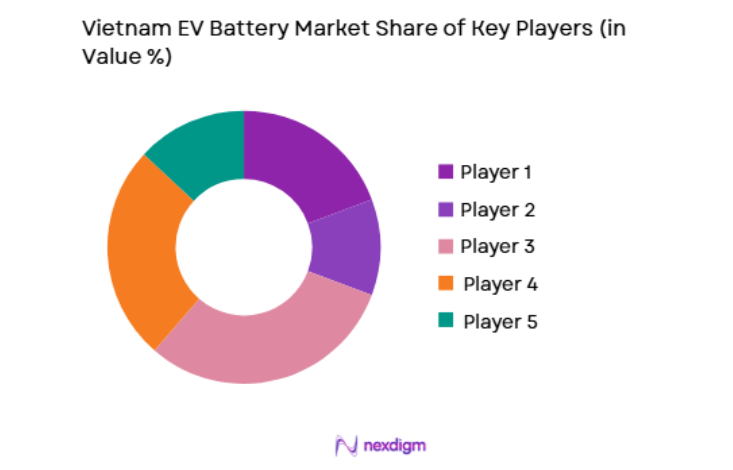
Vietnam EV Battery Market Analysis
Growth Drivers
Expansion of Domestic Electric Vehicle Manufacturing and Vertical Battery Integration
Vietnam’s EV battery market is strongly driven by the rapid expansion of domestic electric vehicle manufacturing combined with strategic efforts to vertically integrate battery supply chains within the country. Local EV manufacturer VinFast has significantly accelerated demand for lithium-ion battery packs through the rollout of multiple passenger EV models and its ambition to scale exports into international markets, which in turn requires a stable and localized battery supply ecosystem. The company has established VinES Energy Solutions to develop domestic battery manufacturing capabilities, enabling Vietnam to reduce dependency on imported battery packs while strengthening industrial value chains. Government policies supporting electric mobility adoption, industrial technology investment, and green manufacturing further encourage battery production facilities and component manufacturing clusters to emerge within Vietnam’s industrial zones. Foreign battery manufacturers from South Korea, China, and Japan have increasingly partnered with Vietnamese firms to establish joint production lines, technology transfer arrangements, and research collaborations focused on battery chemistry improvements and large-scale manufacturing. The growing availability of battery production infrastructure enables Vietnamese EV manufacturers to shorten supply chains, lower production costs, and improve supply stability for high-volume electric vehicle assembly operations. Battery pack manufacturing also benefits from Vietnam’s competitive labor costs and expanding electronics manufacturing ecosystem, which allows efficient production of battery management systems, power electronics, and associated vehicle components. As electric vehicle sales expand domestically and exports increase, the demand for lithium-ion battery cells, modules, and battery packs is expected to accelerate significantly across the automotive value chain.
Government-Led Electrification Policies and Sustainable Mobility Targets
Vietnam’s EV battery market is also being driven by national policies focused on reducing transportation emissions, improving air quality, and supporting long-term energy transition strategies aligned with global sustainability commitments. Government authorities have introduced multiple policy frameworks encouraging electric mobility adoption through tax incentives, registration fee exemptions, and supportive regulatory environments for electric vehicle manufacturing and battery investment. These initiatives encourage both domestic automakers and international battery manufacturers to establish production facilities within Vietnam while supporting the rapid scaling of electric vehicle deployment across major urban centers. The transportation sector represents a significant share of national energy consumption and emissions, which makes vehicle electrification a key priority within Vietnam’s climate and energy transition policies. Public transportation electrification programs, including electric bus deployment initiatives in major metropolitan areas, are also increasing demand for high-capacity lithium-ion battery packs and associated charging infrastructure. Infrastructure development initiatives such as national EV charging network expansion further reinforce battery demand because vehicle adoption becomes more viable when charging accessibility improves across highways, residential complexes, and commercial zones. The Vietnamese government is also supporting domestic battery manufacturing research and development through innovation initiatives and industrial partnerships aimed at improving battery efficiency, safety, and lifecycle performance. These initiatives encourage technological capability building within the country’s advanced manufacturing sector.
Market Challenges
Dependence on Imported Raw Materials for Lithium-Ion Battery Production
Vietnam’s EV battery market faces a significant challenge due to the heavy reliance on imported raw materials required for lithium-ion battery manufacturing, including lithium, nickel, cobalt, manganese, and graphite. These critical battery minerals are largely sourced from international markets, exposing Vietnamese battery manufacturers to global commodity price volatility, supply chain disruptions, and geopolitical risks that can affect the stability of battery production costs. Since Vietnam currently lacks large-scale domestic reserves of many key battery minerals, battery cell manufacturers must rely on global supply chains spanning countries such as Australia, Indonesia, the Democratic Republic of Congo, and China. This dependency increases procurement complexity and creates uncertainties for manufacturers attempting to maintain consistent production output while managing fluctuating raw material costs. Logistics challenges associated with transporting battery minerals across long distances can further increase supply chain vulnerability, particularly during periods of international trade disruptions or shipping bottlenecks. In addition, competition for battery raw materials has intensified globally as electric vehicle production accelerates across North America, Europe, and China, increasing demand pressure on global mineral supply. Vietnamese battery manufacturers must therefore secure long-term supply agreements with international mining companies and material suppliers to maintain stable access to essential raw materials. While recycling technologies and alternative battery chemistries may gradually reduce dependence on certain materials, these solutions remain in early stages of adoption within Vietnam’s battery ecosystem. Until domestic raw material supply chains develop or recycling capacity expands significantly, dependence on imported battery minerals will remain a structural challenge affecting the scalability and cost competitiveness of Vietnam’s EV battery manufacturing industry.
Limited Domestic Battery Recycling Infrastructure and Lifecycle Management Systems
Another major challenge facing the Vietnam EV battery market is the relatively underdeveloped infrastructure for battery recycling, end-of-life battery management, and circular supply chain integration. Lithium-ion batteries contain valuable materials such as lithium, nickel, cobalt, and copper that can be recovered and reused through advanced recycling technologies, but Vietnam currently lacks large-scale industrial recycling facilities capable of processing high volumes of end-of-life EV batteries. Without efficient recycling systems, discarded battery packs risk contributing to environmental hazards while simultaneously wasting recoverable raw materials that could otherwise support domestic battery manufacturing supply chains. Establishing battery recycling infrastructure requires significant capital investment, advanced metallurgical processing technologies, and strict environmental management systems to safely recover battery minerals while minimizing pollution risks. The absence of standardized regulatory frameworks governing battery collection, recycling responsibilities, and material recovery processes further complicates the development of an organized recycling ecosystem. Battery lifecycle management also requires collaboration between EV manufacturers, battery producers, recycling companies, and government agencies to ensure safe transportation, storage, and processing of used battery packs. As EV adoption increases and battery volumes grow, the lack of recycling infrastructure may lead to long-term waste management challenges unless proactive policy interventions are implemented. Developing domestic recycling facilities would allow Vietnam to recover critical minerals from used batteries, reduce reliance on imported materials, and create a circular battery supply chain supporting long-term sustainability.
Opportunities
Development of Gigafactory-Scale Battery Manufacturing Facilities
The Vietnam EV battery market presents significant opportunities through the development of gigafactory-scale battery manufacturing facilities capable of producing high volumes of lithium-ion battery cells and modules for domestic and international electric vehicle markets. Vietnam’s strategic geographic location within Southeast Asia, combined with its rapidly expanding EV manufacturing industry, positions the country as an attractive destination for large-scale battery production investments. International battery manufacturers are increasingly exploring partnerships with Vietnamese companies to establish production facilities that can supply both domestic EV manufacturers and regional automotive markets. These gigafactories allow economies of scale that significantly reduce battery production costs while improving supply reliability for EV assembly operations. The establishment of large battery manufacturing plants also stimulates the development of supporting supply chain industries, including cathode material production, battery management system manufacturing, thermal management technology development, and energy storage system integration. As Vietnam continues attracting foreign direct investment in advanced manufacturing sectors, gigafactory development could transform the country into a regional hub for EV battery production. This industrial expansion would also generate employment opportunities, strengthen technological expertise within Vietnam’s manufacturing workforce, and increase the country’s participation in global electric vehicle supply chains. Government support through industrial zone development, tax incentives, and infrastructure investment further enhances the feasibility of gigafactory projects. With rising EV demand across Southeast Asia, large-scale battery manufacturing facilities in Vietnam could supply both domestic vehicles and export markets, creating substantial long-term growth opportunities for the EV battery sector.
Expansion of Battery Swapping and Energy Storage Ecosystems
Vietnam’s EV battery market also holds strong opportunities through the development of battery swapping systems and stationary energy storage applications that extend the utility of EV battery technologies beyond traditional vehicle propulsion. Battery swapping models are particularly suitable for electric two-wheelers and urban mobility fleets, which represent a large portion of Vietnam’s transportation landscape. Swapping stations allow riders to replace depleted batteries with fully charged units within minutes, significantly reducing charging downtime and improving convenience for delivery drivers, ride-hailing operators, and urban commuters. The same battery technologies used in electric vehicles can also be repurposed for stationary energy storage systems after their automotive lifecycle ends, enabling integration with renewable energy projects such as solar and wind power installations. Energy storage systems help stabilize power grids by storing excess renewable electricity and releasing it during peak demand periods, creating additional commercial value for EV battery technologies. The development of battery swapping infrastructure and energy storage applications expands the economic potential of battery manufacturing investments by creating multiple demand streams for lithium-ion battery systems. As Vietnam accelerates its renewable energy transition and electric mobility adoption simultaneously, integrated battery ecosystems supporting transportation and energy storage could become a key driver of long-term industrial growth within the country’s clean energy sector.
Future Outlook
The Vietnam EV Battery Market is expected to experience substantial growth over the next five years as electric vehicle adoption accelerates and domestic battery manufacturing capacity expands. Continued investments in gigafactory-scale production facilities, lithium-ion technology innovation, and battery supply chain localization will strengthen the country’s position in the regional EV ecosystem. Government policies promoting green mobility and renewable energy integration will further support battery demand. Expanding EV charging infrastructure and rising consumer adoption of electric vehicles will also contribute to sustained market expansion.
Major Players
- VinFas
- VinES Energy Solutions
- LG Energy Solution
- Samsung SDI
- CATL
- Panasonic Energy
- BYD
- SK On
- Gotion High-Tech
- Farasis Energy
- Envision AESC
- CALB
- Toshiba Battery
- Amperex Technology Limited
- EVE Energy
Key Target Audience
- Investments and venture capitalist firms
- Government and regulatory bodies
- Electric vehicle manufacturers
- Automotive component manufacturers
- Battery manufacturing companies
- Energy storage system developers
- Renewable energy developers
- Electric mobility fleet operators
Research Methodology
Step 1: Identification of Key Variables
The research process begins by identifying key variables influencing the Vietnam EV Battery Market, including electric vehicle adoption trends, battery technology development, supply chain dynamics, and government electrification policies. Primary indicators such as battery demand by vehicle category, domestic production capacity, and battery technology adoption patterns are evaluated to define the analytical framework.
Step 2: Market Analysis and Construction
Comprehensive secondary research is conducted using government publications, energy transition reports, electric mobility policy frameworks, company financial disclosures, and industry databases. These sources are used to construct the market structure, segmentation framework, competitive environment, and supply chain relationships shaping Vietnam’s EV battery ecosystem.
Step 3: Hypothesis Validation and Expert Consultation
Industry hypotheses are validated through consultations with battery technology experts, electric vehicle manufacturers, energy policy analysts, and supply chain stakeholders. These discussions refine assumptions related to battery manufacturing expansion, EV adoption rates, and technology innovation pathways influencing the market’s development.
Step 4: Research Synthesis and Final Output
Insights from quantitative data analysis and expert consultations are synthesized to produce a comprehensive market report covering segmentation, competitive landscape, growth drivers, market challenges, and long-term opportunities. The final output provides structured insights to support strategic decision-making for stakeholders participating in the Vietnam EV battery ecosystem.

- Executive Summary
- Research Methodology (Definitions, Scope, Industry Assumptions, Market Sizing Approach, Primary & Secondary Research Framework, Data Collection & Verification Protocol, Analytic Models & Forecast Methodology, Limitations & Research Validity Checks)

- Market Definition and Scope
- Value Chain & Stakeholder Ecosystem
- Regulatory / Certification Landscape
- Sector Dynamics Affecting Demand

- Growth Drivers
Government incentives for battery adoption
Increase in electric vehicle sales
Technological advancements in battery energy density - Market Challenges
High manufacturing costs
Limited availability of raw materials
Regulatory restrictions on battery disposal - Market Opportunities
Advancements in battery recycling technologies
Integration of batteries with renewable energy sources
Growth of electric vehicle infrastructure - Trends
Focus on solid-state battery development
Emergence of second-life battery applications - Government Regulations
- SWOT Analysis
- Porter’s Five Forces

- By Market Value, 2020-2025
- By Installed Units, 2020-2025
- By Average System Price, 2020-2025
- By System Complexity Tier, 2020-2025

- By System Type (In Value%)
Lithium-ion Batteries
Solid-state Batteries
Nickel-Metal Hydride Batteries
Lead-Acid Batteries
Lithium Iron Phosphate Batteries - By Platform Type (In Value%)
Electric Vehicles
Energy Storage Systems
Industrial Applications
Consumer Electronics
Portable Devices - By Fitment Type (In Value%)
OEM Batteries
Aftermarket Batteries
Integrated Battery Packs
Standalone Battery Systems - By End User Segment (In Value%)
Automobile Manufacturers
Energy Storage Providers
Battery Manufacturers

- Market Share Analysis
- Cross Comparison Parameters (Battery Type, Platform Type, End User Segment, System Complexity Tier, Market Value, Energy Density, Manufacturing Cost, Raw Material Sourcing, Battery Lifespan)
- SWOT Analysis of Key Competitors
- Pricing & Procurement Analysis
- Key Players
LG Chem
Panasonic
BYD
Samsung SDI
CATL
SK Innovation
A123 Systems
Tesla
Hitachi Chemical
Contemporary Amperex Technology Co. Limited
Mitsubishi Chemical
Fuji Electric
Guoxuan
Pirelli
VARTA

- Rise in electric vehicle adoption
- Growing demand for home energy storage
- Increased focus on energy efficiency
- Shift toward sustainable battery solutions

- Forecast Market Value, 2026-2035
- Forecast Installed Units, 2026-2035
- Price Forecast by System Tier, 2026-2035
- Future Demand by Platform, 2026-2035


 Request a Sample
 Ask for Customization
 Get a Quote
 Enquire Now